
Life, 1908-10-29 · page 12 of 20
Life — October 29, 1908 — page 12: what you’re looking at
What you’re looking at
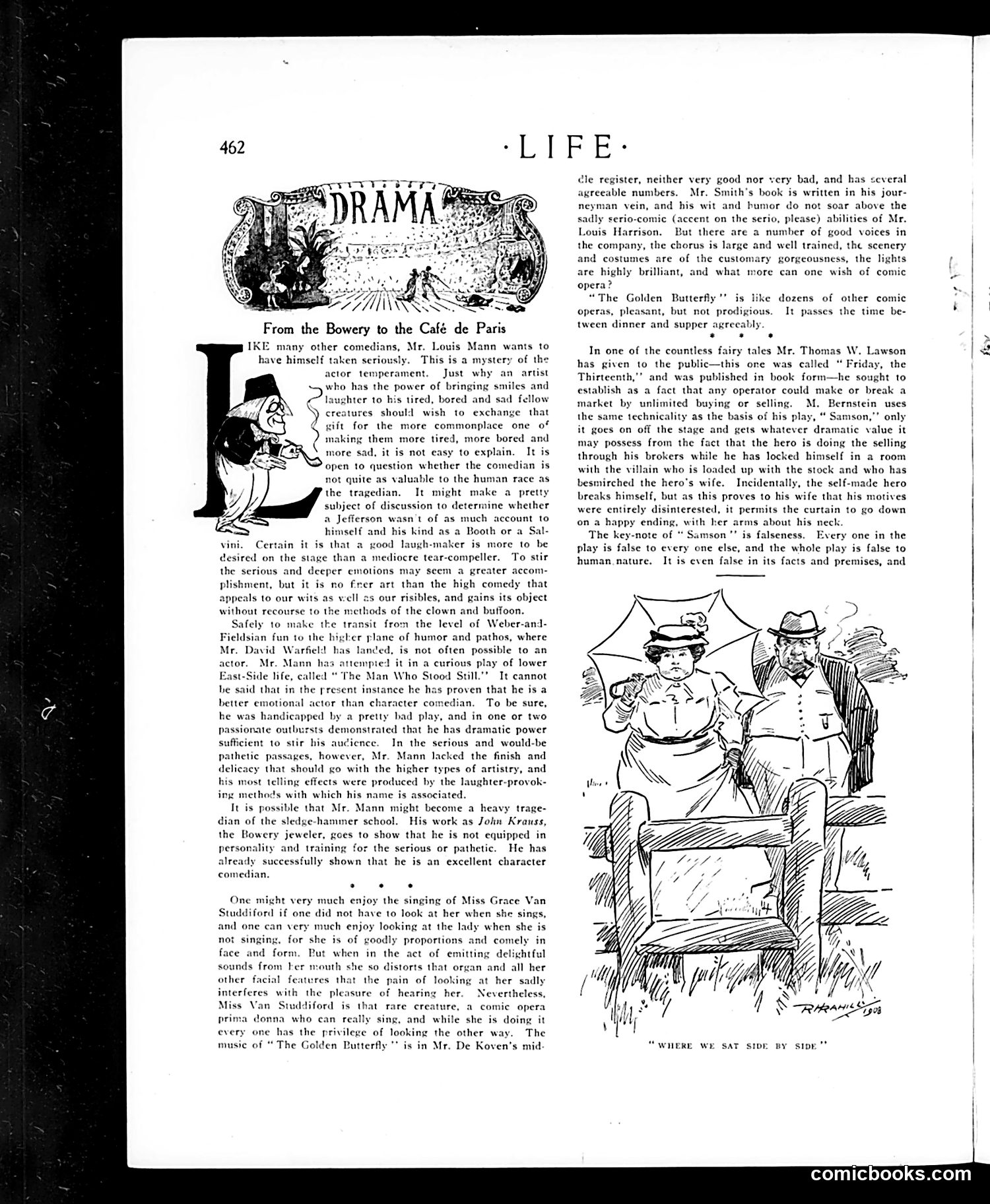
This page reviews theatrical productions, focusing on comic opera and comedians. The left illustration shows a caricatured figure in formal dress—likely representing a specific actor or theatrical personality, though the identity isn't explicitly stated in the visible text. The main article discusses "The Golden Butterfly" opera and critiques various performers including Louis Mann, David Warfield, and mentions Miss Grace Van Studdiford. The text praises some actors' emotional range while criticizing others for lacking dramatic depth or finish. The right cartoon ("Where We Sat Side by Side") depicts two figures in casual dress sitting together outdoors—likely satirizing a theatrical romance or relationship. The overall tone is critical yet affectionate commentary on Broadway's entertainment scene.
📄 Transcribed text from this page (OCR, searchable)
Machine-transcribed from the original scan — historical spelling and the odd misread are preserved.
LIFE e register, neither very good nor very bad, and has several agreeable numbers. Mr. Smith's book is written in his jour- neyman vein, and his wit and humor do not soar above the sadly serio-comic (accent on the serio, please) abilities of Mr. Louis Harrison. But there are a number of good voices in the company, the chorus is large and well trained, the scenery are highly brilliant, and what more can one wish of comic opera? a “The Golden Butterfly’ is like dozens of other comic se BRS SeN RS Ser 8 and costumes are of the customary gorgcousness, the lights ' | = operas, pleasant, but not prodigious. It passes the time be- tween dinner and supper agreeably From the Bowery to the Café de Paris nee, Is IKE many other comedians, Mr. Louis Mann wants to In one of the countless fairy tales Mr. Thomas W. Lawson |g has given to the public—this one was called “Friday, the Thirteenth,” and was published in book form—he sought to establish as a fact that any operator could make or break a market by unlimited buying or selling. M. Bernstein use: ures. should’ wish to exchange that the same technicality as the basis of his play, “ Samson,’’ only | § for the more commonplace one 0 it goes on off the stage and gets whatever dramatic value it i making them more tired, more bored and may possess from the fact that the hero is doing the selling : n. It is through his brokers while he has locked himself in a room open to question whether the comedian is with the villain who is loaded up with the stock and who has not quite as valuable to the human race as besmirched the hero's wife. Incidentally, the self-made hero the tragedian. It might make a pretty breaks himself, but as this proves to his wife that his motives subject of discussion to determine whether were entirely disinterested, it permits the curtain to go down a Jefferson wasn't of as much account to on a happy ending, with her arms about his neck himself and his kind as a Booth or a Sal- The key-note of “ Samson’’ is falseness. Every one in the one else, and the whole play is false to desired on the stage than a mediocre tear-compeller. To stit human.nature. It is even false in its facts and premises, and the serious and deeper emotions may seem a greater accom- plishment, but it is no fer art than the high comedy that appeals to our wits as well ss our risibles, and gains its object without recourse to the methods of the clown and buffoon. Safely to make the transit from the level of Weber-and- Fieldsian fun to the higker plane of humor and pathos, where Mr. David Warfield has landed, is not often possible to an actor. Mr. Mann has attempted it in a curious play of lower East-Side life, called “The Man Who Stood Still.” It cannot he said that in the present instance he has proven that he is a better emotional actor than character comedian. To be sure, was handicapped by a pretty bad play, and in one or two s dramatic power ficient to stir his audience. In the serious and would-be pathetic passages, however, Mr. Mann lacked the finish and delicacy that should go with the higher types of artistry, and his most telling effects were produced by the laughter-provok- have himself taken seriously. This is a mystery of the perament. Just why an artist > has the power of bringing smiles and ghter to his tired, bored and sad fellow tor ter ore sad, it is not easy to exp vini. Certain it is that 2 good laugh-maker is more to be play is false to eve! st passionate outbursts demonstrated that he ing methods with which his name is associated. It is possible that Mr. Mann might become a heavy trage- nmer school. His work as John Krauss, the Bowery jeweler, goes to show that he is not equipped in personality and training for the serious or pathetic. He has already successfully shown that he is an excellent character comedian. dian of the sledge-ha One might very much enjoy the singing of Miss Grace Van Studdiford if one did not have to look at her when she sings, and one can very much enjoy looking at the lady when she is not singing, for she is of goodly proportions and comely in face and form, Put when in the act of emitting delightful sounds from ber mouth she so distorts that organ and all her other facial features that the pain of looking at her sadly interferes with the pleasure of hearing her. Nevertheless, Miss Van Studdiford is that rare creature, a comic opera prima donna who can really sing, and while she is doing it every one has the privileze of looking the other way. The music of “ The Golden Butterfly "* is in Mr. De Koven’s mid: “WIERE WE SAT SIDE BY SIDE comicbooks.com