
Life, 1908-10-29 · page 7 of 20
Life — October 29, 1908 — page 7: what you’re looking at
What you’re looking at
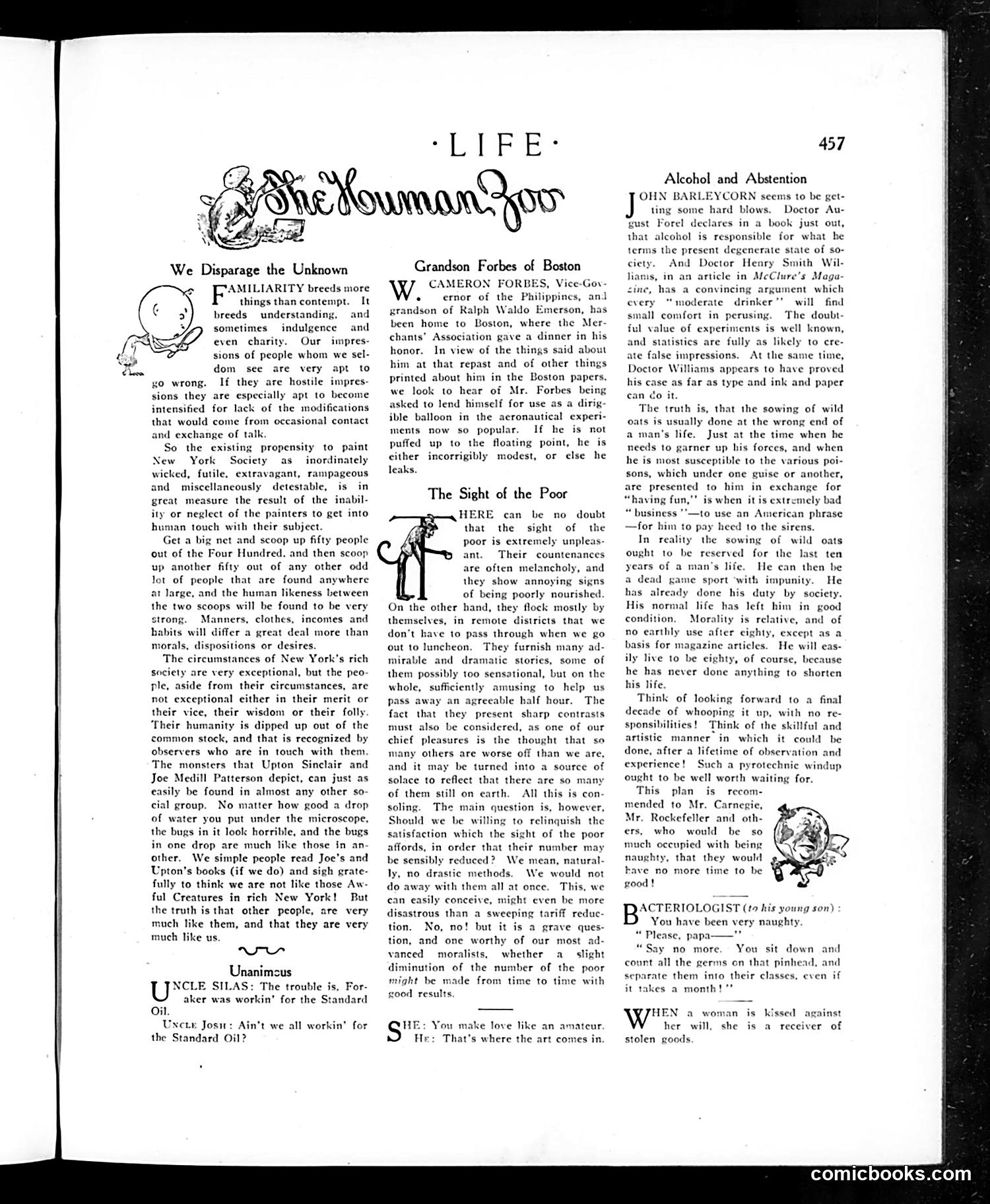
This page contains several satirical columns and brief jokes typical of Life's humor section. The main pieces include: **"We Disparage the Unknown"** - Critiques New York's snobbish attitude toward unfamiliar things, using the analogy of bugs under a microscope appearing equally strange to each other. **"The Sight of the Poor"** - Discusses whether society should reduce poverty through "drastic methods" or maintain the satisfaction of charitable giving. It's social commentary questioning whether the poor exist partly to make the wealthy feel virtuous. **Brief jokes** at bottom include wordplay about oil companies and a quip about kissing women against their will as "receiving stolen goods." The small cartoon illustrations are generic vignettes rather than specific political caricatures. This appears to be general social satire rather than commentary on particular events or figures.
📄 Transcribed text from this page (OCR, searchable)
Machine-transcribed from the original scan — historical spelling and the odd misread are preserved.
‘LIFE* ouman po We Disparage the Unknown AMILIARITY breeds more things than contempt. It breeds understanding, and sometimes indulgence and even charity. Our impres- sions of people whom we sel- dom see are very apt to so wrong. If they are hostile impres- sions they are especially apt to become intensified for lack of the modifications that would come from occasional contact and exchange of talk. So the existing propensity to paint New York Society as inordinately wicked, futile, extravagant, rampageous and miscellaneously detestable, is in great measure the result of the inabil- ity or neglect of the painters to get into human touch with their subject. Get a big net and scoop up fifty people out of the Four Hundred, and then scoop up another fifty out of any other odd lot of people that are found anywhere at large, and the human likeness between the two scoops will be found to be very strong. Manners, clothes, incomes and habits will differ a great deal more than morals, dispositions or desires. The circumstances of New York's rich society are very exceptional, but the peo- ple, aside from their circumstances, are not exceptional cither in their merit or their vice, their wisdom or their folly. heir humanity is dipped up out of the comnion stock: and-that is recognized’ by observers who are in touch with them. The monsters that Upton Sinclair and Joe Medill Patterson depict, can just as easily be found in almost any other so- cial group. No matter how good a drop of water you put under the microscope, the bugs in it look horrible, and the bugs in one drop are much like those in an. other. We simple people read Joe's and Upton’s books (if we do) and sigh grate- fully to think we are not like those Aw- ful Creatures in rich New York! But the truth is that other people, are very much like them, and that they are very much like us. bas aed Unanimsus ‘CLE SILAS: The trouble is, For- aker was workin’ for the Standard Oil. Unsctr Jos: Ain't we all workin’ for the Standard Oil? Grandson Forbes of Boston CAMERON FORBES, Vice-Gov- ernor of the Philippines, and grandson of Ralph Waldo been home to Boston, where the Mer- chants’ Association gave a dinner in his honor. In view of the things said about him at that repast and of other things printed about him in the Boston papers. we look to hear of Mr. Forbes being asked to lend himself for use as a dirig- ible balloon in the aeronautical experi- ments now so popular. If he is not puffed up to the floating point, he is cither incorrigibly modest, or else he leaks. merson, has The Sight of the Poor HERE can be no doubt that the sight of the poor is extremely unpleas- ant. Their countenances are often melancholy, and they show annoying signs of being poorly nourished. On the other hand, they flock mostly by themselves, in remote districts that we don’t have to pass through when we go out to luncheon. They furnish many ad- mirable and some of them possibly too sensational, but on the whole, sufficiently amusing to help us pass away an agreeable half hour. The fact that they present sharp contrasts must also be considered, as one of our chief pleasures is the thought that so many others are worse off than we are, and it may be turned into a source of solace to reflect that there are so many of them still on earth. All this is con soling. The main question is, however, Should we be willing to relinquish the satisfaction which the sight of the poor affords, in order that theif number 1 be sensibly reduced? We mean, natu ly, no drastic methods. We would not do away with them all at once. This, we can easily conceive, might even be more disastrous than a sweeping tariff reduc- tion. No, no! but it is a grave ques- tion, and one worthy of our most a vanced moralists, whether a slight diminution of the number of the poor might be made from time to time with good results dramatic stories, HE: You make love like an amateur, He: That's where the art comes in. 457 Alcohol and Abstention OHN BARLEYCORN scems to be get- J ting some hard blows. Doctor Au- gust Forel declares in a book just out, that alcohol is responsible for what be terms the present degenerate state of so- And Doctor Henry Smith Wil- in an article in McClure’s Maga- sine, has a convincing argument which every “moderate drinker’? will find small comfort in perusing. The doubt- ful value of experiments is well known, and statistics are fully as likely to cre- ate false impressions. At the same time, Doctor Williams appears to have proved his case as far as type and ink and paper can co it. The truth is, that the sowing of wild oats is usually done at the wrong end of a man's life. Just at the time when be needs to garner up his forces, and when he is most susceptible to the various poi- sons, which under one guise or another, are presented to him in exchange for “having fun,” “ business ""—to use an / is when it is extremely bad erican phrase heed to the sirens. sowing of wild oats ought to be reserved for the last ten years of a man’s life. He can then be © sport ‘with impunity. He —for him to pa In reality the ready done his duty by society. His normal life has left him in good condition. Morality is relative, and of no earthly use after eighty, except as a asis for magazine articles. He will eas- ily live to be eighty, of course, because he has never done anything to shorten his life. Think of looking forward to a final decade of whooping it up, with no re- sponsibilities! Think of the skillful and artistic manner in which it could be done, after a lifetime of observation and experience! Such a pyrotechnic windup ought to be well worth waiting for. This plan is recom- mended to Mr. Carnegie, Mr. Rockefeller and oth- ers, who would be so much occupied with being naughty, that they would have no more time to be rood! ACTERIOLOGIST (ta his y You have been very naughty. “ Please, papa Say no more. You sit count all the germs on that pinhead, and separate them into their classes, even if it takes a month!"* ng son) down and is kissed receiver of HEN a her will, she is a woman against stolen goods. comicbooks.com