
A complete issue · 24 pages · 1908
Life — October 8, 1908
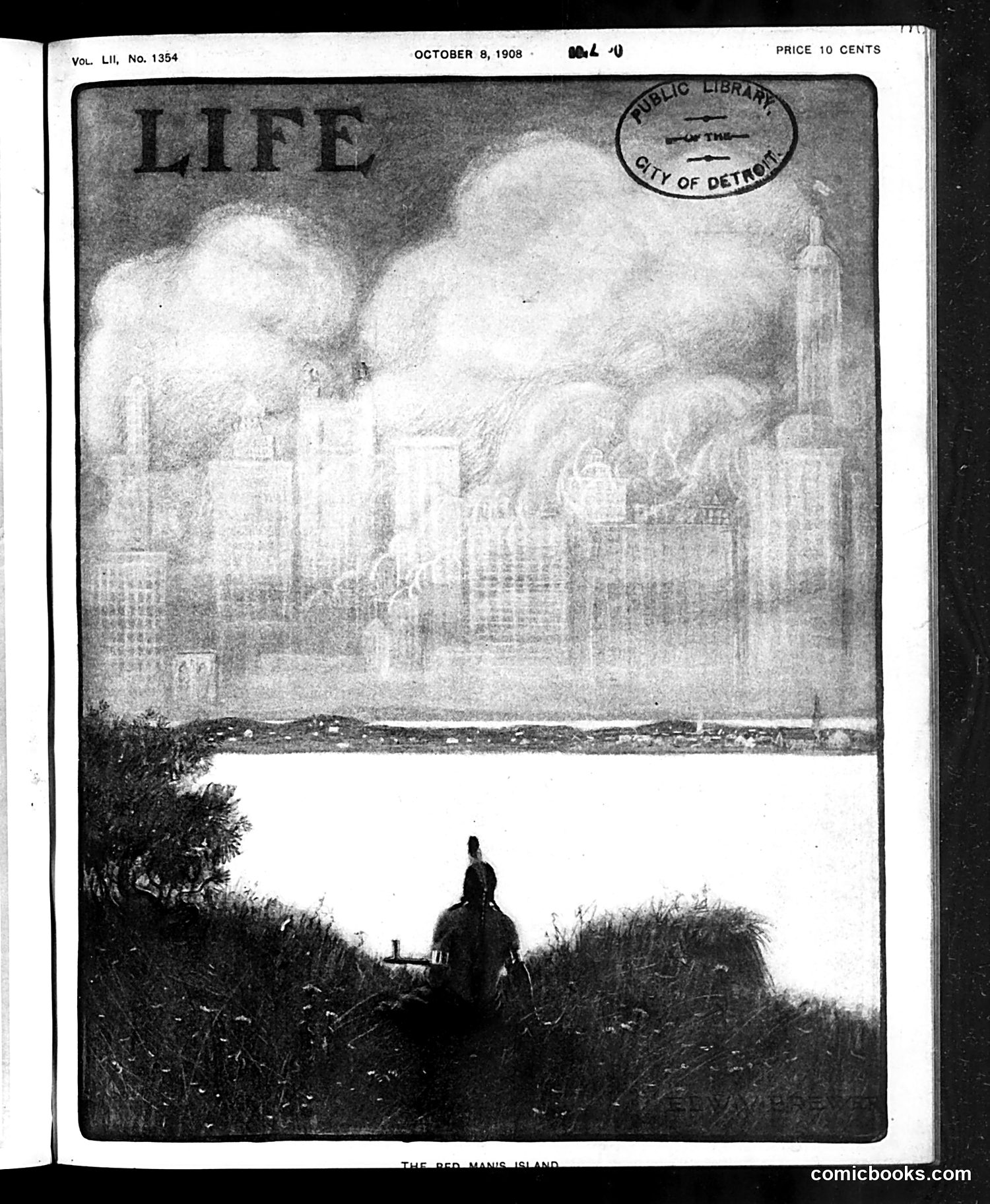
This cover depicts "The Red Man's Island"—a silhouetted Native American figure gazing across water toward a dramatically rendered New York City skyline with massive clouds of smoke or steam rising above the buildings. The composition contrasts the solitary Indigenous observer in natural grassland with the industrial urban landscape beyond. The image appears to reference American expansion and industrialization's impact on Native American lands and peoples. The figure's isolated, contemplative pose facing the distant city suggests themes of displacement, observation of a transformed landscape, or melancholy regarding civilization's encroachment. The title implies this may be examining Native American perspectives on Manhattan's development, though specific historical context for "Red Man's Island" remains unclear without additional documentation.
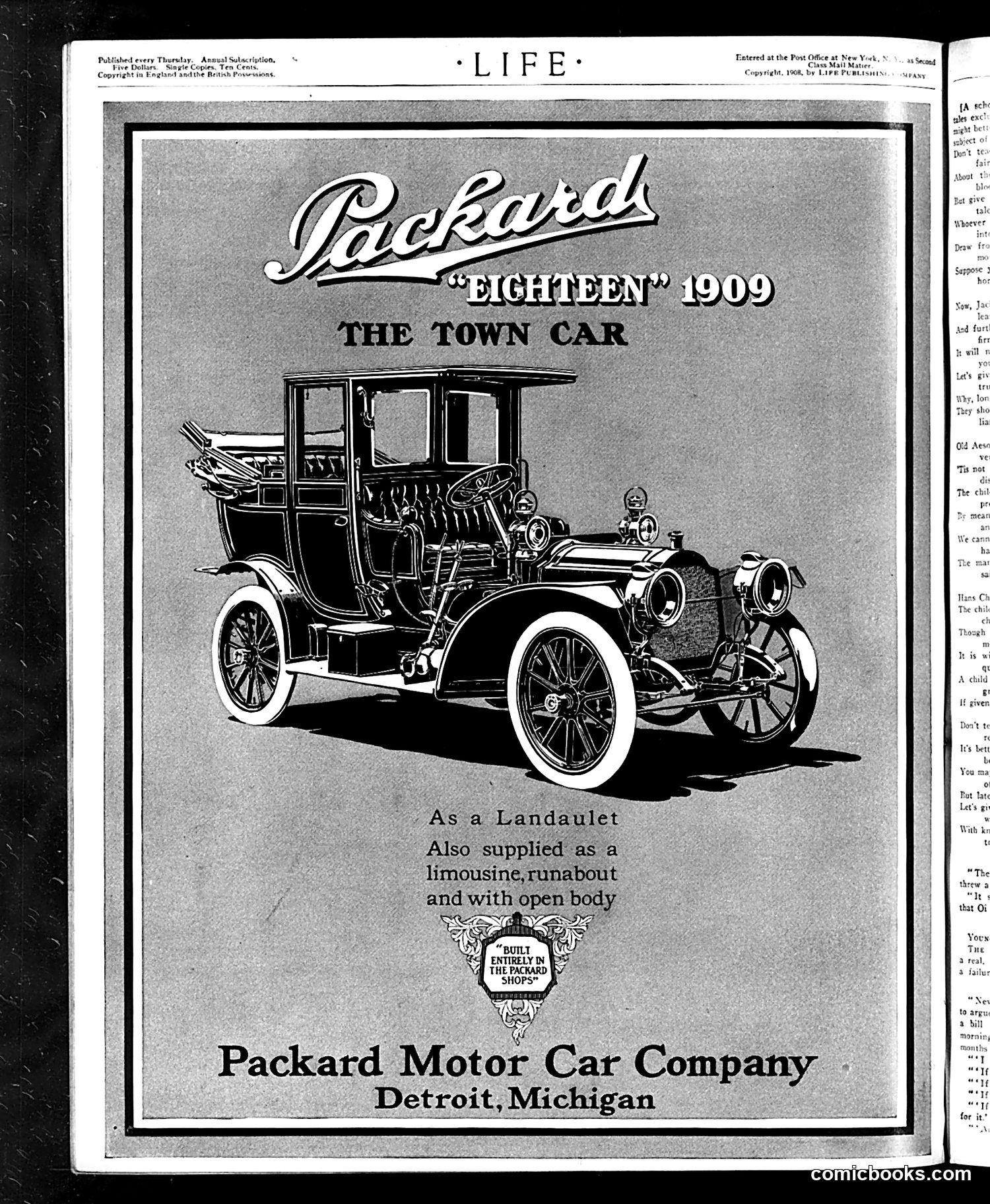
This page is **entirely an advertisement**, not satire or editorial content. It promotes the Packard "Eighteen" 1909, a luxury automobile manufactured by the Packard Motor Car Company in Detroit, Michigan. The ad features a detailed technical illustration of the vehicle and emphasizes its versatility—available as a landaulet, limousine, runabout, or with an open body. The decorative crest states "Built Entirely in the Packard Shops," highlighting the company's manufacturing control and quality. This represents early automotive advertising in a prestigious publication like *Life*. The emphasis on multiple body styles and construction quality reflects the era when automobiles were luxury goods marketed to wealthy consumers who could afford customization options.
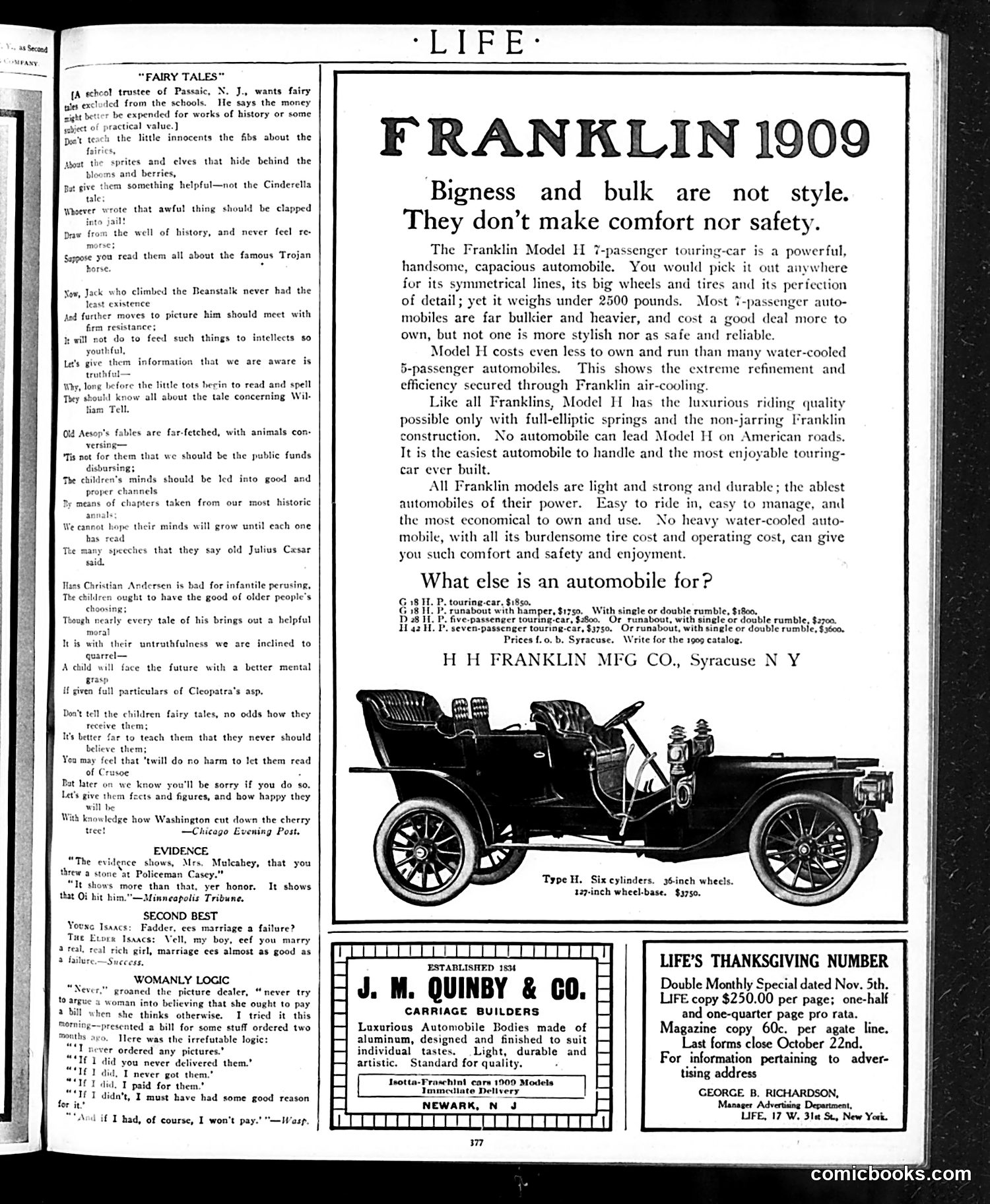
This page contains **no political cartoon or satire**. Instead, it features: 1. **"Fairy Tales" editorial column** (left) – a school trustee from Passaic, NJ argues against teaching fairy tales in schools, claiming they waste educational funds better spent on history and practical subjects. The column satirizes this overly-serious position through ironic counterarguments about children's moral development. 2. **Franklin automobile advertisement** (right) – a straightforward 1909 car ad emphasizing the Model II's power, comfort, and reliability, with technical specifications and pricing. 3. **J.M. Quinby & Co. carriage builder advertisement** (bottom left) 4. **Life's Thanksgiving number announcement** (bottom right) The page is primarily **advertising and editorial content**, not political satire.
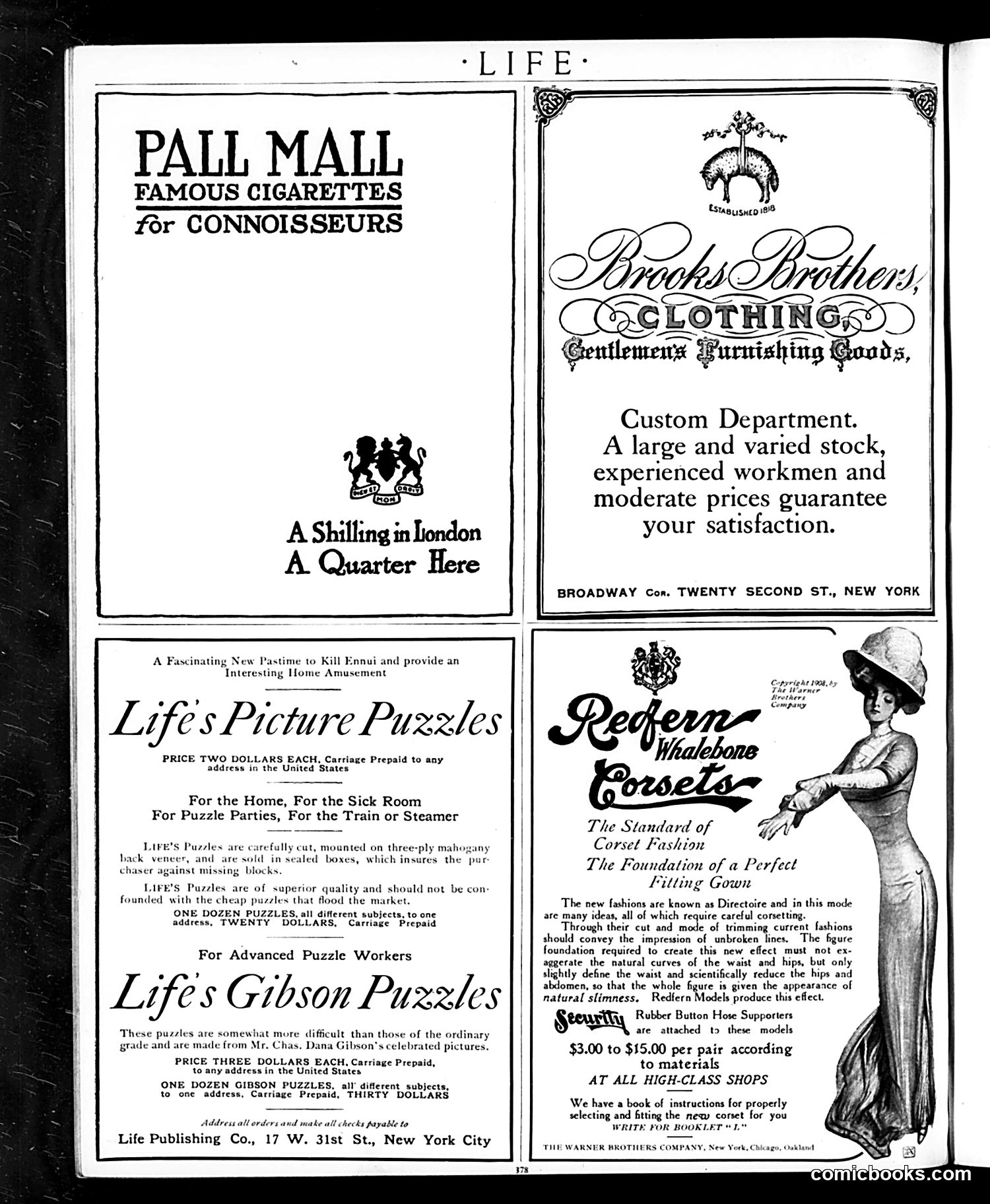
This page is **primarily advertisements**, not satirical cartoons. It contains four commercial ads from what appears to be an early 20th-century issue of Life magazine: 1. **Pall Mall cigarettes** - marketed as "Famous Cigarettes for Connoisseurs" 2. **Brooks Brothers clothing** - advertising custom tailoring for gentlemen 3. **Life's Picture Puzzles** - promoting jigsaw puzzles as home entertainment 4. **Redfern Whalebone Corsets** - featuring an illustration of a woman in fashionable dress, marketed as "The Standard of Corset Fashion" There are no political cartoons or satirical commentary visible. The page reflects period consumer goods and fashion standards, with the corset ad notably emphasizing artificial body shaping as desirable—a practice modern readers would recognize as problematic.
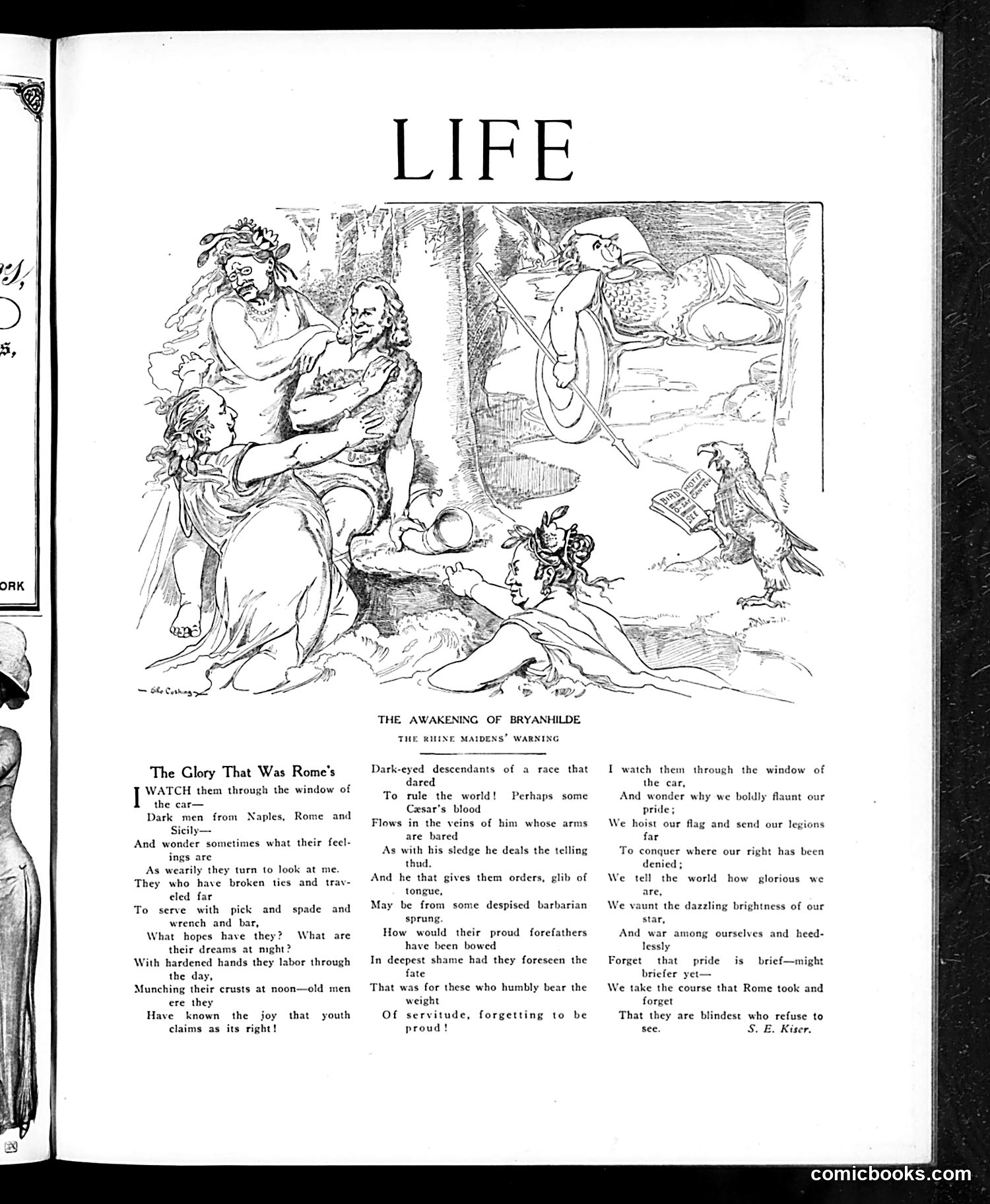
This page satirizes **William Jennings Bryan**, the three-time presidential candidate (1896, 1900, 1908). The title "Bryanhilde" combines his name with Wagner's operatic Valkyrie, mocking his grandiose political ambitions. The illustration shows classical and mythological figures observing Bryan's awakening, while the poem "The Rhine Maidens' Warning" critiques his jingoistic imperialism. The verses mock Bryan's supporters who seek military glory and territorial expansion ("conquer where our right has been denied"), warning that such pride leads to ruin. The satire targets Bryan's contradictions: while appearing to champion humble workers, his political movement embraced aggressive American expansionism and imperial ambitions—betraying progressive ideals for nationalistic bluster.
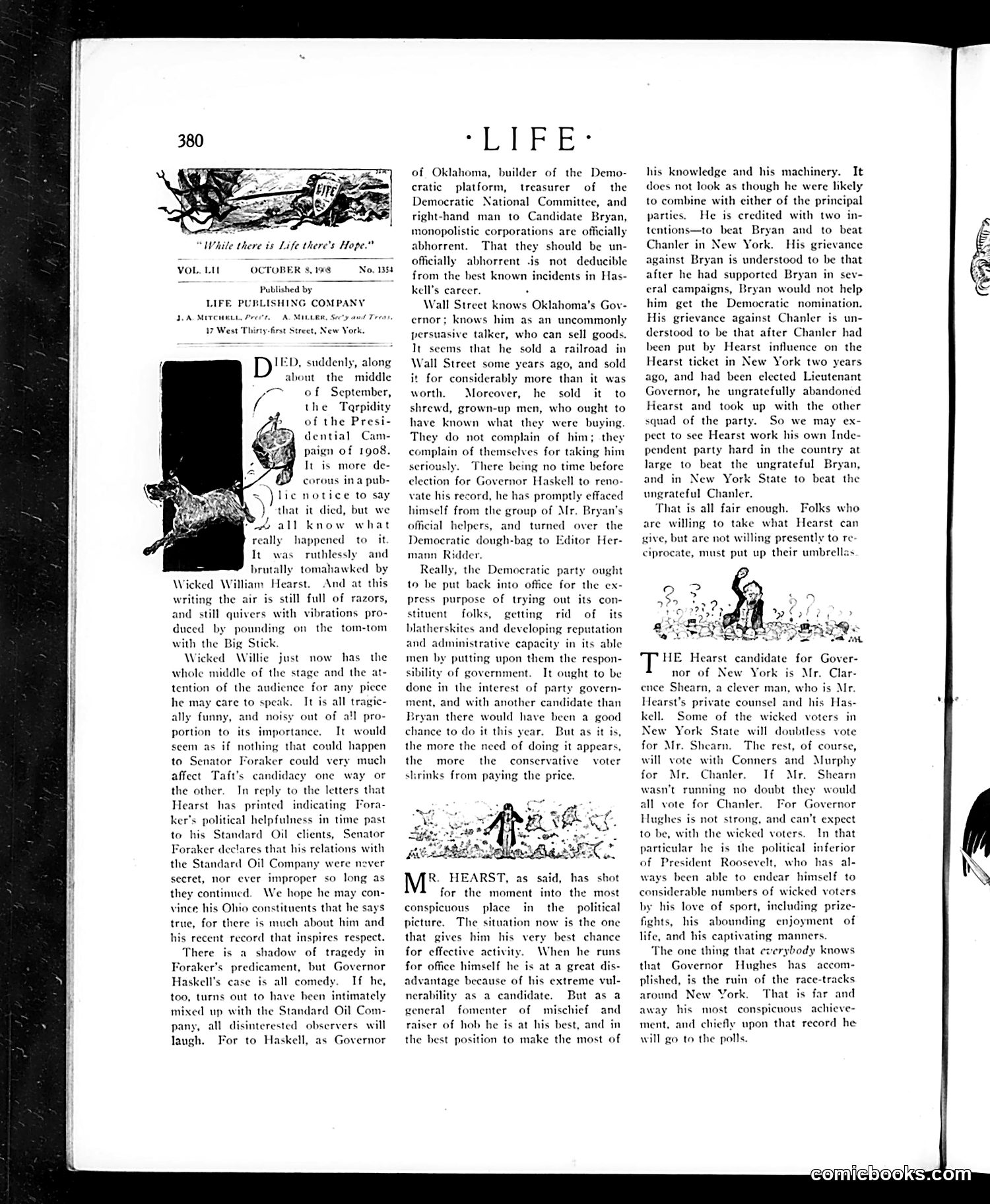
This page discusses the 1908 presidential campaign, specifically addressing William Jennings Bryan's candidacy and his relationship with William Randolph Hearst. The main cartoon (top left) depicts "Wicked William Hearst" and appears to satirize Hearst's political influence and opportunism—the text notes he "sold a railroad in Wall Street some years ago" and is now attempting to shape Democratic politics. The article criticizes both Bryan and Hearst's involvement in party politics, suggesting Hearst uses his media power to manipulate outcomes. It also discusses the New York gubernatorial race and Clarence Shearn as Hearst's preferred candidate. The cartoons mock the volatility and self-interest of wealthy political figures attempting to control party nominations, rather than focusing on genuine governance.
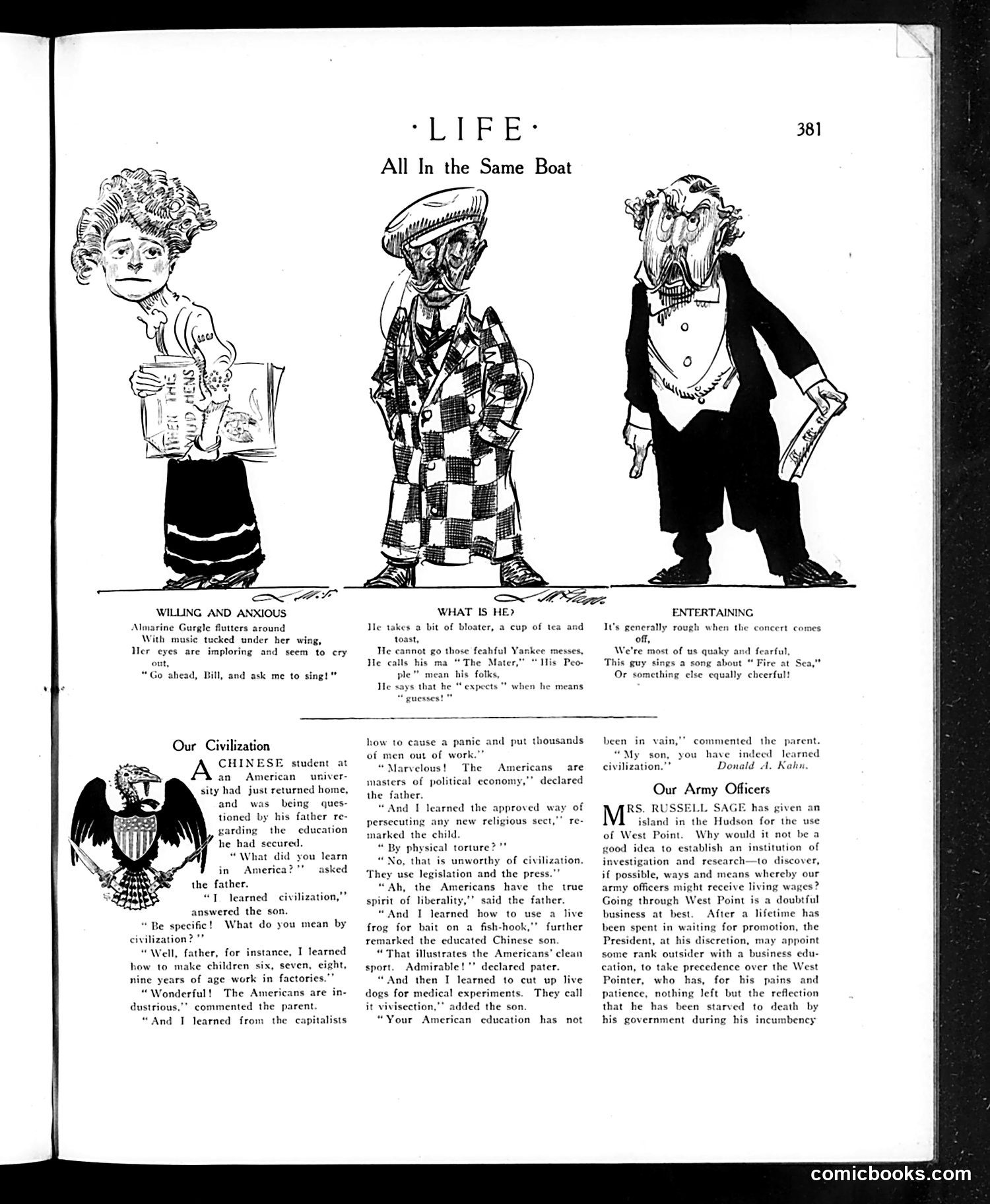
This satirical cartoon depicts three figures representing different social anxieties of the era: 1. **Left figure**: A woman labeled "Willing and Anxious," showing concern about entertainment and social dancing ("Go ahead, Bill, and ask me to sing!") 2. **Center figure**: Labeled "What is He?", portraying a working-class man worried about economic hardship and labor disputes (references to "Yankee messes" and union concerns) 3. **Right figure**: Labeled "Entertaining," showing an upper-class man experiencing entertainment sector struggles The title "All In the Same Boat" suggests class unity during shared economic uncertainty. Below, "Our Civilization" satirizes a Chinese student's observations of American practices—using his outsider perspective to mock American child labor, vivisection, and capitalist exploitation as hypocritical "civilization." The cartoons express early 20th-century anxieties about labor, class conflict, and American social values.
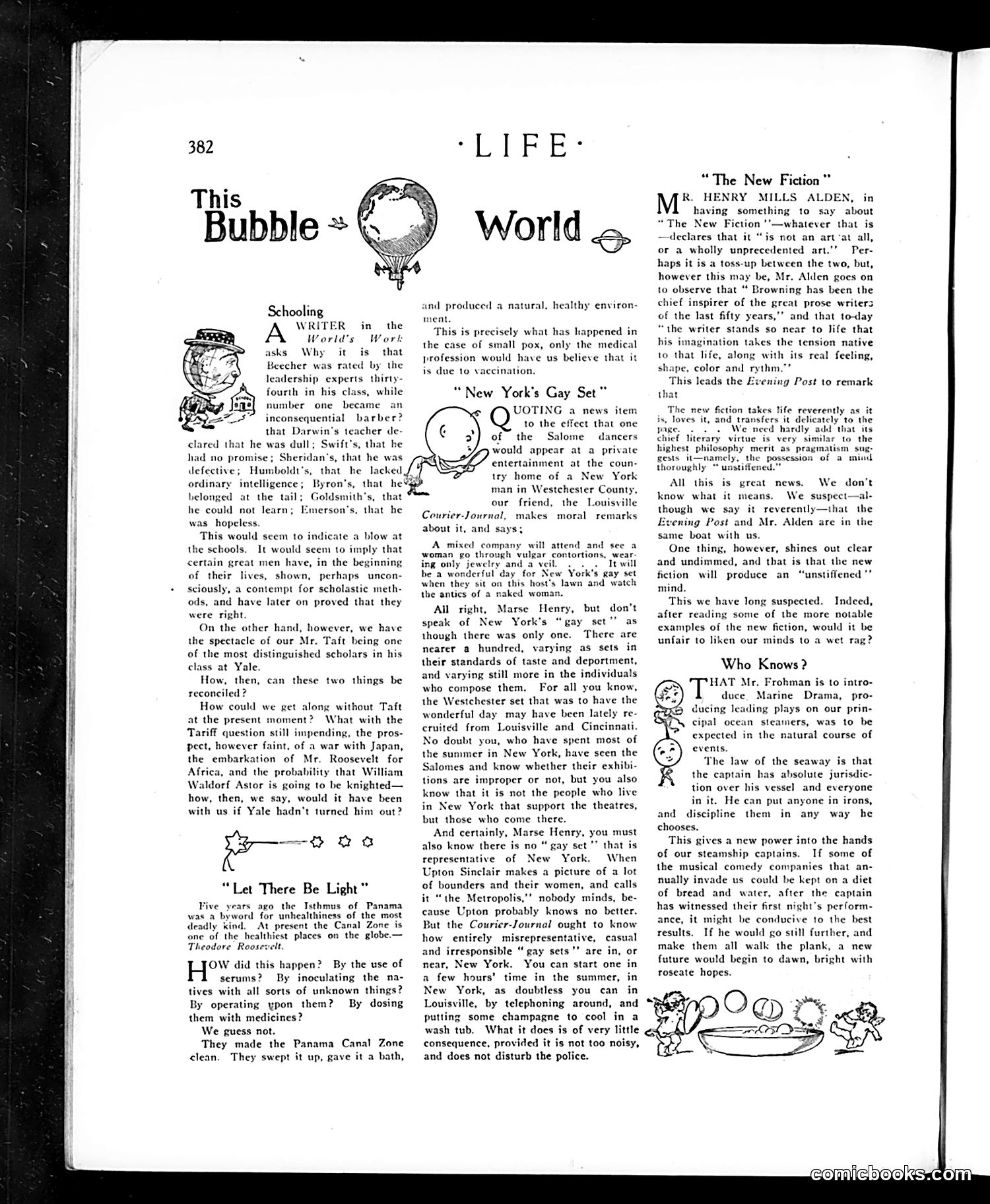
This satirical page critiques educational philosophy and New York's social scene. The left column attacks inconsistency in American schooling: it mocks scholars (Darwin, Taft, Tariff advocates, Roosevelt, Waldorf Astor) who promoted contradictory ideas yet were celebrated as "ordinary intelligence" failures. The piece questions how institutions could honor such self-contradictory thinkers. The right column ridicules New York's "gay set"—wealthy Westchester socialites—for their pretentious theater attendance and moral hypocrisy. It suggests they're unrepresentative of actual New York culture, which is sustained by working people, not elite dilettantes. The Panama Canal reference ("Let There Be Light") briefly celebrates engineering achievements, contrasting with human institutional failures. Overall, the page satirizes American intellectual and social pretension.
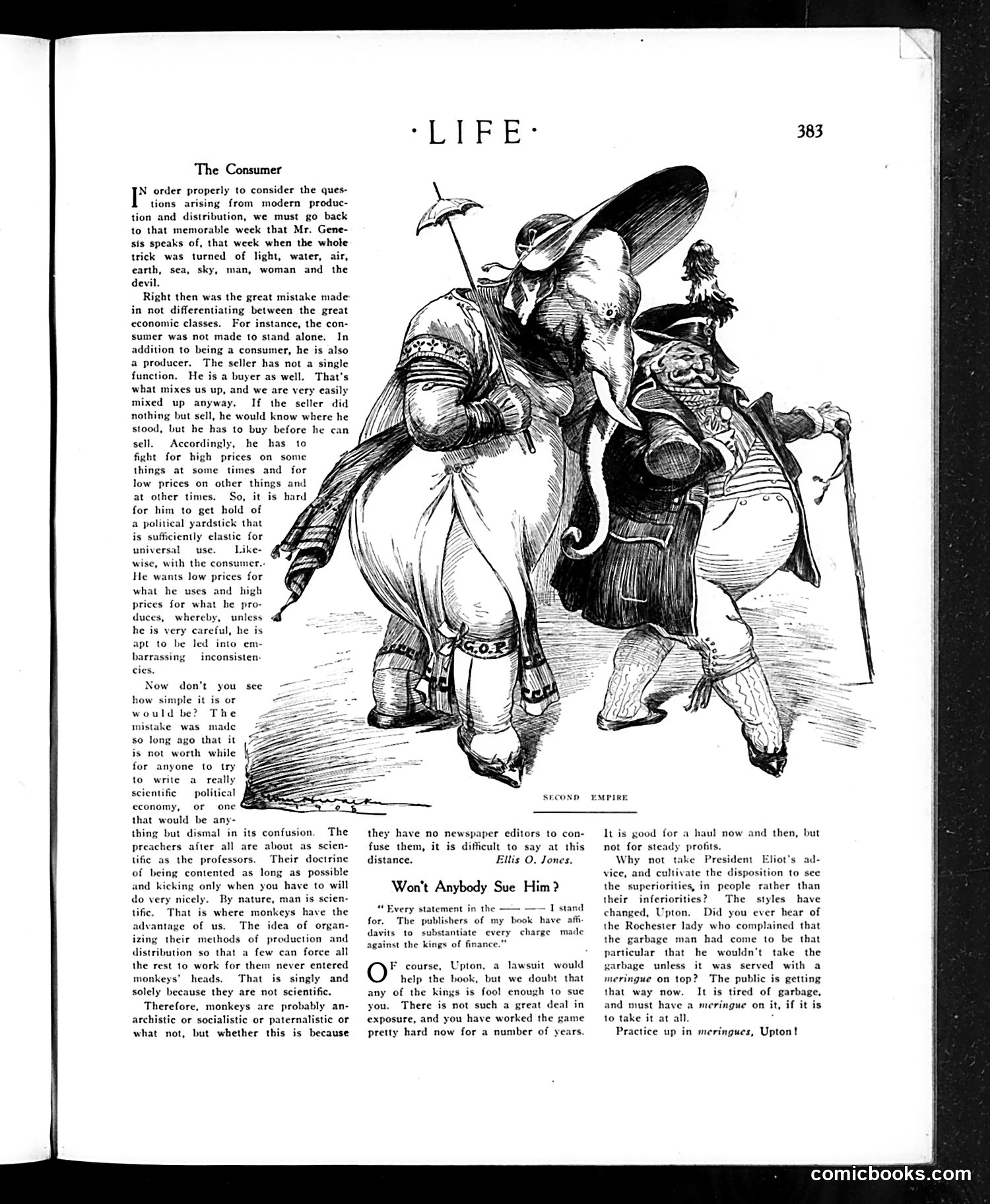
This satirical cartoon depicts a rotund, elaborately dressed figure (likely representing a wealthy industrialist or monopolist) being confronted by a smaller, working-class figure carrying a cane. The title "Second Empire" references France's Second Empire period (1852-1870), suggesting American wealth and power mirror that historical era's excess. The accompanying article, "The Consumer," critiques economic inequality and the disconnect between producers and consumers. The cartoon illustrates this tension: the bloated capitalist, laden with goods and wealth, faces accountability from ordinary citizens demanding fair practices. The satire mocks how the wealthy insulate themselves from market consequences while ordinary people bear the burden of economic imbalance—a progressive-era critique of unchecked industrial capitalism and monopolistic practices.
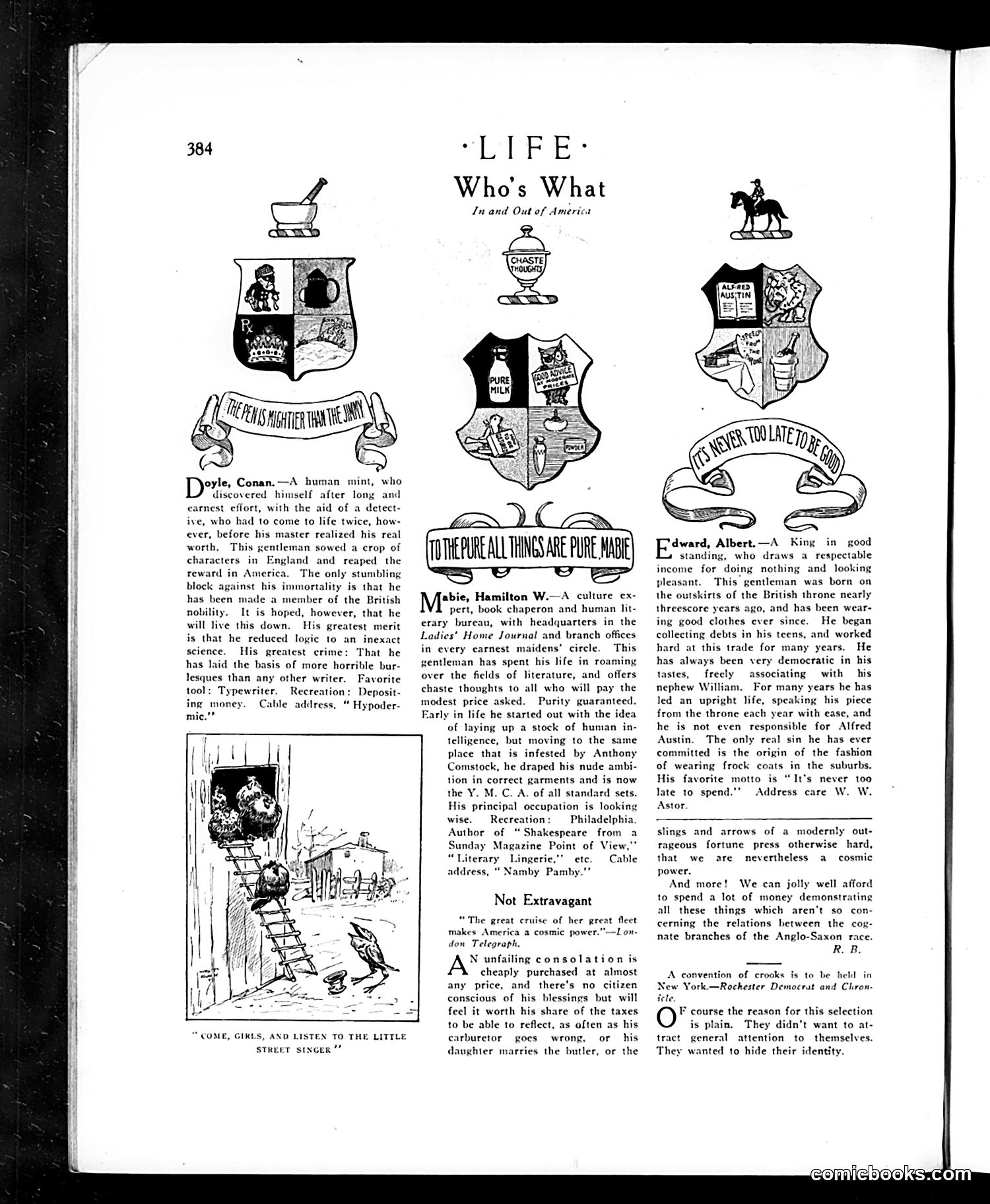
This page features humorous character sketches of notable Americans. The main subjects visible are: **Doyle, Conan** — Described as a detective fiction writer who discovered himself after long effort, now recognized as valuable. The satire notes his greatest merit is logical science; his crime is inventing "more horrible" legacies than others. **Mabie, Hamilton W.** — A culture expert and literary figure who aims for "purity" in life and literature, offering "modest thoughts" at low prices. **Edward, Albert** — A British nobleman drawing income from doing nothing, now collecting debts in suburbs rather than estates—satirizing aristocratic decline into genteel poverty. The page uses heraldic shields and satirical biographical entries to mock these public figures' pretensions and contradictions between their stated values and actual behaviors.
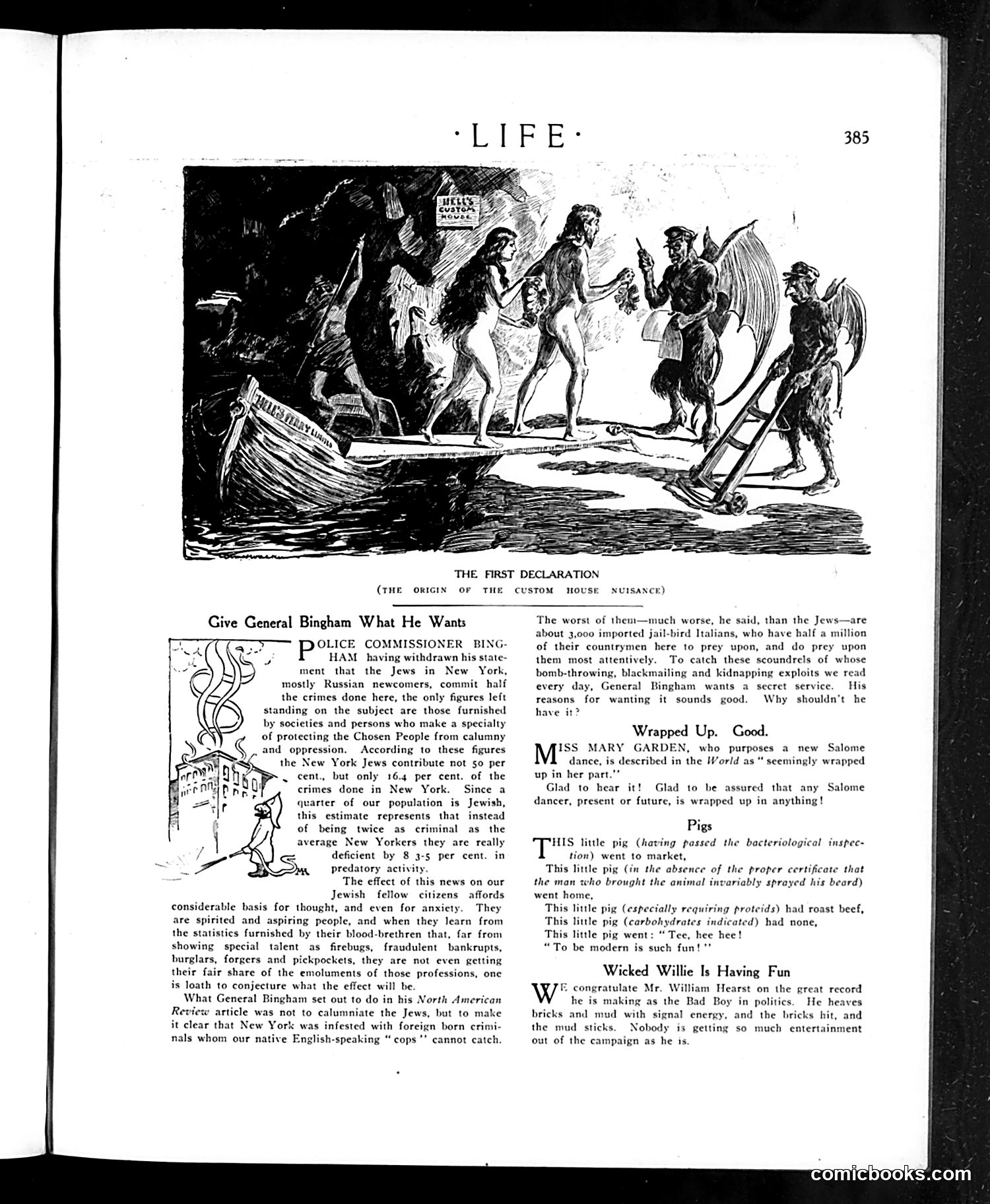
The top engraving titled "THE FIRST DECLARATION (The Origin of the Custom House Nuisance)" depicts demons or devils on a boat, apparently satirizing the origins of bureaucratic customs regulations—suggesting they have demonic origins. The main article criticizes Police Commissioner Bingham's claims that Jews commit half of New York's crimes. The text argues this statistic is inflated and unfairly blames Jewish immigrants. It notes that if Jews actually committed crimes at rates Bingham claims, they'd be "twice as criminal as the average New Yorkers" despite being "six per cent" of the population—using sarcasm to expose the commissioner's prejudiced logic. The remaining brief items are unrelated humor pieces about a dancer, a pig, and a politician named William Hearst.
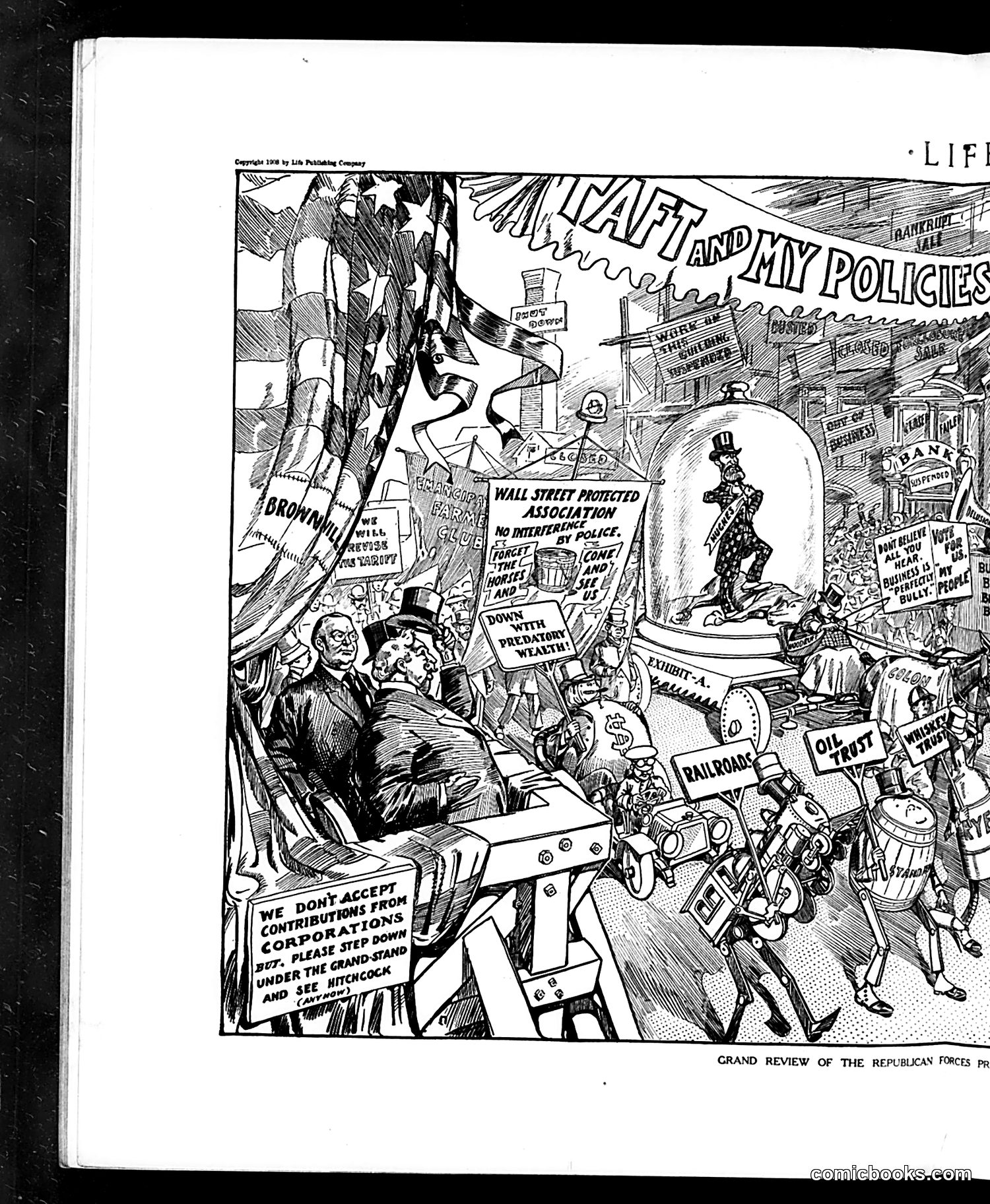
This Life magazine cartoon satirizes Republican Party policies and corporate influence during the Gilded Age. The central figures appear to be Republican leaders sheltering within a protective dome labeled "Wall Street Protected Association," which claims "no interference by police, courts and legislatures." Outside this bubble, various corporate entities ("Oil Trust," "Railroad," "Exhibit A") are depicted as chaotic forces. A sign reads: "We don't accept contributions from corporations. Please step down [and] under the grandstand and see Hitchcock [and] Cannock." The cartoon criticizes Republican hypocrisy—publicly rejecting corporate donations while privately benefiting from them. The bubble represents how Republican policies protect wealthy business interests from legal oversight, while the disclaimer sign exposes this contradiction as transparently false to viewers.
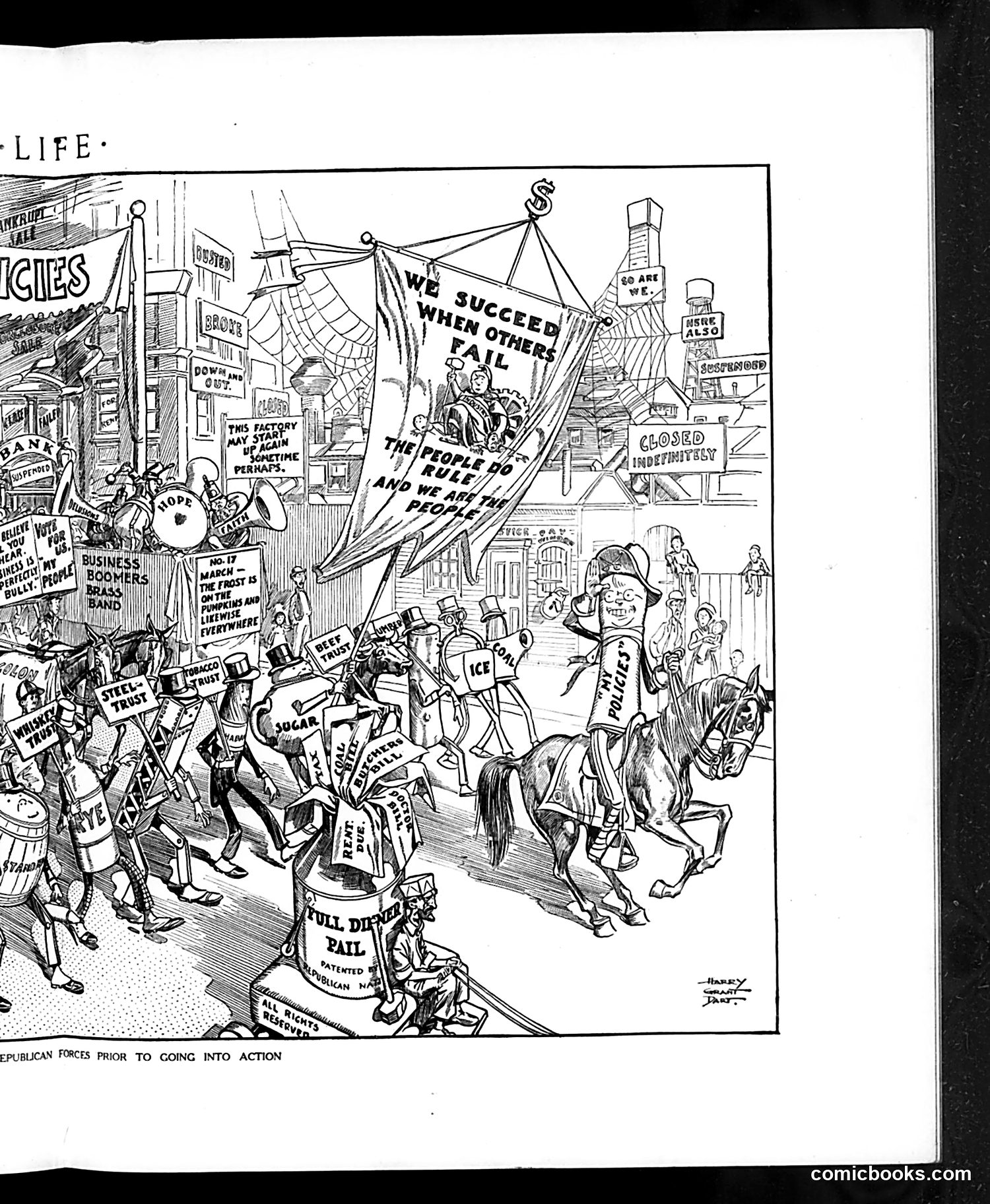
This Life magazine cartoon satirizes Republican political strategy during what appears to be an election period. The central banner reads "WE SUCCEED WHEN OTHERS FAIL" and "THE PEOPLE DO NOT REALIZE AND WE ARE PEOPLE," suggesting Republicans are exploiting economic hardship for political gain. The street scene depicts various business and economic concerns—factories, shops marked "CLOSED INDEFINITELY," and signs referencing "TRUST," "ICE," and "SUGAR"—representing industries affected by economic crisis. A mounted police officer and various figures carry banners, while the large figure on the right appears to be a political candidate or Republican operative. The caption states "REPUBLICAN FORCES PRIOR TO GOING INTO ACTION," indicating this criticizes how Republicans plan to campaign during economic difficulty, profiting from public suffering.
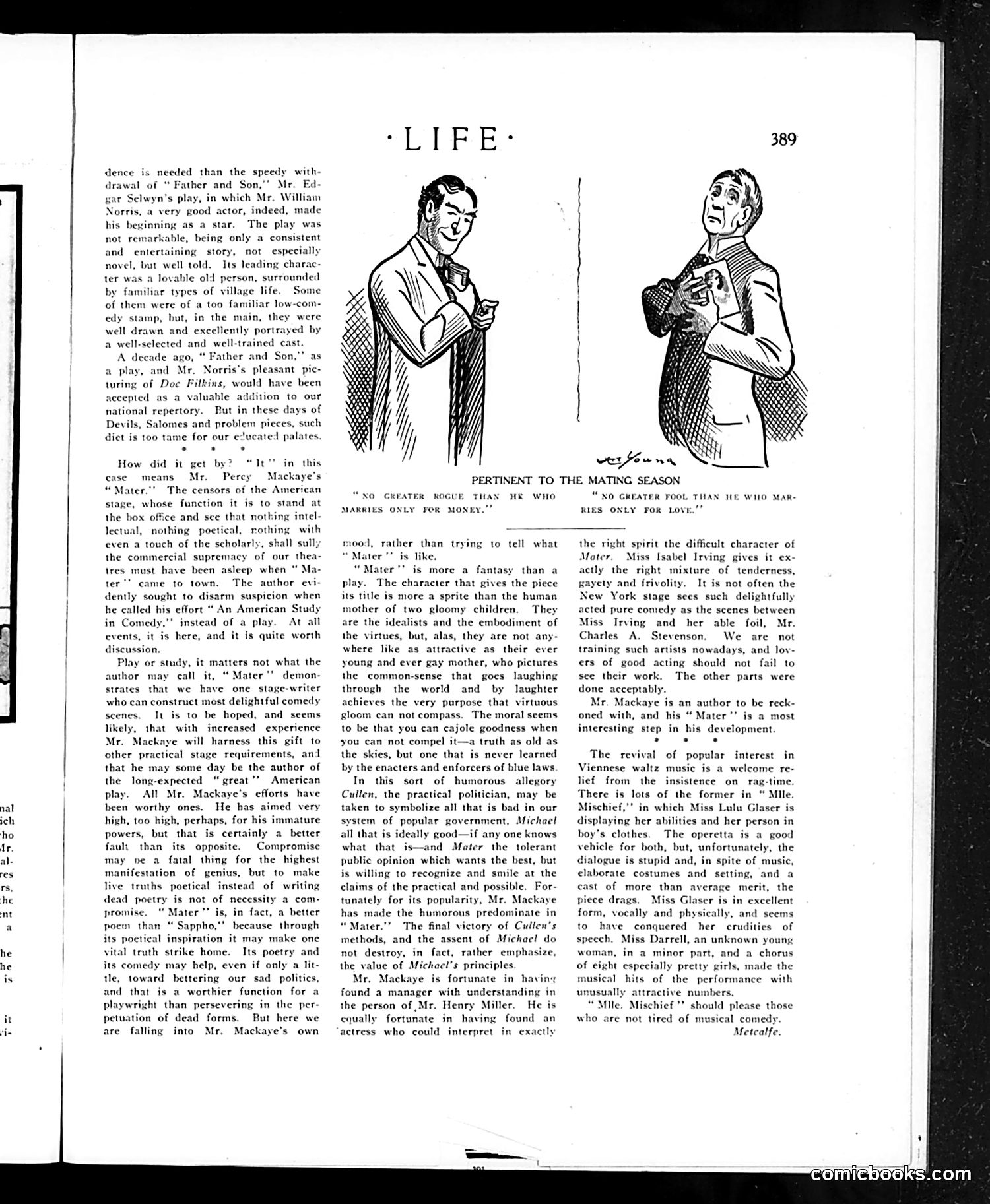
This page reviews Percy Mackaye's play "Mater," debating whether it qualifies as genuine drama or merely a "study." The critic argues Mackaye successfully crafted delightful comedy scenes, though questions whether the censors were asleep allowing such intellectual material past the box office. The two cartoons above critique marriage motives during "the mating season." The left figure's caption reads: "No greater rogue than he who marries only for money." The right responds: "No greater fool than he who marries only for love." This satirizes the era's tension between practical and romantic marriage considerations—a common theme in Life's social commentary. The cartoons suggest both financial mercenary marriages and purely romantic ones are foolish, implying an ideal balance between economic security and affection. The contemporary debate about whether marriage should be practical or romantic remains recognizable today.
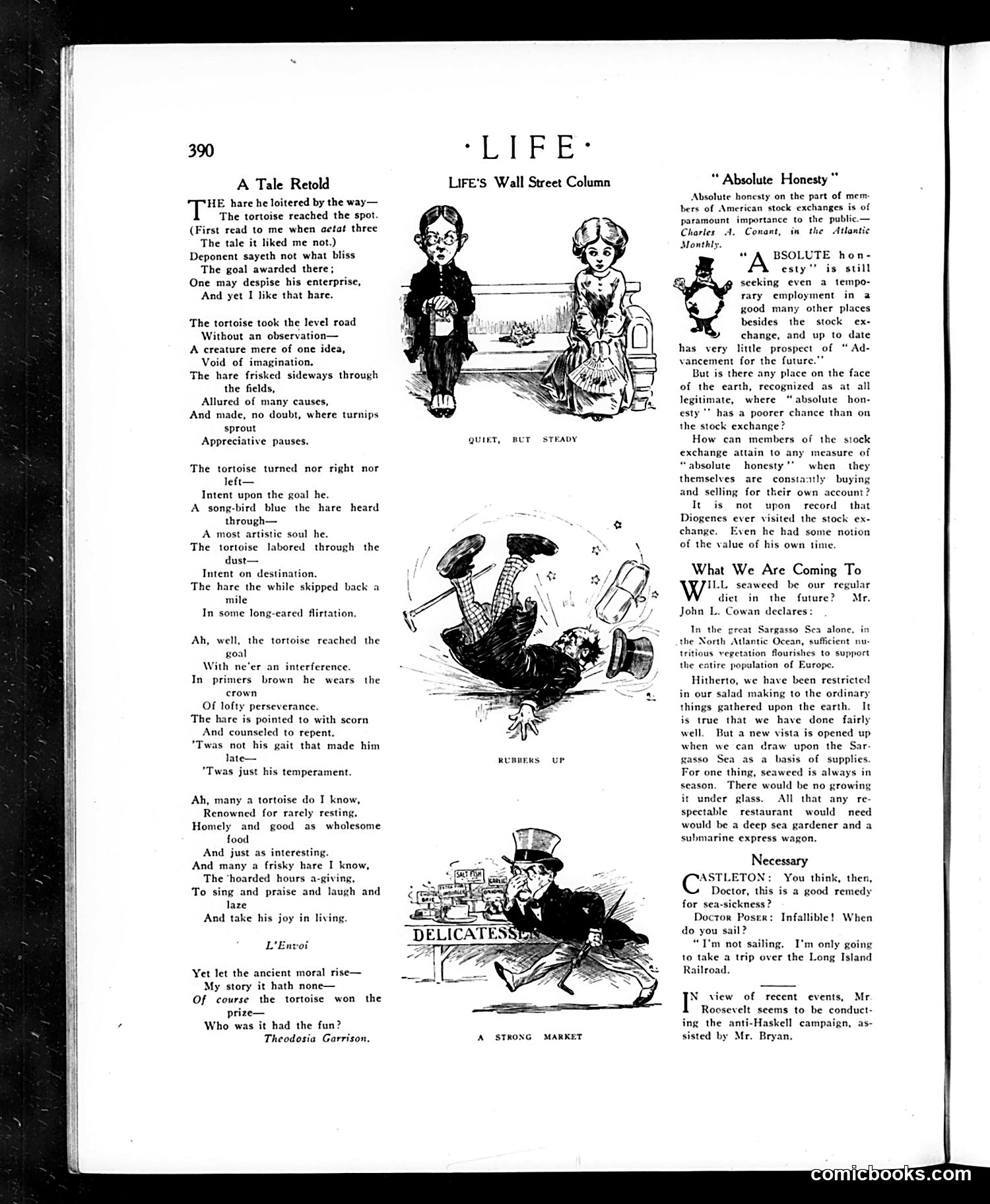
This page contains three satirical pieces: **"A Tale Retold"** (poem by Theodosia Garrison): A cynical reimagining of Aesop's tortoise-and-hare fable. Rather than celebrating the tortoise's victory, Garrison questions the moral: the tortoise wins through plodding single-mindedness, while the sensitive, artistic hare loses because of his temperament—not laziness. She argues the hare actually had more joy in living. The satire critiques rigid moralism that rewards conformity over individuality. **"Absolute Honesty"** (Wall Street Column): Sardonic commentary on stock exchange ethics. The piece mocks the call for "absolute honesty" among brokers while they constantly trade for personal profit—an inherent conflict of interest. The reference to Diogenes (ancient cynic philosopher searching for honest men) suggests honesty is practically nonexistent on Wall Street. **"What We Are Coming To"**: Light satire on futuristic predictions about harvesting Sargasso Sea seaweed as food. The humor lies in imagining impractical logistics like "submarine express wagons." The page blends political/social critique (Wall Street corruption) with cultural commentary on morality and individualism.
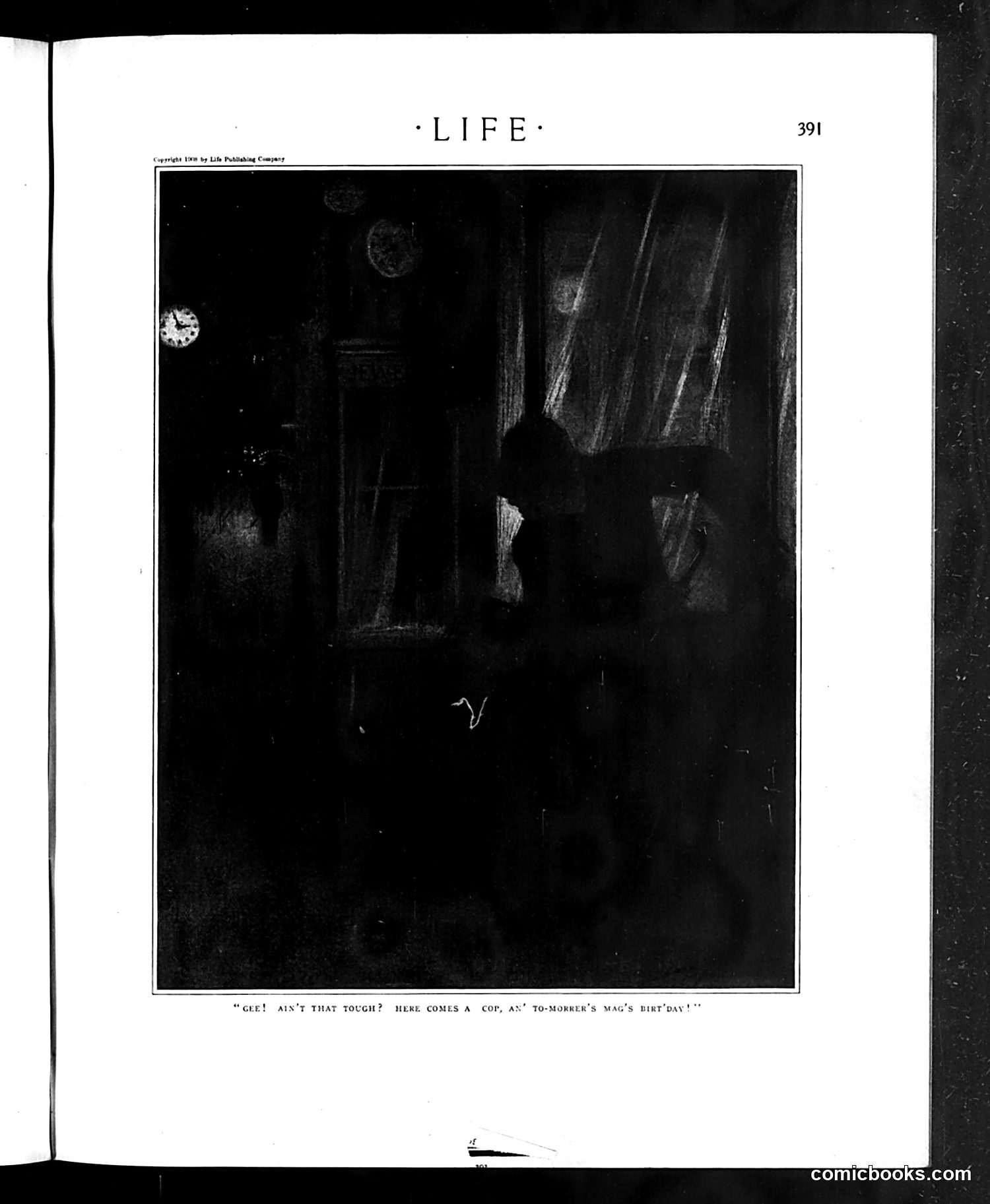
This is a dark, shadowy scene depicting what appears to be a street encounter. The caption suggests working-class or criminal characters using colloquial dialect ("Gree!", "Aix't", "Cor"). The speaker warns someone that "a cop" is coming, and references "to-morrow's mag's birt'day" (magazine's birthday). This appears to be satirizing *Life* magazine itself—suggesting the publication's birthday celebration might be disrupted by police interference, possibly alluding to raids or legal troubles. The heavy shadows and dramatic lighting underscore the illicit nature of the scene. Without additional context, the exact reference remains unclear, but the satire appears self-referential, mocking *Life*'s own situation or reputation during this period.
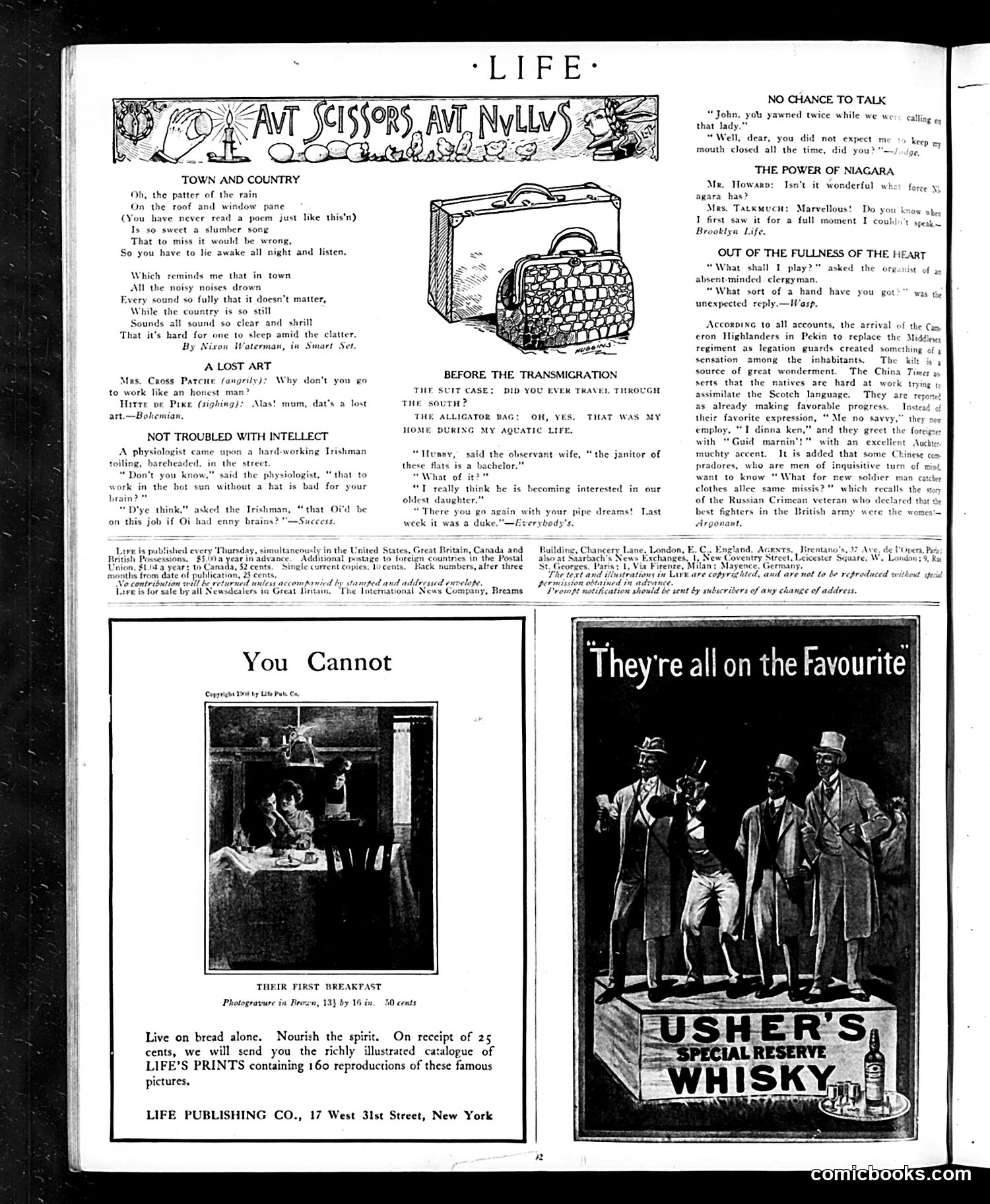
This page from *Life* magazine contains several satirical pieces typical of early 20th-century American humor: **Main Cartoons:** - "Town and Country" and "A Lost Art" are brief comic dialogues mocking domestic life and labor attitudes - "Not Troubled with Intellect" jokes about an Irishman's practical (if risky) work habits—playing on ethnic stereotypes common to the era - "Before the Transmigration" references Scottish Highland soldiers stationed in Peking (Beijing), satirizing their culture clash with Chinese residents who find kilts and Scottish dialect amusing **Advertisements:** The page includes ads for *Life* prints and Usher's Whisky, reflecting the magazine's commercial nature. **Context:** These pieces reflect early 1900s attitudes toward immigration, class, and international encounters. The Scottish soldier cartoon references Britain's role in China during the Boxer Rebellion aftermath, when foreign military presence was novel to Chinese civilians. The humor relies heavily on dialect, national stereotypes, and class-based comedy—standard for *Life*'s satirical approach.
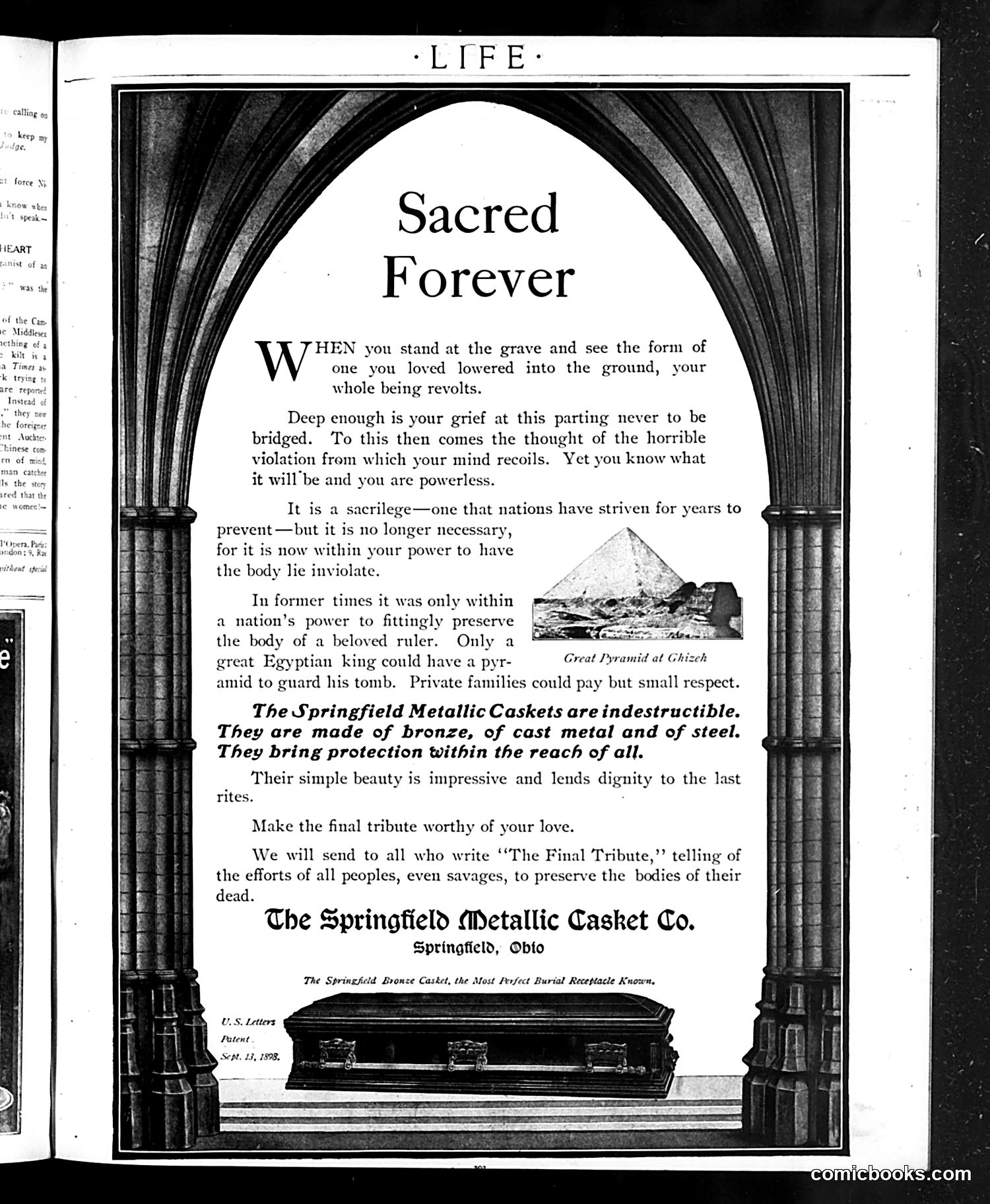
This is a **funeral casket advertisement**, not satire or political commentary. The Springfield Metallic Casket Company uses emotional appeals about death and burial preservation to market their product. The "joke" or persuasive angle: the ad acknowledges a modern anxiety—fear that bodies will decompose or be desecrated—then positions their indestructible bronze caskets as a solution now affordable for ordinary families, not just Egyptian pharaohs. The reference to the Great Pyramid at Giza evokes ancient preservation methods, implying their product offers comparable protection. The text explicitly states caskets bring dignity and "protection within the reach of all," converting a morbid concern into a commercial opportunity. By 1908 (patent date visible), this represented aggressive emotional marketing in a mass-circulation magazine, treating death reverence as a consumer good rather than purely a religious or family matter. It's advertisement, not editorial satire.
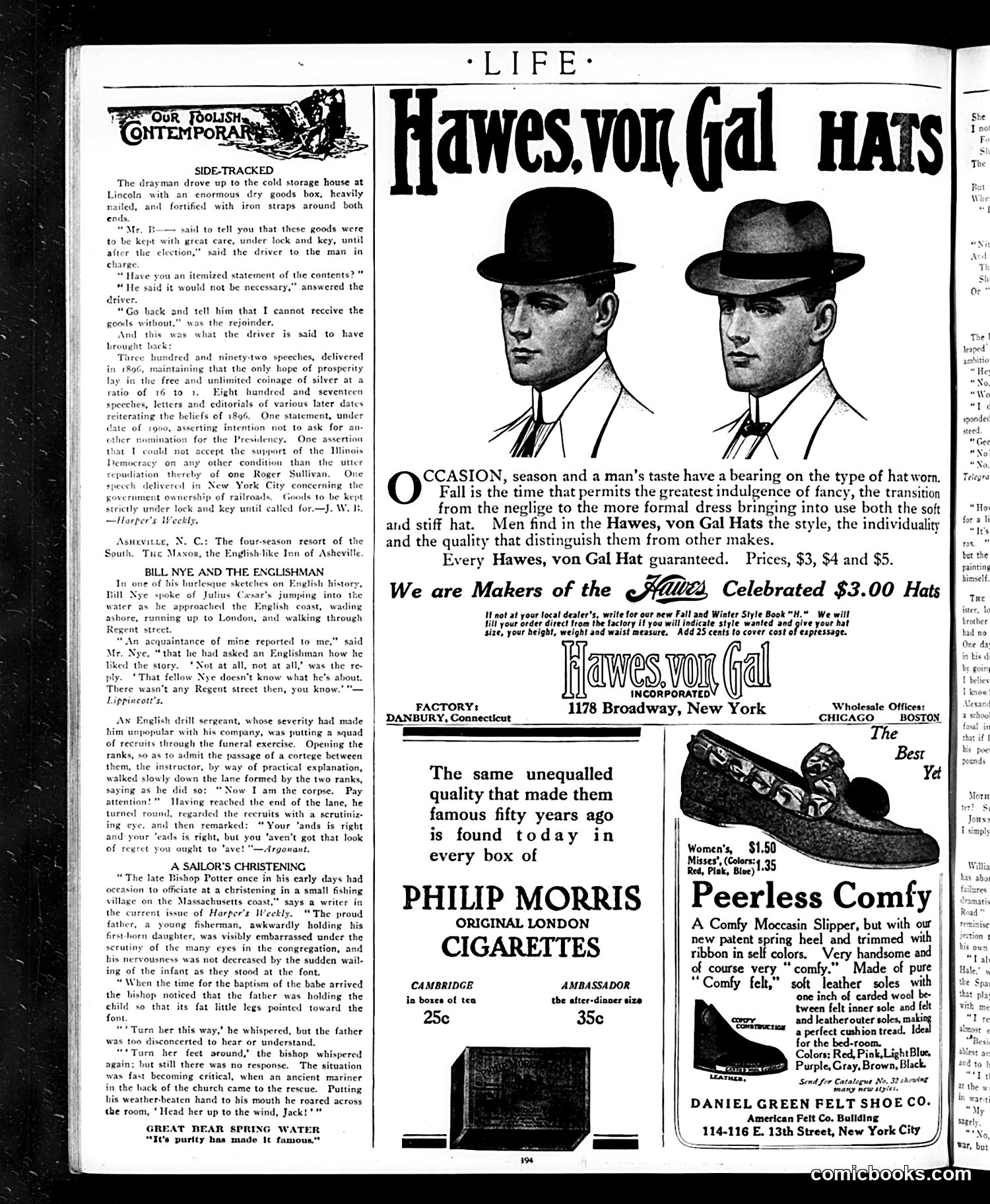
This page contains primarily **advertising and anecdotal humor**, not political cartoons. The main advertisements feature **Hawes, von Gal Hats** with illustrations of two men wearing fedoras—promoting seasonal hat fashion for fall's transition from casual to formal dress. The text sections are period humor pieces: a Bill Nye anecdote mocking English responses ("Not at all, not at all"), a British drill sergeant's practical joke during funeral practice, and a reverential story about Bishop Potter christening a fisherman's daughter, with a sailor solving the problem by shouting nautical instructions. The opening "Side-Tracked" section references political concerns around the 1896 election (mentioning Roger Sullivan and Illinois Democrats), discussing storage of goods under lock and key—likely satirizing political patronage or corruption disputes. The humor relies on class/cultural contrasts (English stiffness, fishermen's coarseness) and linguistic mishaps typical of Life magazine's genteel satire of that era.
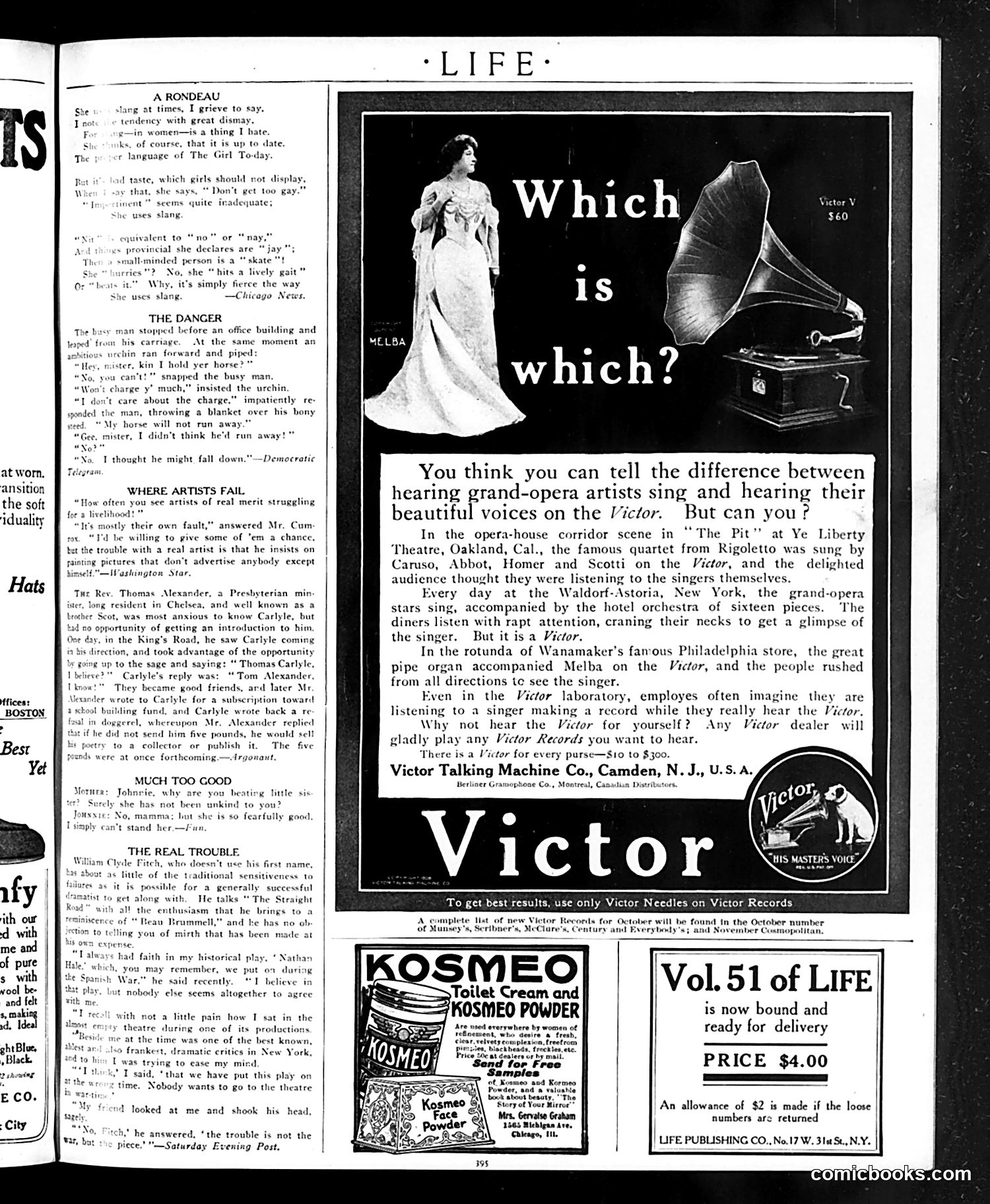
This page is primarily **advertising** for Victor Talking Machine Company's phonograph records, not political satire. The large central advertisement features "Melba" (likely the famous opera singer Nellie Melba) and asks "Which is which?" — challenging readers to distinguish between hearing live grand-opera singers and hearing them played on a Victor phonograph. The advertisement emphasizes the Victor's remarkable audio fidelity through anecdotes: audiences at the Waldorf-Astoria believed they heard live singers; people at Wanamaker's store rushed to see a singer who was actually a recording. The left column contains unrelated brief humorous pieces about modern girl slang, a carriage accident, artistic merit, and playwright William Clyde Fitch—typical satirical content for Life magazine. The bottom shows ads for Kosmeo cosmetics and Volume 51 of Life itself ($4.00). This represents early 20th-century marketing emphasizing new technology's ability to replicate reality convincingly.
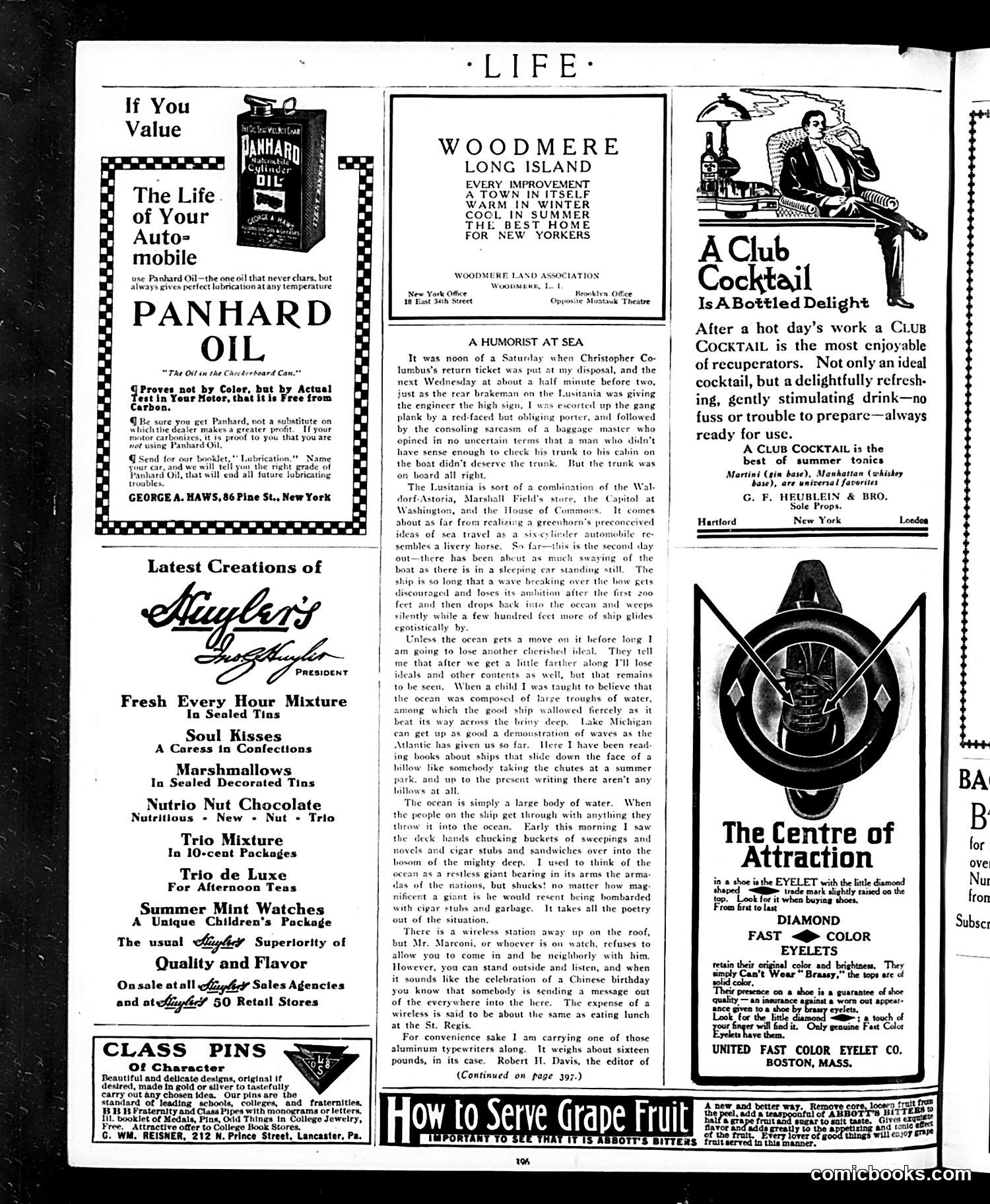
This is primarily a **commercial advertising page** from an early 20th-century issue of Life magazine, with one notable satirical piece. The main content is the short humor essay "A Humorist at Sea," which appears to be a first-person account of a transatlantic voyage aboard the *Lusitania*. The author compares romantic childhood expectations of ocean travel—reading adventure novels, imagining dramatic waves—with disappointing reality: calm seas, mundane garbage disposal, and a ship that resembles "a livery" rather than a noble vessel. The satire targets both sentimental maritime romanticism and the prosaic modern ocean liner experience. The remainder consists of **period advertisements**: Panhard motor oil, Stayler's candies and confections, class pins and fraternity jewelry, Woodmere real estate development on Long Island, and eyelet shoe advertisements. These ads reflect early 1900s consumer culture and lifestyle aspirations.
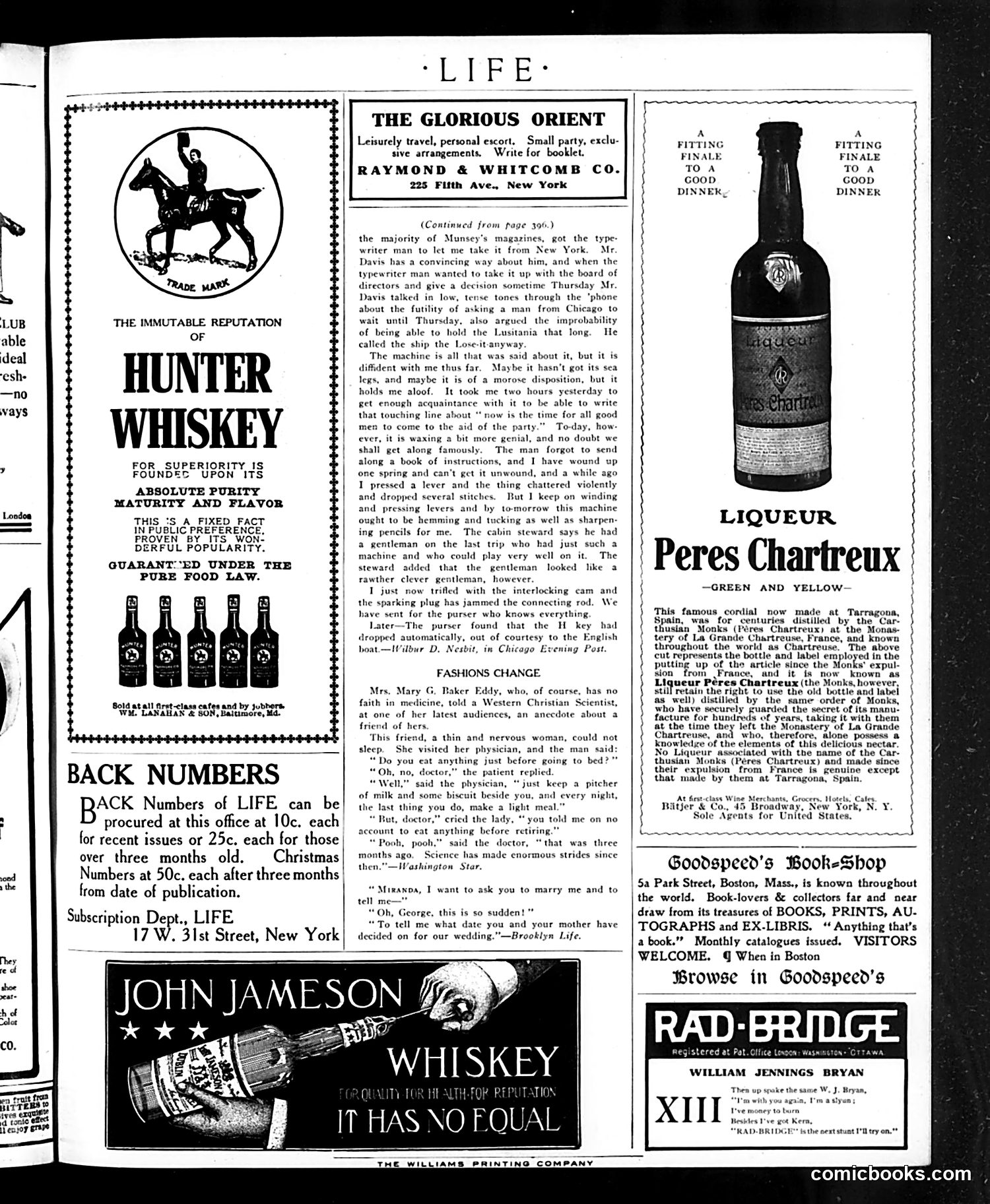
This page is primarily **advertisements and miscellaneous content** from *Life* magazine rather than satirical cartoons. The main advertisements include Hunter Whiskey (emphasizing "purity" and Pure Food Law compliance), liqueurs, and travel services. The editorial content consists of a serialized story by Wilbur D. Nesbit about a man struggling with a new typewriter aboard what appears to be the RMS Lusitania—referencing the famous ship (sunk in 1915). Additional humor pieces mock outdated medical advice (a doctor's recommendations become obsolete in three months) and present a joke about a woman confusing a marriage proposal with wedding planning logistics. The page captures early-20th-century American magazine advertising and light humor, but contains **no significant political satire or caricature** requiring historical context. It reflects period concerns about new technology and gentle domestic humor rather than social commentary.
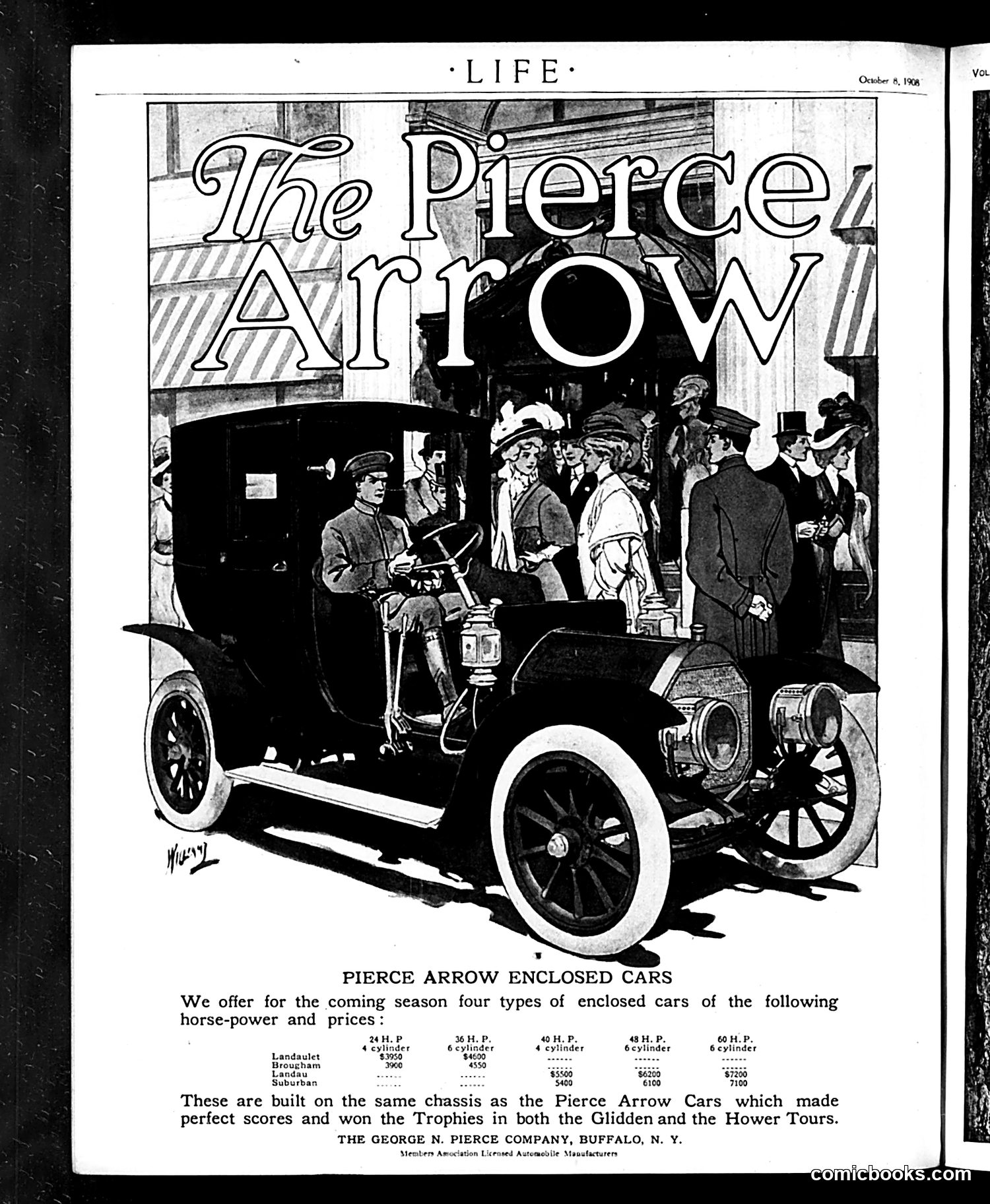
This is primarily a **Pierce Arrow automobile advertisement**, not political satire. The page features an illustration showing an early 1900s luxury car surrounded by well-dressed pedestrians and onlookers admiring it on a city street. The advertisement promotes four types of enclosed automobiles (Landaulet, Brougham, Landau, Suburban) with various engine specifications and prices ranging from $3,900 to over $6,000—substantial sums in 1908. The marketing strategy emphasizes prestige: the cars share chassis with Pierce Arrow vehicles that won prestigious automotive competitions (the Glidden and Hower Tours). The illustration's focus on elegant, interested bystanders suggests these are luxury status symbols for wealthy buyers. There is no evident political commentary or satire here—this is straightforward product marketing using aspirational imagery typical of early automobile advertising in *Life* magazine.