
Life, 1908-10-08 · page 7 of 24
Life — October 8, 1908 — page 7: what you’re looking at
What you’re looking at
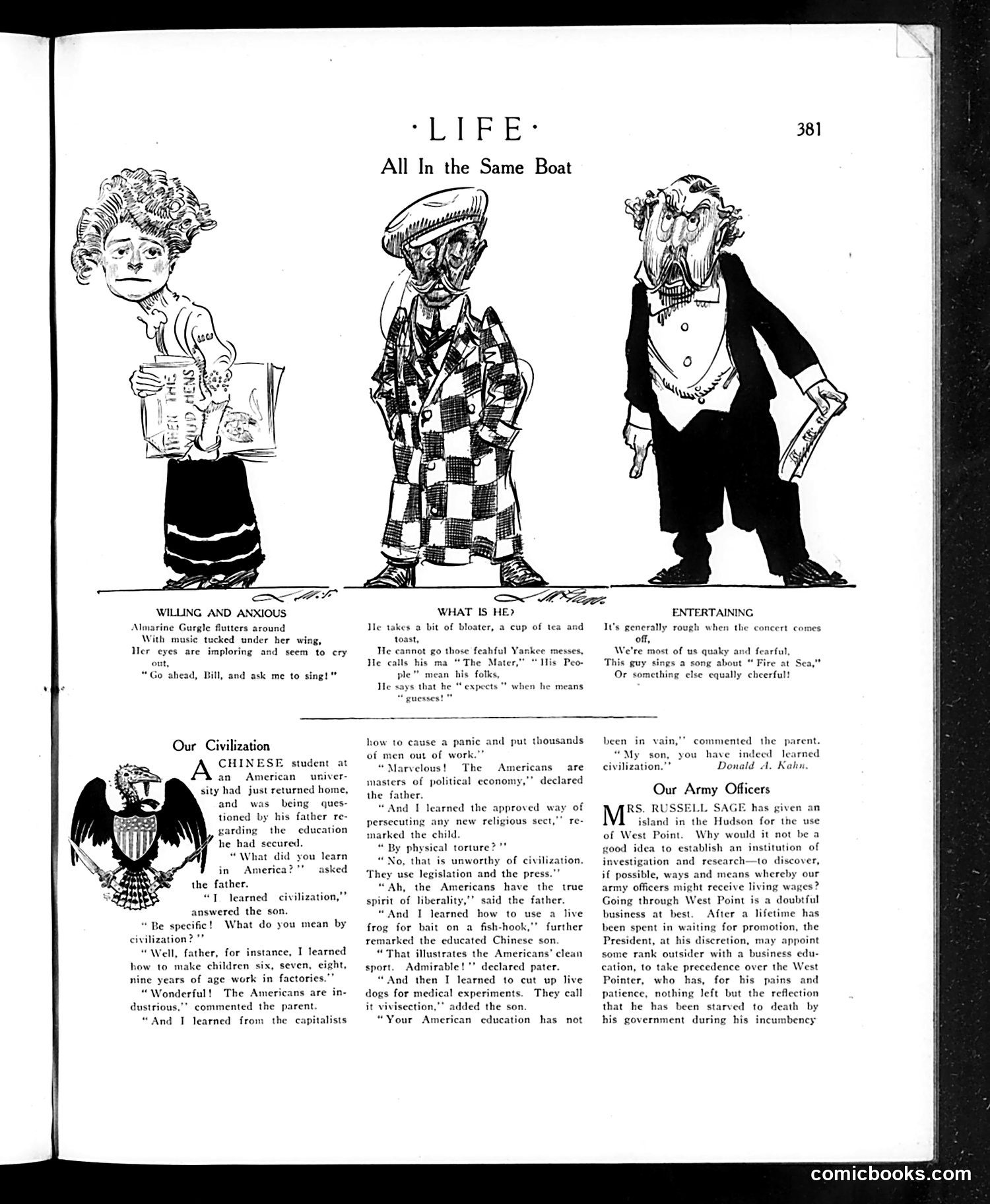
This satirical cartoon depicts three figures representing different social anxieties of the era: 1. **Left figure**: A woman labeled "Willing and Anxious," showing concern about entertainment and social dancing ("Go ahead, Bill, and ask me to sing!") 2. **Center figure**: Labeled "What is He?", portraying a working-class man worried about economic hardship and labor disputes (references to "Yankee messes" and union concerns) 3. **Right figure**: Labeled "Entertaining," showing an upper-class man experiencing entertainment sector struggles The title "All In the Same Boat" suggests class unity during shared economic uncertainty. Below, "Our Civilization" satirizes a Chinese student's observations of American practices—using his outsider perspective to mock American child labor, vivisection, and capitalist exploitation as hypocritical "civilization." The cartoons express early 20th-century anxieties about labor, class conflict, and American social values.
📄 Transcribed text from this page (OCR, searchable)
Machine-transcribed from the original scan — historical spelling and the odd misread are preserved.
NN WILLING AND ANXIOUS Amarine Gurgle flutters around With music tucked under her wing, Mer eyes are imploring and seem to cry head, Bill, and ask me to sing!" ‘LIPE* All In the Same Boat WHAT IS HE? Ie takes a bit of bloater, a cup of tea and toast, ce messes, He calls his ma “The } “His Peo- ple mean his. folk Me says that he guesses!” expects" when he means ENTERTAINING It's generally rough when the concert comes off, We're most of us quaky ai i RS a song about Or something else equally cheerful! 1 fearful, ire at Our Civilization CHINESE student at an American univer sity had just returned home, and was being ques- tioned by his father re- garding the education he had secured. What did you learn in America?’ asked the father. “T learned civilization,”” answered the son. “Be specific! What do you mean by civilization? “Well, father, for instance, I learned how to make children six, seven, eight, ine years of age work in factories.”” Wonderful! The Americans are in- dustrious,”’ commented the parent. “And I learned from the capitalists how to cause a panic and put thousands n out of work.” Marvelous! The masters of political economy,” the father. “And I learned the approved way of persecuting any jous sect,” re- marked the child By physical torture? No, that is unworthy of civilization. They use legislation and the press."’ ‘Ab, the Americans have the true spirit of liberality,"” said the father. “And I learned how frog for bait on a fish-hook,”” further remarked the educated Chinese son hat illustrates the Americans’ clean sport. Admirable!? declared pater. “And then I learned to cut up live dogs for medical experiments. They call it vivisection,”” added the son. “Your of m Americans are declared new relij to use a live American education has not been in vain,'’ commented the parent. have indeed learned Donald A, Kah ly son, you civilization.” Our Army Officers RS. RUSSELL SAGE has given an island in the Hudson for the use of West Point. Why would it not be a good idea to establish an institution of investigation and research—to discover, if possible, ways and means whereby our army officers might receive living wages? Going through West Point is a doubtful business at best. After a lifetime has been spent in waiting for promotion, the President, at hi some rank outsider with a business edu- cation, to take precedence over the West Pointer, who has, for his patience, nothing left but the reflect that he has been starved to death by his government during his incumbency discretion, may appoint comicbooks.com