
Life, 1908-10-08 · page 15 of 24
Life — October 8, 1908 — page 15: what you’re looking at
What you’re looking at
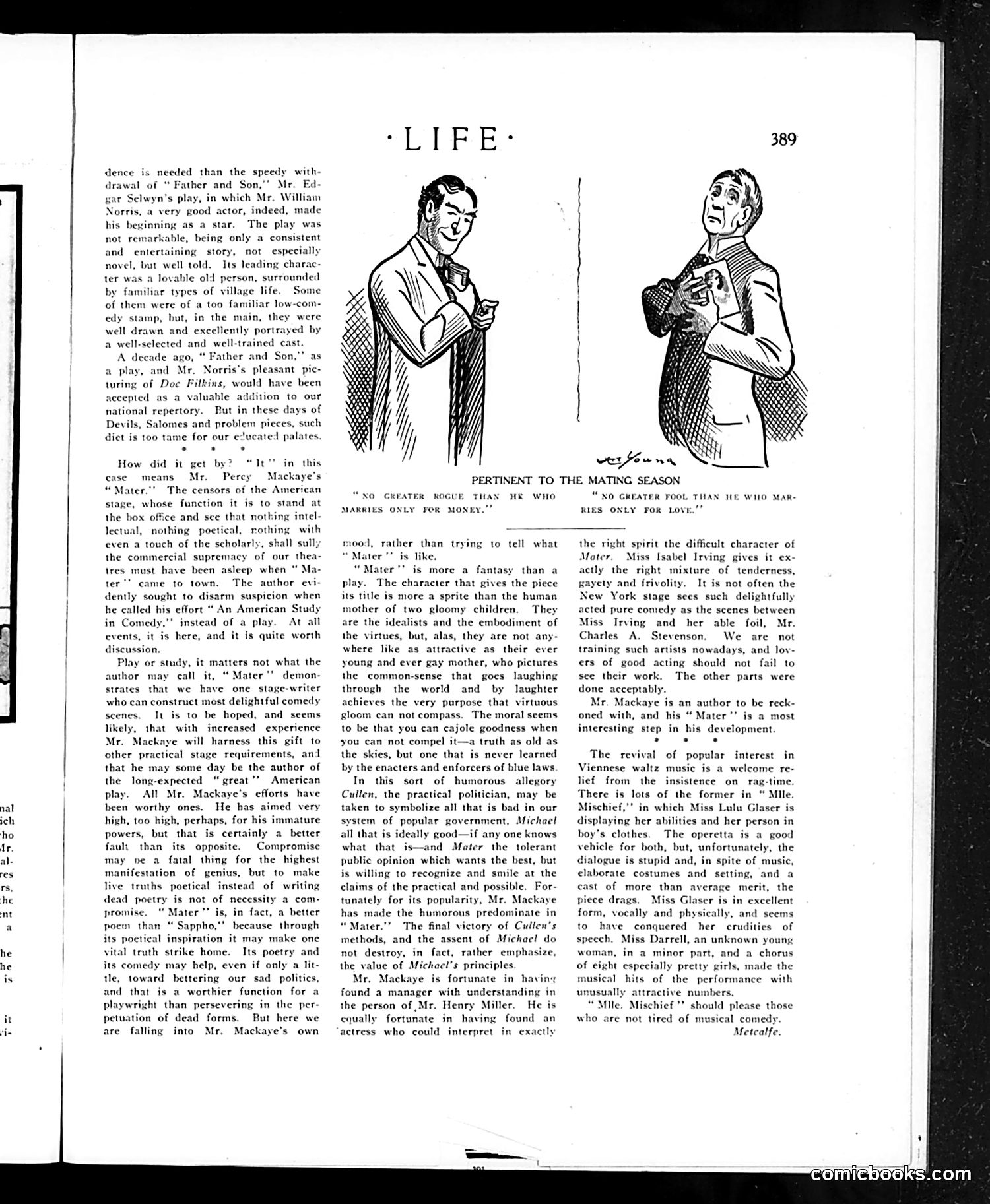
This page reviews Percy Mackaye's play "Mater," debating whether it qualifies as genuine drama or merely a "study." The critic argues Mackaye successfully crafted delightful comedy scenes, though questions whether the censors were asleep allowing such intellectual material past the box office. The two cartoons above critique marriage motives during "the mating season." The left figure's caption reads: "No greater rogue than he who marries only for money." The right responds: "No greater fool than he who marries only for love." This satirizes the era's tension between practical and romantic marriage considerations—a common theme in Life's social commentary. The cartoons suggest both financial mercenary marriages and purely romantic ones are foolish, implying an ideal balance between economic security and affection. The contemporary debate about whether marriage should be practical or romantic remains recognizable today.
📄 Transcribed text from this page (OCR, searchable)
Machine-transcribed from the original scan — historical spelling and the odd misread are preserved.
nal ich ho fr, al- res it dence is needed than the speedy with- drawal of “Father and Son,’? Mr. Ed- gar Selwyn’s play, in which Mr. William Norris, a very good actor, indeed, made his beginning as a star. The play was not remarkable, being only a consistent and entertaining story, not especially novel, but well told. Its leading charac- ter was a lovable old person, surrounded by familiar types of village life. Some of them were of a too familiar low-com- edy stamp, but, in the main, they were well drawn and excellently portrayed a well-selected and well-trained cast. A decade ago, “ Father and Son,"" as a play, and Mr. Norris's pleasant pic- turing of Doc Filkins, would have been accepted as a valuable addition to our national repertory. Rut in these days of Devils, Salomes and problem pieces, such diet is too tame for our etucated palates. How did it get by In? in this case means Mr. Percy Mackaye's “Mater.” The censors of the American stage, whose function it is to stand at the box office and sce that nothing intel- lectual, nothing poetical, nothing with even a touch of the scholarly, shall sull; the commercial suprem. of our thea- tres must have been asleep when “ M. hor evi- ter'’ came to town, Thy dently sought to disarm suspicion when he called his effort “ An American Study in Comedy,"” instead of a play. At all events, it is here, and it is quite worth discussion. Play or study, it matters not what the author may call it, “ Mater"? demon- strates that we have one stage-writer who can construct most delightful comedy scenes. It is to be hoped, and seems likely, that with increased experience Mr. Mackaye will harness this gift to other practical stage requirements, ant that he may some day be the author of the long-expected “ great"? American play. All Mr. Mackaye’s efforts have been worthy ones. He has aimed very high, too high, perhaps, for his immature powers, but that is certainly a better fault than its opposite. Compromise may ne a fatal thing for the highest manifestation of genius, but to make live truths poetical instead of writing dead poetry is not of necessity a com- promise. “ Mater’ is, in fact, a better poem than “ Sappho,’ because through its poetical inspiration it may make one vital truth strike home. Its poetry and its comedy may help, even if only a lit- tle, toward bettering our sad_ politics, and that is a worthier function for playwright than persevering in the per- petuation of dead forms, But here we are falling into Mr. Mackaye's own wee PERTINENT TO THE MATING SEASON NO GREATER KOGUE THAN HK WHO MARRIES ONLY FOR MONEY,”’ mood, rather than trying to tell what “ Mater"? is like. “Mater? is more a fantasy than a play. The character that gives the piece its title is more a sprite than the human mother of two gloomy children. They are the idealists and the embodiment of the virtues, but, alas, they are not any- where like as attractive as their ever young and ever gay mother, who pictures the common-sense that goes laughing through the world and by laughter achieves the very purpose that virtuous gloom can not compass. The moral seems to be that you can cajole goodness when you can not compel it—a truth as old as the skies, but one that is never learned by the enacters and enforcers of blue laws In this sort of humorous allegory Cullen, the practical politician, may be taken to symbolize all that is bad in our system of popular government, Michael all that is ideally good—if any one knows what that is—and Mater the tolerant public opinion which wants the best, but is willing to recognize and smile at the claims of the practical and possible. For- tunately for its popularity, Mr. Mackaye has made the humorous predominate in “Mater.” The final victory of Cullen's methods, and the assent of Michael do not destroy, in fact, rather emphasize, the value of Michael's principles Mr. Mackaye is fortunate in havin found a manager with understanding in the person of Mr. Henry Miller. He is equally fortunate in having found an actress who could interpret in exactly “NO GREATER FOOL THAN HE WHO MAR- RIES ONLY FOR LOVE the right spirit the difficult character of Mater. Miss Isabel Irving gives it ex- actly the right mixture of tenderness, gayety and frivolity. It is not often the New York stage secs such delightfully acted pure comedy as the scenes between Miss Irving and her able foil, Mr. Charles A. Stevenson. We are not training such artists nowadays, and lov- ers of good acting should not fail to see their work. The other parts were done acceptably. Mr. Mackaye is an author to be reck- oned with, and his “ Mater’ is a most interesting step in his development. oe The revival of popular interest in Viennese waltz music is a welcome re- lief from the insistence on rag-time. There is lots of the former in “ Mile Mischief,” in which Miss Lulu Glaser is displaying her abilities and her person in boy's clothes. The operetta is a good vehicle for both, but, unfortunately, the dialogue is stupid and, in spite of mus elaborate costumes and setting, and a cast of more than average merit, the piece drags. Miss Glaser is in excellent form, vocally and physically, and seems to have conquered her crudities of speech. Miss Darrell, an unknown young woman, in a minor part, and a chorus of eight especially pretty girls, made the musical hits of the performance with attractive numbers. “Mile. Mischief '? should please those who are not tired of musical comedy. Metcalfe