
Life, 1908-10-08 · page 8 of 24
Life — October 8, 1908 — page 8: what you’re looking at
What you’re looking at
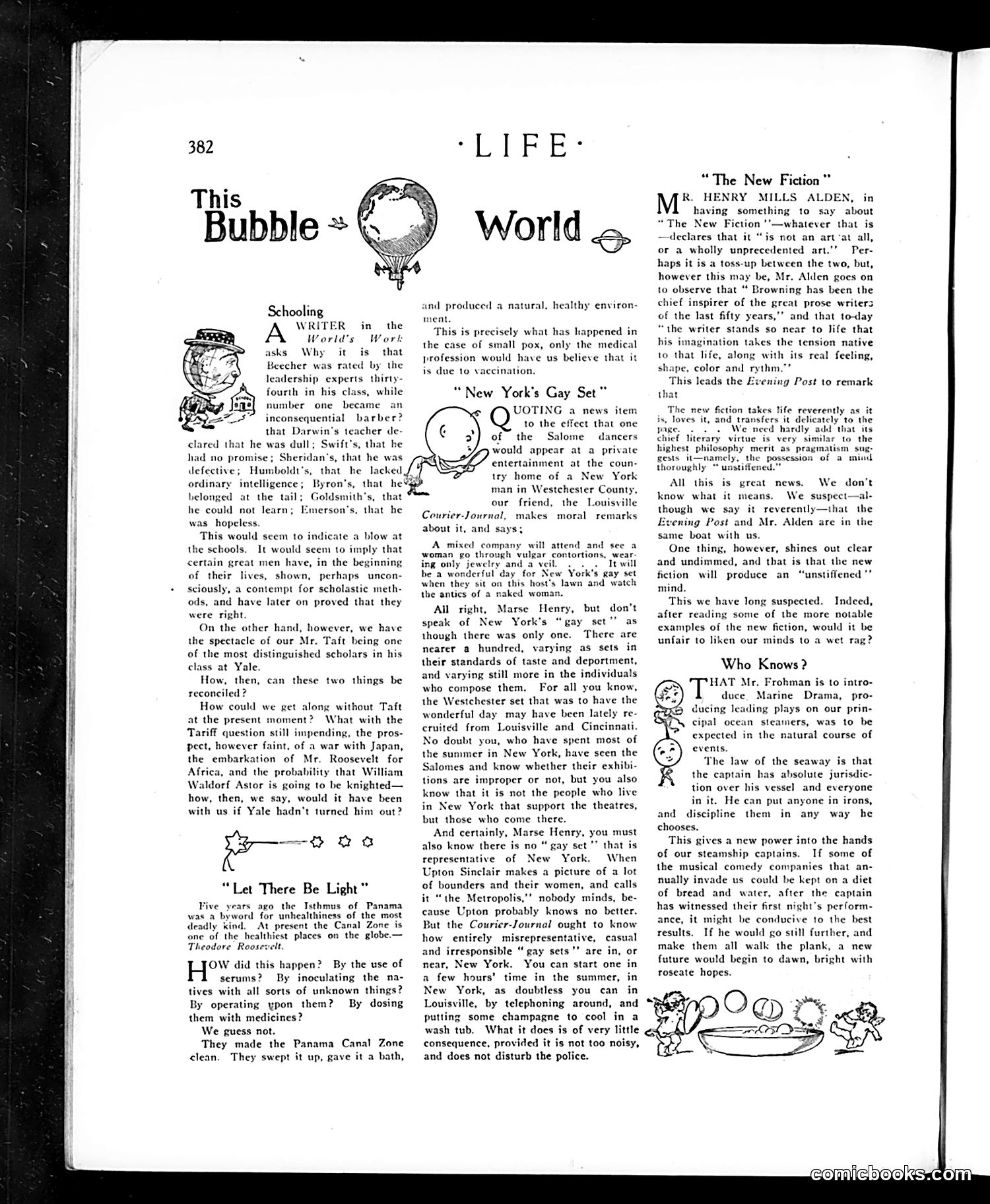
This satirical page critiques educational philosophy and New York's social scene. The left column attacks inconsistency in American schooling: it mocks scholars (Darwin, Taft, Tariff advocates, Roosevelt, Waldorf Astor) who promoted contradictory ideas yet were celebrated as "ordinary intelligence" failures. The piece questions how institutions could honor such self-contradictory thinkers. The right column ridicules New York's "gay set"—wealthy Westchester socialites—for their pretentious theater attendance and moral hypocrisy. It suggests they're unrepresentative of actual New York culture, which is sustained by working people, not elite dilettantes. The Panama Canal reference ("Let There Be Light") briefly celebrates engineering achievements, contrasting with human institutional failures. Overall, the page satirizes American intellectual and social pretension.
📄 Transcribed text from this page (OCR, searchable)
Machine-transcribed from the original scan — historical spelling and the odd misread are preserved.
382 This Bubble = Schooling WRITER in the World's Work Why it is that Beecher was rated by the leadership experts thirty- fourth in his class, while number one became an inconsequential barber? that Darwin's teacher de- that he n’s, that he was . that he lacked Byron's, that he’ asks had no promi defective; Humboldt ordinary intelligence; belonged at the tail; he could not learn; was hopeless. This would scem to indicate a blow at the schools. It would seem to imply that certain great men have, in the beginning their lives, shown, perhaps uncon- sciously, a contempt for scholastic meth- ods, and have later on proved that they were right On the other hand, however, we have the spectacle of our Mr. Taft being one of the most distinguished scholars in his class at Yale. How, then, can these two things be reconciled? How could we get along without Taft at the present moment? What with the Tariff question still impending, the pros- pect, however faint, of a war with Japan, the embarkation of Mr. Roosevelt for Africa, and the probability that William Waldorf Astor is going to be knighted— how, then, we say, would it have been with us if Yale hadn't turned him out? ee 88 “Let There Be Light” Five years ago the Isthmus of Panama was a byword for unhealthiness of the most deadly kind, At present the Canal Zone is one of the healthiest places on the globe.— Theodore Roosevelt OW did this happen? By the use of serums? By inoculating the na- tives with all sorts of unknown things? By operating ypon them? By dosing them with medicines? We guess not. They made the Panama Canal Zone clean. They swept it up, gave it a bath, merson’s, that he ‘LIF E* World and produced a natural, healthy environ- ment. This is precisely what has happened in the case of small pox, only the medical profession would have us believe that it is due to vaccination. “New York's Gay Set” UOTING a news item to the effect that one of the Salome dancers would appear at a private entertainment at the coun- try home of a New York man in Westchester County, our friend, the Courier-Journal, about it, and s: Louisville makes moral remarks A mixed company will attend and see a woman go through vulgar contortions, wear. ing only jewelry and a veil. Te will be a wonderful day for New York's gay set they sit on this host's lawn and watch the antics of a naked woman. Allright speak of New York's “gay set’ as though there was only one. There are nearer a hundred, varying as sets in their standards of taste and deportment, and varying still more in the individuals who compose them. For all you know, the Westchester set that was to have the wonderful day may have been lately re- cruitéd from Louisville and Cincinnati. No doubt you, who have spent most of summer in New York, have seen the Salomes and know whether their exhibi- tions are improper or not, but you also know that it is not the people who live in New York that support the theatres, but those who come there. And certainly, Marse Henry, you must also know there is no “ gay set’? that is representative of New York. When Upton Sinclair makes a picture of a lot of bounders and their women, and calls it “the Metropolis," nobody minds, be- cause Upton probably knows no better. But the Courier-Journal ought to know how entirely misrepresentative, casual and irresponsible “gay sets"? are in, or near, New York. You can start one in a few hours’ time in the summer, in New York, as doubtless you can in Louisville, by telephoning around, and putting some champagne to cool in a wash tub, What it does is of very little consequence, provided it is not too noisy, and does not disturb the police. don't Marse Henry, but “The New Fiction” M* HENRY MILLS ALDEN, in having something tos. about “The New Fiction "—whatever that is —declares that it “is not an art‘at all, or a wholly unprecedented art.” Per- haps it is a toss-up between the two, but, however this may be, Mr. Alden goes on to observe that “ Browning has been the chief inspirer of the great prose writers of the last fifty years,"’ and that to-day “the writer stands so near to life that his imagination takes the tension native to that life, along with its real feeling, shape, color and rythm.’? This leads the Evening Post to remark that The new fiction takes life reverently as it is, loves it, and transfers it delicately to the page... « We need hardly add that its chief literary vi is very similar to the josophy merit as pragmatism sug- nely, the possession of a mind unstiffened.” thoroughly All this is great news. We don't know what it means. We suspect—al- though we say it reverently—that the Evening Post and Mr. Alden are in the same boat with us. One thing, however, shines out clear and undimmed, and that is that the new fiction will produce an “unstiffened " mind. This we have long suspected. Indeed, after reading some of the more notable examples of the new fiction, would it be unfair to liken our minds to a wet rag? Who Knows? HAT Mr, Frohman is to intro- duce. Marine Drama, pro- ducing leading plays on our prin- cipal ocean steamers, was to be expected in the natural course of events. ‘The law of the seaway is that the captain has absolute jurisdie- tion over his vessel and everyone in it. He can put anyone in irons, and discipline them in any way he chooses. This gives a new power into the hands of our steamship captains. If some of the musical comedy companies that an- nually invade us could be kept on a diet of bread and water, after the captain has witnessed their first night's perform- ance, it might be conducive to the best results. If he would go still further, and make them all walk the plank, a new future would begin to dawn, bright with roseate hopes.