
A complete issue · 21 pages · 1908
Life — June 25, 1908
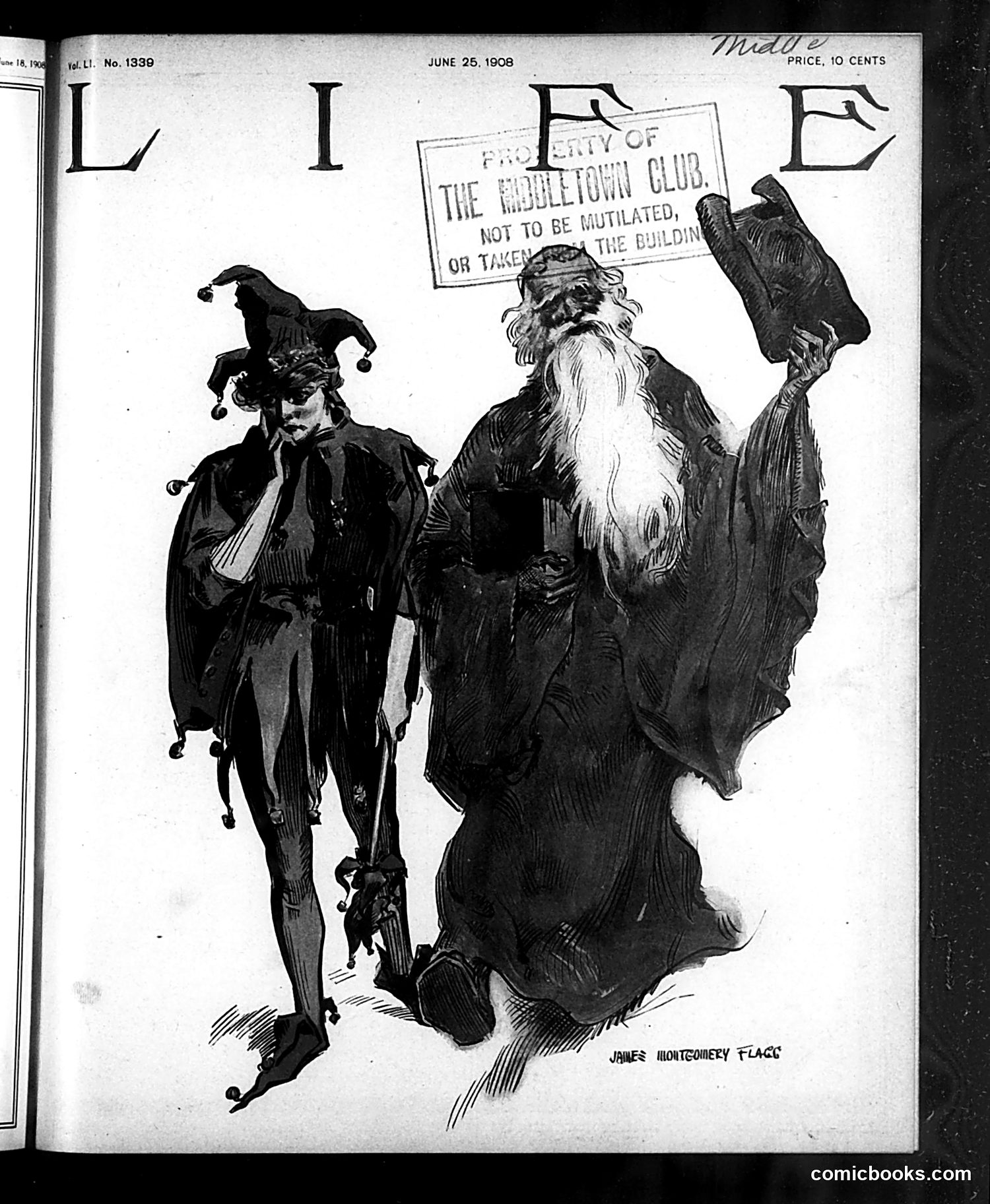
This satirical cartoon depicts three figures in formal attire with exaggerated features. The central character has a long white beard and appears to be a wizardly or mystical figure, holding what looks like a property deed or document labeled "PROPERTY OF THE MIDDLETOWN CLUB. NOT TO BE MUTILATED, OR TAKEN FROM THE BUILDING." The cartoon likely satirizes disputes over club property or membership rights in Middletown during this period. The presence of jester or fool-like figures flanking the bearded character suggests mockery of authority figures or decision-makers involved in the controversy. The specific nature of the "Middletown Club" dispute remains unclear without additional context, but the tone indicates public ridicule of those managing the club's affairs or resources.
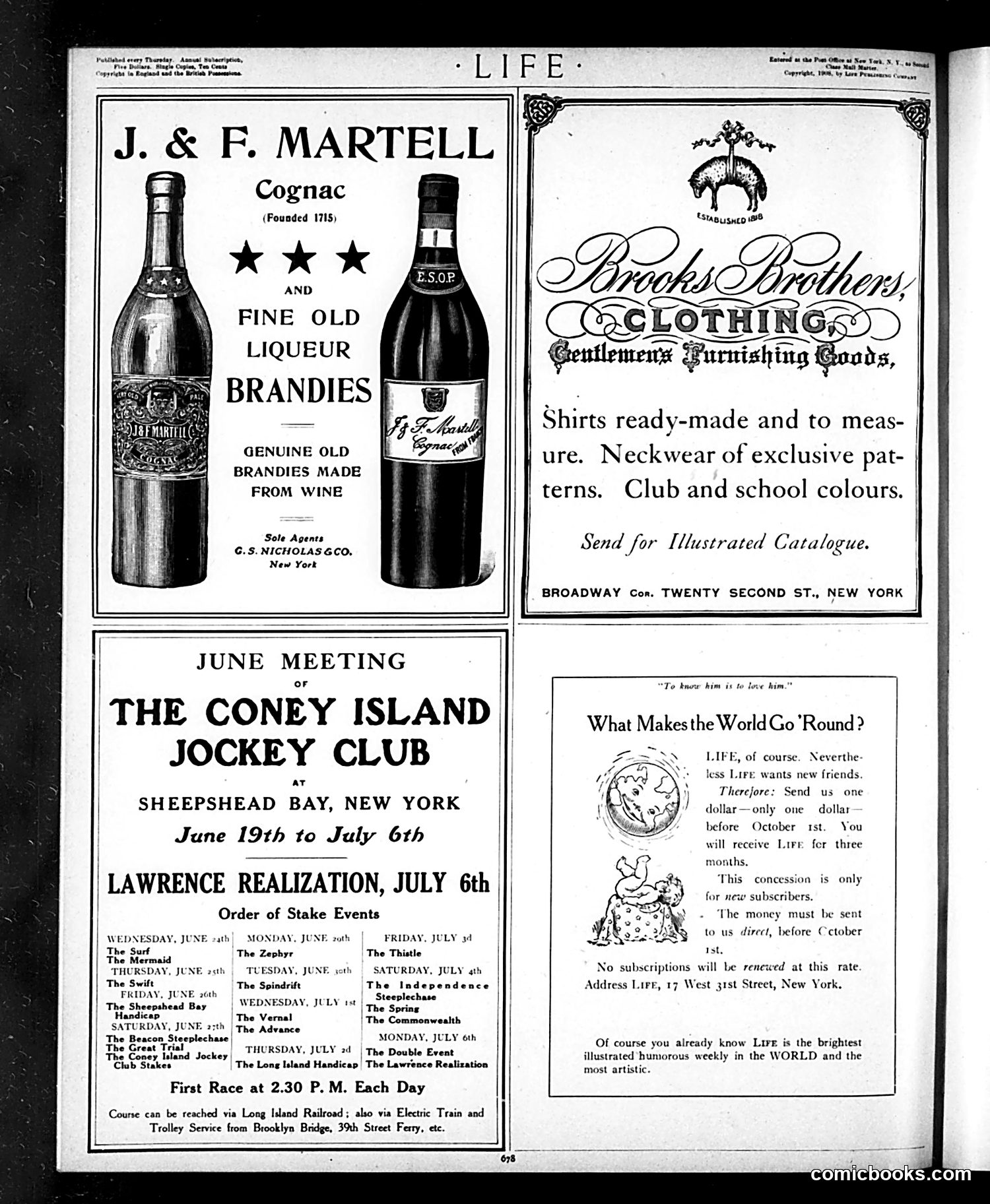
This page is **primarily advertising**, not satire or political commentary. The ads include: - **J. & F. Martell Cognac**: Period liquor advertisement featuring brandy bottles - **Brooks Brothers**: Clothing merchant advertising gentlemen's furnishings, shirts, and neckwear - **Coney Island Jockey Club**: Racing event announcement for June 19–July 6, listing horse races with first race at 2:30 PM The only editorial content is a small box titled "What Makes the World Go 'Round?" offering a subscription promotion to *Life* magazine itself for one dollar, playfully suggesting friendship as life's motivation. The page reflects early 20th-century consumer culture and entertainment venues rather than satirical commentary on current events or politics.
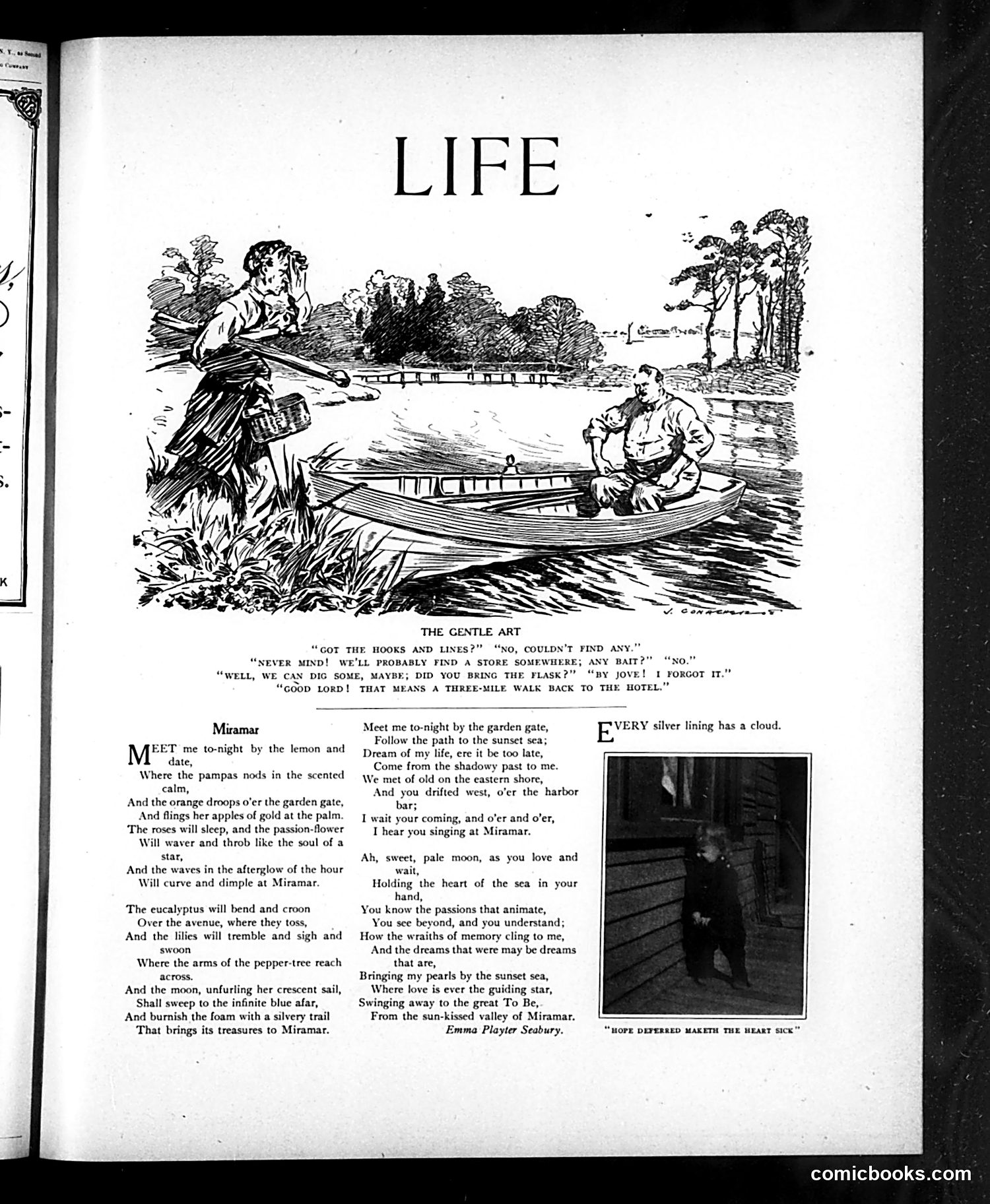
**The Cartoon:** "The Gentle Art" depicts two fishermen—one on the bank, one in a boat—having a conversation about fishing supplies. The dialogue is humorous domestic banter: one forgot the flask (alcohol), necessitating a three-mile walk back to the hotel. **The Content:** Below is a romantic poem titled "Miramar" by EmmaPlaytor Seabury, describing moonlit encounters and love by the sea. The small photograph shows what appears to be a romantic couple, captioned "Hope Deferred Maketh the Heart Sick." **The Theme:** This page combines gentle humor about outdoorsmen with sentimental romantic poetry—typical Life magazine content blending comedy, literature, and illustrations for general audiences. The satire is mild; no specific political or social commentary is evident.
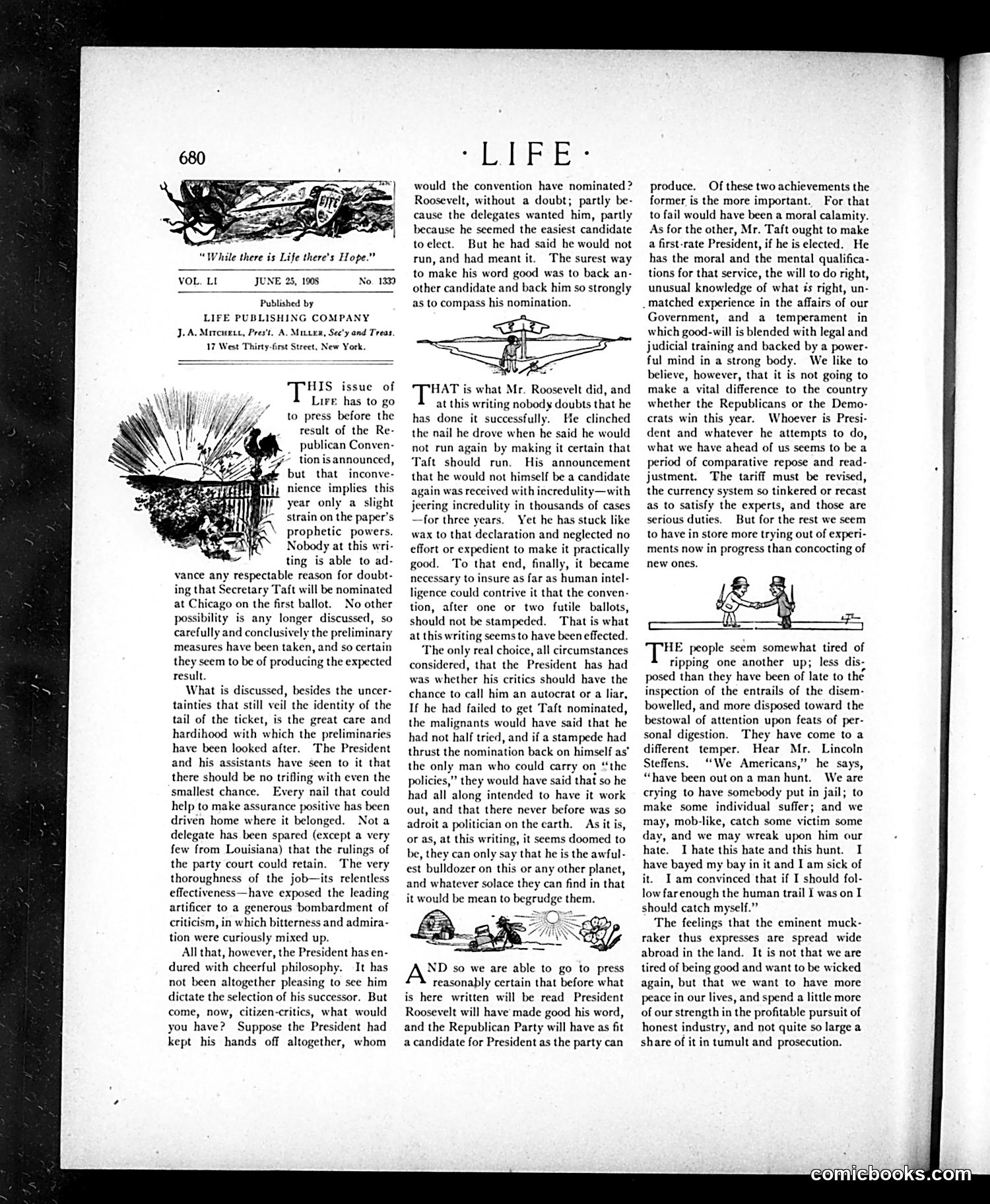
This page discusses President Theodore Roosevelt's announcement that he would not seek another term, and the resulting Republican Convention selection of William Howard Taft as his successor. The cartoons illustrate contemporary political sentiment. The left illustration showing a figure being thrown or ejected appears to reference the turbulent convention process. The right cartoon depicts two figures on a seesaw, likely symbolizing the political balance and tension between different factions regarding the presidential succession. The text debates whether critics should have called Roosevelt an "autocrat" or "liar," and expresses cautious optimism that Roosevelt will support Taft and the Republican Party will field a competitive candidate. The piece reflects anxiety about the transition of power and questions about whether the new candidate can adequately fill Roosevelt's shoes.
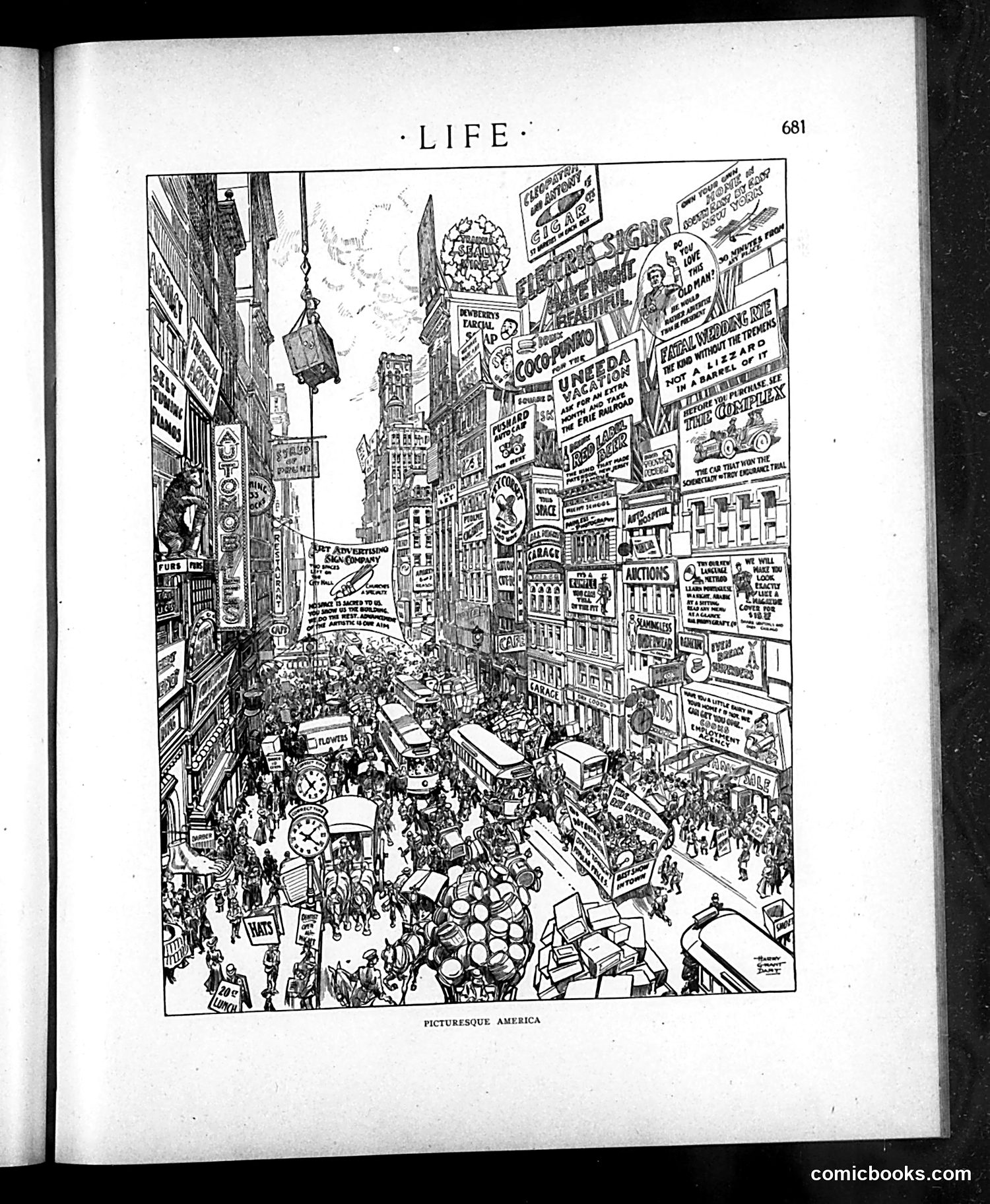
This is titled "Picturesque America" and depicts a densely crowded urban street scene—likely Times Square or a similar commercial district—rendered in intricate detail with hundreds of pedestrians, vehicles, and towering buildings covered in advertisements. The satire critiques American commercialism and urban chaos. Every available surface displays advertisements for products, services, and entertainments, creating visual cacophony. The crowded masses navigate this commercialized landscape, suggesting how advertising and consumer culture dominate American public life. The "picturesque" irony is pointed: instead of natural scenic beauty, the cartoon shows America's defining landscape as one of commercial clutter and urban density. This appears to mock how thoroughly advertising and commercial interests saturate American cities and daily life, replacing traditional aesthetics with commercial messaging.
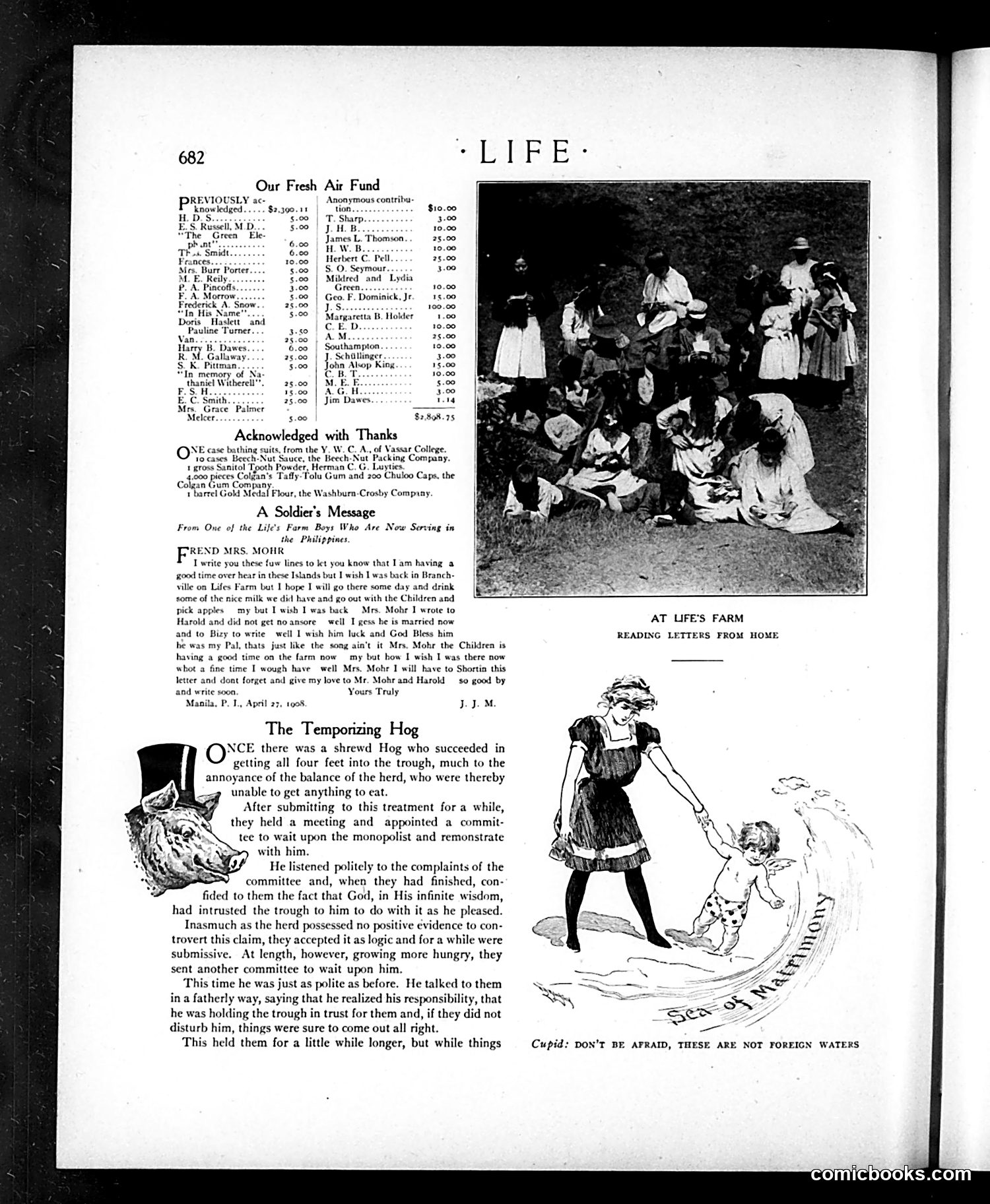
The page contains two distinct pieces: **"A Soldier's Message"** is a letter from a soldier in the Philippines (dated April 27, 1908) expressing contentment with life there, mentioning children and farm life. **"The Temporizing Hog"** is a fable/cartoon about a shrewd hog who manipulates other animals by holding their communal food trough "in trust," claiming God authorized this arrangement. When the hungry animals grow restless, the hog talks them into submission through smooth rhetoric about his "responsibility." The satire critiques monopolistic control of resources and manipulation through false authority—the hog represents a wealthy monopolist using paternalistic language to justify exploitative control while animals (the working class) go hungry. The accompanying illustration shows the hog addressing the other animals.
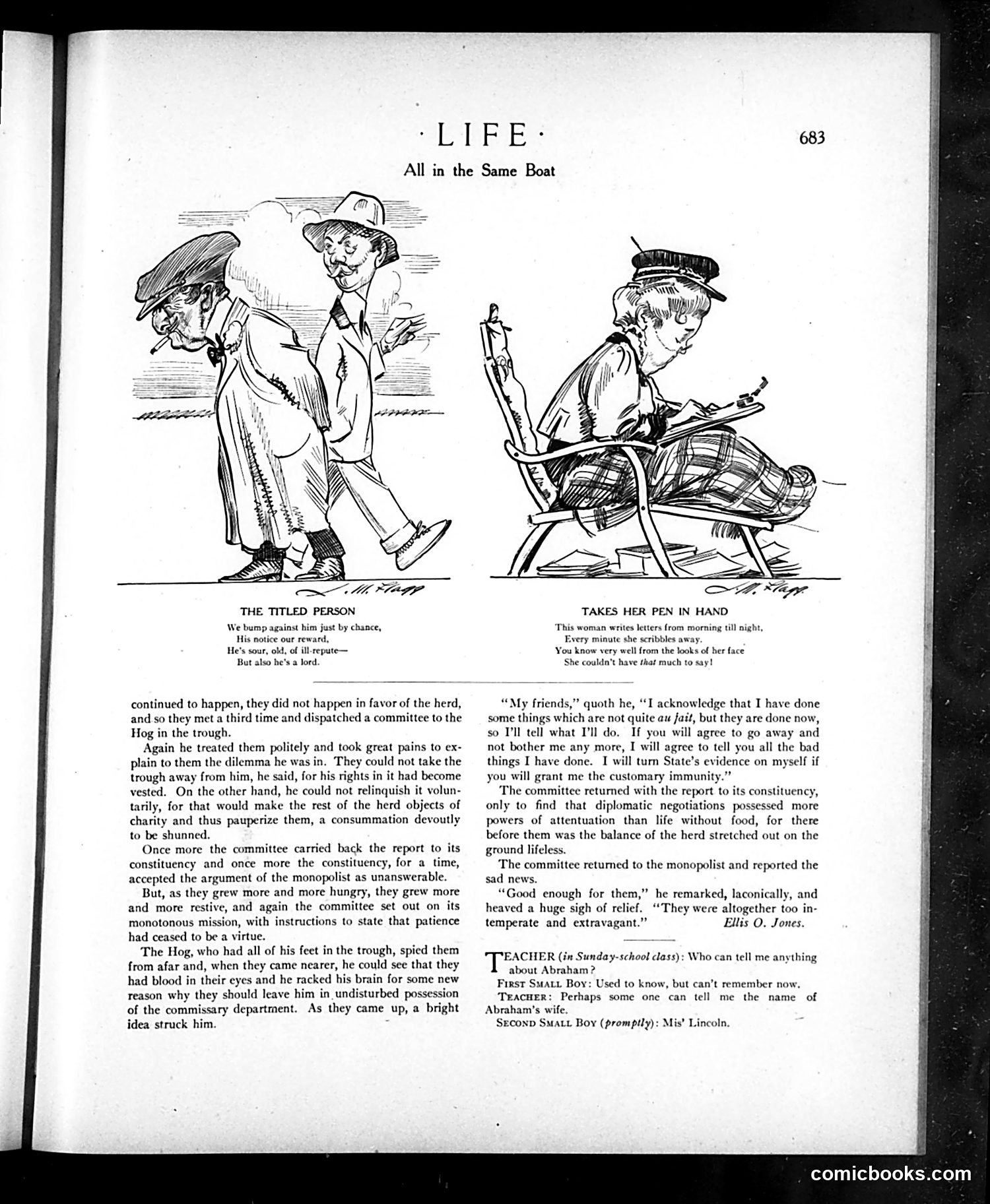
This page contains two satirical cartoon panels and accompanying commentary critiquing bureaucratic inefficiency. **Left panel** ("The Titled Person"): Shows a well-dressed, pompous man with an inflated sense of self-importance bumping into someone. The verse mocks his pretension—he considers himself superior ("old, of ill-repute") yet paradoxically also "a lord." **Right panel** ("Takes Her Pen in Hand"): Depicts a woman frantically writing letters day and night, unable to stop despite exhaustion. The accompanying text criticizes her compulsive correspondence. The overall theme, supported by the surrounding prose about a committee investigating a monopolist's treatment of livestock, suggests satire about how various self-important or obsessive figures create unnecessary problems. The title "All in the Same Boat" implies everyone—regardless of class or temperament—contributes to societal dysfunction through their flawed character traits.
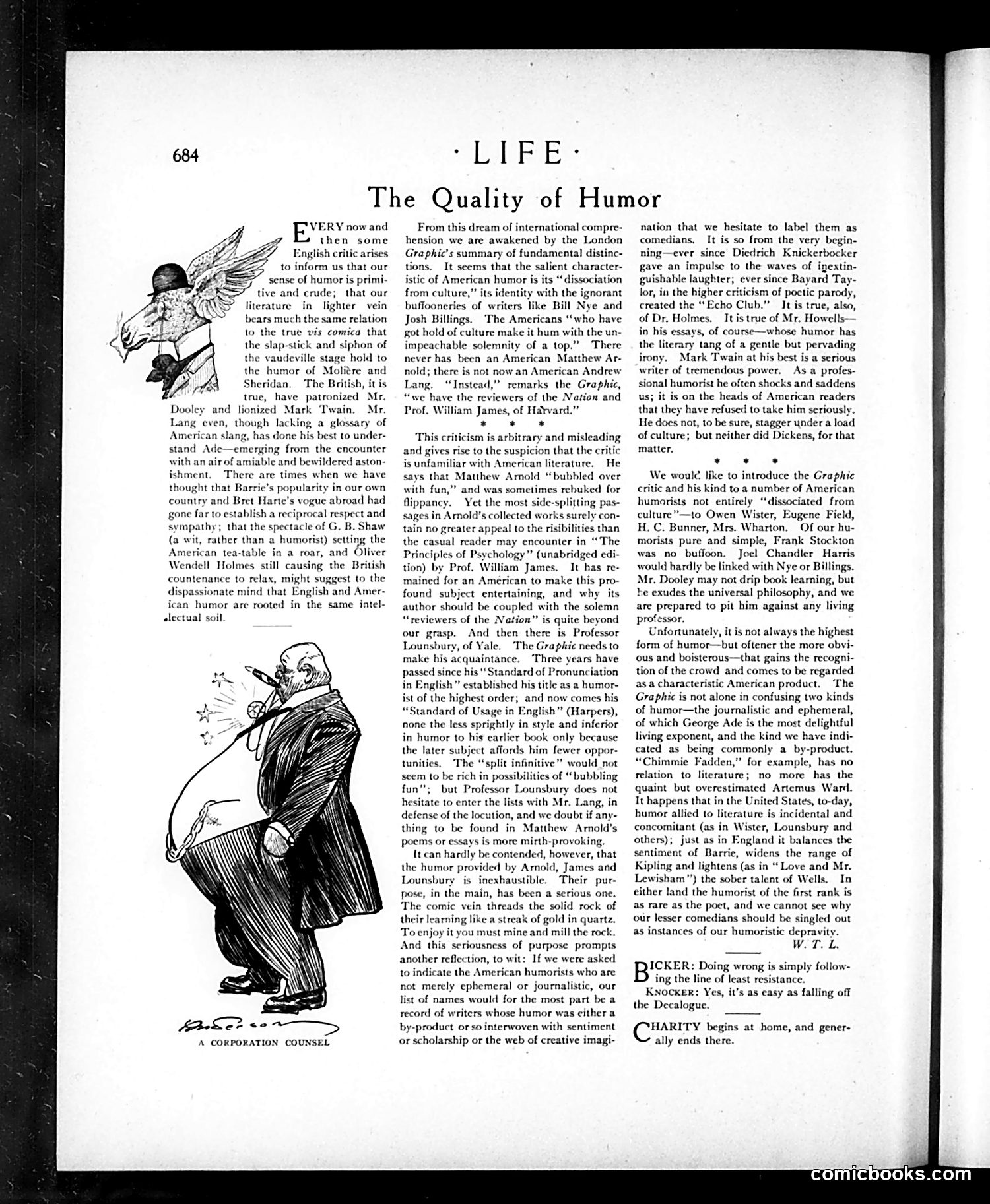
This article debates American humor's character. The text critiques a *Graphic* magazine summary claiming American humor lacks "culture," defending figures like Mark Twain and suggesting the critic unfairly dismisses American literature. The two cartoons illustrate the article's points: The top sketch shows a figure in formal dress, apparently representing genteel or "high" culture. The lower cartoon, titled "A CORPORATION COUNSEL," depicts a stout businessman in a coat—likely satirizing pompous corporate figures or lawyers. This visual example supports the article's argument about American humor targeting recognizable social types. The article concludes by quoting dialogue between characters named "Bicker" and "Knocker," suggesting these personify cynical American attitudes.
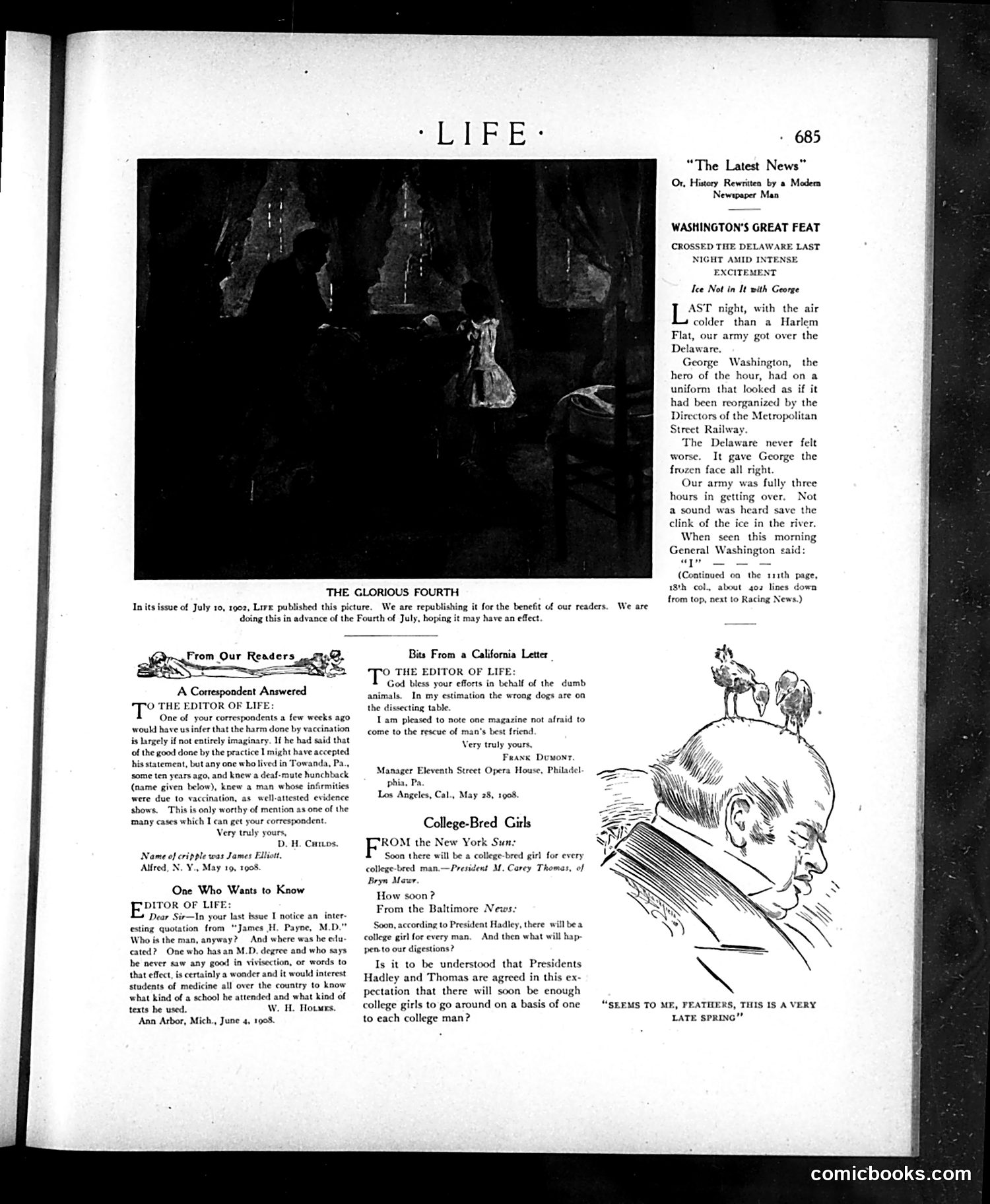
The page features "The Glorious Fourth," a dark illustration apparently depicting Washington's crossing of the Delaware River, republished for Independence Day. The main content is a reader's correspondence section addressing three topics: 1. **Vaccination debate**: A letter questions whether vaccination causes harm, with the editor defending medical science. 2. **Dog rescue**: A California reader praises efforts to save dogs from vivisection (animal testing). 3. **College-bred girls**: Items discuss whether colleges should admit women, with satirical skepticism about whether enough "college girls" exist to match "college-bred men." The cartoon on the right ("Seems to Me, Feathers, This is a Very Late Spring") depicts animals, likely commenting on seasonal or social conditions, though the specific satire remains unclear from the image alone.
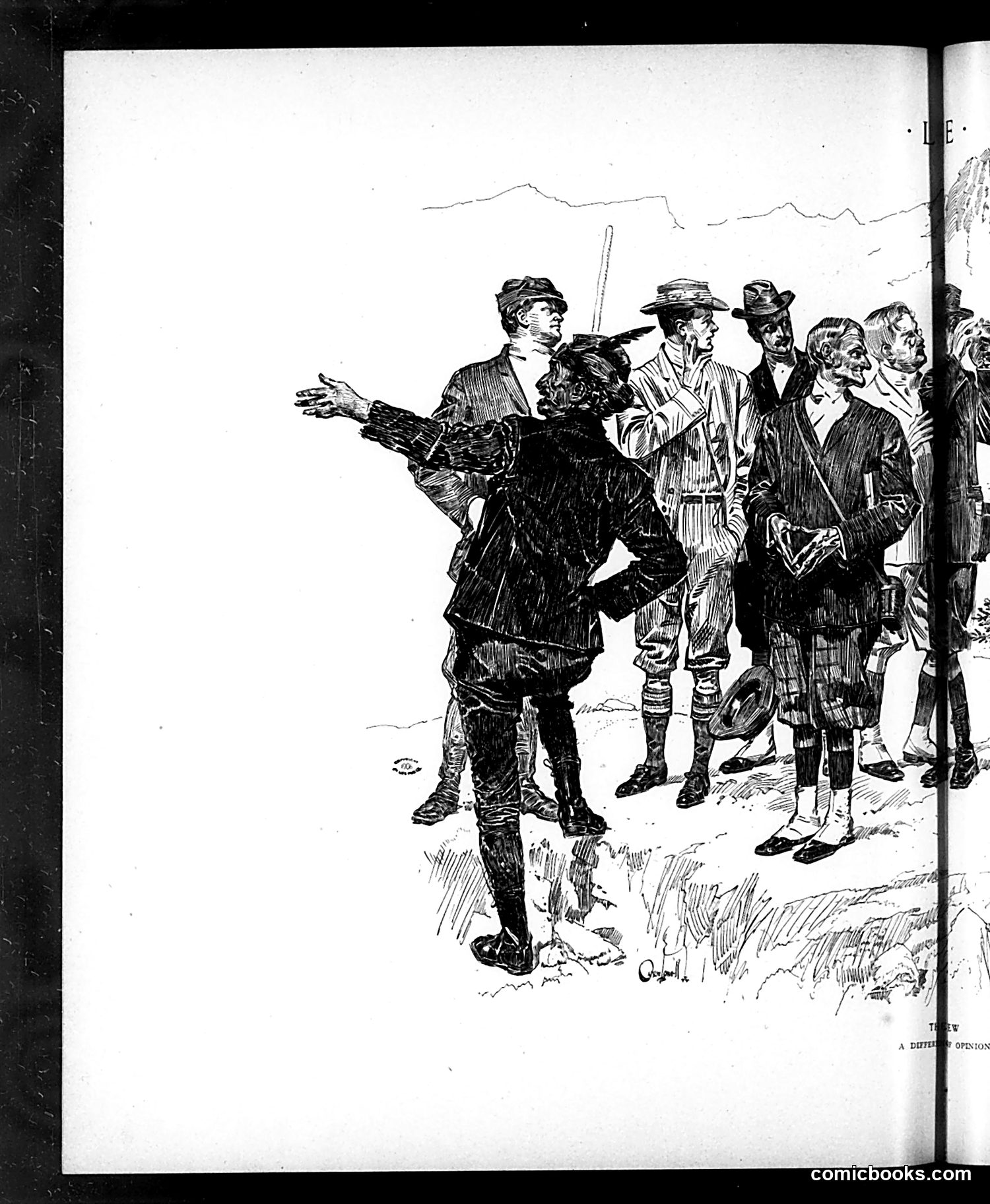
This political cartoon depicts a military or authority figure (shown in dark uniform with sword, gesturing emphatically to the left) addressing a group of civilians and soldiers. The title "A Differing Opinion" suggests conflict between the speaker's position and that of his audience. The cartoon likely satirizes a specific historical moment when a military or political leader's views diverged from public or military opinion. The gathered crowd's body language—some attentive, some skeptical—implies disagreement or resistance to the speaker's argument. Without more specific OCR text or publication date visible, the exact historical context remains unclear, though the composition suggests commentary on authority, dissent, or military leadership during an era of public debate.
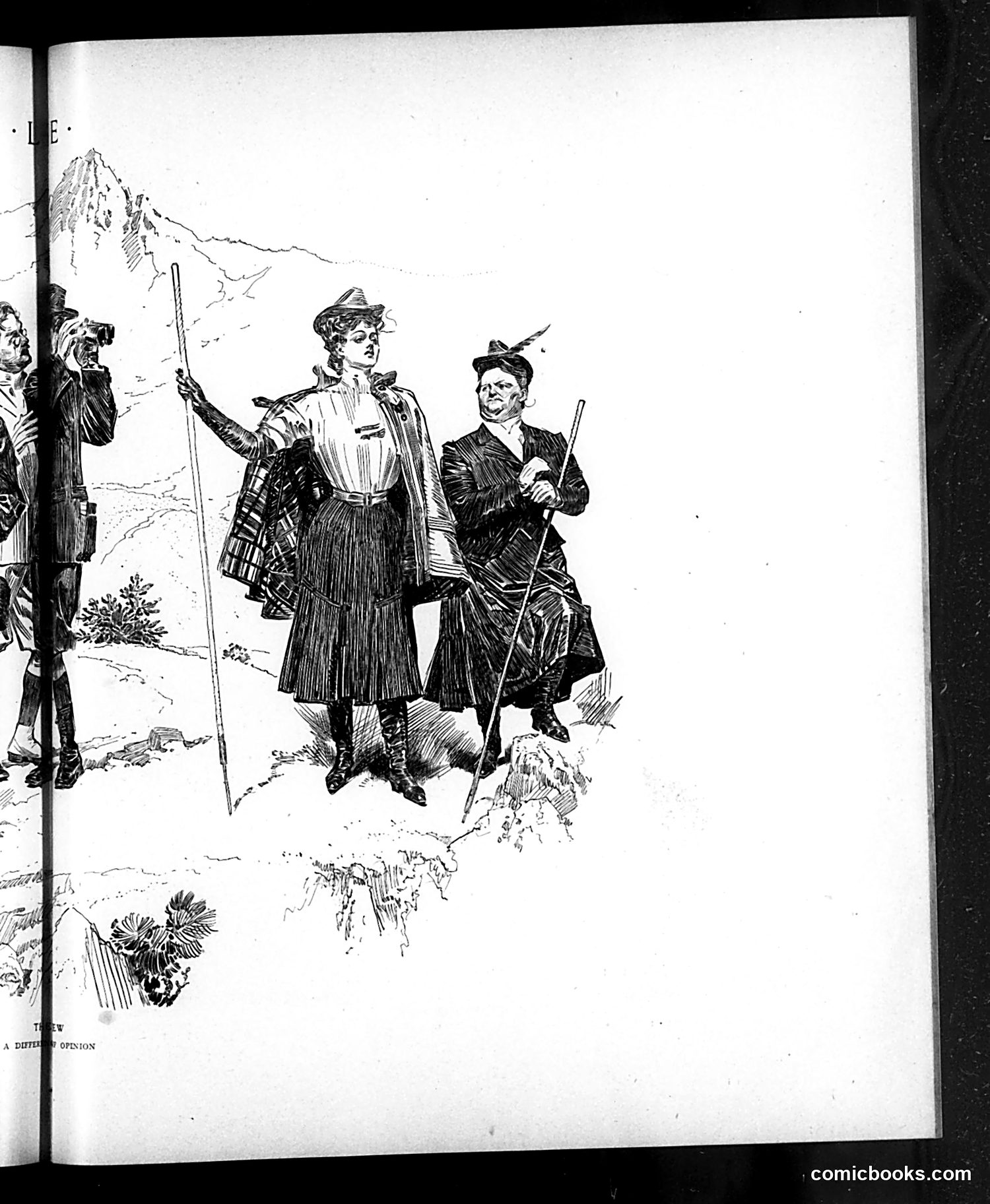
The page shows a political cartoon titled "A Differing Opinion" (visible at bottom). Two figures in period dress stand in a snowy mountain landscape, each holding a long pole or staff. The figure on the left wears a plaid cape and hat, while the figure on the right wears darker clothing. Both adopt confrontational stances. Without additional context visible on this page, I cannot definitively identify the specific figures or the historical event being satirized. The snowy mountain setting and period clothing suggest this may reference a mountaineering expedition or alpine exploration, but the political commentary remains unclear from the image alone. The "differing opinion" likely refers to a disagreement between two historical figures or positions, but I cannot specify which without more information.
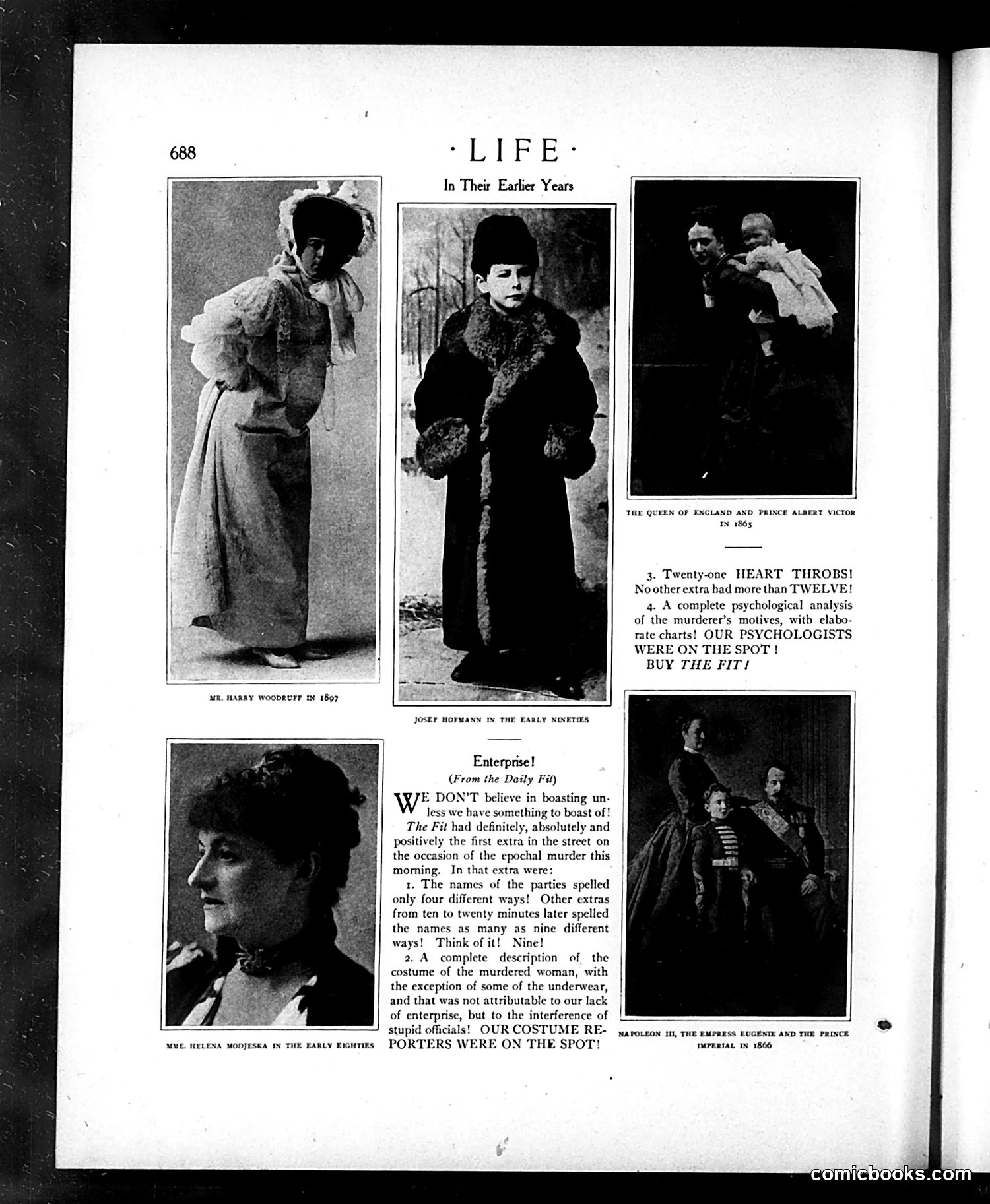
This page celebrates *The Fit*, an early film about a murder case. The heading "In Their Earlier Years" presents historical photographs of real people alongside film stills. The satirical text mocks the film's sensationalism: it claims the film had "Twenty-one HEART THROBS" (emotional moments) and boasts that psychologists and costume designers were "ON THE SPOT" during production—suggesting overblown claims of authenticity and expertise. The joke is that the filmmakers are exploiting a real murder for entertainment while pretending to serious documentary standards. References to "parties spelled only four different ways" and costume details "attributable to our lack of enterprise" sarcastically credit the production's attention to trivial details rather than meaningful analysis. This reflects early cinema's sensationalist approach to crime stories.
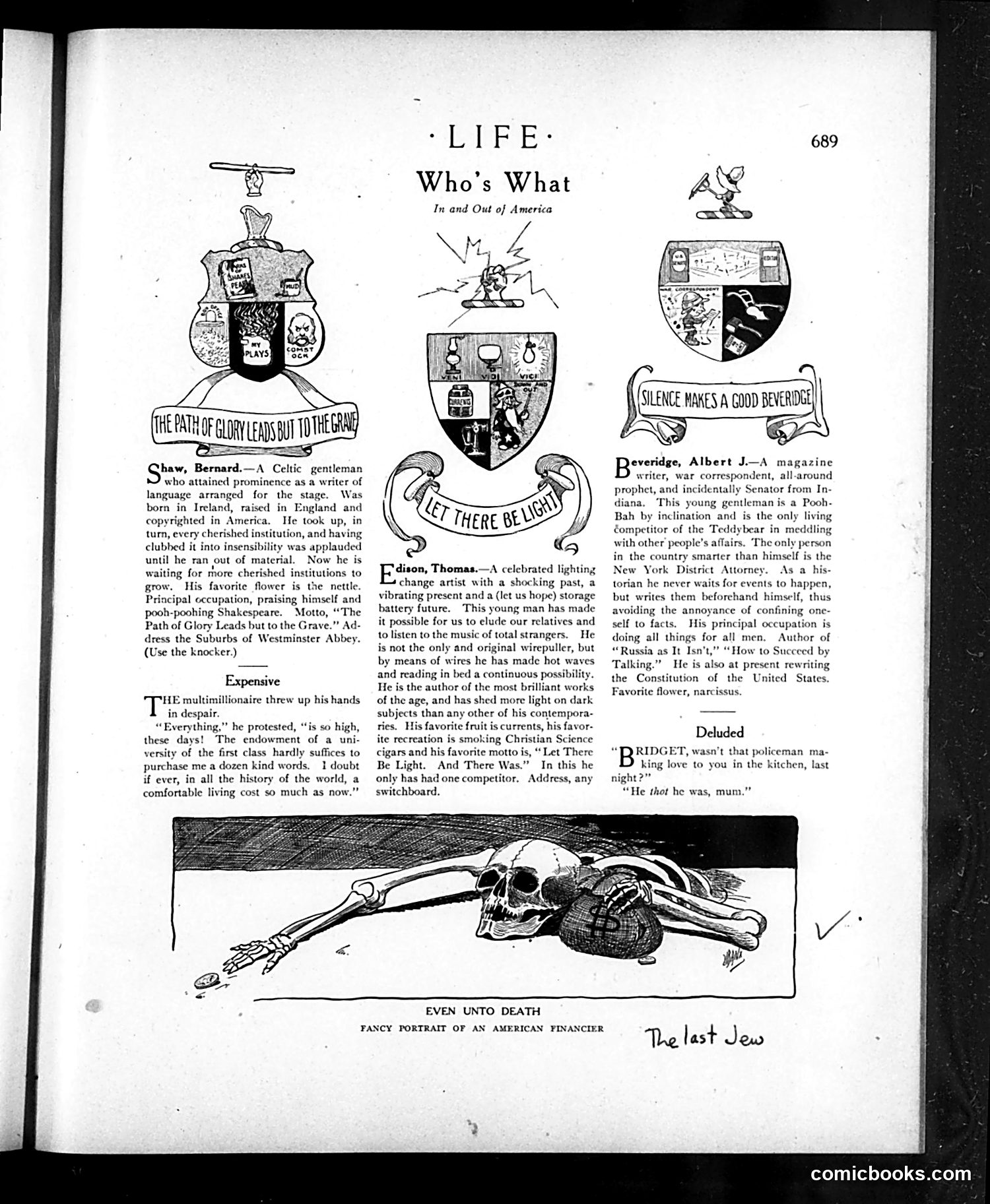
This "Who's What" section profiles notable figures. The page includes biographical sketches of **Shaw, Bernard** (Irish writer), **Edison, Thomas** (lighting innovator), and **Beveridge, Albert J.** (magazine writer and Senator). The main illustration—titled "Even Unto Death: Fancy Portrait of an American Financier"—depicts a skeleton surrounded by wealth (money, bonds, valuables). This is memento mori satire: a commentary on how wealthy financiers accumulate riches but ultimately die and lose everything. The skeleton emphasizes that material wealth cannot protect against mortality—a common satirical theme critiquing Gilded Age obsession with money. Handwritten annotations ("The last Jew") appear to be later additions unrelated to the original publication.
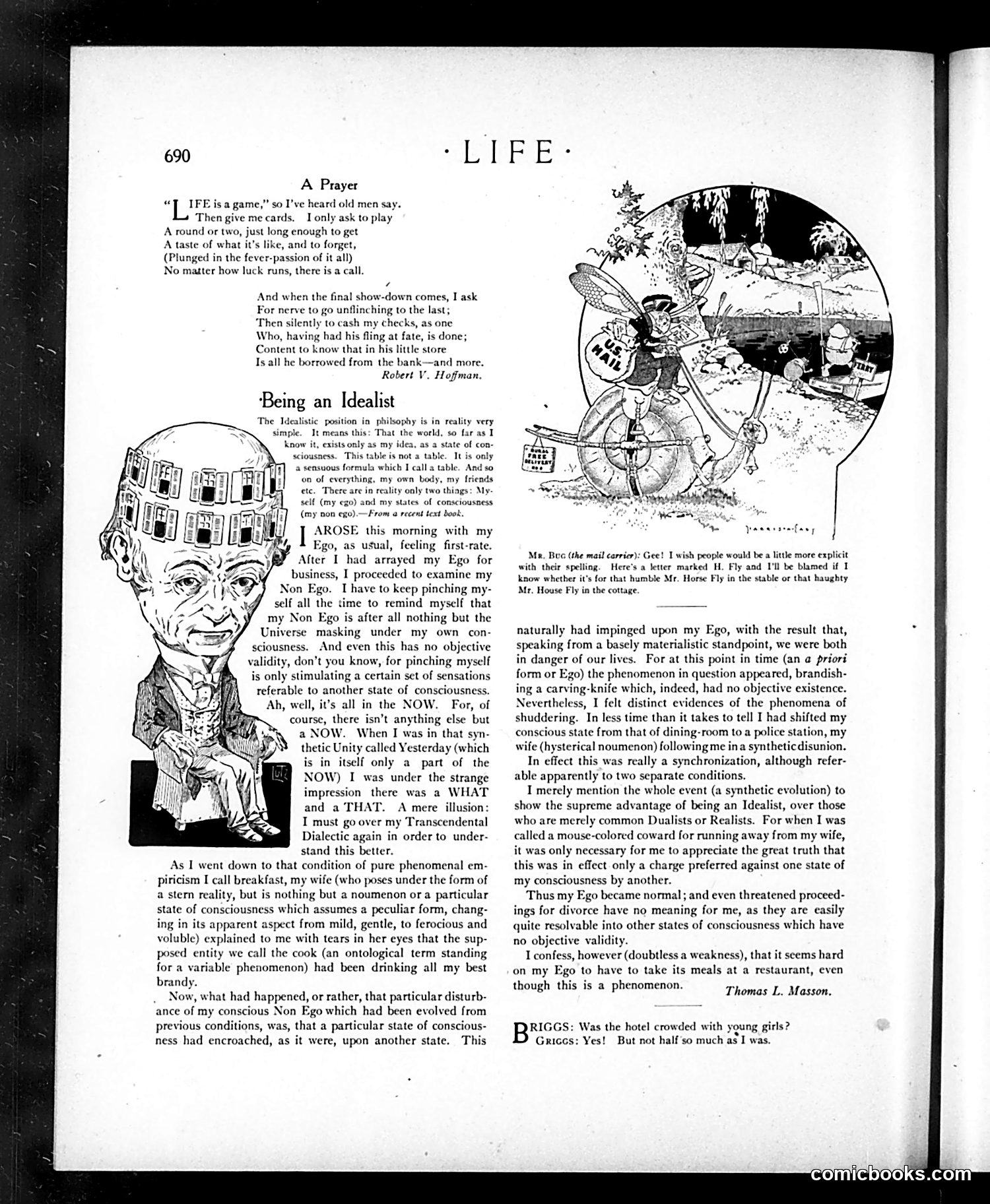
This page satirizes the fashion for German Idealist philosophy (particularly Immanuel Kant's thought) that was gaining intellectual currency in early 20th-century America. The main cartoon illustrates a man's absurd attempt to live by Idealist principles—the belief that reality exists only as mental constructs ("ideas") rather than objective facts. The humor comes from applying this abstract philosophy to everyday life: he dismisses his wife as merely a "noumenon" (thing-in-itself), treats breakfast as "phenomenal empiricism," and describes a cook stealing brandy as merely "a particular state of consciousness." The joke escalates when his wife attacks him with a knife—which he insists has "no objective existence"—yet he still flees to the police station in panic, exposing the philosophy's absurdity. One cannot actually live as if reality is merely subjective. A secondary cartoon shows a mail carrier confused by spelling ambiguity between "H. Fly" and similar names, a lighter joke about miscommunication. The satire targets intellectuals who adopt fashionable Continental philosophy while remaining practically unable to doubt material reality.
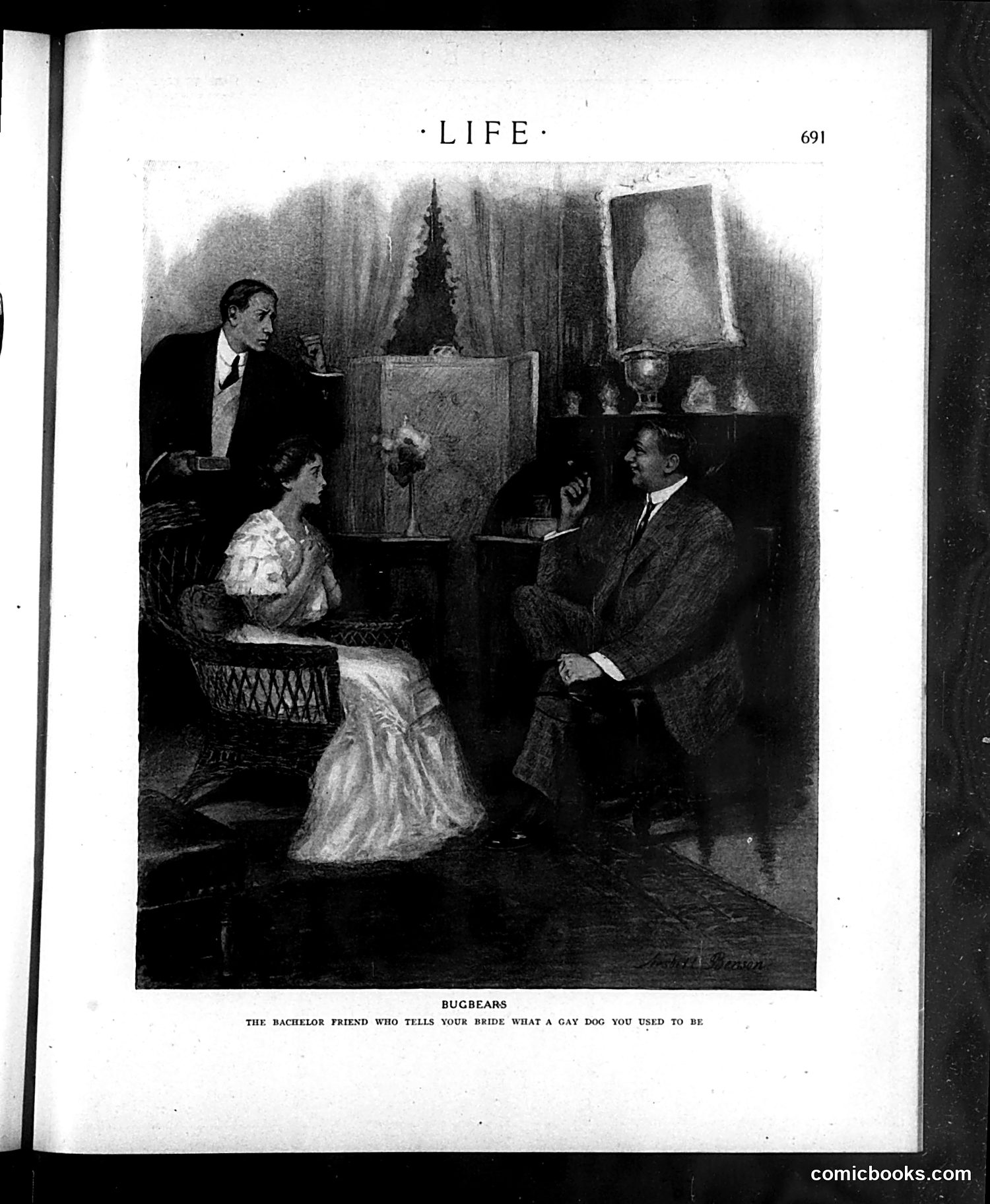
This is a social satire cartoon about embarrassing revelations at a wedding or newlywed gathering. The scene shows three men and a woman in an elegant interior. The caption indicates one man (standing, left) is a "bachelor friend" who is embarrassing the groom (seated right) by telling his new bride what a "gay dog" (meaning a carefree, fun-loving ladies' man) he used to be before marriage. The humor targets the awkwardness of pre-marital secrets being revealed to a bride, and society's expectations that men should change their behavior upon marriage. The woman appears dismayed or uncomfortable hearing these revelations about her husband's past. It's gentle satire about marital propriety and the tension between a man's bachelor days and married respectability.
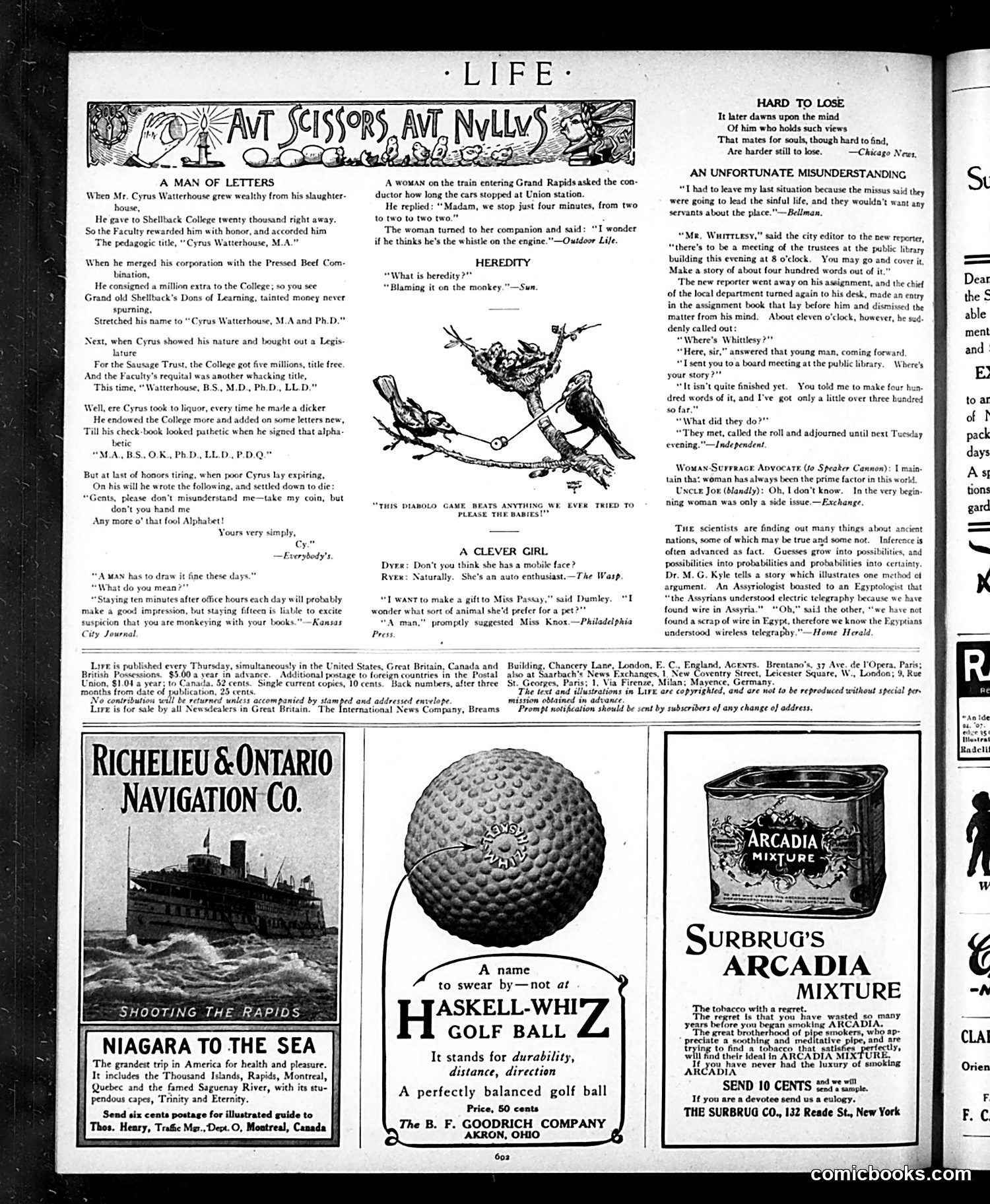
This page contains satirical commentary on early 20th-century American social issues. **"A Man of Letters"** mocks the corruption of academic integrity through wealthy donors. Cyrus Waterhouse, a slaughterhouse owner, purchases academic credentials (M.A., Ph.D., LL.D., etc.) by making increasingly large donations to "Shellback College." The satire critiques how institutions compromise their standards for money, awarding meaningless titles to unqualified donors. His deathbed request—to stop the "fool Alphabet"—suggests even Waterhouse recognizes the absurdity. The accompanying office humor jokes about the difficulty of appearing industrious without seeming dishonest—staying exactly ten minutes late looks good, but fifteen minutes suggests embezzlement. Other brief pieces satirize: - **Heredity**: Blaming monkeys for human flaws - **Gender dynamics**: A woman's "mobile face" attributed to her being an auto enthusiast - Workplace misunderstandings The page primarily lampoons academic corruption and institutional hypocrisy through wealthy patronage—relevant criticism that persists today.
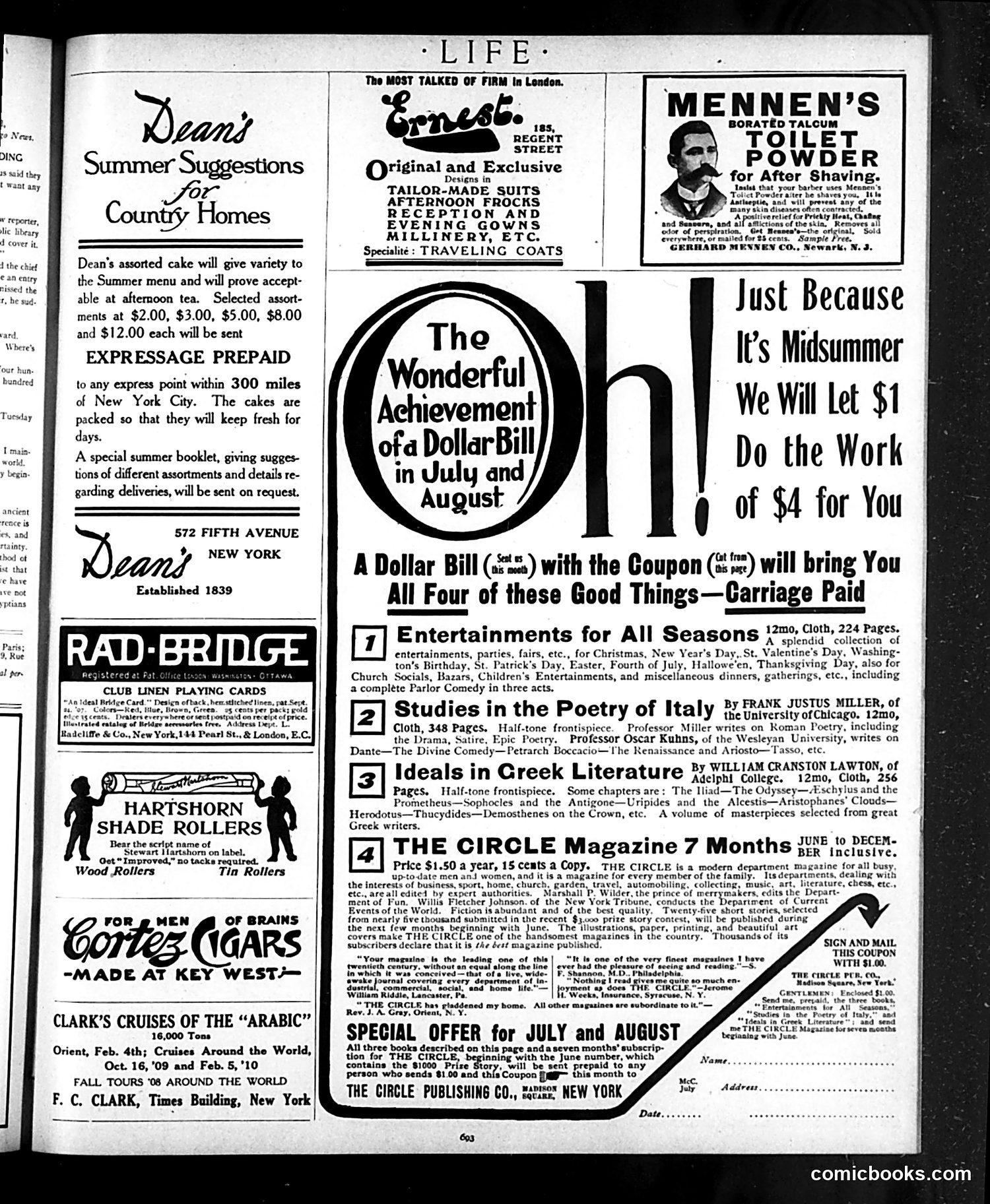
This is a Life magazine page (circa early 1900s) consisting almost entirely of advertisements and product promotions. There are **no political cartoons or satirical commentary** to analyze. The main content includes: - **Dean's bakery** advertising prepaid cake delivery - **Ernest** (London tailor) promoting suits and gowns - **Mennen's toilet powder** for men's grooming - **The Circle Publishing Company's** central promotion: a "$1 Does the Work of $4" offer—one dollar plus a coupon gets you four books on entertainment, Italian poetry, Greek literature, and a 7-month magazine subscription - Various other ads for playing cards, cruises, shade rollers, and cigars The page is a commercial one, typical of early 20th-century Life magazine, which mixed satirical content with substantial advertising revenue.
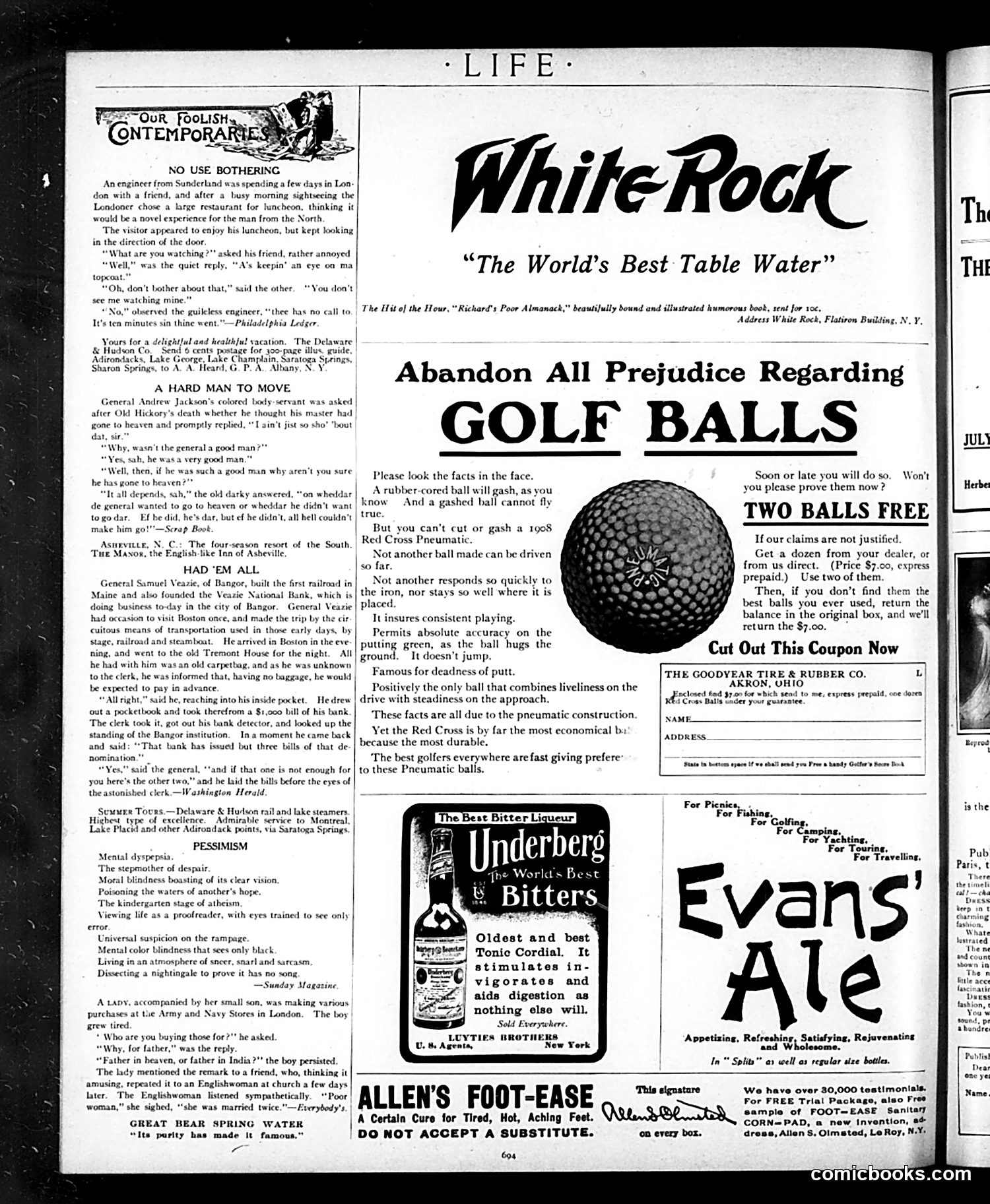
This page contains several short humorous anecdotes rather than political cartoons. The jokes reflect early-20th-century attitudes: 1. **"No Use Bothering"**: A dialect humor piece contrasting a Northern English engineer with a London businessman—playing on regional accents and stereotypes about working-class vigilance. 2. **"A Hard Man to Move"**: A post-Civil War joke about Andrew Jackson's enslaved servant, using racist dialect ("dat," "sah") and perpetuating harmful stereotypes about African Americans while framing stubbornness as Jackson's defining trait. 3. **"Had 'Em All"**: A humorous anecdote about a wealthy Maine banker proving his legitimacy through currency. The page is primarily **advertising**, featuring promotions for White Rock water, golf balls, Underberg bitters, Evans Ale, and Allen's Foot-Ease. The "humor" reflects period conventions normalizing racial caricature and dialect comedy considered acceptable entertainment in early-20th-century American magazines.
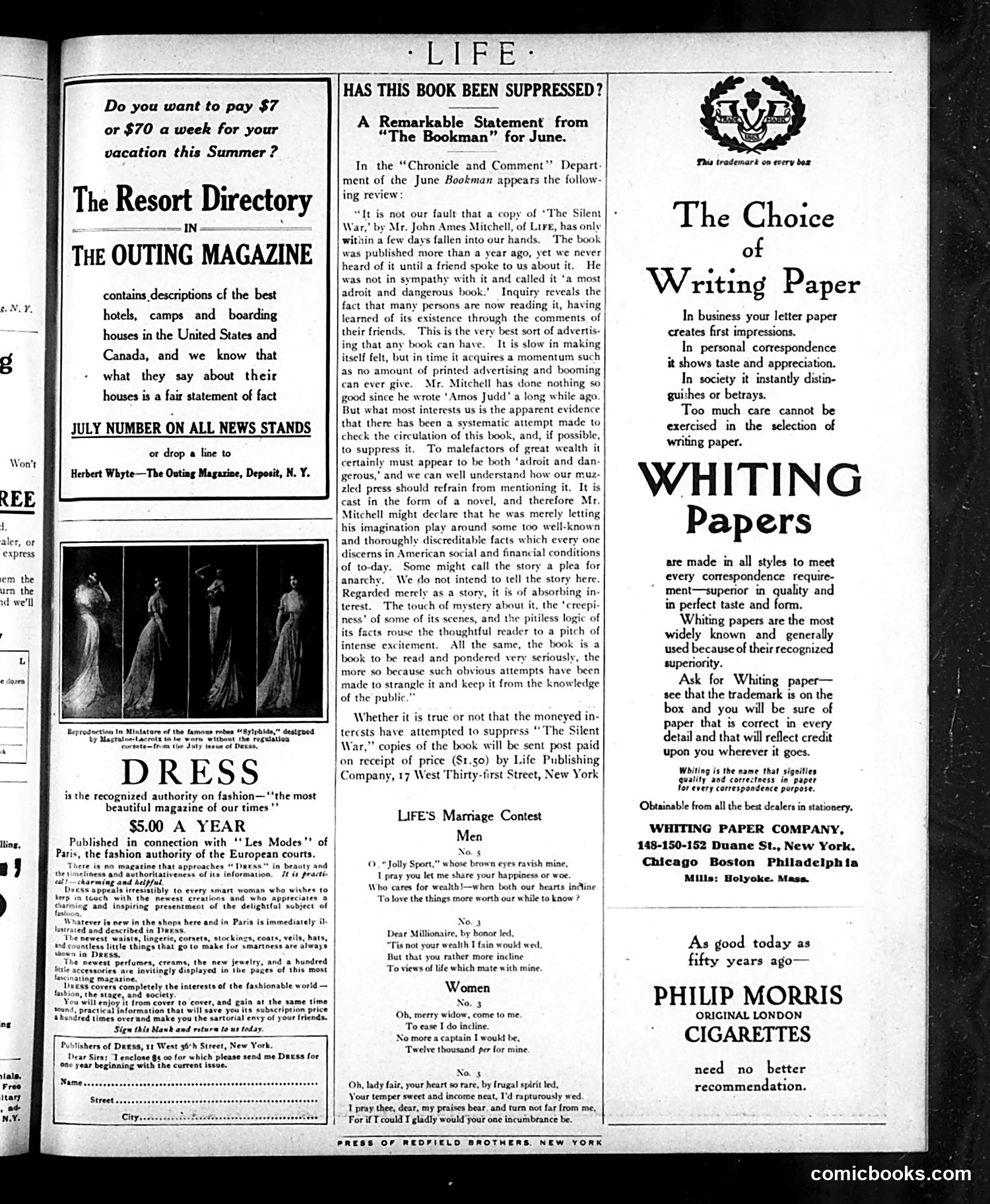
This page is primarily **advertising and editorial content** rather than political cartoons. The key substantive piece is the middle section titled "HAS THIS BOOK BEEN SUPPRESSED?" ## The Main Article The text discusses John Ames Mitchell's novel *The Silent War*, published over a year prior but barely circulated. The *Bookman* magazine review suggests **deliberate suppression** by "malefactors of great wealth"—implying powerful financial interests worked to keep the book from circulation because it critiques "American social and financial conditions" and contains "adroit and dangerous" social commentary, possibly advocating anarchist ideas. The satire is **indirect**: by praising the book's suppression as effective advertising, the piece ironically highlights censorship by the wealthy to protect their interests. ## Context for Modern Readers This reflects early-20th-century anxieties about **corporate censorship** and **radical literature**. The accusation that rich interests suppress dangerous books was a common Progressive Era concern about media control and free speech. The rest of the page consists of fashion magazine, vacation guide, and cigarette advertisements—typical period magazine content.
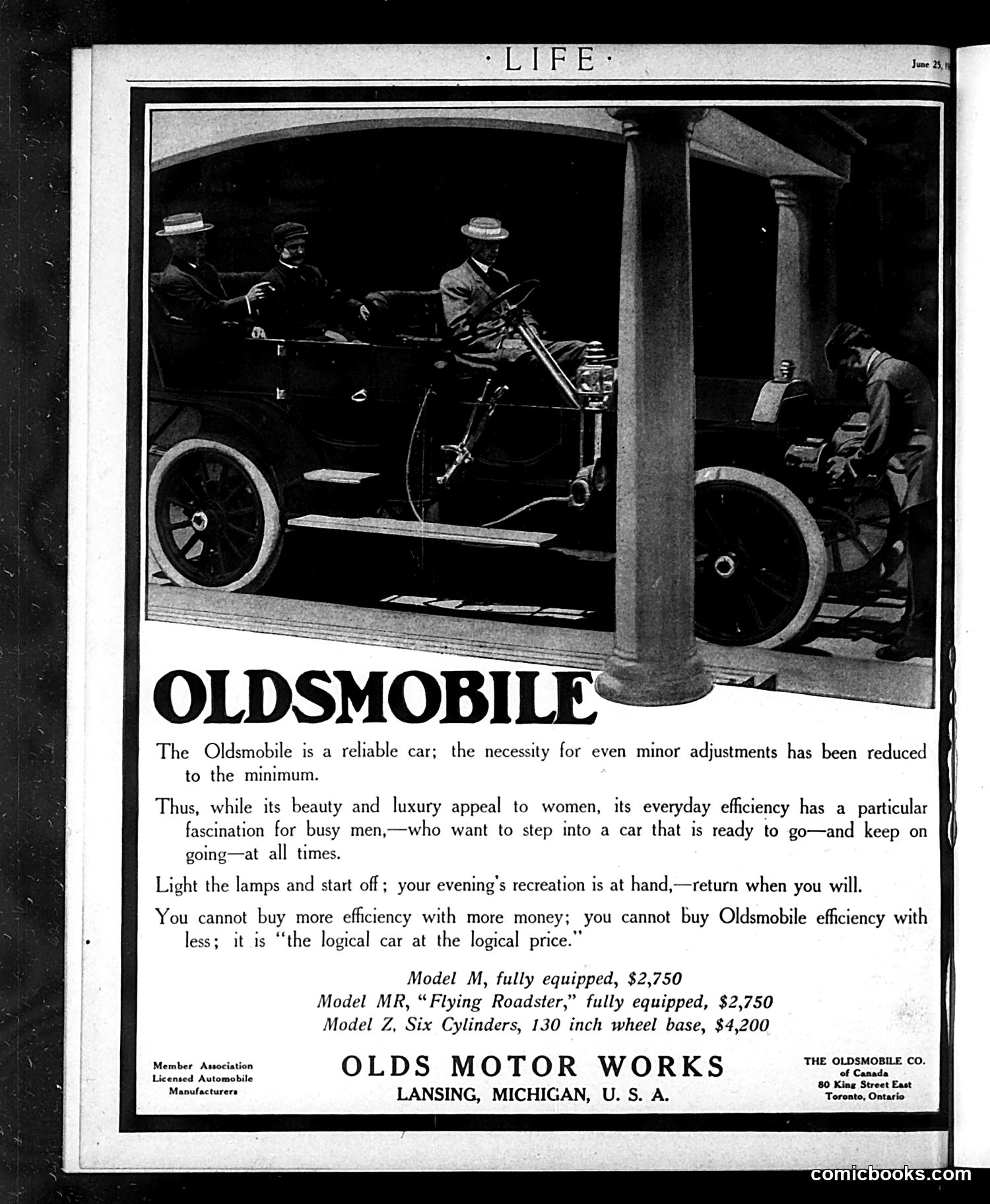
This is a **full-page automobile advertisement**, not political satire. It ran in *Life* magazine (June 25, date unclear from image) promoting Oldsmobile vehicles manufactured in Lansing, Michigan. The advertisement uses gender-targeted marketing typical of the early automotive era: it appeals to women through "beauty and luxury," while emphasizing to men the car's reliability and low-maintenance "efficiency"—the ability to start immediately and run continuously without adjustment. The photograph shows three well-dressed men in a car parked under a covered structure, illustrating the leisure and freedom the vehicle promises: "Light the lamps and start off; your evening's recreation is at hand." The pricing ($2,750–$4,200) positions Oldsmobile as "the logical car at the logical price"—expensive but justified by durability. There is no political satire present; this is straightforward period advertising emphasizing automotive dependability as a selling point.
I can see this is a page from *Life* magazine (indicated by the "comicbooks.com" watermark and the magazine's characteristic layout), but the image shows primarily a blank white page with only fragmentary text visible along the left margin. The legible fragments include partial words like "duced," "cular," "on," and "with," along with what appears to be "E CO." and "East" at the bottom left, but these are insufficient to identify the cartoon's subject matter, political references, or satirical intent. Without a clear view of the actual cartoon or complete text, I cannot accurately explain the page's content or meaning to a modern reader.