
Life, 1908-06-25 · page 4 of 21
Life — June 25, 1908 — page 4: what you’re looking at
What you’re looking at
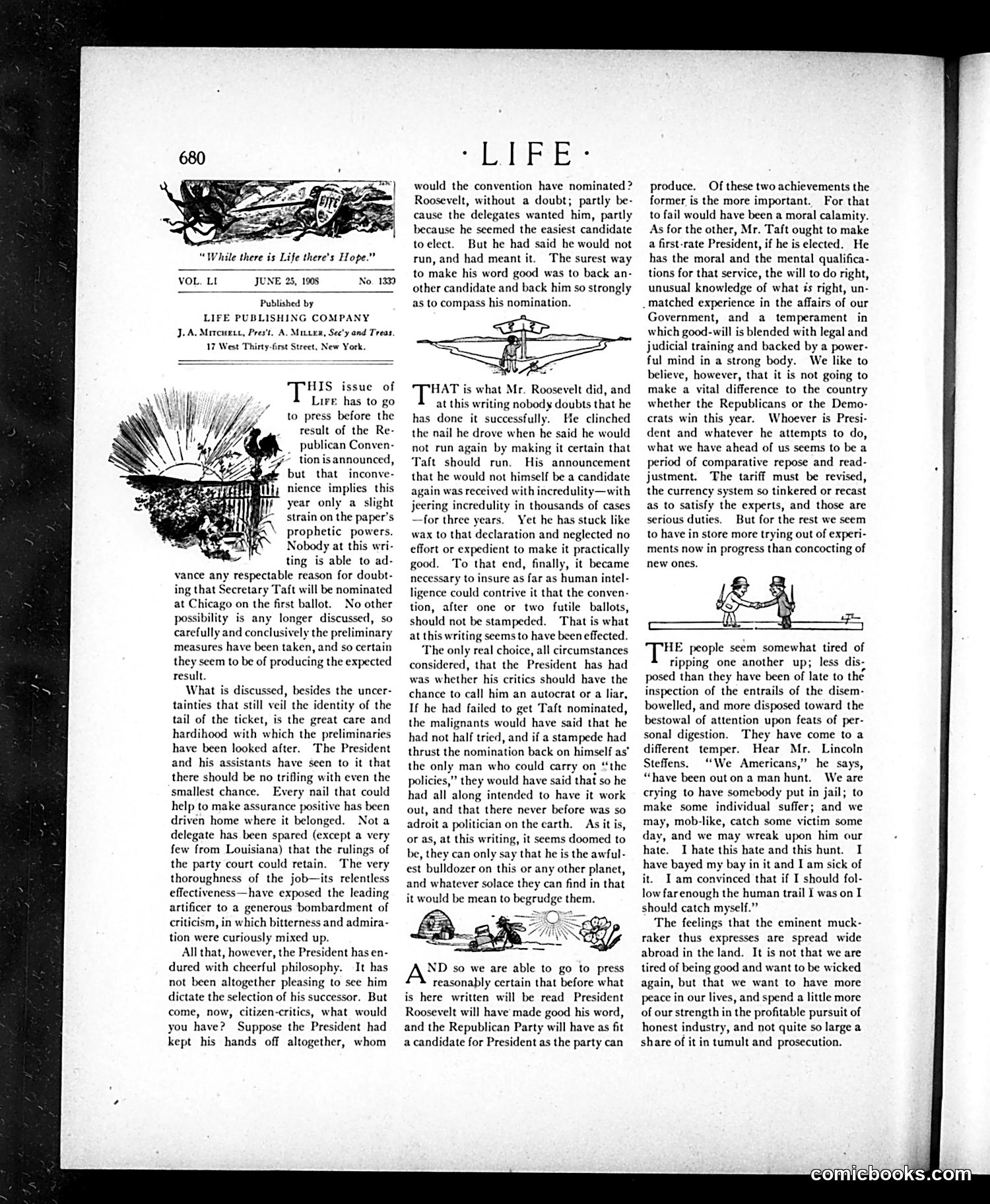
This page discusses President Theodore Roosevelt's announcement that he would not seek another term, and the resulting Republican Convention selection of William Howard Taft as his successor. The cartoons illustrate contemporary political sentiment. The left illustration showing a figure being thrown or ejected appears to reference the turbulent convention process. The right cartoon depicts two figures on a seesaw, likely symbolizing the political balance and tension between different factions regarding the presidential succession. The text debates whether critics should have called Roosevelt an "autocrat" or "liar," and expresses cautious optimism that Roosevelt will support Taft and the Republican Party will field a competitive candidate. The piece reflects anxiety about the transition of power and questions about whether the new candidate can adequately fill Roosevelt's shoes.
📄 Transcribed text from this page (OCR, searchable)
Machine-transcribed from the original scan — historical spelling and the odd misread are preserved.
“While there is Life there's Hope.” No. 130 VOL. LI JUNE 25, 1908 Published by LIFE PUBLISHING COMPANY J.A.Mircurnt, Pres't, A. Muture, Sec’y and Treas. 17 West Thirty-first Street, New York. HIS issue of Lire. has to go to press before the result of the Re- publican Conven- tion isannounced, but that inconve nience implies this year only a slight strain on the paper’s prophetic powers. Nobody at this w ting is able to ad- vance any respectable reason for doubt- ing that Secretary Taft will be nominated at Chicago on the first ballot. No other possibility is any longer discussed, so carefully and conclusively the preliminary measures have been taken, and so certain they seem to be of producing the expected result. What is discussed, besides the uncer- tainties that still veil the identity of the tail of the ticket, is the great care and hardihood with which the preliminaries have been looked after. The President and his assistants have seen to it that there should be no trifling with even the smallest chance. Every nail that could help to make assurance positive has been driven home where it belonged. Nota delegate has been spared (except a very few from Louisiana) that the rulings of the party court could retain. The very thoroughness of the job—its relentle: effectiveness—have exposed the leading artificer to a generous bombardment of criticism, in which bitterness and admira- tion were curiously mixed up. All that, however, the President has en- dured with cheerful philosophy. It has not been altogether pleasing to see him dictate the selection of his successor. But come, now, citizen-critics, what would you have? Suppose the President had kept his hands off altogether, whom “ale Rees: would the convention have nominated ? Roosevelt, without a doubt; partly be- cause the delegates wanted him, partly because he seemed the easiest candidate toclect. But he had said he would not run, and had meant it. The surest way to make his word good was to back an- other candidate and back him so strongly as to compass his nomination. HAT is what Mr. Roosevelt did, and at this writing nobody doubts that he has done it successfully. He clinched the nail he drove when he said he would not run again by making it certain that Taft should run. His announcement that he would not himself be a candidate again was received with incredulity—with jeering incredulity in thousands of cases —for three years. Yet he has stuck like wax to that declaration and neglected no effort or expedient to make it practically good. To that end, finally, it became necessary to insure as far as human intel- ligence could contrive it that the conven- tion, after one or two futile ballots, should not be stampeded. That is what at this writing seems to have been effected. The only real choice, all circumstances considered, that the President has had whether his critics should have the chance to call him an autocrat or a liar, If he had failed to get Taft nominated, the malignants would have said that he had not half tried, and if a stampede had thrust the nomination back on himself as’ the only man who could carry on “the policies,” they would have said that so he had all along intended to have it work out, and that there never before was so adroit a politician on the earth, As it is, or as, at this writing, it seems doomed to be, they can only say that he is the awful- est bulldozer on this or any other planet, and whatever solace they can find in that it would be mean to begrudge them. ND so we are able to go to press reasonably certain that before what is here written will be read President Roosevelt will have’ made good his word, and the Republican Party will have as fit a candidate for President as the party can produce. Of these two achievements the former is the more important. For that to fail would have been a moral calamity. As for the other, Mr. Taft ought to make a first-rate President, if he is elected. He has the moral and the mental qualifica- tions for that service, the will to do right, unusual knowledge of what is right, un- . matched experience in the affairs of our Government, and a temperament in vhich good-will is blended with legal and judicial training and backed by a power- ful mind in a strong body. We like to believe, however, that it is not going to make a vital difference to the country whether the Republicans or the Demo- crats win this year. Whoever is Presi- dent and whatever he attempts to do, what we have ahead of us seems to be a period of comparative repose and read- justment. The tariff must be revised, the currency system so tinkered or recast as to satisfy the experts, and those are serious duties. But for the rest we seem to have in store more trying out of experi- ments now in progress than concocting of new ones. HE. people seem somewhat tired of ripping one another up; less dis- posed than they have been of late to the inspection of the entrails of the disem- bowelled, and more disposed toward the bestowal of attention upon feats of per- sonal digestion. They have come to a different temper. Hear Mr. Lincoln Steffens, “We Americans,” he says, “have been outon a manhunt. We are crying to have somebody put in jail; to make some individual suffer; and we may, mob-like, catch some victim some day, and we may wreak upon him our hate. I hate this hate and this hunt. I have bayed my bay in it and I am sick of it. Iam convinced that if I should fol- low farenough the human trail I was on I should catch myself.” The feelings that the eminent muck- raker thus expresses are spread wide abroad in the land. It is not that we are tired of being good and want to be wicked again, but that we want to have more peace in our lives, and spend a little more of our strength in the profitable pursuit of honest industry, and not quite so large a share of it in tumult and prosecution.