
Life, 1908-06-25 · page 8 of 21
Life — June 25, 1908 — page 8: what you’re looking at
What you’re looking at
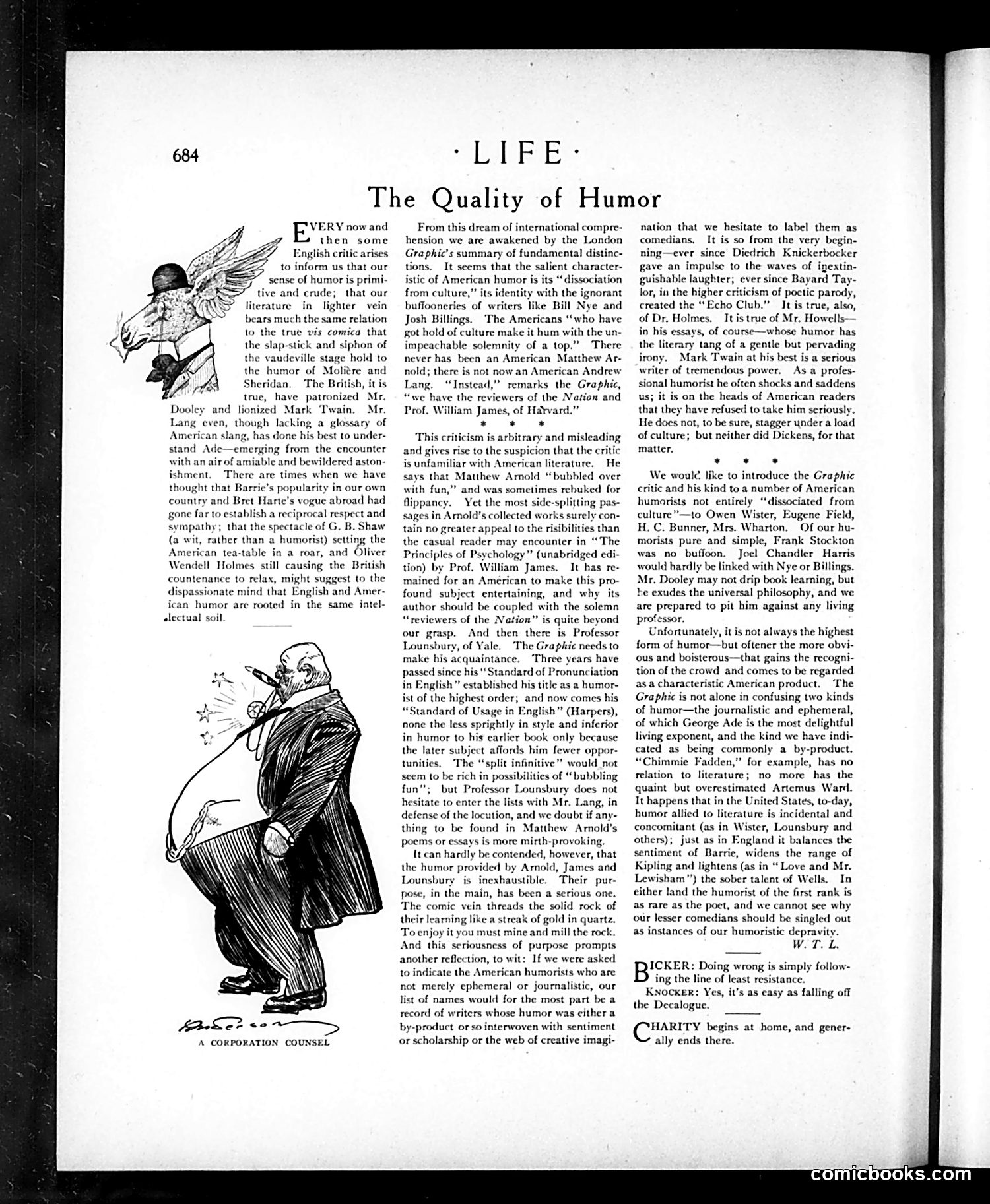
This article debates American humor's character. The text critiques a *Graphic* magazine summary claiming American humor lacks "culture," defending figures like Mark Twain and suggesting the critic unfairly dismisses American literature. The two cartoons illustrate the article's points: The top sketch shows a figure in formal dress, apparently representing genteel or "high" culture. The lower cartoon, titled "A CORPORATION COUNSEL," depicts a stout businessman in a coat—likely satirizing pompous corporate figures or lawyers. This visual example supports the article's argument about American humor targeting recognizable social types. The article concludes by quoting dialogue between characters named "Bicker" and "Knocker," suggesting these personify cynical American attitudes.
📄 Transcribed text from this page (OCR, searchable)
Machine-transcribed from the original scan — historical spelling and the odd misread are preserved.
“EAL RIES: The Quality of Humor ERY now and then some English critic arises to inform us that our sense of humor is primi- ; that our literature in lighter vein bears much the same relation to the true vis comica that the slap-stick and siphon of the vaudeville stage hold to the humor of Molitre and Sheridan. ‘The British, it is true, have patronized Mr. Dooley and lionized Mark Twain. Mr. Lang even, though lacking a glossary of American slang, has done his best to under- stand Ade—emerging from the encounter with an air of amiable and bewildered aston- ishment. There are times when we have thought that Barrie’s popularity in our own country and Bret Harte’s vogue abroad had gone far to establish a reciprocal respect and sympathy; that the spectacle of G. B. Shaw (a wit, rather than a humorist) setting the American tea-table in a roar, and Oliver Wendell Holmes still causing the British countenance to relax, might suggest to the dispassionate mind that English and Amer- ican humor are rooted in the same intel- alectual soil. A CORPORATION COUNSEL From this dream of international compre- hension we are awakened by the London Graphic’s summary of fundamental distinc tions. It seems that the salient character- istic of American humor is its “dissociation from culture,” its identity with the ignorant buffooneries of writers like Bill Nye and Josh Billings. The Americans “who have got hold of culture make it hum with the un- impeachable solemnity of a top.” There never has becn an American Matthew Ar- nold; there is not now an American Andrew Lang. “Instead,” remarks the Graphic, we have the reviewers of the Nation and Prof. William James, of Havard + 28 8 This criticism is arbitrary and misleading and gives rise to the suspicion that the critic is unfamiliar with American literature. He says that Matthew Amold “bubbled over with fun,” and was sometimes rebuked for flippancy. Yet the most side-splitting pas- sages in Arnold’s collected works surely con- tain no greater appeal to the risibilities than the casual reader may encounter in “The Principles of Psychology” (unabridged edi- tion) by Prof. William James. It has re- mained for an American to make this pro- found subject entertaining, and why its author should be coupled with the solemn “reviewers of the Nation” is quite beyond our grasp. And then there is Professor Lounsbury, of Yale. The Graphic needs to make his acquaintance. Three years have passed since his “ Standard of Pronunciation in English” established his title as a humor- ist of the highest order; and now comes his “Standard of Usage in English” (Harpers), none the less sprightly in style and inferior in humor to his earlier book only because the later subject affords him fewer oppor- tunities. The “split infinitive” would not scem to be rich in possibilities of “bubbling fun”; but Professor Lounsbury does not hesitate to enter the lists with Mr. Lang, in defense of the locution, and we doubt if any thing to be found in Matthew Amold’s poems or essays is more mirth-provoking. It can hardly be contended, however, that the humor provided by Arnold, James and Lounsbury is inexhaustible. Their pur- pose, in the main, has been a serious one. ‘The comic vein threads the solid rock of their learning like a streak of gold in quartz. To enjoy it you must mine and mill the rock. And this seriousness of purpose prompts another reflection, to wit: If we were asked to indicate the American humorists who are not merely ephemeral or journalistic, our list of names would for the most part be a record of writers whose humor was either a by-product or so interwoven with sentiment or scholarship or the web of creative imagi- nation that we hesitate to label them as comedians. It is so from the very begin- ning—ever since Diedrich Knickerbocker gave an impulse to the waves of inextin- guishable laughter; ever since Bayard Tay- lor, in the higher criticism of poctic parody created the “Echo Club.” It is true, also, of Dr, Holmes, It is true of Mr. Howells— in his essays, of course—whose humor has the literary tang of a gentle but pervading irony, Mark Twain at his best is a serious writer of tremendous power. As a profes- sional humorist he often shocks and saddens us; it is on the heads of American readers that they have refused to take him seriously. He does not, to be sure, stagger under a load of culture; but neither did Dickens, for that matter. * 28 8 We would. like to introduce the Graphic critic and his kind to a number of American humorists not entirely “dissociated from culture”—to Owen Wister, Eugene Field, H.C. Bunner, Mrs. Wharton. Of our hu- morists pure and simple, Frank Stockton was no buffoon. Joel Chandler Harris would hardly be linked with Nye or Billings. Mr. Dooley may not drip book learning, but be exudes the universal philosophy, and we are prepared to pit him against any living professor. Unfortunately, it is not always the highest form of humor—but oftener the more ob: ous and boisterous—that gains the recogni- tion of the crowd and comes to be regarded asa characteristic American product. The Graphic is not alone in confusing two kinds of humor—the journalistic and ephemeral, of which George Ade is the most delightful living exponent, and the kind we have indi- cated as being commonly a by-product. “Chimmie Fadden,” for example, has no relation to literature; no more has the quaint but overestimated Artemus Ward. It happens that in the United States, to-day, humor allied to literature is incidental and concomitant (as in Wister, Lounsbury and others); just as in England it balances the sentiment of Barrie, widens the range of Kipling and lightens (as in “Love and Mr. Lewisham”) the sober talent of Wells, In either land the humorist of the first rank is as rare as the poet, and we cannot see why our lesser comedians should be singled out as instances of our humoristic depravity. WT. LL. ICKER: Doing wrong is simply follow- ing the line of least resistance. Knocker: Yes, it’s as easy as falling off the Decalogue. HARITY begins at home, and gener- ally ends there. Ccomicbooks.com