
A complete issue · 20 pages · 1908
Life — June 11, 1908
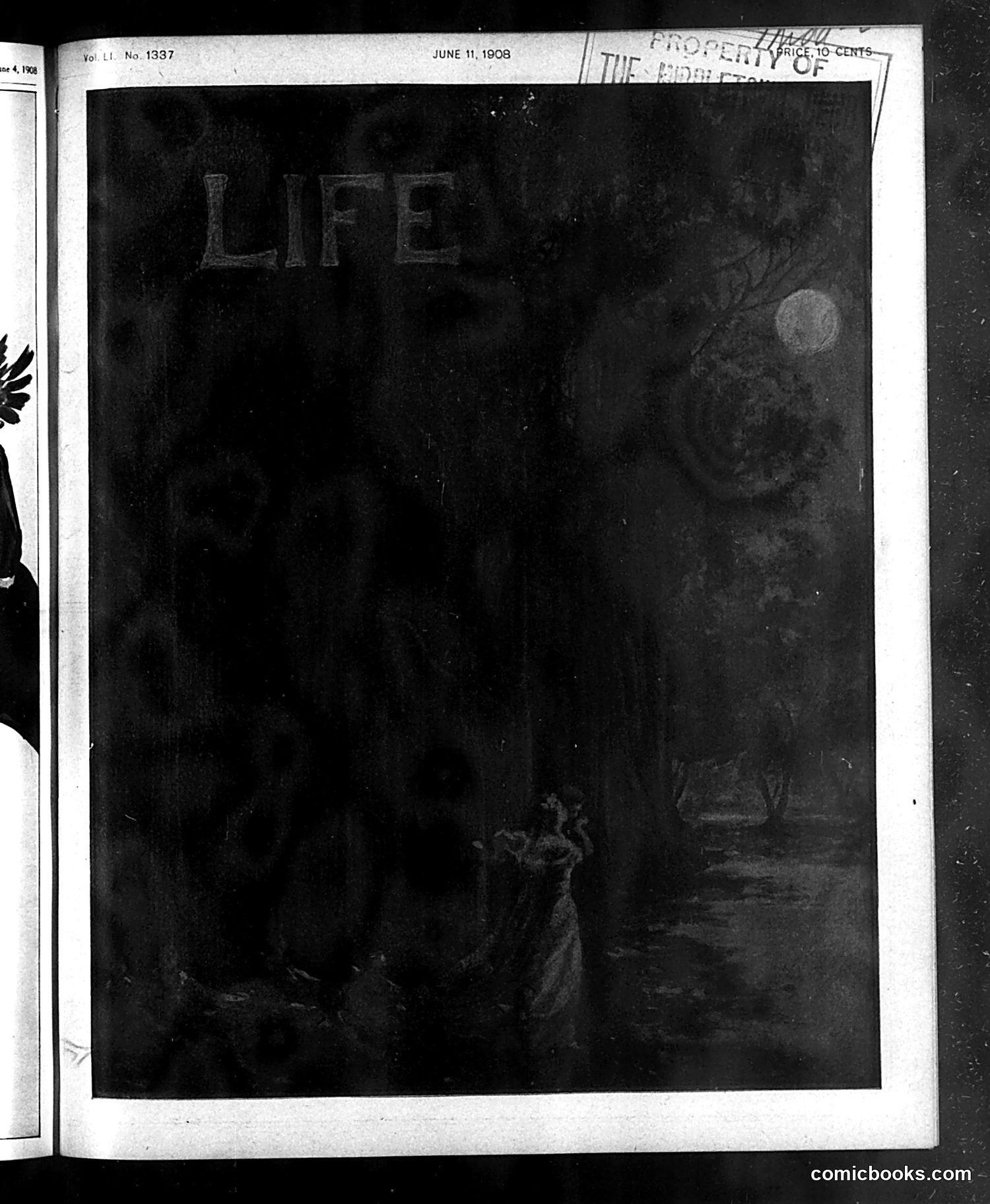
I can see this is a cover from Life magazine dated June 11, 1908 (Vol. 51, No. 1337). The image shows the word "LIFE" in large letters at the top of a dark, atmospheric illustration. Below appears to be a nighttime scene with what looks like a figure or figures in shadow, and possibly a moon visible in the background. However, the image quality is too poor and dark for me to make out specific details with confidence. I cannot clearly identify any particular figures, caricatures, or political references. Without being able to read additional text on the page or see the image more clearly, I cannot reliably explain what satire or commentary this cover is meant to convey. The artistic style and mood suggest it may reference a contemporary event or social commentary from 1908, but I cannot specify what that is with certainty.
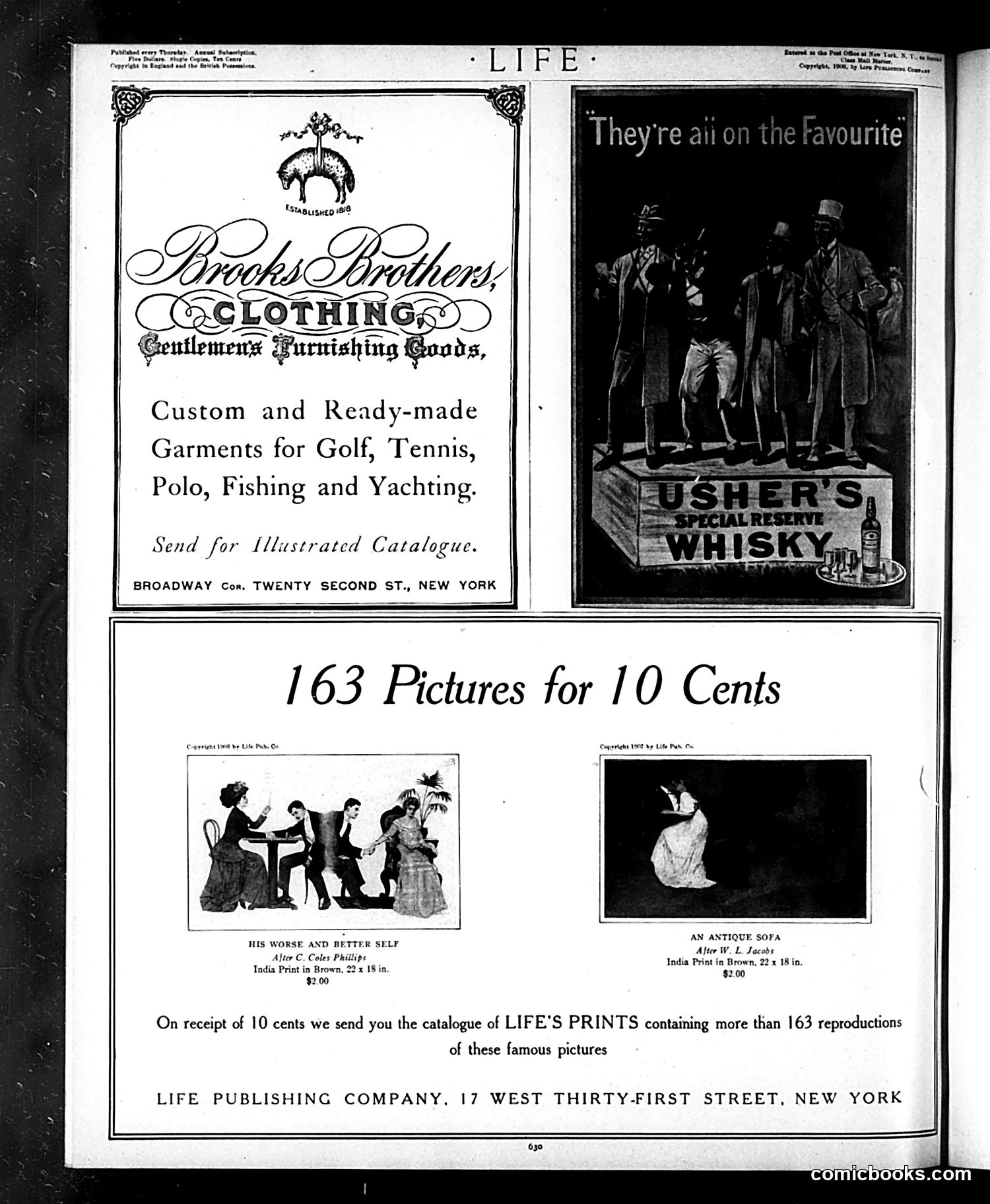
This page is primarily **advertising**, not satirical content. It contains three advertisements: 1. **Brooks Brothers** (top left): Promotes custom and ready-made clothing for sports and leisure activities (golf, tennis, polo, fishing, yachting). Address: Broadway, 22nd Street, New York. 2. **Usher's Whisky** (top right): Shows men in formal attire with the slogan "They're all on the Favourite," advertising their Special Reserve whisky. 3. **Life Publishing Company** (bottom): Promotes a catalogue of 163 reproducible pictures available for 10 cents, featuring sample images like "His Worse and Better Self" and "An Antique Sofa." The page reflects early 20th-century consumer culture targeting affluent readers, with luxury goods and entertainment products.
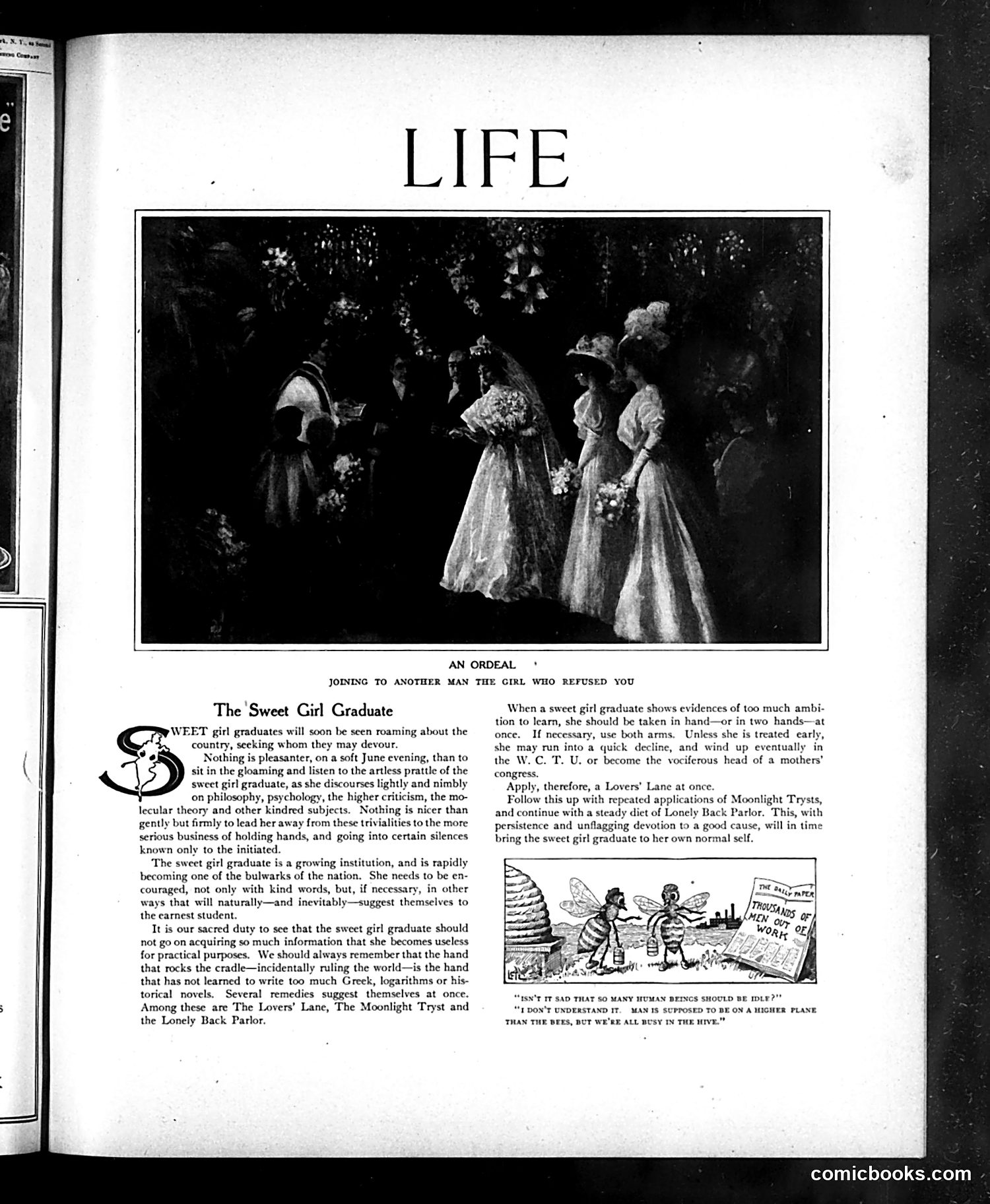
This satirical piece mocks the newly graduated female college student of the era. The article humorously warns that sweet girl graduates are becoming "one of the bulwarks of the nation" and need guidance to avoid becoming nuisances—suggesting they might pursue "hard" intellectual work, join the W.C.T.U. (Women's Christian Temperance Union), or lead mothers' congresses. The accompanying cartoon ridicules women's ambitions by depicting bees working while a human figure lounges idle, with the caption mocking that "so many human beings should be idle" when "man is supposed to be on a higher plane than the bees." The satire reflects early 20th-century anxiety about educated women entering the workforce and public sphere, positioning female ambition as both laughable and potentially dangerous to social order.
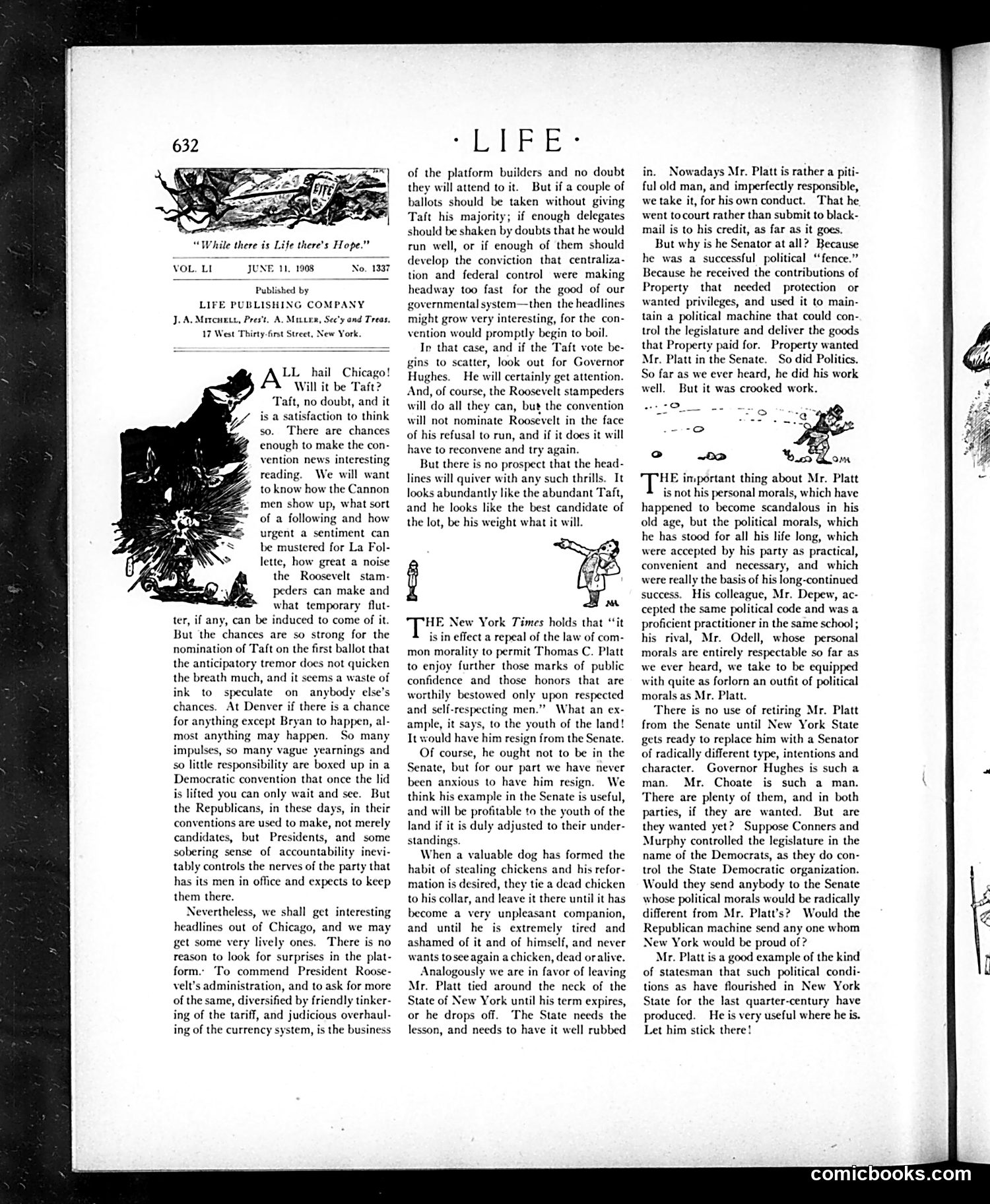
**The Main Cartoon** (top left) depicts a large figure labeled "Taft" alongside smaller figures representing "platform builders." The satire mocks how Republican convention delegates might manipulate nominee William Howard Taft, suggesting his policies could be shaped like clay. **The Article's Message**: Life argues that while Taft appears the best Republican candidate, party operatives (including Roosevelt's supporters) risk controlling him too heavily. The piece warns Democrats shouldn't expect Taft to resign or cause major upheaval, though anything could happen at conventions. **Historical Context**: This addresses the 1908 Republican convention and President Roosevelt's chosen successor. Life suggests Taft, while seemingly solid, might become a "fence" protecting political machinery rather than independent leadership—a concern about party control over individual politicians.
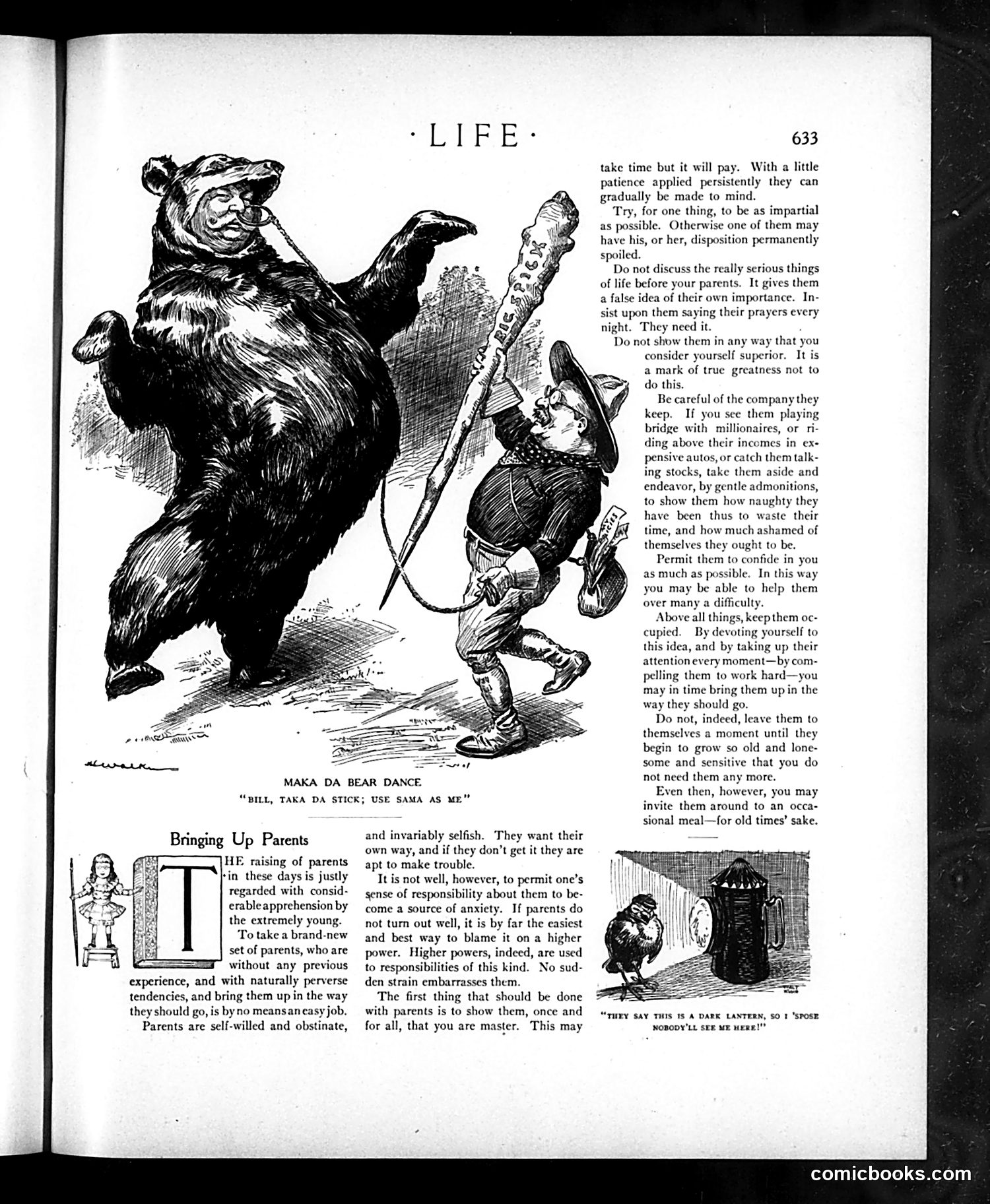
The main cartoon titled "MAKA DA BEAR DANCE" depicts a large bear and a small figure (labeled "BILL") in what appears to be a performance or confrontation. The accompanying text "BILL, TAKA DA STICK, USE SAMA AS ME" uses exaggerated dialect, suggesting a minstrel-style or racist caricature typical of early 20th-century American humor. The article "Bringing Up Parents" addresses parental authority and child discipline, advising parents to establish dominance early while remaining fair-minded. The tone reflects period attitudes about strict parental control. The second small cartoon shows figures with a dark lantern, with the caption suggesting hide-and-seek play. The satire appears to mock both parental authority dynamics and uses offensive racial caricature for comedic effect—perspectives considered deeply inappropriate by modern standards.
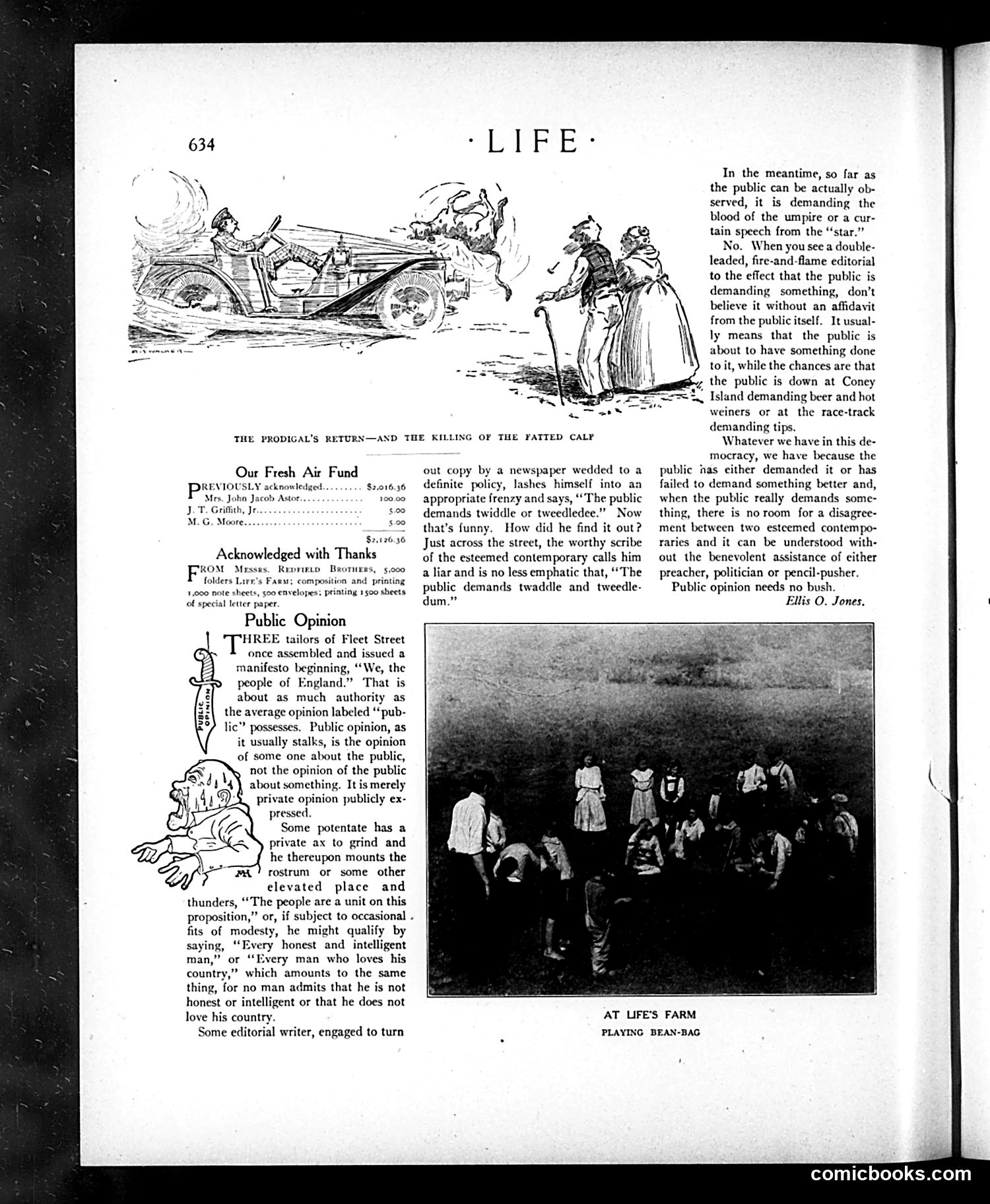
This page satirizes **public opinion and democratic demands**. The top cartoon depicts a prodigal's return and "killing of the fatted calf"—likely referencing wasteful public spending or a politician's homecoming. The "Public Opinion" essay criticizes how average citizens invoke "the people" to demand action, yet this rarely represents genuine collective will. The author (Ellis O. Jones) argues such demands are often private grievances presented as public mandate—people demanding "twaddle or tweedledee" while claiming democratic authority. The accompanying photograph shows people at "Life's Farm" playing bean-bag, illustrating ordinary public life the editorial discusses. The satire targets the gap between claimed democratic legitimacy and actual individual self-interest in civic discourse.
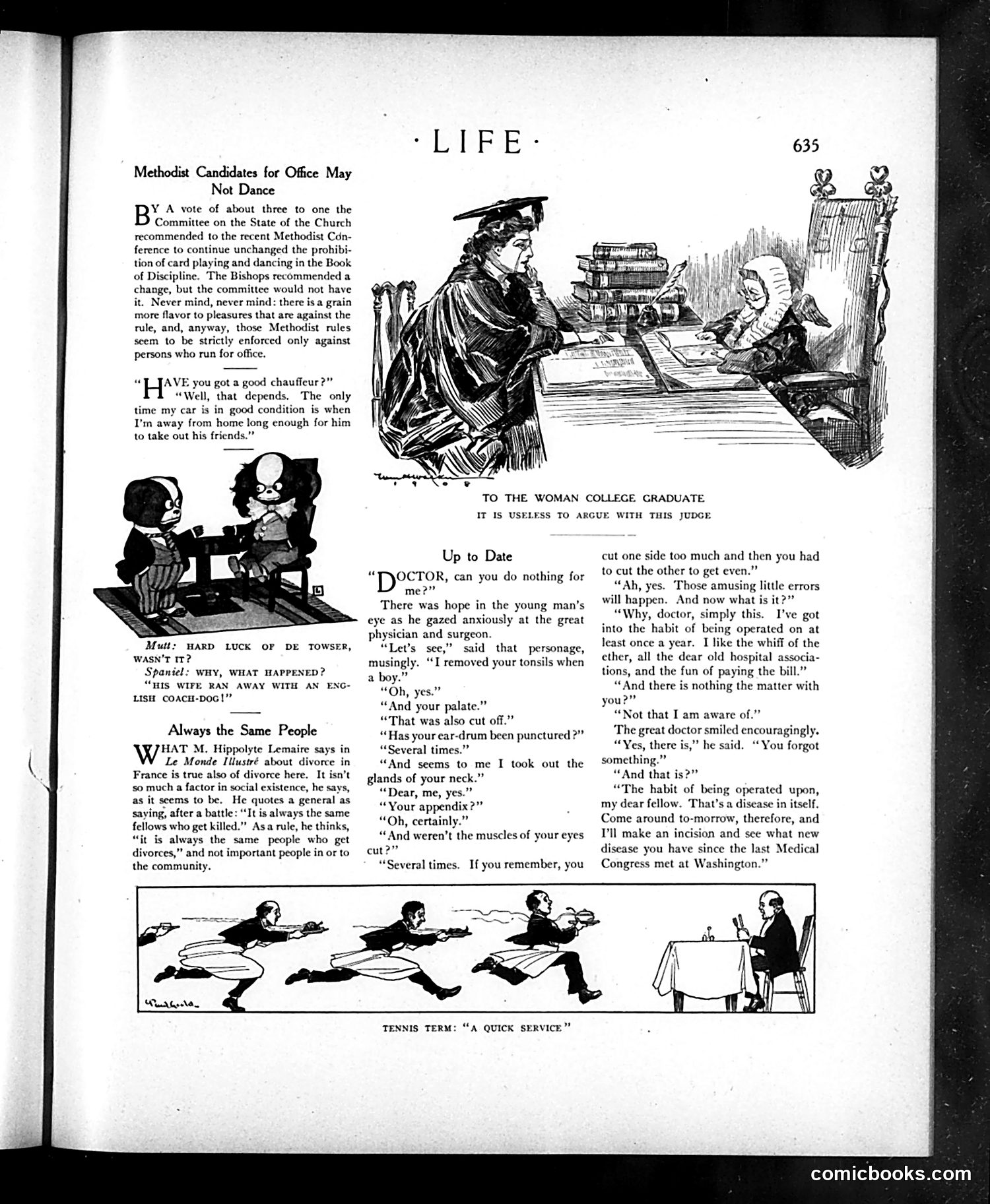
This page contains several satirical pieces about early 20th-century social issues: **Methodist Church Reform**: The top article mocks a Methodist Church committee's debate over prohibiting card-playing and dancing. The accompanying dialogue jokes about a chauffeur whose car only runs well when he's away from home—implying servants' misconduct. **"Always the Same People"**: A piece about French divorce trends, suggesting wealthy elites repeatedly marry and divorce the same social circles, never truly changing. **"To the Woman College Graduate"**: A humorous doctor-patient dialogue where a young woman describes undergoing repeated surgeries, with the doctor diagnosing her habit of unnecessary operations as itself a "disease." **Tennis Cartoon**: A simple visual gag showing "a quick service" in tennis. The satire targets social hypocrisy, medical practices, and changing gender roles of the era.
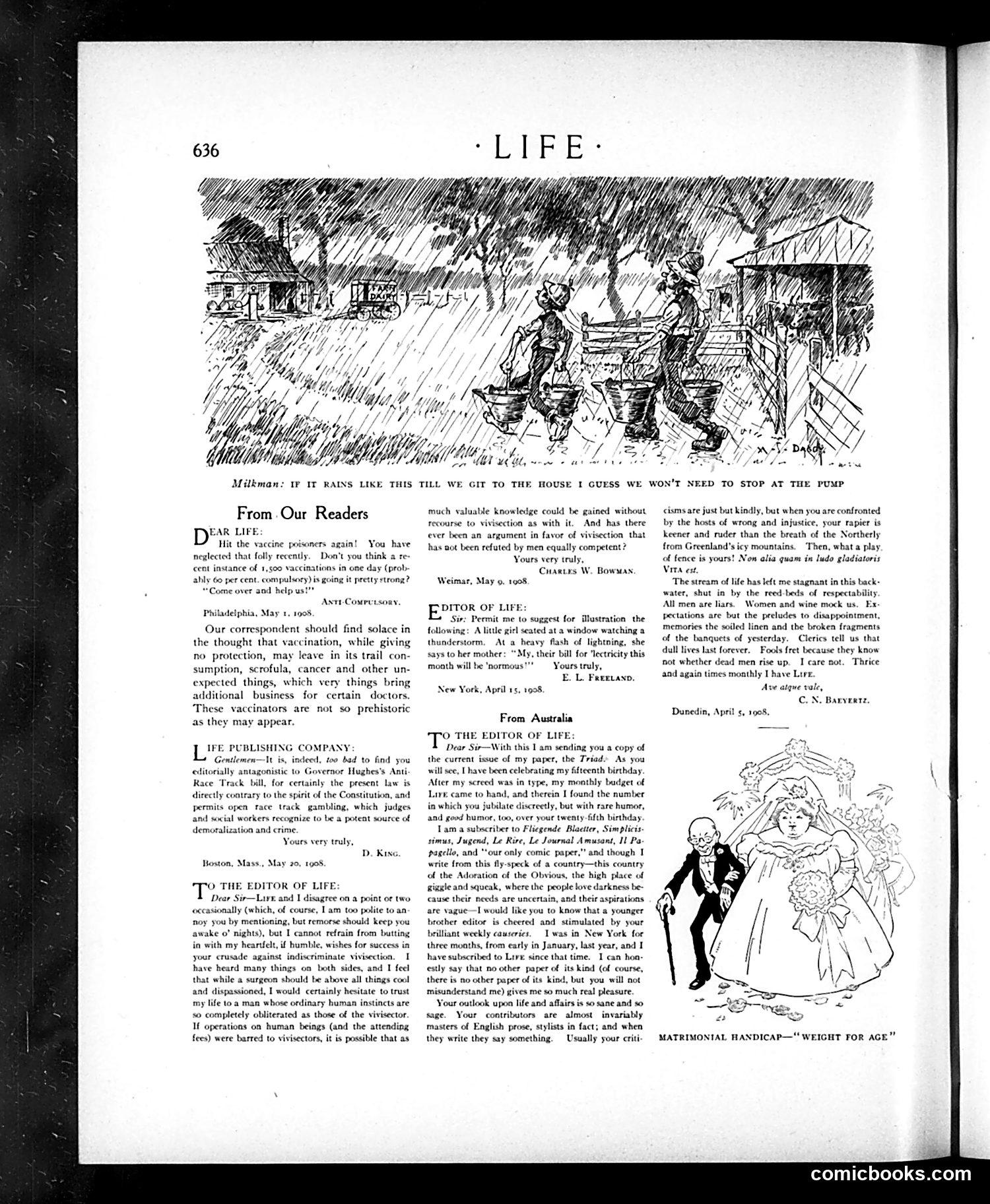
This cartoon satirizes marriage by depicting it as a horse race handicapping system. The image shows a thin groom struggling under the weight of an enormously heavy bride he must carry—a visual metaphor suggesting marriage burdens men disproportionately. The "handicap" racing reference implies wives are dead weight slowing husbands down. This reflects early 20th-century attitudes about marriage as an obligation constraining male freedom, particularly regarding a wife's dependence and financial burden. The cartoon likely targets concerns about matrimony's unfairness to men—a common satirical theme in Life magazine's humor. The grotesque exaggeration of the bride's size emphasizes the joke's misogynistic premise: that wives represent physical and economic encumbrance rather than partnership.
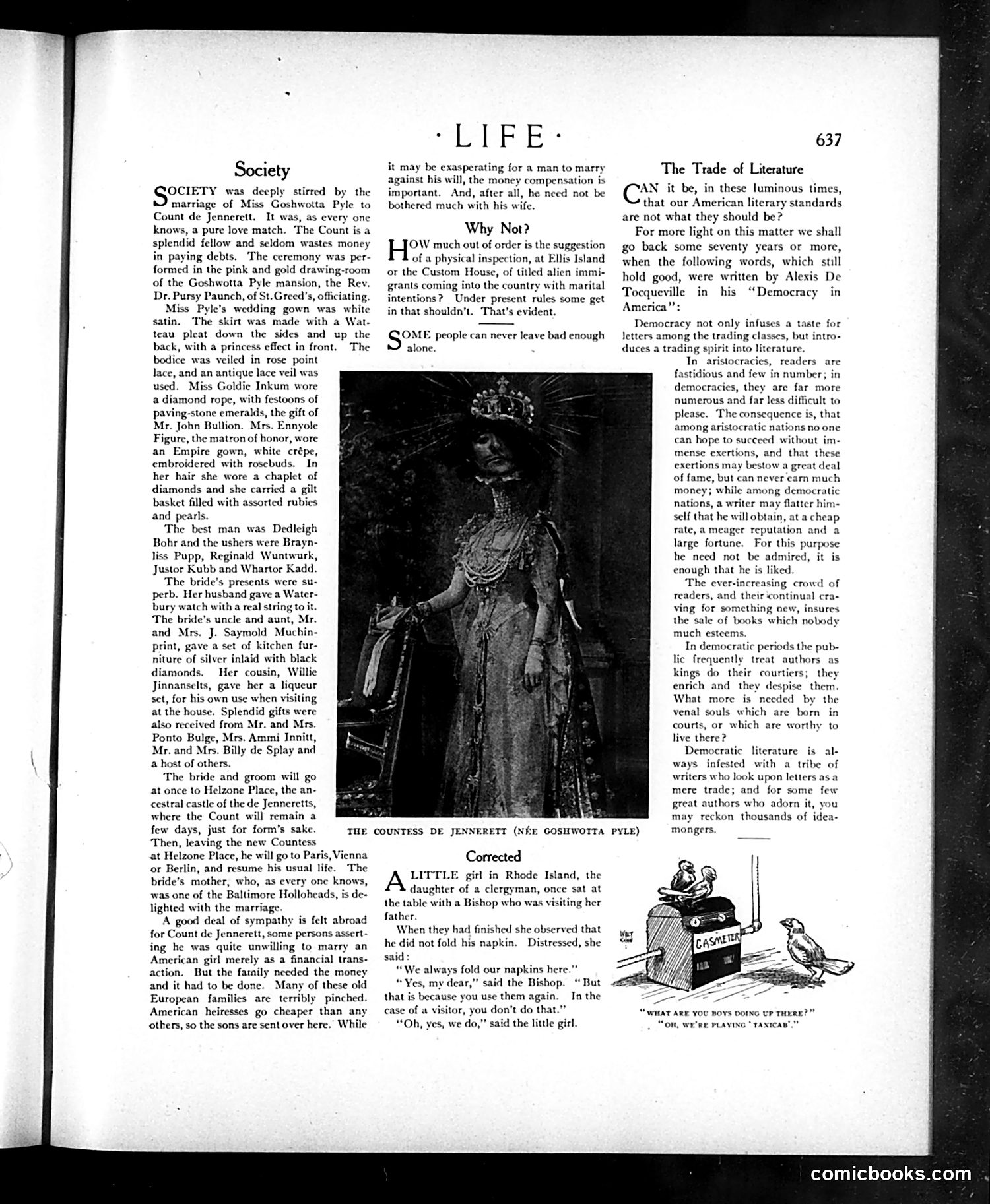
This page contains two distinct sections: **Left column ("Society"):** Reports on the wedding of Miss Goshwatta Pyle to Count de Jennerett, describing the elaborate ceremony and guest list. This appears to be satirizing wealthy American heiresses marrying European nobility—a common practice where American money purchased aristocratic titles. **Right side:** "The Trade of Literature" critiques how democratic societies treat authors. The essay argues that unlike aristocratic nations, democracies produce many mediocre writers competing for readers, allowing even inferior authors to achieve modest financial success through popular appeal rather than merit. **Bottom cartoon:** A simple domestic joke showing children playing "farceau" (possibly "farce"?), with an adult asking what they're doing. The humor appears to rely on wordplay or situational comedy typical of Life's era.
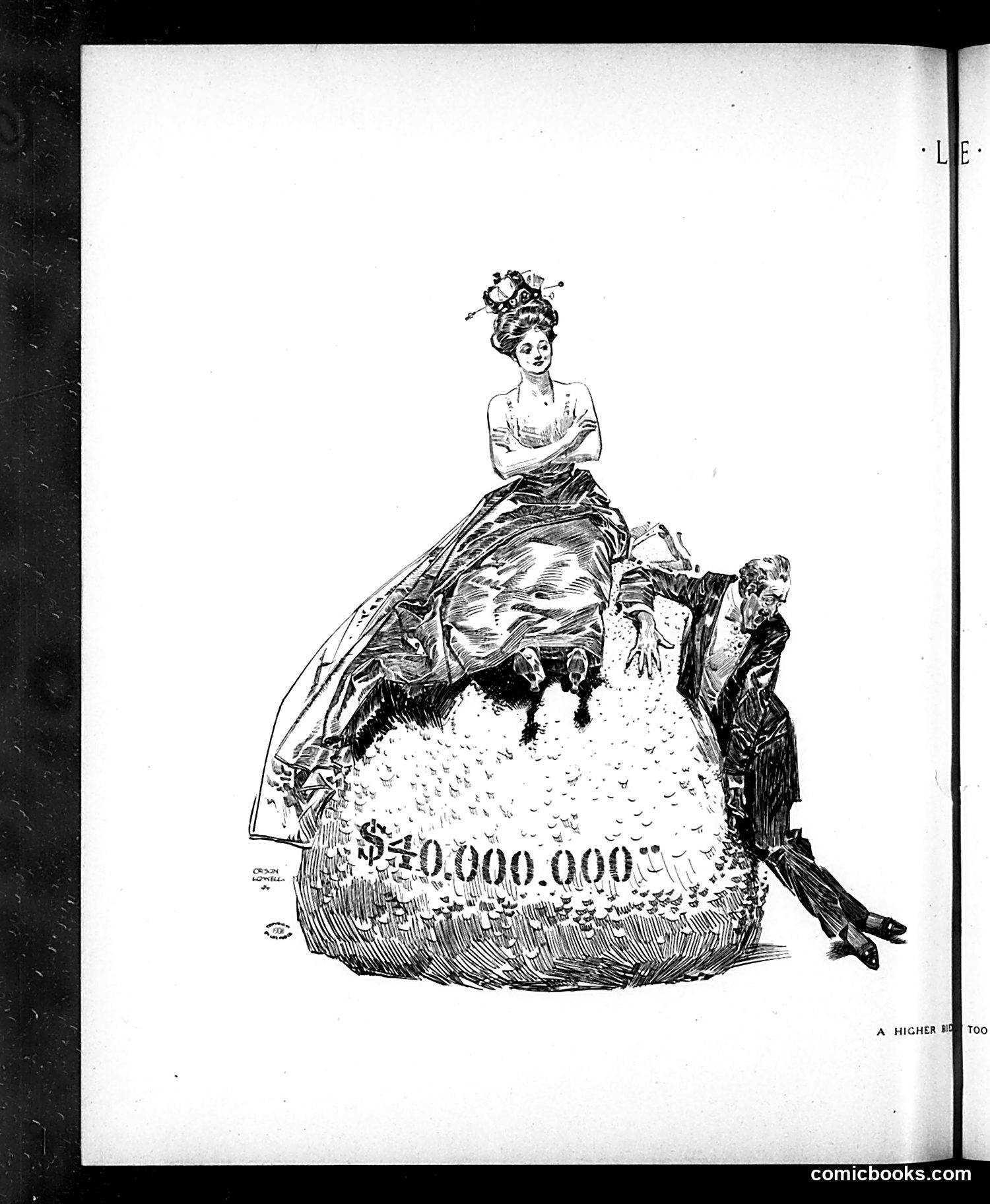
This is a satirical cartoon depicting wealth inequality. A fashionably dressed woman sits atop an enormous money bag labeled "$40,000,000," her elaborate gown and coiffure suggesting aristocratic excess. Two men in formal attire strain to support or manage this massive sum beneath her—one appears to be struggling underneath the weight. The caption reads "A HIGHER FE[E] TOO," suggesting criticism of rising fees or costs, likely for some service or institution. The cartoon's message critiques how vast fortunes enable the wealthy to sit comfortably while working men literally carry the burden of maintaining such enormous wealth. The style and Life magazine context suggest this is early 20th-century American satire addressing class tensions and economic disparity of the era.
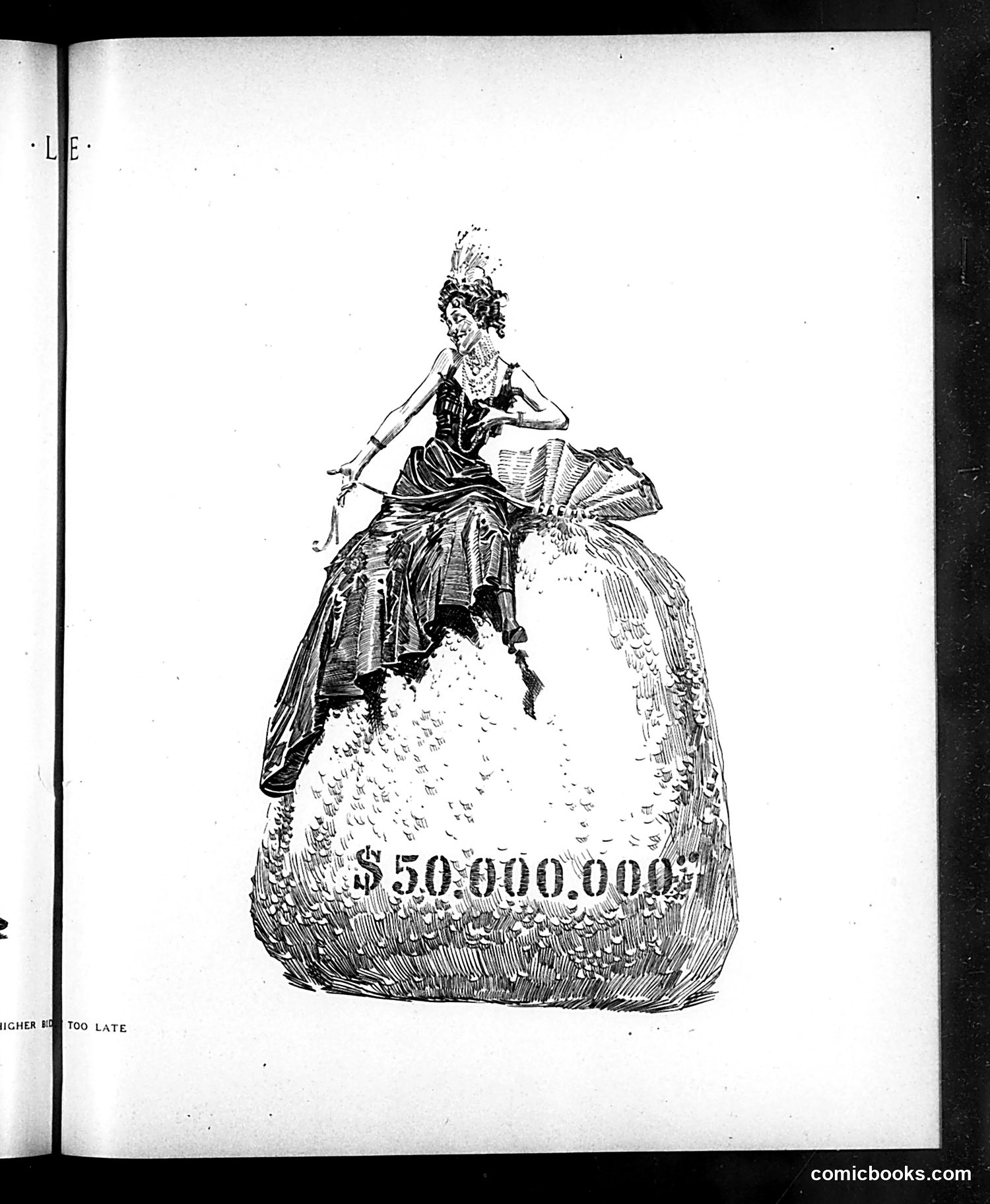
This is a satirical illustration from *Life* magazine showing an elegantly dressed woman seated atop an enormous moneybag labeled "$50,000,000." The woman wears an ornate gown, elaborate headdress, and holds a fan—imagery associated with wealthy leisure-class femininity. The cartoon critiques extreme wealth accumulation and inequality, likely targeting either a specific wealthy heiress or symbolizing the "gilded age" wealthy in general. The enormous sum dwarfs the human figure, emphasizing how wealth has become grotesquely disproportionate. The woman's decorative appearance suggests criticism of frivolous spending and conspicuous consumption by the ultra-wealthy. The partial text "TOO LATE" at bottom (likely part of a larger caption) remains unclear without additional context, but appears to comment on some missed opportunity or inevitable outcome related to such vast fortunes.
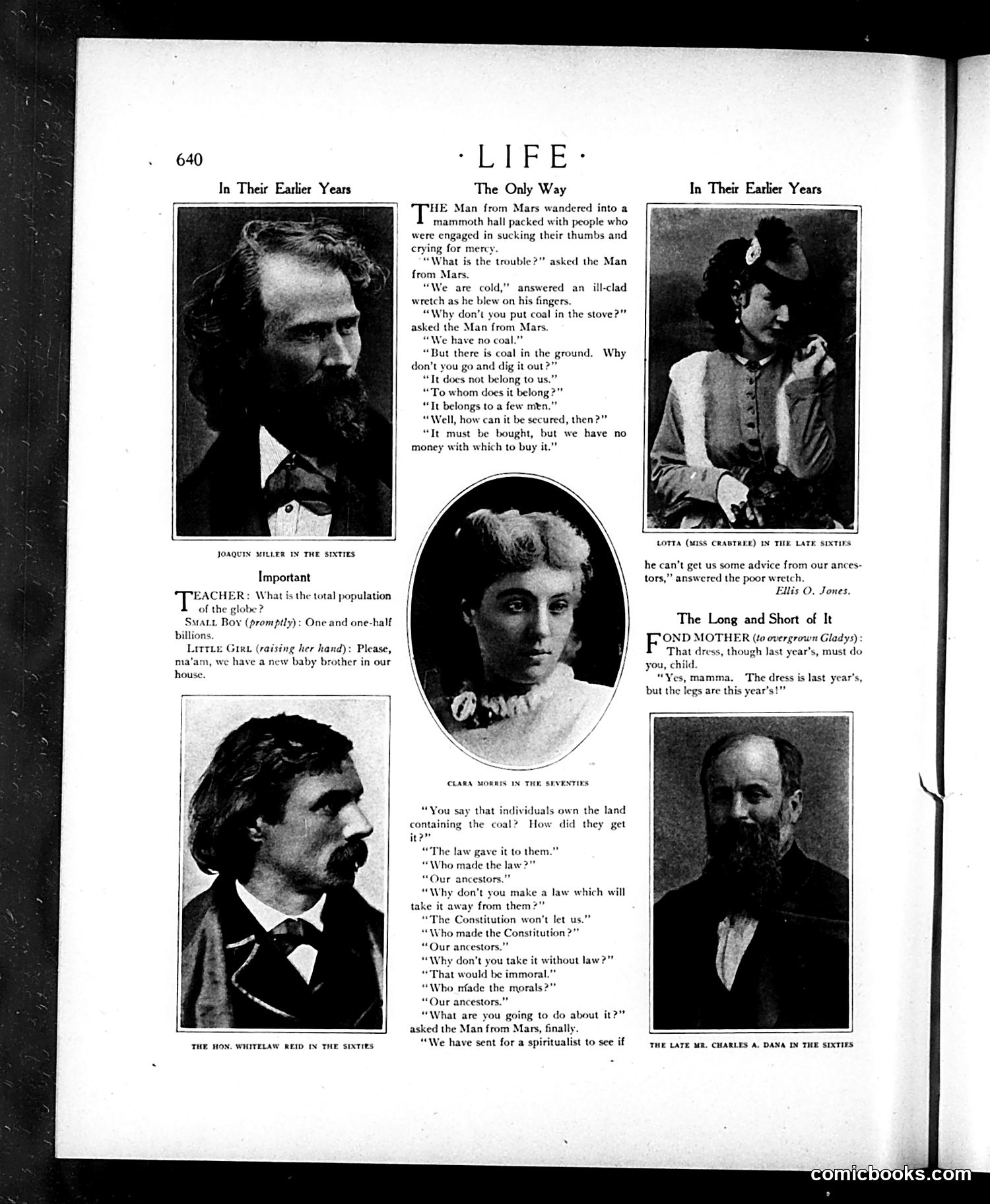
This page contains two satirical pieces from Life's "In Their Earlier Years" section, featuring historical photographs paired with humorous anecdotes. **"The Only Way"** mocks a Martian visitor's confusion about Earth's economic system. The wretch cannot understand why coal exists underground but poor people cannot access it—especially when "a few men" own it and lack money to buy it anyway. The satire targets private property rights and wealth inequality: the absurdity of resources existing but being inaccessible to those in need. **"Important"** and **"The Long and Short of It"** are brief humorous exchanges about teaching and clothing. The identifiable figures include Joaquin Miller, Lotta Crabtree, Clara Morris, Whitelaw Reid, and Charles A. Dana—all prominent 19th-century figures shown in their younger years.
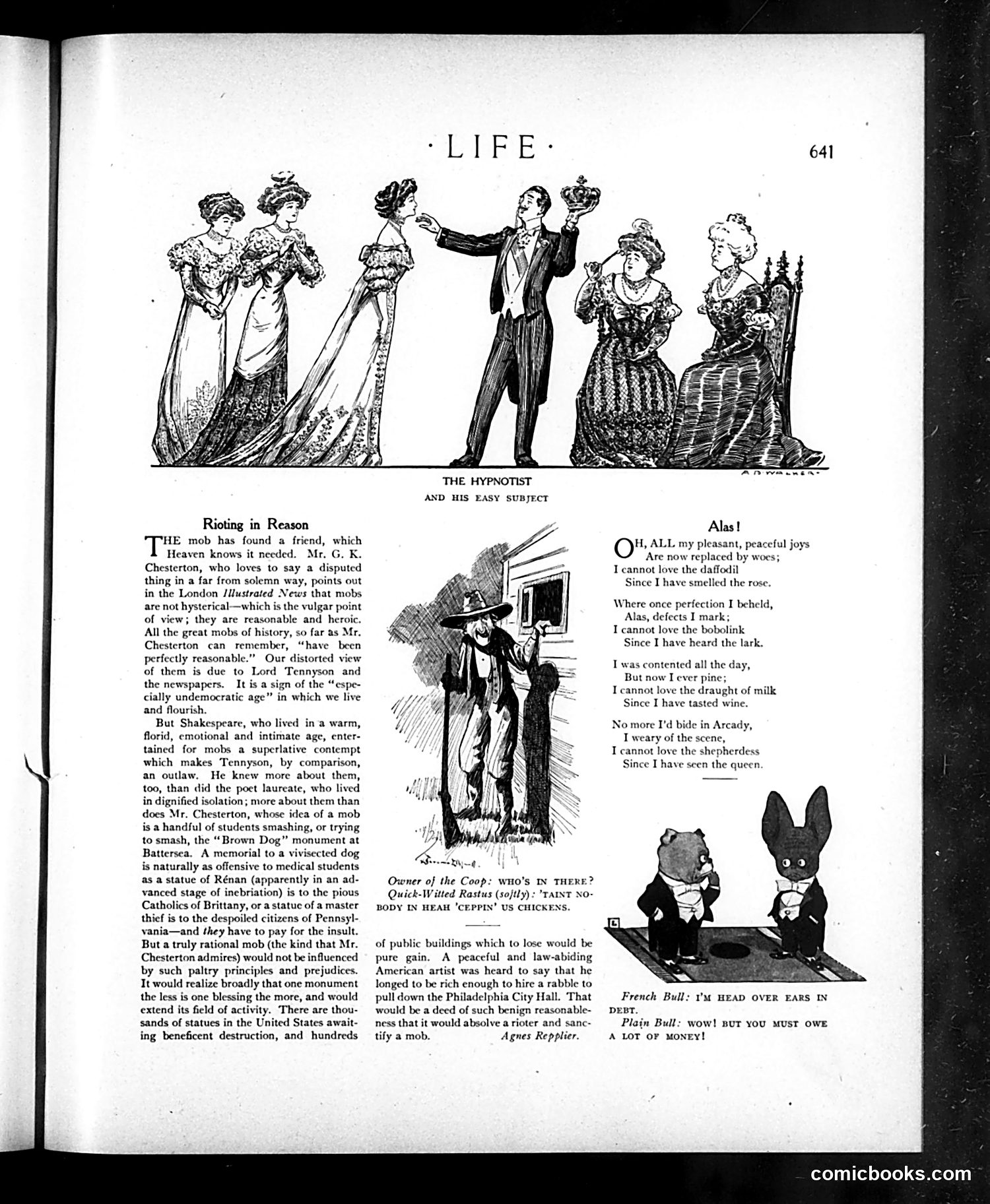
This cartoon satirizes public gullibility and mob mentality. The top illustration shows a hypnotist in formal dress controlling several women, depicting how easily crowds can be manipulated or swayed by charismatic figures. The left column, "Rioting in Reason," discusses monuments and mob behavior, referencing Mr. Chesterton's views on mobs as "reasonable and heroic" compared to Shakespeare's portrayal. It argues that destroying statues benefits society more than preserving them. The right column contains poetry titled "Alas!" expressing disillusionment with lost ideals and perfection. Below are comic dialogue snippets featuring animals (dogs/cats) making puns about debt and money, providing light comic relief contrasting with the serious upper content about social manipulation and mob justice.
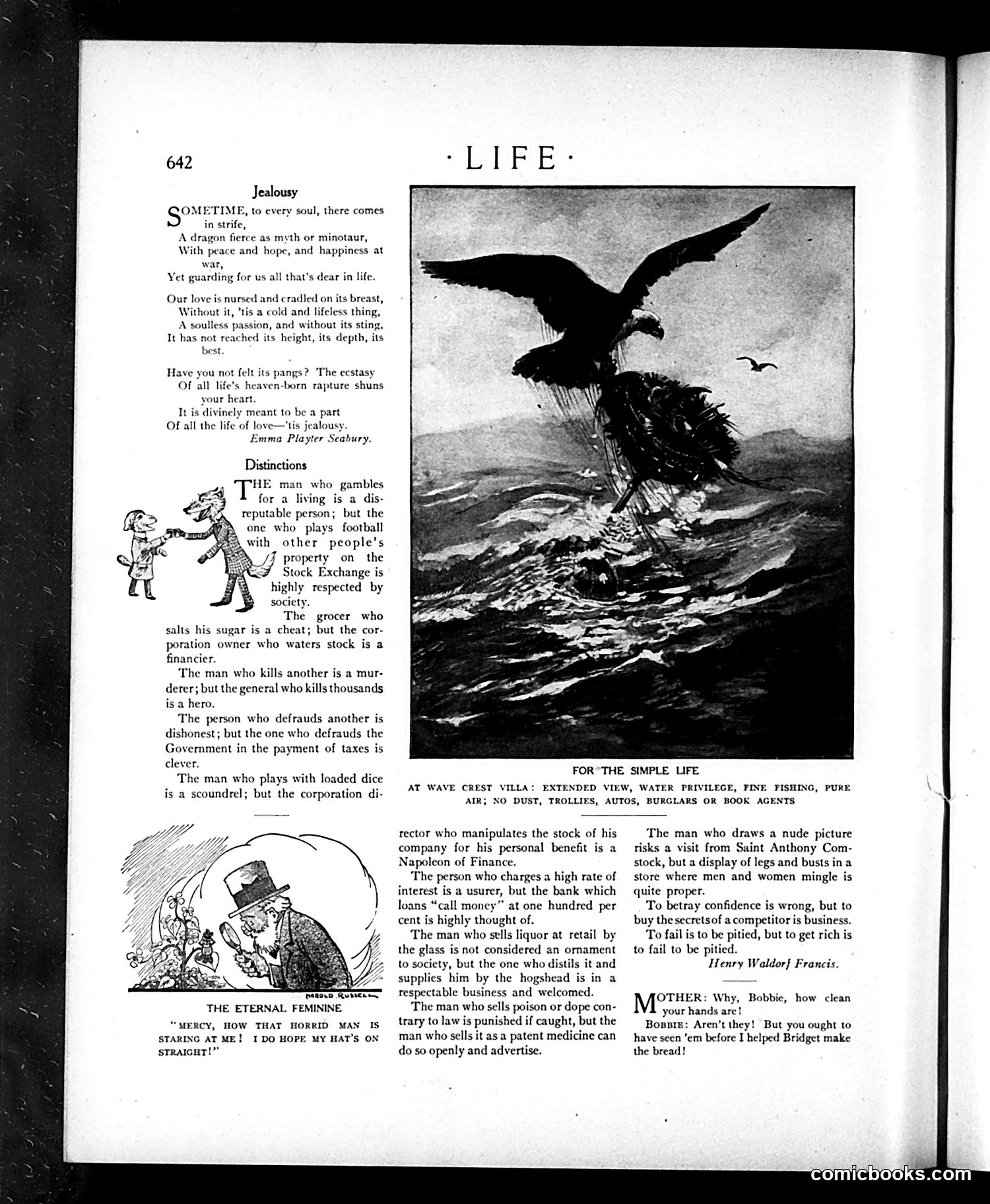
This page contains two distinct pieces of satire: **"Distinctions"** is a moral commentary using parallel structure to expose hypocrisy in Gilded Age society. It contrasts criminal or unethical behavior by ordinary people with socially-respected versions of the same acts by the wealthy and powerful. Examples: a grocer adulterating sugar is dishonest, but a corporation "watering stock" (inflating value fraudulently) is called "financier"; killing one person is murder, but military killing is heroic; retail liquor sales are disreputable, but wholesale distilling is "respectable business." The satire targets how society applies double standards based on class—condemning poor people's crimes while celebrating rich people's identical ones. **"The Eternal Feminine"** shows a woman obsessing over her appearance while claiming not to care ("I do hope my hat's on straight!") while a man stares—satirizing female vanity and pretense. Both pieces critique social hypocrisy, though the first targets economic corruption and class bias, while the second targets gender stereotypes.
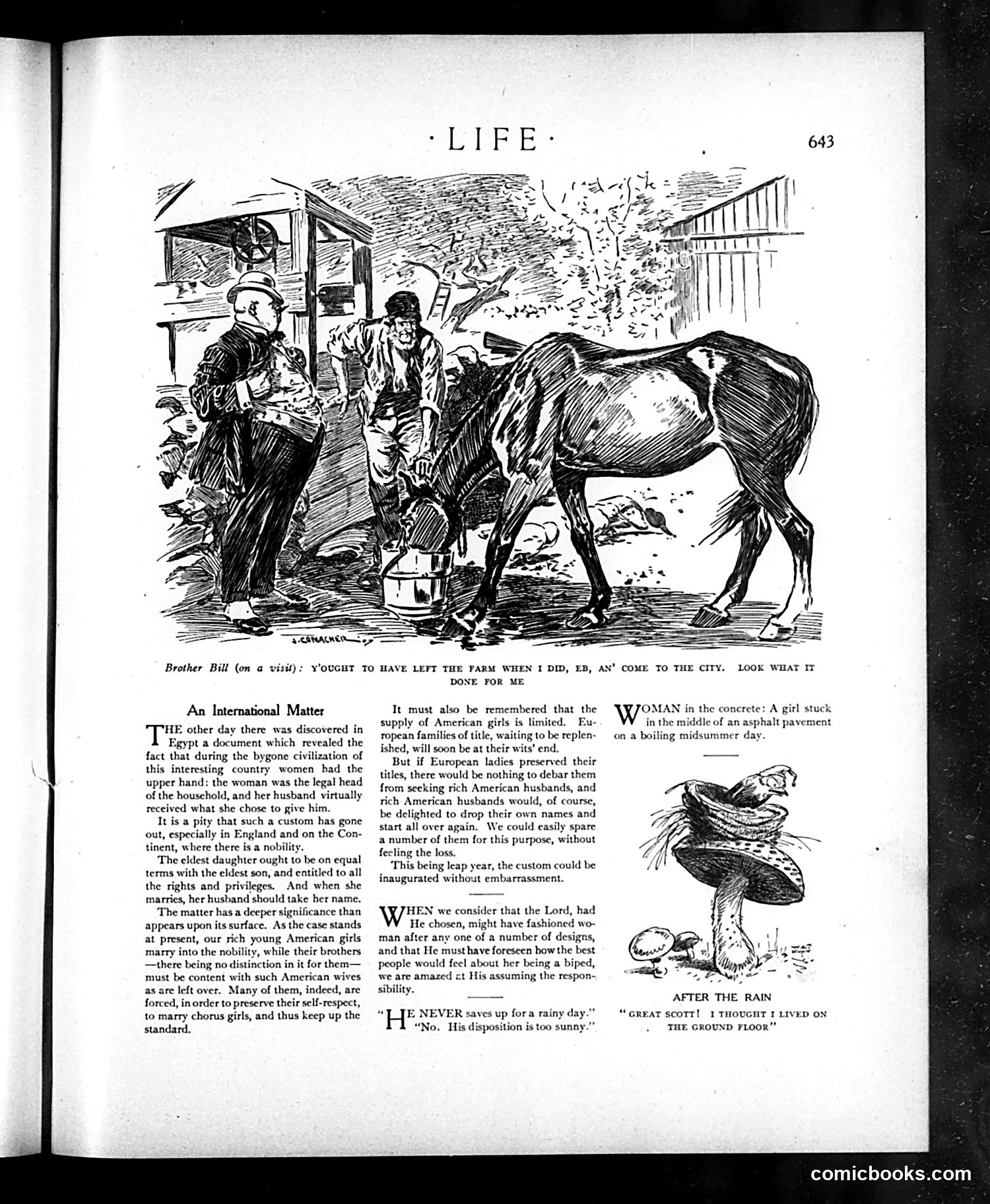
The page contains two distinct pieces: **Main Cartoon & Article**: "Brother Bill (on a visit)" satirizes rural-urban migration. A city visitor urges his farm brother "Eb" to abandon farming for city life, while a cow stands nearby—the implication being that rural life is inferior or less prosperous. The accompanying article titled "An International Matter" ironically proposes that American inheritance laws should follow ancient Egypt's model, giving daughters equal rights to sons. It sarcastically argues this would benefit wealthy American heiresses marrying European nobility, while also allowing European titled women to marry American men. The satire critiques both American social climbing and European aristocratic desperation for American wealth. **Bottom Cartoons**: Two brief sight-gags about urban mishaps—a woman stuck in hot asphalt pavement, and someone confused about their ground-floor apartment location after rain. These are simple observational humor unrelated to the main content. The page reflects early 20th-century anxieties about American wealth, class mobility, and gender roles.
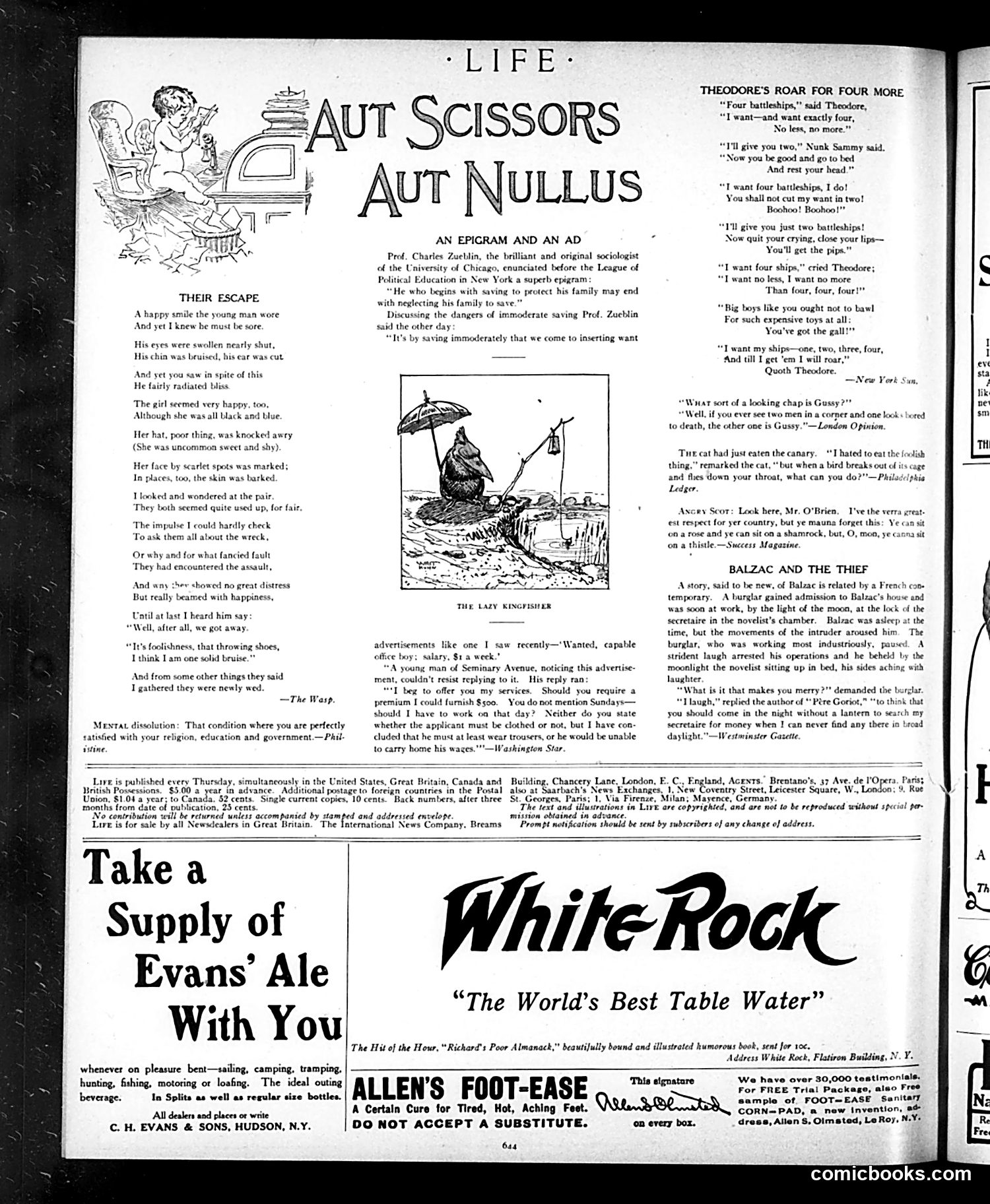
This page from *Life* magazine contains multiple satirical pieces typical of early 20th-century American humor: **"Their Escape"** (poem): A newlywed couple, both visibly bruised and battered, seem unusually happy despite their injuries. The joke plays on Victorian-era prudishness—readers would understand the "wreck" and "assault" as euphemisms for the couple's wedding night. Their contentment despite physical evidence of rough treatment satirizes both marital expectations and social hypocrisy about discussing such matters. **"Theodore's Roar for Four More"**: A political satire featuring Theodore Roosevelt (identifiable as "Theodore") demanding four battleships from "Nunk Sammy" (Uncle Sam/the U.S. government). Roosevelt, known for aggressive military expansion, is mocked as a petulant child throwing tantrums over naval spending—criticizing his imperialist ambitions. **Remaining items** are brief witticisms and anecdotes on various topics, followed by period advertisements. The page exemplifies *Life*'s satirical approach: poking fun at politicians, marriage customs, and social pretenses through humor accessible to educated readers.
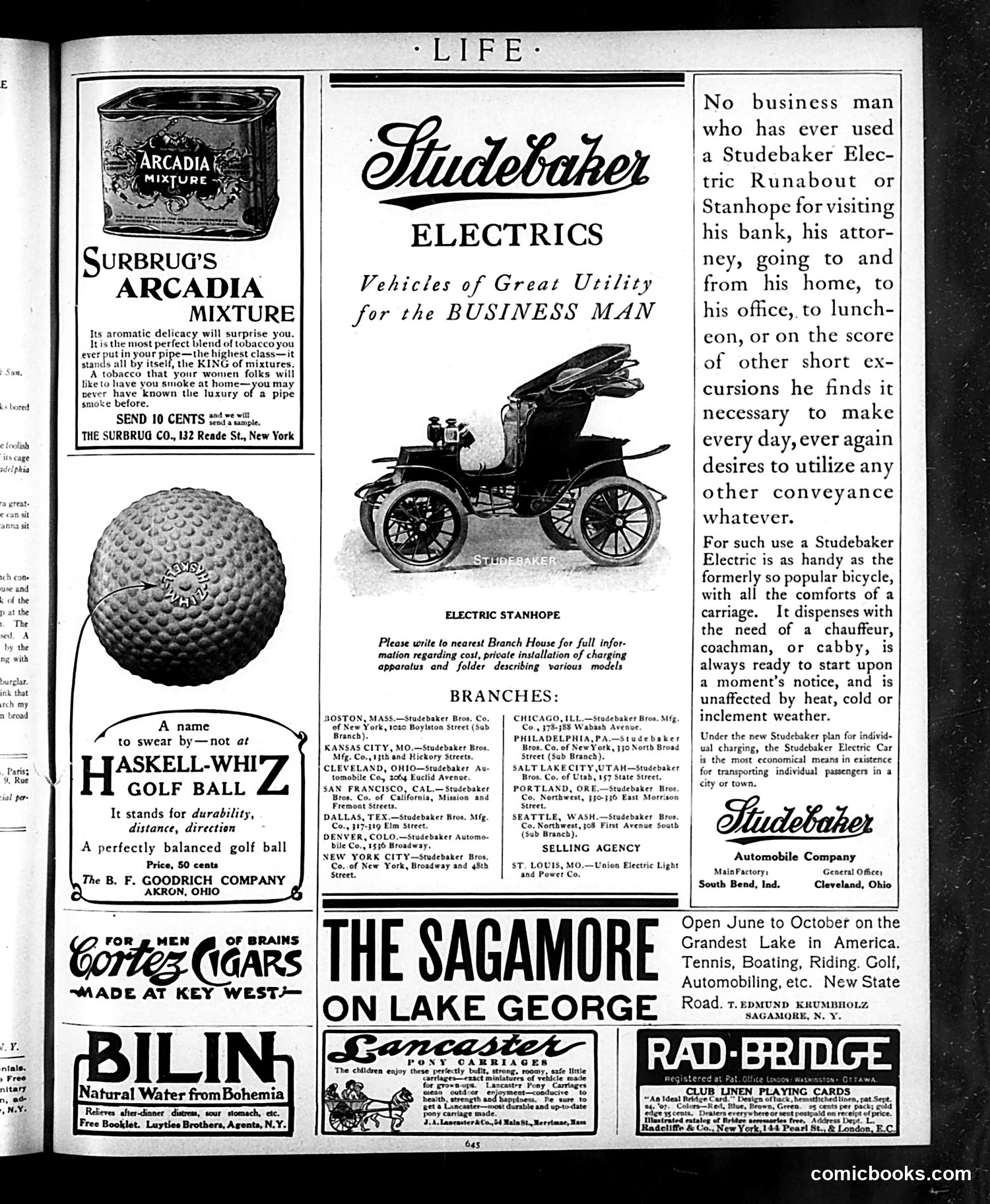
This is primarily an **advertising page** from an early 1900s issue of Life magazine, not a satirical cartoon page. The main content promotes **Studebaker Electric automobiles** to businessmen, positioning electric vehicles as practical for short urban trips—replacing the need for hired drivers ("chauffeur, coachman, or cabby"). The appeal emphasizes convenience, reliability, and economical operation. Supporting advertisements include: - **Surbrug's Arcadia Mixture** tobacco (marketed as superior pipe tobacco) - **Haskell-Whiz Golf Ball** (emphasizing durability) - **Cortez Cigars** (branded "for men of brains") - **The Sagamore** resort (leisure destination) - **Bilin** mineral water and other products The **satire, if any, is subtle**—Life's implicit message appears to be that modern businessmen should adopt progressive technologies (electric cars) while maintaining traditional leisure pursuits (golf, boating). This reflects early-1900s optimism about technology and the emerging automobile industry.
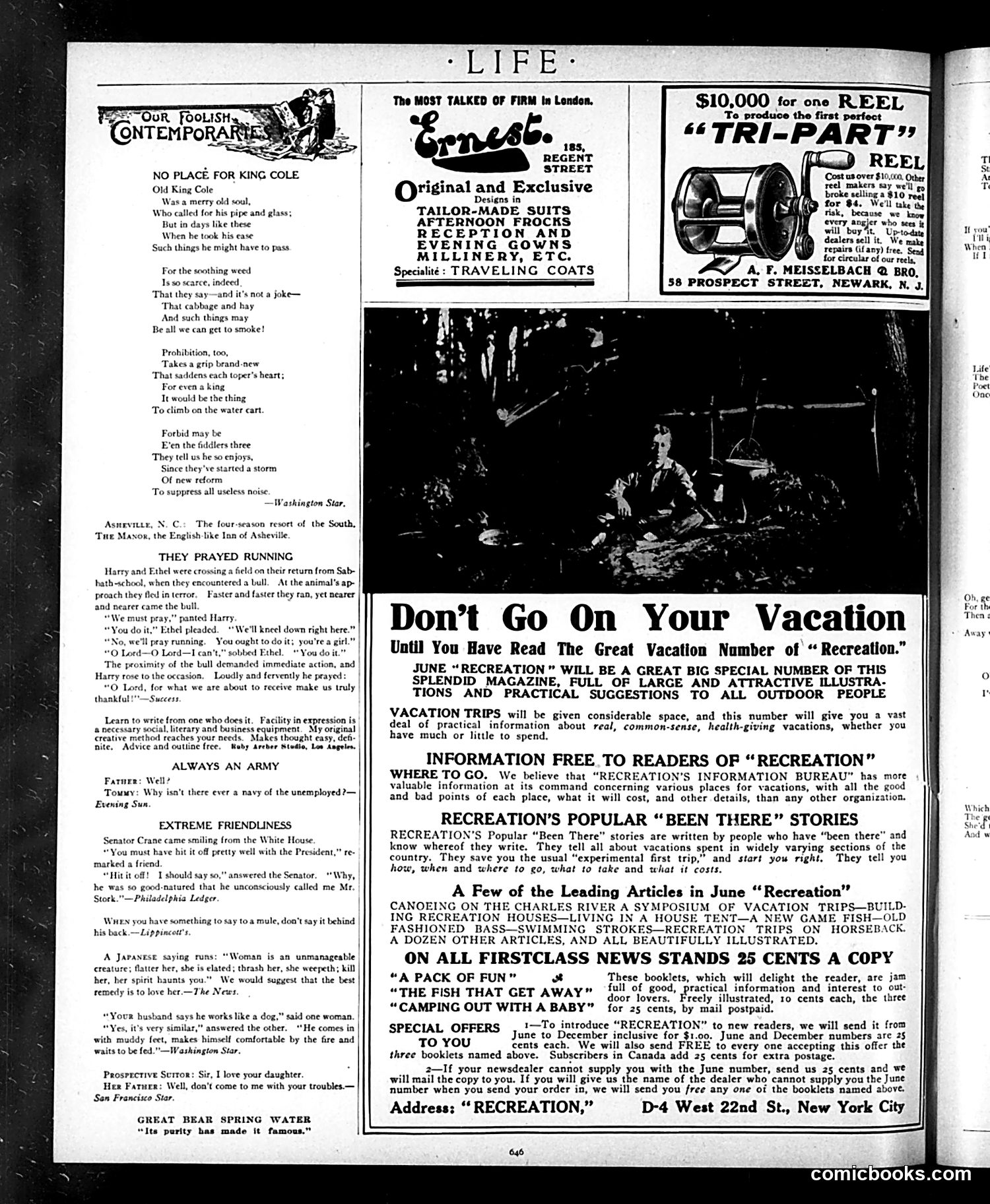
This page from Life magazine contains several satirical short pieces and advertisements from the early 20th century. The main cartoon, "NO PLACE FOR KING COLE," modernizes the nursery rhyme to mock **Prohibition and reform movements**. The satire suggests that King Cole—traditionally a carefree figure—cannot enjoy his pipes, tobacco, or companions because reformers have banned smoking and alcohol. References to "soothing weed" becoming scarce and cabbage replacing tobacco, plus prohibition "taking a grip," ridicule both substance bans and the broader "reform" impulse to suppress "useless noise." Other brief humorous pieces mock contemporary social conventions: a joke about praying while fleeing a bull, a quip about unemployment, and various observations about gender relations and social behavior—typical Life magazine fare. The page is largely **advertisements** for tailor-made suits, fishing reels, and vacation magazines, reflecting early 1900s consumer culture and leisure activities. The overall tone satirizes Progressive Era reforms and their perceived excesses.
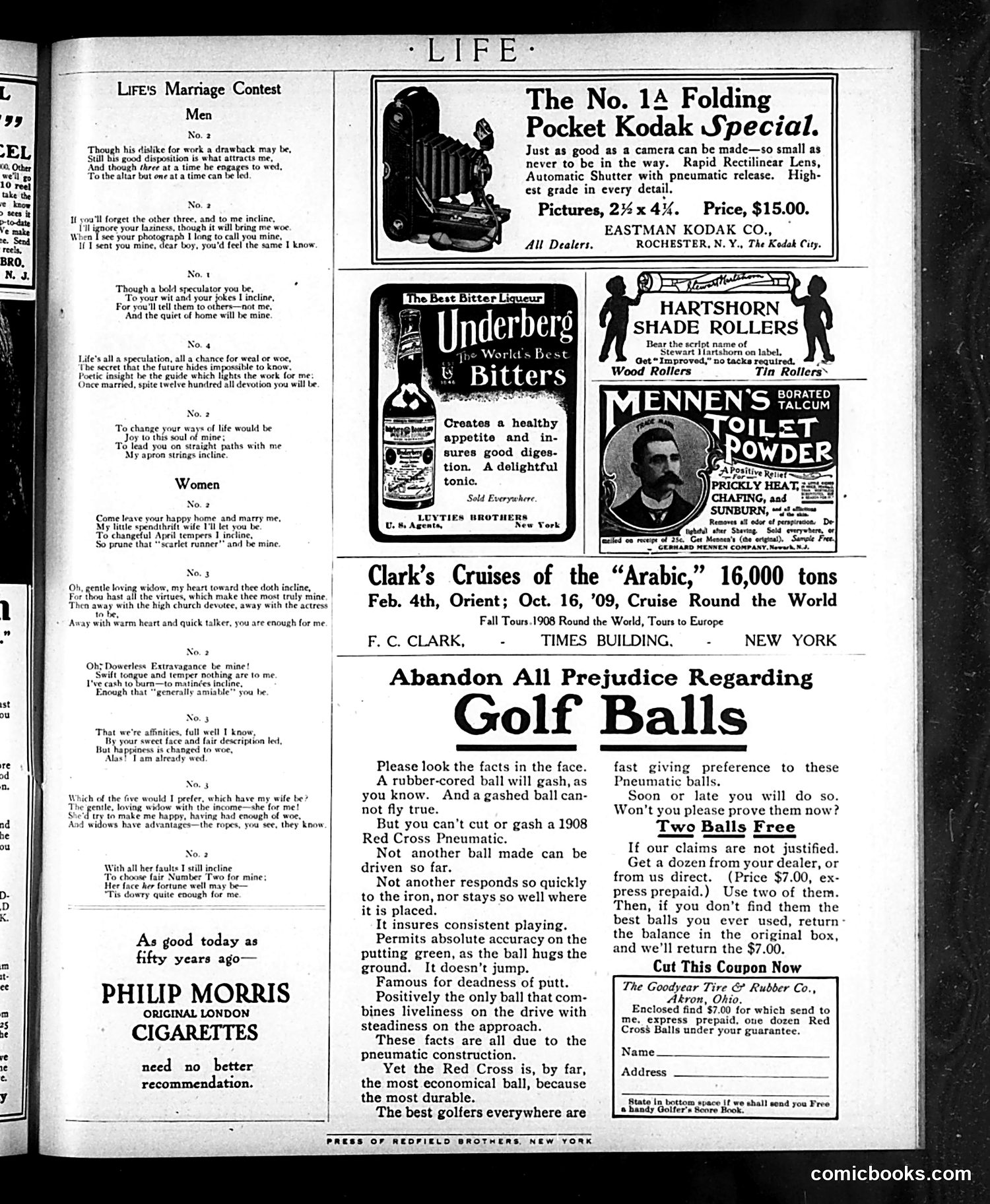
This page is primarily **advertising and commercial content**, not political satire. The top left contains "Life's Marriage Contest"—humorous romantic verses where men and women propose idealized (often mercenary) marriage candidates. These represent period gender stereotypes: men valuing domestic service and beauty, women valuing financial security. The bulk of the page features product advertisements typical of early 1900s Life magazine: Kodak cameras, Underberg Bitters, Hartshorn Shade Rollers, Mennen's Talcum Powder, Philip Morris cigarettes, and a lengthy advertisement for Red Cross Pneumatic golf balls. The golf ball ad's emphasis on proving superiority—offering "Two Balls Free" and promising a $7 refund if customers aren't satisfied—reflects early 20th-century competitive consumer marketing and the emerging reliability concerns with pneumatic (air-filled) versus solid golf balls. This is fundamentally a **commercial publication**, not a political cartoon page. The "satire" is gentle social commentary on marriage attitudes, not political critique.
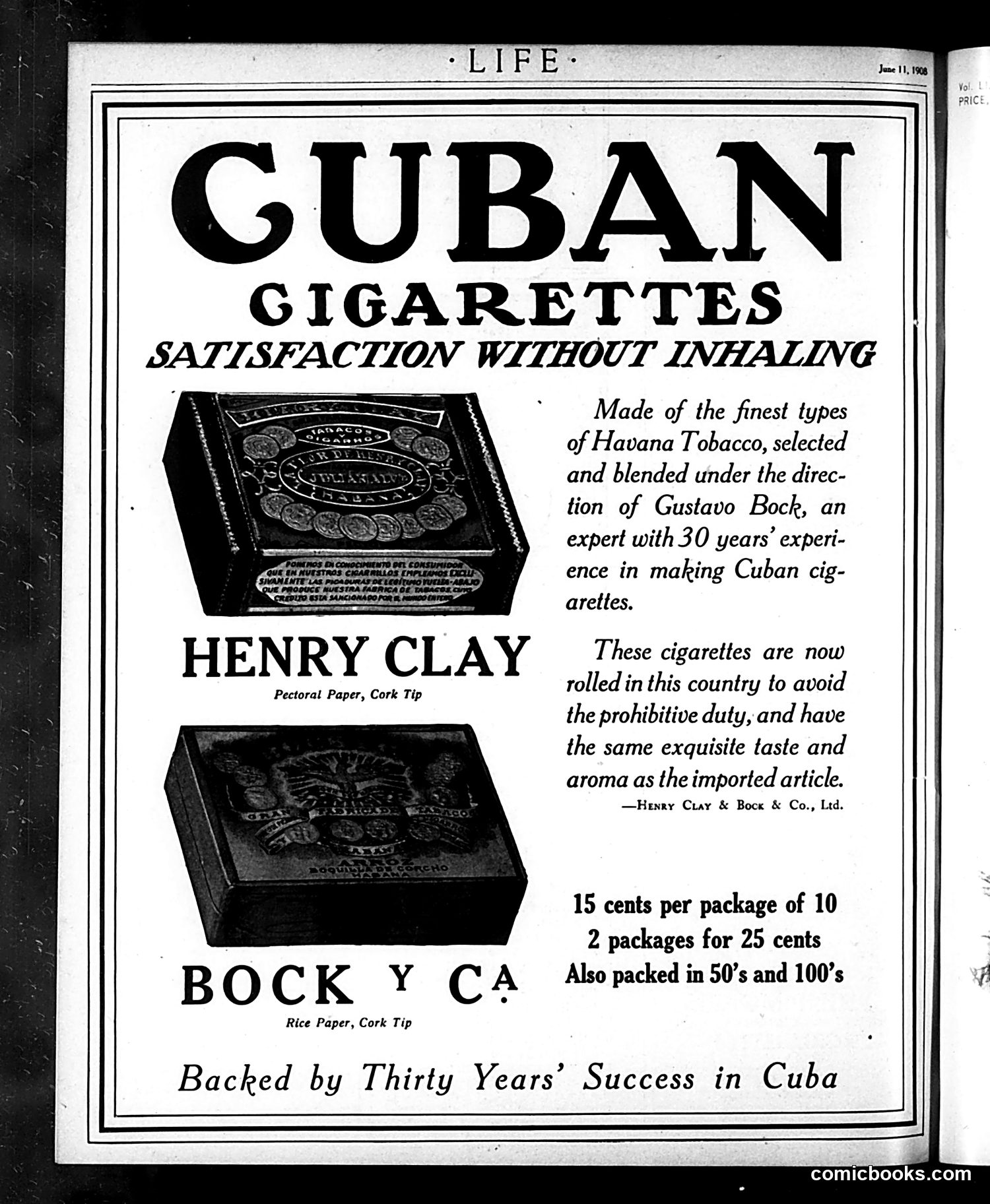
This is an advertisement, not a cartoon. It promotes Cuban cigarettes made by Henry Clay & Bock & Co., dated June 11, 1908. The ad addresses a specific historical context: U.S. tariffs on imported Cuban cigars were prohibitively expensive. The manufacturer's solution was to roll these cigarettes *in America* using Cuban tobacco, thereby avoiding the import duty while claiming to preserve the authentic taste and aroma of imported products. The two brand names shown—"Henry Clay" and "Bock y Ca" (Bock y Compañía)—represent the company's offerings. The tagline "Satisfaction Without Inhaling" is oddly phrased for modern readers but reflects early-20th-century marketing addressing health concerns about smoking. The "Thirty Years' Success in Cuba" references the company's established reputation, lending credibility to a domestically-manufactured alternative to costly imports.