
Life, 1908-06-11 · page 9 of 20
Life — June 11, 1908 — page 9: what you’re looking at
What you’re looking at
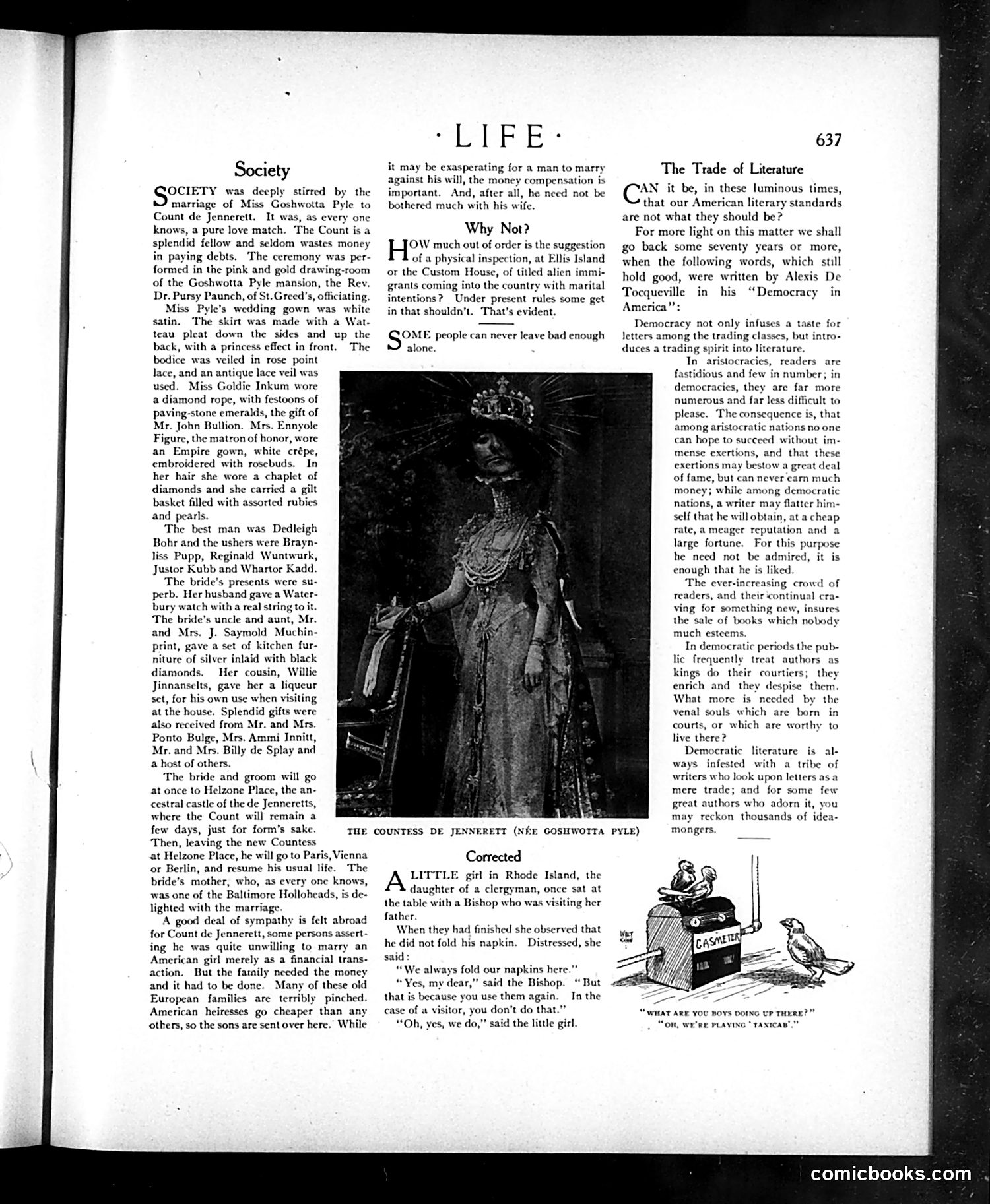
This page contains two distinct sections: **Left column ("Society"):** Reports on the wedding of Miss Goshwatta Pyle to Count de Jennerett, describing the elaborate ceremony and guest list. This appears to be satirizing wealthy American heiresses marrying European nobility—a common practice where American money purchased aristocratic titles. **Right side:** "The Trade of Literature" critiques how democratic societies treat authors. The essay argues that unlike aristocratic nations, democracies produce many mediocre writers competing for readers, allowing even inferior authors to achieve modest financial success through popular appeal rather than merit. **Bottom cartoon:** A simple domestic joke showing children playing "farceau" (possibly "farce"?), with an adult asking what they're doing. The humor appears to rely on wordplay or situational comedy typical of Life's era.
📄 Transcribed text from this page (OCR, searchable)
Machine-transcribed from the original scan — historical spelling and the odd misread are preserved.
Society OCIETY was deeply stirred by the marriage of Miss Goshwotta Pyle to Count de Jennerett. It was, as every one knows, a pure love match. The Count is a splendid fellow and seldom wastes money in paying debts. The ceremony was per- formed in the pink and gold drawing-room of the Goshwotta Pyle mansion, the Rev. Dr. Pursy Paunch, of St.Greed’s, officiating. Miss Pyle’s wedding gown was white satin. The skirt was made with a Wat- teau pleat down the sides and up the back, with a princess effect in front. The bodice was veiled in rose point lace, and an antique lace veil was used. Miss Goldie Inkum wore a diamond rope, with festoons of paving-stone emeralds, the gift of Mr. John Bullion. Mrs. Ennyole Figure, the matron of honor, wore an Empire gown, white crépe, embroidered with rosebuds. In her hair she wore a chaplet of diamonds and she carried a gilt basket filled with assorted rubies and pearls. The best man was Dedleigh Bohr and the ushers were Brayn- liss Pupp, Reginald Wuntwurk, Justor Kubb and Whartor Kadd. ‘The bride’s presents were su- perb. Her husband gave a Water- bury watch with a real string to i The bride’s uncle and aunt, Mr. and Mrs. J. Saymold Muchin- print, gave a set of kitchen fur- niture of silver inlaid with black diamonds. Her cousin, Willie Jinnanselts, gave her a liqueur set, for his own use when visiting at the house. Splendid gifts were also received from Mr. and Mrs. Ponto Bulge, Mrs. Ammi Innitt, Mr. and Mrs. Billy de Splay and a host of others. ‘The bride and groom will go at once to Helzone Place, the an- cestral castle of the de Jenneretts, where the Count will remain a few days, just for form’s sake. Then, leaving the new Countess at Helzone Place, he will go to Paris, Vienna or Berlin, and resume his usual life. ‘The bride's mother, who, as every one knows, was one of the Baltimore Holloheads, is de- lighted with the marriage. ‘A good deal of sympathy is felt abroad for Count de Jennerett, some persons assert- ing he was quite unwilling to marry an American girl merely as a financial trans- action. But the fatnily needed the money and it had to be done. Many of these old European families are terribly pinched. American heiresses go cheaper than any others, so the sons are sent over here. While “LE Bs it may be exasperating for a man to marry against his will, the money compensation is important. And, after all, he need not be bothered much with his wife. Why Not? OW much out of order is the suggestion of a physical inspection, at Ellis Island or the Custom House, of titled alien immi- grants coming into the country with marital intentions? Under present rules some get in that shouldn't. That's evident. GOME people can never leave bad enough alone. Corrected LITTLE girl in Rhode Island, the daughter of a clergyman, once sat at the table with a Bishop who was visiting her father. When they had finished she observed that he did not fold his napkin. Distressed, she said: “We always fold our napkins here.” “Yes, my dear,” said the Bishop. “ But that is because you use them again. In the case of a visitor, you don't do that.” “Oh, yes, we do,” said the little girl. 637 The Trade of Literature AN it be, in these luminous times, that our American literary standards are not what they should be? For more light on this matter we shall go back some seventy years or more, when the following words, which still hold good, were written by Alexis De Tocqueville in his “Democracy in America”: Democracy not only infuses a taste for letters among the trading classes, but intro- duces a trading spirit into literature, In aristocracies, readers are fastidious and few in number; in democracies, they are far more numerous and far less difficult to please. The consequence is, that among aristocratic nations no one can hope to succeed without im- mense exertions, and that these exertions may bestow a great deal of fame, but can never carn much money; while among democratic nations, a writer may flatter him- self that he will obtain, at a cheap rate, a meager reputation and a large fortune. For this purpose he need not be admired, it is enough that he is liked. The ever-increasing crowd of readers, and their continual cra- ving for something new, insures the sale of books which nobody much esteems. In democratic periods the pub- lic frequently treat authors as kings do their courtiers; they enrich and they despise them. What more is necded by the venal souls which are born in courts, or which are worthy to live there? Democratic literature is al- ways infested with a tribe of writers who look upon lette mere trade; and for some few great authors who adorn it, you may reckon thousands of idea- $a THE COUNTESS DE JENNERETT (NEE GOSHWOTTA PYLE) mongers. “WHAT ARE YOU BOYS DOING UP THER! “OM, WE'RE PLAYING ‘ TANTCAB’."” comicbooks.com