
Life, 1908-06-11 · page 15 of 20
Life — June 11, 1908 — page 15: what you’re looking at
What you’re looking at
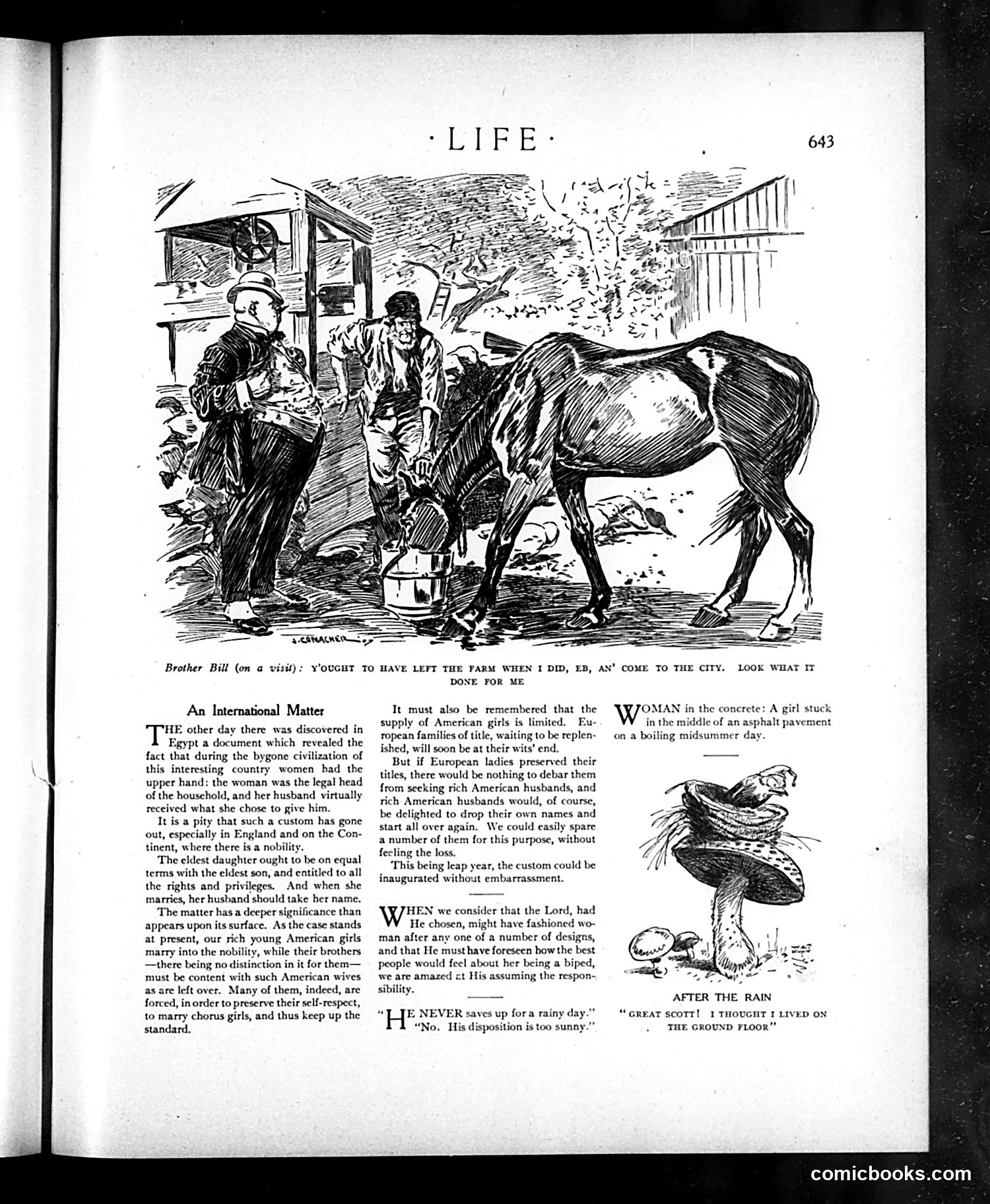
The page contains two distinct pieces: **Main Cartoon & Article**: "Brother Bill (on a visit)" satirizes rural-urban migration. A city visitor urges his farm brother "Eb" to abandon farming for city life, while a cow stands nearby—the implication being that rural life is inferior or less prosperous. The accompanying article titled "An International Matter" ironically proposes that American inheritance laws should follow ancient Egypt's model, giving daughters equal rights to sons. It sarcastically argues this would benefit wealthy American heiresses marrying European nobility, while also allowing European titled women to marry American men. The satire critiques both American social climbing and European aristocratic desperation for American wealth. **Bottom Cartoons**: Two brief sight-gags about urban mishaps—a woman stuck in hot asphalt pavement, and someone confused about their ground-floor apartment location after rain. These are simple observational humor unrelated to the main content. The page reflects early 20th-century anxieties about American wealth, class mobility, and gender roles.
📄 Transcribed text from this page (OCR, searchable)
Machine-transcribed from the original scan — historical spelling and the odd misread are preserved.
Brother Bill (on a visit): Y'OUGHT TO HAVE LEFT THE FARM WHEN I DID, EB, AN’ COME TO THE CITY. An International Matter 'HE other day there was discovered in Egypt a document which revealed the fact that during the bygone civilization of this interesting country women had the upper hand: the woman was the legal head of the household, and her husband virtually received what she chose to give him. It is a pity that such a custom has gone out, especially in England and on the Con- tinent, where there is a nobility. The eldest daughter ought to be on equal terms with the eldest son, and entitled to all the rights and privileges. And when she marries, her husband should take her name. ‘The matter has a deeper significance than appears upon its surface. As the case stands at present, our rich young American girls marry into the nobility, while their brothers —there being no distinction in it for them— must be content with such American wives as are left over. Many of them, indeed, are forced, in order to preserve their self-respect, to marry chorus girls, and thus keep up the standard, DONE FOR ME It must also be remembered that the supply of American girls is limited. Eu- ropean families of title, waiting to be replen- ished, will soon be at their wits’ end, But if European ladies preserved their titles, there would be nothing to debar them from seeking rich American husbands, and rich American husbands would, of course, be delighted to drop their own names and start all over again. We could easily spare a number of them for this purpose, without ing the loss. his being leap year, the custom could be inaugurated without embarrassment. HEN we consider that the Lord, had He chosen, might have fashioned wo- man after any one of a number of designs, and that He must have foreseen how the best people would feel about her being a biped, we are amazed ct His assuming the respon- sibility. "H NEVER saves up fora rainy day.” ‘No. His disposition is too sunny. ill yay | ‘i LOOK WHAT IT Ww: N in the concrete: A girl stuck in the middle of an asphalt pavement on a boiling midsummer day. AFTER THE RAIN “GREAT SCOTT! I THOUGHT I LIVED ON THE GROUND FLOOR” comicbooks.com