
Life, 1908-06-11 · page 4 of 20
Life — June 11, 1908 — page 4: what you’re looking at
What you’re looking at
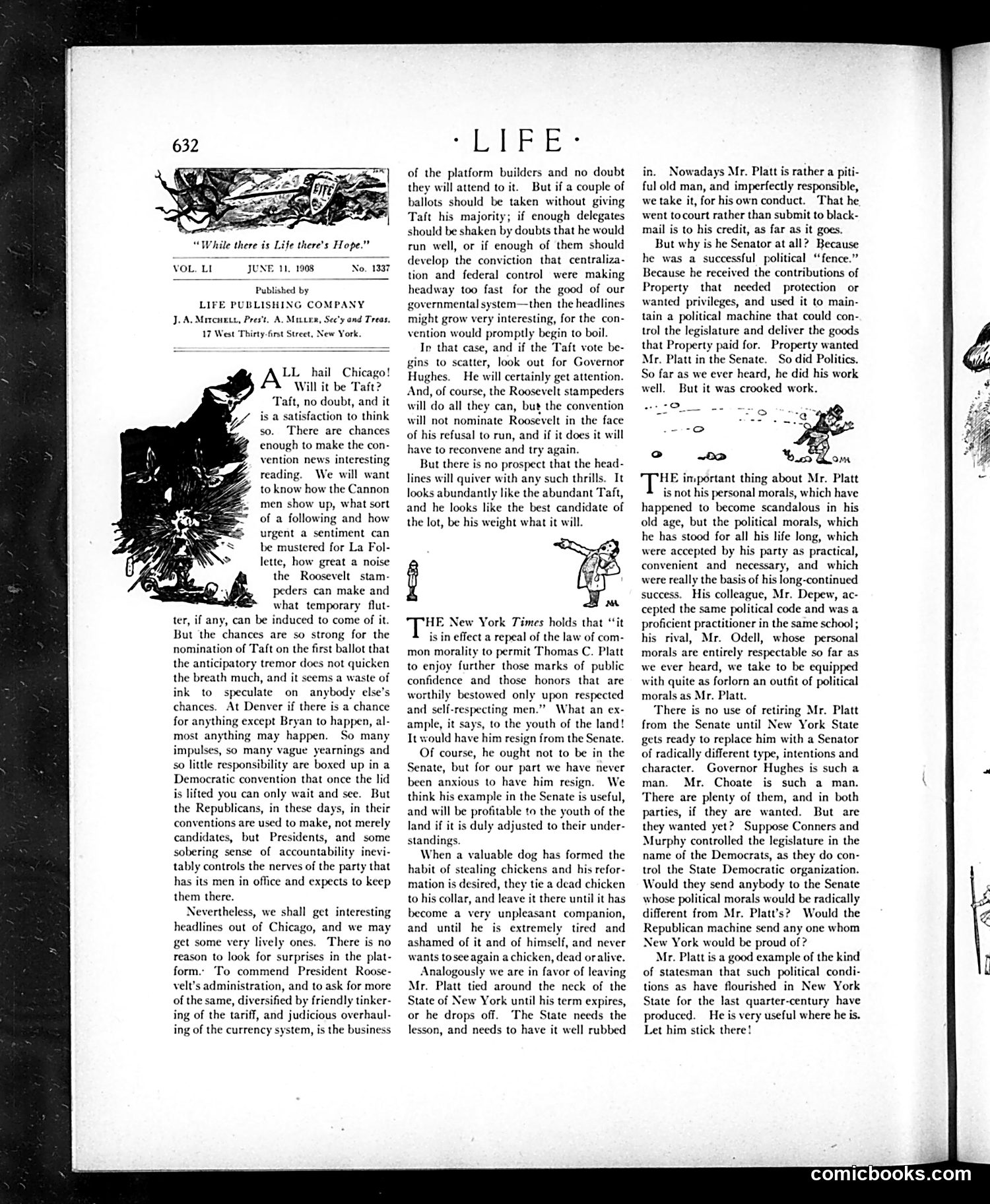
**The Main Cartoon** (top left) depicts a large figure labeled "Taft" alongside smaller figures representing "platform builders." The satire mocks how Republican convention delegates might manipulate nominee William Howard Taft, suggesting his policies could be shaped like clay. **The Article's Message**: Life argues that while Taft appears the best Republican candidate, party operatives (including Roosevelt's supporters) risk controlling him too heavily. The piece warns Democrats shouldn't expect Taft to resign or cause major upheaval, though anything could happen at conventions. **Historical Context**: This addresses the 1908 Republican convention and President Roosevelt's chosen successor. Life suggests Taft, while seemingly solid, might become a "fence" protecting political machinery rather than independent leadership—a concern about party control over individual politicians.
📄 Transcribed text from this page (OCR, searchable)
Machine-transcribed from the original scan — historical spelling and the odd misread are preserved.
“While there is Life there's Hope.” VOL. LI JUNE 11, 1908 Published by LIFE PUBLISHING COMPANY J. A. Mircnntt, Pres't. A. Miter, Sec’y and Treas, 17 West Thirty-first Street, New York, LL hail Chicago! Will it be Taft? Taft, no doubt, and it a satisfaction to think so. There are chances enough to make the con- vention news interesting reading. We will want to know how the Cannon men show up, what sort of a following and how urgent a sentiment can be mustered for La Fol- lette, how great a noise the Roosevelt stam- peders can make and 4 what temporary flut- ter, if any, can be induced to come of it. But the chances are so strong for the nomination of Taft on the first ballot that the anticipatory tremor does not quicken the breath much, and it seems a waste of ink to speculate on anybody else’s chances. At Denver if there is a chance for anything except Bryan to happen, al- most anything may happen. So many impulses, so many vague yearnings and so little responsibility are boxed up in a Democratic convention that once the lid is lifted you can only wait and see. But the Republicans, in these days, in their conventions are used to make, not merely candidates, but Presidents, and some sobering sense of accountability inevi- tably controls the nerves of the party that has its men in office and expects to keep them there. Nevertheless, we shall get interesting headlines out of Chicago, and we may get some very lively ones. There is no reason to look for surprises in the plat- form. To commend President Roose- velt’s administration, and to ask for more of the same, diversified by friendly tinker- ing of the tariff, and judicious overhaul- ing of the currency system, is the business Bi cal Ba of the platform builders and no doubt they will attend to it. But if a couple of ballots should be taken without giving Taft his majority; if enough delegates should be shaken by doubts that he would run well, or if enough of them should develop the conviction that centraliza- tion and federal control were making headway too fast for the good of our governmental system—then the headlines might grow very interesting, for the con- vention would promptly begin to boil. In that case, and if the Taft vote be- gins to sca Hughes. He will certainly get attention. And, of course, the Roosevelt stampeders will do all they can, but the convention will not nominate Roosevelt in the face of his refusal to run, and if it does it will have to reconvene and try again. But there is no prospect that the head- lines will quiver with any such thrills. It looks abundantly like the abundant Taft, and he looks like the best candidate of the lot, be his weight what it will. HE New York Times holds that ‘it is in effect a repeal of the law of com- mon morality to permit Thomas C. Platt to enjoy further those marks of public confidence and those honors that are worthily bestowed only upon respected and self-respecting men.” What an ex- ample, it says, to the youth of the land! It would have him resign from the Senate. Of course, he ought not to be in the Senate, but for our part we have never been anxious to have him resign. We think his example in the Senate is useful, and will be profitable to the youth of the land if it is duly adjusted to their under- standing: When a valuable dog has formed the habit of stealing chickens and his refor- mation is desired, they tie a dead chicken to his collar, and leave it there until it has become a very unpleasant companion, and until he is extremely tired and ashamed of it and of himself, and never wants tosee again a chicken, dead oralive. Analogously we are in favor of leaving Mr. Platt tied around the neck of the State of New York until his term expires, or he drops off. The State needs the lesson, and needs to have it well rubbed in. Nowadays Mr. Platt is rather a piti- ful old man, and imperfectly responsible, we take it, for his own conduct. That he went tocourt rather than submit to black- mail is to his credit, as far as it goes. But why is he Senator at all? Because he was a successful political “fence. Because he received the contributions of Property that needed protection or wanted privileges, and used it to main- tain a political machine that could con- trol the legislature and deliver the goods that Property paid for. Property wanted Mr. Platt in the Senate. So did Politics. So far as we ever heard, he did his work well, But it was crooked work. ° HE important thing about Mr. Platt not his personal morals, which have happened to become scandalous in his old age, but the political morals, which he has stood for all his life long, which were accepted by his party as practical, convenient and necessary, and which were really the basis of his long-continued success. His colleague, Mr. Depew, ac- cepted the same political code and was a proficient practitioner in the same school ; his rival, Mr. Odell, whose personal morals are entirely respectable so far as we ever heard, we take to be equipped with quite as forlorn an outfit of political morals as Mr. Platt. There is no use of retiring Mr. Platt from the Senate until New York State gets ready to replace him with a Senator of radically different type, intentions and character. Governor Hughes is such a man. Mr. Choate is such a man. There are plenty of them, and in both parties, if they are wanted. But are they wanted yet? Suppose Conners and Murphy controlled the legislature in the name of the Democrats, as they do con- trol the State Democratic organization. Would they send anybody to the Senate whose political morals would be radically different from Mr. Platt’s? Would the Republican machine send any one whom New York would be proud of ? Mr. Platt is a good example of the kind of statesman that such political condi- tions as have flourished in New York State for the last quarter-century have produced. He is very useful where he is. Let him stick there! comicbooks.com £ g Praag