
A complete issue · 24 pages · 1908
Life — April 16, 1908
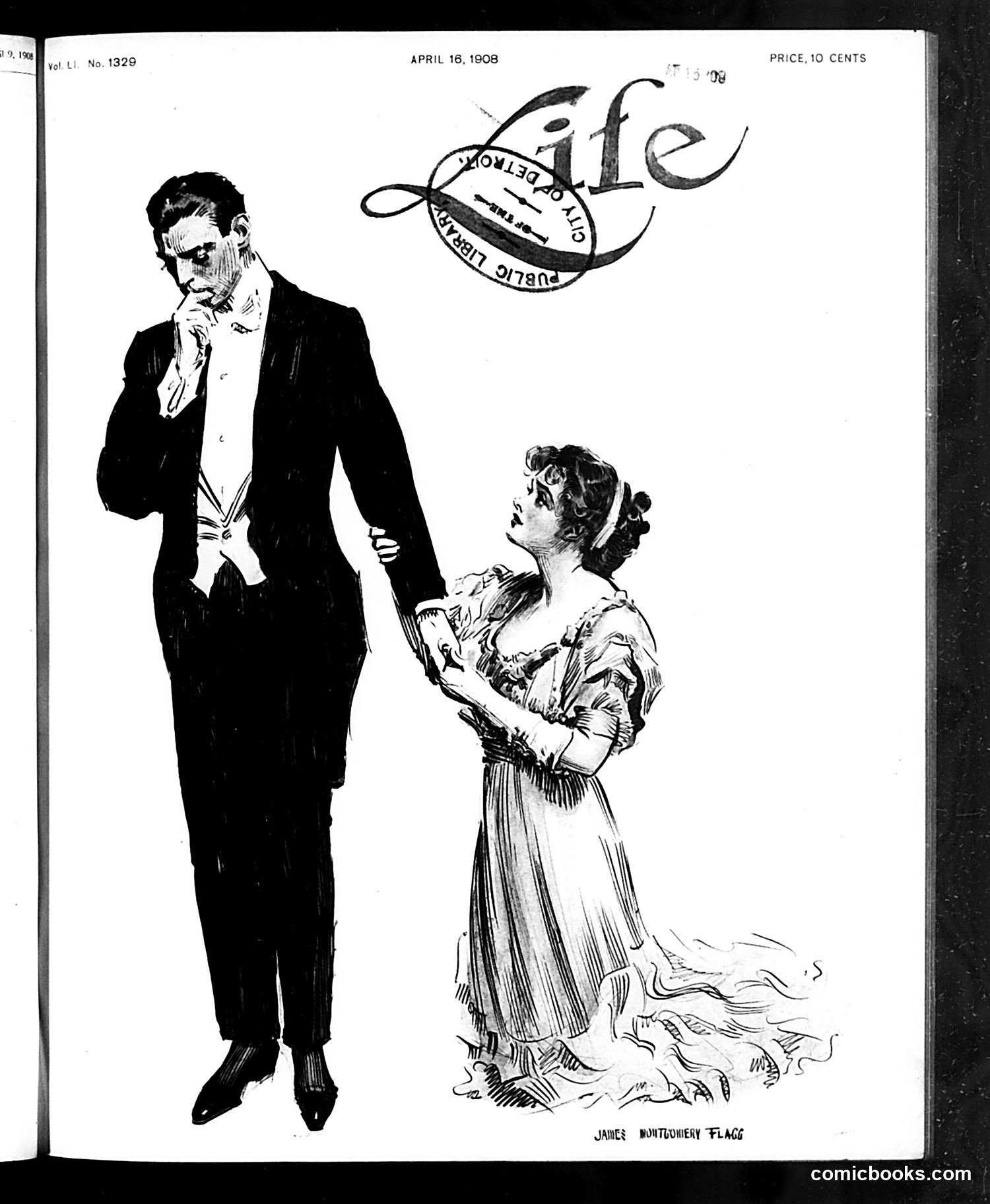
This cover illustration by James Montgomery Flagg depicts a well-dressed man in formal evening wear appearing distressed or anxious, with his hand to his face. A woman in a light dress stands beside him, gazing upward at him with apparent concern or adoration. The specific political or social reference is unclear from the image alone without additional context about April 1908 events. The illustration's style and composition suggest a romantic or domestic drama—possibly satirizing social expectations around courtship, marriage, or male emotional vulnerability among the upper classes. The formal attire indicates these are society figures, likely used to comment on contemporary social customs or relationship dynamics among the wealthy.
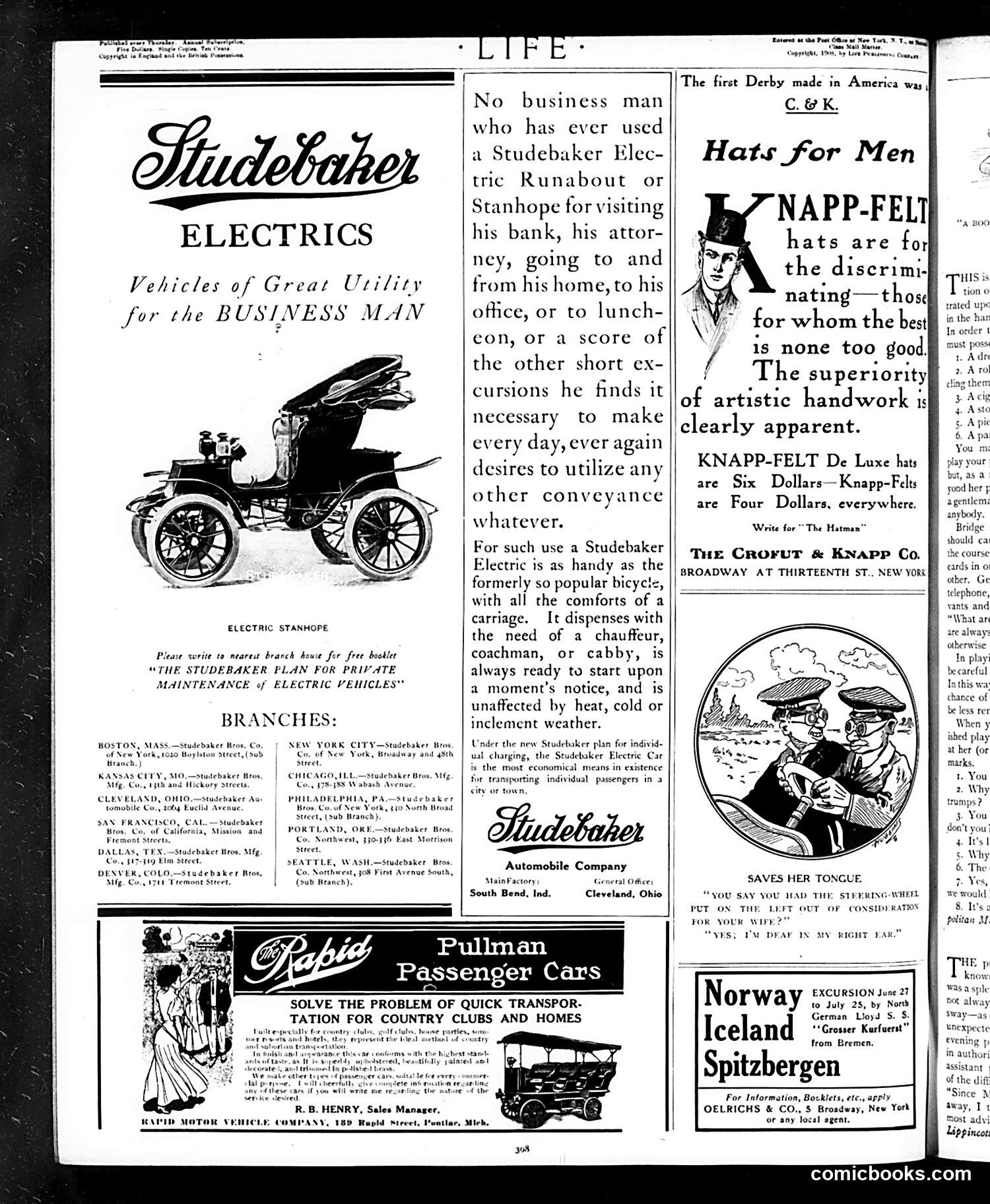
This page is **primarily advertising** for early automobiles and men's fashion, with no political cartoons or satire present. The main content includes: 1. **Studebaker Electric** advertisement—promoting electric vehicles as practical transportation for businessmen making short trips around town, positioning them as reliable alternatives to horse-drawn carriages. 2. **Knapp-Felt Hats** advertisement—marketing premium hats for discerning men, emphasizing superior craftsmanship. 3. **Rapid Pullman Passenger Cars** and **Studebaker Automobile Company** advertisements. 4. A travel advertisement for **Norway, Iceland, and Spitzbergen** excursions. The page reflects early 1900s consumer culture, showcasing emerging automotive technology and luxury goods marketed to affluent American businessmen. There is no satirical or political content to analyze.
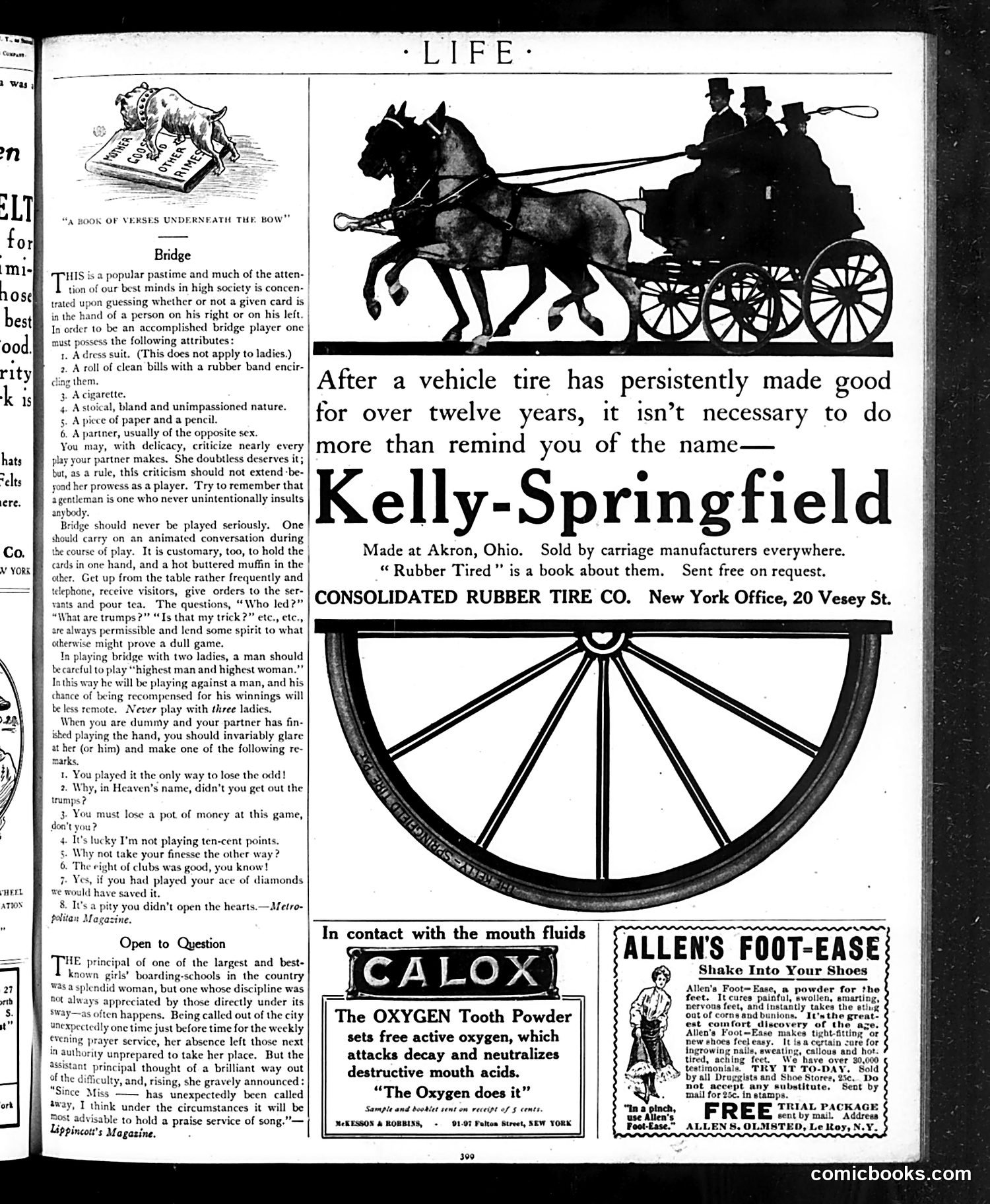
This page is primarily **advertising**, not political satire. The dominant content consists of three commercial advertisements: 1. **Kelly-Springfield Tires** (center): Features a horse-drawn carriage with silhouetted passengers, promoting a tire brand made in Akron, Ohio. The ad claims twelve years of reliable performance. 2. **Calox Tooth Powder** (bottom left): Advertises an "oxygen" toothpaste claiming to neutralize mouth acids and fight decay. 3. **Allen's Foot-Ease** (bottom right): Promotes a powder for foot ailments like corns and bunions. The left column contains a brief article about **Bridge** (the card game), offering etiquette tips for players—typical of Life magazine's satirical social commentary, but this particular section is instructional rather than satirical. No political cartoons appear on this page.
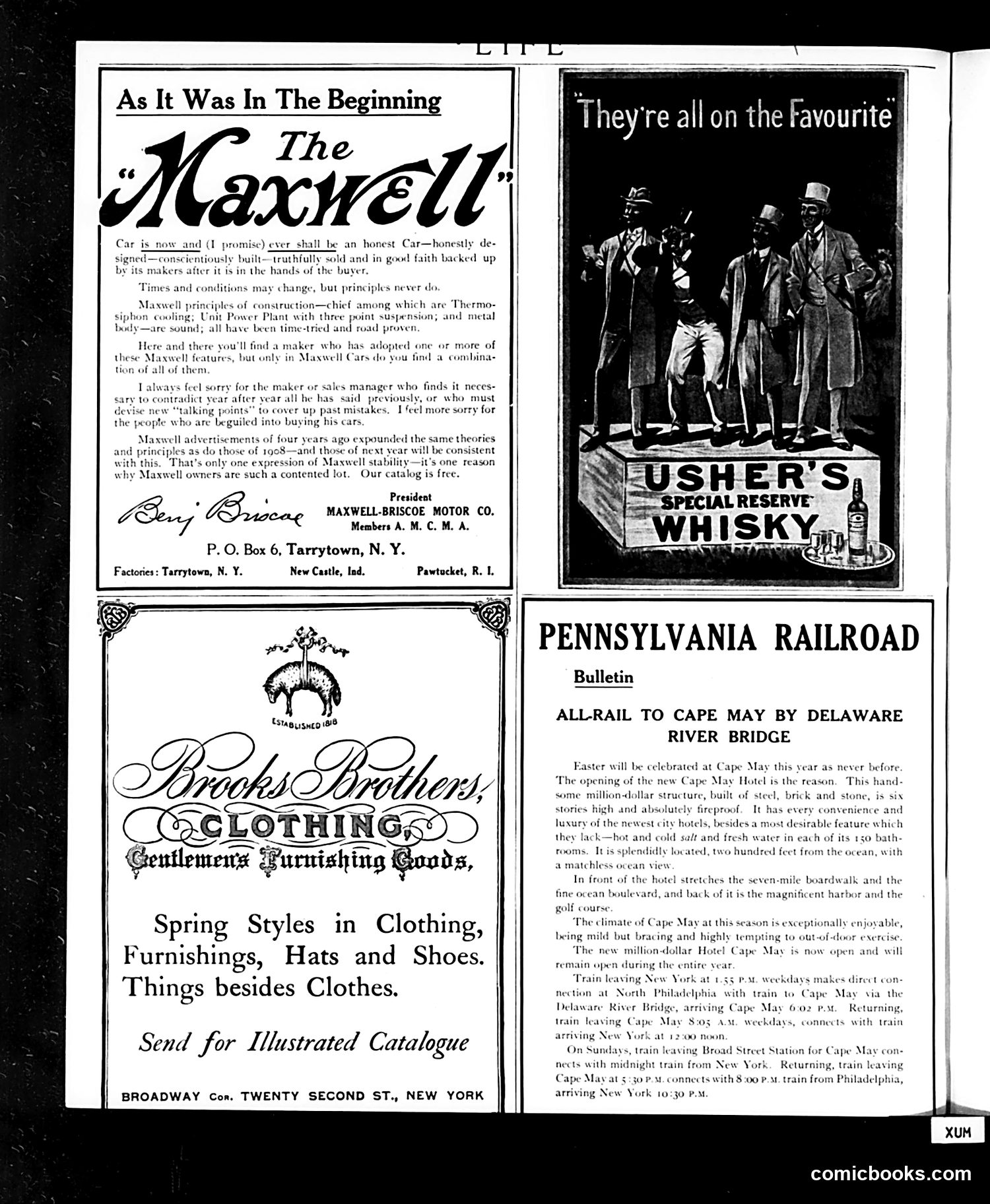
This Life magazine page is predominantly **advertising**, not satire or political commentary. The ads feature: 1. **Maxwell automobile** — emphasizing honest manufacturing and reliability 2. **Usher's whisky** — showing well-dressed men endorsing the product 3. **Brooks Brothers clothing** — promoting spring fashions 4. **Pennsylvania Railroad** — announcing new rail service to Cape May via Delaware River Bridge, with schedule details The only potentially noteworthy element is the whisky ad's tagline "They're all on the Favourite," using figures in formal attire as implied endorsement — a common advertising strategy of the era. Otherwise, this is a straightforward commercial page typical of early 20th-century Life magazine, which supported itself through advertising revenue alongside its satirical editorial content.
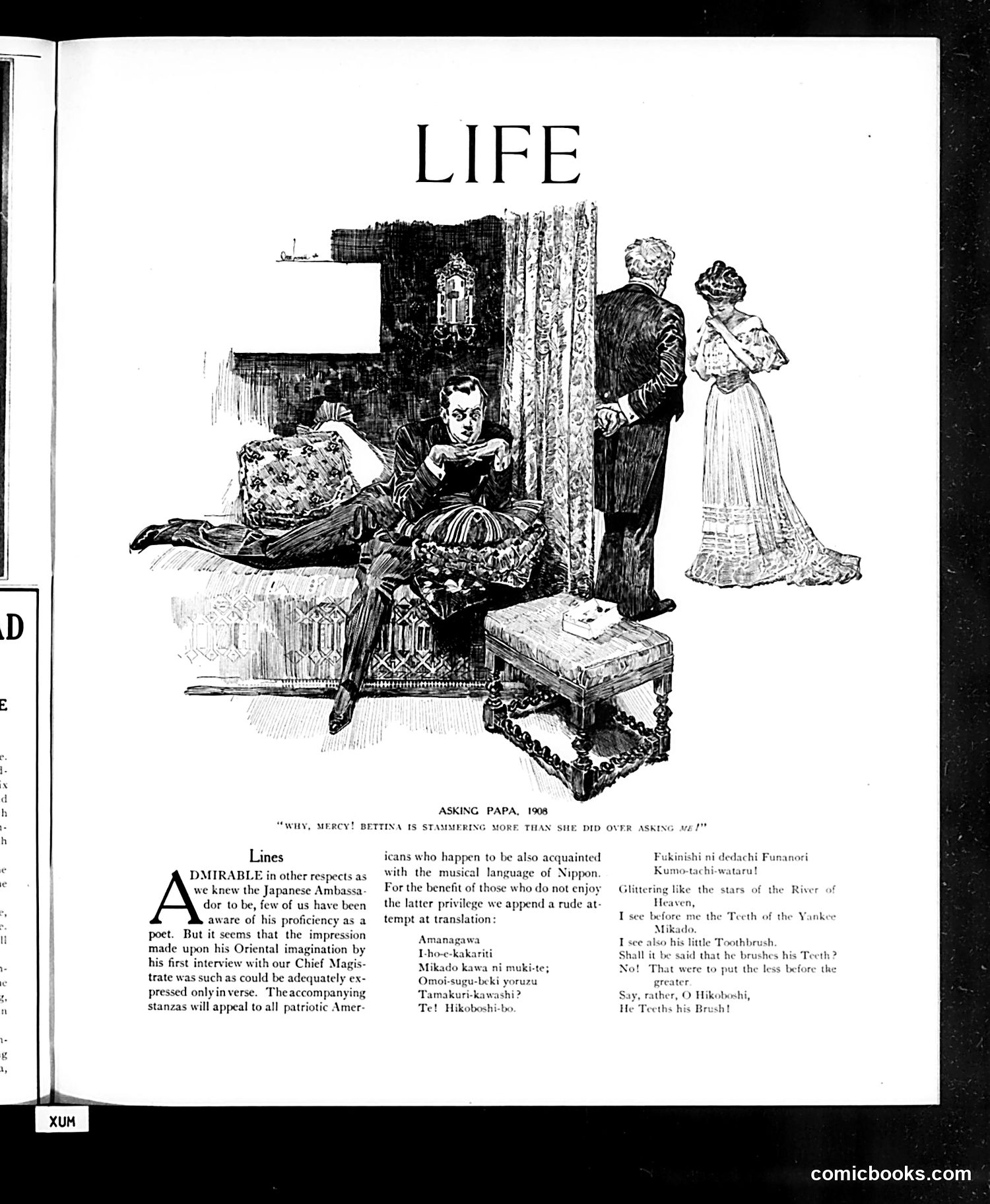
This page presents a satirical cartoon titled "Asking Papa, 1908" with the caption: "Why, Mercy! Bettina is stammering more than she did over asking me!" The scene depicts a domestic interior where a young woman (Bettina) appears to be stammering while making a request to her father, who sits reading. Other family members observe from the background. The satire plays on the Victorian-era social convention where young women required paternal permission for significant decisions—likely regarding courtship or marriage. The joke's humor derives from the assumption that asking permission to marry would be more anxiety-inducing than her natural speech impediment. The accompanying Japanese poetry translations and literary discussion appear unrelated to the cartoon, suggesting this is a multi-topic magazine page.
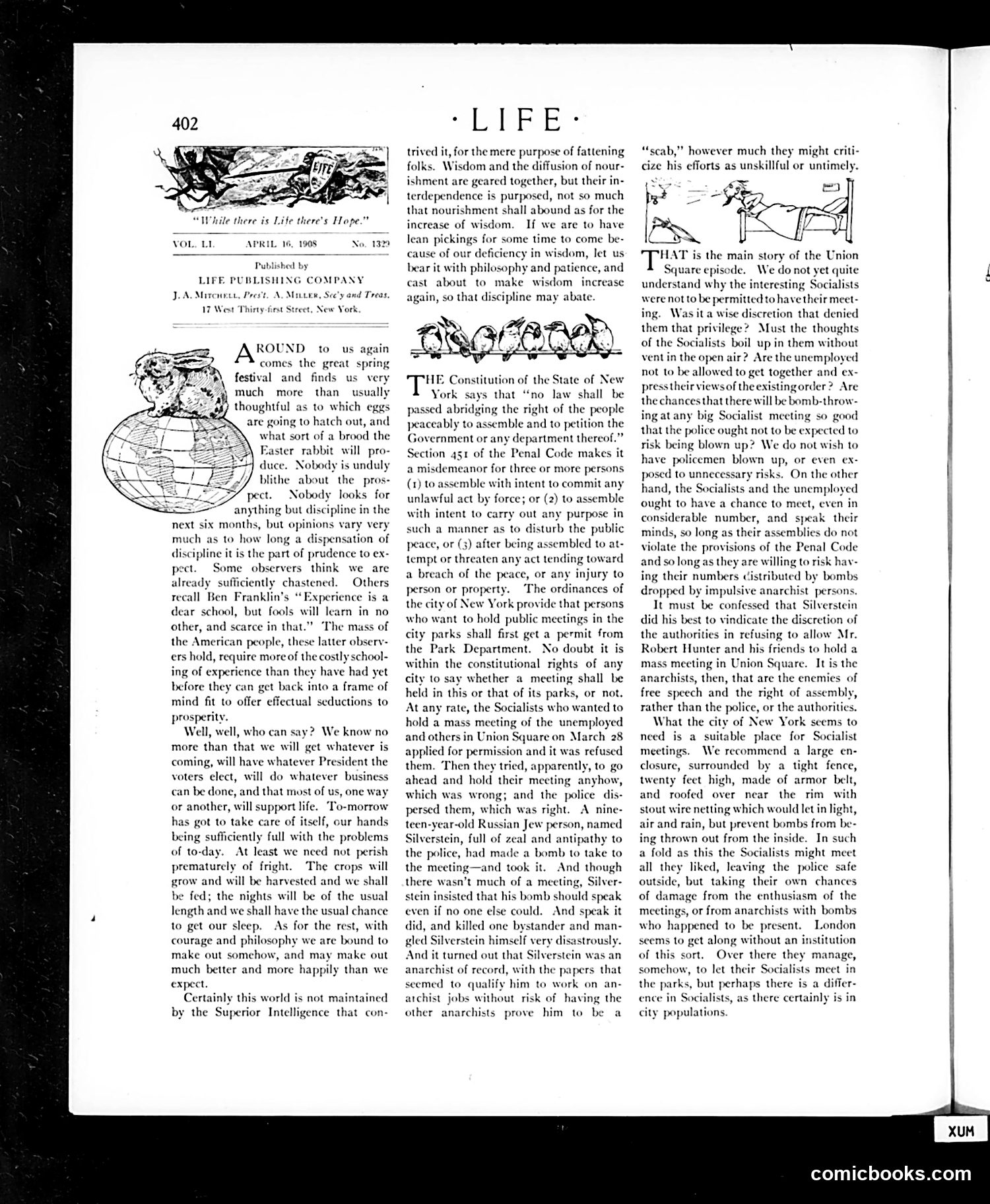
The page contains editorial commentary rather than political cartoons. The main text discusses the Union Square Socialist incident in New York, where police dispersed a planned mass meeting on March 28. The article criticizes both the Socialists and authorities, arguing the Socialists shouldn't expect police protection while promoting anarchism, but also suggesting cities should designate spaces for public assemblies to prevent disorder. A specific case mentioned: a nineteen-year-old Russian Jewish anarchist named Silverstein attempted to bring a bomb to the meeting. He was caught, killed a bystander, and was identified as an anarchist through documents found on him. The cartoons appear decorative/illustrative rather than satirical commentary on this specific event.
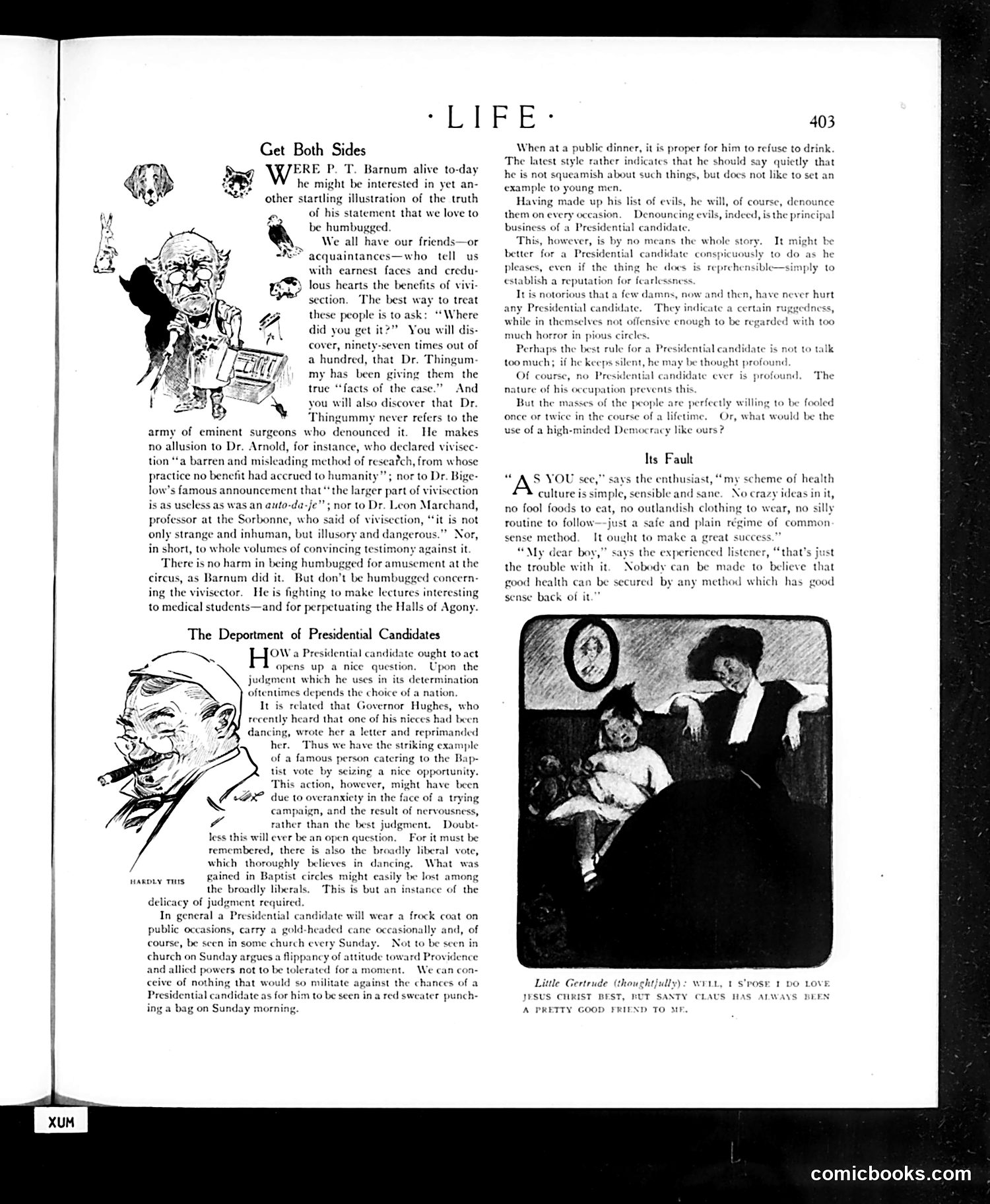
This page satirizes two topics: **"Get Both Sides"** mocks P.T. Barnum's credibility regarding vivissection (animal testing). The cartoon ridicules doctors who cite Barnum's endorsement of medical research, dismissing such authorities as useless or dangerous to scientific integrity. **"The Department of Presidential Candidates"** critiques how candidates present themselves publicly. The caricatured figure (drawn by Cesare, labeled "HARDLY THIS") illustrates the tension between candidates' actual beliefs and their public persona. The text warns that a Baptist candidate dancing or a liberal supporting dancing creates judgment problems—candidates must carefully manage their image across different voter constituencies to avoid losing support. The accompanying photograph shows a domestic scene, though its specific relevance to the text remains unclear.
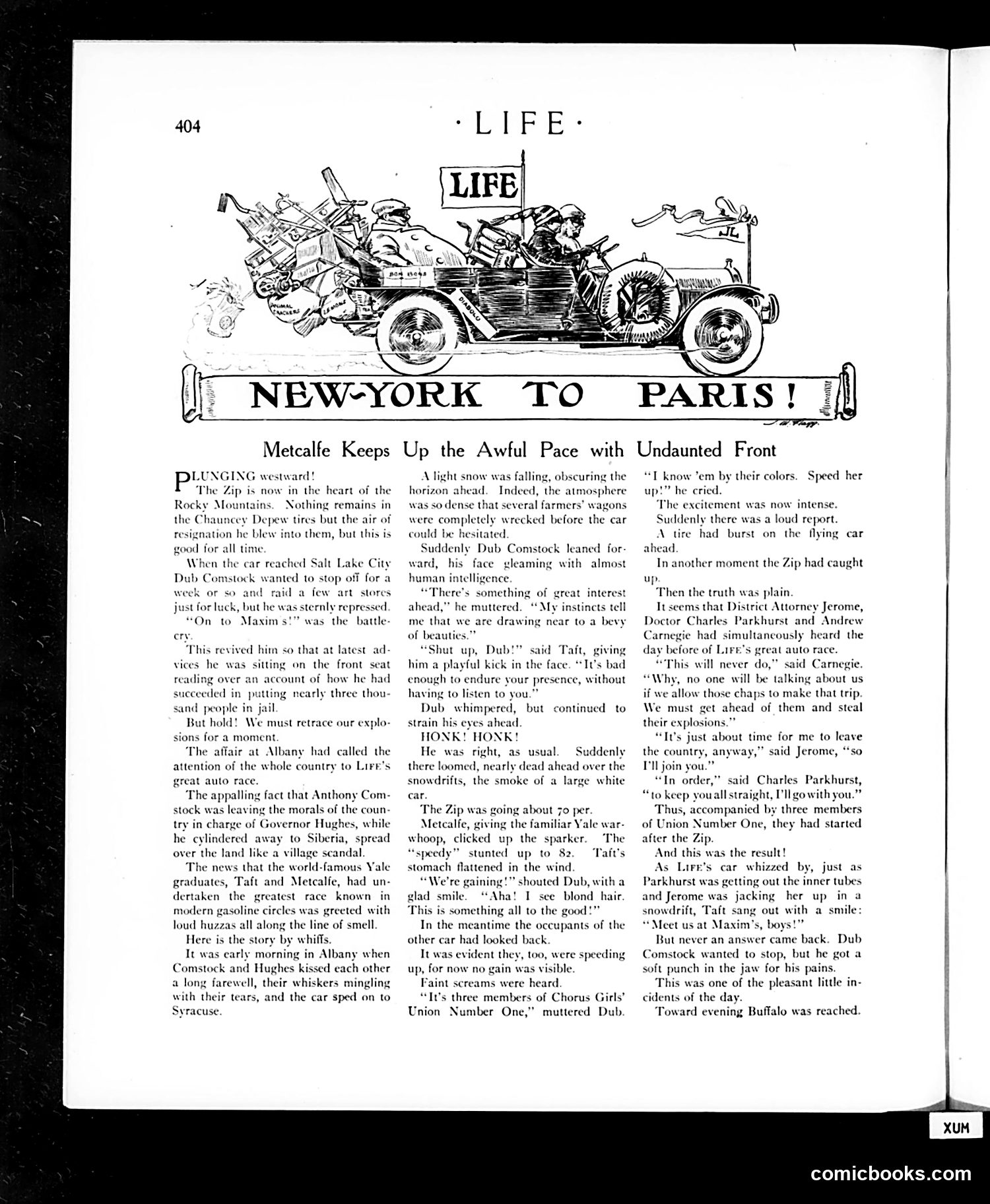
This page depicts a chaotic motorcar race from New York to Paris, a real event that captured public imagination in the early 1900s. The illustration shows an overloaded automobile bursting with supplies, passengers, and absurd cargo, representing the extravagant, anything-goes spirit of the race. The story follows "Metcalfe" keeping an "undaunted front" as the vehicle encounters mishaps—wrecked wagons, near-collisions, and mechanical failures. References to real figures like "Dub Comstock" and "Taft" suggest actual race participants or observers. The satire mocks both the dangerous recklessness of early automotive racing and the era's obsession with technological spectacle. The cartoon lampoons the chaos, poor safety practices, and media frenzy surrounding this celebrated cross-continental motorsport competition.
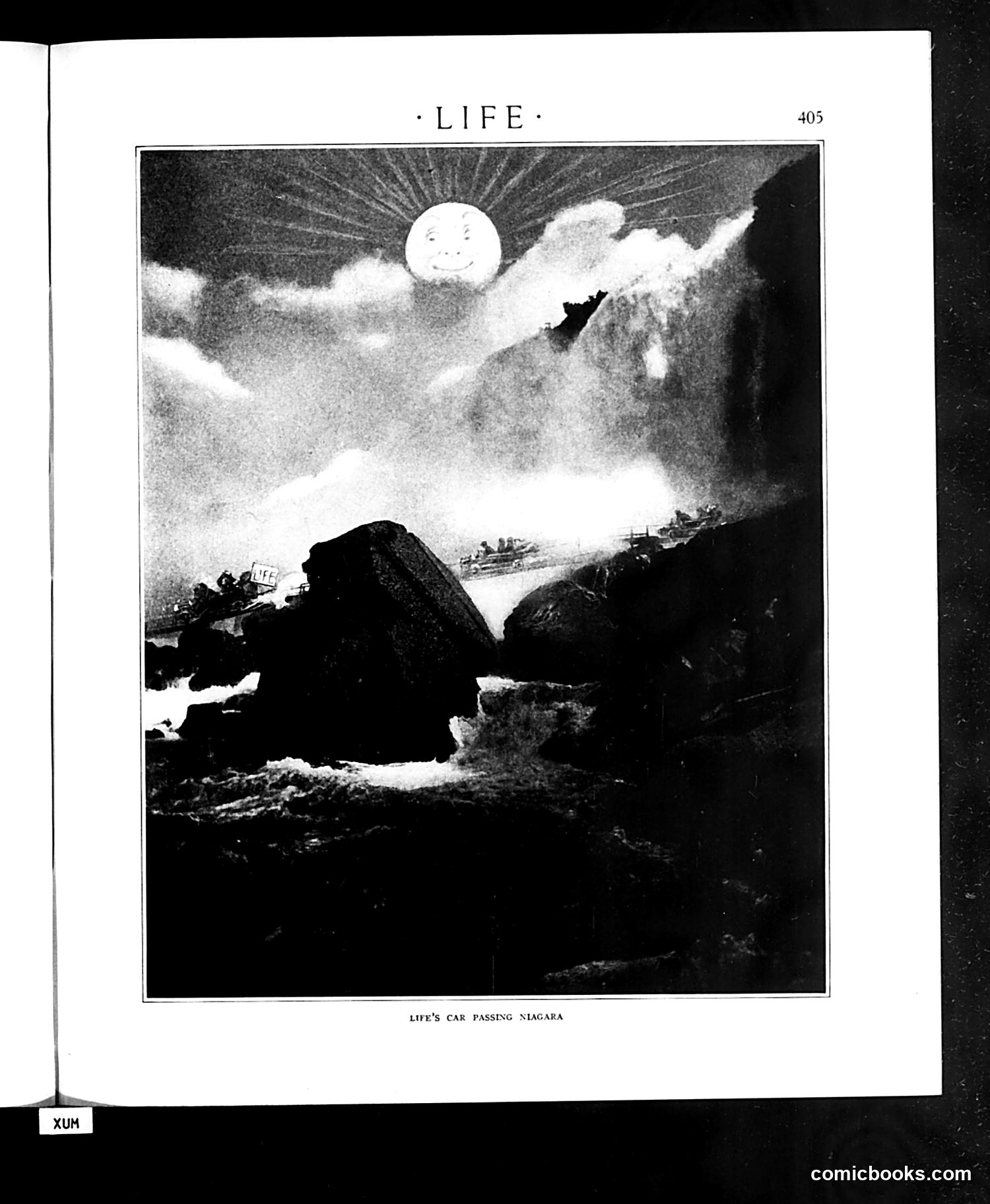
This is a surreal illustration depicting an automobile passing through Niagara Falls. The image shows a car traveling along a rocky outcrop with the massive falls visible in the background, illuminated by moonlight with a smiling face. The composition is dreamlike and fantastical rather than realistic. Without additional context from the magazine's text or surrounding pages, the precise satirical meaning is unclear. However, it likely represents either: a commentary on modern automobile tourism and convenience culture, or perhaps an absurdist contrast between human industrial achievement (the car) and nature's grandeur (Niagara Falls). The anthropomorphic moon suggests whimsical, fantastical intent typical of Life magazine's satirical style.
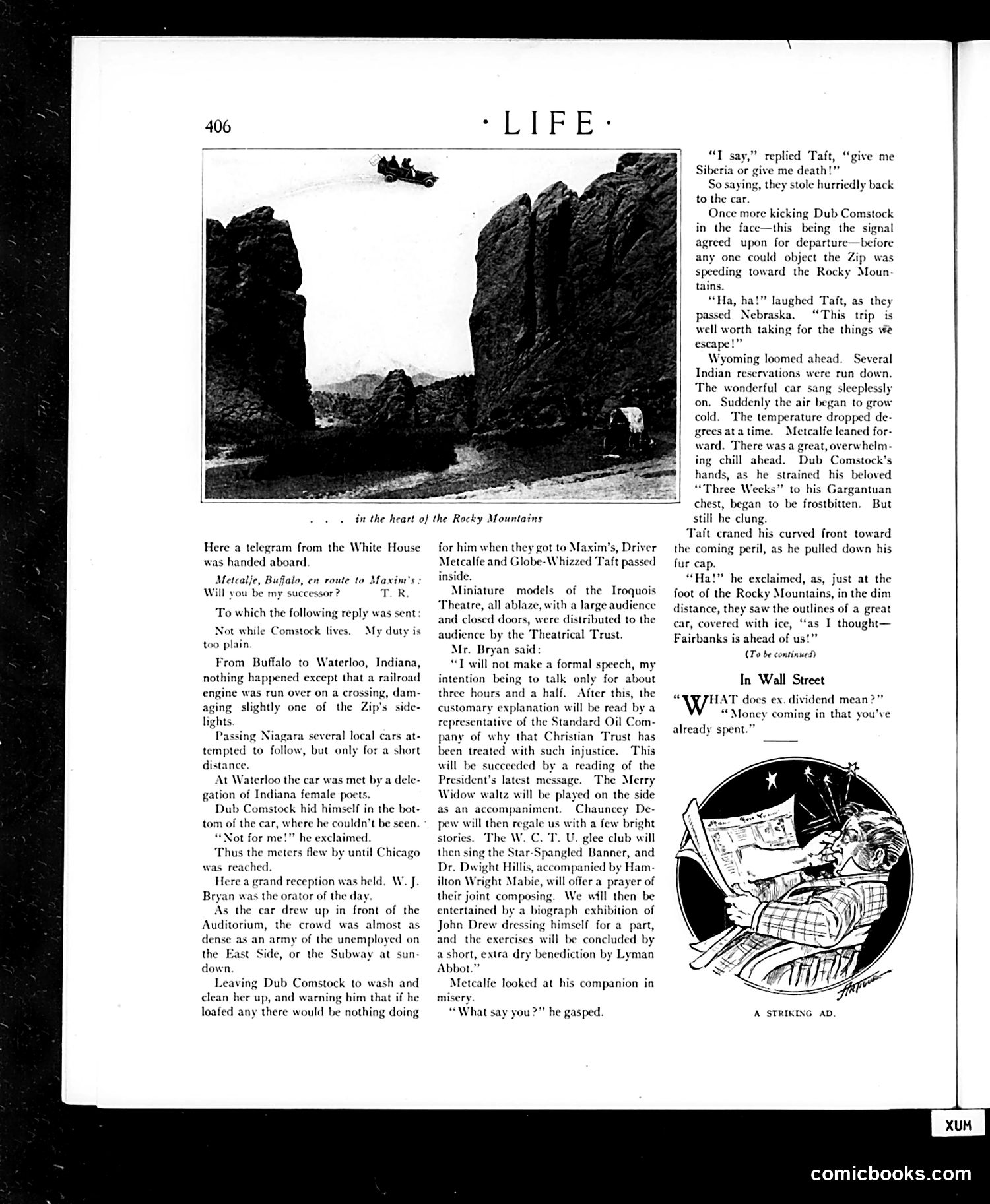
This page contains a serialized story about a cross-country automobile journey, featuring characters named Taft, Dub Comstock, and Metcalfe. The narrative describes their trip through the Rocky Mountains and mentions a telegram from the White House. The bottom section, titled "In Wall Street," includes a small circular cartoon labeled "A STRIKING AD" showing a figure in bed with what appears to be financial/stock market imagery. The caption reads: "WHAT does ex dividend mean?" "Money coming in that you've already spent." This is a joke about stock market terminology, satirizing how investors receive dividend payments for money they've already spent—poking fun at financial speculation and poor money management among Wall Street investors. The humor relies on knowledge of investment terminology and Depression-era financial anxiety.
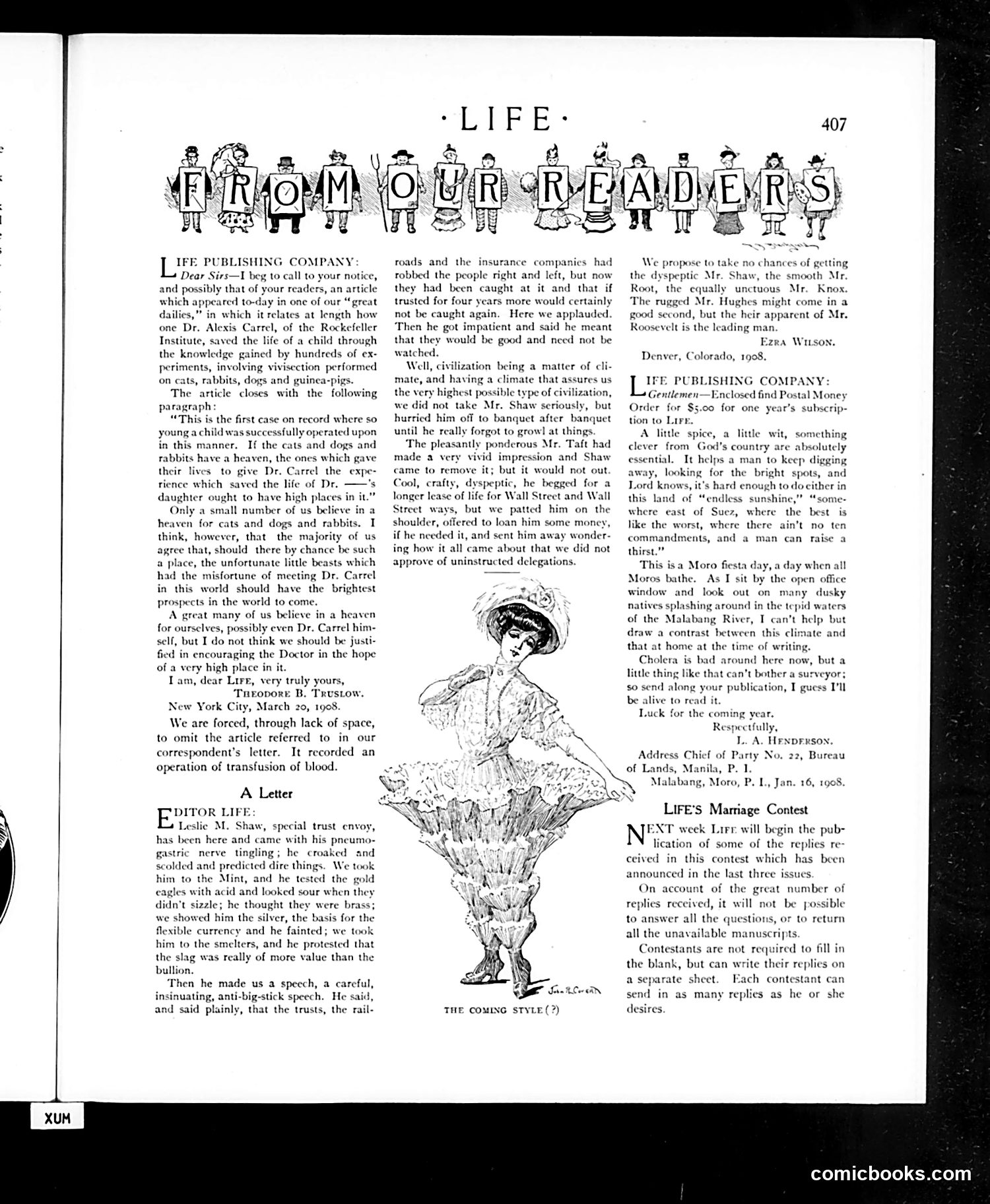
This page contains reader letters and editorial notes rather than political cartoons. The main illustration—labeled "THE COMING STYLE (?)"—depicts a woman in an exaggerated, impractical fashion silhouette with an enormously wide, decorative skirt base. The satire targets contemporary women's fashion trends. The question mark in the title suggests skepticism about whether this extreme silhouette represents actual coming fashion or is merely absurd speculation. The illustration mocks the disconnect between practical clothing and haute couture aspirations. The letters discuss serious topics (blood transfusions, Dr. Carrel's medical work) alongside lighter correspondence, reflecting Life's mix of social commentary and humor typical of early 20th-century American satire magazines.
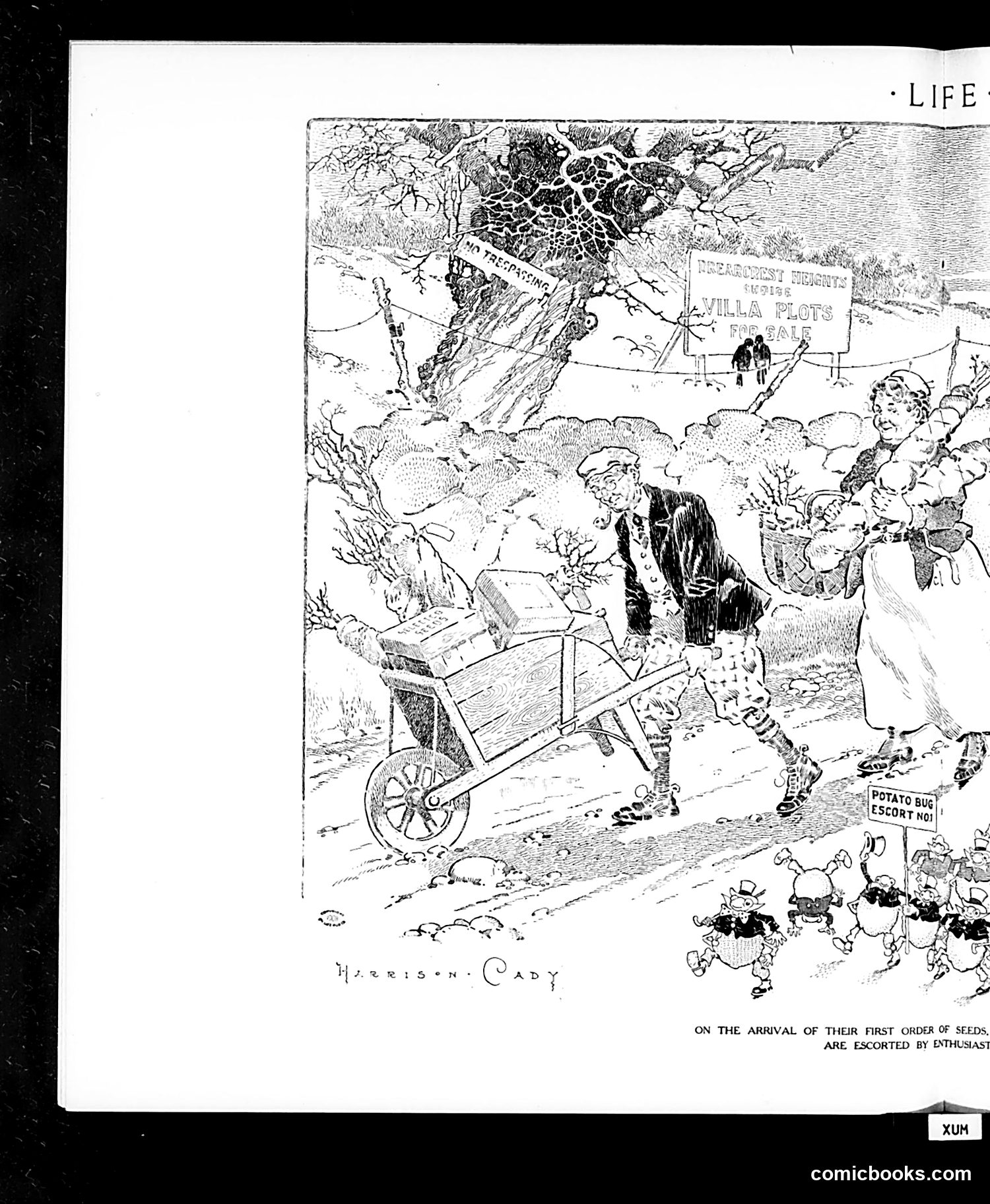
This Harrison Cady cartoon satirizes the early 20th-century seed industry and agricultural commerce. The central figure appears to be a gentleman farmer or seed catalog customer receiving his first order of seeds, escorted by enthusiastic vendors or salesmen ("POTATO BUG ESCORT NO!"). The humor targets the gap between romantic agricultural marketing and reality: farmers ordering seeds receive not just plants but unwanted pests like potato bugs. The sign reading "VILLA PLOTS FOR SALE" suggests marketing to amateur or urban gardeners unfamiliar with farming's practical challenges. The caption confirms this reading: "ON THE ARRIVAL OF THEIR FIRST ORDER OF SEEDS, ARE ESCORTED BY ENTHUSIAST[S]"—mocking how seed companies glamorize farming to inexperienced customers who discover the harder truths of actual cultivation.
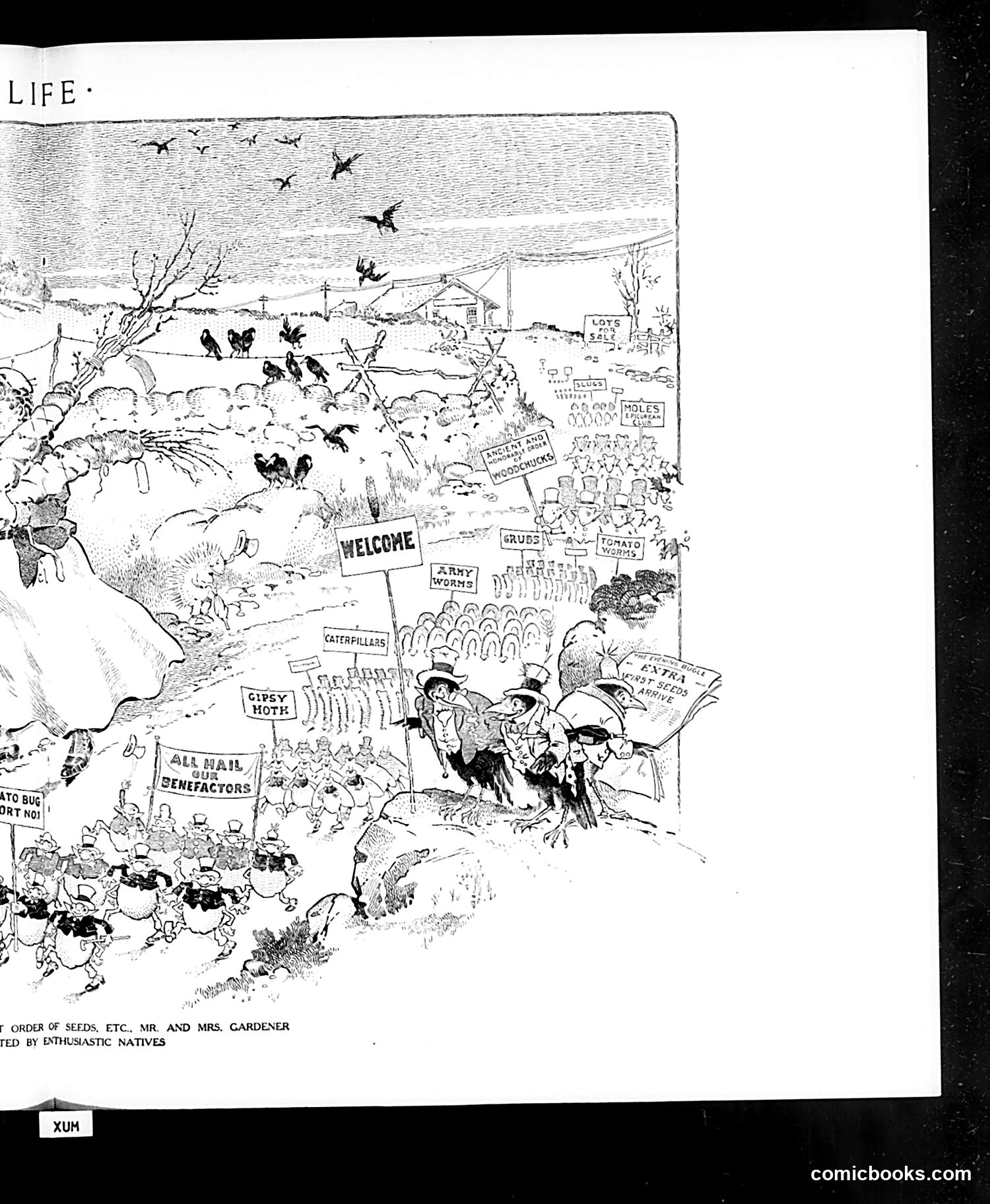
This is a satirical map-style illustration titled "LIFE" depicting an agricultural landscape organized as a humorous social commentary. The cartoon shows various labeled sections including "WELCOME," "ARMY WORMS," "GRUBS," "CATERPILLARS," "SLUGS," "HOTH," "ALL MAIL BENEFACTORS," and references to "TOMATO MOTHS." The illustration appears to satirize gardening and pest management, personifying insects and agricultural pests as distinct communities or populations. Three human figures (appearing to be gardeners wearing hats) are positioned centrally, seemingly surveying or managing this insect-populated landscape. The text mentions "MR AND MRS. GARDENER" and references to "SEEDS, ETC." and "ENTHUSIASTIC NATIVES," suggesting this mocks the challenges gardeners face battling multiple pest species simultaneously. The satire critiques the complexity of maintaining a productive garden against numerous destructive insects.
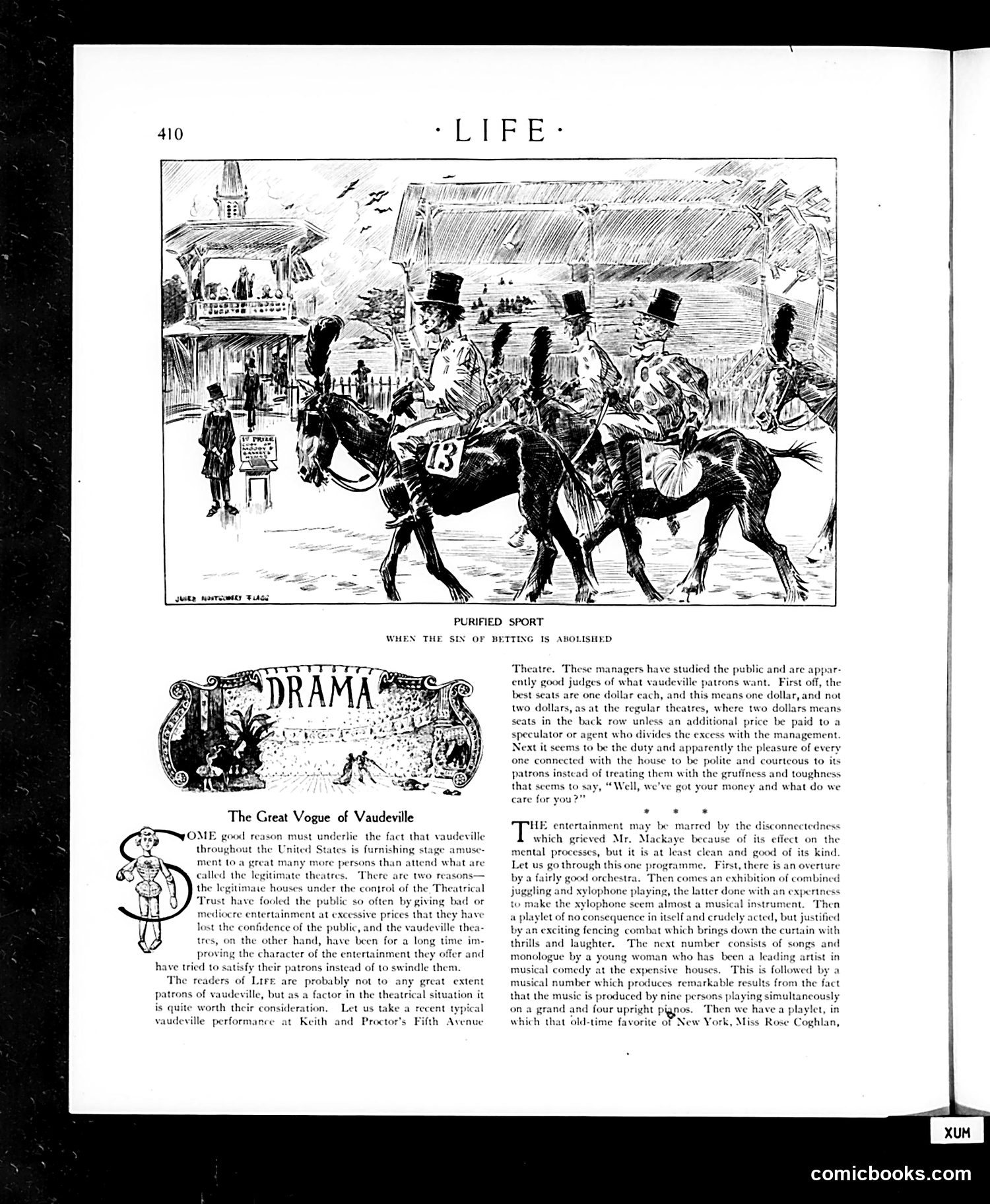
## The Cartoon The top illustration satirizes horse racing after betting is abolished. Gentlemen in top hats ride horses numbered "13" at what appears to be a racetrack grandstand. The title's irony is clear: without gambling, horse racing loses its appeal entirely—the sport becomes absurd and pointless. ## The Text The page discusses vaudeville's popularity and superiority over "legitimate" theater. Theater managers at Keith and Proctor's venues allegedly treat audiences fairly with reasonable pricing and courteous service, unlike Broadway theaters that charge excessive prices and mistreat patrons. The text describes a typical vaudeville program's variety acts: orchestra, juggling, fencing, songs, and established performers like Rose Coghlan. ## Context for Modern Readers This reflects early 1900s entertainment economics: vaudeville was thriving, affordable entertainment competing successfully against expensive legitimate theater. The "purified sport" cartoon jokes that activities derive meaning from vice—remove betting from racing and nothing remains. The vaudeville praise suggests Life magazine favored populist entertainment over elite theater establishments.
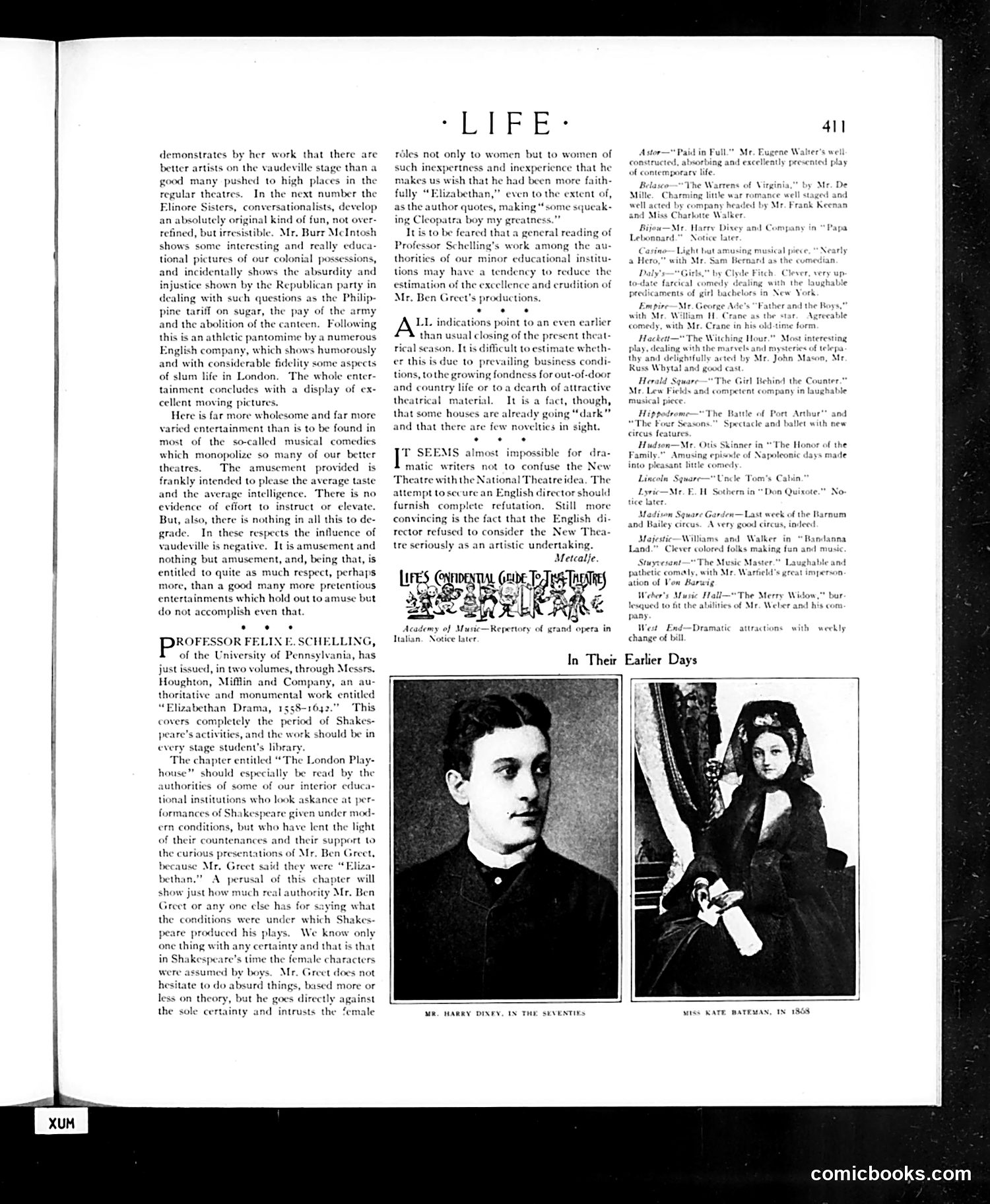
This page from *Life* magazine (page 411) discusses theatrical entertainment and drama history, rather than presenting political cartoons. The content critiques vaudeville performances and reviews a scholarly work on Elizabethan drama by Professor Schelling of the University of Pennsylvania. The page includes two photographs labeled "In Their Earlier Days": one of "Mr. Harry Davey in the Seventies" and another of "Miss Kate Bateman in 1868," showing theatrical performers from the 19th century. The text defends vaudeville as legitimate entertainment while discussing debates about Shakespearean production methods—specifically, the historical practice of using young boys to play female roles. It critiques theater director Ben Greet's attempts to recreate "authentic" Elizabethan conditions, suggesting his casting choices undermine the quality of performances. The overall tone is cultural commentary rather than satire.
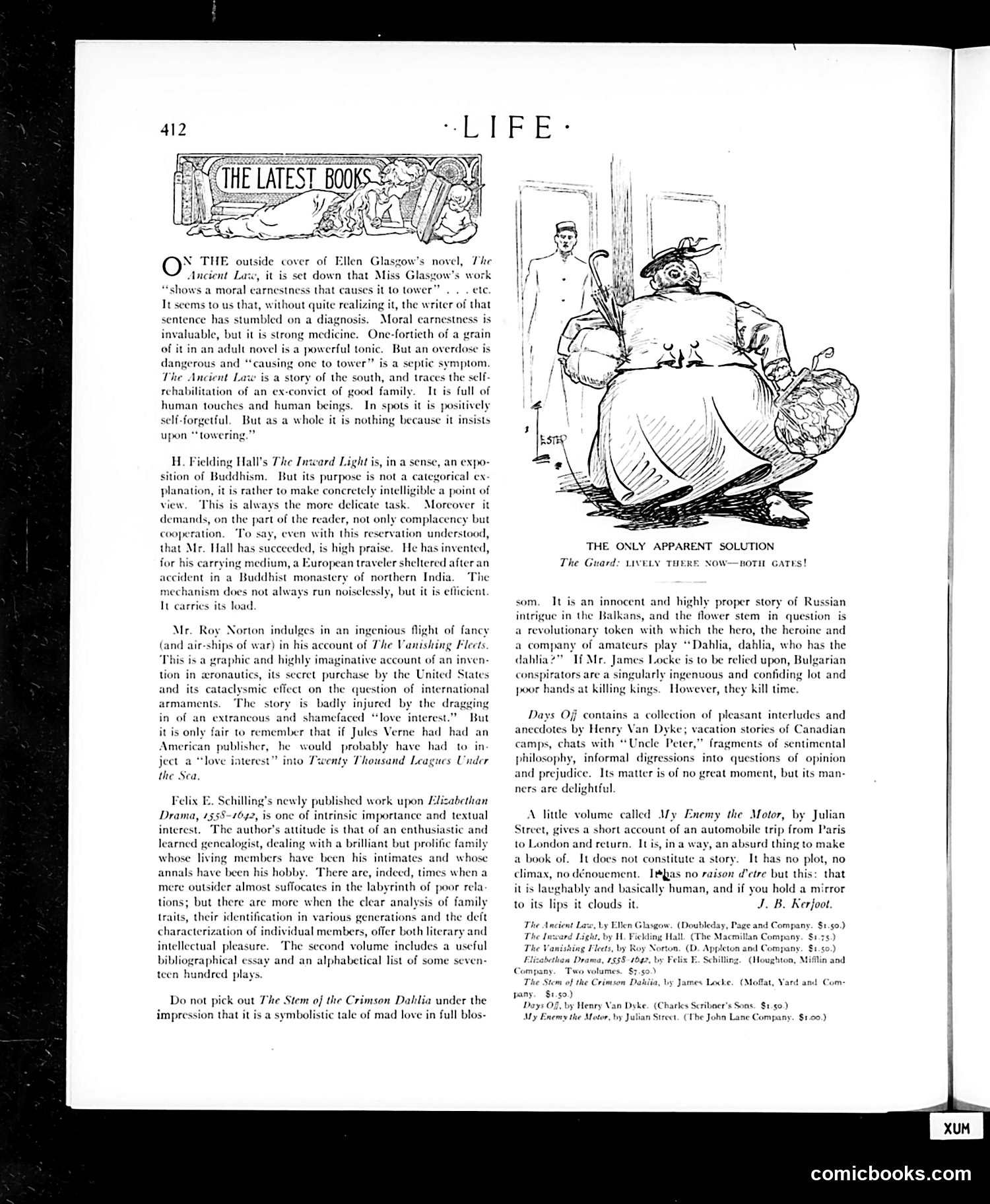
This single cartoon depicts a guard stationed at two gates, addressing someone with "Lively there now—both gates!" The drawing shows a portly, well-fed figure positioned between two doorways, suggesting he must monitor or control access to both simultaneously—an impossible task given his size and positioning. The cartoon likely satirizes a contemporary political or social situation requiring simultaneous management of competing demands or locations. Without additional context from the magazine's date or other pages, the specific reference is unclear, but the humor derives from the physical absurdity: one person cannot effectively guard both gates at once, making the guard's cheerful instruction darkly comedic. The cartoon accompanies book reviews on this "Latest Books" page, though it appears thematically unrelated to the literary content discussed.
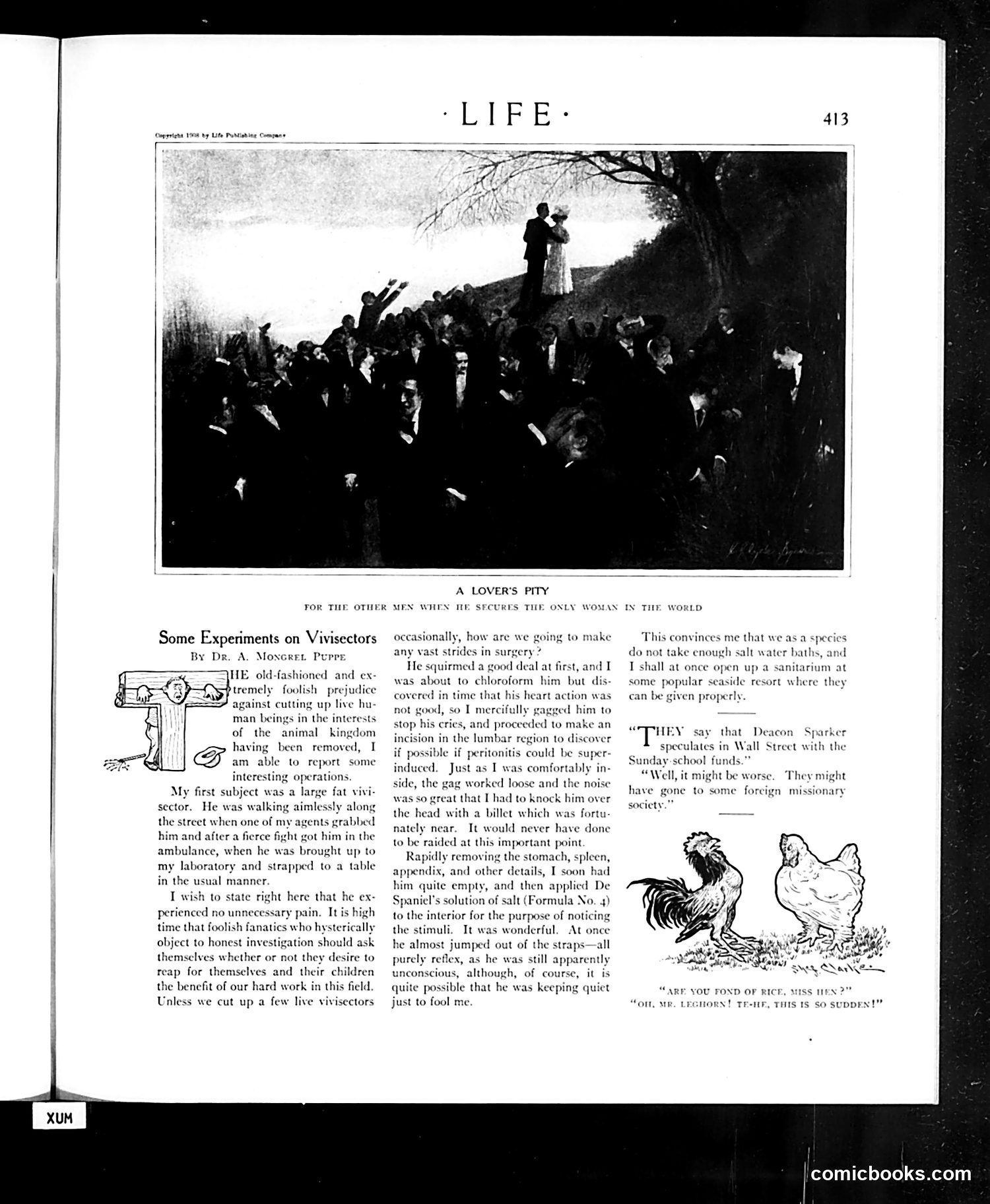
This is satirical role-reversal commentary on anti-vivisection debates of the early 20th century. The author (Dr. A. Mongrel Pup, a transparent pseudonym) proposes turning vivisection—the surgical dissection of live animals for research—against vivisectors themselves. The satire inverts the standard pro-vivisection argument: just as scientists claimed animal testing was necessary medical progress despite animal suffering, the author applies identical logic to experimenting on human vivisectionists. By treating vivisectors as research subjects, the piece exposes the moral inconsistency of those who defend animal experimentation while protecting human subjects. The grotesque surgical details (removing organs while conscious) amplify the horror to make the position absurd. This was a common rhetorical tactic by anti-vivisection advocates, who used exaggeration and dark humor to challenge scientific establishment arguments about necessary cruelty. The bottom cartoon about "Deacon Sparker" is unrelated social satire about financial hypocrisy.
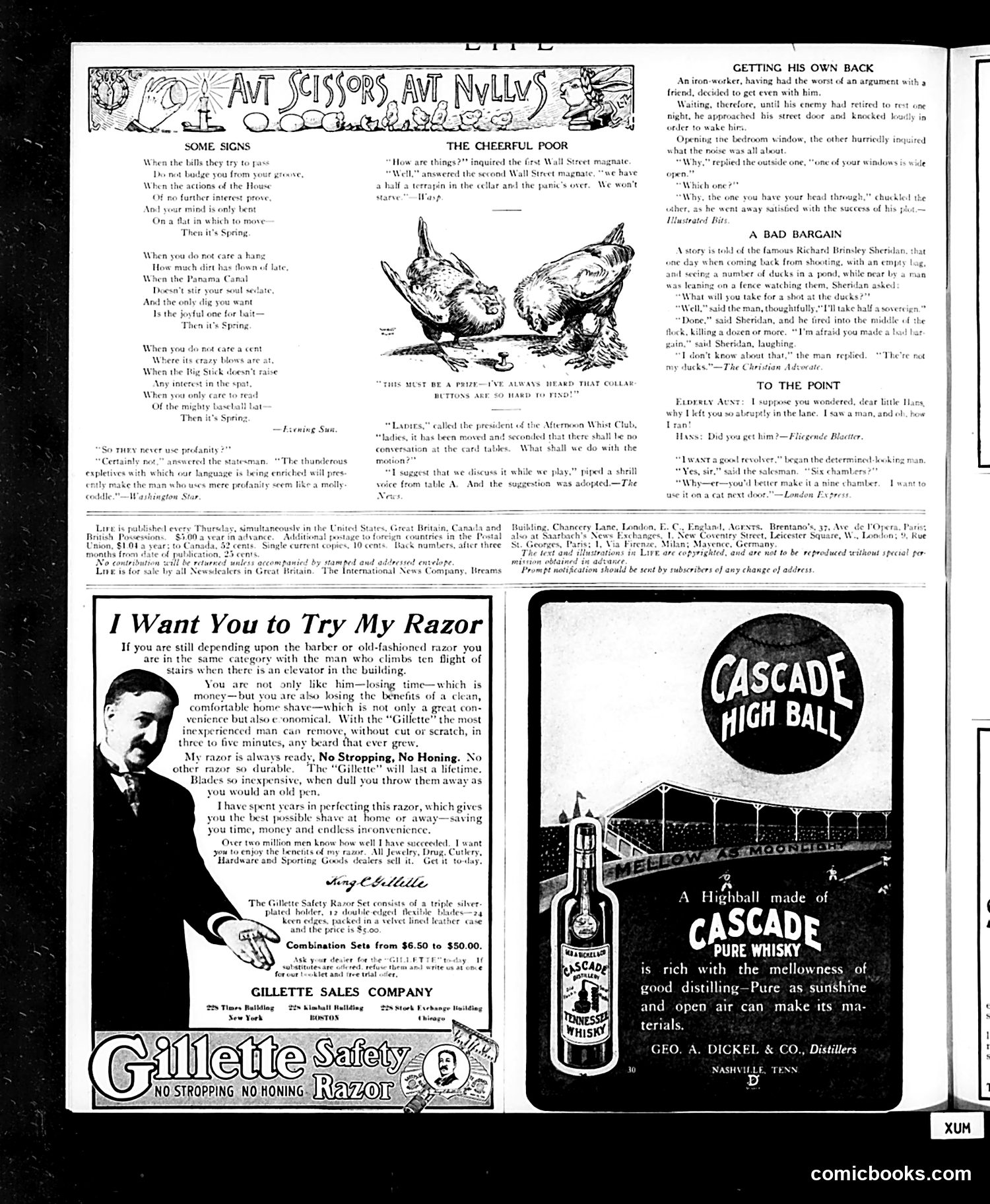
This page contains **multiple unrelated advertisements and comic content** typical of early 20th-century magazine format. The main cartoon "At Scissors, At Nyllis" (top) appears to be a humorous domestic scene, though the OCR text is too corrupted to determine specific satirical intent. The "Cheerful Poor" section includes brief jokes about poverty and financial hardship—common Life magazine fare mocking working-class struggles with ironic cheerfulness. **The dominant content is advertising**: A full-page Gillette Safety Razor advertisement featuring endorsement copy arguing that home shaving is more economical and convenient than barber visits. The rhetoric emphasizes modernity and self-reliance. Below this is a Cascade Pure Whisky advertisement. These advertisements reflect early 1900s consumer culture targeting middle-class men—promoting convenience products and luxury goods during what appears to be the Prohibition era (whisky advertising would soon become illegal). The page exemplifies how satirical magazines relied heavily on advertising revenue, mixing editorial content with commercial messaging.
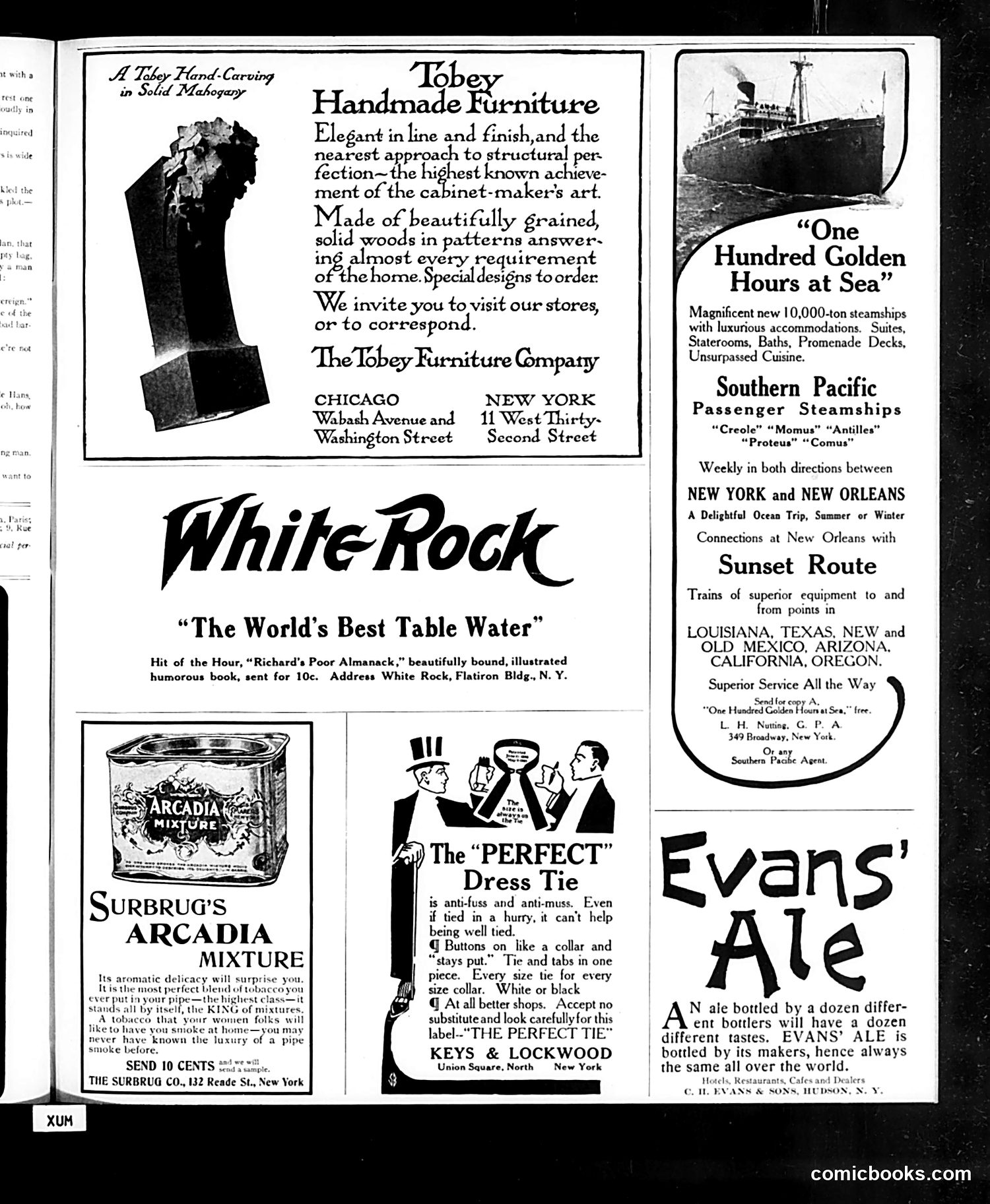
This is primarily an **advertising page**, not a political cartoon. It contains six commercial advertisements from the early 20th century: 1. **Tobey Furniture** — handmade mahogany furniture for the home 2. **White Rock** — mineral water, emphasizing purity and quality 3. **Surburg's Arcadia Mixture** — pipe tobacco blend 4. **The "Perfect" Dress Tie** — self-tying neckwear innovation 5. **Southern Pacific Steamships** — luxury cruise service between New York and New Orleans 6. **Evans' Ale** — beer emphasizing consistent quality across bottlers The page reflects **consumer culture and technological convenience** of the era: automated dress ties, steamship travel, branded products. The ads target middle/upper-class readers with disposable income. There is **no political satire or cartoon content** visible. This appears to be a standard advertising section from *Life* magazine's commercial pages.
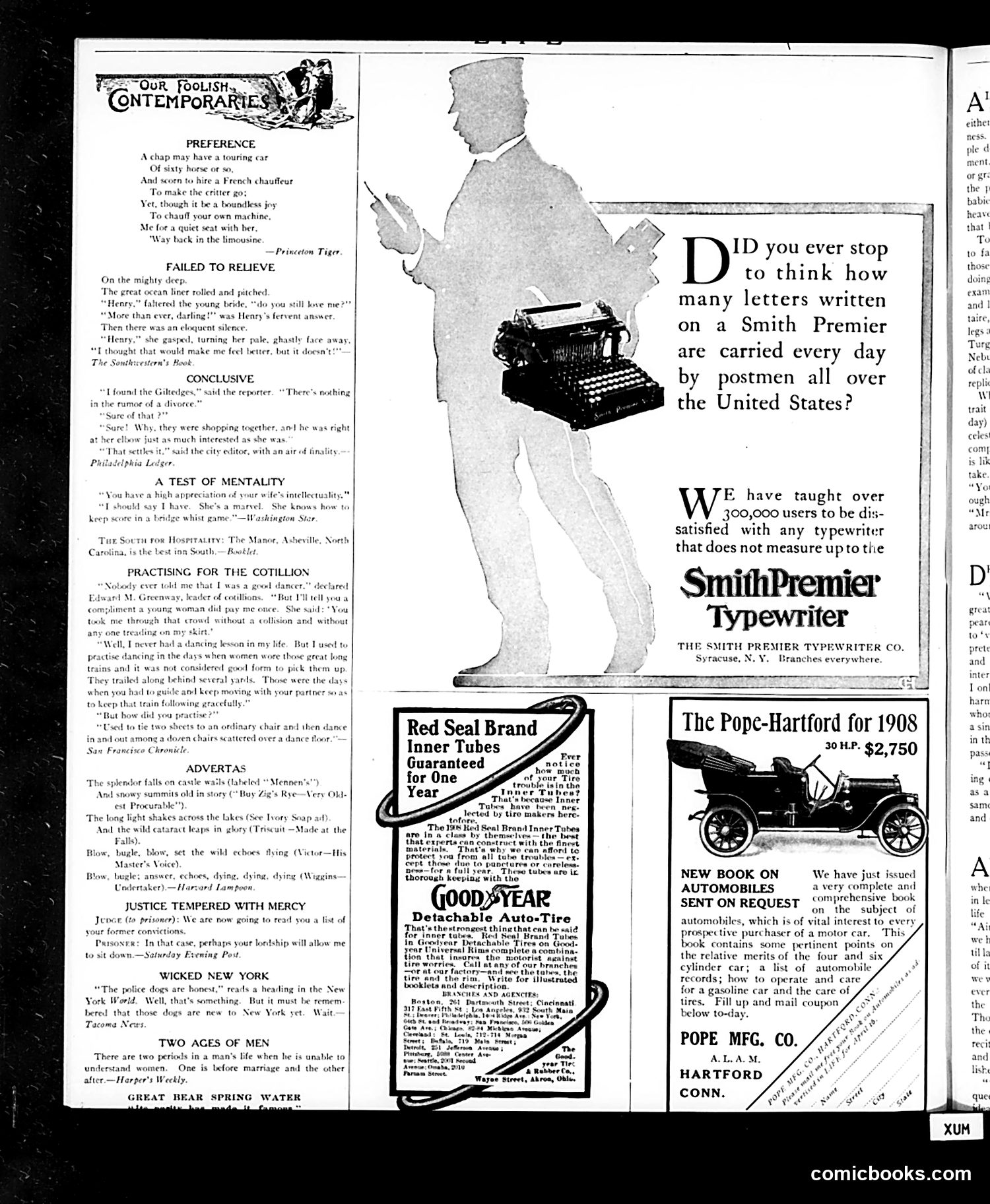
This page from *Life* magazine (undated, but appears early 1900s based on advertising) is primarily **advertising and humor columns** rather than political cartooning. The left side contains humorous prose pieces titled "Our Foolish Contemporaries"—short satirical anecdotes poking fun at social pretensions. These target conventional romantic and social behaviors: a man preferring a French chauffeur over his fiancée; newlyweds quarreling; women's intellectual pretensions; cotillion dancing etiquette; and urban police corruption. The right side features **product advertisements**: Smith Premier typewriters, Goodyear inner tubes, Pope automobiles, and a book on automobile maintenance. The humor is gentle social satire typical of *Life's* era—mocking upper-class affectations, gender relations, and modern urban life. No specific political figures or major events are referenced. The cartoons/illustrations are modest, supporting the text rather than driving the satire. This is primarily a **humor and advertising publication**, not a vehicle for serious political commentary.
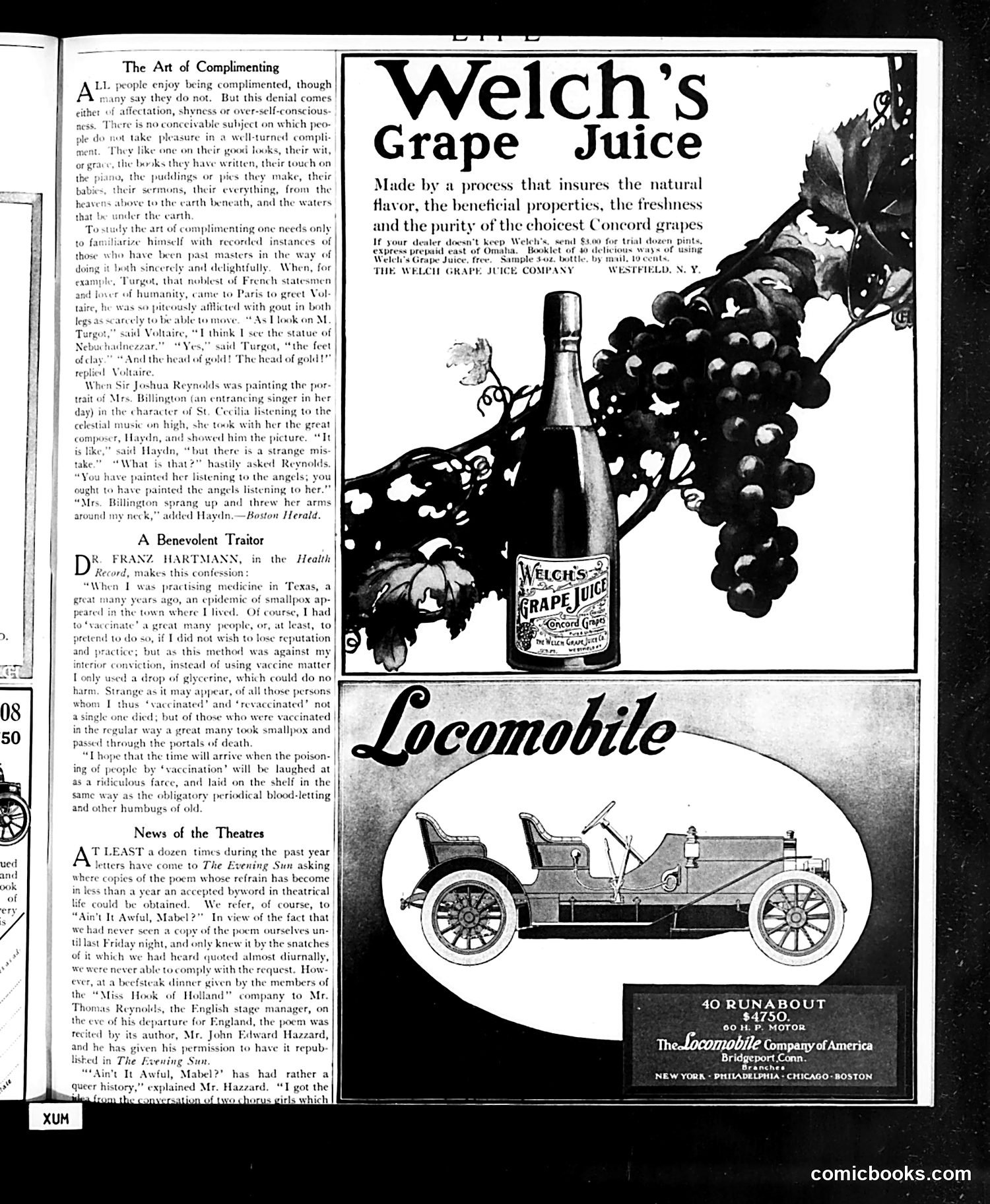
This page contains **primarily advertisements** rather than political satire. The main content includes: **Welch's Grape Juice ad** (top right): A straightforward product advertisement emphasizing that Welch's juice is made from Concord grapes using a process preserving natural flavor and purity. The illustrated bunch of grapes is decorative rather than satirical. **Locomotile automobile ad** (bottom): Features a early 1900s touring car priced at $4,750, marketing it as a luxury vehicle. This is standard period advertising. **Left column articles**: "The Art of Complimenting" and "A Benevolent Traitor" are humorous essays with historical anecdotes (mentioning figures like Voltaire, Haydn, and Franz Hartmann), not political cartoons. The "News of the Theatres" section discusses theatrical gossip. **Verdict**: This is a **magazine miscellany page**—a mix of light humor, theater gossip, and advertisements typical of Life's editorial approach. No significant political satire or caricature is present that would require historical context for modern readers.
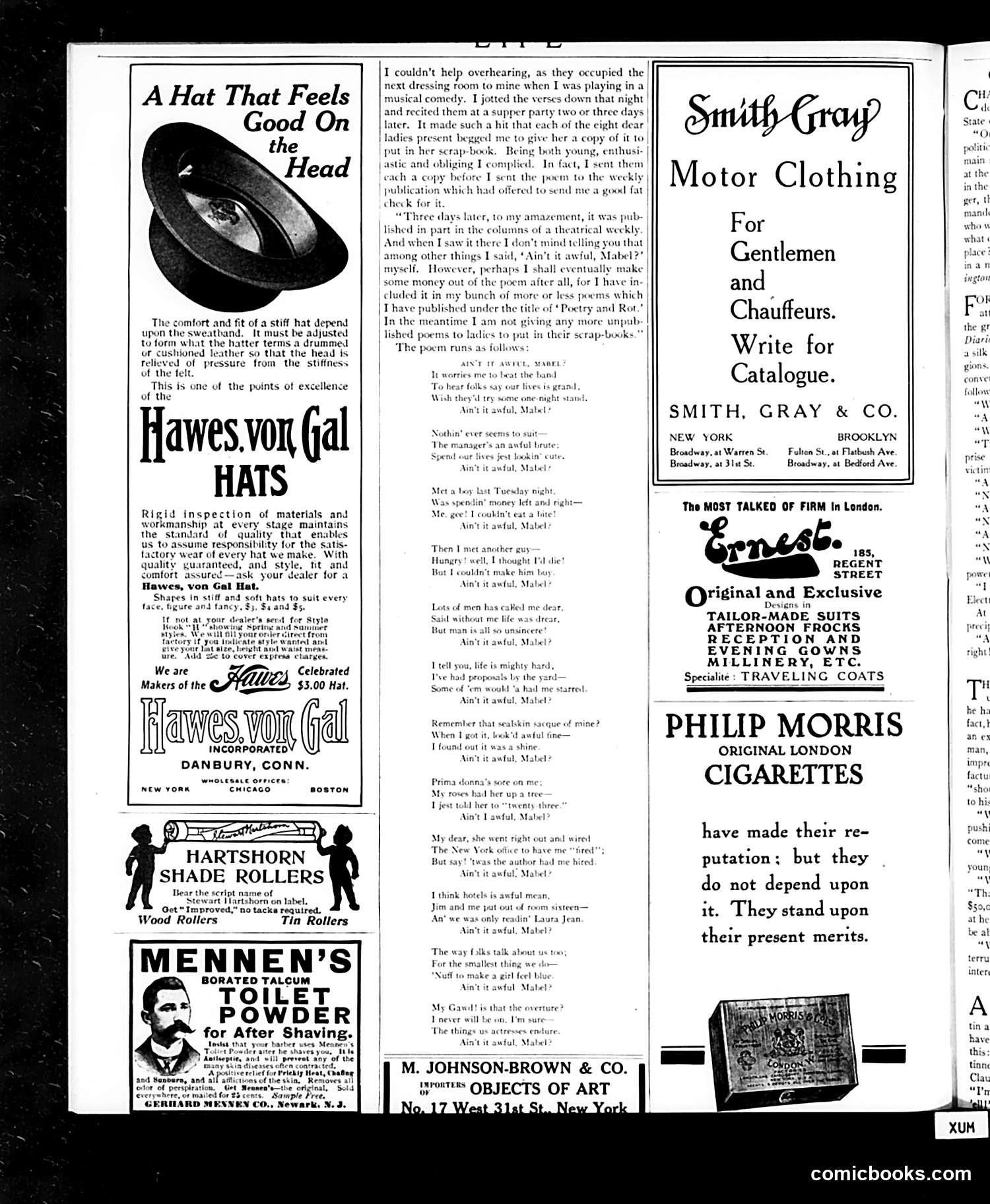
This page is primarily **advertising**, not editorial content or political satire. It features various product ads typical of early 20th-century magazines: Hawes von Gal hats, Hartshorn shade rollers, Mennen's talcum powder, Smith-Gray motor clothing, Ernest tailoring, and Philip Morris cigarettes. The only substantial non-advertising content is a humorous poem titled "Ain't It Awful, Mabel?" — an anecdotal piece about a writer who overheard theatrical performers' gossip, jotted down verses mocking their complaints ("Ain't it awful, Mabel?"), and saw it published in a theatrical weekly. The poem then repeats the refrain with various domestic and social complaints. There is **no political cartoon** on this page. The humor is gentle social comedy about everyday frustrations, not political satire. The "Mabel" references appear to be period slang for gossipy complaints, not references to specific public figures.
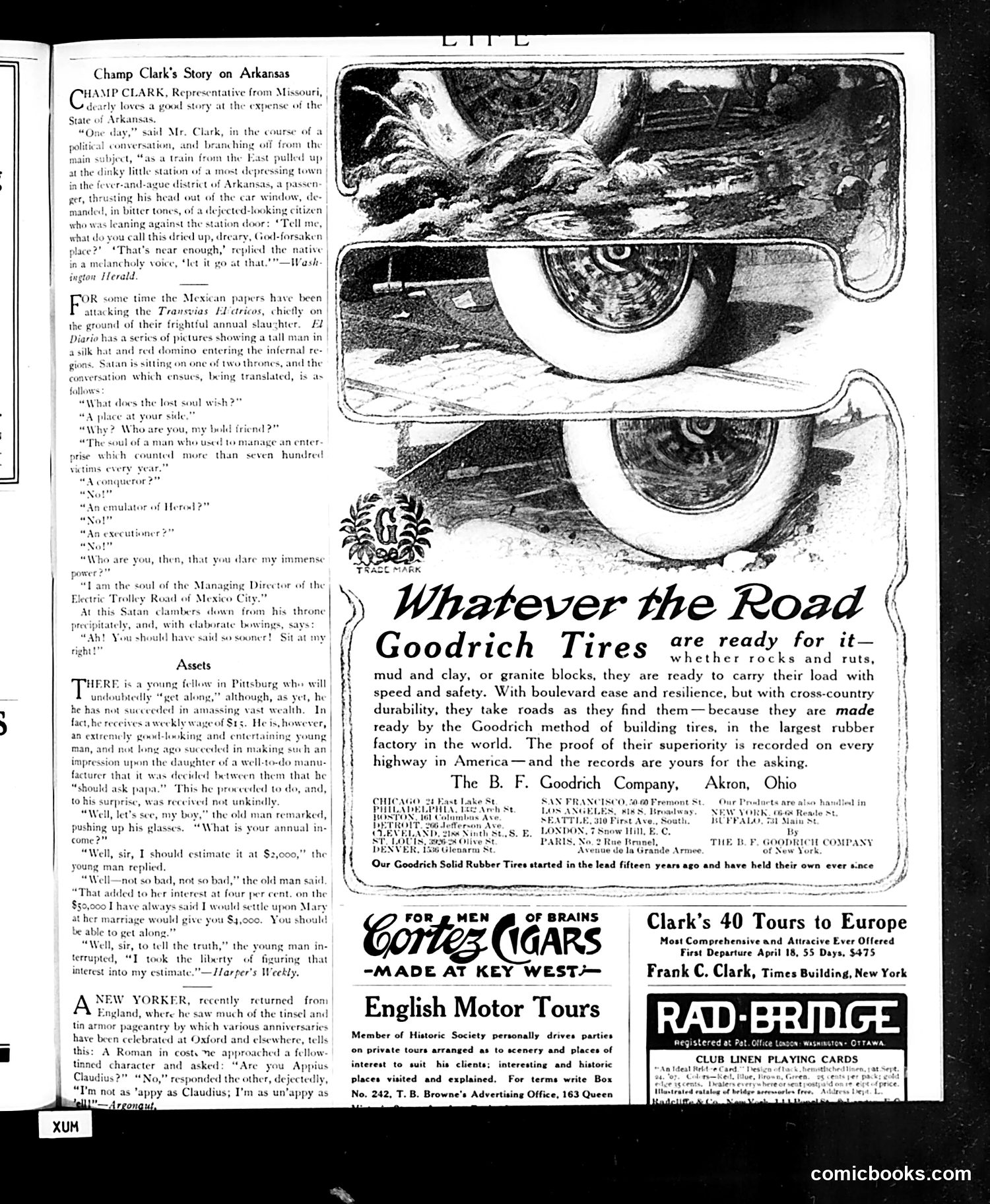
This page contains multiple unrelated content pieces typical of Life magazine's format: **Main Editorial Content:** - "Champ Clark's Story on Arkansas": A humorous anecdote by Champ Clark (a real Missouri congressman) mocking Arkansas as a depressed, desolate state. A train passenger asks a local to name the town; the native replies it's not worth naming. - "Assets": A brief story about a young Pittsburgh man courting a manufacturer's daughter, negotiating a substantial financial settlement ($2,000-$50,000) for marriage—satirizing the transactional nature of wealthy marriages. - A section on "A New Yorker" returning from England, mentioning Roman history and Oxford—appears to be a society anecdote, text partially unclear. **Advertisements:** The page is dominated by ads for Goodrich Tires, Cortez Cigars, Clark's European Tours, English Motor Tours, and Rad-Bridge playing cards. **Overall:** This is primarily an advertising-heavy page with light satirical content targeting regional stereotypes and marriage customs.
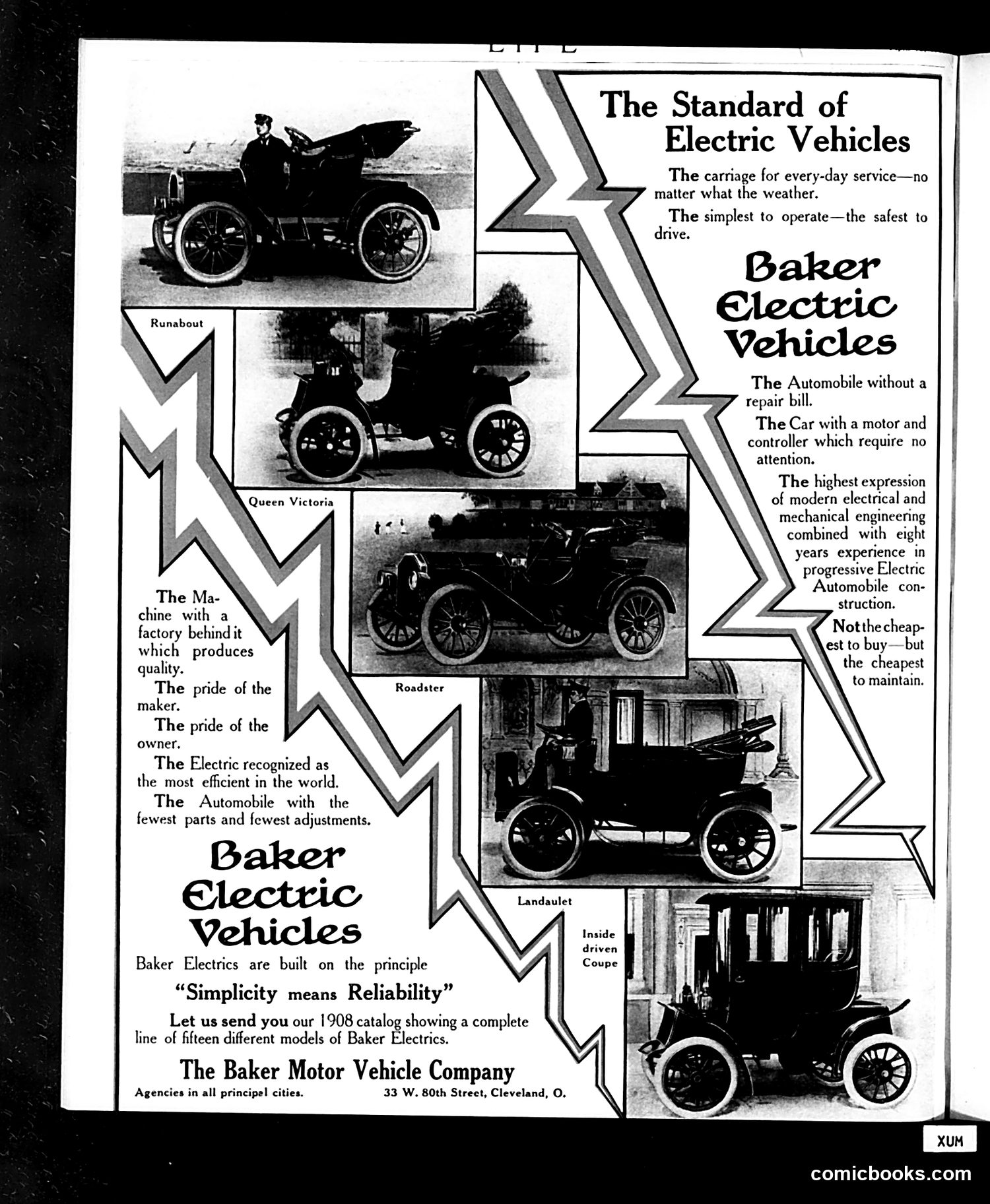
This is entirely **advertising**, not satire or editorial cartooning. It's a 1908 Baker Motor Vehicle Company advertisement promoting electric automobiles. The page displays five vehicle models (Runabout, Queen Victoria, Roadster, Landaulet, and Inside-driven Coupe) alongside marketing claims emphasizing reliability and ease of use: "no repair bill," "safest to drive," "fewest parts and adjustments," and "cheapest to maintain." The pitch targets early-1900s consumers concerned about automotive complexity. Electric vehicles competed with gasoline cars by emphasizing simplicity and low maintenance—key selling points when automobiles were still novel and unreliable. The company's Cleveland address and nationwide agencies suggest national distribution ambitions. The decorative lightning-bolt borders reinforce the "electric" branding. This represents the era when electric vehicles were genuinely competitive technology before gasoline engines ultimately dominated.