
Life, 1908-04-16 · page 6 of 24
Life — April 16, 1908 — page 6: what you’re looking at
What you’re looking at
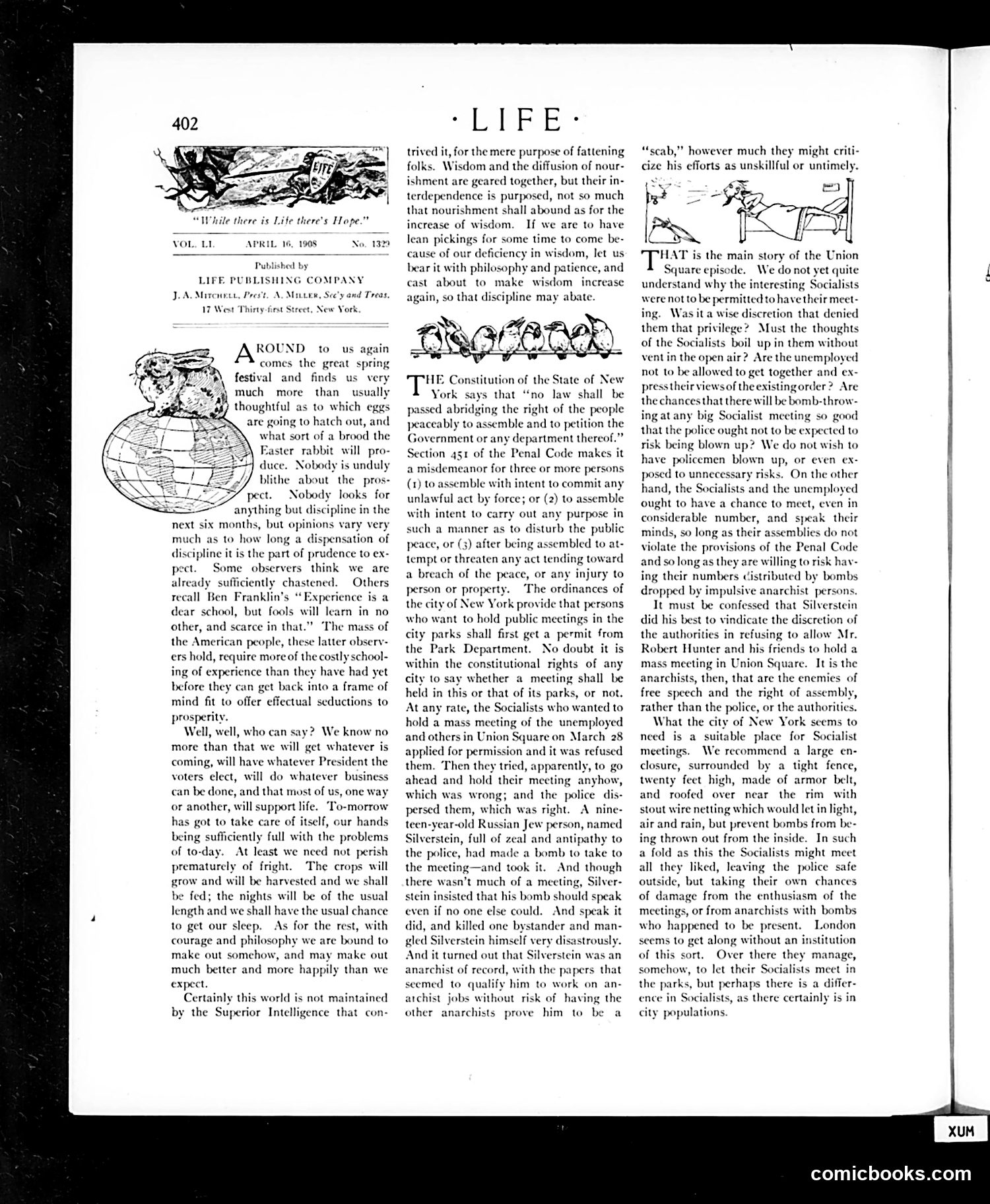
The page contains editorial commentary rather than political cartoons. The main text discusses the Union Square Socialist incident in New York, where police dispersed a planned mass meeting on March 28. The article criticizes both the Socialists and authorities, arguing the Socialists shouldn't expect police protection while promoting anarchism, but also suggesting cities should designate spaces for public assemblies to prevent disorder. A specific case mentioned: a nineteen-year-old Russian Jewish anarchist named Silverstein attempted to bring a bomb to the meeting. He was caught, killed a bystander, and was identified as an anarchist through documents found on him. The cartoons appear decorative/illustrative rather than satirical commentary on this specific event.
📄 Transcribed text from this page (OCR, searchable)
Machine-transcribed from the original scan — historical spelling and the odd misread are preserved.
“While there is Life there's Hope.” VOL. LI Published by LIFE PUBLISHING COMPANY J.-A Miron 17 West Thirty-first Stee 1, Prost, A. Mitre, See'y and Treas, . New Vork. ROUND to us again comes the great spring festival and finds us very much more than usually thoughtful as to which ¢ are going to hatch out, and. what sort of a brood the Easter rabbit will pro- Nobody is unduly blithe about the pros pect. Nobody looks for anything but discipline in the next six months, but opinions vary very much as to how long a dispensation of discipline it is the part of prudence to ex- pect. Some observers think we are already sufficiently chastened. Others recall Ben Franklin's “Experience is a dear school, but fools will learn in no other, and scarce in that.” The mass of the American people, these latter observ- ers hold, require more of the costly school ing of experience than they have had yet before they can get back into a frame of mind fit to offer effectual seductions to prosperity. Well, well, who can say? We know no more than that we will get whatever is coming, will have whatever President the voters elect, will do whatever business can be done, and that most of us, one way or another, will support life. ‘To-morrow got to take care of itself, our hands being sufficiently full with the problems of to-day. At least we need not perish maturcly of fright. The crops will grow and will be harvested and we shall be fed; the nights will be of the usual length and we shall have the usual chance to get our sleep. As for the rest, with courage and philosophy we are bound to make out somehow, and may make out much better and more happily than we expect. Certainly this world is not maintained by the Superior Intelligence that con- ge li a trived it, for the mere purpose of fattening folks. Wisdom and the diffusion of nour- ishment are geared together, but their in- terdependence is purposed, not so much that nourishment shall abound as for the increase of wisdom. If we are to have lean pickings for some time to come be- cause of our deficiency in wisdom, let us bear it with philosophy and patience, and cast about to make wisdom. increase again, so that discipline ma HE Constitution of the State of New York says that ‘no law shall be ed abridging the right of the people peaceably to assemble and to petition the Government or any department thereof.” ction 41 of the Penal Code makes it a misdemeanor for three or more persons (1) to assemble with intent to commit any unlawful act by force; or (2) to assemble with intent to carry out any purpose in stich a manner as to disturb the public peace, or (3) after being assembled to at- tempt or threaten any act tending toward a breach of the peace, or any injury to person or property. ‘The ordinances of the city of New York provide that persons who want to hold public meetings in the city parks shall first get a permit from the Park Department. No doubt it is within the constitutional rights of any city to say whether a meeting shall be held in this or that of its parks, or not. At any rate, the Socialists who wanted to hold a mass meeting of the unemployed and others in Union Square on March 28 applied for permission and it was refused them. Then they tried, apparently, to go ahead and hold their meeting anyhow, which was wrong; and the police dis- persed them, which was right. A nine- teen-year-old Russian Jew person, named Silverstein, full of zeal and antipathy to the police, had made a bomb to take to the meeting—and took it. And though there wasn’t much of a meeting, Silver- stein insisted that his bomb should speak even if no one else could. And speak it did, and killed one bystander and man- gled Silverstein himself very disastrous And it turned out that Silverstein was an anarchist of record, with the papers that seemed to qualify him to work on an- archist jobs without risk of having the other anarchists prove him to scab,” however much they might criti- cize his efforts as unskillful or untimely. HAT is the main story of the Union Square episode. We do not yet quite understand why the interesting Socialists were not to be permitted to have their me ing. Was ita wise discretion that denied them that privilege? Must the thoughts of the Socialists boil up in them without vent in the open air? Are the unemployed not to be allowed to get together and ex- press their views of the existing order? Are the chances that there will be bomb-throw- ing at any big Socialist meeting so good that the police ought not to be expected to risk being blown up? We do not wish to have policemen blown up, or even ex- posed to unnecessary risks. On the other hand, the Socialists and the unemployed ought to have a chance to meet, even in considerable number, and speak their minds, so long as their assemblies do nc violate the provisions of the Penal Code and so long as they are willing to risk hav- ing their numbers distributed by bombs dropped by impulsive anarchist persons. It must be confessed that Silverstein did his best to vindicate the discretion of the authorities in refusing to allow Mr. Robert Hunter and his friends to hold a mass meeting in Union Square. It is the anarchists, then, that are the enemies of free speech and the right of assembl rather than the police, or the authoritie: What the city of New York seems to need is a suitable place for Socialist meetings. We recommend a large en- closure, surrounded by a tight fence, twenty feet high, made of armor belt, and roofed over near the rim with stout wire netting which would let in light, air and rain, but prevent bombs from be- ing thrown out from the inside. In such a fold as this the Socialists might meet all they liked, leaving the police safe outside, but taking their own chances of damage from the enthusiasm of the meetings, or from anarchists with bombs who happened to be present. London seems to get along without an institution of this sort. Over there they manage, somchow, to let their Socialists meet in the parks, but perhaps there is a differ- ence in Socialists, as there certainly is in city populations. comicbooks.com