
Life, 1908-04-16 · page 16 of 24
Life — April 16, 1908 — page 16: what you’re looking at
What you’re looking at
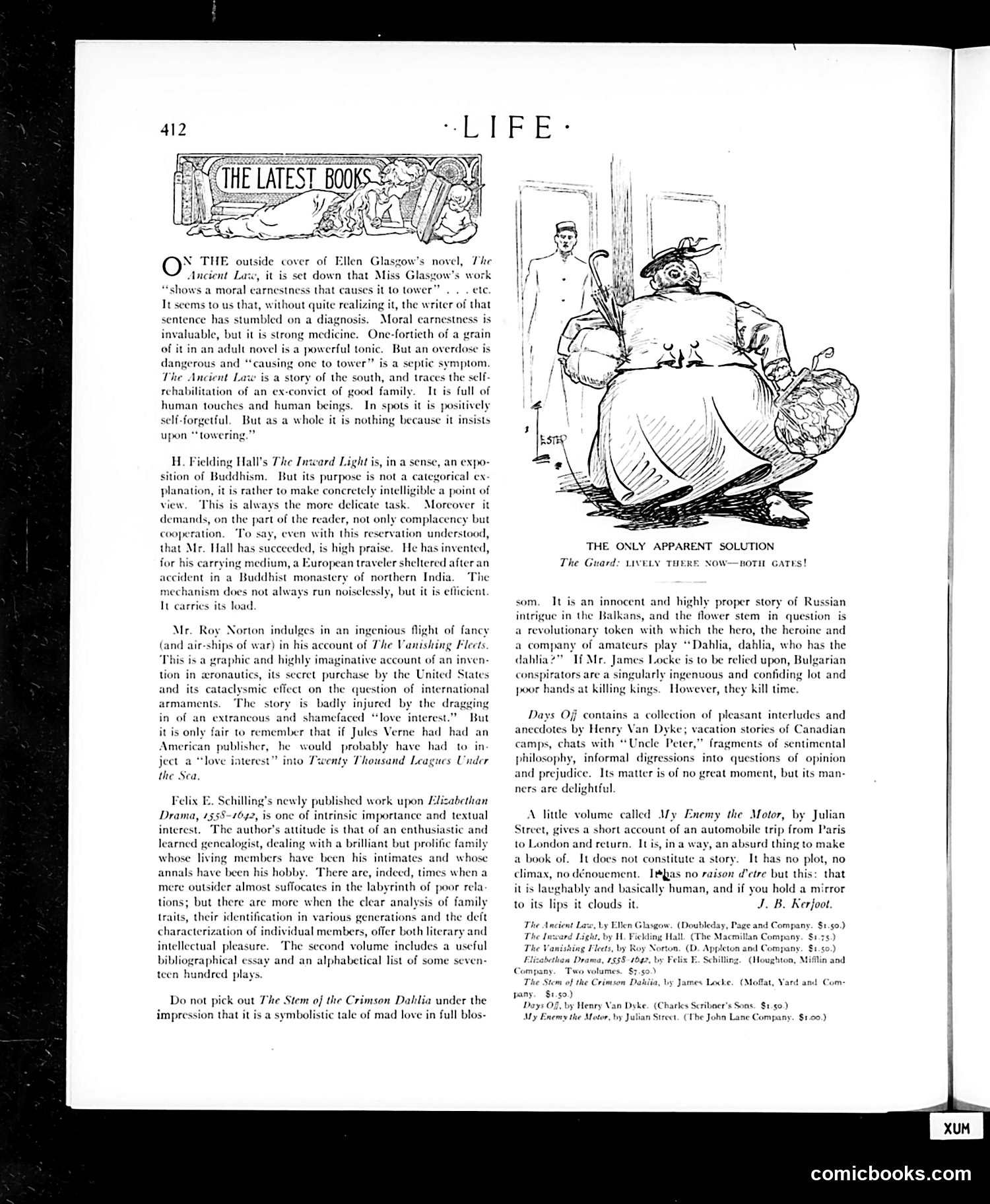
This single cartoon depicts a guard stationed at two gates, addressing someone with "Lively there now—both gates!" The drawing shows a portly, well-fed figure positioned between two doorways, suggesting he must monitor or control access to both simultaneously—an impossible task given his size and positioning. The cartoon likely satirizes a contemporary political or social situation requiring simultaneous management of competing demands or locations. Without additional context from the magazine's date or other pages, the specific reference is unclear, but the humor derives from the physical absurdity: one person cannot effectively guard both gates at once, making the guard's cheerful instruction darkly comedic. The cartoon accompanies book reviews on this "Latest Books" page, though it appears thematically unrelated to the literary content discussed.
📄 Transcribed text from this page (OCR, searchable)
Machine-transcribed from the original scan — historical spelling and the odd misread are preserved.
E LATEST BOO N THE outside cover of Ellen Glasgow's novel, Ancient Law, it is set down that Miss Glasgow's work “shows a moral earnestness that causes it to tower”... etc, It seems to us that, without quite realizing it, the writer of that sentence has stumbled on a diagnosis. Moral carnestness is invaluable, but it is strong medicine. One-fortieth of a grain of it in an adult novel is a powerful tonic. But an overdose is dangerous and “causing one to tower” is a septic symptom The Ancient Law is a story of the south, and traces the self- rehabilitation of an ex-convict of good family. It is full of human touches and human beings. In spots it is positively self-forgetful. But whole it is nothing because it insists upon “towering.” H. Fielding Hall's The Inveard Light is, in a sense, an expo- sition of Buddhism. But its purpose is not a categorical ex- planation, it is rather to make concretely intelligible a point of view, This is always the more delicate task. Moreover it demands, on the part of the reader, not only complacency but cooperation. ‘To say, even with this reservation understood, that Mr. Hall has succeeded, is high praise. He has invented, for his carrying medium, a European traveler sheltered after an accident in a Buddhist monastery of northern India. The mechanism does not always run noisclessly, but it is efficient. It carries its load. Mr. Roy Norton indulges in an ingenious flight of fancy (and air-ships of war) in his account of The Vanishing Fleets ‘This is a graphic and highly imaginative account of an inven- tion in wronautics, its secret purchase by the United States and its cataclysmic effect on the question of international armaments. The story is badly injured by the dragging in of an extraneous and shamefaced “love interest.” But it is only fair to remember that if Jules Verne had had an American publisher, he would probably have had to in love interest” into Twenty Thousand Leagues Under ject a the Sea. Felix E. Schilling’s newly published work upon Llizabethan Drama, 1558-1642, is one of intrinsic importance and textua interest. The author’s attitude is that of an enthusiastic and learned genealogist, dealing with a brilliant but prolific family whose living members have been his intimates and whose annals have been his hobby. There are, indeed, times when a mere outsider almost suffocates in the labyrinth of poor rela tions; but there are more when the clear analysis of family traits, their identification in various generations and the deft characterization of individual members, offer both literary and intellectual pleasure. The second volume includes a useful bibliographical essay and an alphabetical list of some seven- teen hundred plays. Do not pick out The Stem oj the Crimson Dahlia under the impression that it is a symbolistic tale of mad love in full blos- The THE ONLY APPARENT SOLUTION The Guard: \AVELY THERE NOW—nOTH GATES! som, It is an innocent and highly proper story of Russian intrigue in the Balkans, and the flower stem. in question is a revolutionary token with which the hero, the heroine and a company of amateurs play “Dahlia, dahlia, who has the dahlia?” “If Mr. James Locke is to be relied upon, Bulgarian conspirators are a'singularly ingenuous and confiding lot and poor hands at killing kings. However, they kill time. Days Ojj contains a collection of pleasant interludes and anecdotes by Henry Van Dyke; vacation stories of Canadian camps, chats with “Uncle Peter,” fragments of sentimental philosophy, informal digressions into questions of opinion and prejudice. Its matter is of no great moment, but its man- ners are delightful \ little volume called My Enemy the Motor, by Julian ccount of an automobile trip from Paris an absurd thing to make Street, gives a short a to London and return. Itis, in a wa, a book of. It does not constitute a story. It has no plot, no climax, no dénouement. It*gas no raison d'etre but this: that it is lavghably and basically human, and if you hold a mirror to its lips it clouds it J.B. Kerjoot. . Ly Ellen Glasgow. (Doubleday, Page and Company. $1.0.) ight, by H. Fielding Hall. (The Macmillan Company. $1.75.) ¢ Fleets, by Roy Norton. (D. Appleton and Company. $1.50.) 4 Drama, 1558-1042, by Felix F. Schilling. (He flin and y. Two volumes. $7.50.) Stem of the Crimson Dahiia, by James Locke. (Moffat, ¥ pany, $1.59.) Days Of, by Henry Van Dyke. (Charks Scribaer’s Sons. $1.50) My Enemy the Motor, hy Julian Strect. (The Joha Lane Company. $1.00.) {1 Com: comicbooks.com