
Life, 1908-04-16 · page 15 of 24
Life — April 16, 1908 — page 15: what you’re looking at
What you’re looking at
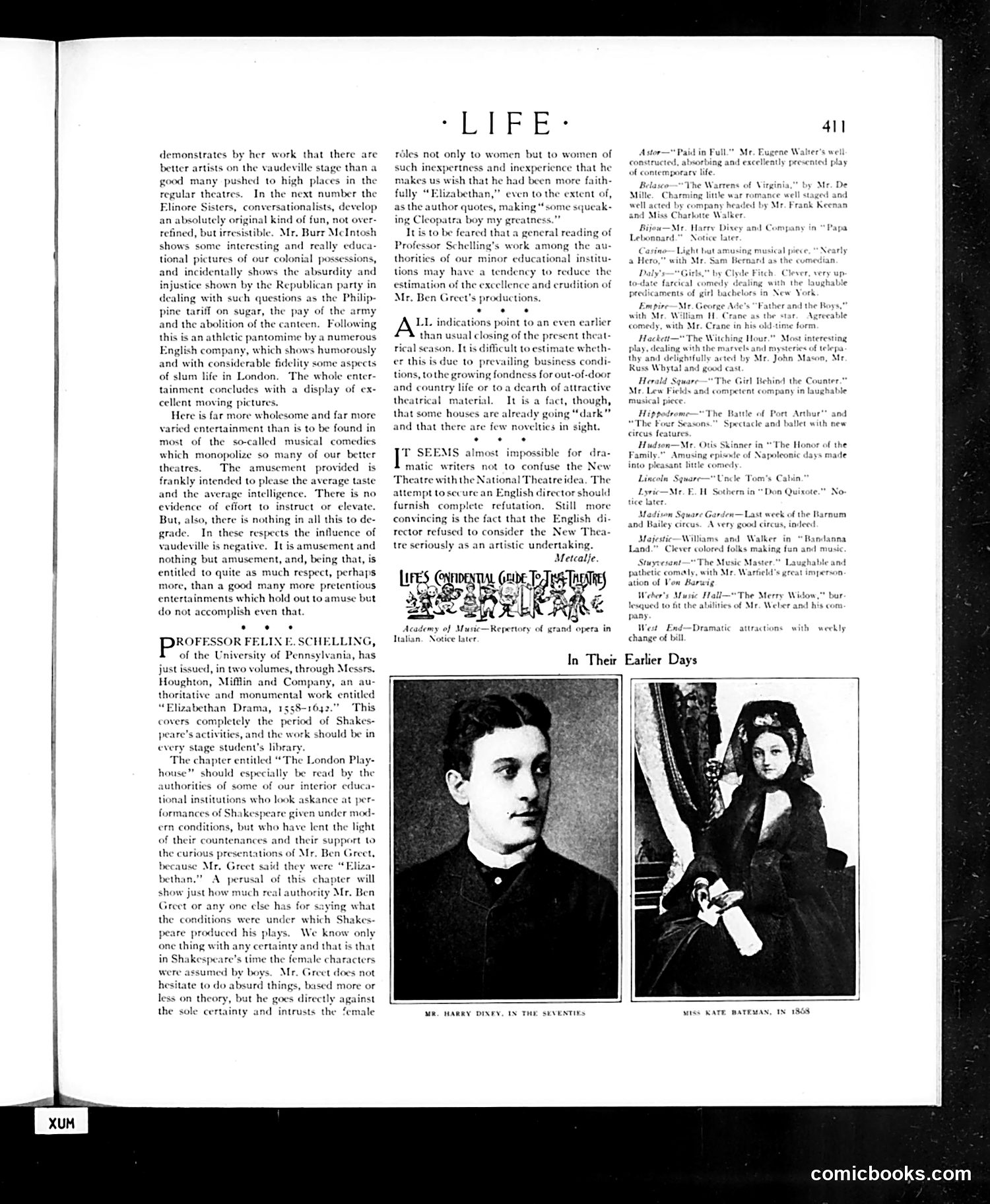
This page from *Life* magazine (page 411) discusses theatrical entertainment and drama history, rather than presenting political cartoons. The content critiques vaudeville performances and reviews a scholarly work on Elizabethan drama by Professor Schelling of the University of Pennsylvania. The page includes two photographs labeled "In Their Earlier Days": one of "Mr. Harry Davey in the Seventies" and another of "Miss Kate Bateman in 1868," showing theatrical performers from the 19th century. The text defends vaudeville as legitimate entertainment while discussing debates about Shakespearean production methods—specifically, the historical practice of using young boys to play female roles. It critiques theater director Ben Greet's attempts to recreate "authentic" Elizabethan conditions, suggesting his casting choices undermine the quality of performances. The overall tone is cultural commentary rather than satire.
📄 Transcribed text from this page (OCR, searchable)
Machine-transcribed from the original scan — historical spelling and the odd misread are preserved.
| j demonstrates by her work that there are better artists on the vaudeville stage than a good many pushed to high places in the regular theatres. In the next number the Elinore Sisters, conversationalists, develop ly original kind of fun, not ove an absol refined, but irresistible. Mr, Burr McIntosh shows some interesting and really educa tional pictures of our colonial possessions, and incidentally shows the absurdity and injustice shown by the Republican party in dealing with such questions as the Philip pine tariff on sugar, the pay of the arm) and the abolition of the canteen. Following numerous this is an athletic pantomime by English company, which shows hu and with considerable fidelity some aspects of slum life in London. ‘The whole enter- tainment concludes with a display of ex- cellent moving pictures. Here is far more wholesome and far more varied entertainment than is to be found in orously most of the so-called musical comedies which monopolize so many of our better theatres. The amusement provided is -ankly intended to please the average taste and the average intelligence. There is no evidence of effort to instruct or elevate. But, also, there is nothing in all this to de- grade. In these respects the influence of vaudeville is negative. It is amusement and nothing but amusement, and, being that, is entitled to quite as much respect, perhaps more, than a good many more pretentious entertainments which hold out to amuse but do not accomplish even that. ROFF CHELLI of the University of Pennsylvania, has just issued, in two volumes, through Messrs. Houghton, Mifflin and Company, an au- thoritative and monumental work entitled “Elizabethan Drama, 1358-1632." ‘This covers completely the period of Shakes- peare’s activities, and the work should be in ry. every stage student's Ii The chapter entitled “ The London Play- house” should especially be read by the authorities of some of our interior educa- tional institutions who look askance at per- Shakespeare given under 1 ern conditions, but who have lent the light formances of of their countenances and their support to the curious prese because Mr, ¢ bethan.” Ape show just how much real authority Greet or ar ‘ the conditions were under which Shakes- peare produced his plays. We know only one thing with any certainty and that is that in Shakespeare's time the female characters were assumed by boys. Mr. G not hesitate to do absurd things, based more or inst female Mr. Ben ing what y one else has fe et doe but he goes directly and intrusts the less on theory, ainty ¢ sole ce: LIFE réles not only to women but to women of such inexpertness and inexperience that he us wish that he had been more faith- ‘lizabetha thor quotes, n,”” even to the extent of, as the making “some squeak- ing Cleopatra boy my greatness.” It is to be feared that a general reading of Professor Schelling’s work among the au- norities of our minor educa y jonal institu- tions may have a tendency to reduce the estimation of the excellence and erudition of Mr. Ben Greet’s productions, LL. indications point to an even ea than usual closing of the present theat- rical season. It is difficult to estimate wheth- er this is due to prevailing business condi- tions, tothe growing fondness for out-of-door and country life or to a dearth of attractive theatrical material. It is a fact, though, that some he and that the uses are already going “dark” are few novelties in sight. ‘T SEEMS almost impossible for dra- matic writers not to confuse the New ‘Theatre with the National Theatre idea, The attempt to secure an English director should furnish complete refutation, Still more convincing is the fact that the English di- rector refused to consider the New Th tre seriously as an artistic undertaking. Oe Bic g aes Gude Te asd In Their Mek {contemporary Belasco—"Vhe Wartens of Virginia.” by Mr. De Mille. Charming little war romance well staged and well acted by company headed by Mr. Frank Keenan and Miss Charlotte Walker Bijou—Me. Harty Dixey and Company in Let Notice later Ca Light but amusing musical piece, “Nearly a Hero,” with Mr. Sam Bernard as the comedian “Girls,” by Clyde F Clever, very up. farcical comedy dealing with the laughable ts of girl bachelors in New York Empire—Mr. Gorge Ade’s “Father and the Bi with Mr, William H. Crane as the star. Agreeable comedy, with Mr. Crane in h ine form Hackett—" The Witching Hour.” Most inter I mysteries of telepa play, dealing with the marvel: thy and delightfully acted by Mr. John Mason, Me Russ Whytal and good cast Herald Square—"The Girl Behind the Counter.” Mr. Lew Fiek!s and competent company in laughable musical piece “The Battle of Port Arthur" and Seasons.” Spectacle and ballet with new Hippodrome “The F circus features. Hudson—Me. Otis Skinner in “The Honor of the Family.” Amusing episnte of Napoleonic days made into pleasant litt L Lyric—Me. FH Sothern in “Don Quixote.” No coln. Square— Tom's Cabin. Madison Square Garden—Last week of the Rarnum and Bailey circus. A very good circus, indeed Majestic—Williams and Walker in “Bandas Land.” Clever colored folks making fun and music Stuyvesant—"The Music Master.” Laughabl pathetic cometly, with Mr. Warfield’s geeat imperson. ation of Vor Barwig Weber's Music Hall—"The Merry Widow,” bur sof Mr. Weber and his com Dramatic attractions with weekly change of bill Earlier Days MARRY DINFY, IN THE SEVENTIES MISS KATE BATEMAN, IN. 1863 comicbooks.com