
A complete issue · 20 pages · 1907
Life — November 14, 1907
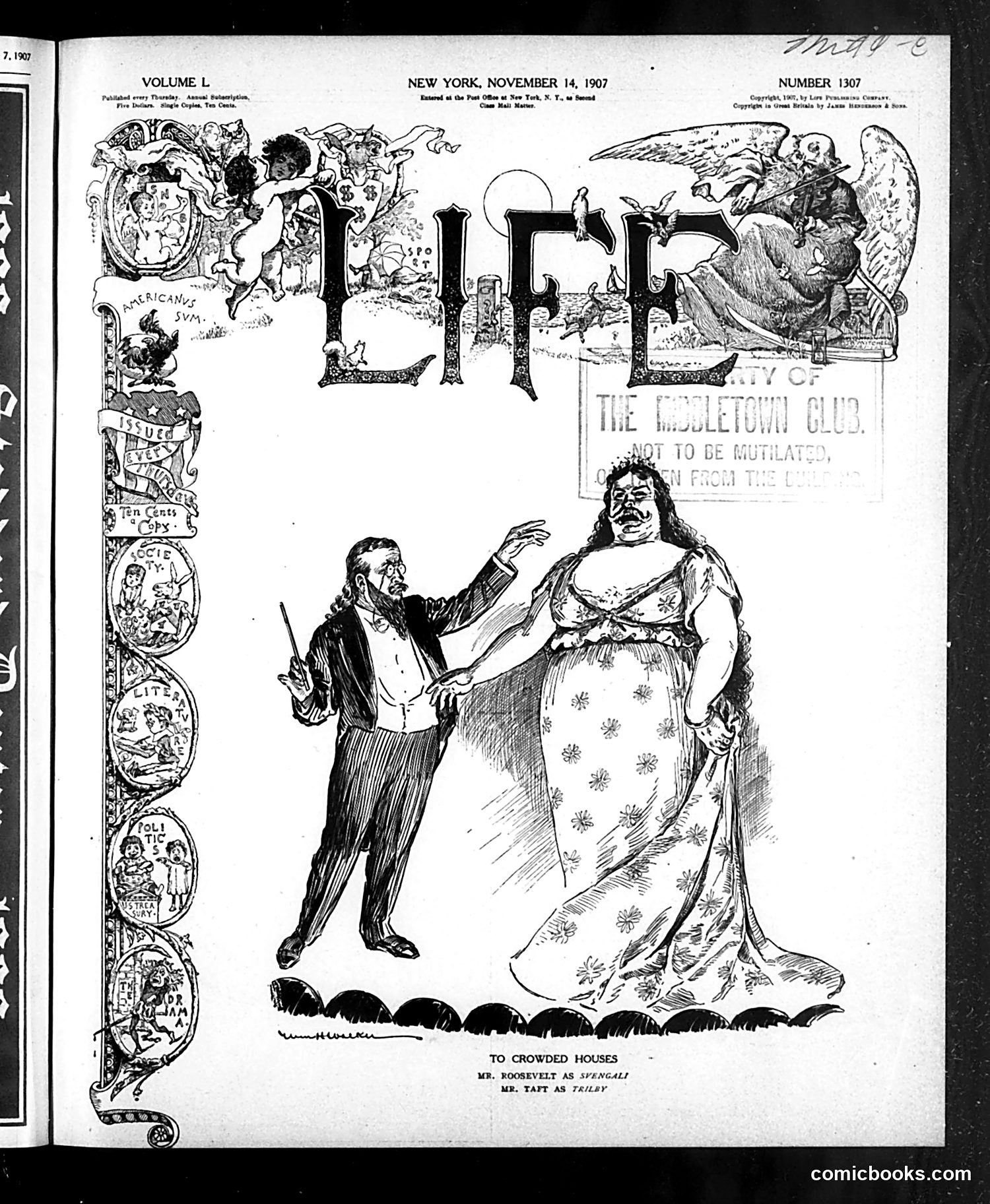
This cartoon satirizes overcrowded housing conditions in New York City. The main illustration shows a thin man (labeled as Roosevelt, appearing as a "special" agent) gesturing helplessly at a massively pregnant woman (labeled as Taft, playing "Taisey"), symbolizing the swelling housing crisis. The caption "To Crowded Houses" suggests the cartoon critiques housing policy during the Roosevelt and Taft administrations. The grotesquely enlarged female figure represents the city's exponentially growing housing problem that neither political figure adequately addressed—depicted as an out-of-control, bloated crisis neither could manage. The ornate left border with decorative vignettes was typical of Life's design aesthetic of this period.
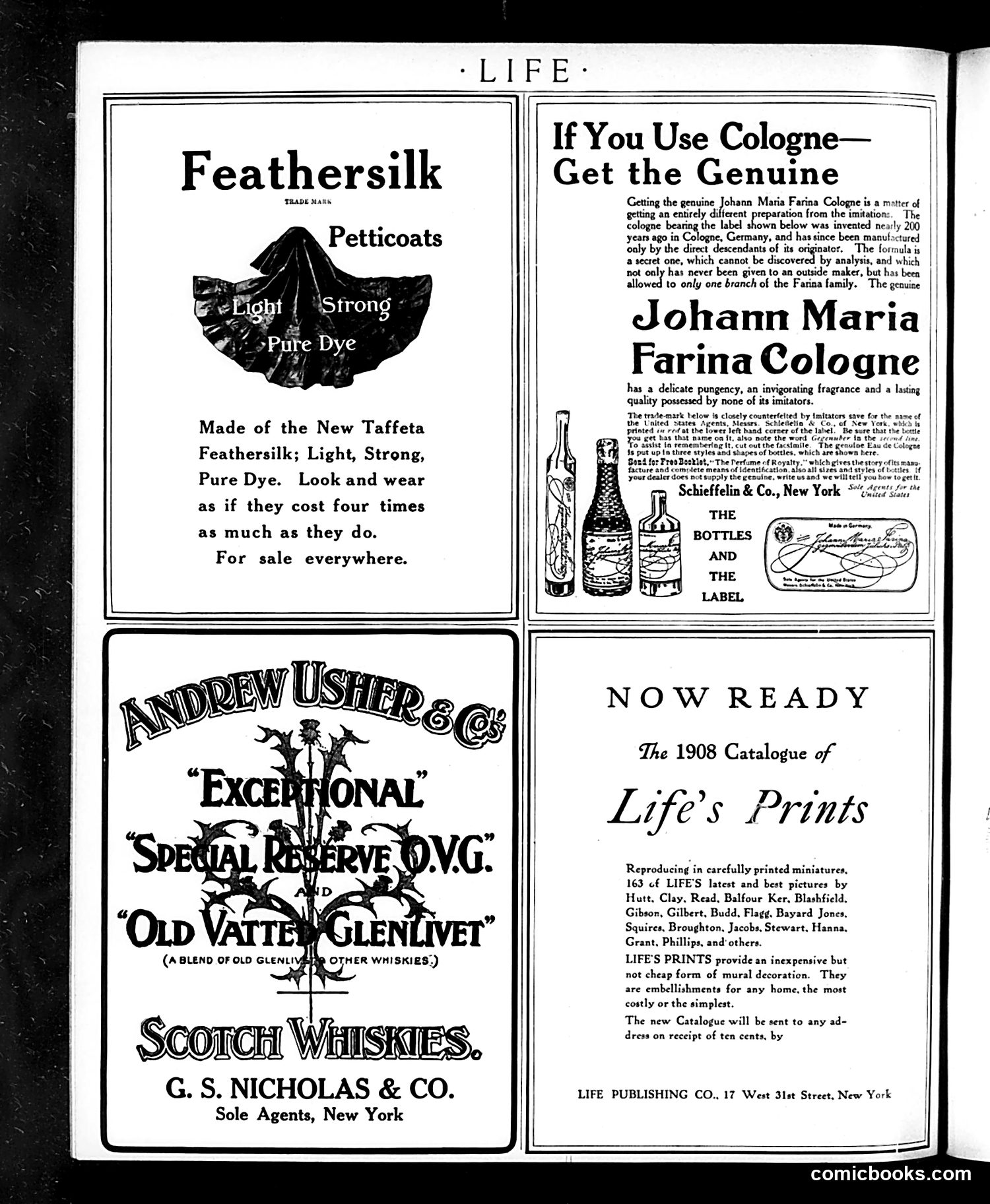
This page contains **no political cartoons or satire**—it's primarily **advertising** from approximately 1908. The four ads promote: 1. **Feathersilk Petticoats**—marketed as durable fabric offering luxury appearance at modest cost 2. **Johann Maria Farina Cologne**—emphasizing authenticity and warning against counterfeits, with bottles and labels shown 3. **Andrew Usher & Co. Scotch Whiskies**—featuring their product line 4. **Life's Prints Catalogue**—announcing a new collection of 163 reproductions of paintings and prints for home decoration The page reflects early 20th-century consumer culture, with emphasis on brand authenticity, affordable luxury goods, and home decoration. There is no satirical content to decode—this is straightforward period advertising.
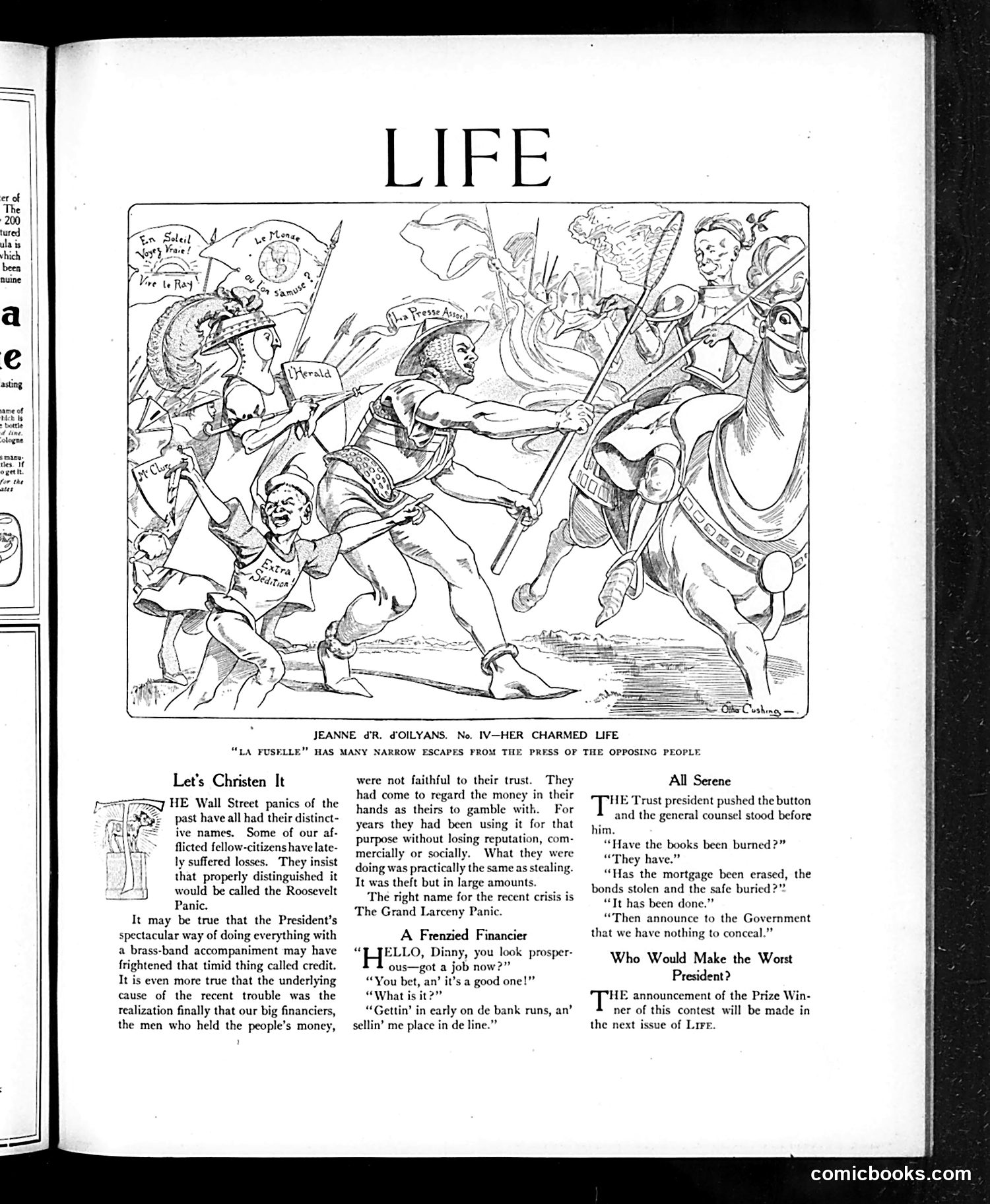
This page satirizes the financial crisis of the early 1920s, likely the 1921 recession. The main cartoon depicts "La Fuselle" (Joan of Arc) escaping "the press of opposing people"—using the historical figure as metaphor for a nation under financial siege. The article "Let's Christen It" mocks how financiers gambled with public money during the crisis, comparing their theft to the "Roosevelt Panic." The "Grand Larceny Panic" heading suggests satirizing how wealthy men manipulated currency and credit while ordinary citizens lost savings. "A Frenzied Financier" depicts banking corruption through dialogue about jobs and "early bank runs"—referencing bank failures when depositors rushed to withdraw funds. The satire targets elite financiers' misuse of public trust and resources.
This page discusses President Roosevelt's handling of the financial panic (the 1907 "Roosevelt Panic"). The text credits Roosevelt with decisive action—calling out the Knickerbocker Trust Company crisis and praising his response to what Wall Street blamed on him. The main cartoon shows a figure (likely Roosevelt) being struck down by what appears to be economic forces or "miscellaneous fury," humorously illustrating how suddenly economic crisis swept over the administration despite his efforts. The article argues Roosevelt shouldn't be held responsible for broader economic conditions, defending him against financiers' criticism. It also discusses potential Republican candidates, including J.P. Morgan (mentioned as unlikely to run for President) and suggests Roosevelt's handling of the crisis demonstrated his executive competence, making discontinuing him as President unwise.
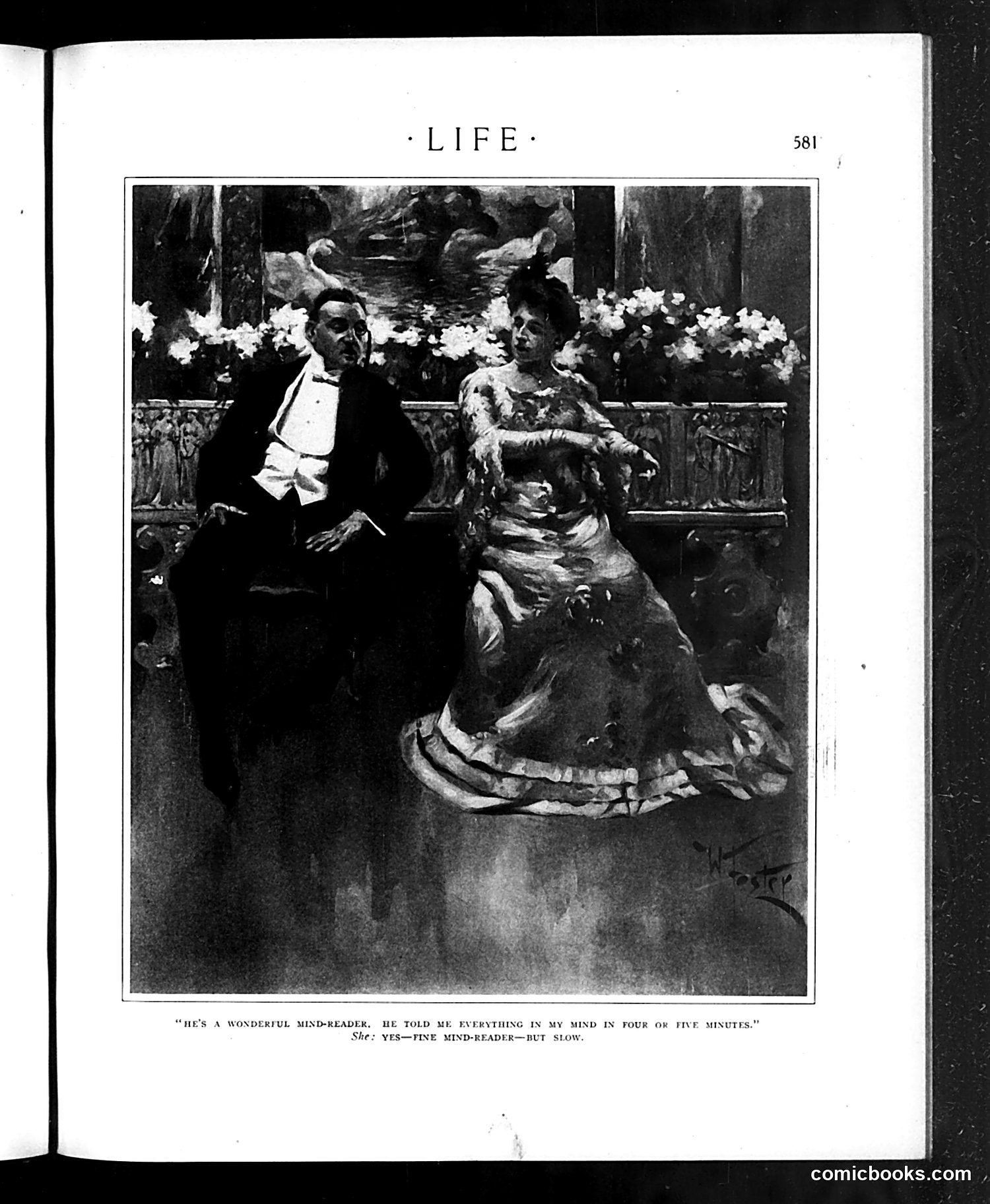
This illustration satirizes a "mind-reader" or fortune teller. A well-dressed man in formal attire sits with a woman in an elegant dress, with flowers visible in the background setting. The caption mocks the encounter: the man claims the mind-reader told him "everything in my mind in four or five minutes," to which the woman replies "Yes—fine mind-reader—but slow," implying his mind contains so little that even a psychic needed extended time to find anything substantial. The joke relies on insulting the man's intelligence through the double meaning of "slow"—both suggesting the mind-reader was sluggish and that the man himself is dim-witted. This appears to be typical early 20th-century *Life* magazine humor targeting male vanity and intellect.
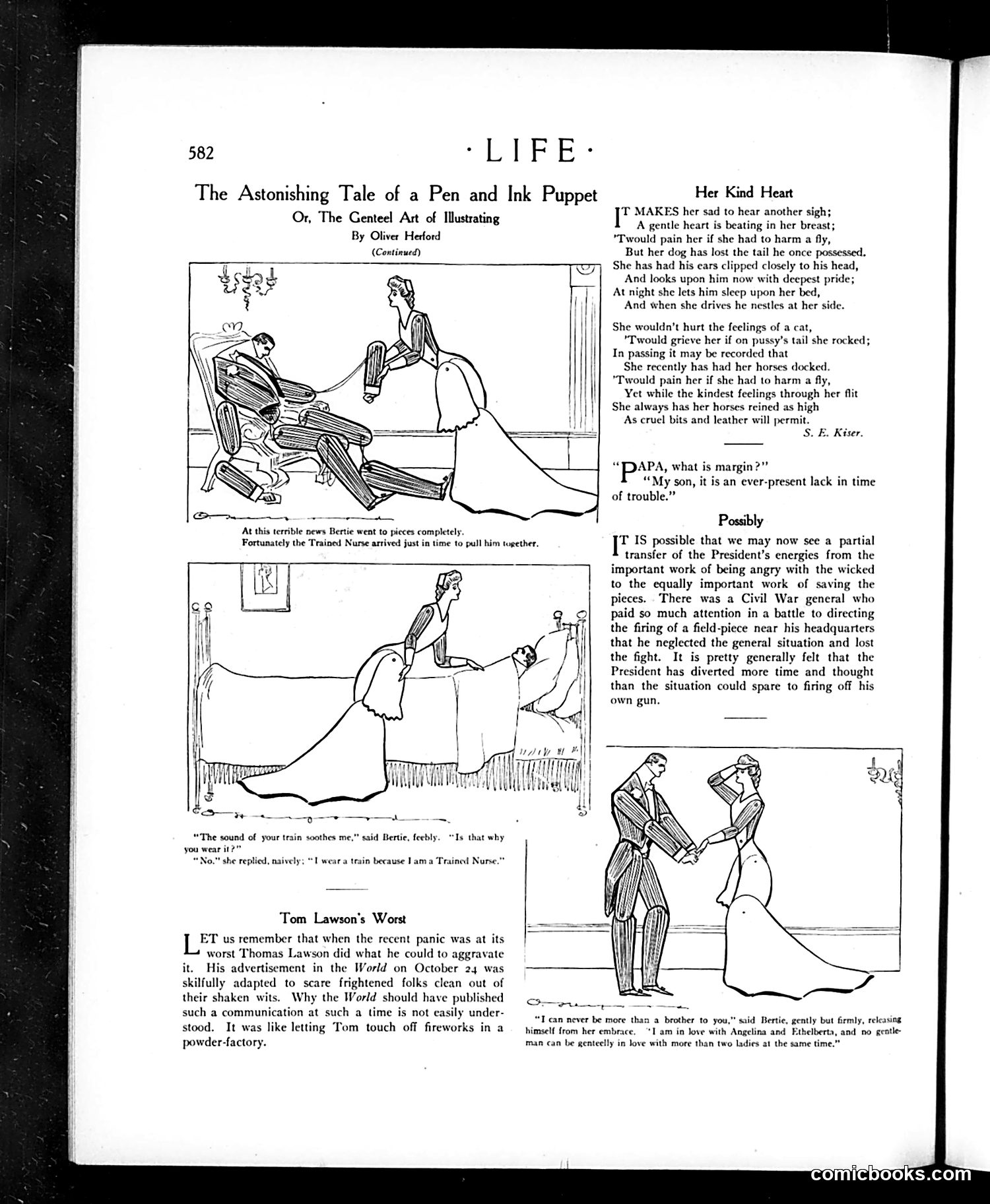
This page contains three separate pieces of satirical content: 1. **"The Astonishing Tale of a Pen and Ink Puppet"** by Oliver Hafford: A serialized comic strip showing what appears to be a trained nurse character in domestic situations, likely satirizing early 20th-century gender roles and social expectations. 2. **"Her Kind Heart"** (poem by S.E. Kiser): Sentimental verse about a woman's compassion toward animals, contrasting with her treatment of horses. This appears to satirize selective compassion or hypocrisy. 3. **"Possibly"** and **"Tom Lawson's Worst"**: These sections reference President Theodore Roosevelt and Thomas Lawson (apparently a financial/public figure), discussing panic, military matters, and newspaper sensationalism—likely from the early 1900s panic period. The overall page satirizes American social pretension and political/economic anxieties of the era.
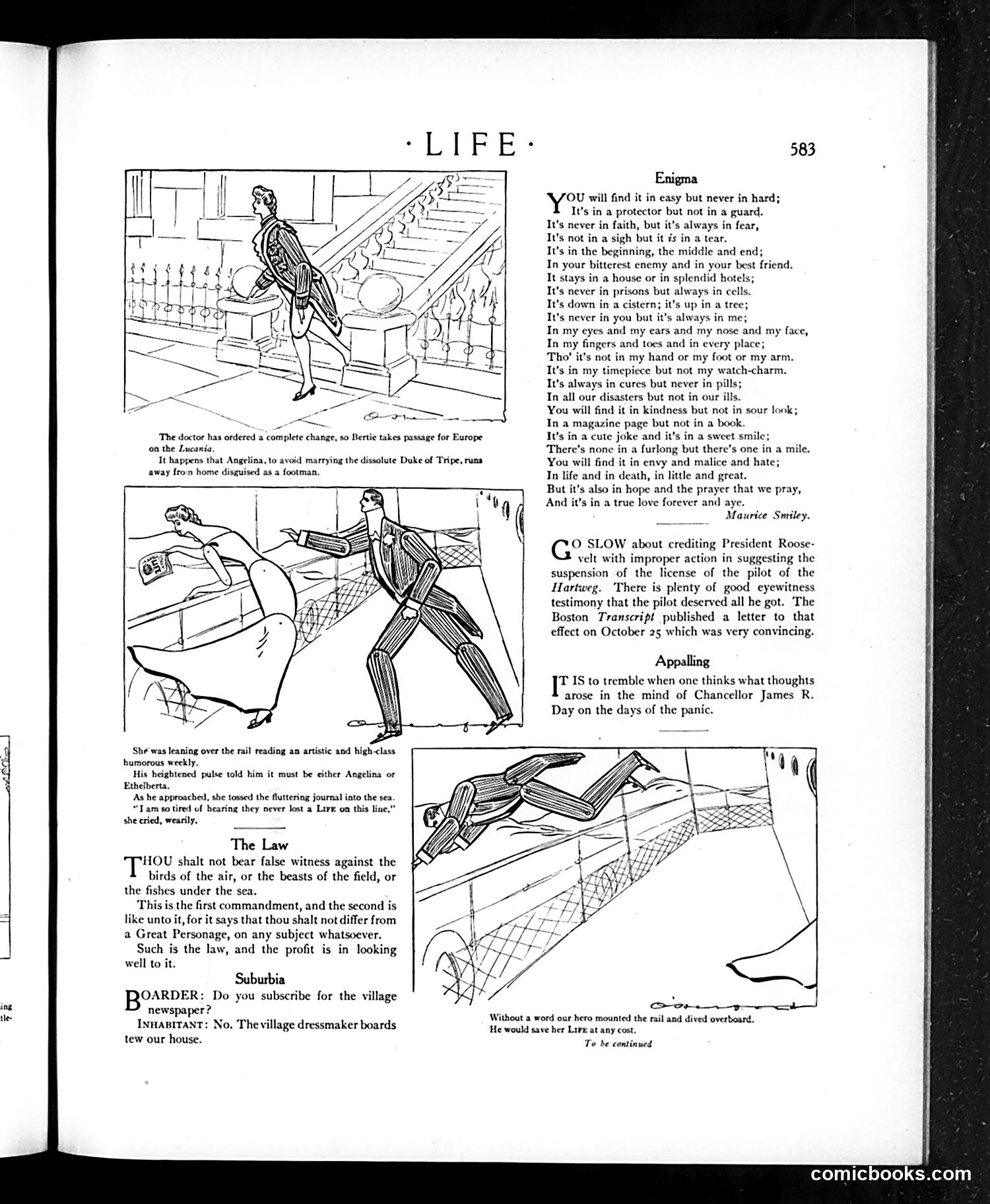
This page contains three distinct sections: 1. **Top cartoon**: A man in formal dress stands on a ship's deck. The caption indicates "the doctor has ordered a complete change, so Herbie takes passage for Europe on the Lusitania." This appears to satirize wealthy Americans taking European vacations for health reasons—a common practice among the affluent. 2. **Middle section**: Two cartoon panels showing a woman and man, with text about crediting President Roosevelt regarding a pilot's license suspension. This references contemporary political/aviation controversy, though specific details are unclear. 3. **"The Law" and "Suburbia" sections**: Brief satirical pieces about false witness and village life. The overall tone is light social satire typical of Life magazine's humor directed at upper-class leisure activities and contemporary civic matters.
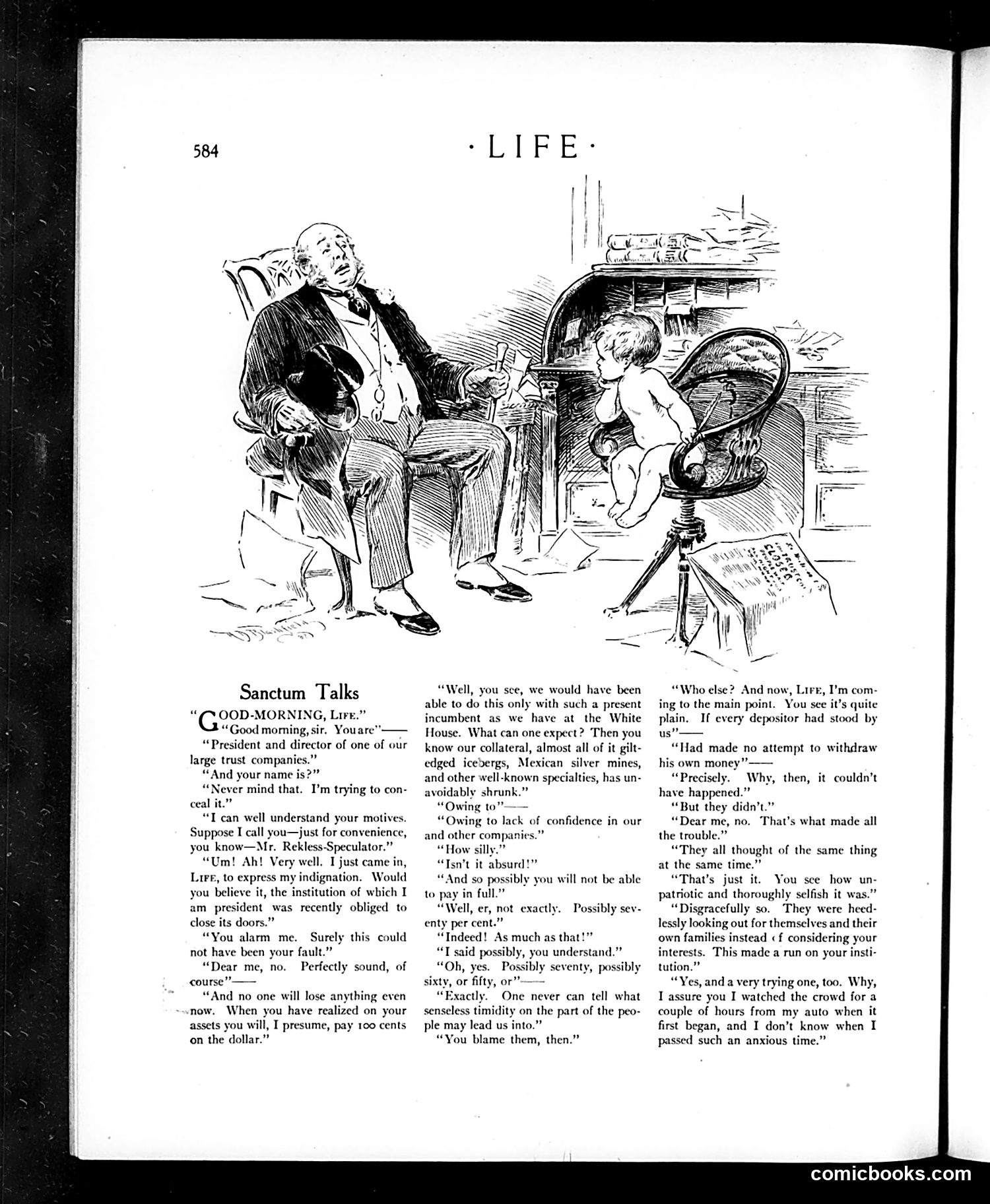
This is a dialogue cartoon titled "Sanctum Talks" depicting a conversation between an older, well-dressed man and the personified figure of "Life" (shown as a cherub/baby in a mirror). The satire mocks wealthy financiers who closed their doors during a banking crisis, claiming they couldn't fulfill financial obligations. The older man defends the "President and directors" of large trust companies, attributing their failures to lack of confidence in other companies and citing shrinkage of assets. "Life" counters that these wealthy men were selfish—prioritizing personal interests over public good. The cartoon criticizes how financiers blamed circumstances beyond their control while protecting their own wealth, rather than taking responsibility for their role in the financial collapse. This reflects early 20th-century tensions between corporate leadership and public accountability.
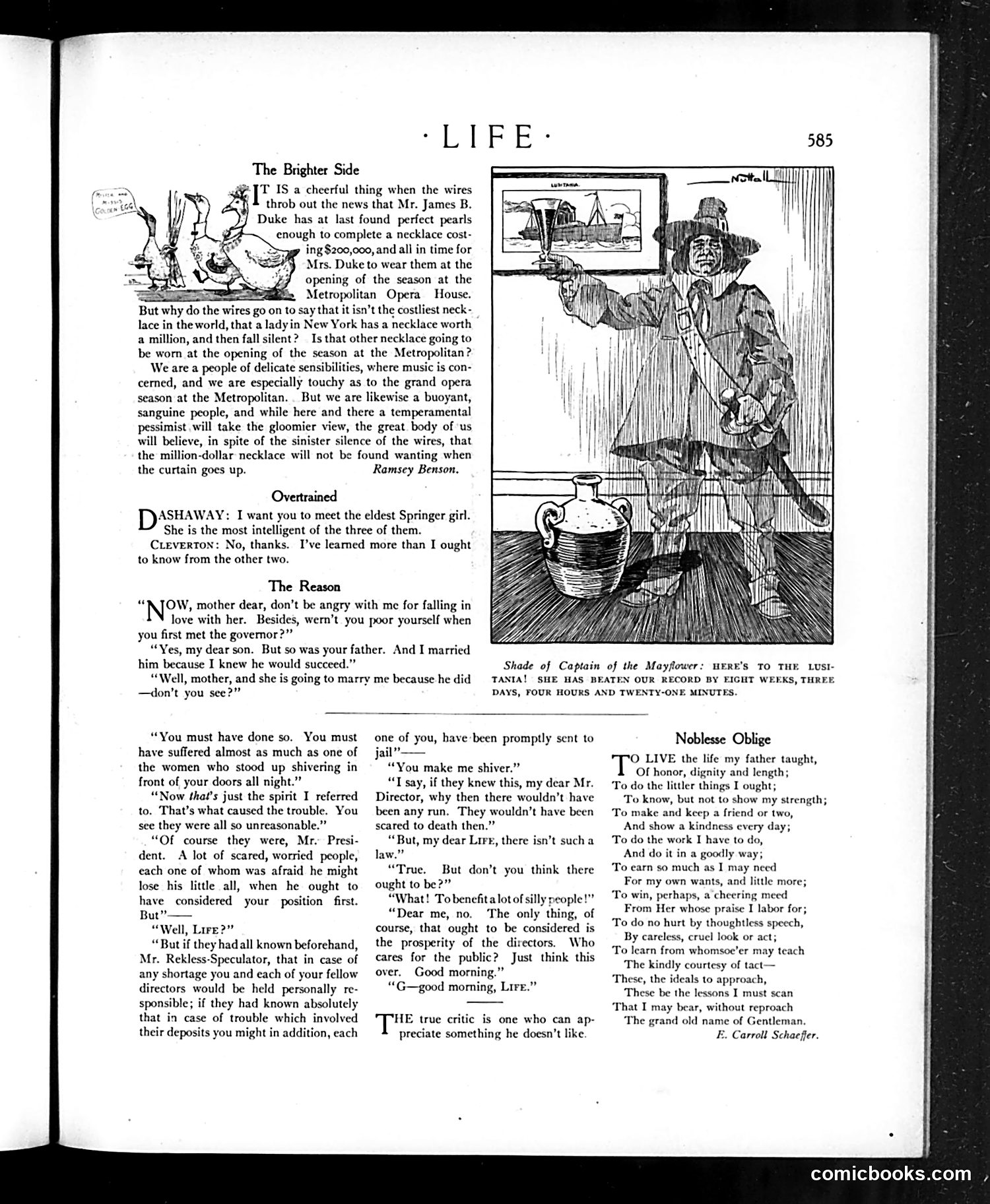
This page contains satirical articles and an illustration rather than a political cartoon. **"The Brighter Side"** mocks wealthy New York society's conspicuous consumption—specifically, James B. Duke's $200,000 pearl necklace for the Metropolitan Opera House opening. The satire questions why such expense matters when other costly necklaces already exist, suggesting the wealthy's competitive display is absurd. **"Overtrained"** and **"The Reason"** are brief comedic dialogues about romance and social class. The large illustration depicts **Captain of the Mayflower**, a historical reference celebrating achievement. The accompanying poem **"Noblesse Oblige"** by E. Carroll Schaeffer emphasizes honor, duty, and propriety—suggesting idealized aristocratic values contrast sharply with the preceding critique of wealthy ostentation.
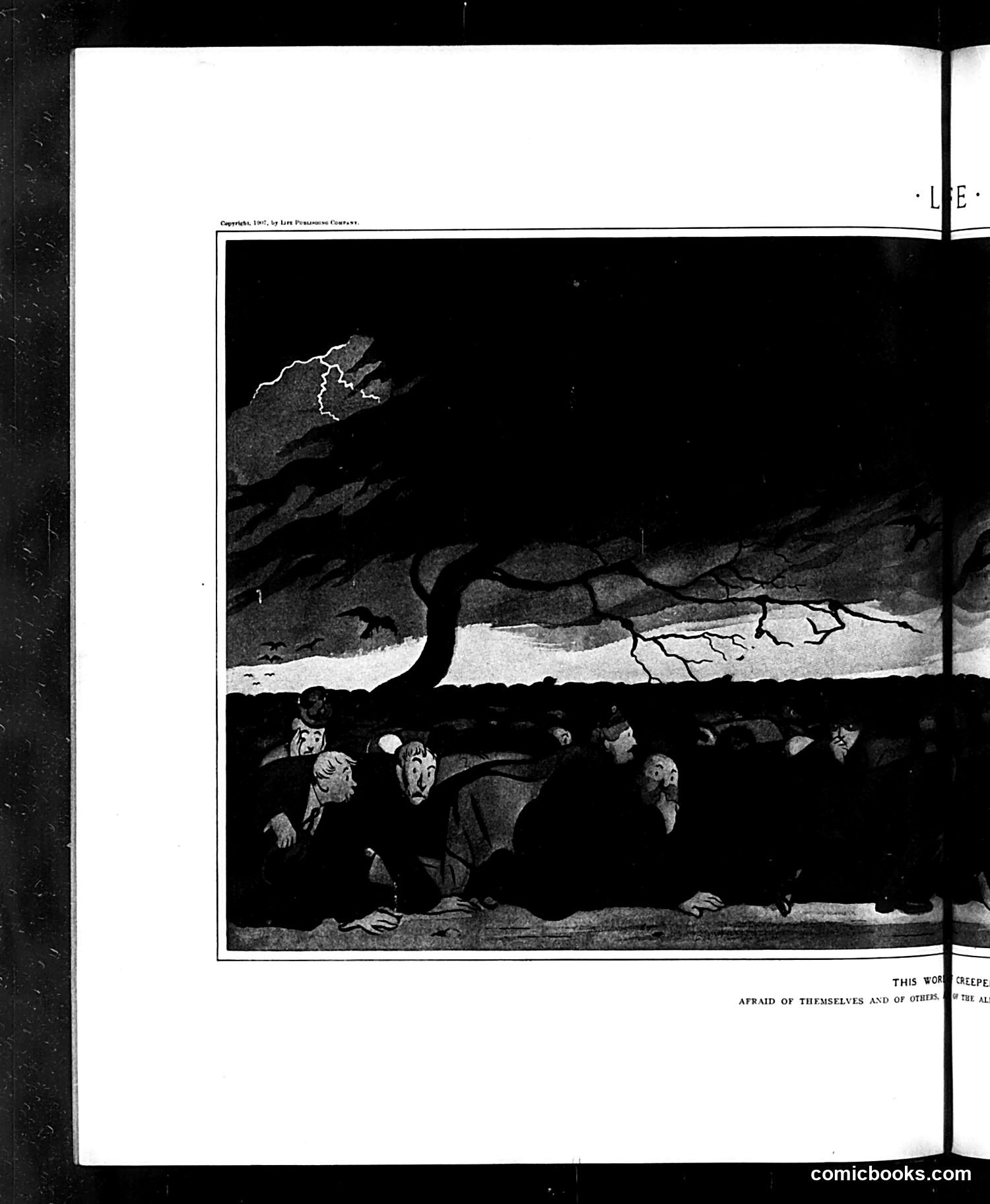
This appears to be a scene from an animated or illustrated film, likely from the early-to-mid 20th century based on the style. The image shows a nighttime landscape with a gnarled, twisted tree silhouetted against the sky, and below it several figures huddled together in darkness. The caption reads: "THIS WOES / AFRAID OF THEMSELVES AND OF OTHERS" (partially visible, text appears cut off). Without clearer text or identifying information visible in the image itself, I cannot definitively identify the specific film, characters, or satirical intent. The scene suggests a horror or suspenseful narrative moment—possibly a fairy tale adaptation or gothic story—but the political or social satire the caption may be making is unclear from what's visible here.
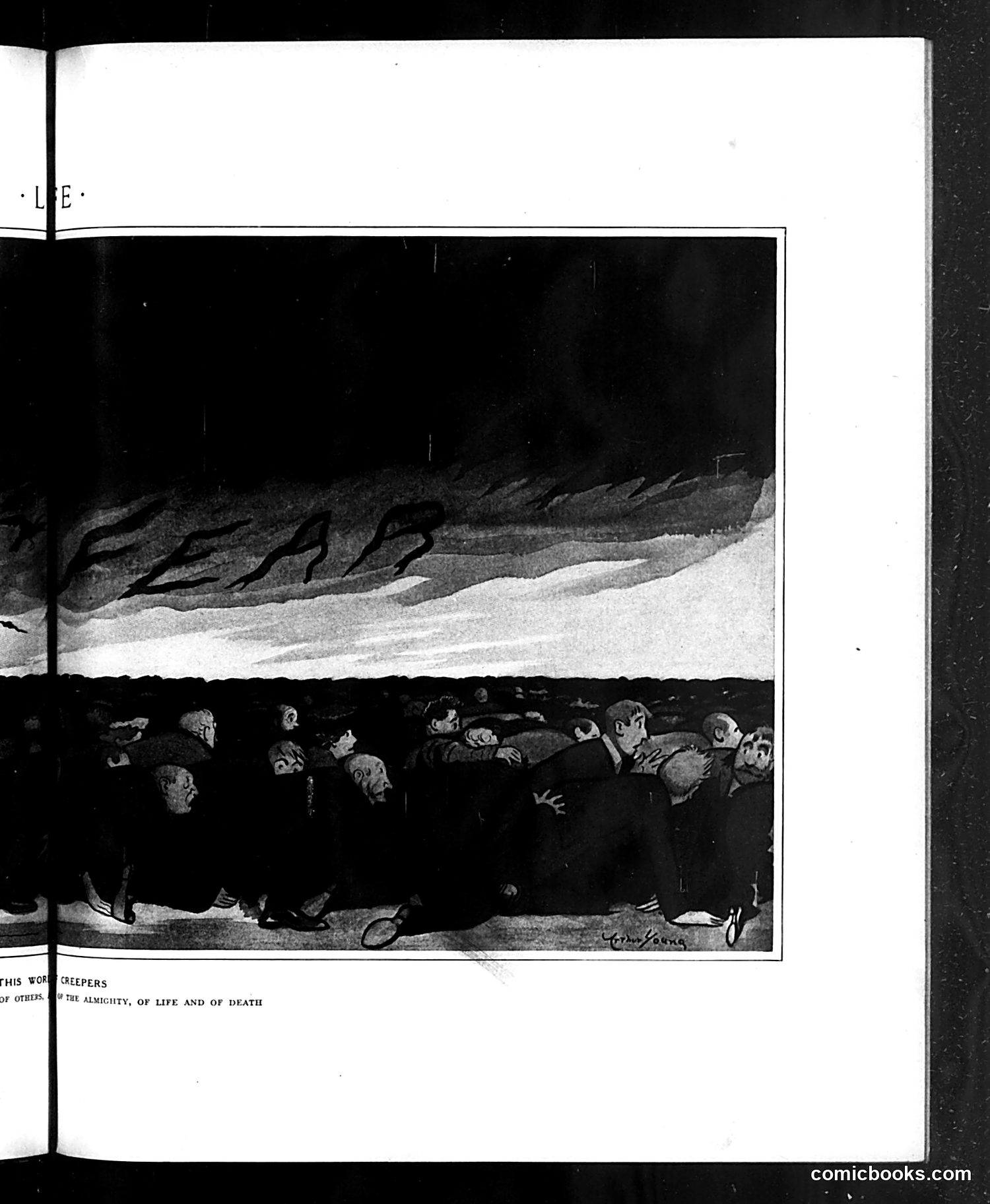
This page shows a political cartoon titled "Creepers" with the subtitle "The Almighty, of Life and of Death." The image depicts a group of figures in dark clothing viewed from behind, watching what appears to be an ominous scene above them—possibly representing death or destruction (the upper portion shows dramatic lighting and forms). The cartoon appears to be satirizing something that "creeps" into society, likely referencing a social or political threat of the era. The figures' postures suggest concern or dread about this encroaching danger. The religious language in the subtitle ("The Almighty") suggests the cartoonist is invoking themes of mortality, divine judgment, or fate. Without the magazine's date, the specific threat being referenced remains unclear, though the dark tone suggests commentary on a serious contemporary crisis or social menace.
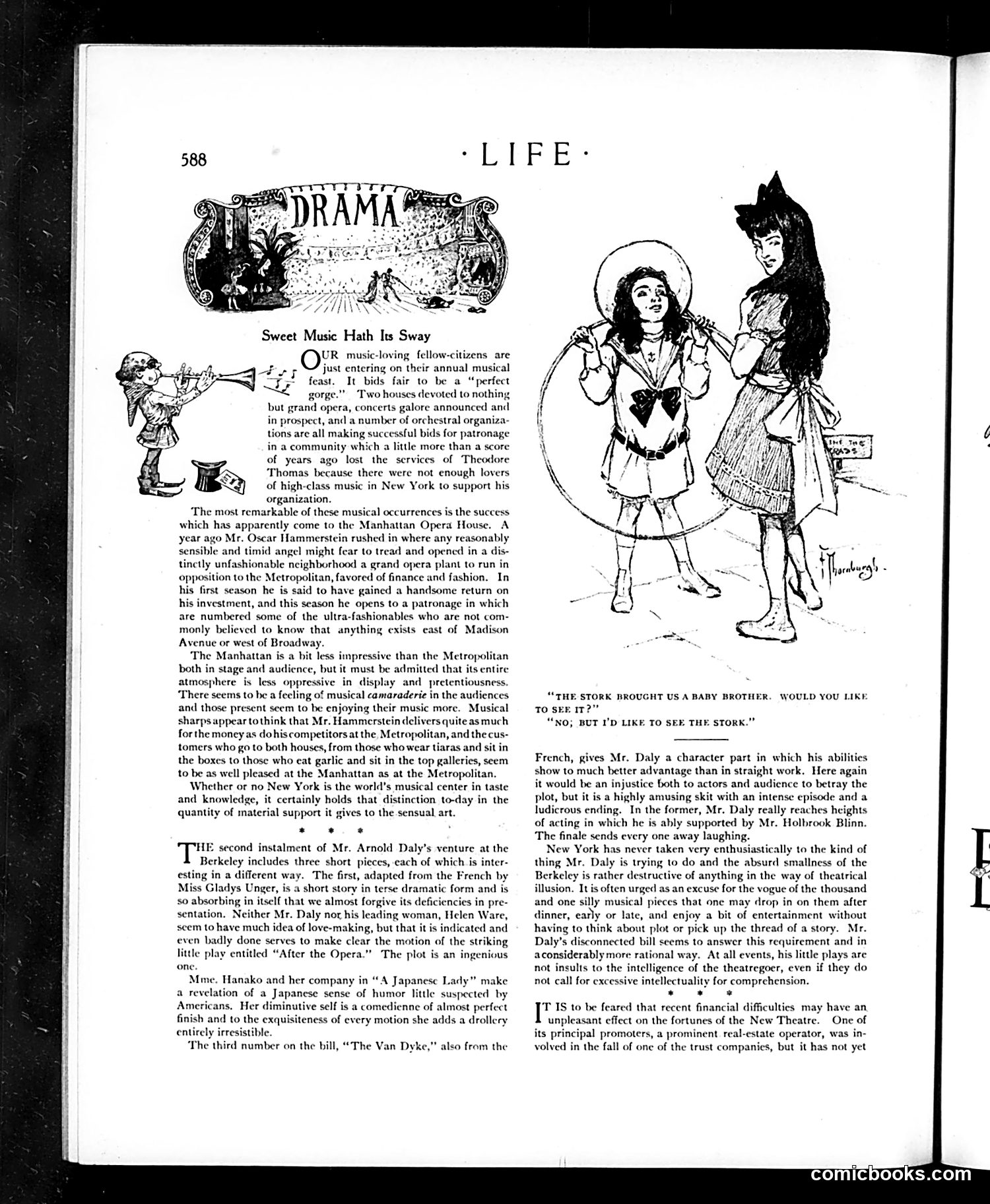
This page discusses New York's musical theater scene, particularly the Metropolitan Opera House and newer ventures. The illustration shows two figures in what appears to be a domestic scene—a woman in a halo (suggesting innocence or virtue) asking a man about seeing a stork, with the man's response being equivocal: "I'd like to see the stork." The text references Mr. Oscar Hammerstein's opera house venture and Mr. Arnold Daly's theatrical productions, including adaptations of French plays. The satire critiques the pretentiousness of high-class musical institutions versus more accessible theater. The domestic cartoon likely satirizes either marital comedy or contemporary debates about propriety in theatrical content and audience behavior at different social venues.
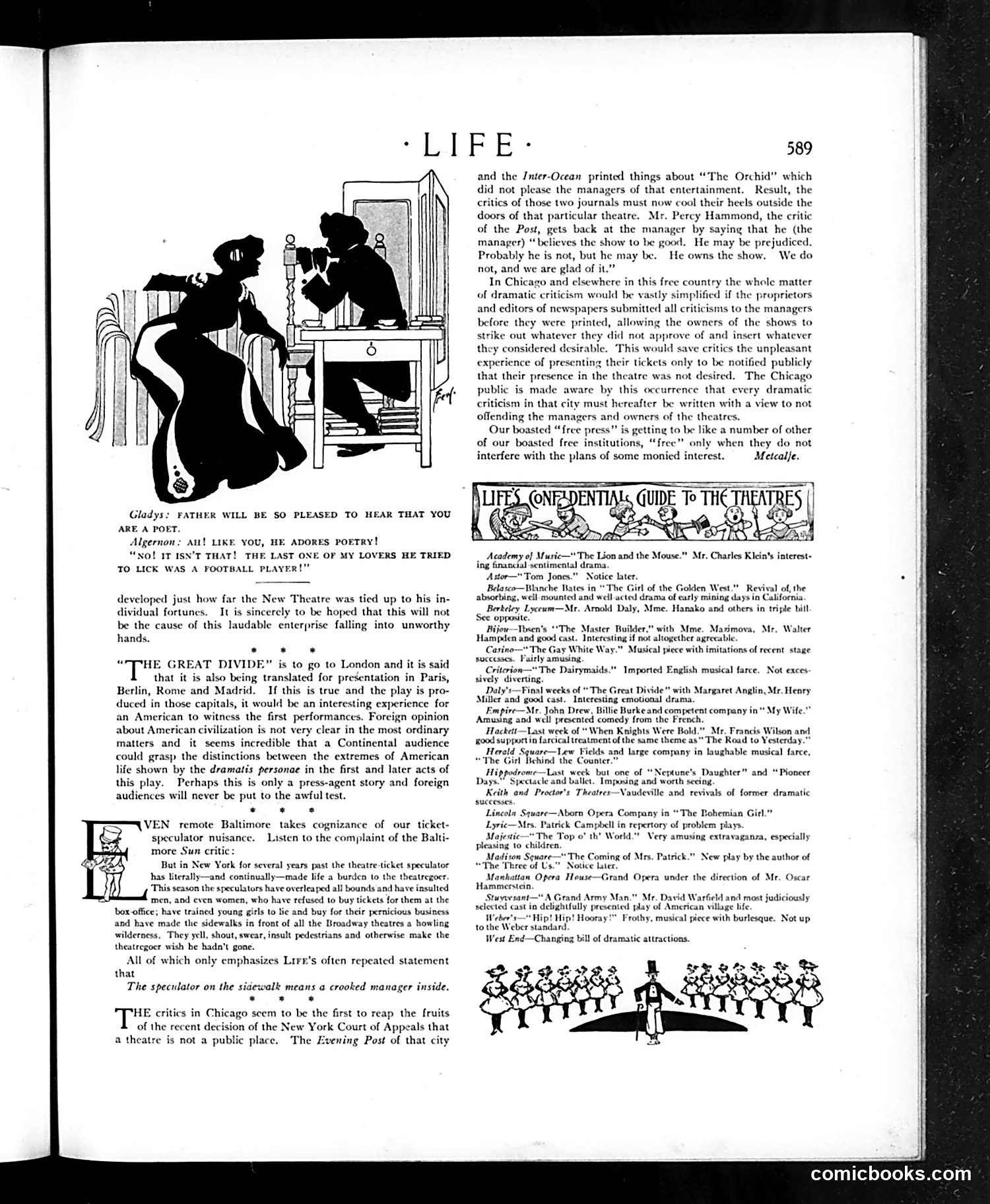
**Main Cartoon (Top Left):** Silhouettes of two figures at a desk—one appears to be a theater manager or critic at a telephone. The dialogue reads: "Gladys: FATHER WILL BE SO PLEASED TO HEAR THAT YOU ARE A POET / Algernon: AH! LIKE YOU, HE ADORES POETRY! 'So!' IT MUST THAT I GET ONE OF MY LOVERS HE TRIED TO LICK A FOOTBALL PLAYER!'" This satirizes pretentious social commentary about poetry and romantic relationships among the upper class, mocking affected aesthetic poses. **Context:** The page discusses theater criticism and theatrical management, critiquing Chicago's "free press" and how newspapers submit reviews to theater managers before publication—suggesting censorship of dramatic criticism. The satire targets compromised journalism and interference with critical independence by commercial interests.
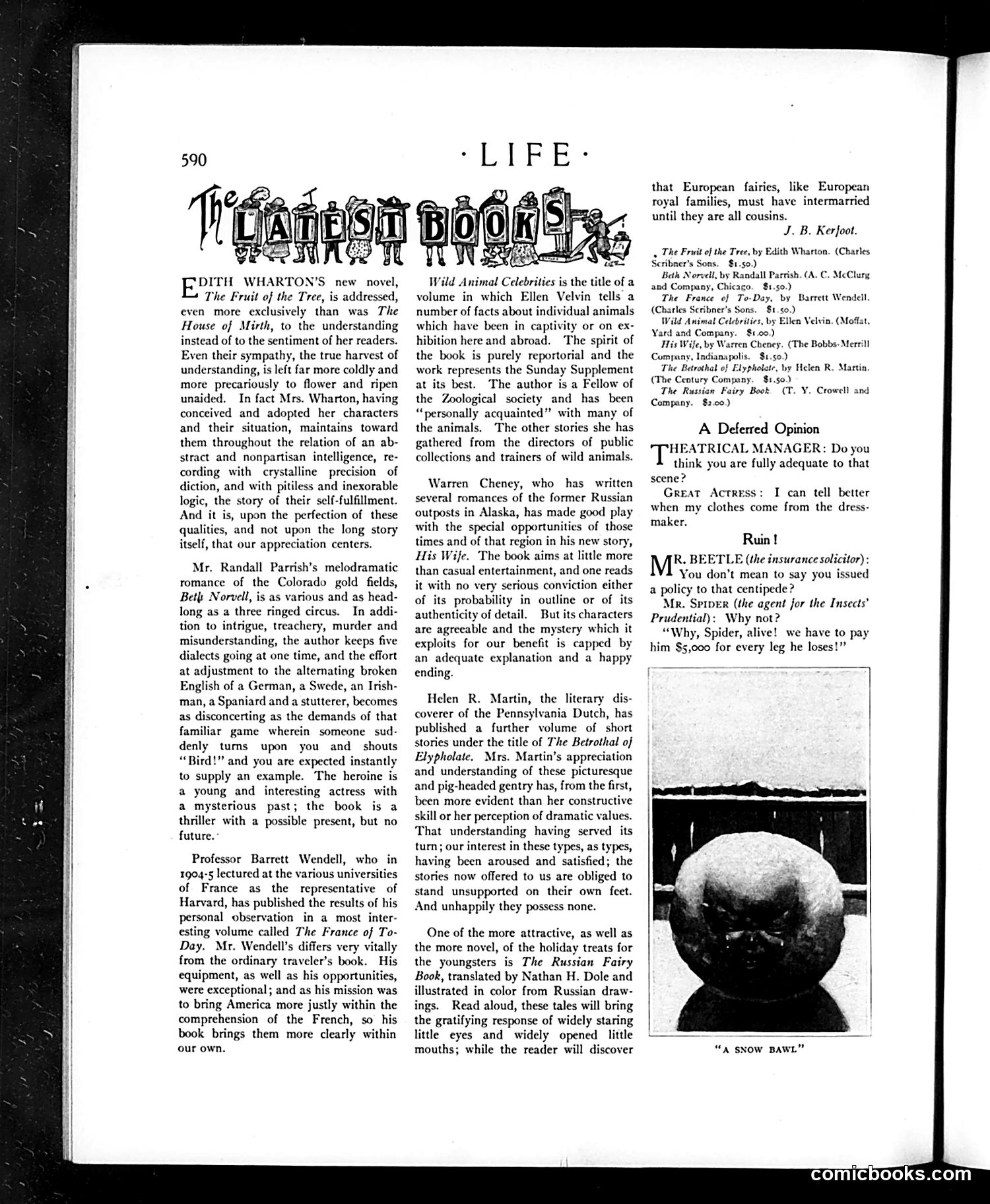
This page reviews contemporary novels, presenting literary criticism through detailed discussion rather than visual satire. The main content analyzes Edith Wharton's *The Fruit of the Tree*, praising her intellectual precision but noting her emotional coldness toward readers. Other reviews cover Randall Parrish's melodramatic gold-rush romance (criticized for its chaotic dialects and overwrought plot), Barrett Wendell's observations of France, and Ellen Velvin's animal celebrity book. The small illustration labeled "A Snow Bawl" appears to be a decorative image of a bird or animal in snow, unrelated to the reviews. A sidebar titled "A Deferred Opinion" contains a humorous dialogue about theatrical insurance—likely satirizing theatrical absurdities rather than addressing serious issues. The page exemplifies *Life* magazine's dual function as both literary arbiter and satirical publication.
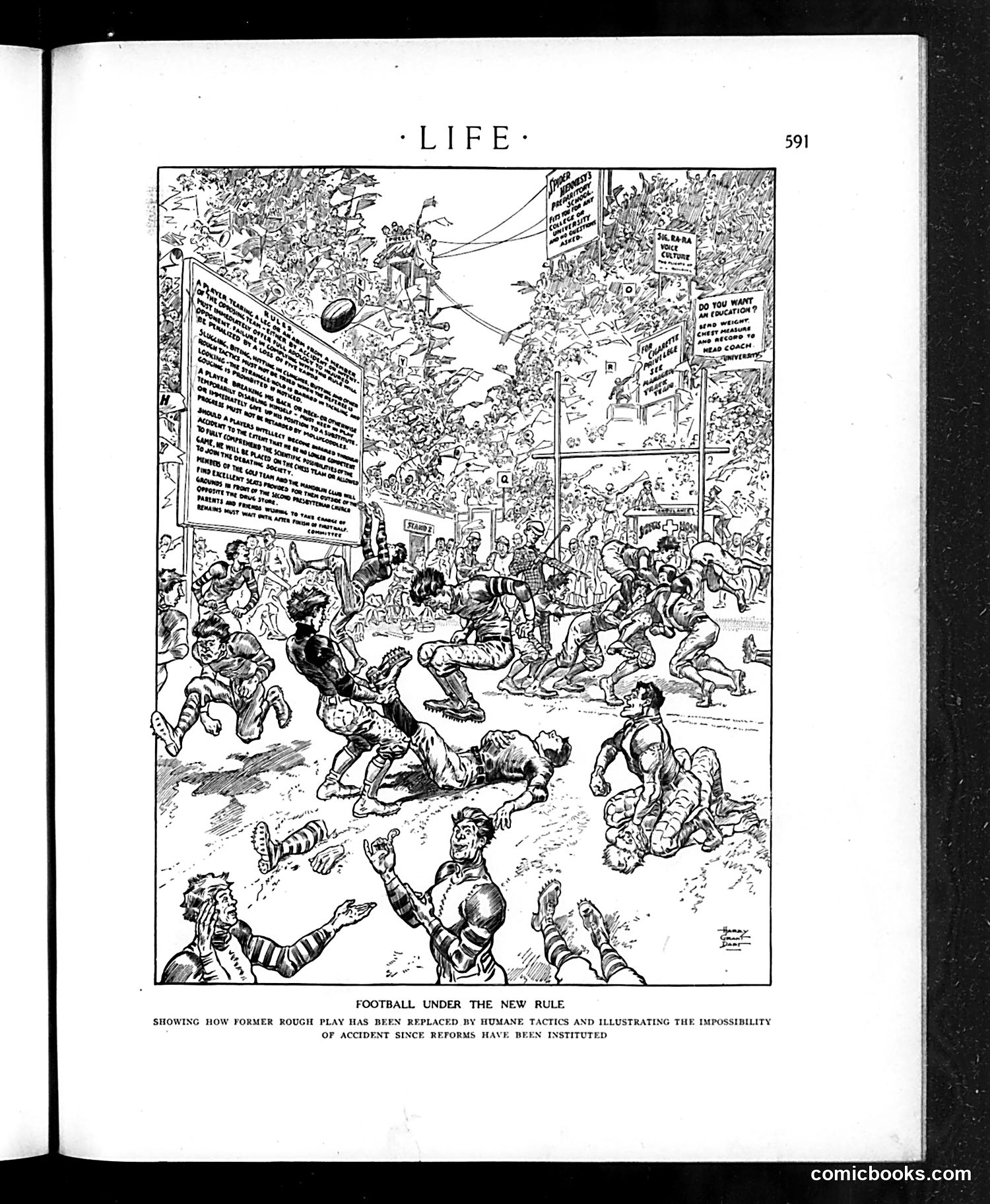
This satirical cartoon mocks football safety reforms by depicting the opposite of their intended effect. The caption claims reforms have replaced "rough play" with "humane tactics" and made accidents "impossible," yet the image shows chaotic violence: players fighting, lying injured, and engaged in brutal contact throughout the field. The satire works through ironic contrast—the text praises safety improvements while the illustration graphically demonstrates continued mayhem. This likely references early 20th-century football reform efforts, which faced skepticism from those who viewed the sport's violence as fundamental to its appeal. The cartoon suggests that rule changes are ineffective window-dressing that cannot actually tame football's inherent brutality. The crowded, frenzied scene emphasizes the sport's uncontrollable nature.
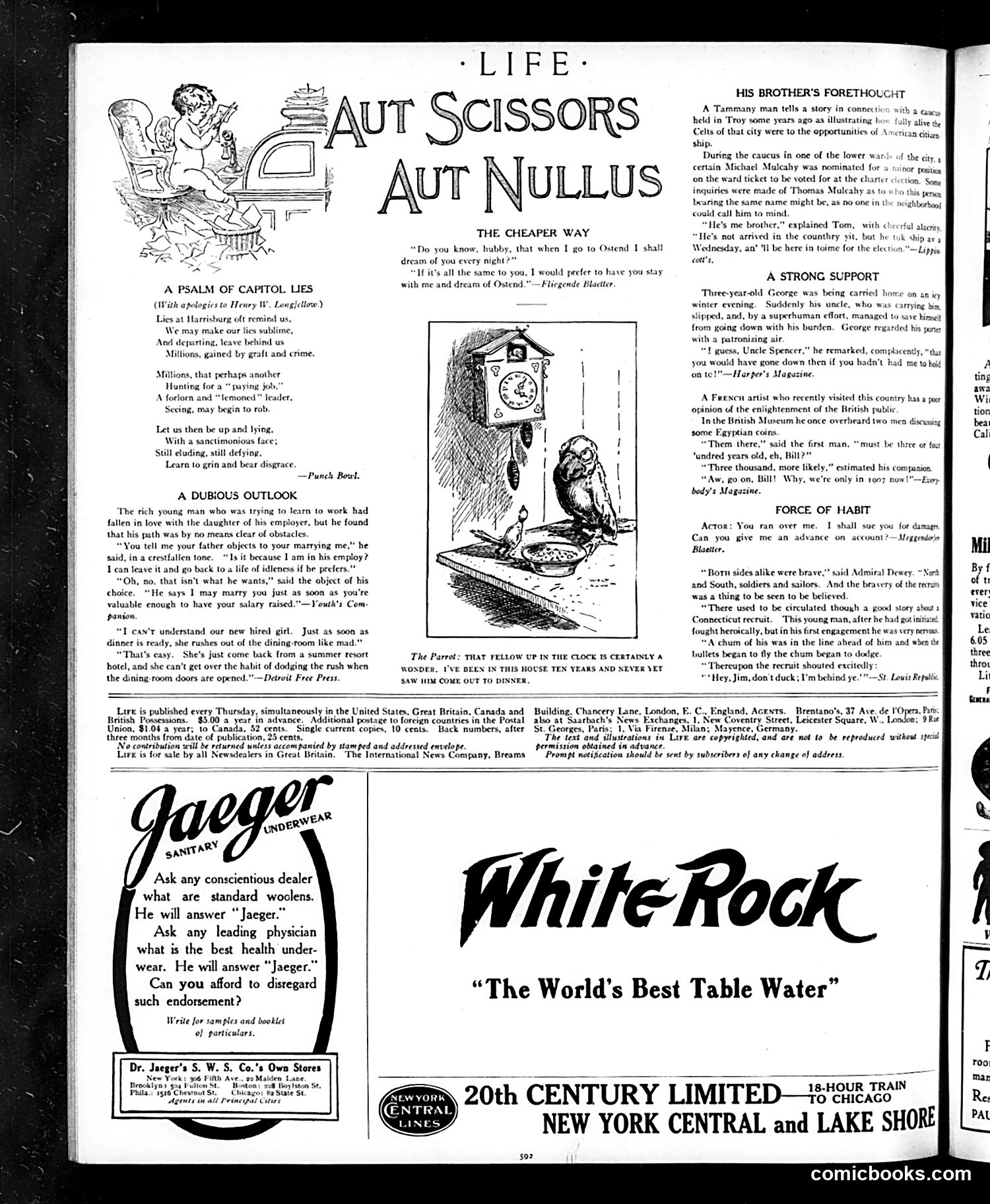
This page from *Life* magazine contains several short humorous pieces typical of early 1900s American satirical publishing. The main cartoon shows a parrot observing a cuckoo clock, with the joke being the bird has never seen the mechanical figure emerge for dinner—a visual gag about the clock's function. The written pieces are brief social comedies: "A Psalm of Capitol Lies" mocks government corruption at Harrisburg (Pennsylvania's capital), using mock-Longfellow verse. "A Dubious Outlook" presents dating/employment humor. Other items satirize class dynamics, Irish immigrant experiences (the Tammany story), and everyday domestic situations. The tone is genteel Victorian humor—focusing on courtship confusion, servant behavior, and family relationships rather than hard political satire. The Tammany reference suggests awareness of Irish political machines in New York. Advertisements for Jaeger underwear and White Rock water fill the lower half, reflecting the magazine's business model.
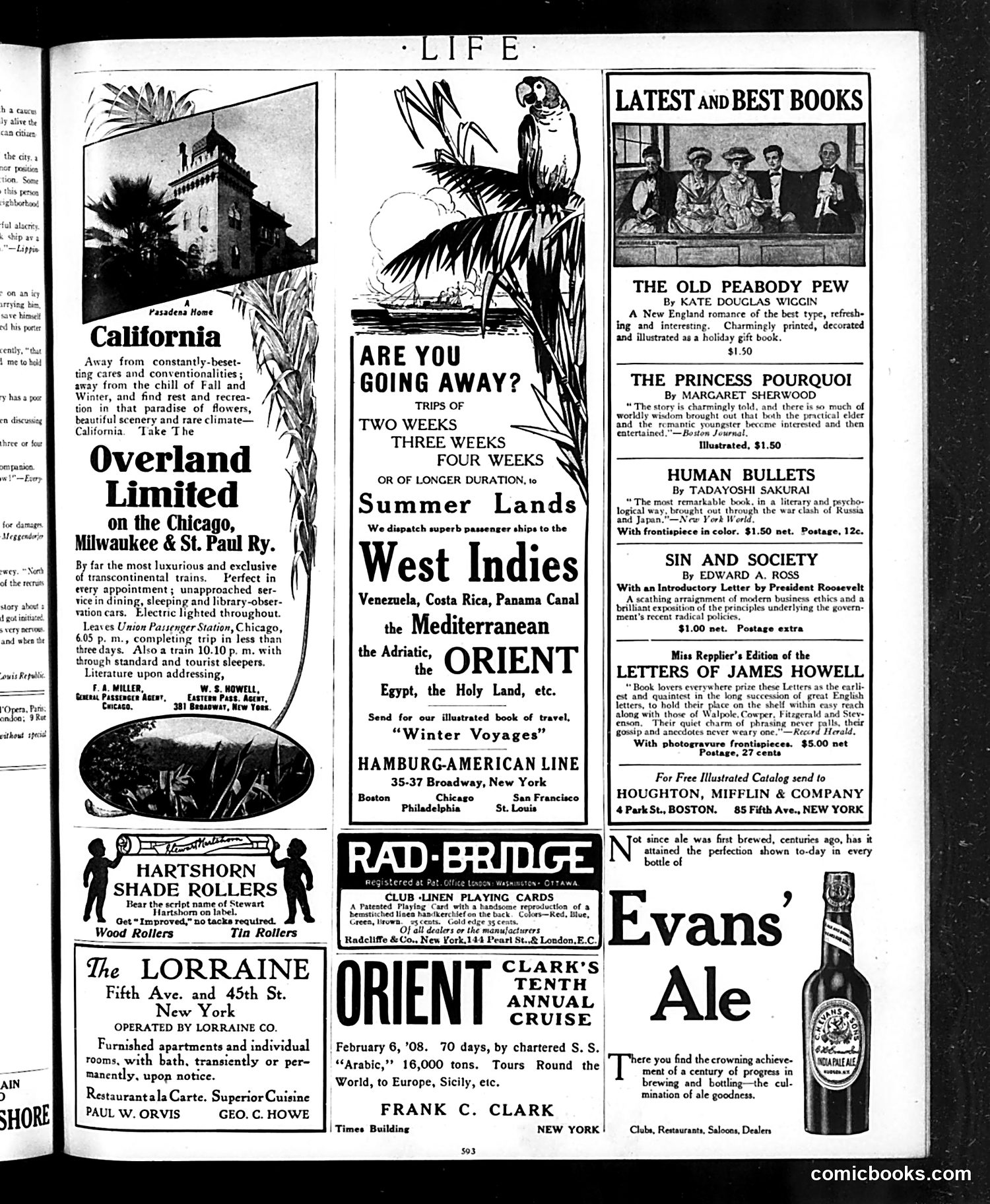
This is primarily an **advertising page** with no political cartoons or satire. The content reflects early 20th-century leisure culture and consumer goods. **Key advertisements:** - **Travel promotions**: Luxury train travel (Overland Limited), cruise ships to exotic destinations (West Indies, Mediterranean, Orient, Egypt) via Hamburg-American Line. These target wealthy Americans seeking fashionable vacations. - **Books**: Publishers advertise titles including Kate Douglas Wiggin's *The Old Peabody Pew* and Edward A. Ross's *Sin and Society* (notably with an endorsement from President Roosevelt), reflecting contemporary literary tastes. - **Household goods**: Hartshorn shade rollers, The Lorraine hotel/apartments, Evans Ale. **Historical context for modern readers**: This page captures Gilded Age consumer culture—when travel abroad signified status, and published books were valued gift items. The Roosevelt endorsement illustrates his public intellectual influence on business ethics debates of the Progressive Era.
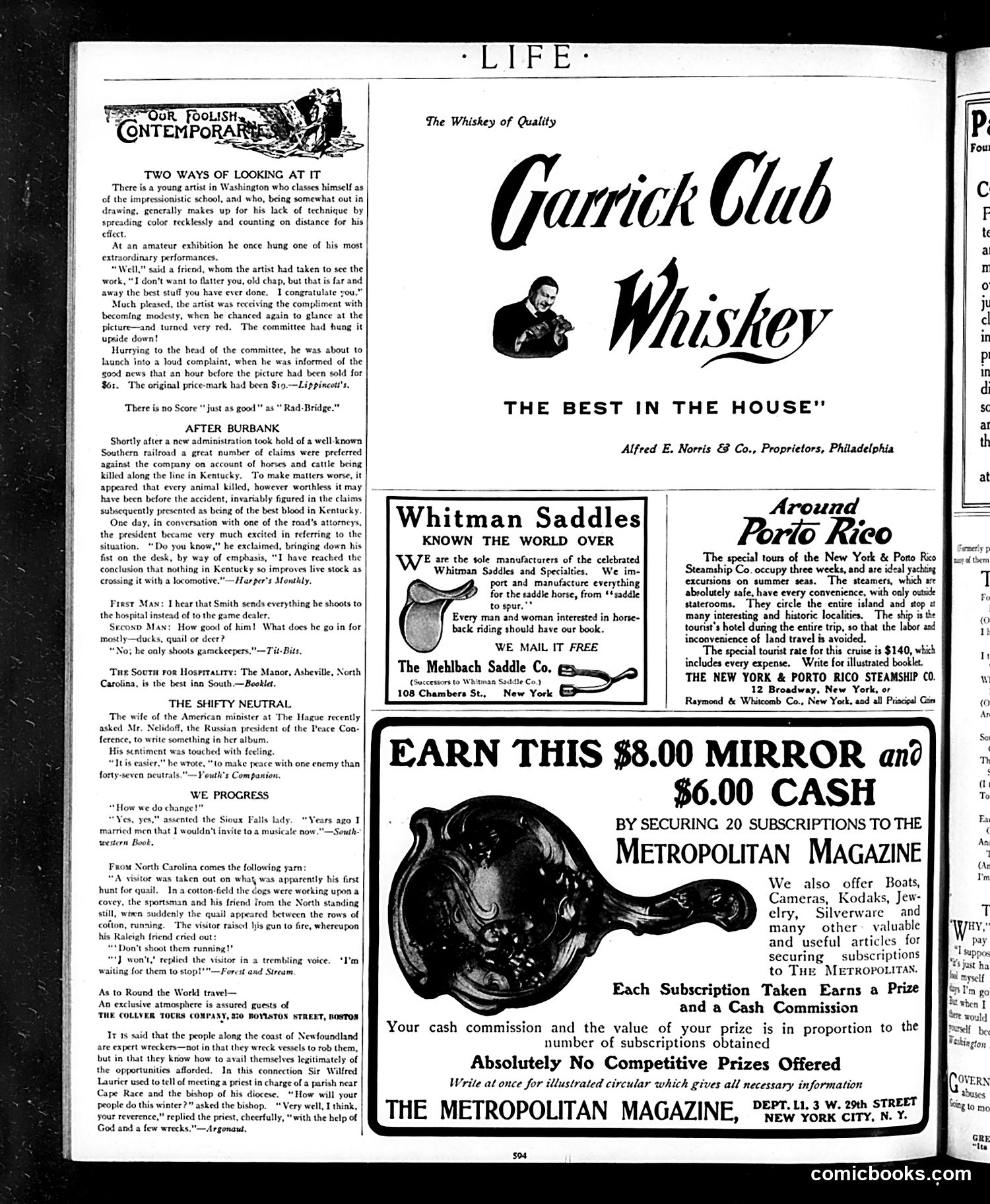
This page is primarily **advertising and humor columns**, not political cartoons. The content consists of several brief satirical anecdotes targeting social pretension and incompetence: 1. **"Two Ways of Looking at It"**: Mocks an incompetent impressionist painter whose work sells for $6 only after being hung *upside down*—satire on modern art's meaninglessness. 2. **"After Burbank"**: Jokes about Kentucky railroad claims where every animal killed mysteriously becomes "best blood"—satirizing fraudulent insurance claims. 3. **Other vignettes**: Mock hunting incompetence, diplomatic neutrality during peace negotiations (likely referencing early 1900s conflicts), and Newfoundland wreckers exploiting shipwrecks. The page's humor targets **class pretension, fraud, and foolish behavior** among educated Americans. The bulk of the page is devoted to advertisements (Garrick Club Whiskey, Whitman Saddles, Porto Rico steamship cruises, and a Metropolitan Magazine subscription offer).
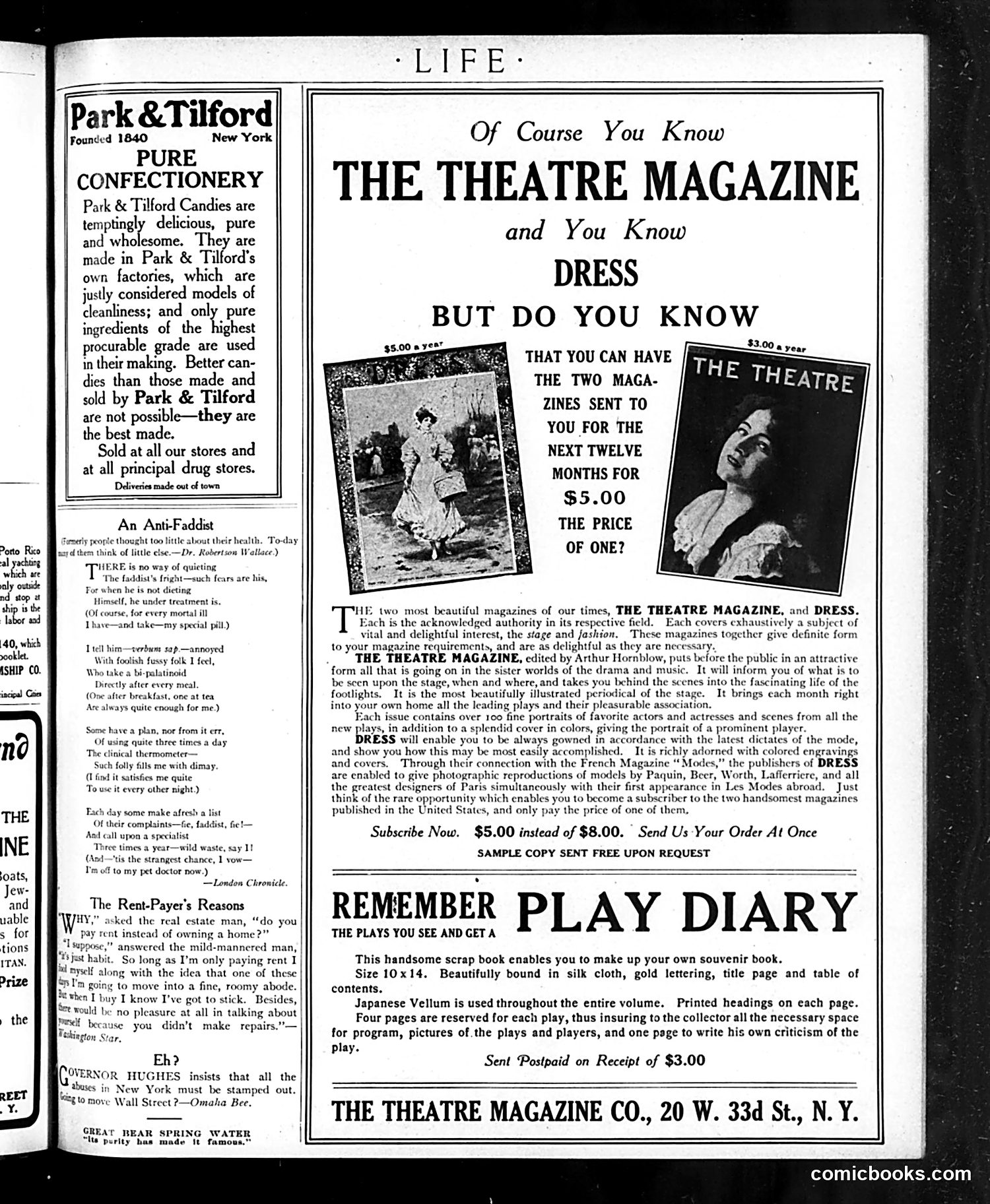
This page is primarily **advertising and promotional material**, not political satire. The main content consists of: 1. **Park & Tilford candy advertisement** (left column) — a straightforward product pitch emphasizing purity and quality. 2. **"An Anti-Faddist" poem** — light satire mocking health-conscious faddists of the era who obsessively diet, take pills, use thermometers frequently, and constantly consult doctors. The joke's irony: the narrator criticizes these habits while admitting to similar behavior ("I'm off to my pet doctor now"). This reflects early 20th-century anxiety about the emerging "wellness" culture. 3. **Rent-Payer's Reasons** — humorous short piece explaining why someone prefers renting to homeownership (avoids commitment, maintenance responsibility). 4. **Large Theatre Magazine/Dress magazine subscription advertisement** — the page's dominant feature, offering both publications for $5 annually. The page contains no political cartoons or significant political commentary—it's a commercial publication page typical of Life's advertising-heavy format from this period.
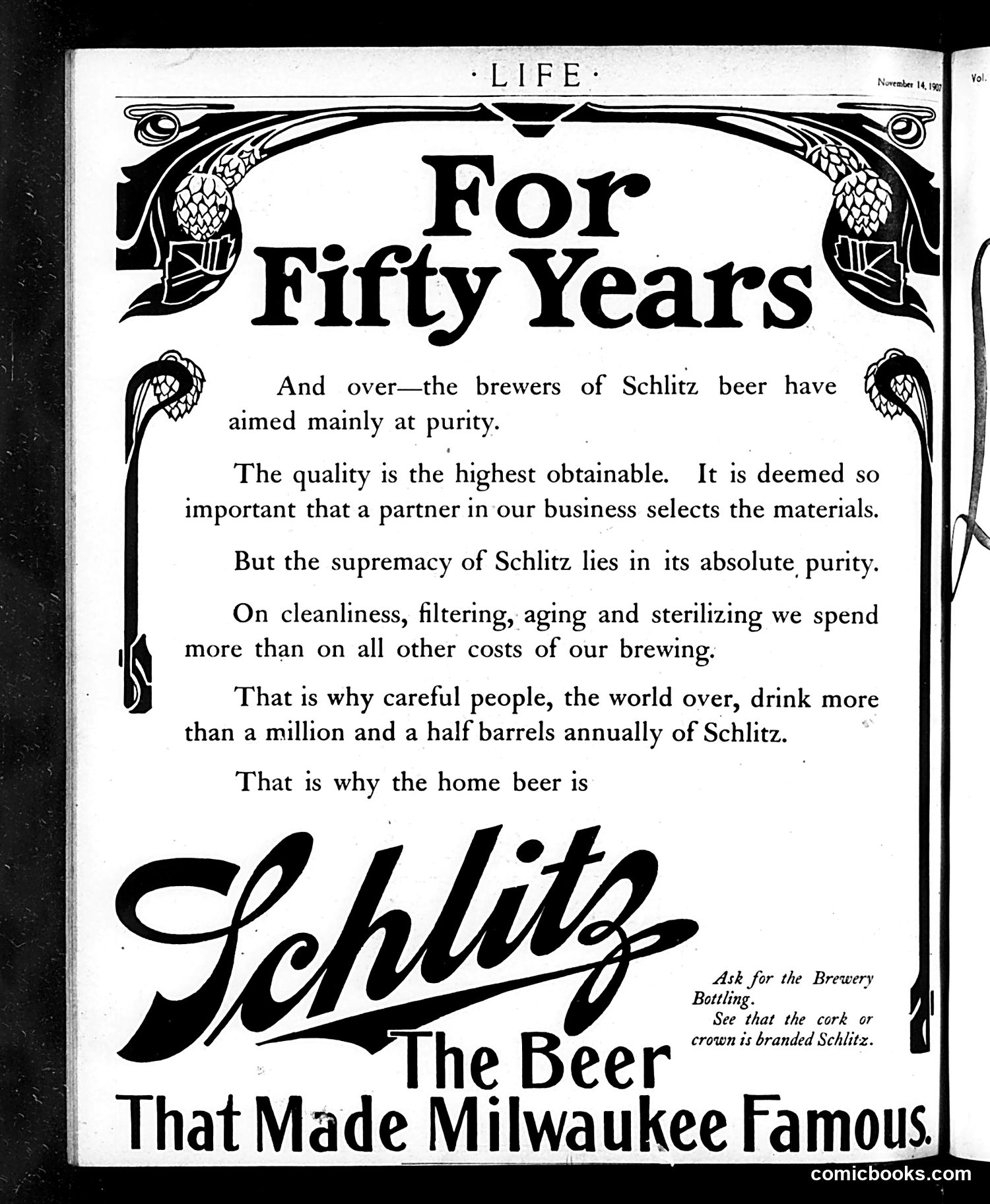
This is a **Schlitz beer advertisement**, not a political cartoon. The page from *Life* magazine (dated November 14, 1908, based on the header) is a full-page commercial promoting Schlitz as "The Beer That Made Milwaukee Famous." The ad emphasizes purity and quality control as Schlitz's competitive advantage, claiming the brewery spends more on "cleanliness, filtering, aging and sterilizing" than other brewing costs. It appeals to "careful people" worldwide who allegedly consume over 1.5 million barrels annually. The decorative border features hop plants (a brewing ingredient), and the text instructs consumers to verify authenticity by checking that bottle corks bear the Schlitz brand. For modern readers: this reflects early-20th-century advertising strategy emphasizing industrial hygiene and scientific brewing during an era when food safety and product purity were genuine consumer concerns. There is no satire present—this is straightforward commercial messaging.