
Life, 1907-11-14 · page 9 of 20
Life — November 14, 1907 — page 9: what you’re looking at
What you’re looking at
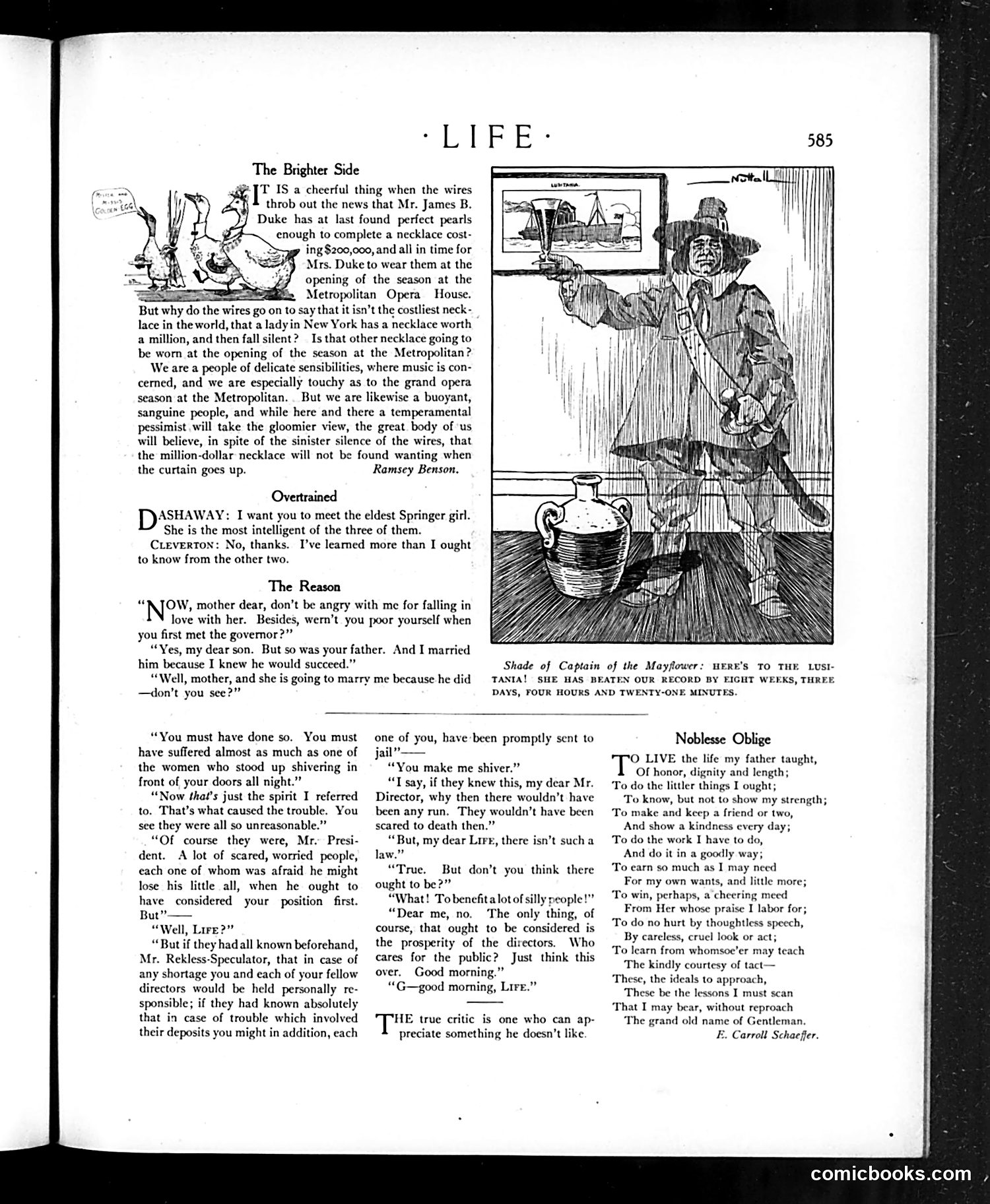
This page contains satirical articles and an illustration rather than a political cartoon. **"The Brighter Side"** mocks wealthy New York society's conspicuous consumption—specifically, James B. Duke's $200,000 pearl necklace for the Metropolitan Opera House opening. The satire questions why such expense matters when other costly necklaces already exist, suggesting the wealthy's competitive display is absurd. **"Overtrained"** and **"The Reason"** are brief comedic dialogues about romance and social class. The large illustration depicts **Captain of the Mayflower**, a historical reference celebrating achievement. The accompanying poem **"Noblesse Oblige"** by E. Carroll Schaeffer emphasizes honor, duty, and propriety—suggesting idealized aristocratic values contrast sharply with the preceding critique of wealthy ostentation.
📄 Transcribed text from this page (OCR, searchable)
Machine-transcribed from the original scan — historical spelling and the odd misread are preserved.
The Brighter Side 'T IS a cheerful thing when the wires throb out the news that Mr. James B. Duke has at last found perfect pearls enough to complete a necklace cost- ing $200,000, and all in time for Mrs. Duke to wear them at the y opening of the season at the = aes. Metropolitan Opera House. But why do the wires go on to say that it isn’t the costliest neck- lace in the world, that a lady in New York has a necklace worth a million, and then fall silent? Is that other necklace going to be worn at the opening of the season at the Metropolitan? We are a people of delicate sensibilities, where music is con- cerned, and we are especially touchy as to the grand opera season at the Metropolitan. . But we are likewise a buoyant, sanguine people, and while here and there a temperamental pessimist will take the gloomier view, the great body of us will believe, in spite of the sinister silence of the wires, that the million-dollar necklace will not be found wanting when the curtain goes up. Ramsey Benson. Overtrained ASHAWAY: I want you to meet the eldest Springer girl. She is the most intelligent of the three of them. CLEVERTON: No, thanks. I’ve leamed more than I ought to know from the other two. The Reason “TOW, mother dear, don’t be angry with me for falling in love with her. Besides, wern’t you poor yourself when you first met the governor?” “Yes, my dear son. But so was your father. And I married him because I knew he would succeed.” “Well, mother, and she is going to marry me because he did —don’t you see?” Shade of Captain of the Mayflower: wERK's TO THE LUSI- TANIA! SHE HAS BEATEN OUR RECORD BY EIGHT WEEKS, THREE DAYS, FOUR HOURS AND TWENTY-ONE MINUTES. “You must have done so. You must one of you, have-been promptly sent to Noblesse Oblige have suffered almost as much as one of the women who stood up shivering in front of your doors all night.” “Now that’s just the spirit I referred to. That’s what caused the trouble. You see they were all so unreasonable.” “Of course they were, Mr. Presi- dent. A lot of scared, worried people, each one of whom was afraid he might lose his little all, when he ought to have considered your position first. But”?—— “Well, Lire?” “But if they hadall known beforehand, Mr. Rekless-Speculator, that in case of any shortage you and each of your fellow directors would be held personally re- sponsible; if they had known absolutely that in case of trouble which involved their deposits you might in addition, each jail?— “You make me shiver.” “T say, if they knew this, my dear Mr. Director, why then there wouldn’t have been any run. They wouldn’t have been scared to death then.” “But, my dear Lire, there isn’t such a law.” “True. But don’t you think there ought to be?” “What! To benefita lot of sil ople!”” “Dear me, no. The only thing, of course, that ought to be considered is the prosperity of the directors. Who cares for the public? Just think this over. Good morning.” “G—good morning, Lire.” 'HE true critic is one who can ap- preciate something he doesn’t like: 0 LIVE the life my father taught, Of honor, dignity and length; To do the littler things I ought; To know, but not to show my strength; To make and keep a friend or two, And show a kindness every day; To do the work I have to do, And do it in a goodly way; To earn so much as I may need For my own wants, and little more; To win, perhaps, a’cheering meed From Her whose praise I labor for; To do no hurt by thoughtless speech, By careless, crucl look or act; To Iearn from whomsoe’er may teach The kindly courtesy of tact— ‘These, the ideals to approach, These be the lessons I must scan ‘That I may bear, without reproach ‘The grand old name of Gentleman. E. Carroll Schaeffer. comicbooks.com ,