
Life, 1907-11-14 · page 12 of 20
Life — November 14, 1907 — page 12: what you’re looking at
What you’re looking at
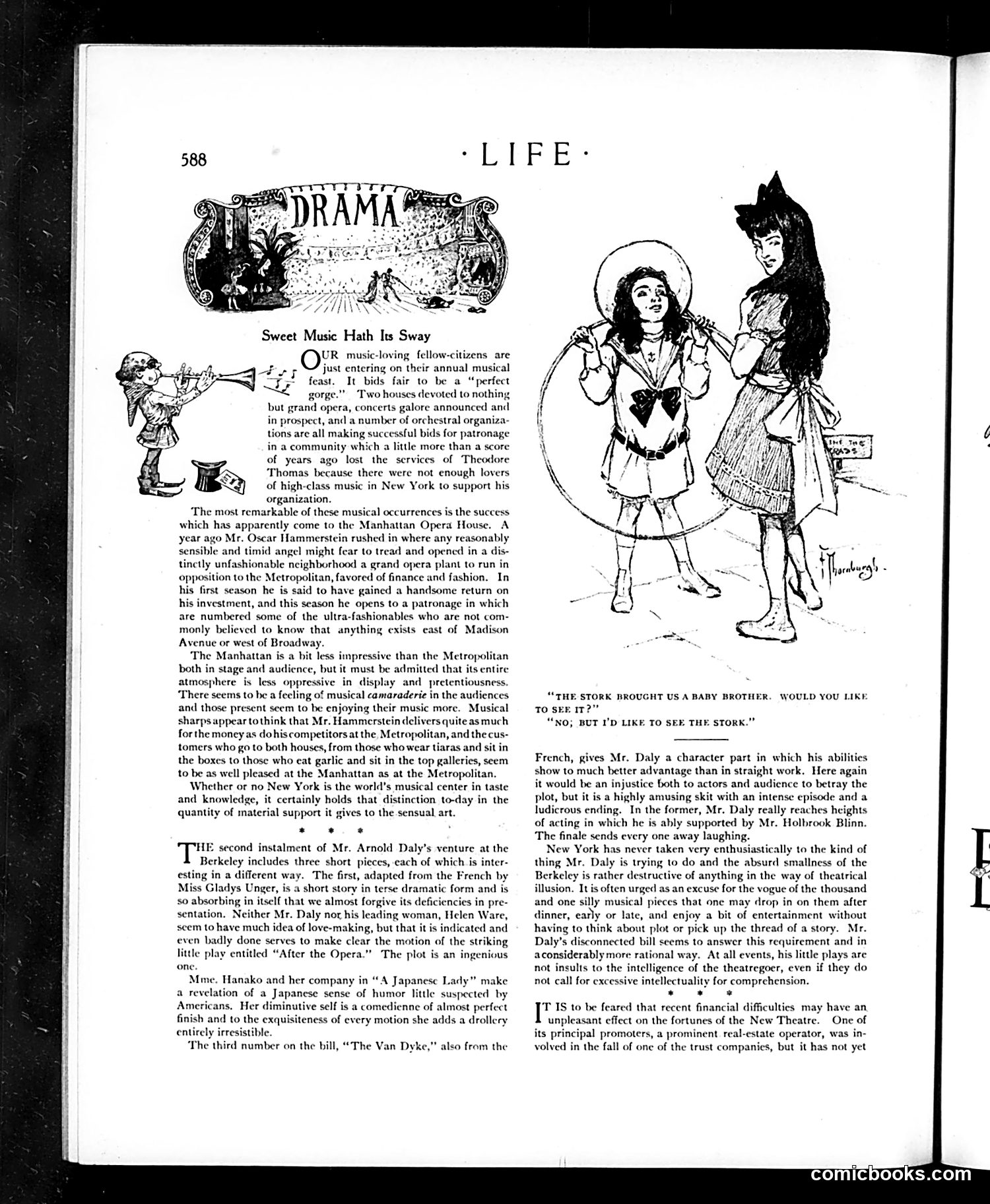
This page discusses New York's musical theater scene, particularly the Metropolitan Opera House and newer ventures. The illustration shows two figures in what appears to be a domestic scene—a woman in a halo (suggesting innocence or virtue) asking a man about seeing a stork, with the man's response being equivocal: "I'd like to see the stork." The text references Mr. Oscar Hammerstein's opera house venture and Mr. Arnold Daly's theatrical productions, including adaptations of French plays. The satire critiques the pretentiousness of high-class musical institutions versus more accessible theater. The domestic cartoon likely satirizes either marital comedy or contemporary debates about propriety in theatrical content and audience behavior at different social venues.
📄 Transcribed text from this page (OCR, searchable)
Machine-transcribed from the original scan — historical spelling and the odd misread are preserved.
Sweet Music Hath Its Sway UR music-loving fellow-citizens are just entering on their annual musical It bids fair to be a “perfect ‘Two houses devoted to nothing and opera, concerts galore announced and in prospect, and a number of orchestral organiza- tions are all making successful bids for patronage in a community which a little more than a score of years ago lost the services of Theodore Thomas because there were not enough lovers of high-class music in New York to support his organization. The most remarkable of these musical occurrences is the success which has apparently come to the Manhattan Opera House. A year ago Mr. Oscar Hammerstein rushed in where any reasonably sensible and timid angel might fear to tread and opened in a dis- tinctly unfashionable neighborhood a grand opera plant to run in opposition to the Metropolitan, favored of finance and fashion. In his first season he is said to have gained a handsome return on his investment, and this season he opens to a patronage in which are numbered some of the ultra-fashionables who are not com- monly believed to know that anything exists cast of Madison Avenue or west of Broadway. The Manhattan is a bit less impressive than the Metropolitan both in stage and audience, but it must be admitted that its entire atmosphere is less oppressive in display and_pretentiousness ‘There seems to be a fecling of musical camaraderie in the audiences and those present seem to be enjoying their music more. Musical sharps appeartothink that Mr. Hammerstein delivers quiteas much forthe money as dohis competitors at the Metropolitan, and the cus- tomers who go to both houses, from those who wear tiaras and sit in the boxes to those who cat garlic and sit in the top galleries, seem to be as well pleased at the Manhattan as at the Metropolitan, Whether or no New York is the world’s musical center in taste and knowledge, it certainly holds that distinction to-day in the quantity of material support it gives to the sensual art. s 8 « HE second instalment of Mr. Arnold Daly’s venture at the Berkeley includes three short pieces, cach of which is inter- esting in a different way. The first, adapted from the French by Miss Gladys Unger, is a short story in terse dramatic form and is so absorbing in itself that we almost forgive its deficiencies in pre- sentation. Neither Mr. Daly nor his leading woman, Helen Ware, scem to have much idea of love-making, but that it is indicated and even badly done serves to make clear the motion of the striking little play entitled “After the Opera.” The plot is an ingenious one. Mme, Hanako and her company in “A Japanese Lady" make a revelation of a Japanese sense of humor little suspected by Americans. Her diminutive self is a comedienne of almost perfect finish and to the exquisiteness of every motion she adds a drollery entirely irresistible. he third number on the bill, “The Van Dyke," also from the “THE STORK BROUGHT US A BABY BROTHER. WOULD YOU 1 TO SEE IT?” “NO; BUT I'D LIKE TO SEE THE STORK.” French, gives Mr. Daly a character part in which his abilities show to much better advantage than in straight work. Here again it would be an injustice both to actors and audience to betray the plot, but a highly amusing skit with an intense episode and a ludicrous ending. In the former, Mr. Daly really reaches heights of acting in which he is ably supported by Mr. Holbrook Blinn. The finale sends every one away laughing. New York has never taken very enthusiastically to the kind of thing Mr. Daly is trying to do and the absurd smallness of the Berkeley is rather destructive of anything in the way of theatrical illusion. It is often urged as an excuse for the vogue of the thousand and one silly musical pieces that one may drop in on them after dinner, early or late, and enjoy a bit of entertainment without having to think about plot or pick up the thread of a story. Mr. Daly's disconnected bill seems to answer this requirement and in considerably more rational way. At all events, his little plays are not insults to the intelligence of the theatregoer, even if they do not call for excessive intellectuality for comprehension. * * 8 T IS to be feared that recent financial difficulties may have an unpleasant effect on the fortunes of the New Theatre. One of its principal promoters, a prominent real-estate operator, was in- volved in the fall of one of the trust compani but it has not yet comicbooks.com