
Life, 1907-11-14 · page 13 of 20
Life — November 14, 1907 — page 13: what you’re looking at
What you’re looking at
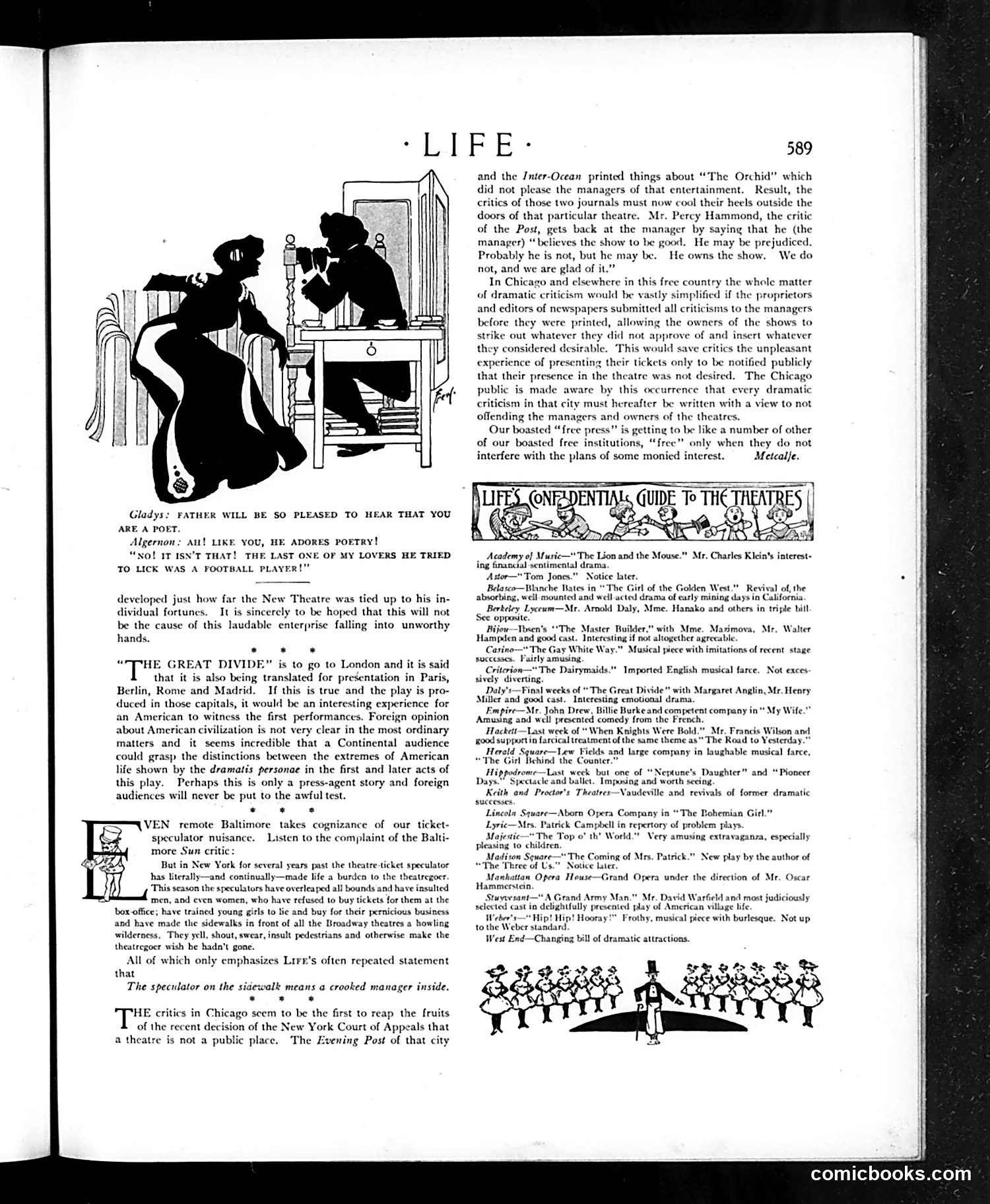
**Main Cartoon (Top Left):** Silhouettes of two figures at a desk—one appears to be a theater manager or critic at a telephone. The dialogue reads: "Gladys: FATHER WILL BE SO PLEASED TO HEAR THAT YOU ARE A POET / Algernon: AH! LIKE YOU, HE ADORES POETRY! 'So!' IT MUST THAT I GET ONE OF MY LOVERS HE TRIED TO LICK A FOOTBALL PLAYER!'" This satirizes pretentious social commentary about poetry and romantic relationships among the upper class, mocking affected aesthetic poses. **Context:** The page discusses theater criticism and theatrical management, critiquing Chicago's "free press" and how newspapers submit reviews to theater managers before publication—suggesting censorship of dramatic criticism. The satire targets compromised journalism and interference with critical independence by commercial interests.
📄 Transcribed text from this page (OCR, searchable)
Machine-transcribed from the original scan — historical spelling and the odd misread are preserved.
Gladys: FATHER WILL BE SO PLEASED TO HEAR THAT YOU ARE. A POET. Algernon: Au! LIKE YOU, HE ADORES PoETRY! “No! IT ISN'T THAT! THE LAST ONE OF MY LOVERS HE TRIED TO LICK WAS A FOOTBALL PLAYER!” developed just how far the New Theatre was tied up to his in- dividual fortunes. It is sincerely to be hoped that this will not be the cause of this laudable enterprise falling into unworthy hands. * 8 6 “CHE GREAT DIVIDE” is to go to London and it is said that it is also being translated for presentation in Paris, Berlin, Rome and Madrid. If this is true and the play is pro- duced in those capitals, it would be an interesting experience for an American to witness the first performances. Foreign opinion about American civilization is not very clear in the most ordinary matters and it seems incredible that a Continental audience could grasp the distinctions between the extremes of American life shown by the dramatis personae in the first and later acts of this play. Perhaps this is only a press-agent story and foreign audiences will never be put to the awful test. . + «8 - VEN CZ speculator nuisance. en more Sun critic: EA But in New York for several years past the theatre-ticket speculator iD has lterally—and continually—made life a burden to the theatregocr remote Baltimore takes cognizance of our ticket- Listen to the complaint of the Balti- ‘This season the speculators have overlea ped all bounds and have insulted ‘men, and even women, who have refused to buy tickets for them at the box-office; have trained young girls to lie and buy for their pernicious business and have made the sidewalks in front of all the Broadway theatres a howling wilderness, They yell, shout, swear, insult pedestrians and otherwise make the theatregoer wish be hadn't gone. All of which only emphasizes Lrrr’s often repeated statement that The speculator on the sidewalk means a crooked manager inside. . * *@ HE critics in Chicago scem to be the first to reap the fruits of the recent decision of the New York Court of Appeals that a theatre is not a public place. The Evening Post of that city 589 and the Inter-Ocean printed things about “The Orchid’ which did not please the managers of that entertainment, Result, the critics of those two journals must now cool their heels outside the doors of that particular theatre. Mr. Percy Hammond, the critic of the Post, gets back at the manager by saying that he (the manager) “believes the show to be good. He may be prejudiced. Probably he is not, but he may be. He owns the show. We do not, and we are glad of it.” In Chicago and elsewhere in this free country the whole matter of dramatic criticism would be vastly simplified if the proprietors and editors of newspapers submitted all criticisms to the managers before they were printed, allowing the owners of the shows to strike out whatever they did not approve of and insert whatever they considered desirable. This would save critics the unpleasant experience of presenting their tickets only to be notified publicly that their presence in the theatre was not desired. The Chicago public is made aware by this occurrence that every dramatic criticism in that city must hereafter be w w to not res. Our boasted “free press” is getting to be like a number of other of our boasted free institutions, “free” only when they do not interfere with the plans of some monied interest. Metcalfe. —=7 TRE | __ Academy of Music—" The Lion and the Mouse.” Mr. Charles Klein's interest- ing financial sentimental drama, Astor—"Tom Jones.” Notice later. Belasco—Blinche Hates in “The Girl of the Golden West."” Revival of, the absorbing, well: mounted and well acted drama of early mining days in California Berkeley Lyceum—Mr. Arnold Daly, Mme. Hanako and others in triple bill See opposite. Bijou—Tbsen’s ‘"The Master Builder.” with Mme. Mazimova, Mr. Walter Hampden and good cast. Interesting if not altogether agrecable. Casino—""The Gay White Way.” Musical piece with imit successes. Fairly amusing. Criterion—"The Dairymaids.” Imported English musical farce. Not exces. sively diverting, Daly's—Final weeks of “The Great Divide" with Margaret Anglin, Mr. Henry Miller and good cast. Interesting emotional drama. Empire—Mr. John Drew. Billie Burke and competent company in My Wife.” Amusing and well presented comedy from the French. Hackett—Last week of “When Knights Were Bold ood support in farcical treatment of the same theme as The Road to Yesterday.” Herald Square—Lew Fields and large company in laughable musical farce, “The Girl Behind the Counter. Hippodrome—Last week but one of “Neptune's Daughter” and “Pioneer Days.” Spectacle and ballet. Imposing and worth seeing Keith and Proctor's Theatres—Naudeville and revivals of former dramatic successes Lincoln Square—Aborn Opera Company in “The Bohemian Girl.” Lyric—Mrs. Patrick Campbell in repertory of problem plays Majewic—"The Top 0 th’ World.” Very amusing extravaganza, especially pleasing 10 children. Madison Seuare—" The Coming of Mrs. Patrick.” New play by the author of «The Three of Us.” Notice later Manhattan Opera House—Grand Opera under the direction of Mr. Oscar Hammerstein. ns of recent stage Mr. Francis Wilson and Stuyvesant—" A Grand Army Man." Mr. David Warfield and most judiciously selected cast in delightfully presented play of American village life Weber's—" Hip! Hip! Hooray!” Frothy, musical piece with burlesque. Not up to the Webcr standard. West End—Changing bill of dramatic attractions. comicbooks.com