
Life, 1907-11-14 · page 4 of 20
Life — November 14, 1907 — page 4: what you’re looking at
What you’re looking at
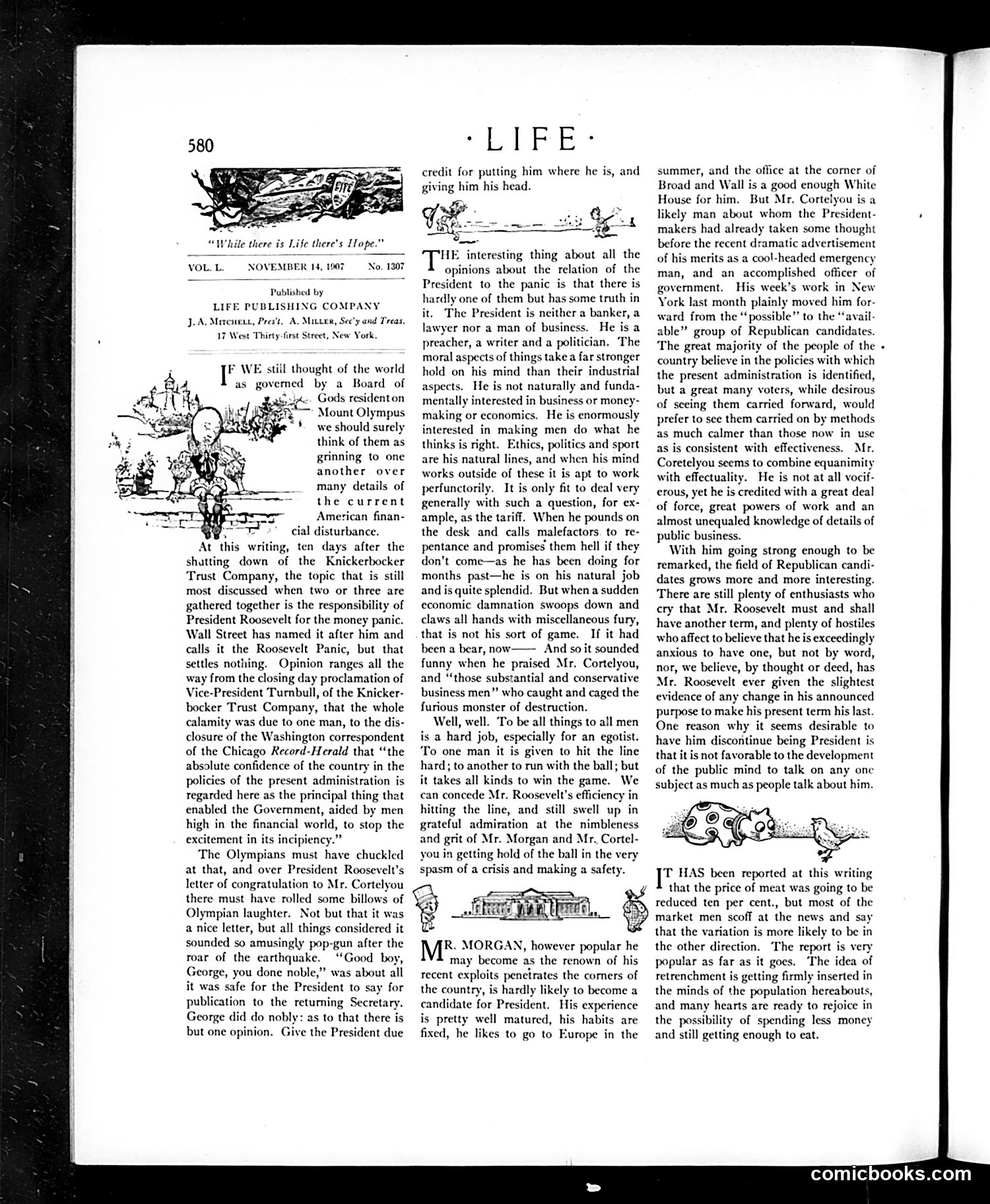
This page discusses President Roosevelt's handling of the financial panic (the 1907 "Roosevelt Panic"). The text credits Roosevelt with decisive action—calling out the Knickerbocker Trust Company crisis and praising his response to what Wall Street blamed on him. The main cartoon shows a figure (likely Roosevelt) being struck down by what appears to be economic forces or "miscellaneous fury," humorously illustrating how suddenly economic crisis swept over the administration despite his efforts. The article argues Roosevelt shouldn't be held responsible for broader economic conditions, defending him against financiers' criticism. It also discusses potential Republican candidates, including J.P. Morgan (mentioned as unlikely to run for President) and suggests Roosevelt's handling of the crisis demonstrated his executive competence, making discontinuing him as President unwise.
📄 Transcribed text from this page (OCR, searchable)
Machine-transcribed from the original scan — historical spelling and the odd misread are preserved.
VOL. L. LIFE PUBLISHING COMPAN J. Mireuent, Pres't, 17 West Thirty-first Street, New York, A. Mitte, Sec’y and Treas. F WE still thought of the world as governed by a Board of a Gods residenton “— Mount Olymp pus, we should surely think of them as grinning to one another over many details of the current American finan- : cial disturbance. At this writing, ten days after the shatting down of the Knickerbocker Trust Company, the topic that is still most discussed when two or three are gathered together is the responsibility of President Roosevelt for the money panic. Wall Street has named it after him and calls it the Roosevelt Panic, but that settles nothing. Opinion ranges all the way from the closing day proclamation of Vice-President Turnbull, of the Knicker- bocker Trust Company, that the whole calamity was due to one man, to the dis- closure of the Washington correspondent of the Chicago Record-Herald that “the absolute confidence of the country in the policies of the present administration is regarded here as the principal thing that enabled the Government, aided by men high in the financial world, to stop the excitement in its incipiency.” The Olympians must have chuckled at that, and over President Roosevelt's letter of congratulation to Mr. Cortelyou there must have rolled some billows of Olympian laughter. Not but that it was a nice letter, but all things considered it sounded so amusingly pop-gun after the roar of the earthquake. ‘‘Good boy, George, you done noble,” was about all it was safe for the President to say for publication to the returning Secretary. George did do nobly: as to that there is but one opinion. Give the President due LIFE credit for putting him where he giving him his head. HE interesting thing about all the opinions about the relation of the President to the panic is that there is hardly one of them but has some truth in it. The President is neither a banker, a lawyer nor a man of business. He is a preacher, a writer and a politician, ‘The moral aspects of things take a far stronger hold on his mind than their industrial aspects. He is not naturally and funda- mentally interested in business or money- making or economics. He is enormously interested in making men do what he thinks is right. Ethics, politics and sport are his natural lines, and when his mind works outside of these it is apt to work perfunctot It is only fit to deal very generally with such a question, for ex- ample, as the tariff. When he pounds on the desk and calls malefactors. to re- pentance and promises them hell if they don’t come—as he has been doing for months past—he is on his natural job and is quite splendid. But when a sudden economic damnation swoops down and claws all hands with miscellaneous fury, that is not his sort of game. If it had been a bear, now—— And soit sounded funny when he praised Mr. Cortelyou, and “those substantial and conservative business men” who caught and caged the furious monster of destruction. Well, well. To be all things to all men is a hard job, especially for an egotist. ‘To one man it is given to hit the line hard; to another to run with the ball; but. it takes all kinds to win the game. We can concede Mr. Roosevelt's efficiency in hitting the line, and still swell up in grateful admiration at the nimbleness and grit of Mr. Morgan and Mr. Cortel- you in getting hold of the ball in the very spasm of a crisis and making a safety. R. MORGAN, however popular he y become as the renown of his recent exploits penetrates the comers of the country, is hardly likely to become a candidate for President. His experience is pretty well matured, his habits are fixed, he likes to go to Europe in the summer, and the office at the corner of Broad and Wall is a good enough White House for him. But Mr. Cortelyou is a likely man about whom the President- makers had already taken some thought before the recent dramatic advertisement of his merits as a coo!-headed emergency man, and an accomplished officer of government. His week’s work in New York last month plainly moved him for- ward from the “possible” to the “‘avail- able” group of Republican candida ‘The great majority of the people of the country believe in the policies with which the present administration is identified, but a great many voters, while desirous of seeing them carried forward, would prefer to sce them carried on by methods as much calmer than those now in use as is consistent with effectiveness. Mr. Coretelyou seems to combine equanimity with effectuality. He is not at all vocif- crous, yet he is credited with a great deal of force, great powers of work and an almost unequaled knowledge of details of public business. With him going strong enough to be remarked, the field of Republican candi- dates grows more and more interesting. There are still plenty of enthusiasts who cry that Mr. Roosevelt must and shall have another term, and plenty of hostiles who affect to believe that he is exceedingly anxious to have one, but not by word, nor, we believe, by thought or deed, has Mr. Roosevelt ever given the slightest evidence of any change in his announced purpose to make his present term his last. One reason why it seems desirable to have him ‘ontinue being President is that it is not favorable to the development of the public mind to talk on any onc subject as much as people talk about him. I" HAS been reported at this writing that the price of meat was going to be reduced ten per cent., but most of the market men scoff at the news and say that the variation is more likely to be in the other direction. ‘The report is very popular as far as it goes. ‘The idea of retrenchment is getting firmly inserted in the minds of the population hereabouts, and many hearts are ready to rejoice in the possibility of spending less money and still getting enough to eat. comicbooks.com