
A complete issue · 24 pages · 1907
Life — August 29, 1907
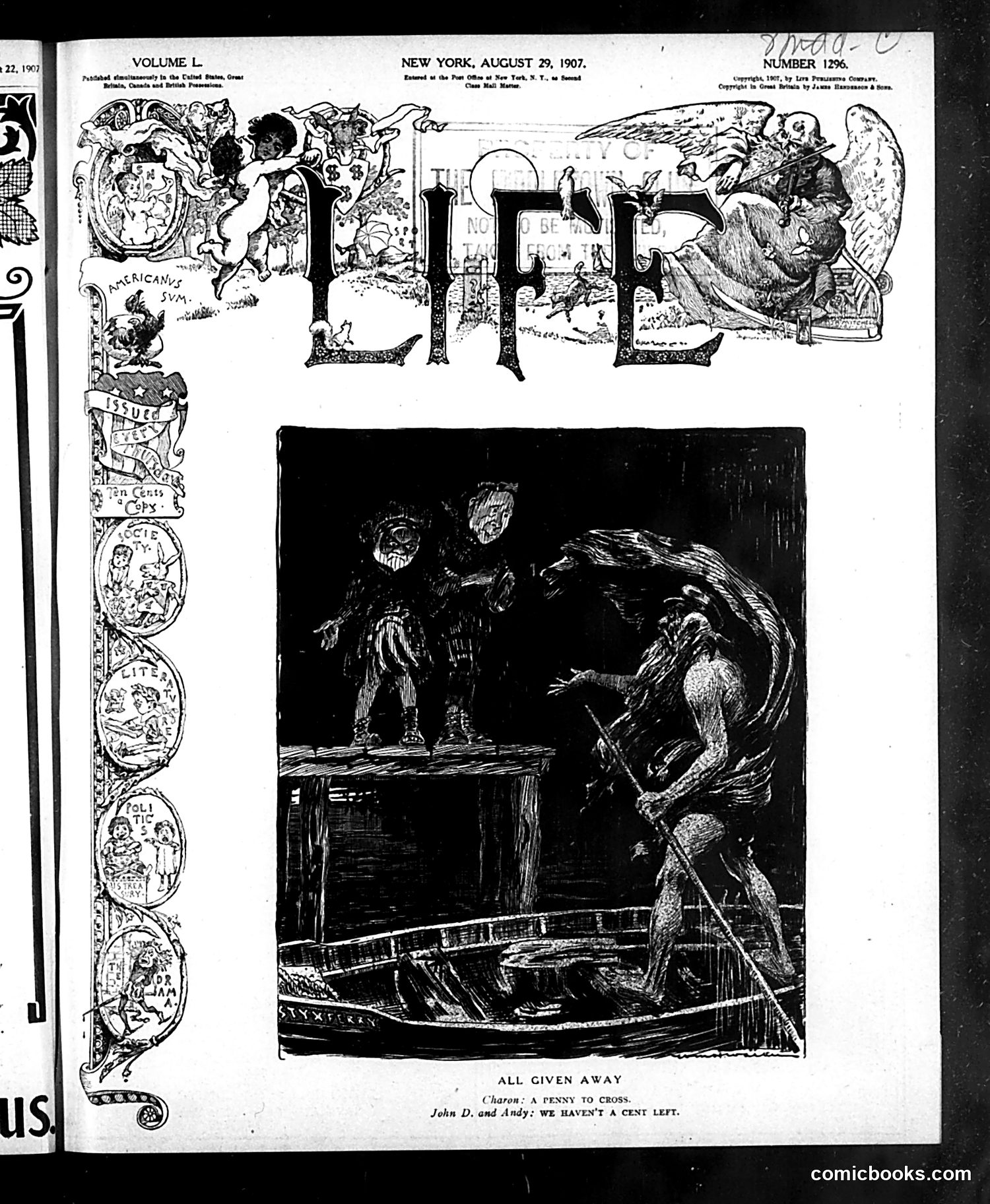
**The Cartoon:** This appears to be a satirical illustration titled "All Given Away" with the subtitle "A Penny to Cross" and characters named "John D. and Andy; We Haven't a Cent Left." The image depicts what seems to be a ferryman or boatman figure (possibly Charon from Greek mythology, who ferries souls across the river) confronting two figures. The reference to "John D." likely refers to John D. Rockefeller, the enormously wealthy oil magnate, while "Andy" probably refers to Andrew Carnegie, another prominent industrialist and philanthropist. The satire suggests irony about these billionaires' charitable giving—despite their vast fortunes, the cartoon jokes they're now so broke they cannot even afford a penny to cross (the mythological River Styx), mocking either their actual philanthropy or public perception of their wealth redistribution.
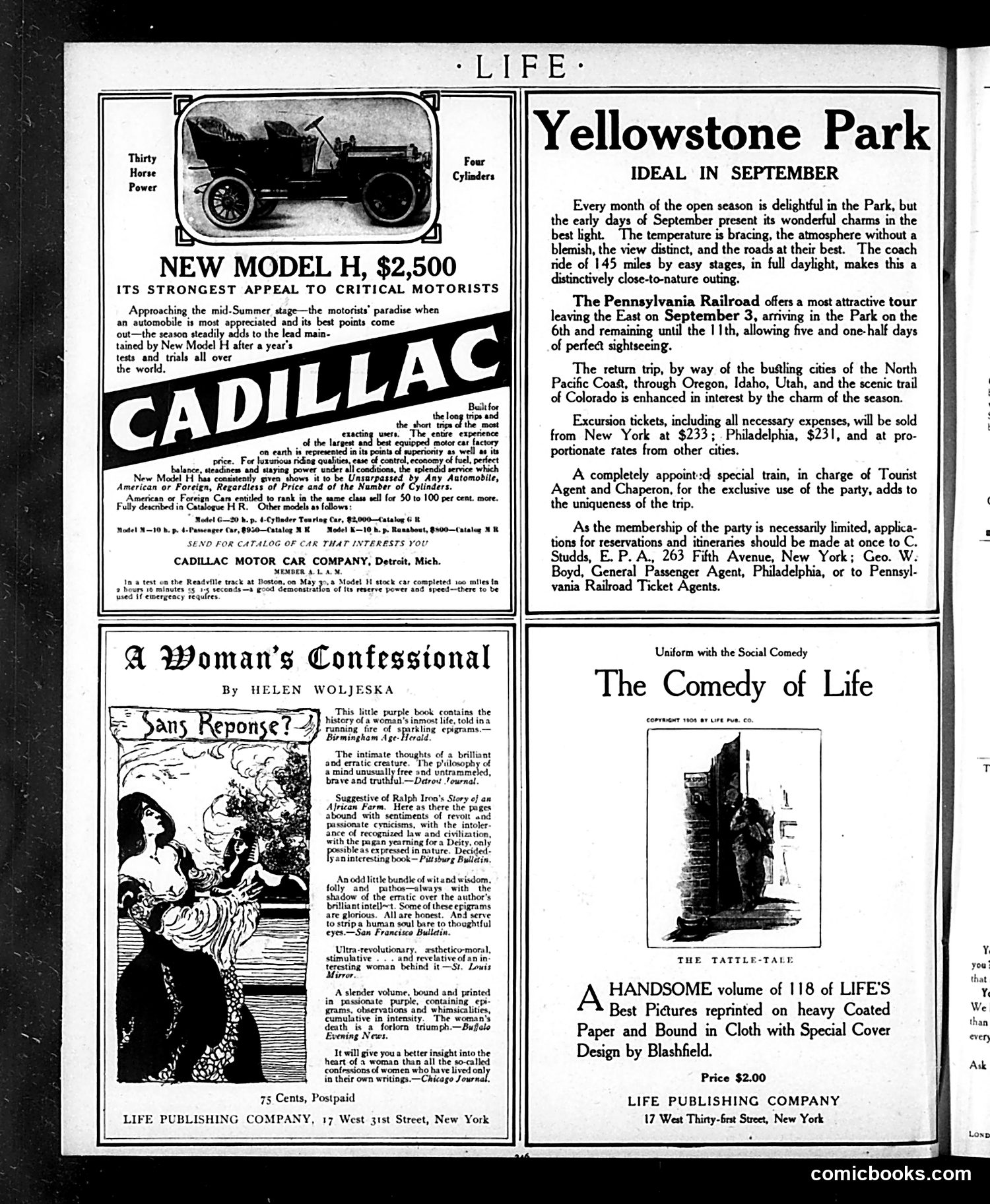
This page is primarily **advertising and promotional content**, not political satire. The top half features a **Cadillac automobile advertisement** highlighting the "New Model H" at $2,500, marketing it to "critical motorists" with emphasis on its powerful engine and economy. Below is a book advertisement for **"A Woman's Confessional" by Helen Woljeska**—described as containing a woman's honest life history with "sentiments of revolt and passionate cynicism." The accompanying illustration shows a woman in period dress. The right side advertises **Yellowstone Park** as ideal for September tourism and **"The Comedy of Life,"** a collection of 118 photographs from Life Publishing Company. No political cartoons or satire appear on this page—it's a standard commercial magazine layout typical of early 20th-century publications.
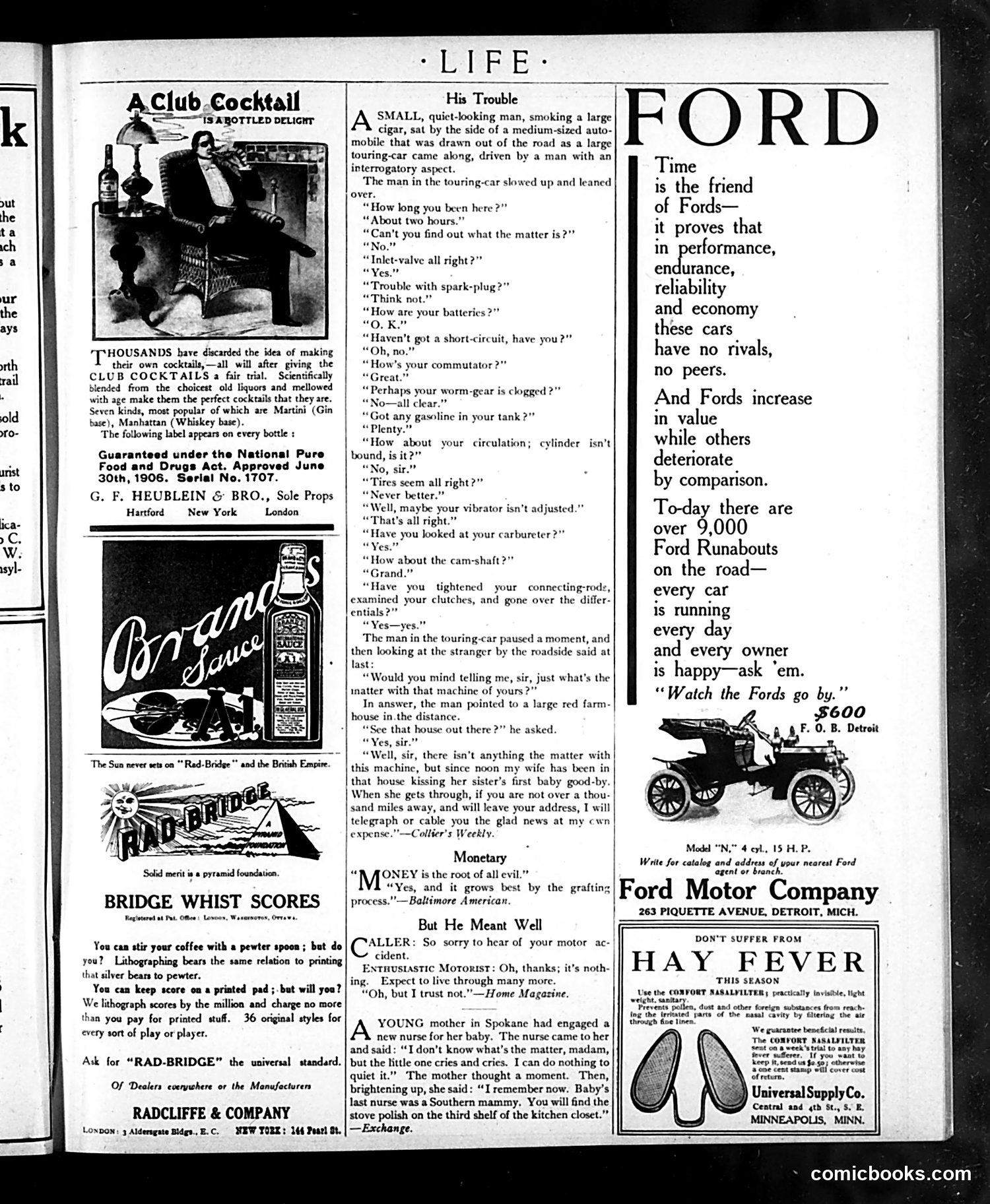
This page is primarily **advertising and commercial content** with minimal satirical elements. The main features include: **"A Club Cocktail"** - A humorous piece mocking elaborate homemade cocktail recipes, popular during Prohibition era (when commercial alcohol was banned). The joke emphasizes that complex preparations still cannot replicate professional bartenders' skill. **"His Trouble"** - A comic dialogue between a motorist and a repair mechanic, satirizing the era's unreliable automobiles and the proliferation of mechanical problems—a common frustration as cars became widespread. The page is otherwise dominated by product advertisements (Ford automobiles, Pyranol Sauce, hay fever remedies) typical of 1920s magazine layouts. The satirical content reflects contemporary concerns: Prohibition, automobile reliability, and domestic inconveniences.
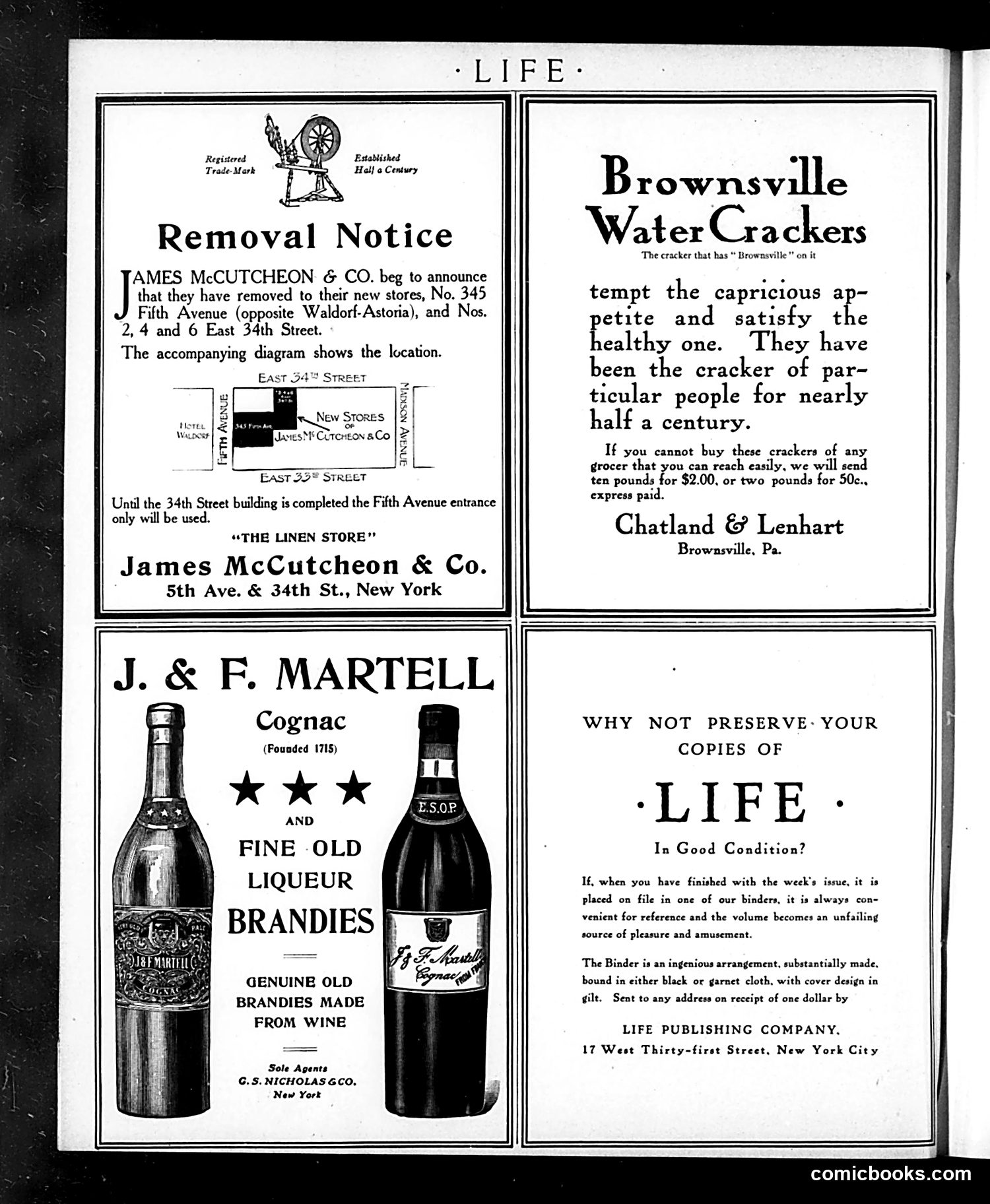
This page contains **primarily advertisements rather than satirical cartoons**. The four ads are: 1. **James McCutcheon & Co.** (top left): A removal notice announcing the relocation of a linen store in New York with a location diagram. 2. **Brownsville Water Crackers** (top right): A product advertisement claiming the crackers have satisfied customers "for nearly half a century," offering mail order service. 3. **J. & F. Martell Cognac** (bottom left): A spirits advertisement promoting French brandies and liqueurs, with bottle illustrations. 4. **Life Publishing Company** (bottom right): An in-house ad promoting magazine binders for preservation. There is **no political satire or cartoon content** on this page—it's a standard advertising section from the magazine.
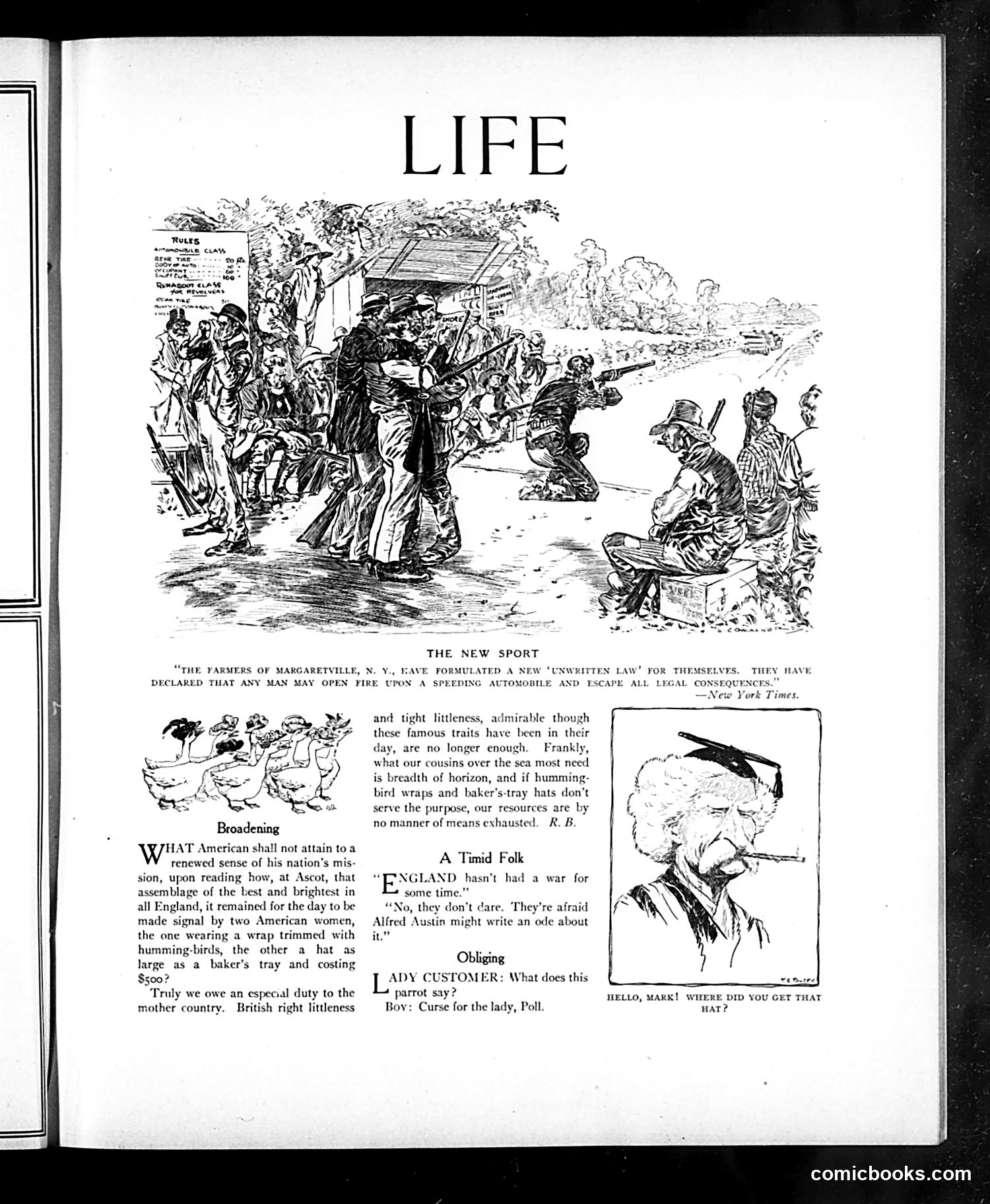
This satirical page mocks a purported "unwritten law" in Margaretville, N.Y., where farmers claim immunity from traffic laws while operating speeding automobiles. The main cartoon depicts rural citizens confronting a motorist, suggesting tension between traditional agrarian communities and modernization via automobiles. The smaller satirical vignettes below—"Broadening," "A Timid Folk," and "Obliging"—humorously contrast British and American cultural attitudes, with a final joke about a parrot's curse and a lady customer. The core satire targets rural resistance to modern laws and technology, while simultaneously poking fun at perceived British timidity versus American assertiveness. The piece reflects early 20th-century anxieties about automobiles disrupting established social order.
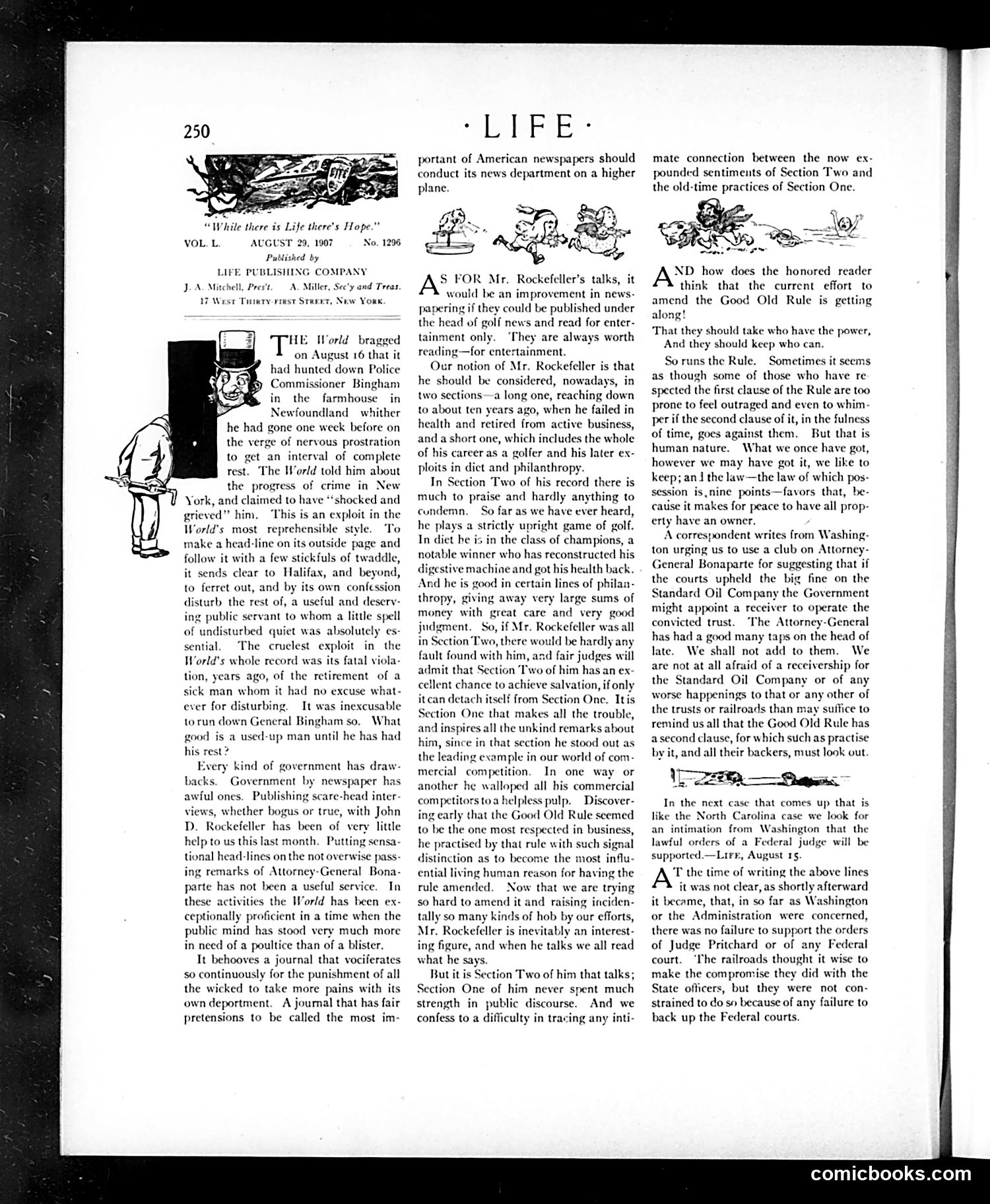
The main cartoon depicts a police officer or official arresting/confronting a thin criminal figure. The caption references "The World" newspaper's reporting on a crime wave in New York, suggesting this is satirizing either ineffective law enforcement or sensationalist crime journalism. The text discusses John D. Rockefeller, focusing on two "sections" of his life: his earlier business practices (Section One) versus his later philanthropic work (Section Two). The article suggests tension between these phases, questioning whether his current charitable giving can justify or offset his previous business conduct. The satire appears to critique both public figures who reinvent themselves through charity and newspapers that sensationalize crime for circulation.
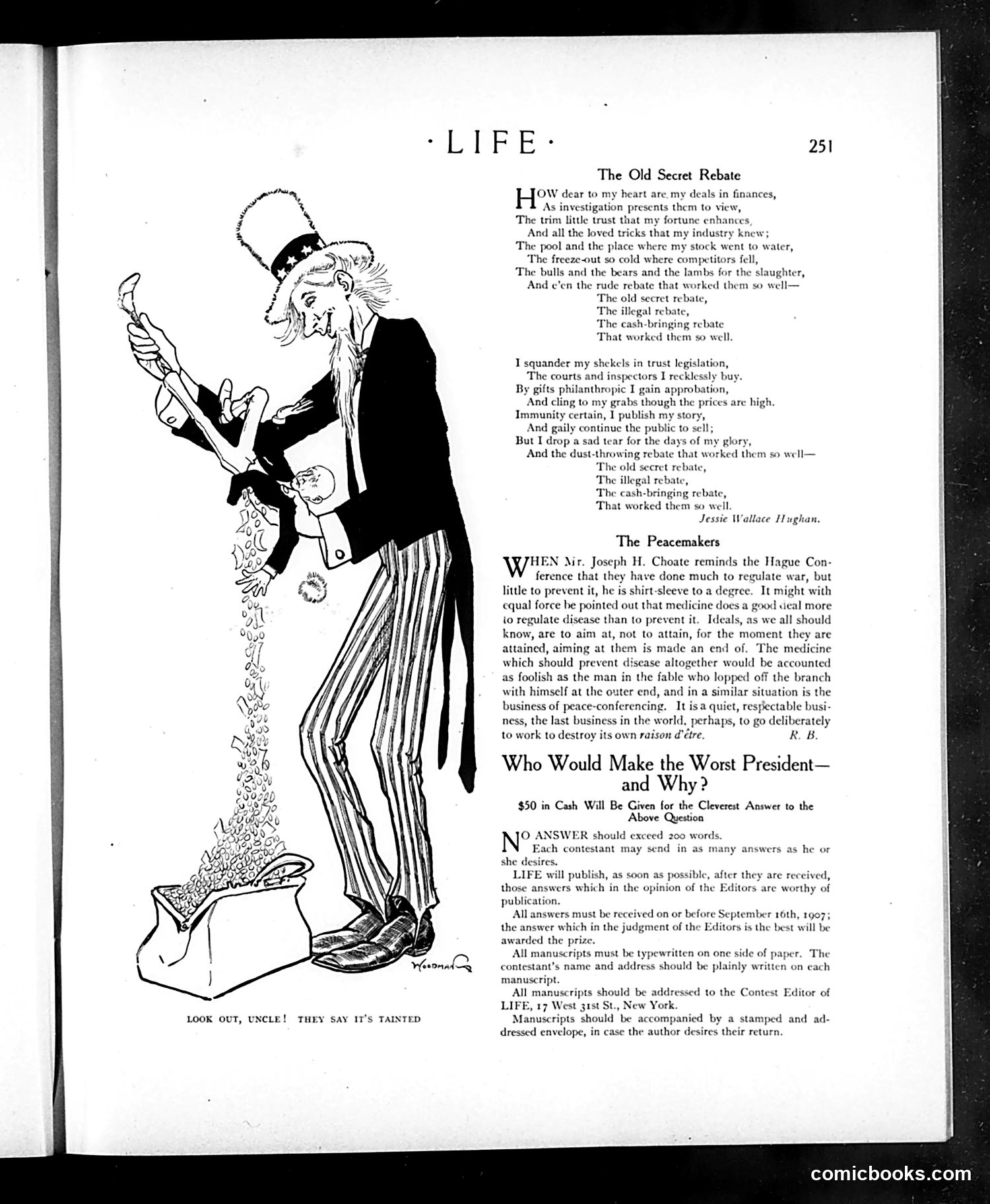
This political cartoon depicts an elderly man (likely representing Uncle Sam or American leadership) pouring money from a seemingly contaminated source. The exaggerated, grotesque caricature of the figure controlling the money spout suggests corruption or tainted influence in American politics or business. The caption warns that "it's tainted"—a reference to illegitimate or corrupted funds entering the American system. This appears to be satire about financial corruption, possibly related to monopolies, trusts, or foreign influence in early 20th-century America. The page also contains "The Old Secret Rebate," a poem critiquing business practices like illegal rebates and price-fixing that harmed fair competition—reflecting Progressive Era concerns about corporate malfeasance.
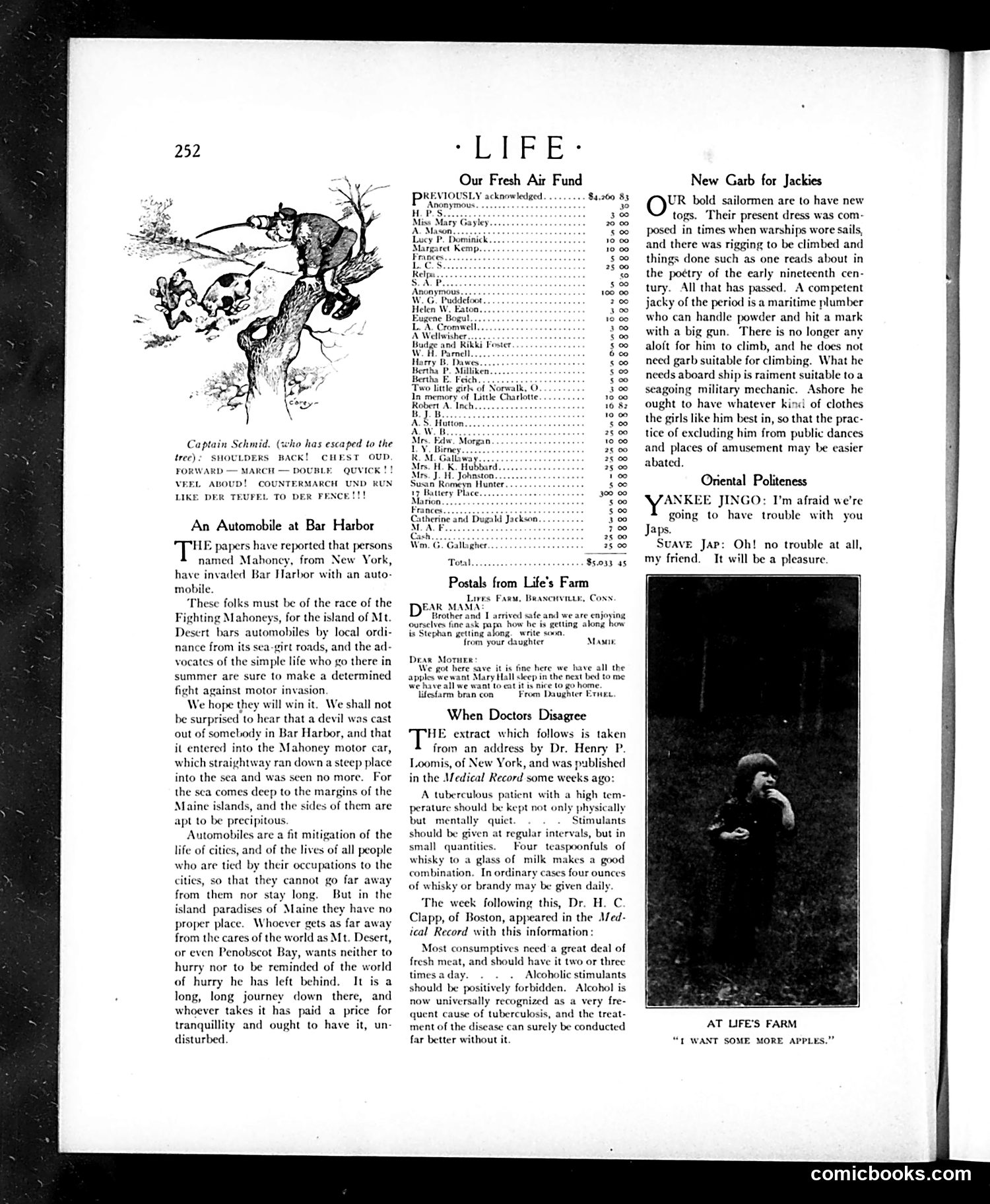
The main cartoon depicts "Captain Schmid" clinging to a tree while being chased by what appears to be a large dog or animal. The German-language caption suggests this is satirizing German resistance to something, with phrases about "shoulders back" and "chest forward." The page's primary content concerns an automobile invasion of Bar Harbor, Maine—a wealthy resort community. The satire mocks local resistance to wealthy mainlanders (particularly New Yorkers named Mahoney) bringing automobiles to the island, disrupting its peaceful character. The piece humorously positions islanders as fighting against modernization and motor-vehicle intrusion into their traditional way of life. The right column contains unrelated medical and social commentary pieces, including content about doctors and health practices.
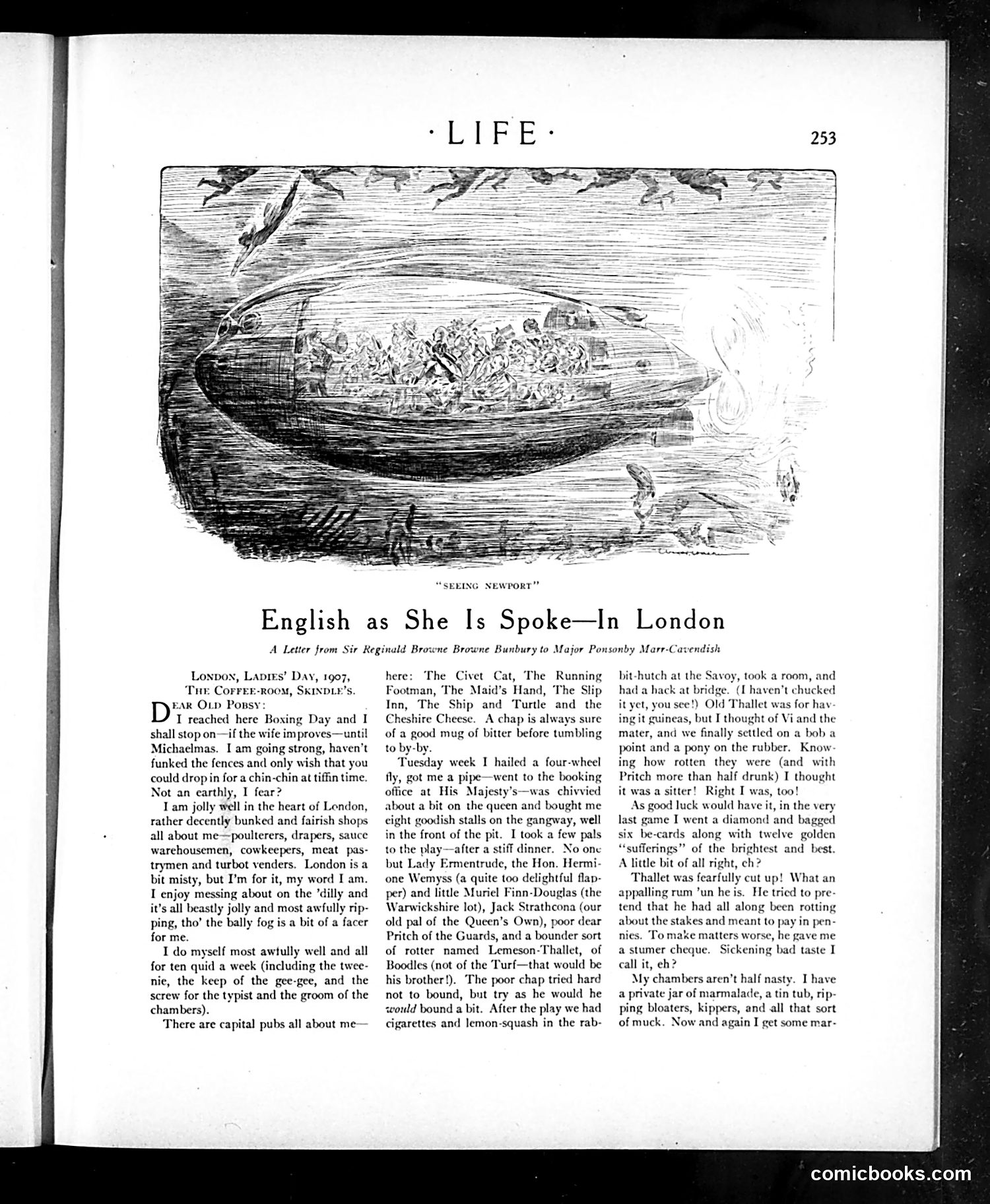
This is a humorous letter titled "English as She Is Spoke—In London," presented as correspondence from Sir Reginald Broome Bexenbury to Major Ponsonby Marr-Cavendish, dated Ladies' Day, 1907. The accompanying engraving depicts a crowded pleasure boat packed with passengers, illustrating the letter's satirical commentary on London leisure activities. The writer humorously complains about English social life—specifically the cramped, unpleasant conditions at popular entertainment venues like theaters and pubs where the narrator encounters various colorfully-named characters (Lemeson-Thallet, Jack Strathcona, etc.). The satire mocks both English social pretensions and the discomforts of crowded public amusements, using the boat image as a visual joke about the packed, chaotic nature of fashionable London society outings.
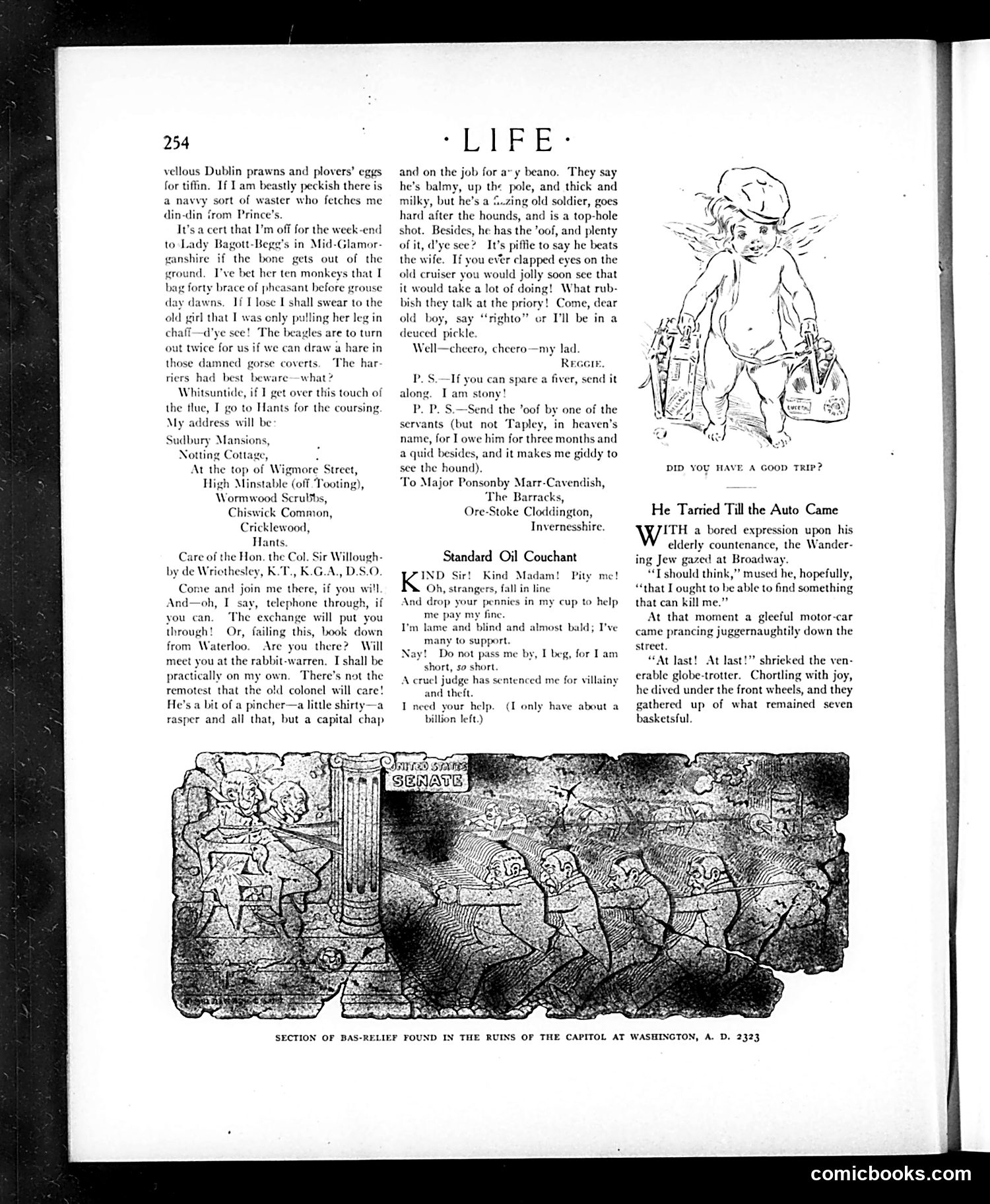
This page contains two distinct pieces of humor content: **Left Column - "Letters to the Editor"**: Personal correspondence from readers, including complaints about Dublin water quality and addresses for correspondence at various English locations. **Right Side - "He Tarred Till the Auto Came"**: A short story/cartoon about a wandering Jewish character (indicated by the stereotype caricature) who encounters a motor car on Broadway. The humor derives from the character's amazement at modern automobile technology—he's so startled he jumps into the street and loses his possessions. The joke exploits the comedic contrast between an immigrant unfamiliar with new technology and urban modernity. **Bottom Image**: A bas-relief reproduction from the Capitol at Washington (A.D. 2343—a speculative future date), depicting classical figures, likely used as decorative historical reference. The content reflects early 20th-century American satirical attitudes toward immigrants and technological progress.
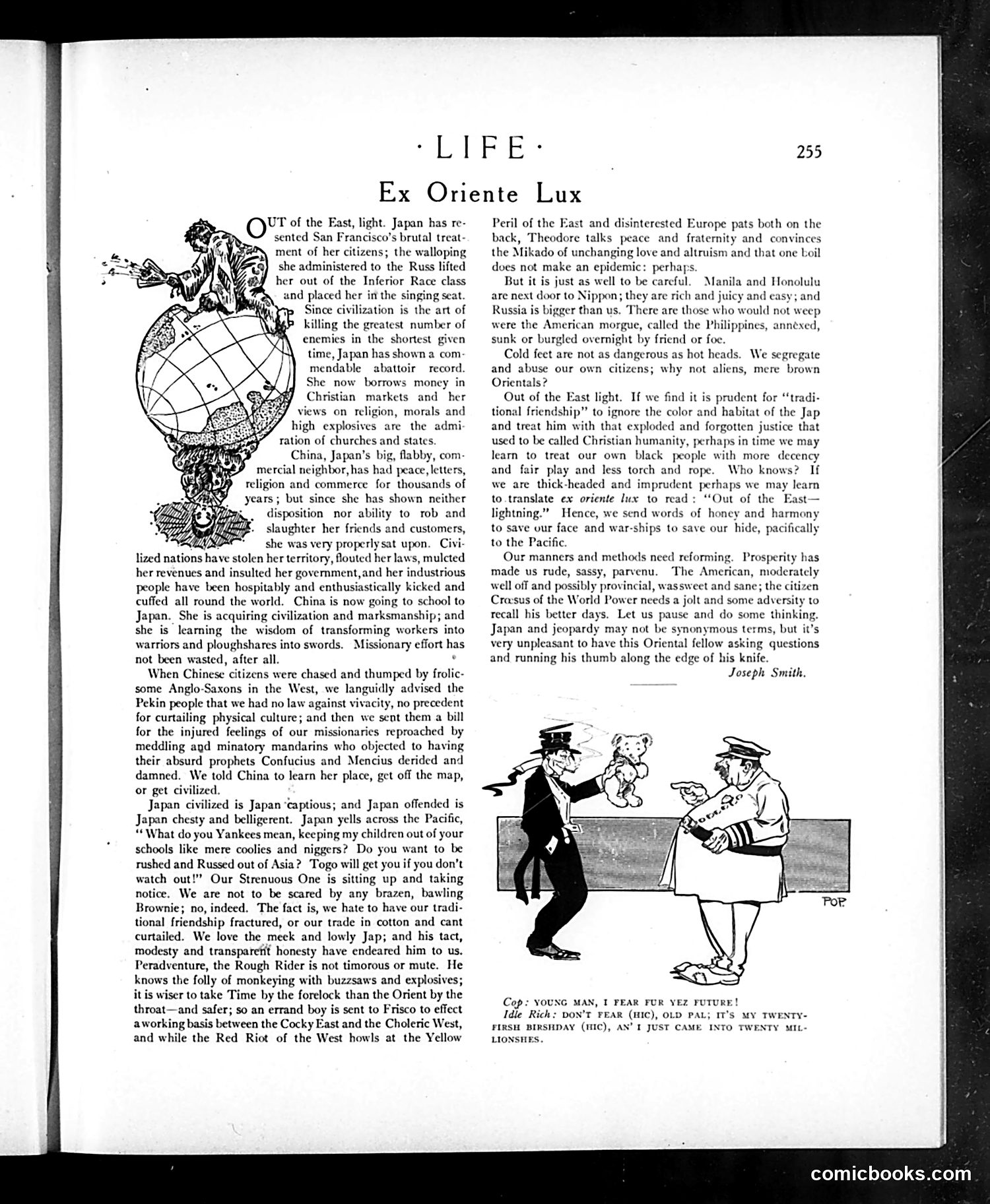
This page contains an essay by Joseph Smith criticizing American attitudes toward Japan and Asia. Smith argues against racist stereotyping of Japanese and Chinese people, advocating instead for fair treatment and respect. The cartoon below depicts a confrontation between three figures: a young man (labeled "Young Man, I fear for yer future!"), an older man called "Idle Rich," and what appears to be a person of Asian descent. The dialogue references the young man's twenty-fifth birthday and "twenty lionesses"—likely a sexual innuendo joke about the young man's romantic pursuits. The cartoon appears to satirize wealthy idleness and possibly racial attitudes of the period, though the exact meaning is unclear from context alone.
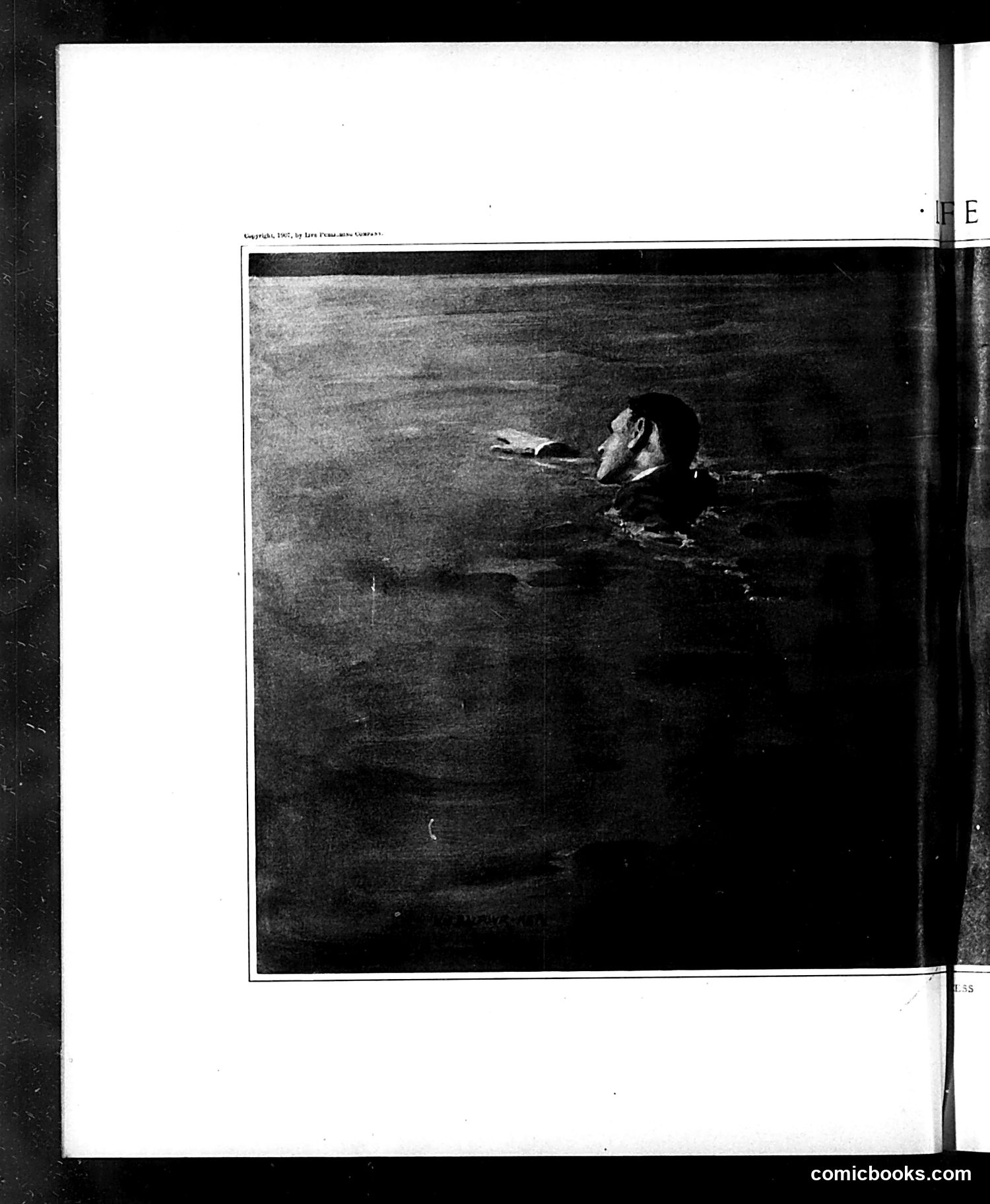
This appears to be a dramatic black and white photograph or illustration showing a person in dark clothing partially submerged in water, with their head tilted back. The image has a stark, theatrical quality typical of early 20th-century Life magazine content. However, I cannot definitively identify the specific political or social reference this depicts without clearer text or caption information. The OCR text provided is illegible/blank, which prevents me from confirming the cartoon's intended meaning, target figures, or satirical point. To properly explain this to a modern reader, I would need: the caption, date, artist attribution, or any visible text labeling figures or events. Without these contextual elements, any interpretation would be speculation rather than the evidence-based analysis your rules require.
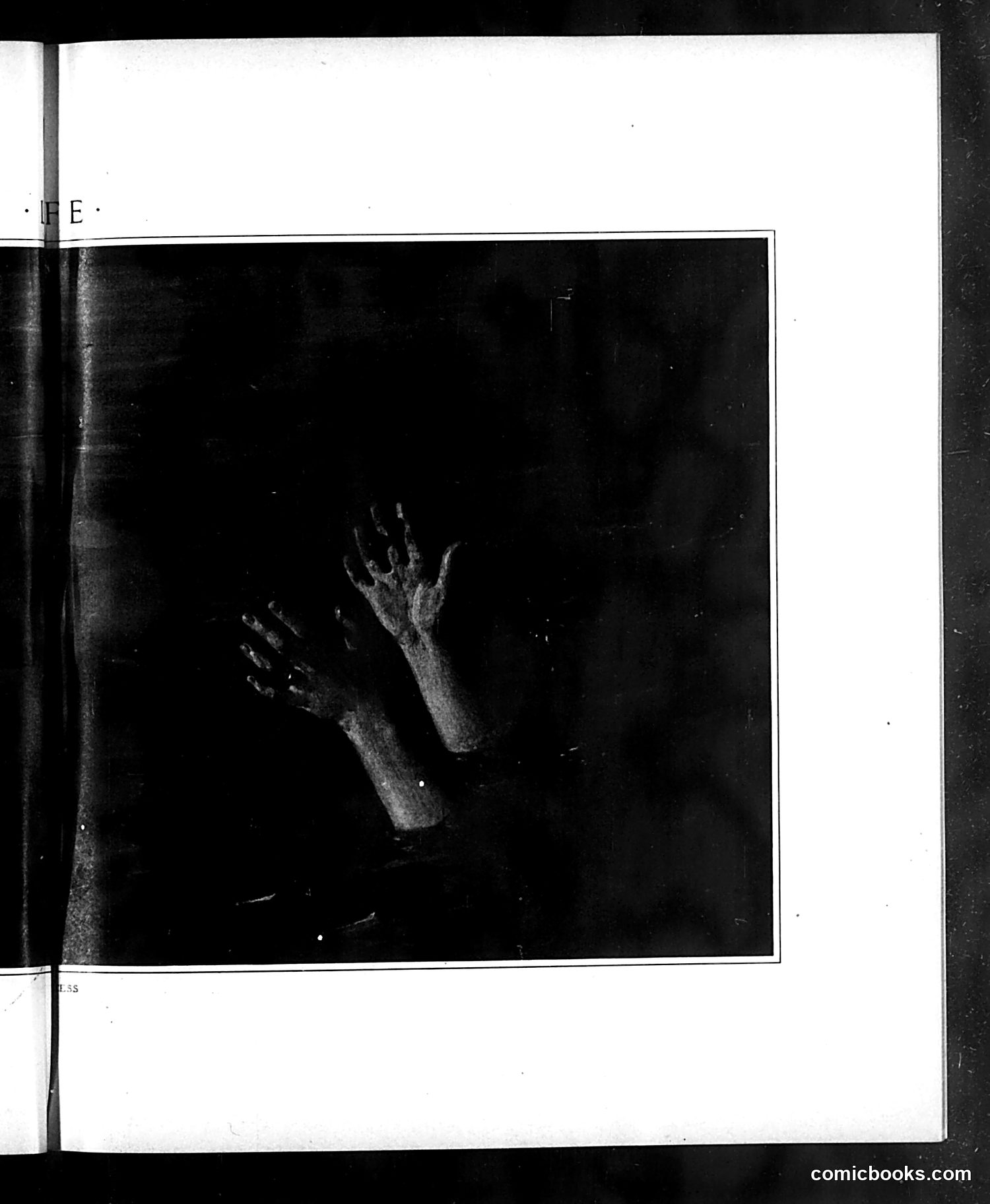
I can see this page contains what appears to be an X-ray or skeletal image of hands against a dark background, mounted on a white page with minimal text visible. The letter "E" appears at the top left, and there's a reference number "F-35" at the bottom left. However, I cannot reliably read the OCR text or identify specific satirical content, political figures, or social commentary from this image alone. The skeletal/X-ray imagery could reference medical, scientific, or metaphorical themes common to early-to-mid 20th century satirical magazines, but without clearer text or additional context, I cannot confidently explain what specific point or joke this cartoon makes. I'd need clearer text or additional page content to provide an accurate historical interpretation.
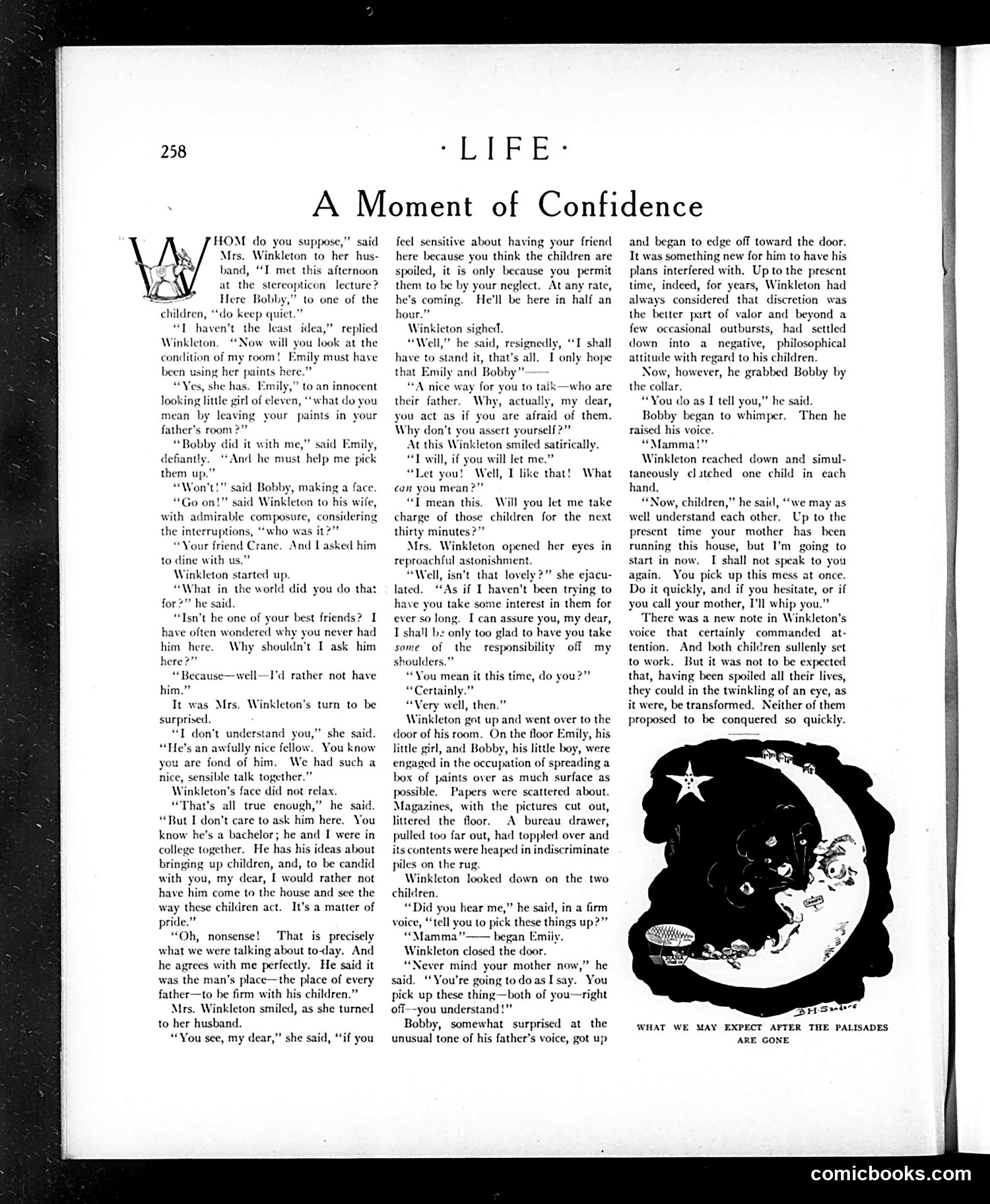
This domestic humor story satirizes early 20th-century parenting debates. Mr. Winkleton, embarrassed by his undisciplined children, initially refuses to let his bachelor friend Crane visit, fearing judgment about his parenting. His wife Mrs. Winkleton counters that *he* is responsible for the children's spoiled behavior through lack of firmness. When challenged to prove he can discipline them, Winkleton accepts a thirty-minute test of authority. The accompanying cartoon (captioned "What We May Expect After the Palisades Are Gone") appears unrelated to the story. The satire targets the gender dynamics of child-rearing: the wife controls domestic policy but blames the father for not asserting "masculine" authority, while the father avoids responsibility by claiming his wife won't permit discipline. The piece mocks both parental positions in this common marital conflict.
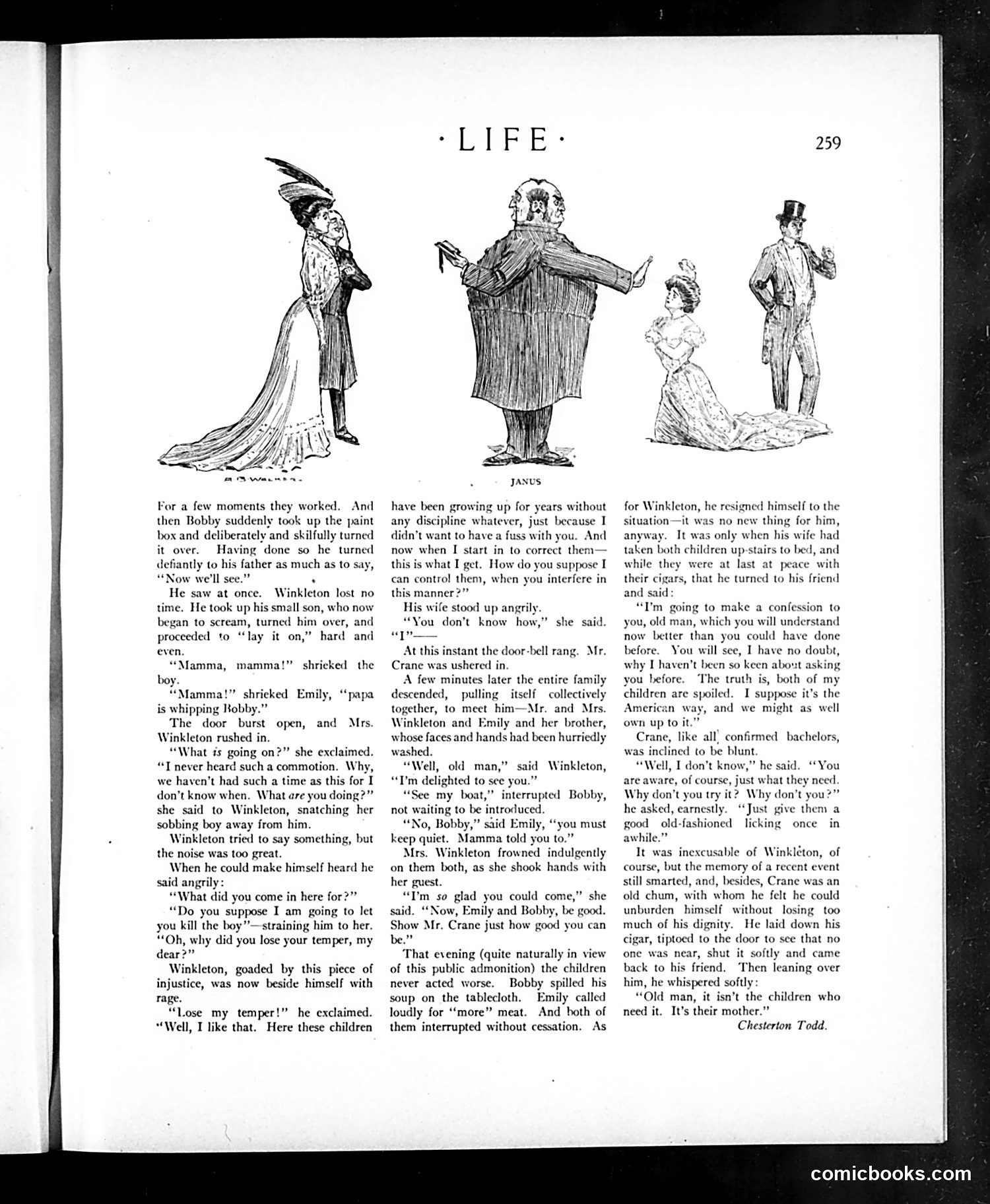
This satirical story illustrates early 20th-century debates about child discipline and parental authority. The narrative depicts Mr. Winkleton attempting to discipline his misbehaving son Bobby by spanking him after Bobby deliberately spills paint. His wife Emily interrupts, snatches the child away, and accuses him of excessive force—despite years of allowing the children to grow up "without any discipline whatever." The satire targets **permissive parenting**: Mrs. Winkleton prevents discipline yet expects obedience, and later publicly commands the children to "be good" for a visiting guest (Mr. Crane), only to have them behave worse. Winkleton's eventual confession to Crane—that both children are "spoiled" and it's "the American way"—suggests the cartoonist is critiquing contemporary American parenting practices as indulgent and ineffective. The joke underscores the contradiction between mothers' interference in discipline and their simultaneous demands for children's good behavior.
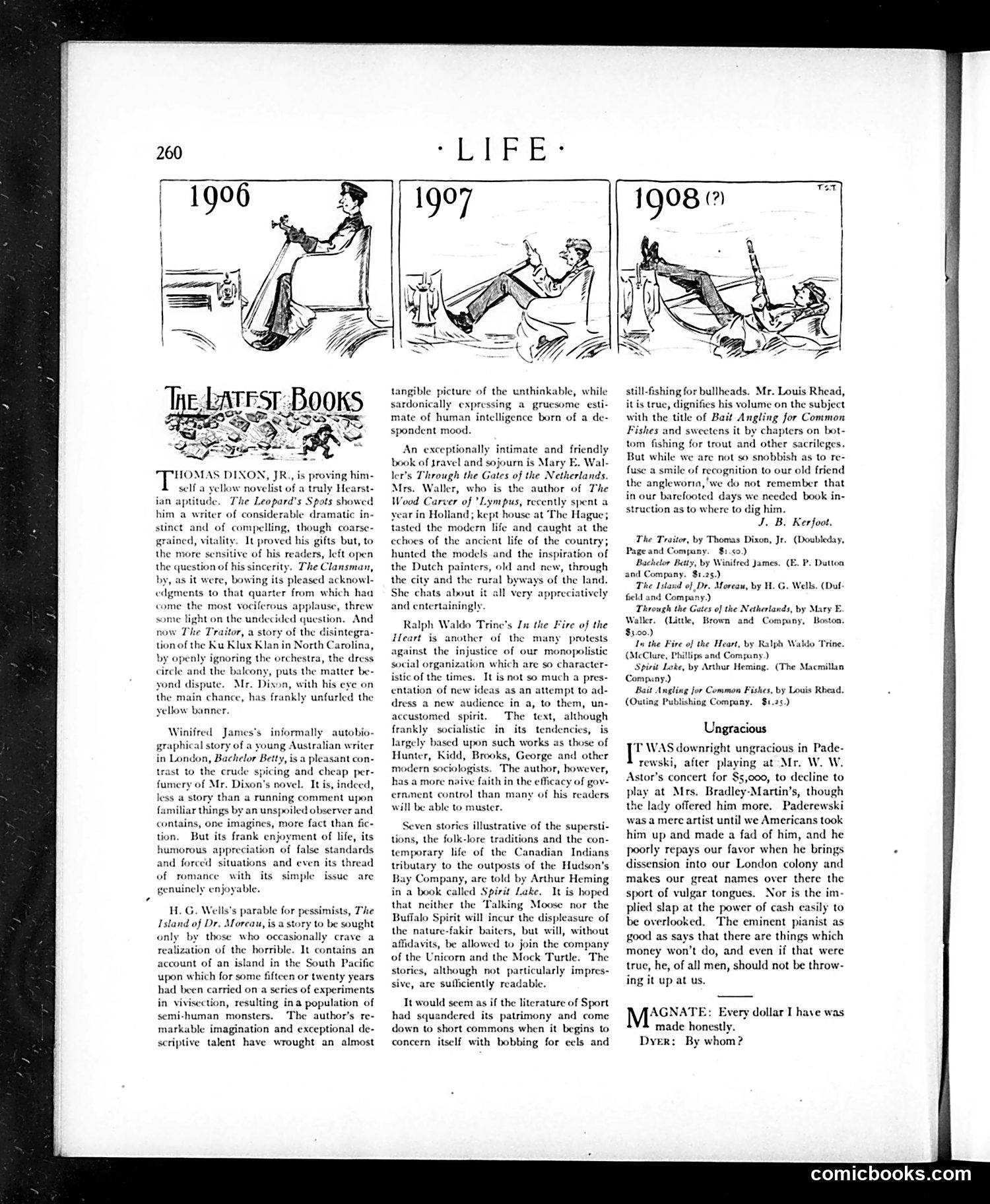
## The Cartoons (top) Three small comic strips dated 1906-1908(?) depict a man in various fishing scenarios—holding up a caught fish, lounging while fishing, and struggling with fishing equipment. These appear to be humorous commentary on sport fishing as leisure activity, likely mocking either incompetent anglers or the pretensions of fishing as a gentleman's pursuit. ## Book Reviews (main text) The page critiques contemporary literature, most notably **Thomas Dixon Jr.**, whose novels *The Leopard's Spot* and *The Clansman* are attacked as "yellow" (sensationalist). The reviewer accuses Dixon of cynically appealing to lower-class tastes and "unfurling the yellow banner"—suggesting his work exploits racial prejudice for commercial gain. The *Clansman* notably deals with the Ku Klux Klan's activities. Other reviews discuss H.G. Wells's *The Island of Doctor Moreau* and travel writings by Mary Waller. ## Context This reflects Progressive-era literary criticism condemning popular fiction that exploited racial anxieties and social fears for profit.
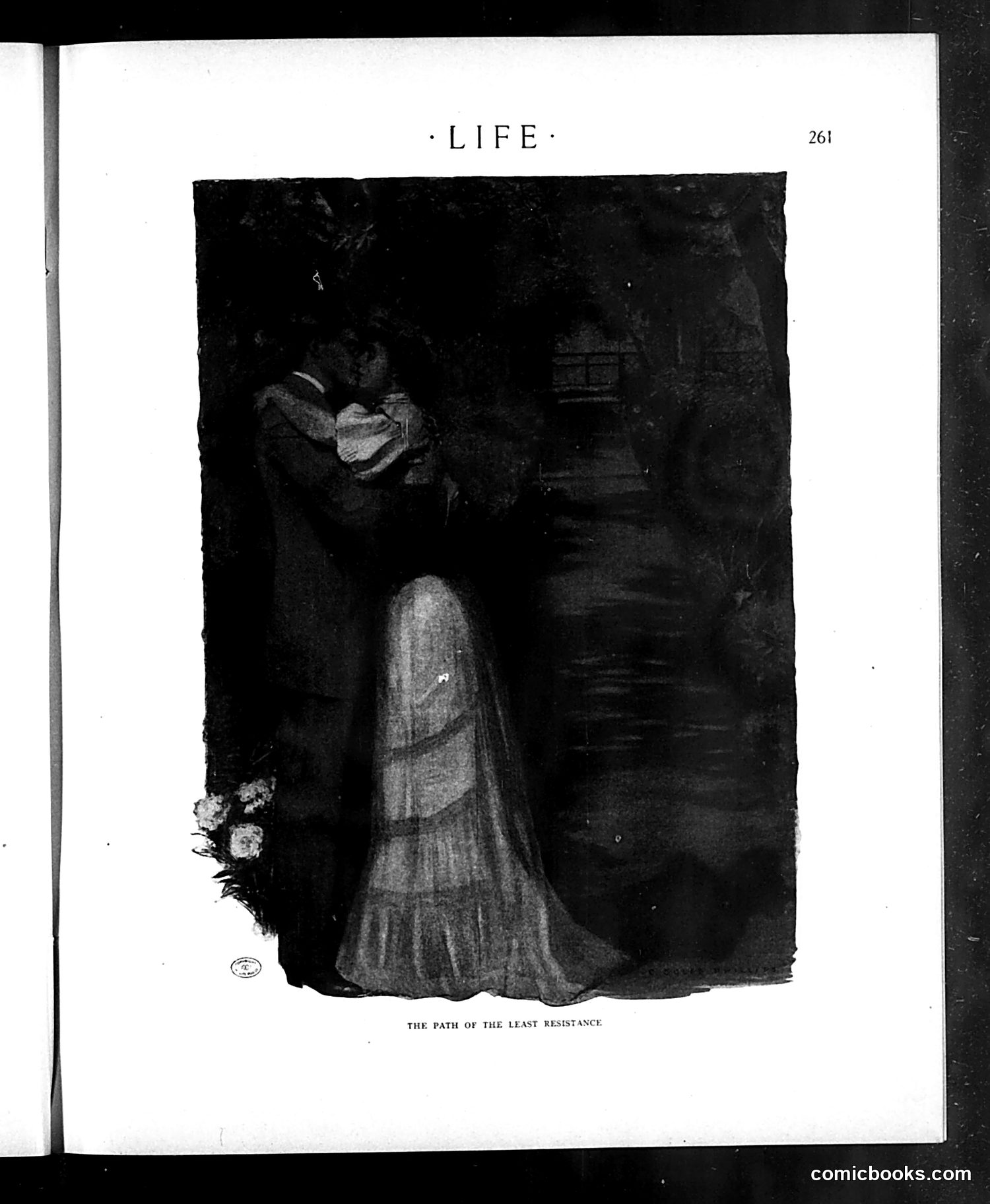
This illustration depicts a woman in an elegant gown, viewed from behind, walking down a dark corridor toward a doorway. A man's silhouette appears in the shadows behind her, and flowers are visible at the lower left. The caption—"The Path of the Least Resistance"—suggests social commentary on women's choices and morality. The image likely satirizes the idea that women might take "easy" or morally questionable paths (implied by the man's pursuing presence). This reflects early 20th-century anxieties about women's independence and respectability. The dark, ambiguous setting reinforces the suggestive nature of the commentary. Without additional context about the specific issue date, the exact target of this satire remains unclear.
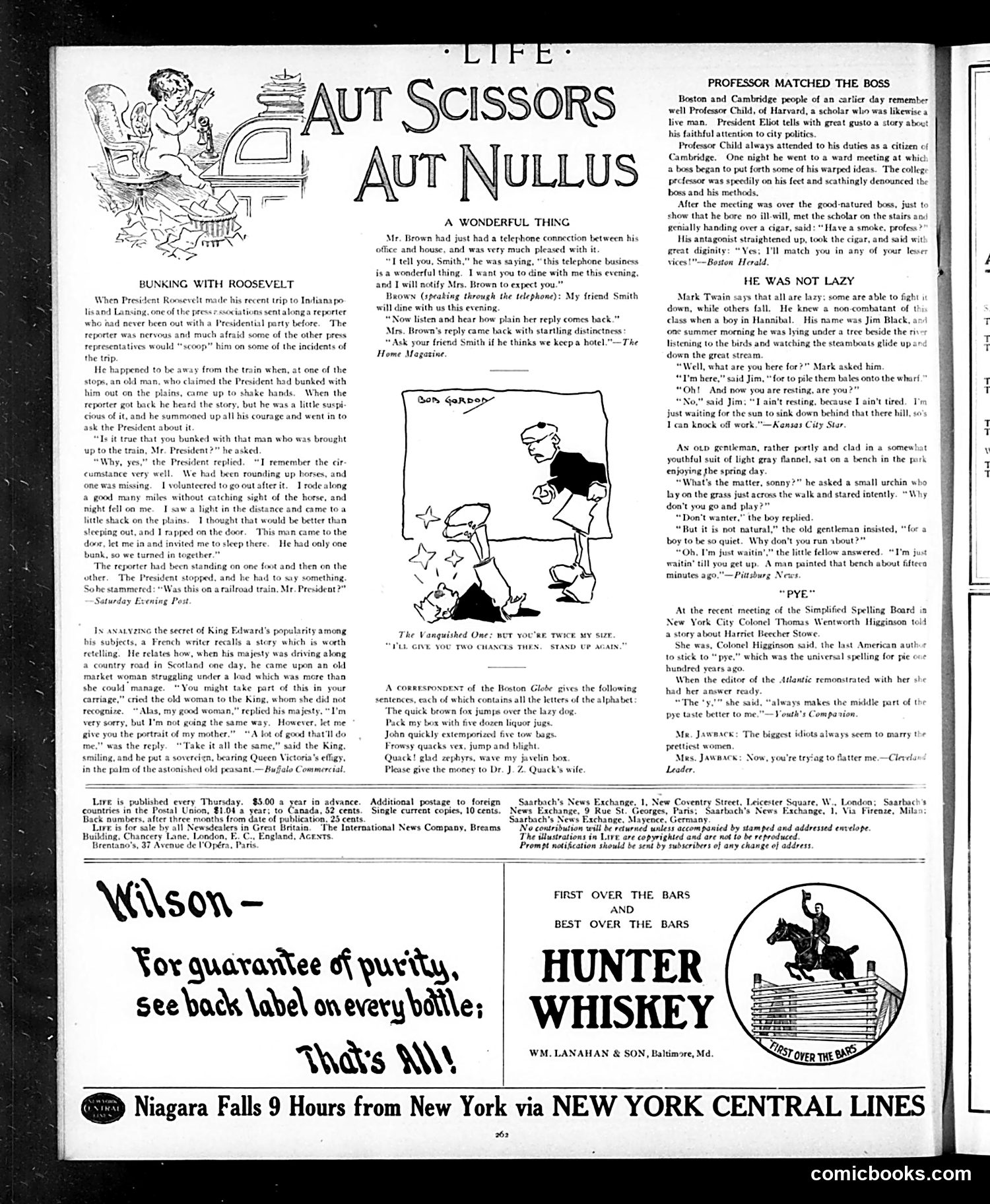
This page contains several unrelated humorous anecdotes and advertisements typical of early Life magazine. The main cartoons illustrate brief jokes: 1. **"A Wonderful Thing"** - Satirizes new telephone technology by showing a man's wife's sarcastic reply when he tries to invite a dinner guest via telephone, suggesting the technology creates unnecessary complications. 2. **"Bunking with Roosevelt"** - A nervous reporter finally asks President Theodore Roosevelt about allegedly sleeping in a bunk with a stranger. Roosevelt confirms the story matter-of-factly, deflating the reporter's suspicions. 3. **"Born Gorge"** - A small boxing cartoon where one fighter offers his larger opponent "two chances" to fight fairly. The page also includes advertisements (Wilson whiskey, Hunter Whiskey, New York Central Lines) and filler content like alphabet pangrams—typical of Life's format mixing satire, humor, and commerce.
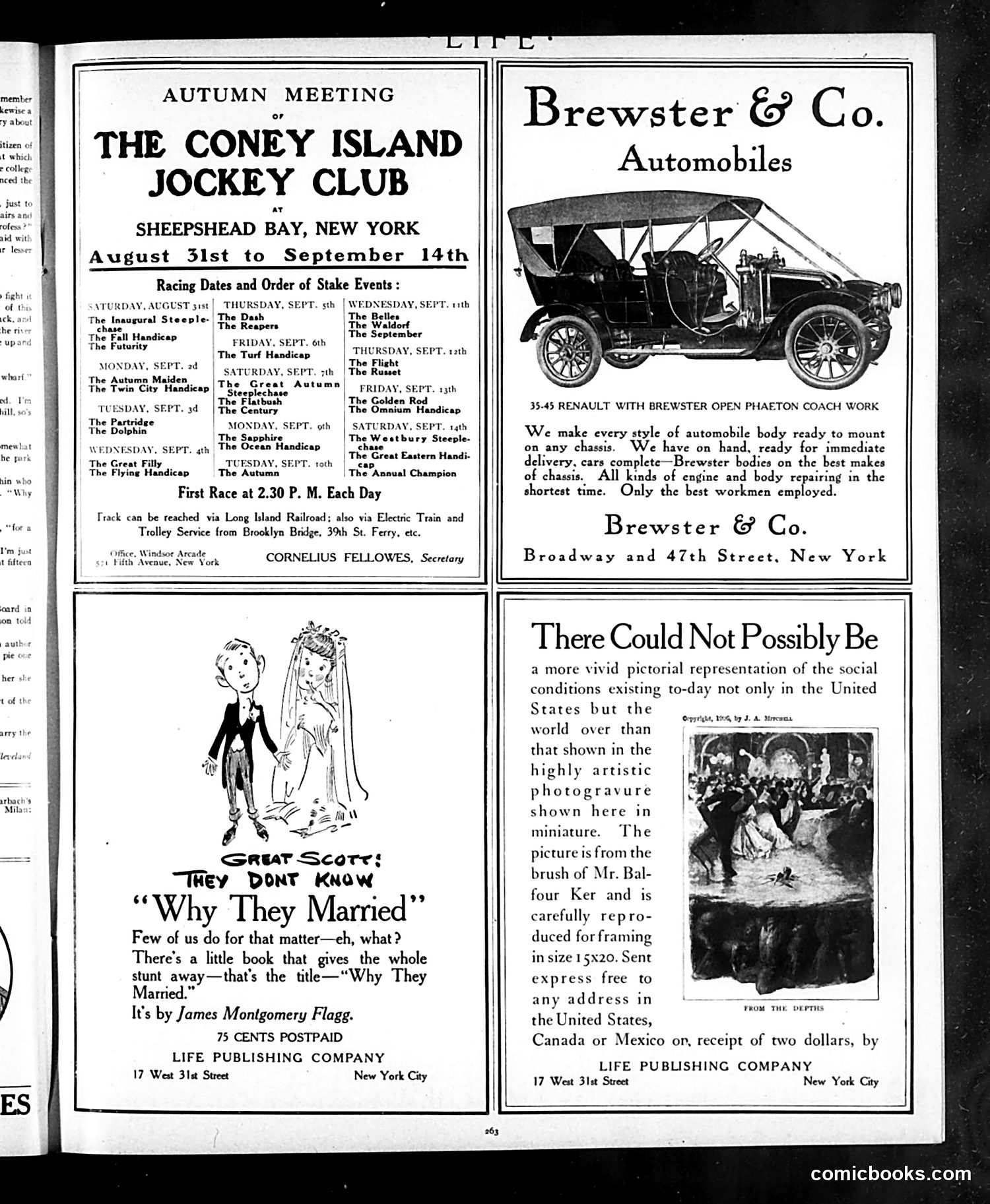
This page consists primarily of **advertisements and event announcements** rather than political satire. The main content includes: 1. **Coney Island Jockey Club announcement** — a horse racing event at Sheepshead Bay, New York (August 31-September 14), listing various stake races. 2. **Brewster & Co. automobile advertisement** — promoting luxury car bodies, particularly a Renault phaeton coach, emphasizing custom manufacturing and repair services. 3. **"Why They Married" book advertisement** — a comedic promotion by cartoonist James Montgomery Flagg for a humorous book about marriage, playing on the universal bewilderment about why people marry ("Few of us do for that matter—eh, what?"). The accompanying cartoon shows a groom looking confused beside his bride. 4. **Photogravure advertisement** — promoting an artistic social commentary photograph by Balfour Ker depicting contemporary social conditions, available for framing. The page reflects early 20th-century American consumer culture and leisure interests.
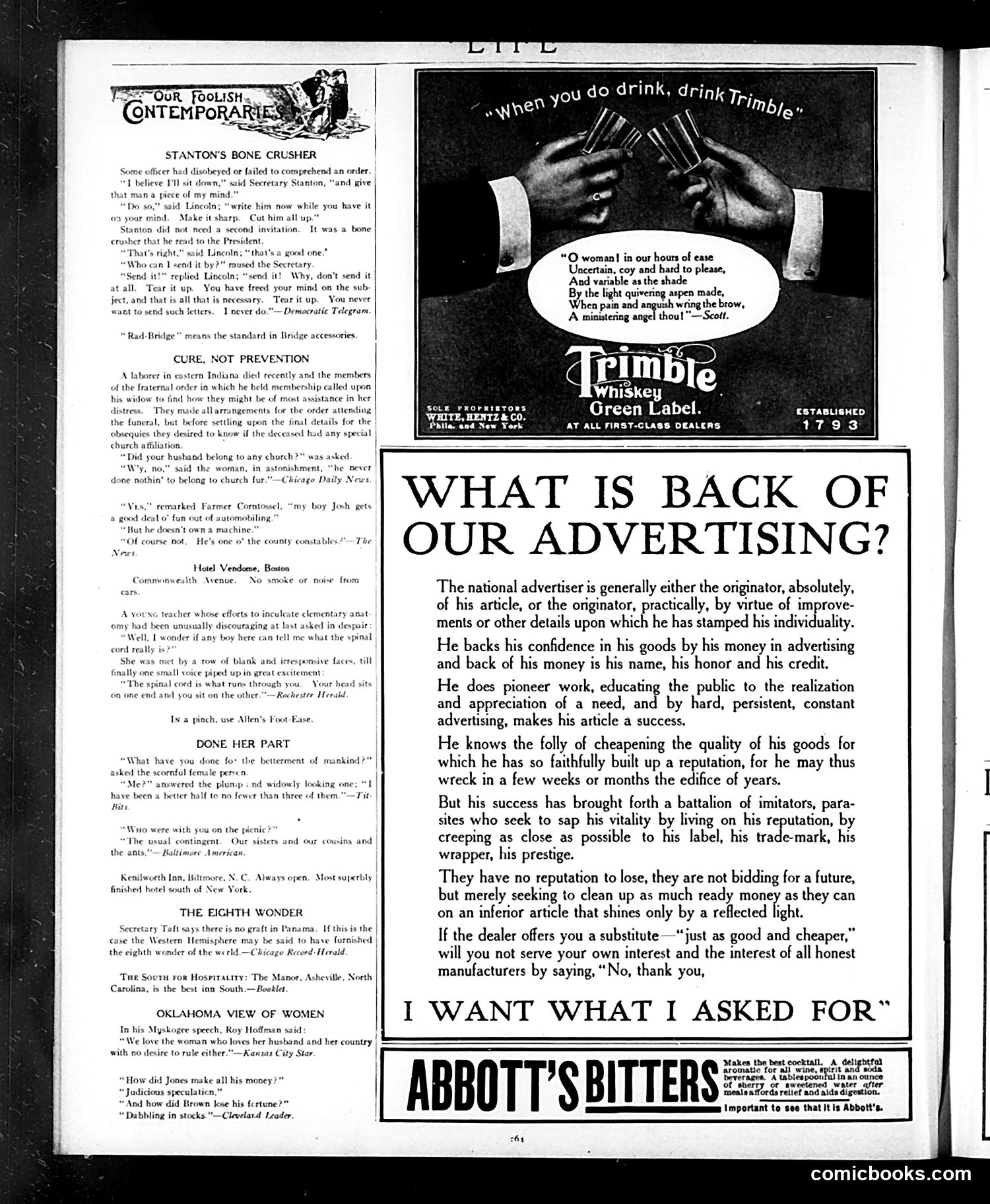
This page is primarily **advertising and editorial commentary**, not political satire. The main content is a defense of national advertising against counterfeit products and cheap imitations. The large central text argues that legitimate advertisers stake their reputation and money on quality goods, educating the public about products they've genuinely innovated or improved. The piece warns against "parasites" — counterfeit manufacturers who exploit established brands' reputations by copying labels, trademarks, and packaging while offering inferior products. The surrounding short humor pieces are unrelated filler typical of Life magazine's format. The advertisements (Trimble Whiskey, Abbott's Bitters) exemplify the very products being defended — established brands with long histories (1793) positioning themselves as trustworthy. **For modern readers:** This reflects early 1900s concerns about counterfeit goods and brand protection before modern trademark law was fully developed. The editorial essentially argues: buy the real brand, not cheap knockoffs.
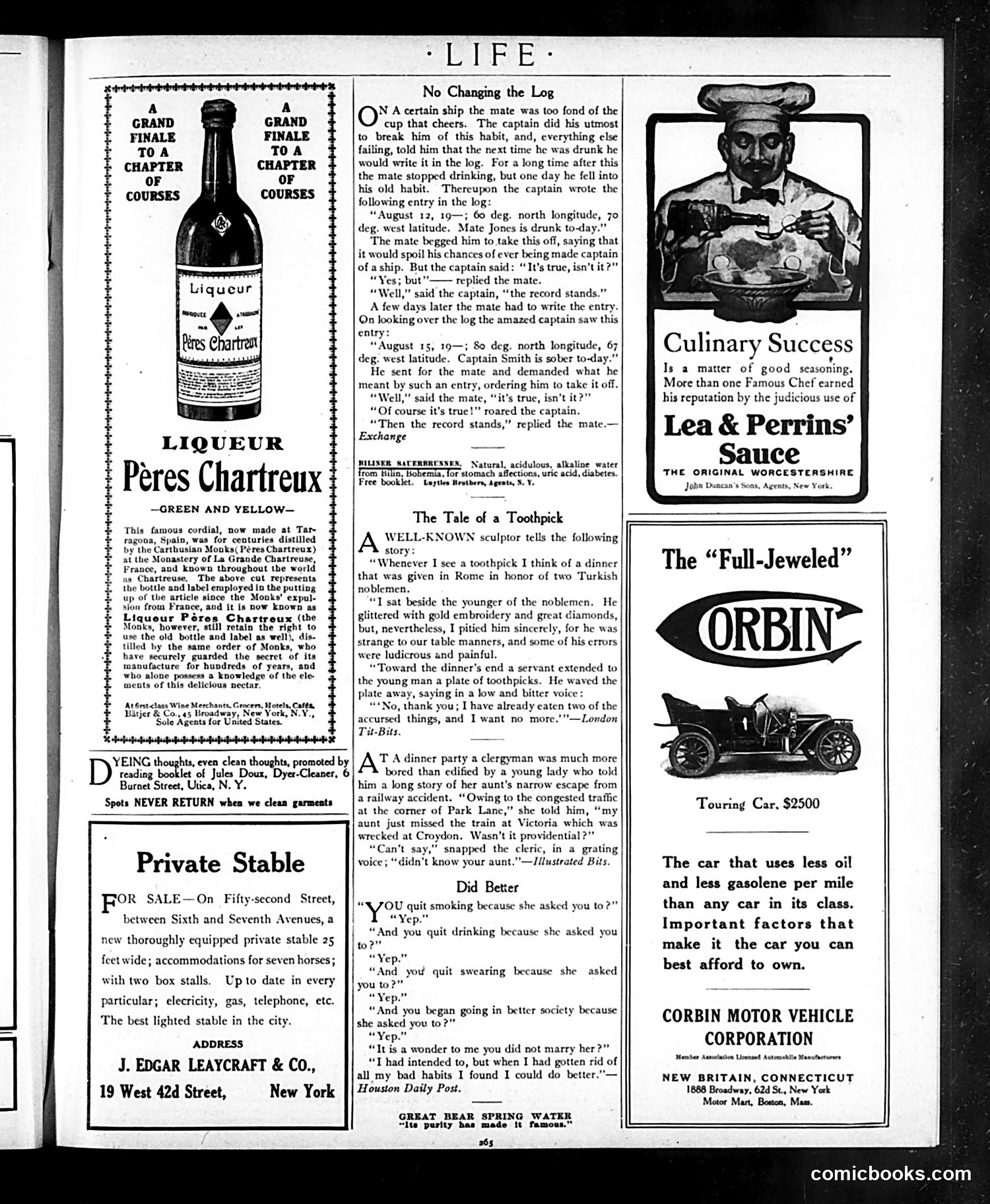
This page contains primarily **advertisements and humorous anecdotes** rather than political cartoons. The main content includes: 1. **Liqueur Péres Chartreux ad**: A liqueur advertisement emphasizing the product's centuries-old monastic origins from France. 2. **"No Changing the Log"**: A humorous story about a ship's mate and captain. The satire works through ironic role-reversal: the captain disciplines the drunk mate by recording it in the ship's log; when the mate later drinks again, he retaliates by recording the captain's sobriety—using the captain's own logic against him. The joke mocks stubbornness and hypocrisy. 3. **"The Tale of a Toothpick"**: An anecdote about a Turkish nobleman's embarrassment at a Roman dinner, mistaking toothpicks for food. It gently mocks cultural misunderstandings and the awkwardness of unfamiliar etiquette. 4. **Other ads**: For sauce, automobiles, and real estate. The page reflects early 20th-century genteel humor and consumer advertising rather than sharp political satire.
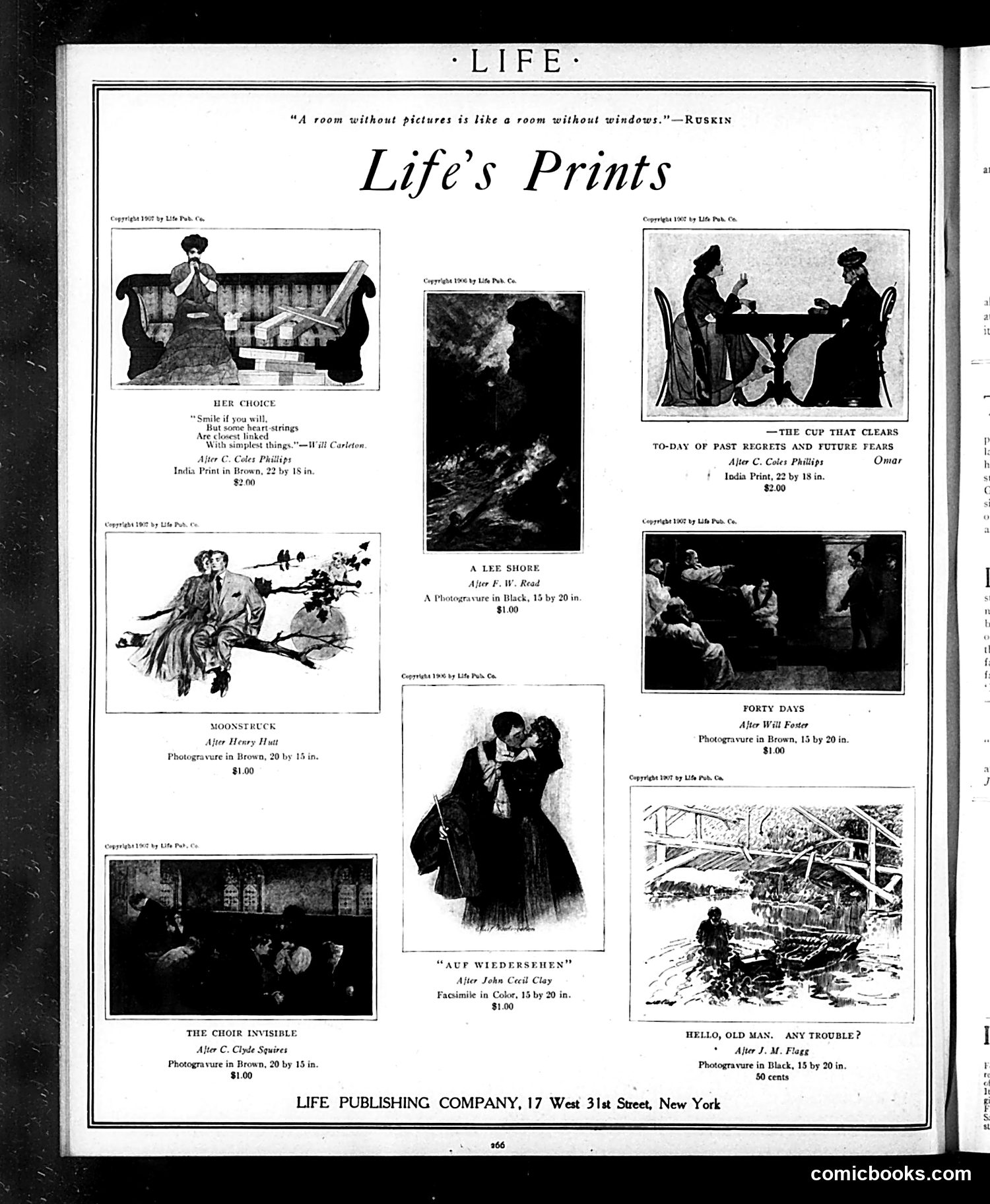
This is not a satirical cartoon page but rather an **advertising catalog** for Life Publishing Company's art reproductions (circa 1907, based on copyright dates). The page showcases eight available prints by various illustrators, each priced between 50 cents and $2.00. The works feature sentimental and romantic themes typical of early 20th-century commercial art: "Her Choice," "Moonstruck," "The Choir Invisible," and "Auf Wiedersehen" depict romantic or emotionally evocative scenes. The epigraph from Ruskin emphasizes that pictures are essential decor. These are **photogravures and facsimiles** — mass-produced reproductions meant for middle-class home decoration. The page demonstrates Life magazine's business model: selling refined artwork reproductions to ordinary Americans, combining journalism with commercial art publishing.
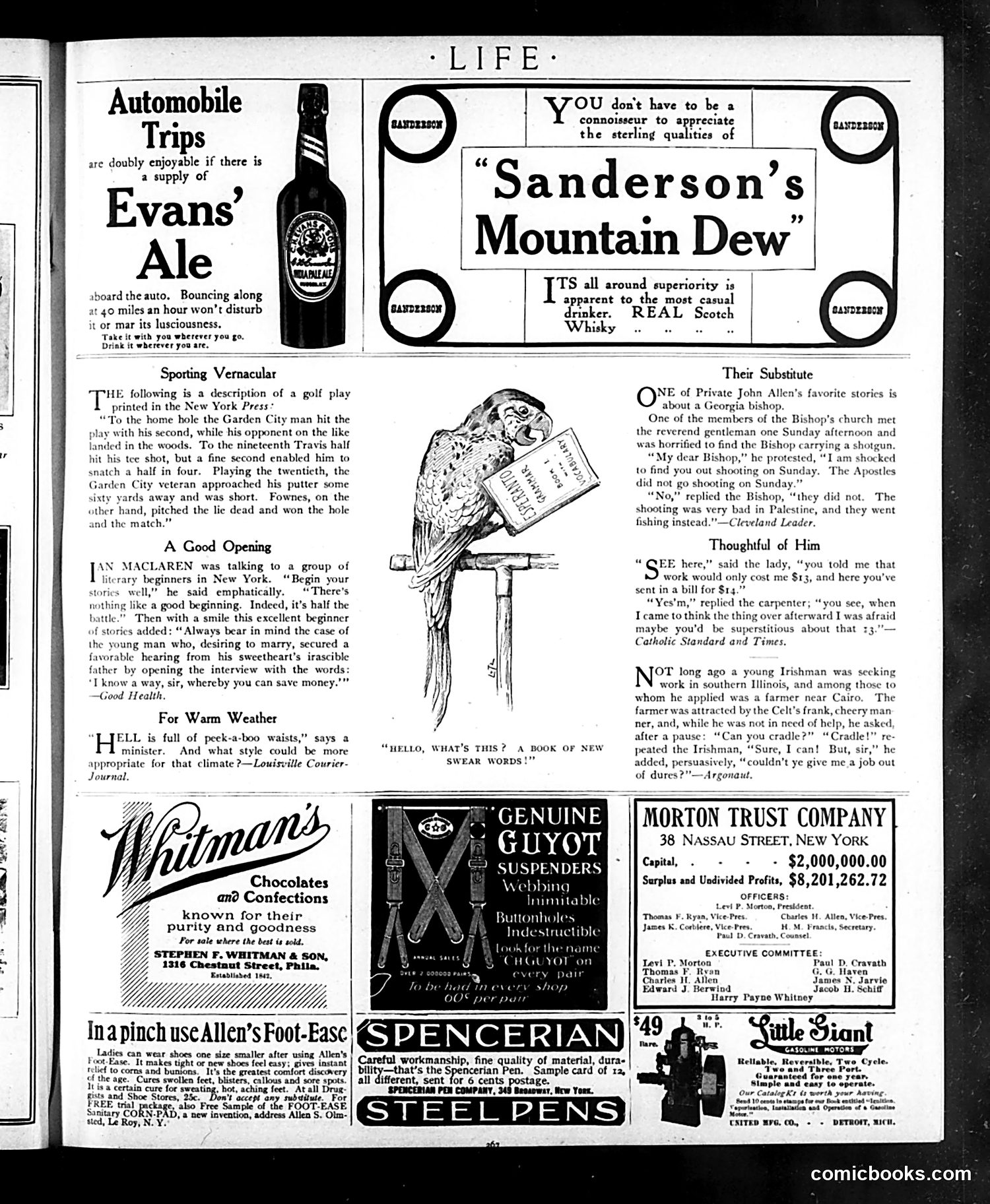
This page is primarily **advertising with humorous filler content**, typical of Life magazine's format. The main satirical cartoon shows a **parrot reading a "book of new swear words,"** captioned "Hello, what's this?" This is gentle satire on society's prudishness—the joke being that even a bird is curious about forbidden language, mocking the era's strict censorship of profanity. The surrounding content includes **anecdotes mocking social hypocrisy**: a bishop caught shooting on Sunday (claiming the Apostles didn't because conditions were poor in Palestine), and an Irishman's cheerful pragmatism about "cradle" work. These are light humor about religious contradiction and immigrant resourcefulness. **Context**: Early 20th-century Life was a humor magazine (not the photo magazine it later became), mixing advertisements with short jokes, stories, and illustrations. The ads for Whitman's Chocolates, Spencerian Pens, and Allen's Foot-Ease were typical revenue sources. The overall tone reflects middle-class American attitudes toward propriety, religion, and work.
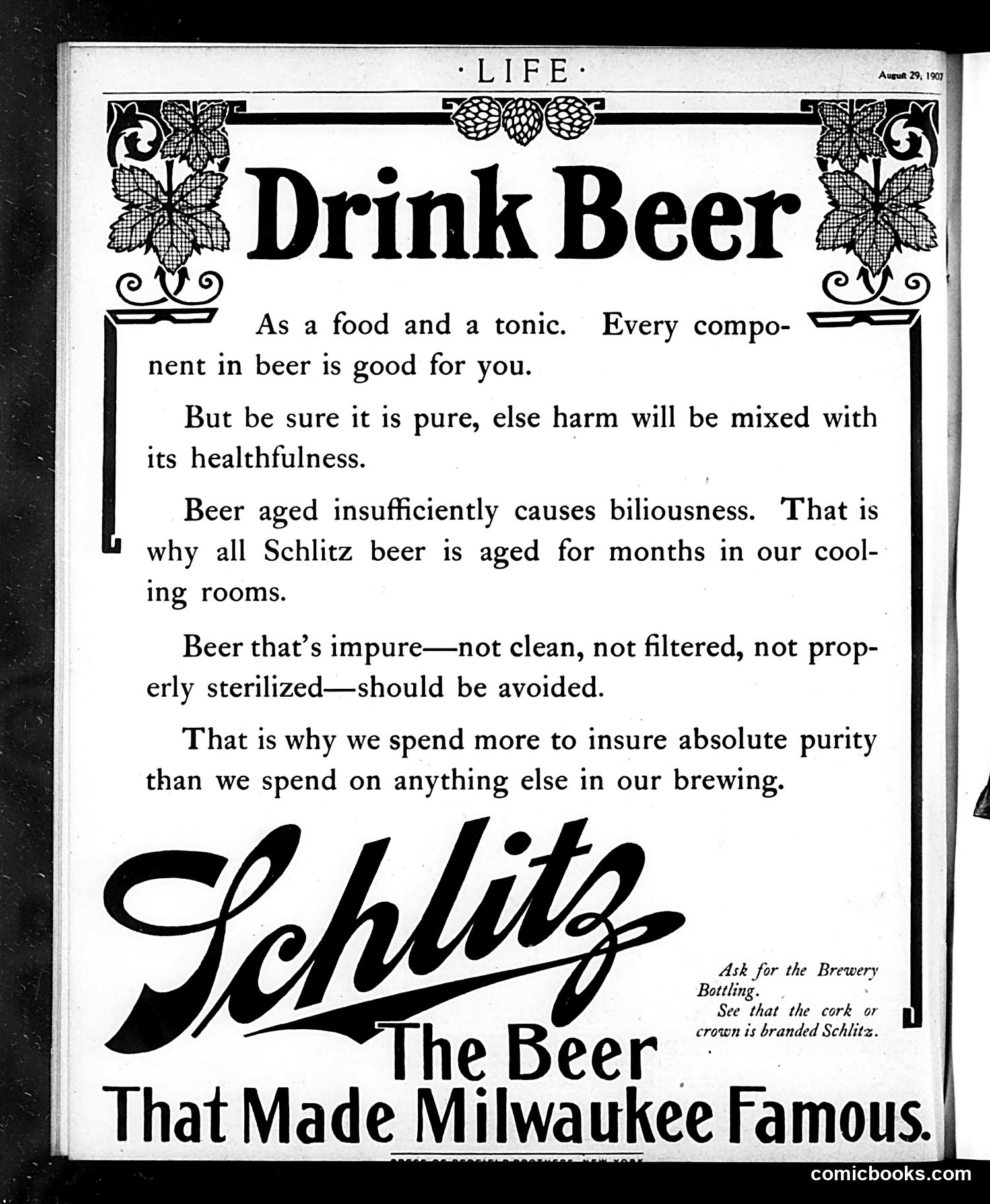
This is a **beer advertisement**, not a political cartoon. It's a Schlitz brewery ad from August 29, 1903, appearing in *Life* magazine. The page promotes Schlitz beer by framing beer consumption as healthful—positioning it as "a food and a tonic" where "every component...is good for you." This reflects early-1900s attitudes when beer was marketed for medicinal benefits. The ad's central argument targets competitors: Schlitz claims superiority through rigorous quality control—aging beer for months, ensuring purity through filtering and sterilization. The text emphasizes that impure beer causes "biliousness" (digestive illness), implying rival breweries cut corners. The ornamental design and prominent "Schlitz" signature convey premium branding. A note instructs buyers to verify authenticity by checking for "Schlitz" branding on cork or crown cap—suggesting counterfeit concerns. This represents pre-Prohibition advertising when beer marketing emphasized health claims now considered misleading.