
Life, 1907-08-29 · page 6 of 24
Life — August 29, 1907 — page 6: what you’re looking at
What you’re looking at
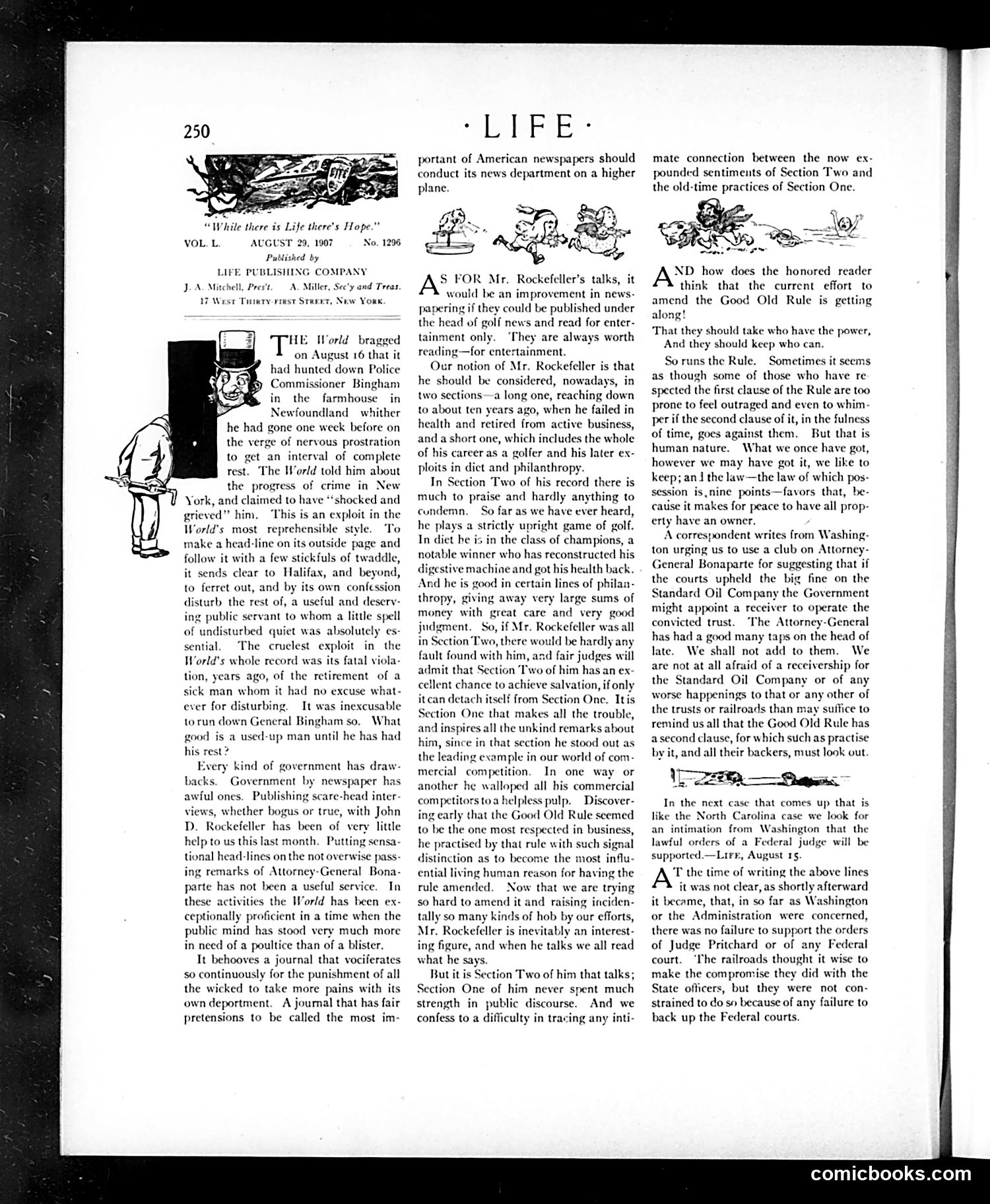
The main cartoon depicts a police officer or official arresting/confronting a thin criminal figure. The caption references "The World" newspaper's reporting on a crime wave in New York, suggesting this is satirizing either ineffective law enforcement or sensationalist crime journalism. The text discusses John D. Rockefeller, focusing on two "sections" of his life: his earlier business practices (Section One) versus his later philanthropic work (Section Two). The article suggests tension between these phases, questioning whether his current charitable giving can justify or offset his previous business conduct. The satire appears to critique both public figures who reinvent themselves through charity and newspapers that sensationalize crime for circulation.
📄 Transcribed text from this page (OCR, searchable)
Machine-transcribed from the original scan — historical spelling and the odd misread are preserved.
“While there is Life there's Hope.” VOL. L. AUGUST 29, 1907 No. Published by LIFE PUBLISHING COMPANY J.AOMi A. Miller, Sec’y and Treas. 17 West Tunery rinsr Sterner, Nw York hell, Pres't HE World bragged on August 16 that it had hunted down Police Commissioner Bingham in the farmhouse in Newfoundland — whither he had gone one weck before on the verge of nervous prostration to get an interval of complete rest. The World told him about the progress of crime in New T York, and claimed to have “shocked and grieved” him. ‘This is an exploit in the World's most reprehensible style. To make a head-line on its outside page and follow it with a few stickfuls of twaddle, it sends clear to Halifax, and beyond, to ferret out, and by its own confession disturb the rest of, a useful and deserv- ing public servant to whom a little spell of undisturbed quiet was absolutely es- sential, The cruelest exploit in the World's whole record was its fatal viola- tion, years ago, of the retirement of a sick man whom it had no excuse wh ever for disturbing. It was inexcusable torun down General Bingham so, What good is a used-up man until he has had his rest? Every kind of government has draw- backs. Government by newspaper has awful ones. Publishing scare-head inter views, whether bogus or true, with John D. Rockefeller has been of very little help to us this last month. Putting sensa- tional head-lines on the not overwise pass- ing remarks of Attorney-General Bona- parte has not been a useful service. In these activities the World has been ex- ceptionally proficient in a time when the public mind has stood very much more in need of a poultice than of a blister, It behooves a journal that vociferates so continuously for the punishment of all the wicked to take more pains with its own deportment. A journal that has fair pretensions to be called the most im- mE? portant of American newspapers should conduct its news department on a higher plane. S FOR Mr. Rockefeller’s talks, it would be an improvement in news- papering if they could be published under the head of golf news and read for enter- tainment only. ‘They are always worth reading—for entertainment. Our notion of Mr. Rockefeller is that he should be considered, nowadays, in two sections—a long one, reaching down to about ten years ago, when he failed in health and retired from active business, and a short one, which includes the whole of his career as a golfer and his later ex- ploits in dict and philanthropy. In Section Two of his record there is much to praise and hardly anything to condemn. So far as we have ever heard, he plays a strictly upright game of golf. In dict he is in the class of champions, a notable winner who has reconstructed his. digestive machine and got his health back. And he is good in certain lines of philan- thropy, giving away very large sums of money with great care and very good judgment. So, if Mr. Rockefeller was all in Section Two, there would be hardly any fault found with him, and fair judges will admit that Section Two of him has an ex- cellent chance to achieve salvation, ifonly itcan detach itself from Section One. Itis Section One that makes all the trouble, and inspires all the unkind remarks about him, since in that section he stood out as the leading example in our world of com- meri ion. In one way or another he walloped all his commercial competitors toa helpless pulp. Discover- ing early that the Good Old Rule seemed to be the one most respected in business, he practised by that rule with such signal distinction as to become the most influ- ential living human reason for having the rule amended. Now that we are trying so hard to amend it and raising inciden- tally so many kinds of hob by our efforts, Mr. Rockefeller is inevitably an interest- ing figure, and when he talks we all read what he say: But it is Section Two of him that talks; Section One of him never spent much strength in public discourse. And we confess to a difficulty in tracing any inti- mate connection between the now ex- pounded sentiments of Section Two and the old-time practices of Section One. ND how does the honored reader think that the current effort to amend the Good Old Rule is getting along! ‘That they should take who have the power, And they should keep who can, So runs the Rule. Sometimes it seems as though some of those who have re spected the first clause of the Rule are too prone to feel outraged and even to whim- per if the second clause of it, in the fulness of time, goes against them. But that is human nature. What we once have got, however we may have got it, we like to keep; and the law—the law of which pos- session is,nine points—favors that, be- catise it makes for peace to have all prop- erty have an owner, A correspondent writes from Washing- ton urging us to use a club on Attorney- General Bonaparte for suggesting that if the courts upheld the big fine on the Standard Oil Company the Government might appoint a receiver to operate the convicted trust. The Attorney-General has had a good many taps on the head of late. We shall not add to them. We are not at all afraid of a receivership for the Standard Oil Company or of any worse happenings to that or any other of the trusts or railroads than may suffice to remind us all that the Good Old Rule has a second clause, for which such as practise by it, and all their backers, must look out In the next case that comes up that is like the North Carolina case we look for an intimation from Washington that the lawful orders of a Federal judge will be supported.—Lirr, August 15. T the time of writing the above lines it was not clear, as shortly afterward it became, that, in so far as Washington or the Administration were concerned, there was no failure to support the orders of Judge Pritchard or of any Federal court. ‘he railroads thought it wise to make the compromise they did with the State officers, but they were not con- strained to do so because of any failure to back up the Federal courts. comicbooks.com