
Life, 1907-08-29 · page 14 of 24
Life — August 29, 1907 — page 14: what you’re looking at
What you’re looking at
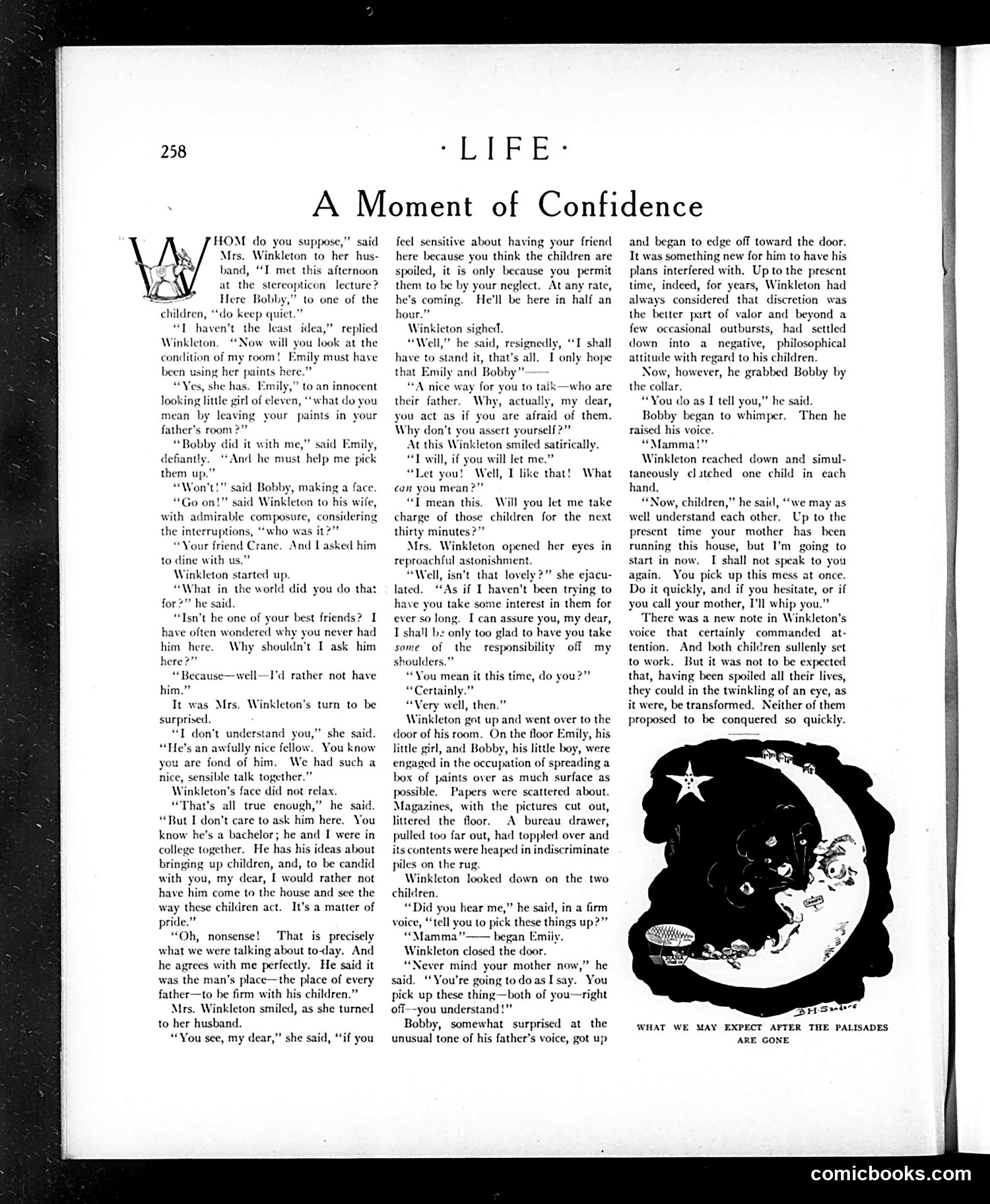
This domestic humor story satirizes early 20th-century parenting debates. Mr. Winkleton, embarrassed by his undisciplined children, initially refuses to let his bachelor friend Crane visit, fearing judgment about his parenting. His wife Mrs. Winkleton counters that *he* is responsible for the children's spoiled behavior through lack of firmness. When challenged to prove he can discipline them, Winkleton accepts a thirty-minute test of authority. The accompanying cartoon (captioned "What We May Expect After the Palisades Are Gone") appears unrelated to the story. The satire targets the gender dynamics of child-rearing: the wife controls domestic policy but blames the father for not asserting "masculine" authority, while the father avoids responsibility by claiming his wife won't permit discipline. The piece mocks both parental positions in this common marital conflict.
📄 Transcribed text from this page (OCR, searchable)
Machine-transcribed from the original scan — historical spelling and the odd misread are preserved.
LP E* A Moment of Confidence HOM do you suppose,” said Mrs. Winkleton to her hus- band, “I met this afternoon at the stereopticon lecture? Here Bobby,” to one of the children, ‘‘do keep quiet.” “IT haven't the least idea,” replied Winkleton. ‘Now will you look at the condition of my room! Emily must have been using her paints here.” “Yes, she has. Emily,” to an innocent looking little girl of eleven, “what do you mean by leaving your paints in your father’s room ?”” “Bobby did it with me,” said Emily, defiantly. “And he must help me pic them up.” “Won't!” said Bobby, making a fac “Go on!” said Winkleton to his wife, with admirable composure, considering the interruptions, “who was it?” “Your friend Crane. And Lasked him to dine with us.” Winkleton started up, “What in the world did you do that for?” he said “Isn't he one of your best friends? I have often wondered why you never had him here. Why shouldn’t I ask him here?” “Because—well—I'd rather not have him.” Tt was Mrs. surprised. “T don’t understand you,” she said. “He's an awiully nice fellow. You know you are fond of him. We had such a nice, sensible talk together.” Winkleton’s face did not relax. “That's all true enough,” he said. “But I don’t care to ask him here. You know he’s a bachelor; he and I were in together. He has his ideas about bringing up children, and, to be candid with you, my dear, I would rather not have him come to the house and see the way these children act. It’s a matter of pride.” “Oh, nonsense! That is precisely what we were talking about to-day, And he agrees with me perfectly. He said it was the man’s place—the place of every father—to be firm with his children.” Mrs. Winkleton smiled, as she turned to her husband. “You see, my dear,” she said, “if you Winkleton’s turn to be feel sensitive about having your friend here because you think the children are spoiled, it is only because you permit them to be by your neglect. At any rate, he’s coming. He'll be here in half an hour.” Winkieton sighed. “Well,” he said, resignedly, “I shall have to stand it, that’s all. I only hope that Emily and Bobby” “A nice way for you to taik—who are their father. Why, actually, my dear, you act as if you are afraid of them. Why don't you assert yourself?” At this Winkleton smiled satirically. “T will, if you will let me.” “Let you! Well, I like that! can you mean?” “JZ mean this. Will you let me take charge of those children for the next thirty minutes ? Mrs. Winkleton opened her eyes in reproachful astonishment. “Well, isn’t that lovely?” she ejacu- lated. “As if I haven’t been trying to have you take some interest in them for ever so long. I can assure you, my dear, I shall be only too glad to have you take some of the responsibility ‘off my shoulders.” “You mean it this time, do you?” “Certainly.” “Very well, then.” Winkleton got up and went over to the door of his room. On the floor Emily, his little girl, and Bobby, his little boy, were engaged in the occupation of spreading a box of paints over as much surface as possible. Papers were scattered about. Magazines, with the pictures cut out, littered the floor. A bureau drawer, pulled too far out, had toppled over and its contents were heaped in indiscriminate piles on the rug. Winkleton looked down on the two children. “Did you hear me,” he said, in a firm “tell you to pick these things up?” “Mamma”— began Emiiy. Winkleton closed the door. “Never mind your mother now,” he said. “You're going todoas I say. You pick up these thing—both of you—right off--you understand! Bobby, somewhat surprised at the unusual tone of his father’s voice, got up What and began to edge off toward the door. It was something new for him to have hi: plans interfered with. Up to the present time, indeed, for years, Winkleton had always considered that discretion was the better part of valor and beyond a few occasional outbursts, had_ settled down into a negative, philosophical attitude with regard to his children. Now, however, he grabbed Bobby by the collar. “You do as I tell you,” he said. Bobby began to whimper. Then he raised his voice. “Mamma!” Winkleton reached down and simul- taneously clatched one child in cach hand. “Now, children,” he said, “we may as well understand each other. Up to the present time your mother has been running this house, but I’m going to start in now. I shall not speak to you again. You pick up this mess at once. Do it quickly, and if you hesitate, or if you call your mother, I'll whip you.” There was a new note in Winkleton’s voice that certainly commanded at- tention. And both children sullenly set to work. But it was not to be expected that, having been spoiled all their liv they could in the twinkling of an eye, as it were, be transformed. Neither of them proposed to be conquered so quickly. WHAT WE ARE GONE MAY EXPECT AFTER THE PALISADES comicbooks.com