
Life, 1907-08-29 · page 16 of 24
Life — August 29, 1907 — page 16: what you’re looking at
What you’re looking at
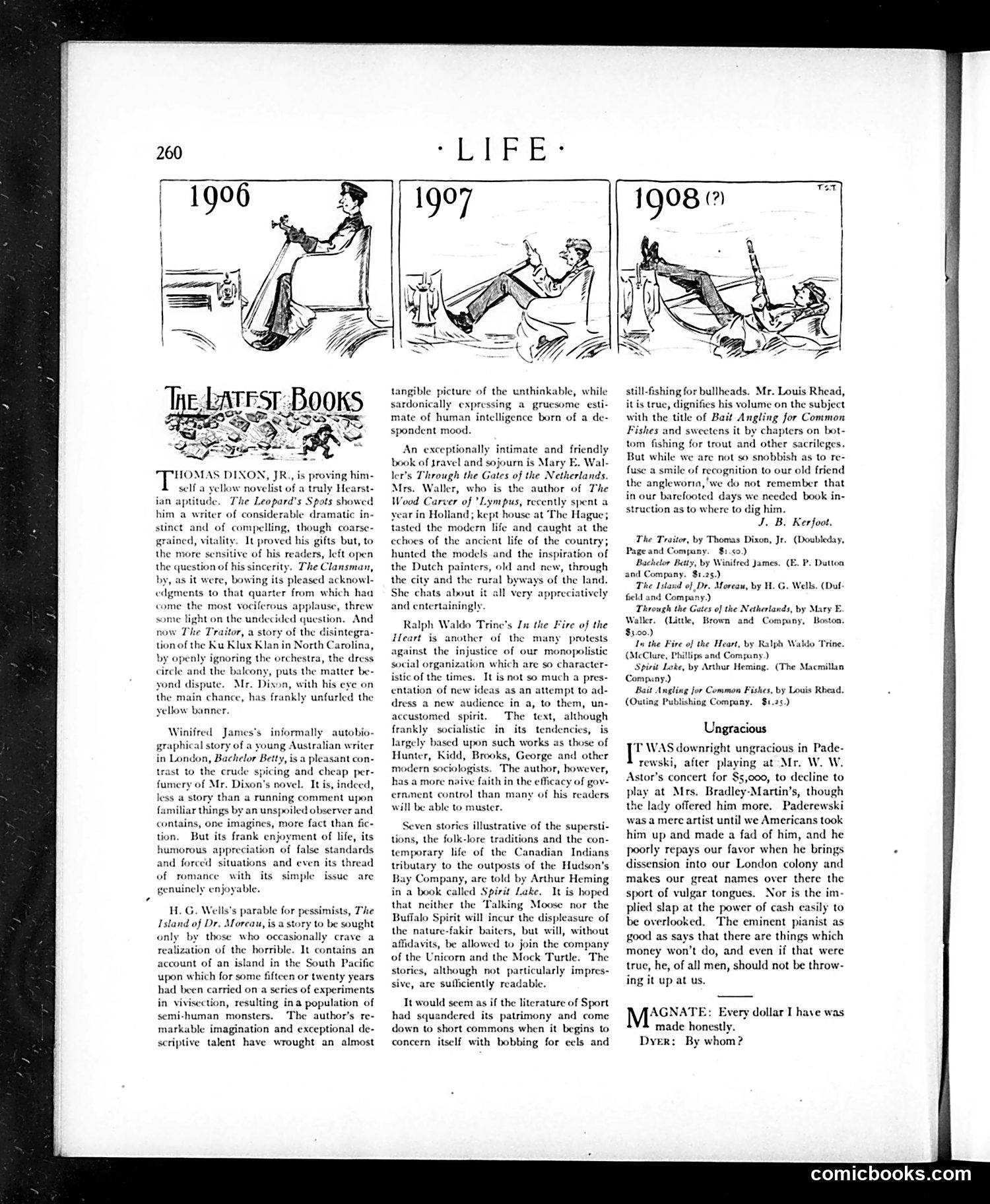
## The Cartoons (top) Three small comic strips dated 1906-1908(?) depict a man in various fishing scenarios—holding up a caught fish, lounging while fishing, and struggling with fishing equipment. These appear to be humorous commentary on sport fishing as leisure activity, likely mocking either incompetent anglers or the pretensions of fishing as a gentleman's pursuit. ## Book Reviews (main text) The page critiques contemporary literature, most notably **Thomas Dixon Jr.**, whose novels *The Leopard's Spot* and *The Clansman* are attacked as "yellow" (sensationalist). The reviewer accuses Dixon of cynically appealing to lower-class tastes and "unfurling the yellow banner"—suggesting his work exploits racial prejudice for commercial gain. The *Clansman* notably deals with the Ku Klux Klan's activities. Other reviews discuss H.G. Wells's *The Island of Doctor Moreau* and travel writings by Mary Waller. ## Context This reflects Progressive-era literary criticism condemning popular fiction that exploited racial anxieties and social fears for profit.
📄 Transcribed text from this page (OCR, searchable)
Machine-transcribed from the original scan — historical spelling and the odd misread are preserved.
HOMAS DIXON, JR., is proving him- self a yellow novelist of a truly Hearst- ian aptitude. The Leopard's Spots showed him a writer of considerable dramatic in- stinct and of compelling, though coarse- grained, vitality. It proved his gifts but, to the more sensitive of his readers, left open the question of his sincerity. The Clansman, by, as it were, bowing its pleased acknowl- edgments to that quarter from which haa me the most vociferous applause, threw led question. And y of the disintegra- tion of the Ku Klux Klan in North Carolina, by openly ignoring the orchestra, the dress circle and the balcony, puts the matter be- yond dispute. Mr. Dixon, with his eye on the main chance, has frankly unfurled the yellow banner. Winifred James's informally autobio- graphical story of a young Australian writer in London, Bachelor Betty, is a pleasant con- trast to the crude spicing and cheap per- fumery of Mr. Dixon’s novel. It is, indeed, less a story than a running comment upon familiar things by an unspoiled observer and i nes, more fact than fic- nent of life, its ion of false standards tion humorous appreci and forced situations and even its thread of romance with its simple genuinely enjoyable. issue are H. G. Wells's parable for pessimists, The Island of Dr. Moreau, is a story to be sought only by those who occasionally crave a realization of the horrible. It contains an account of an island in the South Pacific upon which for some fifteen or twenty years had been carried on a series of experiments in vivisection, resulting ina population of semi-human monsters. ‘The author's re- arkable imagination and exceptional de- scriptive talent have wrought an almost ¢ picture of the unthinkable, while donically expressing a grucsome est mate of human intelligence born of a de- spondent mood. An exceptionally intimate and friendly book of travel and sojourn is Mary E. Wal- ler’s Through the Gates of the Netherlands. Mrs. Waller, who is the author of The Wood Carver of "Lympus, recently spent a year in Holland kept house at The Hague; tasted the modern life and caught at the echoes of the ancient life of the country; hunted the models and the inspiration of the Dutch painters, old and new, through the city and the r of the land. She chats about appreciatively and entertainingly Ralph Waldo Trine’s In the Fire of the Heart is another of the many protests against the injustice of our monopolistic social organization which are so character- istic of the times. It is not so much a pre: entation of new ideas as an attempt to ad- dress a new audience in a, to them, un- The text, although socialistic in its tendencies, is largely based upon such works as those of Hunter, Kidd, Brooks, George and other modern sociologists. The author, however, has a more naive faith in the efficacy of gov- ernment control than many of will be able to muster. accustomed. spirit. frankly is readers Seven stories illustrative of the supersti- tions, the folk-lore traditions and the con- temporary life of the Canadian Indians tributary to the outposts of the Hudson's Bay Company, are told by Arthur Heming in a book called Spirit Lake. It is hoped that neither the Talking Moose nor the Buffalo Spirit will incur the displeasure of the nature-fakir baiters, but will, without affidavits, be allowed to join the company of the Unicorn and the Mock Turtle. The stories, although not particularly impres- sive, are sufficiently readable. It would seem as if the literature of Sport had squandered its patrimony and come down to short commons when it begins to concern itself with bobbing for cels and with the title of Bait Angling for Common Fishes and sweetens it by chapters on bot- tom fishing for trout and other sacrileges. But whi re not so snobbish as to re- fuse a smile of recognition to our old friend the angleworta,'we do not remember that in our barefooted days we needed book in- struction as to where to dig him. J. B. Kerfoot. The Traiter, by Tomas Dixon, Jr. Page and Company. $1.50.) Bachelor Betty, by Winifred James. (E. P. Duttoa and Company. $1.25.) The Island of Dr. Moreau, by H.G. Wells. (Dul field and Company.) Through the G Waller. (Little, $3.00.) In the Fire o] the Heart, by Ralph Waldo Trine. (McClure, P ips and Ce any.) Spirit Loke, by Arthur Heming. (The Macmillan Company.) Bait Angling jor Common Fishes, by Louis Rhead. (Outing Publishing Company. $1.25.) (Doubleday, of the Netherlands, by Mary Brown and Company, Boston. Ungracious T WAS downright ungracious in Pade- ki, after play ing at Mr. W. W. 's concert for $5,000, to decline to at Mrs. Bradley-Martin’s, though the lady offered him more. Paderewski was a mere artist until we Americans took him up and made a fad of him, and he poorly repays our favor when he brings dissension into our London colony and makes our great names over there the sport of vulgar tongues. Nor is the im- plied slap at the power of cash easily to be overlooked. The eminent pianist as good as says that there are things which money won't do, and even if that were true, he, of all men, should not be throw- ing it up at us, AGNATE: Eve made honestly. Dyer: By whom? dollar I have was comicbooks.com