
A complete issue · 24 pages · 1907
Life — August 22, 1907
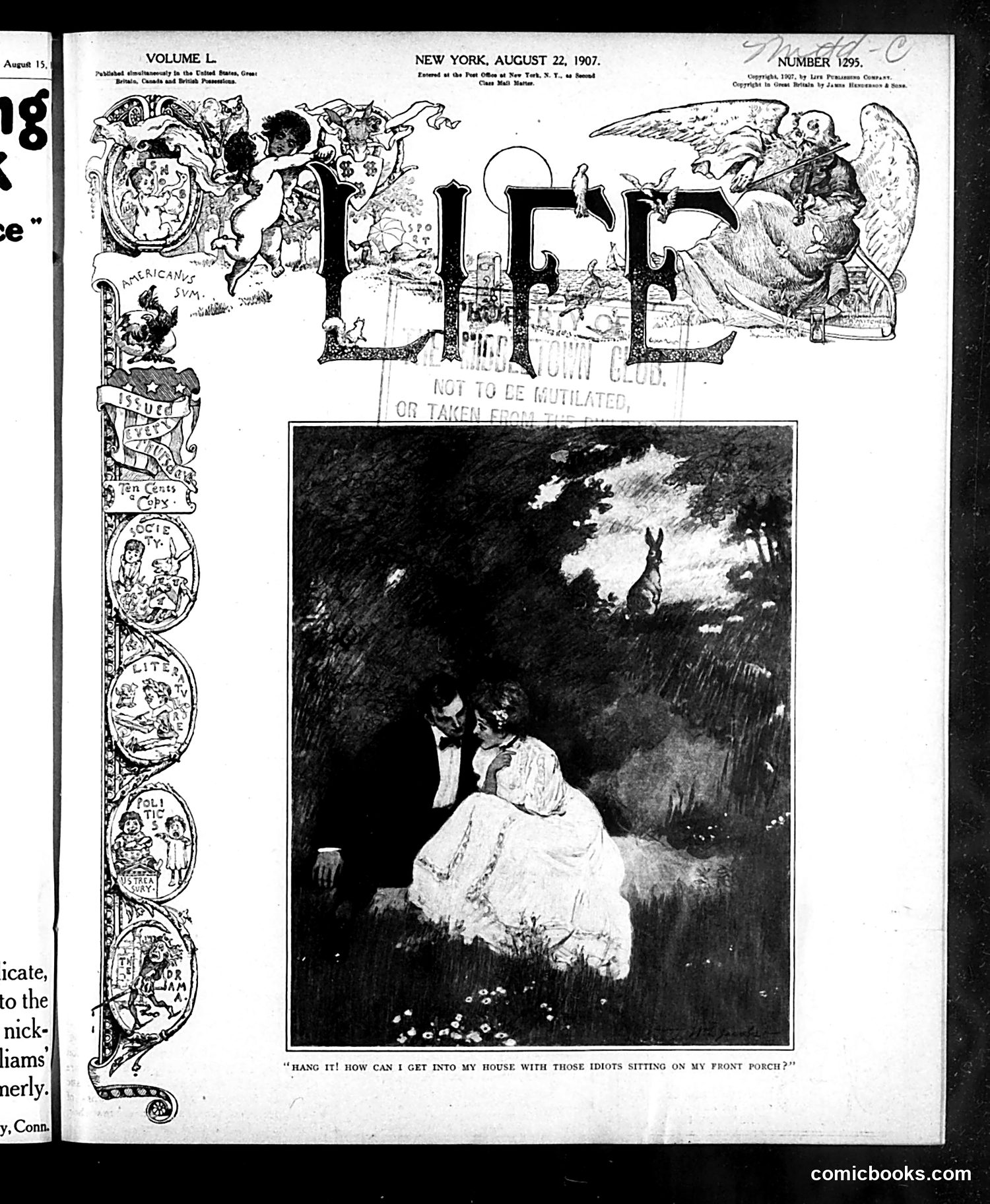
This page features a humorous illustration captioned: "HANG IT! HOW CAN I GET INTO MY HOUSE WITH THOSE IDIOTS SITTING ON MY FRONT PORCH?" The image depicts a well-dressed man in evening attire unable to access his home because uninvited guests occupy his front porch. This appears to be social satire about the era's visiting customs and unwanted callers—a common complaint among the upper classes during this period. The elaborate decorative border with mythological and literary figures is typical of Life's ornamental design aesthetic. The specific identity of the illustrated man is unclear from the image alone, but the cartoon satirizes the social awkwardness of dealing with persistent visitors who overstay their welcome—a relatable domestic frustration for the magazine's wealthy readership.
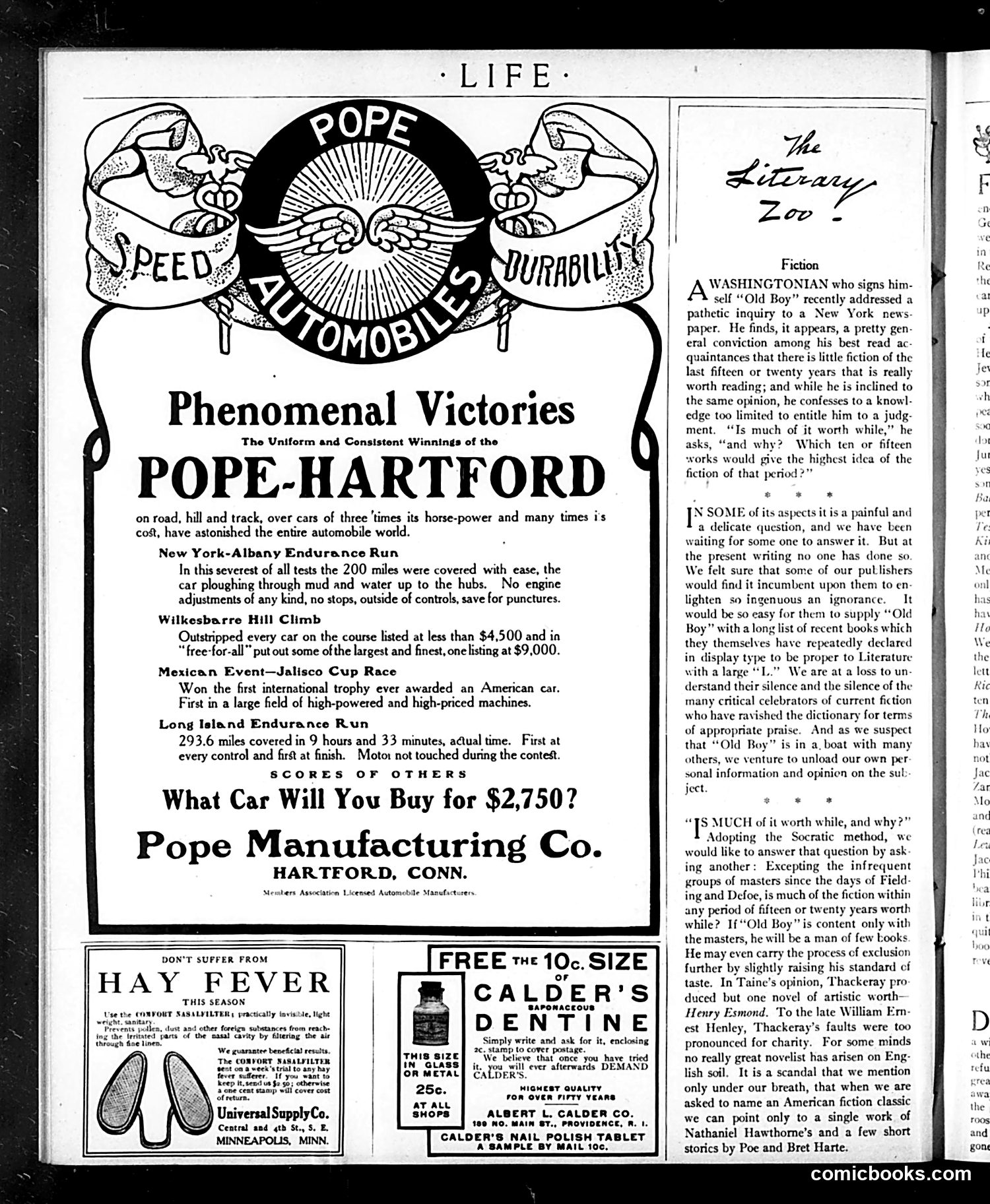
This page is primarily **advertising**, not political satire. The dominant feature is a Pope Manufacturing Company automobile advertisement promoting "Phenomenal Victories" of Pope-Hartford cars in various racing and endurance competitions (New York-Albany run, Wilkes-Barre hill climb, Mexican race, etc.). The decorative header uses allegorical figures labeled "Speed" and "Durability" flanking a Pope automobile logo—standard advertising imagery emphasizing product qualities rather than political commentary. The right column contains "The Literary Zoo," a fiction discussion piece about American literature, unrelated to the advertisement. Lower advertisements promote hay fever remedies and Calder's Denture products. This represents early 1900s automotive marketing, not satirical content.
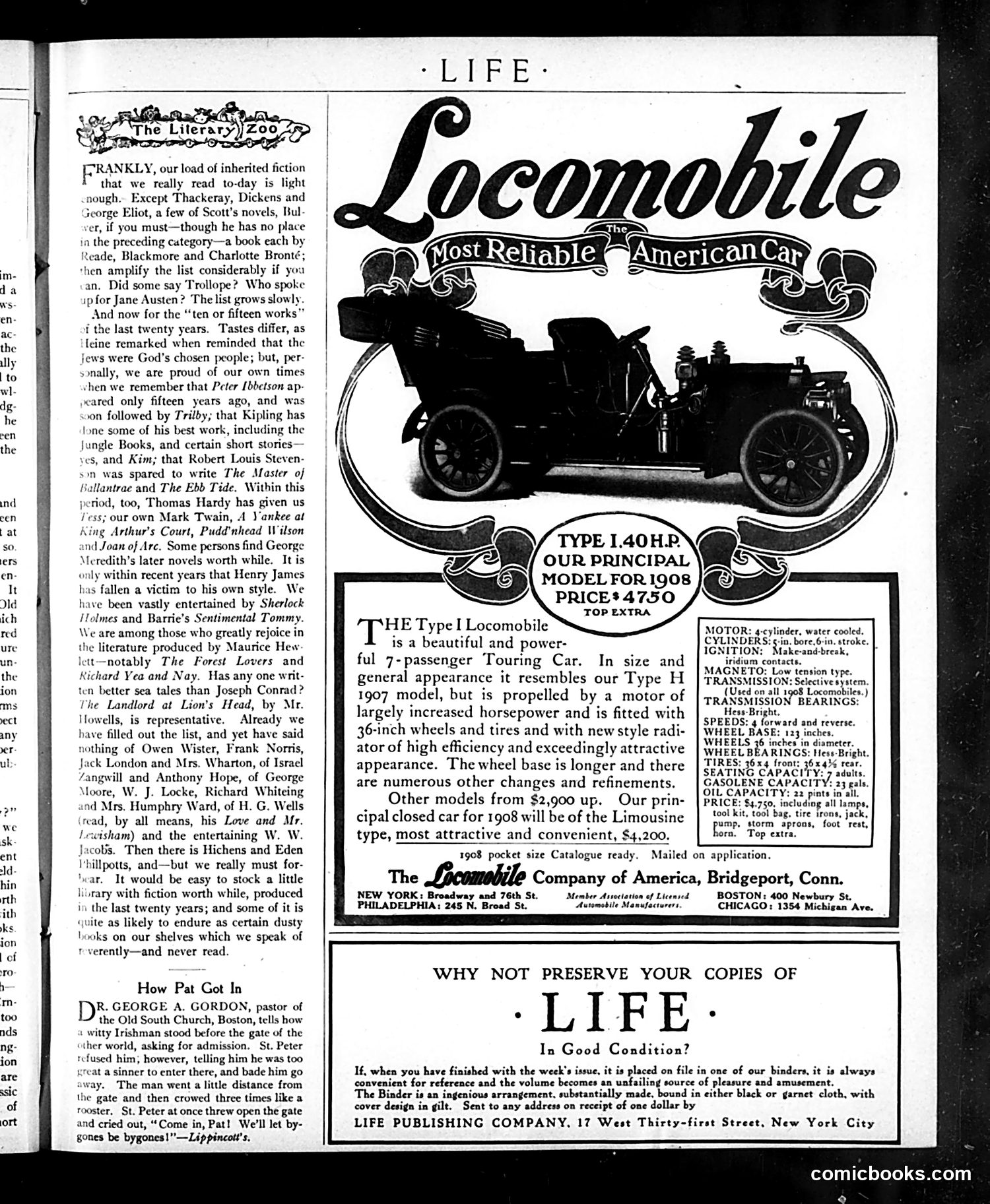
This page is primarily **advertising, not satire**. The dominant feature is a large Locomobile automobile advertisement claiming it as "The Most Reliable American Car." The ad emphasizes the Type I model's specifications—40 horsepower, 7-passenger capacity, 36-inch wheels—and lists prices starting at $4,750, positioning it as a luxury vehicle. The left column contains "The Literary Zoo," a book review discussing inherited fiction authors (Thackeray, Dickens, the Brontës), with no political satire evident. Below that is "How Fat Got In," a brief anecdote about a pastor's practical joke. The bottom contains a house advertisement encouraging readers to preserve Life magazine copies in binders. This entire page reflects early 1900s commercial publishing priorities rather than political commentary.
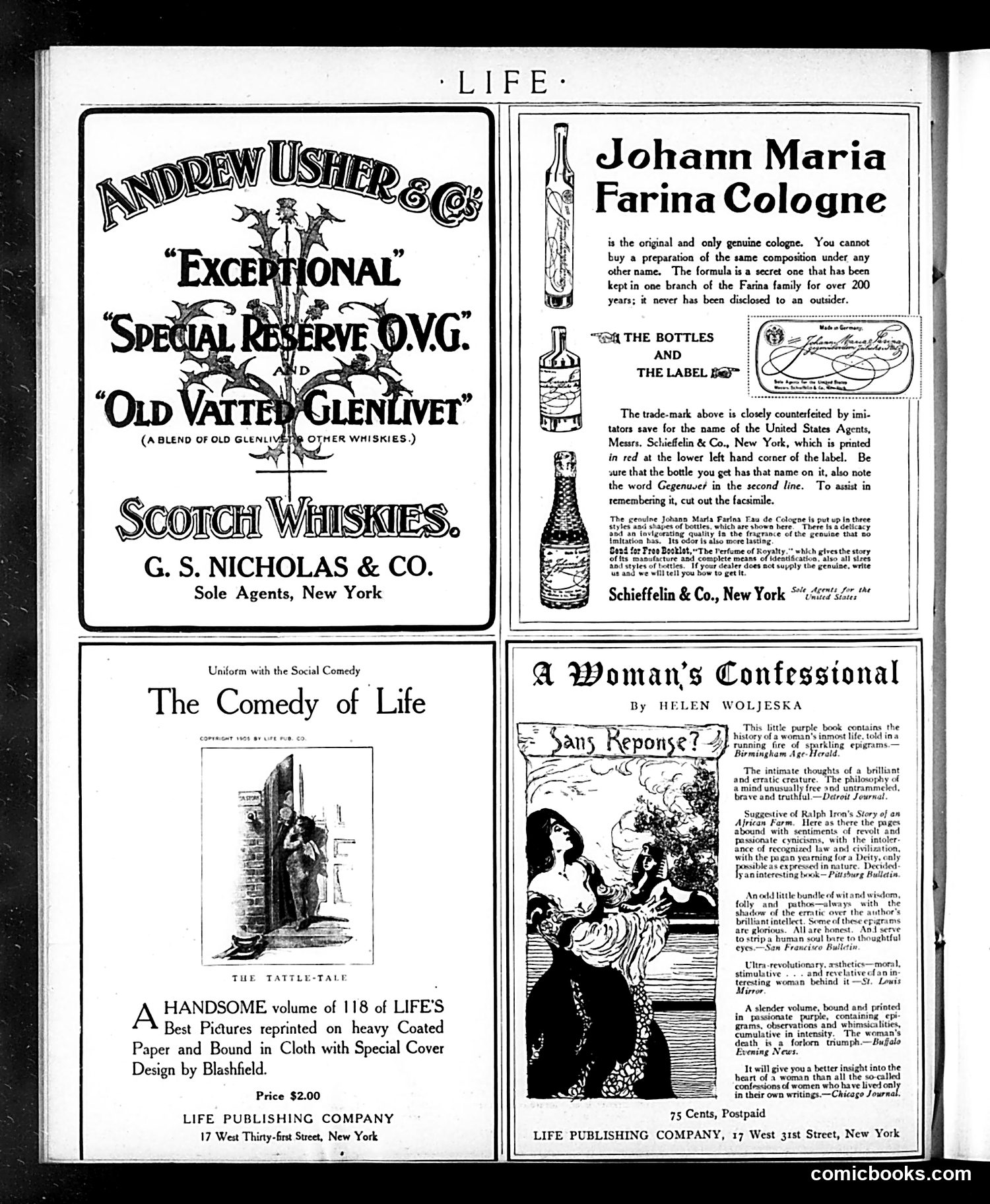
This page is primarily **advertising and book promotions**, not political cartoons. The top half features two ads: Andrew Usher & Co.'s Scotch whiskeys (sold by G.S. Nicholas & Co. in New York) and Johann Maria Farina Cologne, emphasizing authenticity and warning against counterfeits. The bottom half promotes two publications: "The Comedy of Life," a 118-page LIFE magazine collection of illustrations priced at $2.00, and Helen Woljeska's "A Woman's Confessional," a 75-cent book about women's intimate thoughts and experiences. The woman's confessional excerpt uses contemporary early-20th-century language discussing feminine psychology and morality—typical of period literature exploring women's inner lives.
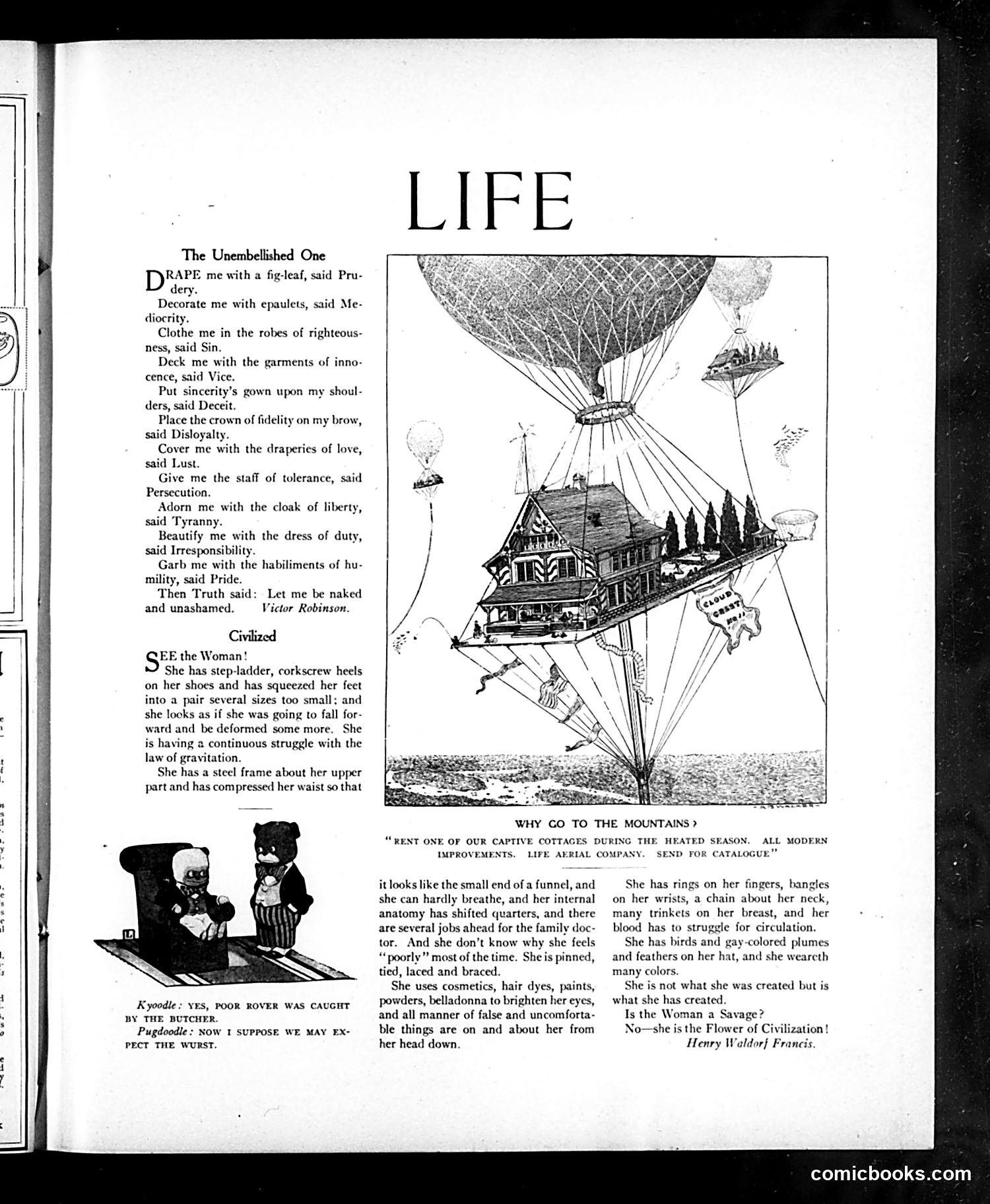
This satirical page critiques women's fashion and social constraints of the early 20th century. **"The Unembellished One"** is a poem mocking how society adorns women with virtues (modesty, innocence, fidelity, duty, etc.) like decorative garments, suggesting these are artificial impositions rather than genuine qualities. **"Civilized"** section ridicules women's restrictive fashion—corsets, high heels, and steel frames that literally deform the body and restrict breathing. The accompanying illustration shows a woman suspended by multiple balloons, visually representing how fashion constrains and distorts her. **"Why Go to the Mountains?"** advertises a "captive cottage" as an alternative vacation, sarcastically depicting women's elaborate ornamentation (cosmetics, jewelry, dyes, feathers) and constrained appearance. The overall message critiques how civilization supposedly "improves" women through restrictive fashion and artificial adornment.
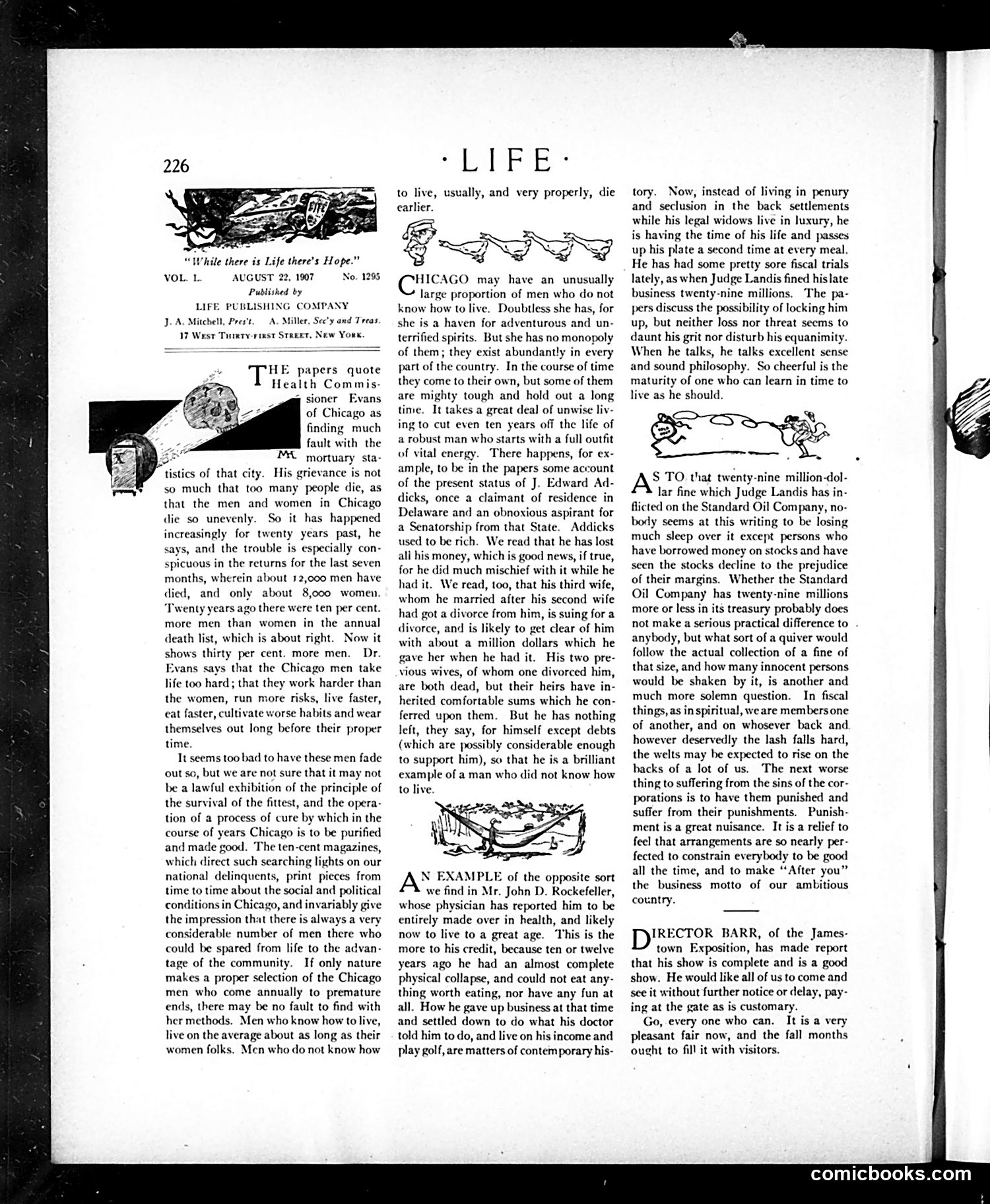
This page primarily contains **satirical editorial commentary** rather than political cartoons. The main article critiques **Chicago's mortality statistics**, noting the city has an unusually high proportion of men who don't know how to live properly. The text mocks wealthy Chicago men, particularly referencing **J. Edward Addicks** (described as a former Delaware resident and failed senatorial candidate) who squandered his fortune through poor financial decisions and failed marriages. The piece then contrasts this with positive examples like **John D. Rockefeller**, whose physician reportedly transformed his health through disciplined living, and **Director Barr of the Jamestown Exposition**, celebrated for his longevity and continued activity. The satire suggests Chicago's death rate reflects men's inability to manage their lives wisely—a commentary on Gilded Age excess and poor judgment among the wealthy.
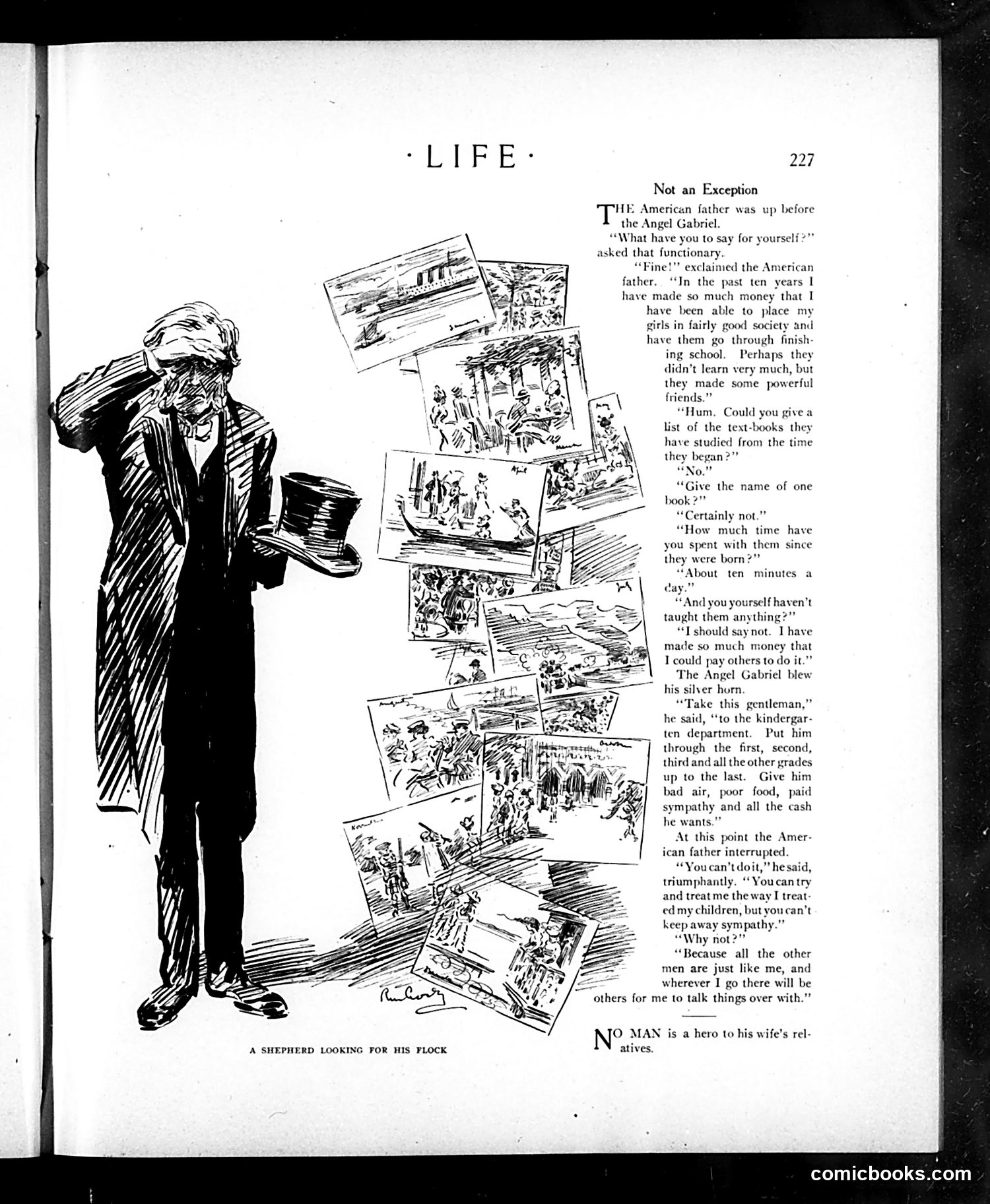
This satirical piece titled "Not an Exception" critiques wealthy American fathers who buy their children's education rather than provide genuine parenting. The cartoon shows a figure (labeled "A Shepherd Looking for His Flock") juggling multiple photographs—representing his children's accomplishments purchased through money rather than earned through teaching or involvement. The Angel Gabriel questions the father about his parental contribution. The father boasts of placing daughters in "society" through wealth alone, admitting he's spent minimal time with them and taught them nothing. The satire's point: True paternal worth isn't measured by financial provision but by personal guidance and moral education. The "shepherd" has lost his flock—his children lack genuine parental care despite material advantages. This reflects early-20th-century anxieties about wealthy parents outsourcing child-rearing entirely to institutions.
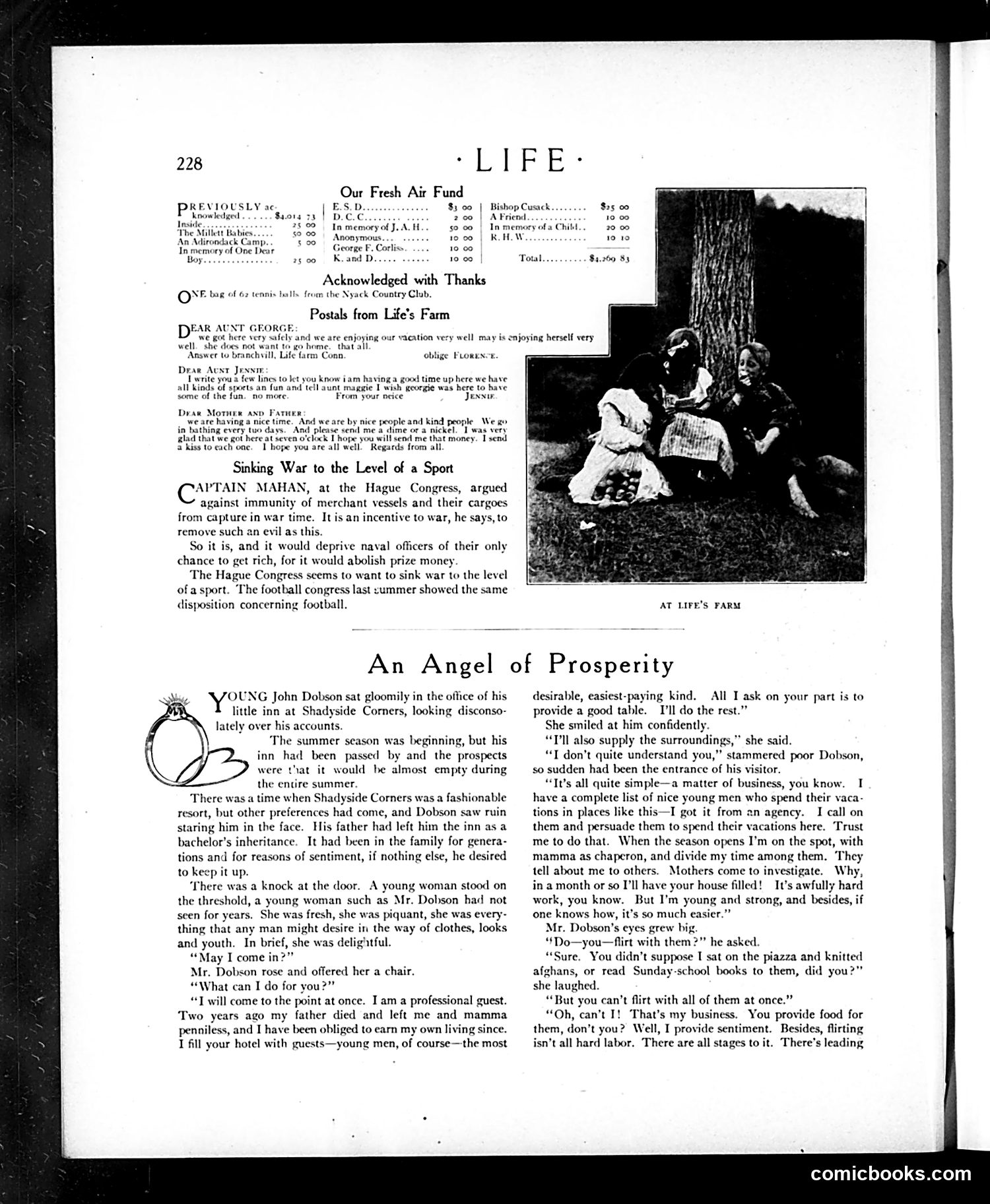
This page contains personal correspondence and a short story titled "An Angel of Prosperity," not political cartoons. The upper section features "Postals from Life's Farm"—reader letters about vacation enjoyment and family matters. Below that is "Sinking War to the Level of a Sport," where Captain Mahan argues against immunity for merchant vessels in wartime, criticizing The Hague Congress for treating war like sport (comparing it to recent football discussions). The main story depicts young John Dolson, struggling innkeeper, meeting a mysterious woman who offers to fill his inn with paying guests. She proposes a business arrangement: he provides food; she provides "sentiment" and brings young men seeking companionship. The story appears to be social commentary on hospitality business practices, though the exact satirical point remains unclear from this excerpt alone.
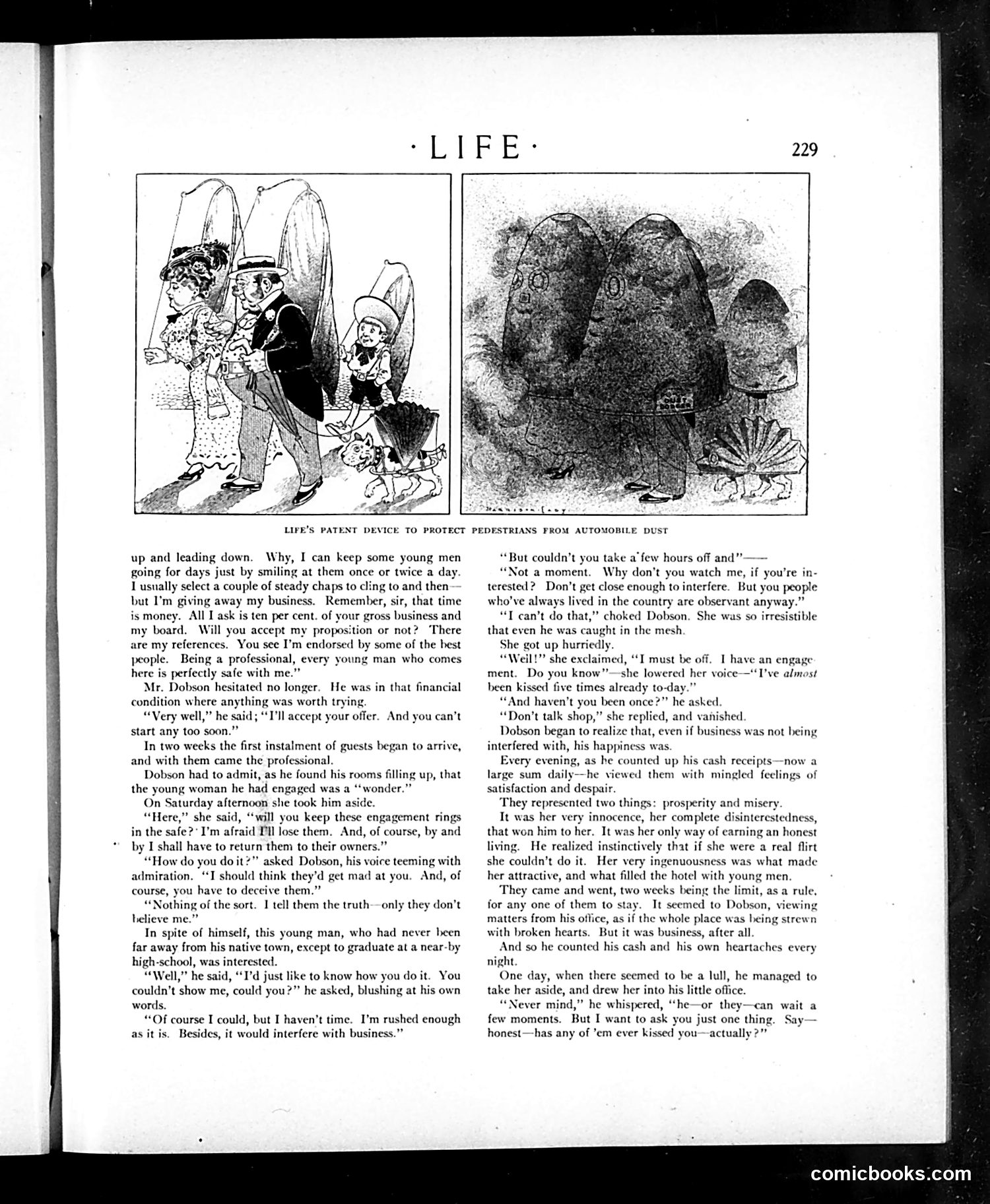
This page contains a satirical cartoon titled "LIFE'S PATENT DEVICE TO PROTECT PEDESTRIANS FROM AUTOMOBILE DUST" paired with a short story about a hotel manager named Dobson. The left cartoon depicts three figures in elaborate protective gear—appearing to be full-body coverings with hats—walking with a small dog, presumably shielded from dust. The satire targets the proliferation of automobiles in early-20th-century America. As cars became common, they kicked up clouds of dust on unpaved roads, making pedestrian travel unpleasant. The cartoon mocks this problem by showing absurdly exaggerated protective clothing, suggesting the situation had become ridiculous. The accompanying story about Dobson appears unrelated to the cartoon's automotive theme.
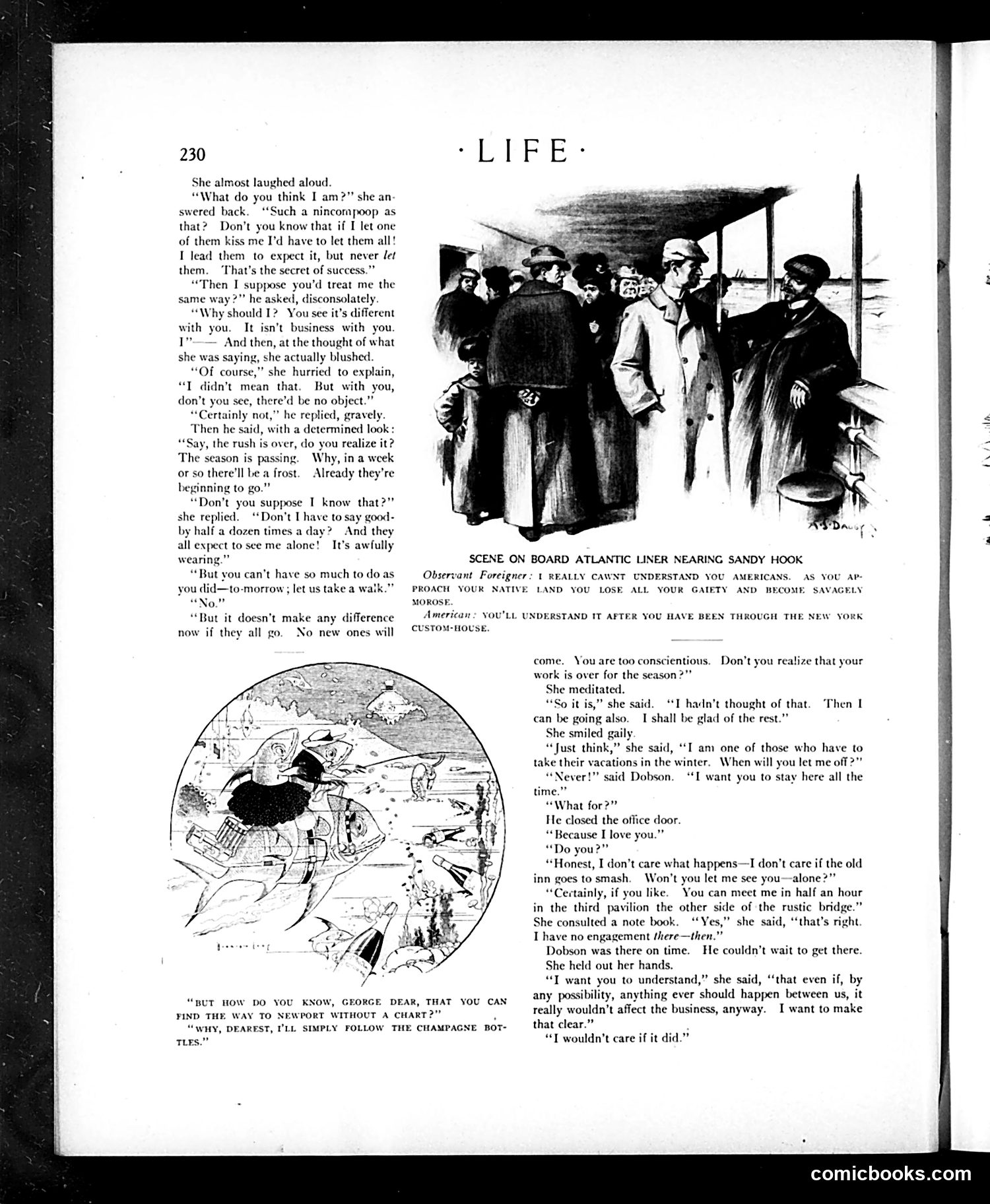
This page contains fictional narrative dialogue rather than political satire. The text depicts a conversation between two characters—apparently a woman and a man named Dobson—discussing business, vacation, and their relationship. The two illustrations are **narrative cartoons** accompanying the story: the upper shows a group of people on what appears to be an Atlantic ocean liner near Sandy Hook (captioned as such), while the lower depicts a conversation scene, likely between the main characters. The dialogue references New York customs, business obligations, and romantic tension. This appears to be **serialized fiction with illustrations**—a common Life magazine format—rather than editorial cartooning or political satire. The humor seems domestic and romantic rather than satirical.
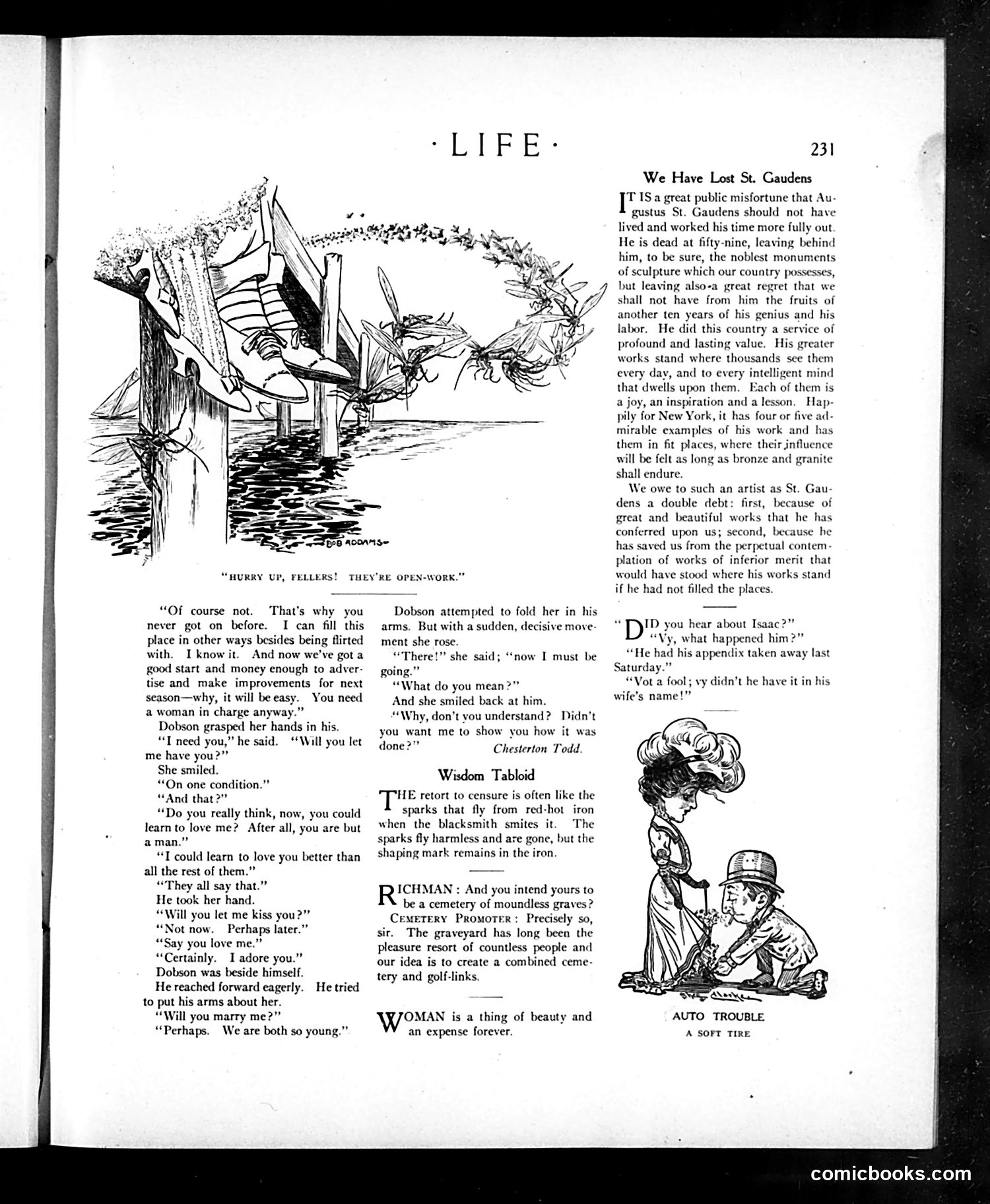
This page contains a literary narrative with accompanying illustrations rather than political satire. The main story depicts a romantic dialogue between a man (Dobson) and a woman, where he proposes marriage. The conversation shows him initially hesitant ("Perhaps. We are both so young"), then becoming eager as he tries to embrace her. The page includes two sidebar features: a tribute to sculptor Augustus St. Gaudens (who died at 59), praising his artistic legacy; a "Wisdom Tabloid" about censorship; and a humorous "Auto Trouble" cartoon showing two figures examining a soft tire. The romantic narrative represents typical early 20th-century Life magazine fiction—sentimental rather than satirical. No specific political figures or events are referenced on this page.
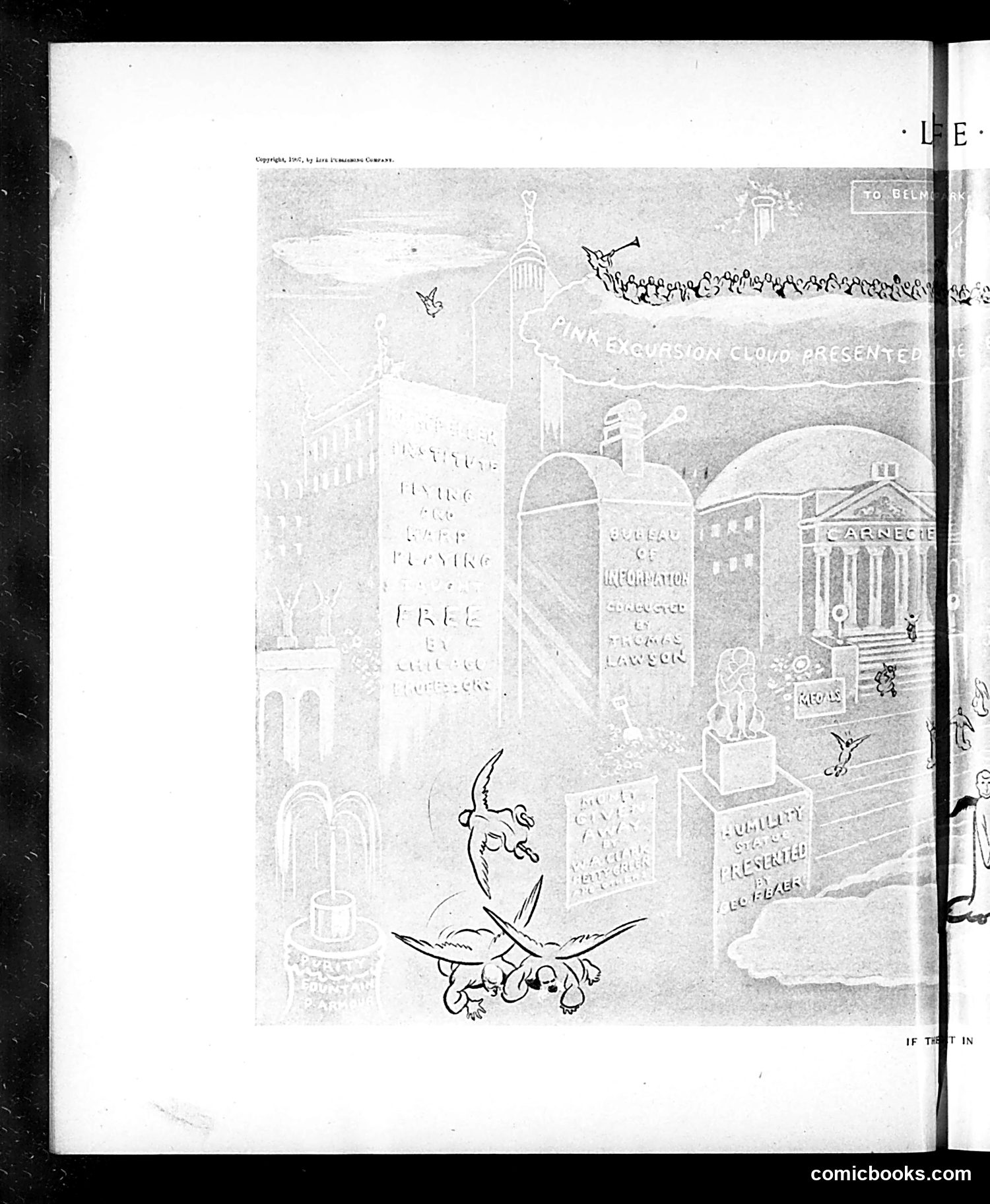
This appears to be a satirical illustration from *Life* magazine depicting an idealized futuristic cityscape. The image shows tall buildings, a prominent tower or monument in the center, and what appears to be crowds of people at the top. The handwritten annotations and crude sketches overlay the print—including caricatured figures at the bottom—suggest this may be a work-in-progress or annotated proof rather than a finished published piece. Text visible includes references to "FREE," "PLAYING," and what appears to be "CLOUD PRESENTED," though the OCR is difficult to read clearly. Without being able to definitively identify the specific date, political figures referenced, or the exact satirical target, I cannot confidently explain the intended meaning or social commentary to a modern reader. The quality and condition of the image limits interpretation.
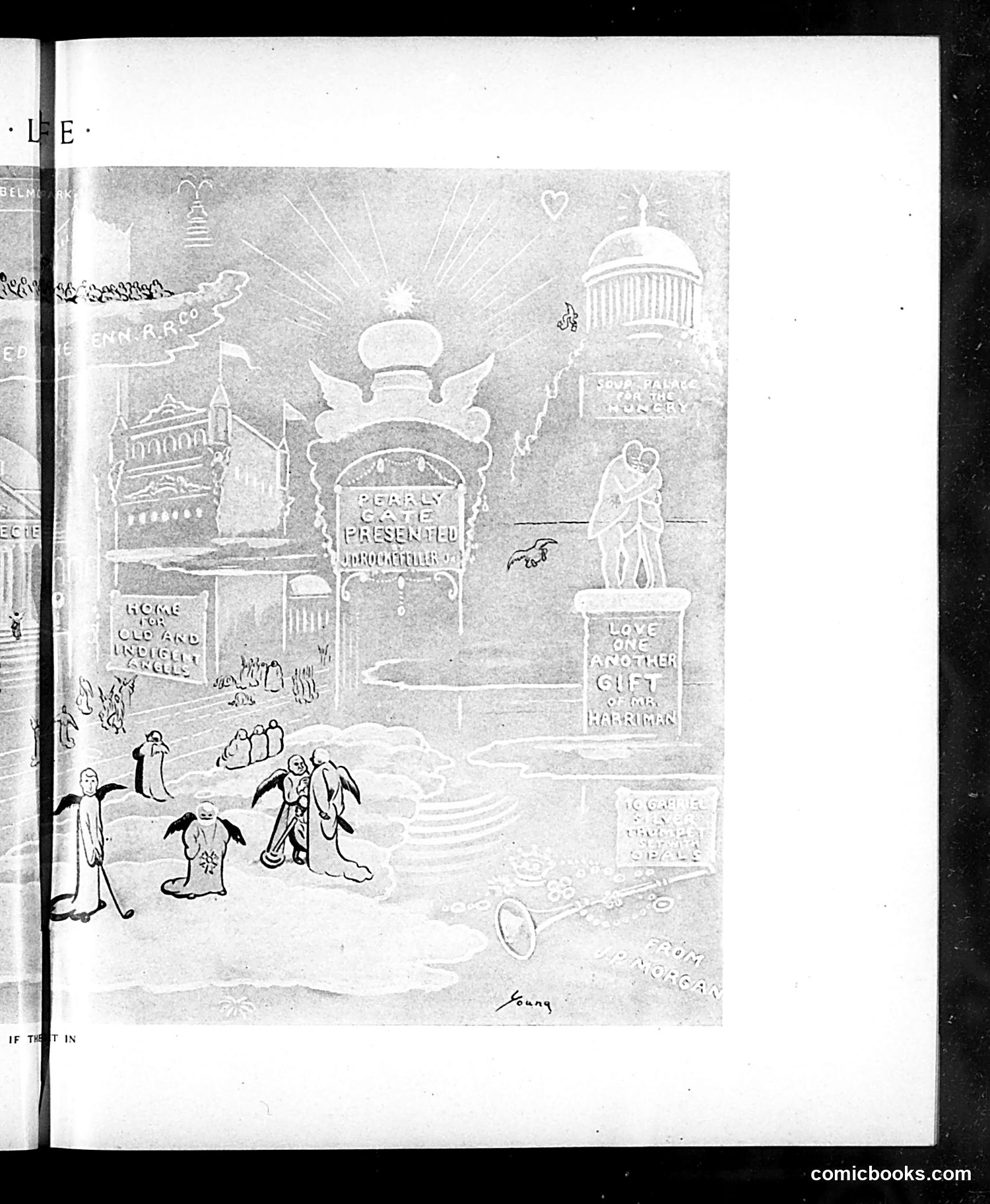
This appears to be a satirical cartoon depicting an idealized, heavenly marketplace or fair. The central structure labeled "PEARLY GATE PRESENTED" suggests this is set at the gates of heaven. Various architectural monuments and buildings surround the scene—including what appears to be references to "HOME FOR ELDERLY SHELL" and "SERIAL PALACE FOR THE RICH." Angels and figures populate the space below, seemingly shopping or browsing goods being presented. The inscription "LOVE ONE ANOTHER GIFT" is visible on a pedestal with a statue. The satire likely critiques wealth inequality and commercialism by imagining heaven itself as a market structured by class distinctions—with separate facilities for the rich versus the elderly poor. The artist appears to be mocking the irony of Christian ideals (love one another) coexisting with materialistic, class-based hierarchies, even in the afterlife.
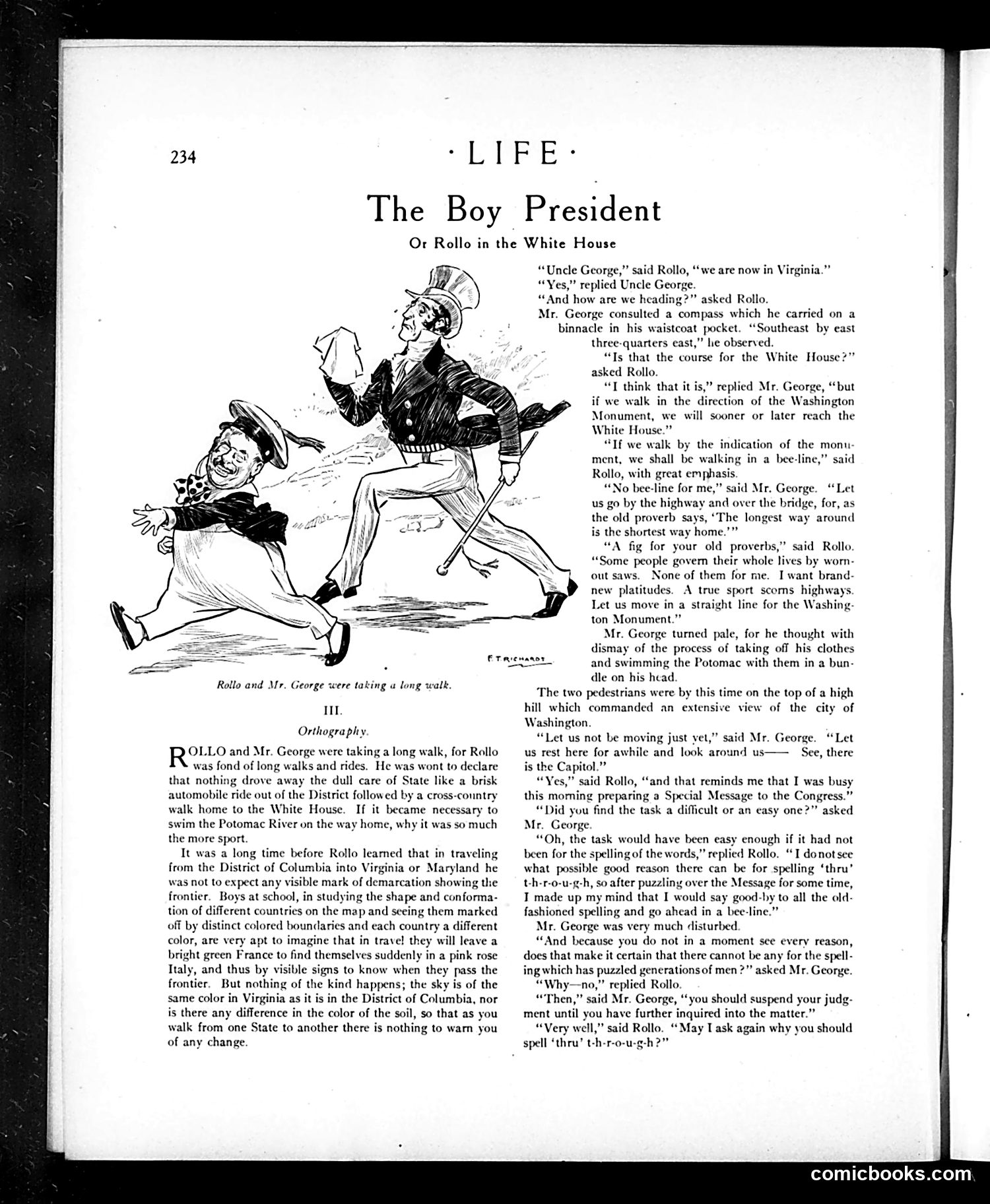
This satirical piece mocks Theodore Roosevelt as an impulsive, reckless leader ("The Boy President"). The cartoon depicts "Rollo" (Roosevelt stand-in) and "Mr. George" (likely an advisor or established figure) on a walk—a thin premise for criticizing Roosevelt's governing style. The satire targets Roosevelt's: - **Impulsiveness**: Rollo refuses sensible routes, insisting on straight lines and swimming rivers for sport - **Dismissal of tradition**: He scorns "old proverbs" and "old-fashioned spelling," wanting only "brand-new platitudes" - **Recklessness**: He prioritizes being a "true sport" over practical governance The spelling discussion (questioning why "thru" isn't spelled "through") seems metaphorical—mocking Roosevelt's cavalier attitude toward established conventions and institutions. The overall message: this youthful president treats serious matters (presidential messages, navigation, tradition) as sports, disregarding wisdom and consequences. It's vintage early-1900s political satire criticizing Roosevelt's energetic but unconventional presidency.
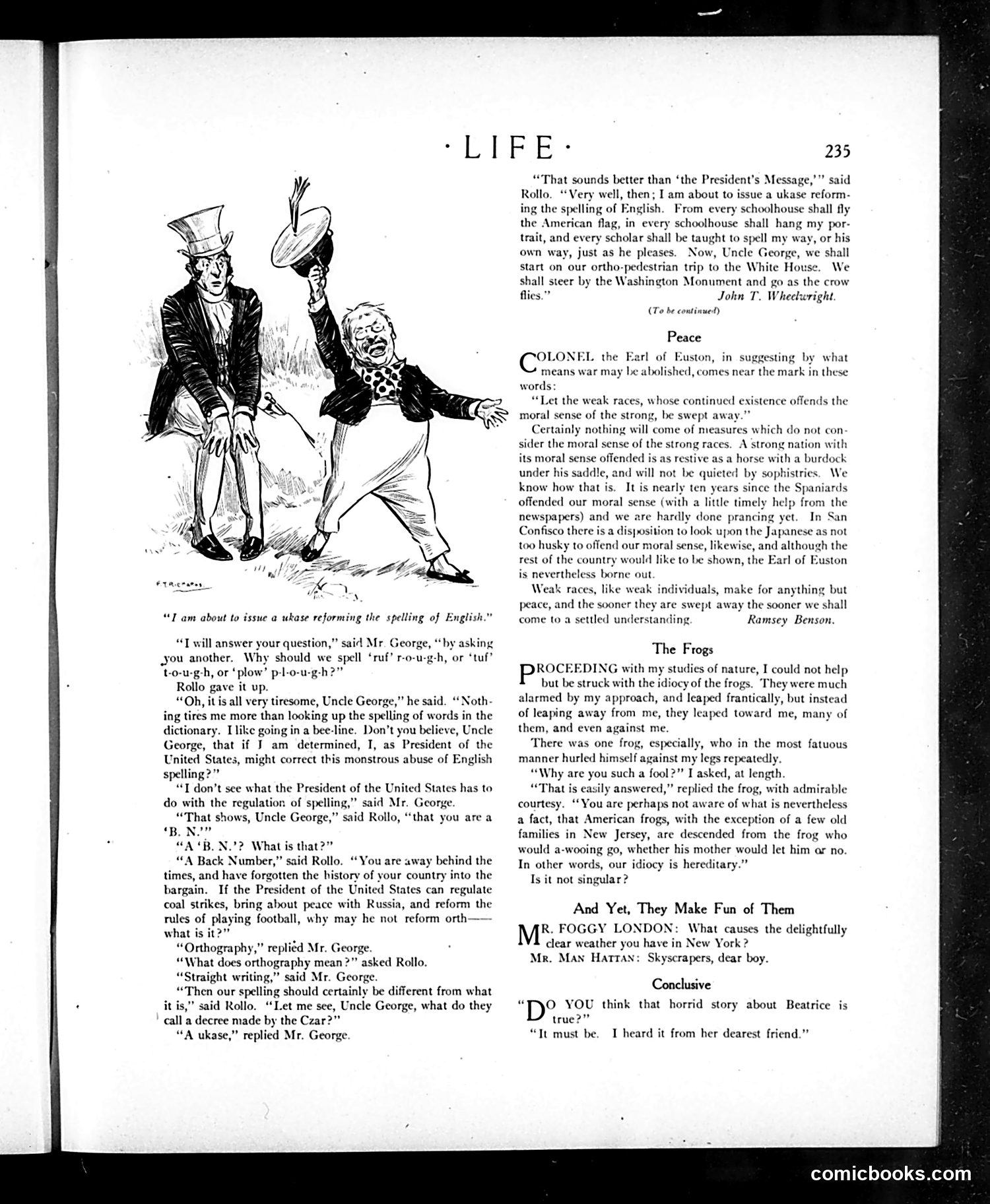
The cartoon depicts Uncle George (an older man) and young Rollo, likely a precocious child character. Rollo proposes issuing a "ukase" (Russian imperial decree) to reform English spelling as President of the United States—a satirical jab at presidential overreach. The humor targets Theodore Roosevelt's expansive executive power during his presidency. Roosevelt had recently intervened in labor disputes (coal strikes) and international affairs (Russian-Japanese peace negotiations), prompting criticism that he wielded authority beyond constitutional limits. Rollo's absurd proposal—that a president can arbitrarily reform language and demand portrait displays—mocks this perceived executive overreach by taking it to ridiculous extremes. The reference to "ukase" adds another layer: comparing American presidential orders to Russian autocratic decrees—a stinging critique of presidential power concentration.
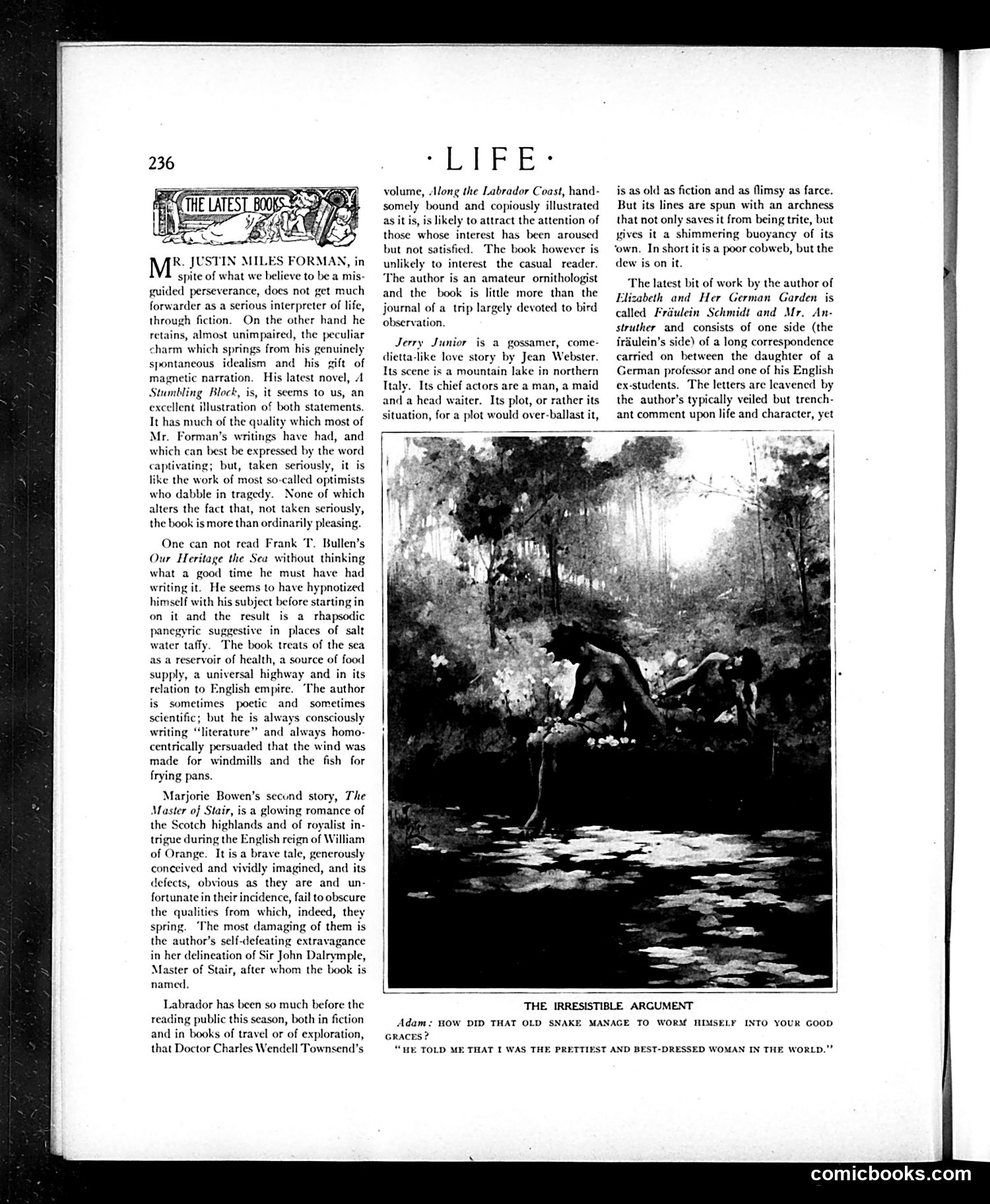
This single-panel cartoon depicts the Biblical story of Adam and Eve's temptation in the Garden of Eden. Adam questions Eve about how the serpent convinced her to eat the forbidden fruit. Eve's response—that the snake flattered her by calling her "the prettiest and best-dressed woman in the world"—satirizes women's vanity and susceptibility to compliments. The joke relies on period stereotypes about female superficiality: that women can be manipulated through appeals to appearance and fashion rather than reason. The cartoon suggests women are inherently gullible when flattered about their looks or clothing. This reflects early 20th-century attitudes about gender, presenting feminine vanity as humanity's original sin—literally the cause of mankind's fall from grace. The accompanying book reviews on the page are unrelated to this cartoon's content.
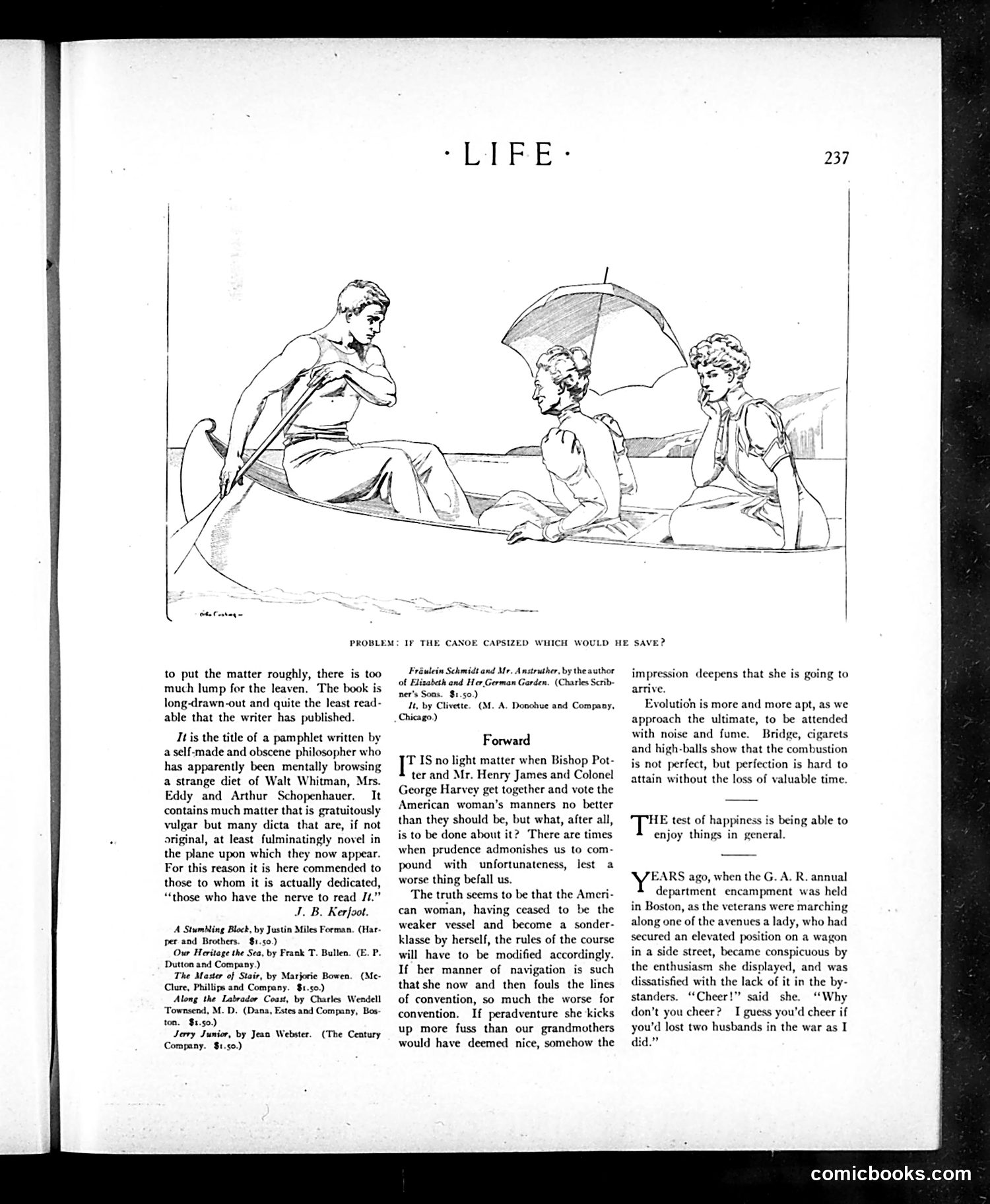
**The Cartoon:** The illustration shows a boating scene with the caption "PROBLEM: If the Canoe Capsized Which Would He Save?" A man in a canoe faces two women on a beach—one holding an umbrella. This appears to be a visual joke about male priorities and chivalry during the early 1900s, likely satirizing debates about modern women's independence and changing gender roles. **The Editorial Content:** The page includes book reviews and two opinion pieces. One discusses controversial criticism of American women's manners by prominent figures (Bishop Potter, Henry James, Colonel George Harvey), arguing that as women have gained independence and social power, old social conventions must adapt. The author suggests women's "noise and fume" during this social evolution is evidence of progress. The anecdote about the G.A.R. widow humorously illustrates women's changing social status—she demands public recognition for her wartime sacrifice, a stark contrast to traditional female passivity. **The Satire:** The page reflects early-20th-century anxieties about the "New Woman"—educated, assertive, and challenging Victorian gender norms.
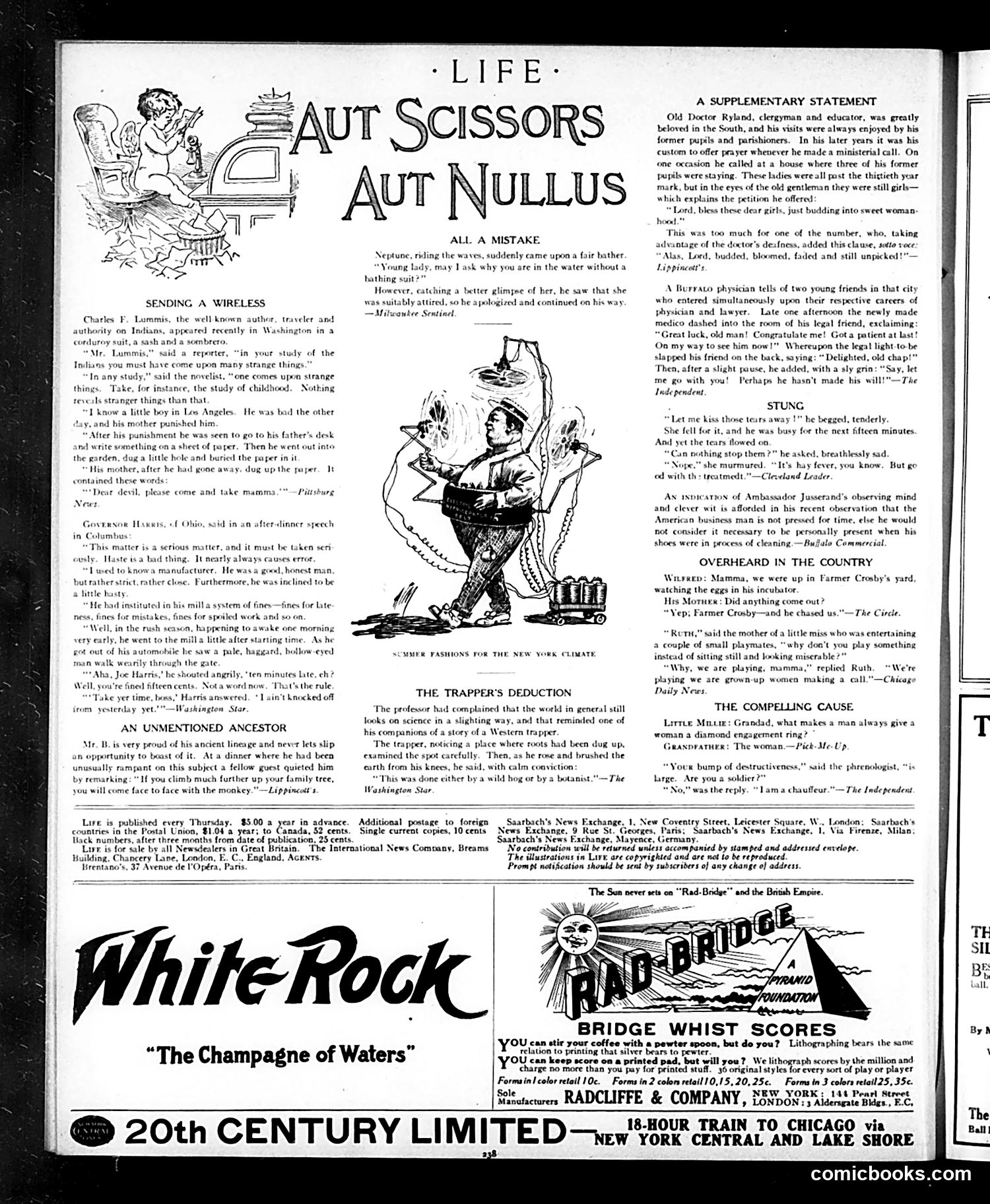
This page from *Life* magazine contains several short humorous anecdotes and cartoons typical of early 20th-century satirical humor: **"Aut Scissors/Aut Nullus"** appears to be the main feature, with accompanying illustrations showing everyday domestic and social scenes. **Key stories include:** - A tale about Charles F. Lummis (a real author/Indian expert) and a boy who writes a note to the devil - Anecdotes about haste causing errors in manufacturing - A joke about climbing one's family tree and encountering "the monkey" (an evolutionary reference) - Neptune encountering a bather without proper attire - A trapper deducing whether roots were dug by a "wild hog or botanist" - A prayer scene where unmarried women add a bitter addendum about being "budded, bloomed, faded and still unpicked" The humor relies on wordplay, unexpected twists, and social commentary—particularly regarding gender (unmarried women's status) and class dynamics. The advertisements below promote beverages and transportation services typical of the era.
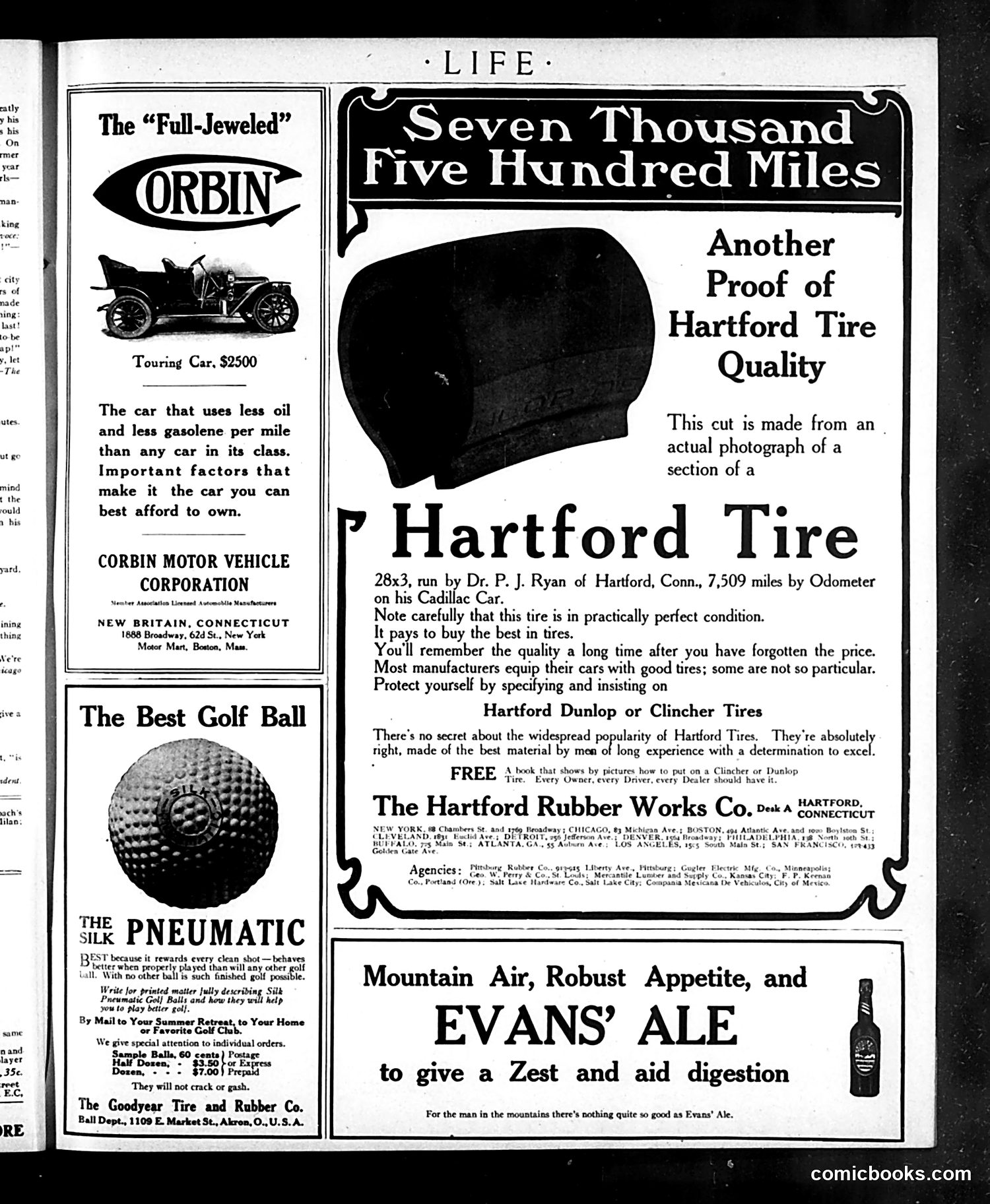
This page is **primarily advertising, not satire or editorial content**. It contains four advertisements typical of early 1900s publications: 1. **Corbin Motor Vehicle** — promotes an economical touring car ($2,500) emphasizing fuel efficiency 2. **Silk Pneumatic Golf Balls** — luxury sports equipment for affluent golfers 3. **Hartford Tire** — the dominant advertisement, featuring a photograph of a tire that allegedly survived 7,509 miles with minimal wear, positioned as proof of superior quality 4. **Evans' Ale** — beverages marketed to mountain travelers The Hartford Tire ad is most prominent, using a customer testimonial (Dr. P.J. Ryan) and visual evidence to establish credibility—a common early advertising strategy before modern consumer protection standards. **No political cartoon or satire is present.** This is a straightforward commercial page targeting middle-to-upper-class consumers interested in automobiles, leisure sports, and premium products.
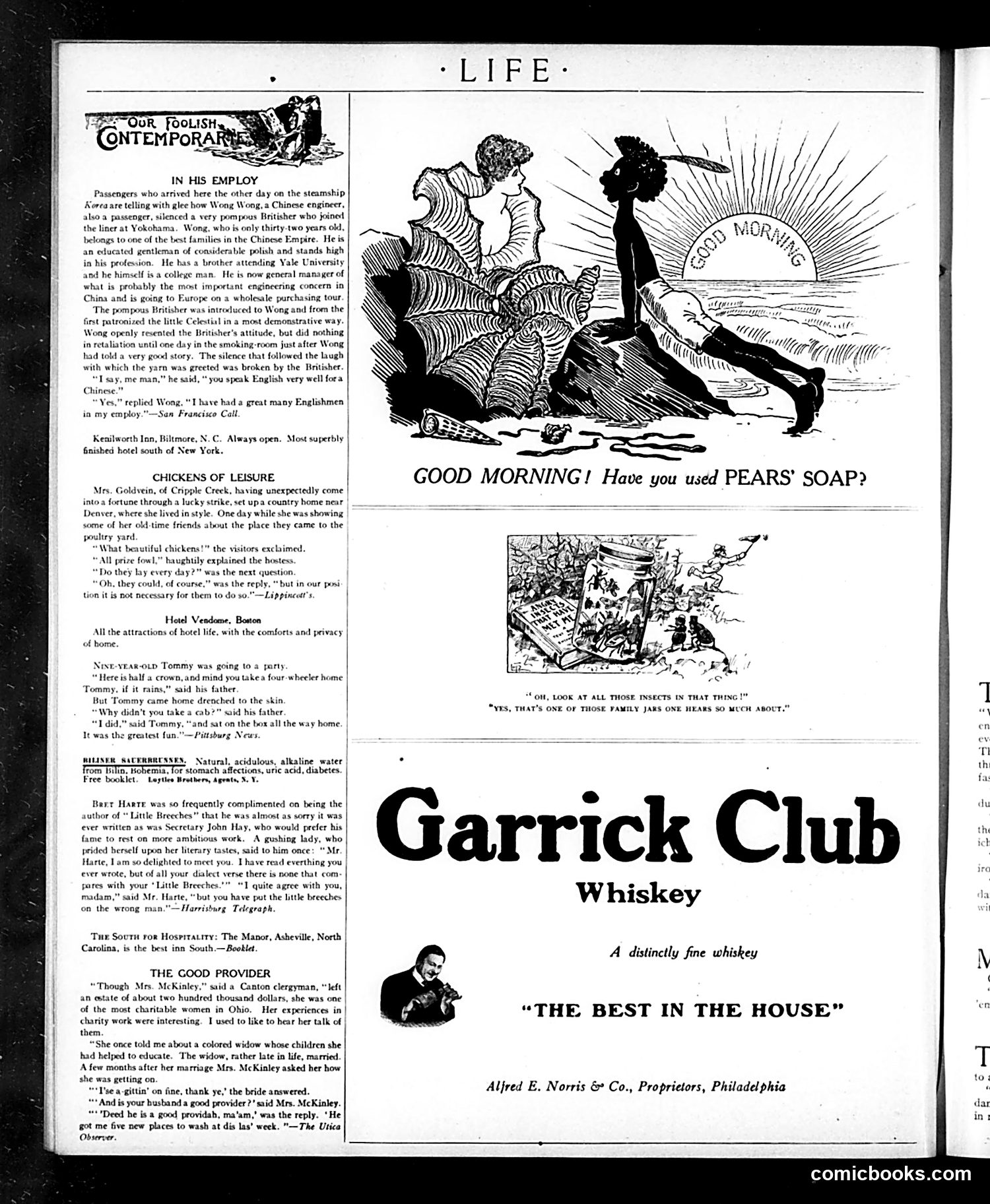
This page contains several humorous anecdotes rather than political cartoons. **Main narratives:** The featured story concerns Wong Wong, a wealthy, educated Chinese engineer who silences a patronizing British passenger aboard a steamship. The satire targets British colonial arrogance—the Britisher condescends to Wong, who responds by revealing he employs many Englishmen, inverting the power dynamic. The joke exposes racist assumptions about Asian inferiority. **Other brief humor pieces** include: - A newly rich Denver woman's chickens that needn't work (mocking nouveau riche pretension) - A child sitting atop a taxi in the rain for fun (childhood innocence) - Anecdotes about author Bret Harte and a charity story about Mrs. McKinley The Pears' Soap advertisement and Garrick Club whiskey ad are standard period marketing. The overall page mixes social satire with genteel humor typical of *Life* magazine's format—poking fun at class pretension, ethnic stereotypes (though here sympathetically), and human folly.
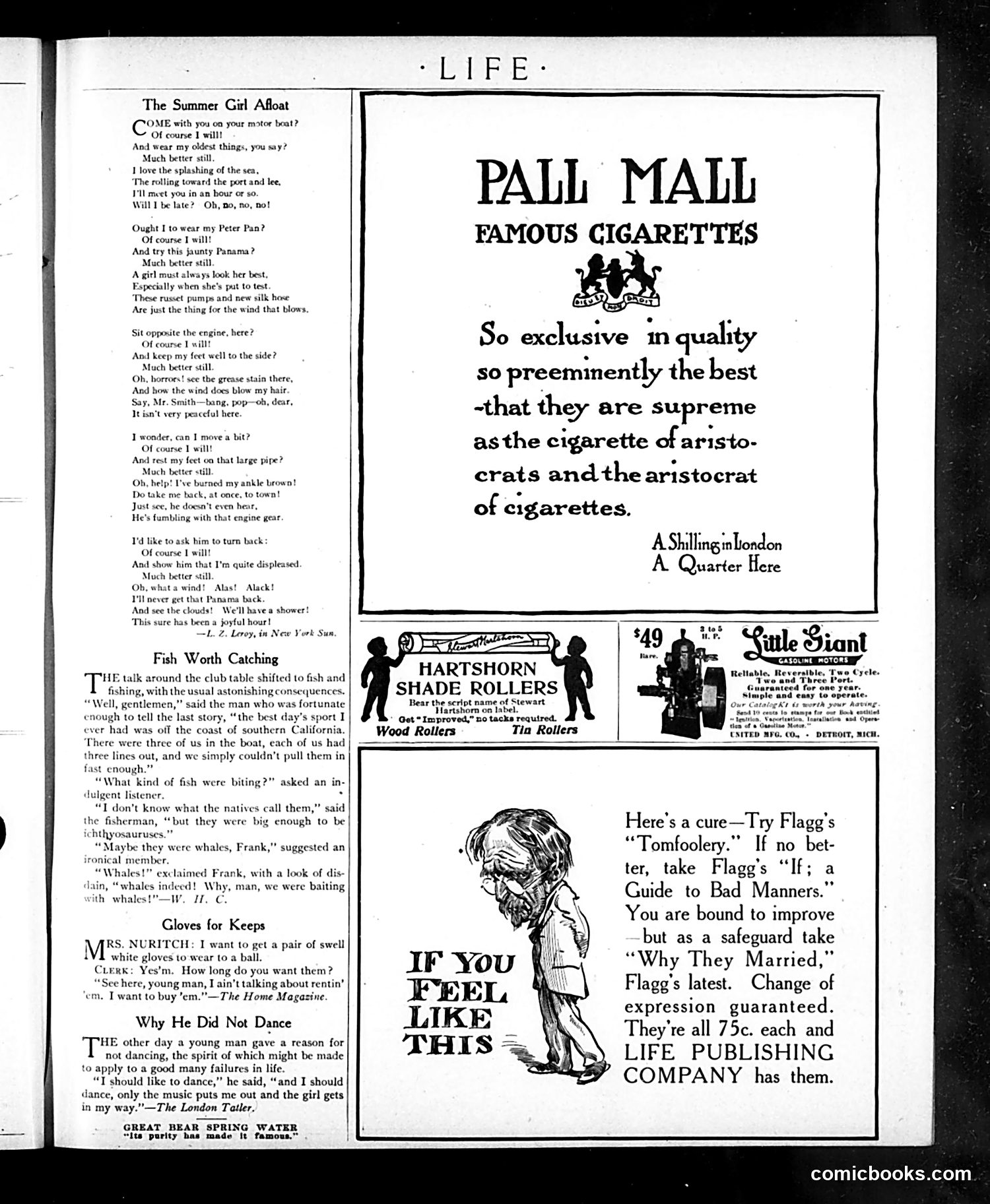
This page from *Life* magazine contains primarily **humorous short pieces and advertisements** rather than political cartoons. The main content includes: 1. **"The Summer Girl Afloat"** — A satirical poem mocking women's vanity and impracticality. A woman agrees to join a motorboat trip but complains constantly: she worries about appearance (wearing "Peter Pan" and Panama hat), gets grease stains, burns her ankle on the engine, loses her hat to wind, and fears rain—all while claiming to enjoy the outing. The joke is the contradiction between her desire to appear refined and her complete discomfort with actual outdoor activity. 2. **"Fish Worth Catching"** — A club-table tall tale where a fisherman claims to have caught so many enormous fish they "couldn't pull them in fast enough," leading to increasingly absurd suggestions (whales). It satirizes exaggeration in sporting stories. 3. **Other brief humorous pieces** on gloves, dancing, etc. The page is largely **advertising-driven**, featuring Pall Mall cigarettes, Hartshorn shade rollers, and Flagg's books. The satire is gentle social commentary on contemporary manners rather than political critique.
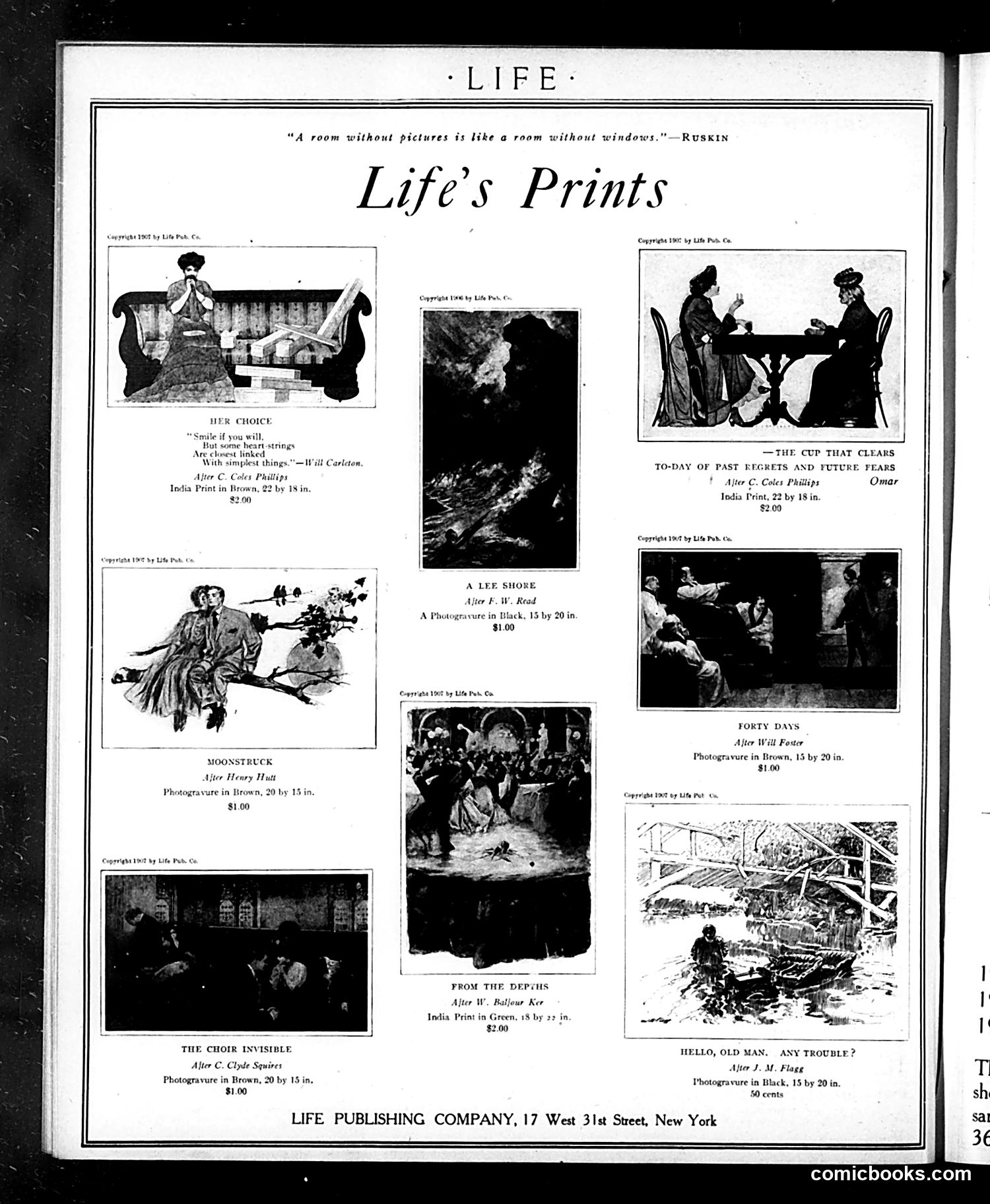
This is not a satirical cartoon page but rather an **advertisement** for Life Publishing Company's art print catalog. The page showcases reproducible prints available for home purchase—a common early-20th-century practice when quality art reproductions were luxury goods. The prints feature romantic and sentimental imagery typical of the era: "Her Choice" (a woman on a divan), "Moonstruck" (an ethereal figure), "The Choir Invisible" (a religious scene), and "The Cup That Clears" (two figures at tea). Artists credited include Henry Hutt and Coles Phillips, popular illustrators of that period. The Ruskin epigraph positioning art as essential to domestic life reflects Victorian/Edwardian aesthetics. Prices ($1-$2) indicate these were affordable middle-class decorations, available in various printing techniques (photogravure, India print). This represents commercial art democratization before mass-produced home décor became ubiquitous.
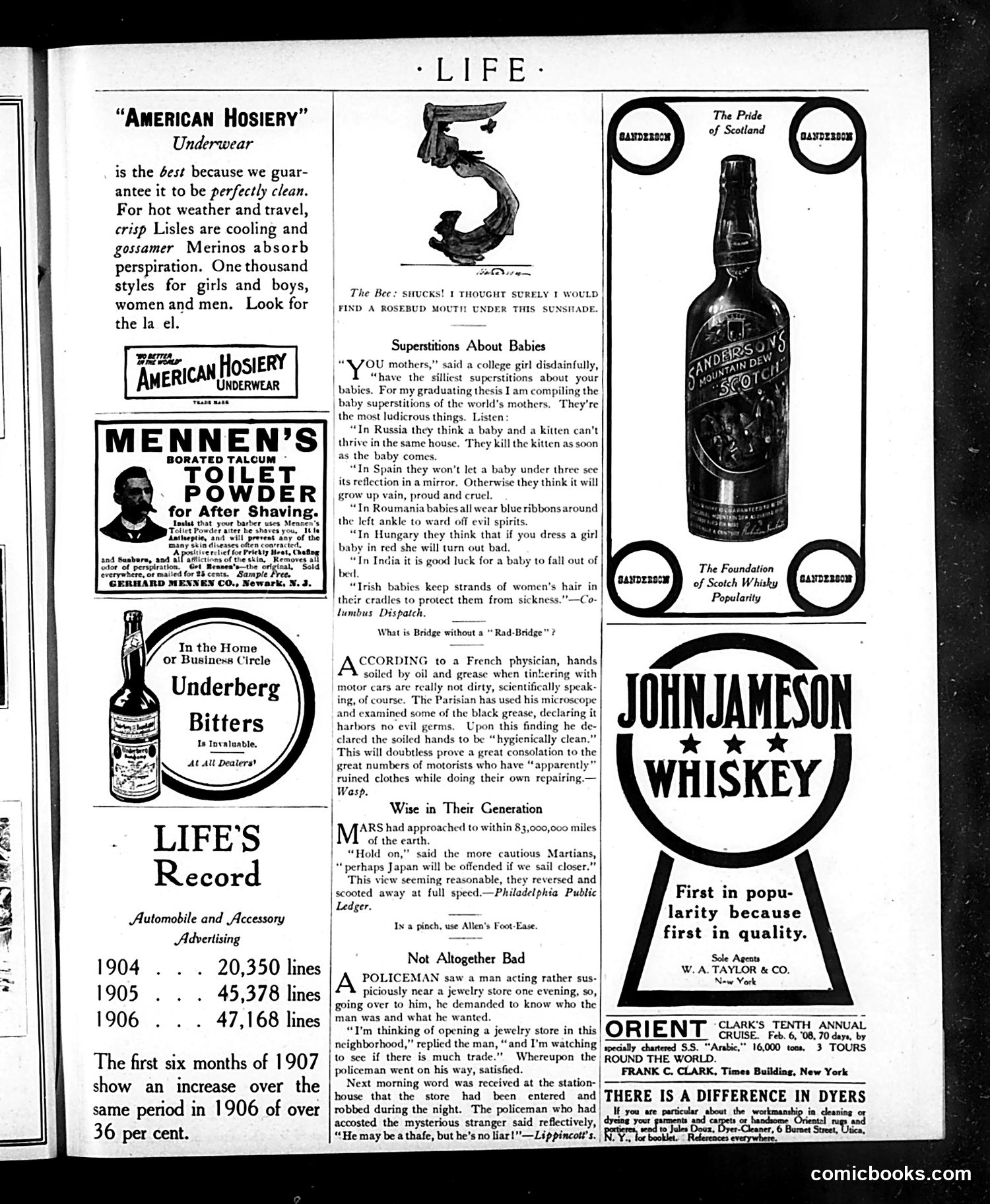
This is primarily an **advertising page** from Life magazine (early 1900s), with several small humorous items interspersed. The main cartoon depicts **"The Bee"** searching under a woman's parasol for a "rosebud mouth"—a flirtatious reference to romantic pursuit typical of the era's light humor. The page includes period advertisements for products like American Hosiery, Mennen's talcum powder, and John Jameson whiskey, reflecting early 1900s consumer goods. A notable content section titled **"Superstitions About Babies"** catalogues folk beliefs from various countries (Russia, Spain, Romania, Hungary, India) about infant care and protection—presented with a tone of educated dismissal, reflecting the era's growing skepticism toward traditional superstitions as modernization advanced. Additional brief humorous anecdotes address French automotive hygiene and a policeman's encounter with a suspicious jewelry store visitor, exemplifying Life's mix of satirical social commentary and light humor. The page reflects **early 20th-century American attitudes**: modernization, skepticism toward "old-world" superstitions, and consumer culture expansion.
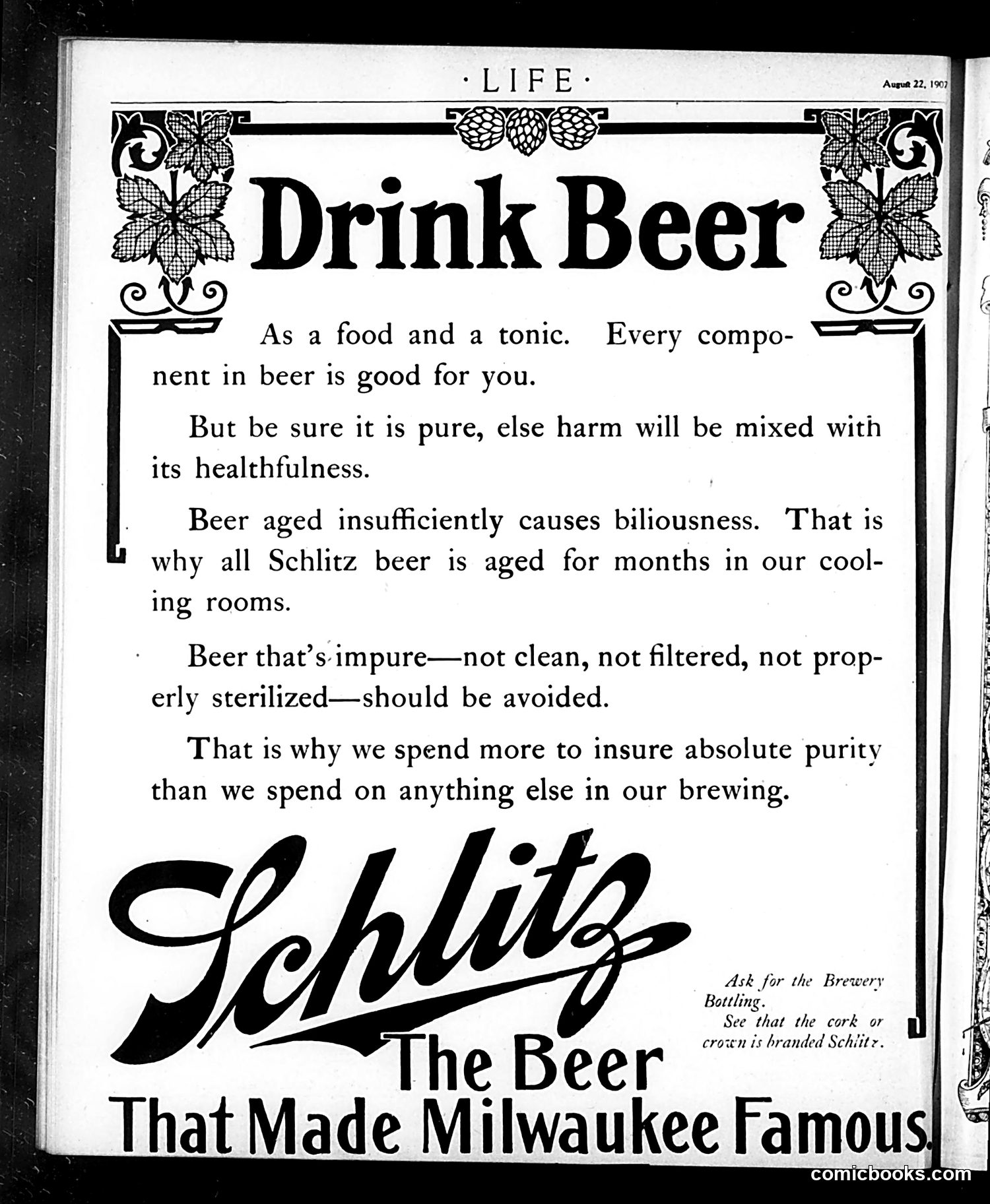
This is **a beer advertisement, not satire or political commentary.** It's a Schlitz beer ad from Life magazine (August 22, 1907) making health claims common to early 20th-century advertising. The ad presents beer as "a food and a tonic" with beneficial components, then emphasizes Schlitz's purity through aging, filtering, and sterilization—positioning these as competitive advantages. The tagline "The Beer That Made Milwaukee Famous" references Milwaukee's reputation as a major brewing center. For modern readers, the striking element is the **health claim**: early 1900s advertisers routinely marketed alcohol as medicinal and nutritious. This predates FDA regulations and reflects attitudes before medical understanding of alcohol's actual effects. The ornamental hop and flower designs are period-typical decorative flourishes. This represents straightforward commercial advertising rather than editorial satire or political content.