
Life, 1907-08-22 · page 15 of 24
Life — August 22, 1907 — page 15: what you’re looking at
What you’re looking at
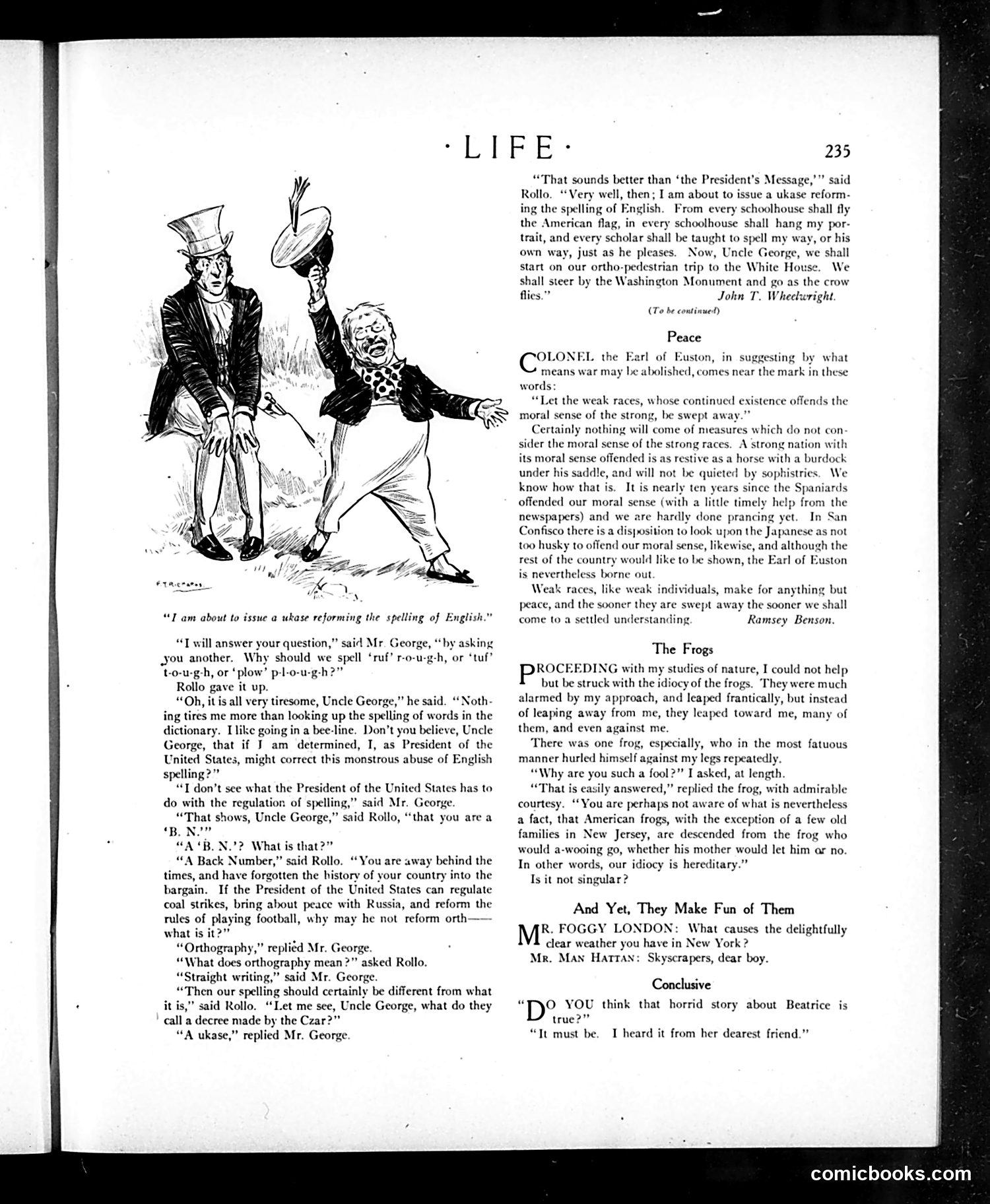
The cartoon depicts Uncle George (an older man) and young Rollo, likely a precocious child character. Rollo proposes issuing a "ukase" (Russian imperial decree) to reform English spelling as President of the United States—a satirical jab at presidential overreach. The humor targets Theodore Roosevelt's expansive executive power during his presidency. Roosevelt had recently intervened in labor disputes (coal strikes) and international affairs (Russian-Japanese peace negotiations), prompting criticism that he wielded authority beyond constitutional limits. Rollo's absurd proposal—that a president can arbitrarily reform language and demand portrait displays—mocks this perceived executive overreach by taking it to ridiculous extremes. The reference to "ukase" adds another layer: comparing American presidential orders to Russian autocratic decrees—a stinging critique of presidential power concentration.
📄 Transcribed text from this page (OCR, searchable)
Machine-transcribed from the original scan — historical spelling and the odd misread are preserved.
-LIFE: 235 “Tam about to issue a ukase reforming the spelling of English.” “T will answer your question,” said Mr. George, “by asking you another. Why should we spell ‘ruf? r-o-u-g-h, or ‘tuf? t-o-u-g-h, or ‘plow’ p-l-o-u-g-h?” Rollo gave it up. “Oh, it is all very tiresome, Uncle George,” he said. ‘‘ Noth- ing tires me more than looking up the spelling of words in the dictionary. [like going in a bee-line. Don’t you believe, Uncle George, that if J am determined, I, as President of the United States, might correct this monstrous abuse of Eng! spelling?” “T don’t see what the President of the United States has to do with the regulation of spelling,” said Mr. George. “That shows, Uncle George,” said Rollo, “that you are a ‘BLNZY “A ‘B.N.’? What is that?” “A Back Number,” said Rollo. “You are away behind the times, and have forgotten the history of your country into the bargain. If the President of the United States can regulate coal strikes, bring about peace with Ru and reform the rules of playing football, why may he not reform orth— what is it? “Orthography,” repliéd Mr. George. “What does orthography mean?” asked Rollo. “Straight writing,” said Mr. George. “Then our spelling should certainly be different from what it is,” said Rollo, “Let me see, Uncle George, what do they call a decree made by the Czar?” “A ukase,” replied Mr. George. “That sounds better than ‘the President’s Message,’”” said Rollo. ‘Very well, then; I am about to issue a ukase reform- ing the spelling of English. From every schoolhouse shall fly the American flag, in every schoolhouse shall hang my por- trait, and every scholar shall be taught to spell my way, or his own way, just as he pleases. Now, Uncle George, we shall start on our ortho-pedestrian trip to the White Hou We shall steer by the Washington Monument and go as the crow flies.” John T. Wheelwright. (To be continued) Peace OLONEL the Earl of Euston, in suggesting by what means war may be abolished, comes near the mark in these words: “Let the weak races, whose continued existence offends the moral sense of the strong, be swept away Certainly nothing will come of measures which do not con sider the moral sense of the strong races. A strong nation with its moral sense offended is as restive horse with a burdock under his saddle, and will not be quieted by sophistries.. We know how that is. It is nearly ten years since the Spaniards offended our moral sense (with a little timely help from the newspapers) and we are hardly done prancing yet. In San Confisco there is a disposition to look upon the Japanese as not too husky to offend our moral sense, likewise, and although the rest of the country would like to be shown, the Earl of Euston is nevertheless borne out Weak races, like weak individuals, make for anything but peace, and the sooner they are swept away the sooner we shall come toa settled understanding Ramsey Benson. The Frogs prec DING with my studies of nature, I could not help but be struck with the idiocy of the frogs. They were much alarmed by my approach, and leaped frantically, but instead of leaping away from me, they leaped toward me, many of them, and even against me. There was one frog, especially, who in the most fatuous manner hurled himself against my legs repeatedly. “Why are you such a fool?” I asked, at length. “That is easily answered,” replied the frog, with admirable courtesy. “You are perhaps not aware of what is nevertheless a fact, that American frogs, with the exception of a few old families in New Jersey, are descended from the frog who would a-wooing go, whether his mother would let him ar no. In other words, our idiocy is hereditary.” Is it not singular? And Yet, They Make Fun of Them R. FOGGY LONDON: What causes the delightfully clear weather you have in New York ? Mr. Man Hatran: Skyscrapers, dear boy. Conclusive “D° YOU think that horrid story about Beatrice is true?” “Tt must be. I heard it from her dearest friend.” comicbooks.com