
Life, 1907-08-22 · page 6 of 24
Life — August 22, 1907 — page 6: what you’re looking at
What you’re looking at
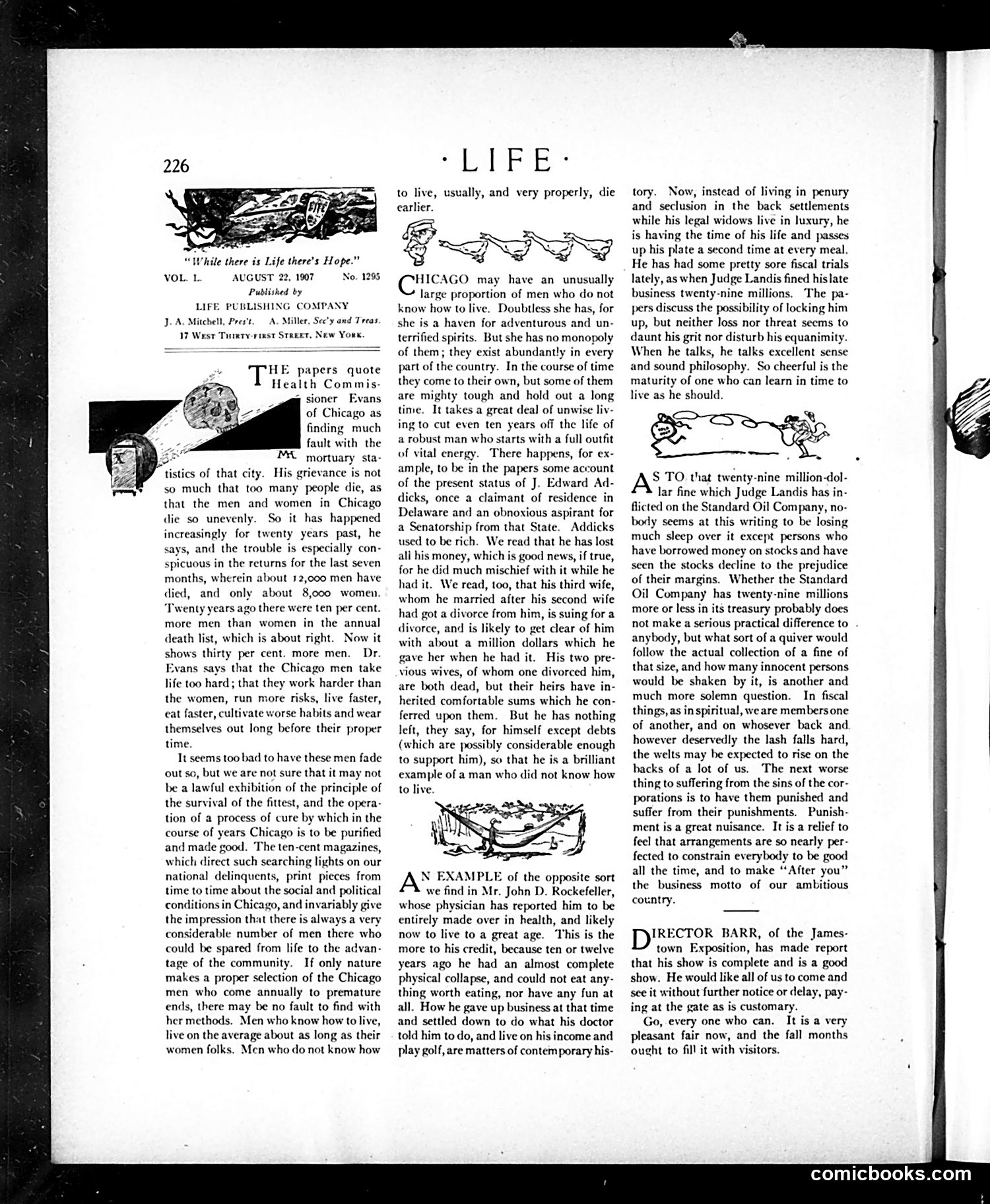
This page primarily contains **satirical editorial commentary** rather than political cartoons. The main article critiques **Chicago's mortality statistics**, noting the city has an unusually high proportion of men who don't know how to live properly. The text mocks wealthy Chicago men, particularly referencing **J. Edward Addicks** (described as a former Delaware resident and failed senatorial candidate) who squandered his fortune through poor financial decisions and failed marriages. The piece then contrasts this with positive examples like **John D. Rockefeller**, whose physician reportedly transformed his health through disciplined living, and **Director Barr of the Jamestown Exposition**, celebrated for his longevity and continued activity. The satire suggests Chicago's death rate reflects men's inability to manage their lives wisely—a commentary on Gilded Age excess and poor judgment among the wealthy.
📄 Transcribed text from this page (OCR, searchable)
Machine-transcribed from the original scan — historical spelling and the odd misread are preserved.
“While there is Life there’s Hope.” VOL. L. AUGUST 22, 1907 No. 1295 Published by LIFE PUBLISHING COMPANY J. A, Mitchell, Pres't. A. Miller, Sec'y and Treas. 17 West Turery-rixst Street, New York. HE papers quote Health Commi mg sioner Evans of Chicago as finding much fault with the MU mortuary sta- tistics of that city. His grievance is not so much that too many people die, as that the men and women in Chicago die so unevenly. So it has happened increasingly for twenty years past, he , and the trouble is especially con- spicuous in the returns for the last seven months, wherein about 12,000 men have died, and only about 8,000 women. ‘Twenty years ago there were ten per cent. more men than women in the annual death list, which is about right. Now it shows thirty per cent. more men. Dr. Evans says that the Chicago men take life too hard; that they work harder than the women, run more risks, live faster, eat faster, cultivate worse habits and wear themselves out long before their proper time. It seems too bad to have these men fade out so, but we are not sure that it may not be a lawful exhibition of the principle of the survival of the fittest, and the opera- tion of a process of cure by which in the course of years Chicago is to be purified and made good. The ten-cent magazines, which direct such searching lights on our national delinquents, print pieces from time to time about the social and political conditions in Chicago, and invariably give the impression that there is always a very considerable number of men there who could be spared from life to the advan- tage of the community. If only nature makes a proper selection of the Chicago men who come annually to premature ends, there may be no fault to find with her methods. Men who know how to live, live on the average about as long as their women folks. Men who do not know how “EP PRE* to live, usually, and very proper! HICAGO may have an unusually large proportion of men who do not know how to live. Doubtless she has, for she is a haven for adventurous and un- terrified spirits. But she has no monopoly of them; they exist abundantly in every part of the country. In the course of time they come to their own, but some of them are mighty tough and hold out a long time. It takes a great deal of unwise liv- ing to cut even ten years off the life of a robust man who starts with a full outfit of vital energy. There happens, for ex- ample, to be in the papers some account of the present status of J. Edward Ad- dicks, once a claimant of residence in Delaware and an obnoxious aspirant for a Senatorship from that State. Addicks used to be rich. We read that he has lost ali his money, which is good news, if true, for he did much mischief with it while he had it. We read, too, that his third wife, whom he married after his second wife had got a divorce from him, is suing for a divorce, and is likely to get clear of him with about a million dollars which he gave her when he had it. His two pre- vious wives, of whom one divorced him, are both dead, but their heirs have in- herited comfortable sums which he con- ferred upon them. But he has nothing left, they say, for himself except debts (which are possibly considerable enough to support him), so that he is a brilliant example of a man who did not know how MPLE of the opposite sort we find in Mr. John D. Rockefeller, whose physician has reported him to be entirely made over in health, and likely now to live to a great age. This is the more to his credit, because ten or twelve years ago he had an almost complete physical collapse, and could not eat any- thing worth eating, nor have any fun at all. How he gave up business at that time and settled down to do what his doctor told him to do, and live on his income and play golf, are matters of contemporary his- tory. Now, instead of living in penury and seclusion in the back settlements while his legal widows live in luxury, he is having the time of his life and passes up his plate a second time at every meal. He has had some pretty sore fiscal trials lately, as when Judge Landis fined hislate business twenty-nine millions. The pa- pers discuss the possibility of locking him up, but neither loss nor threat seems to daunt his grit nor disturb his equanim: When he talks, he talks excellent sense and sound philosophy. So cheerful is the maturity of one who can learn in time to live as he should. ae: S TO that twenty-nine million-dol- lar fine which Judge Landis has in- flicted on the Standard Oil Company, no- body seems at this writing to be losing much sleep over it except persons who have borrowed money on stocks and have seen the stocks decline to the prejudice of their margins. Whether the Standard Oil Company has twenty-nine millions more or less in its treasury probably does not make a serious practical difference to anybody, but what sort of a quiver would follow the actual collection of a fine of that size, and how many innocent persons would be shaken by it, is another and much more solemn question. In fiscal things, as in spiritual, we are membersone of another, and on whosever back and however deservedly the lash falls hard, the welts may be expected to rise on the backs of a lot of us. The next worse thing to suffering from the sins of the cor- porations is to have them punished and suffer from their punishments. Punish- ment is a great nuisance. It is a relief to feel that arrangements are so nearly per- fected to constrain everybody to be good all the time, and to make “After you” the business motto of our ambitious country. PD REETOE BARR, of the James- town Exposition, has made report that his show is complete and is a good show. He would like all of us to come and see it without further notice or delay, pay- ing at the gate as is customary. Go, every one who can. It is a very pleasant fair now, and the fall months ought to fill it with visitors. comicbooks.com