
Life, 1907-08-22 · page 14 of 24
Life — August 22, 1907 — page 14: what you’re looking at
What you’re looking at
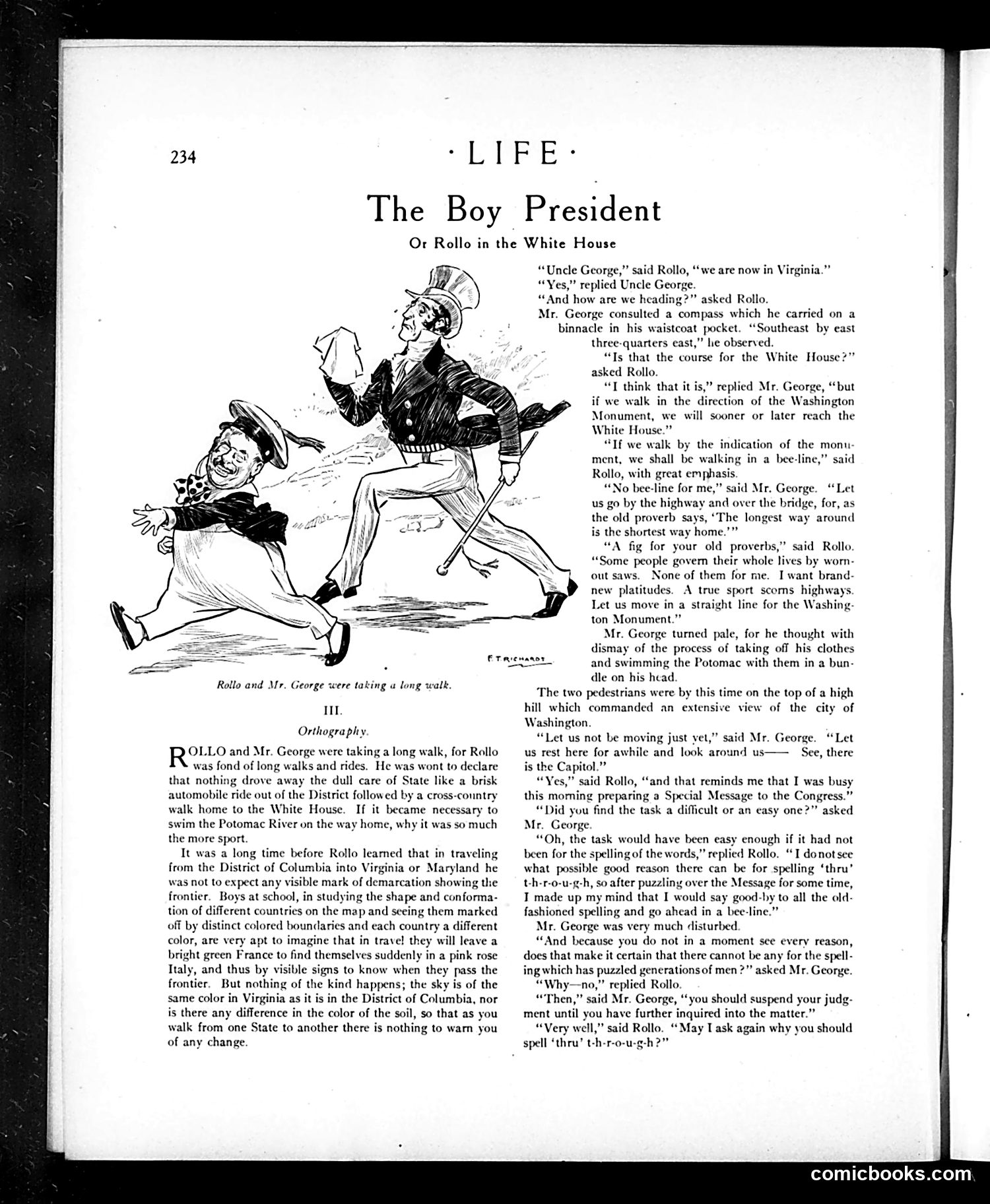
This satirical piece mocks Theodore Roosevelt as an impulsive, reckless leader ("The Boy President"). The cartoon depicts "Rollo" (Roosevelt stand-in) and "Mr. George" (likely an advisor or established figure) on a walk—a thin premise for criticizing Roosevelt's governing style. The satire targets Roosevelt's: - **Impulsiveness**: Rollo refuses sensible routes, insisting on straight lines and swimming rivers for sport - **Dismissal of tradition**: He scorns "old proverbs" and "old-fashioned spelling," wanting only "brand-new platitudes" - **Recklessness**: He prioritizes being a "true sport" over practical governance The spelling discussion (questioning why "thru" isn't spelled "through") seems metaphorical—mocking Roosevelt's cavalier attitude toward established conventions and institutions. The overall message: this youthful president treats serious matters (presidential messages, navigation, tradition) as sports, disregarding wisdom and consequences. It's vintage early-1900s political satire criticizing Roosevelt's energetic but unconventional presidency.
📄 Transcribed text from this page (OCR, searchable)
Machine-transcribed from the original scan — historical spelling and the odd misread are preserved.
‘LIPS: The Boy President Or Rollo in the White House FT meuanos Rollo and Mr. George were taking « long walk. II, Orthography OLLO and Mr. George were taking a long walk, for Rollo was fond of long walks and rides. He was wont to declare that nothing drove away the dull care of State like a brisk automobile ride out of the District followed by a cross-country walk home to the White House. If it became necessary to swim the Potomac River on the way home, why it was so much the more sport. It was a long time before Rollo learned that in traveling from the District of Columbia into Virginia or Maryland he was not to expect any visible mark of demarcation showing the frontier. Boys at school, in studying the shape and conforma- tion of different countries on the map and seeing them marked off by distinct colored boundaries and each country a different color, are very apt to imagine that in travel they will leave a bright green France to find themselves suddenly in a pink rose Italy, and thus by visible signs to know when they pass the frontier, But nothing of the kind happens; the sky is of the same color in Virginia as it is in the District of Columbia, nor is there any difference in the color of the soil, so that as you walk from one State to another there is nothing to warm you of any change. “Uncle George,” said Rollo, “we are now in Virginia.” “Yes,” replied Uncle George. “And how are we heading?” asked Rollo. Mr. George consulted a compass which he carried on a binnacle in his waistcoat pocket. “Southeast by east three-quarters cast,” he observed. “Ts that the course for the White House asked Rollo. “T think that it is,” replied Mr. George, “but if we walk in the direction of the Washington Monument, we will sooner or later reach the White House.” “If we walk by the indication of the monu- ment, we shall be walking in a bee-line,” said Rollo, with great emphasis. ‘o bee-line for me,” said Mr. George. “Let us go by the highway and over the bridge, for, as the old proverb says, ‘The longest way around is the shortest way home.’” “A fig for your old proverbs,” said Rollo. “Some people govem their whole lives by worn- out saws. None of them for me. I want brand- new platitudes. A true sport scoms highways. Let us move in a straight line for the Washing ton Monument.” Mr. George turned pale, for he thought with dismay of the process of taking off his clothes and swimming the Potomac with them in a bun- dle on his head. The two pedestrians were by this time on the top of a high hill which commanded an extensive view of the city of Washington. “Let us not be moving just yet,” said Mr. George. “Let us rest here for awhile and look around us: See, there is the Capitol.” “Yes,” said Rollo, “and that reminds me that I was busy this moming preparing a Special Message to the Congress.” “Did you find the task a difficult or an easy one?” asked Mr. George. “Oh, the task would have been easy enough if it had not been for the spelling of the words,” replied Rollo. “I donot see what possible good reason there can be for spelling ‘thru’ t-h-r-o-u-g-h, so after puzzling over the Message for some time, I made up my mind that I would say good-by to all the old- fashioned spelling and go ahead in a bee-line.” Mr. George was very much disturbed “And because you do not in a moment sce every reason, does that make it certain that there cannot be any for the spell- ing which has puzzled generations of men ?” asked Mr. George. “Why—no,” replied Rollo. “Then,” said Mr. George, “you should suspend your judg- ment until you have further inquired into the matter.” “Very well,” said Rollo. “May Task again why you should spell ‘thru’ t-h-r-o-u-g-h?” comicbooks.com