
Life, 1907-08-22 · page 16 of 24
Life — August 22, 1907 — page 16: what you’re looking at
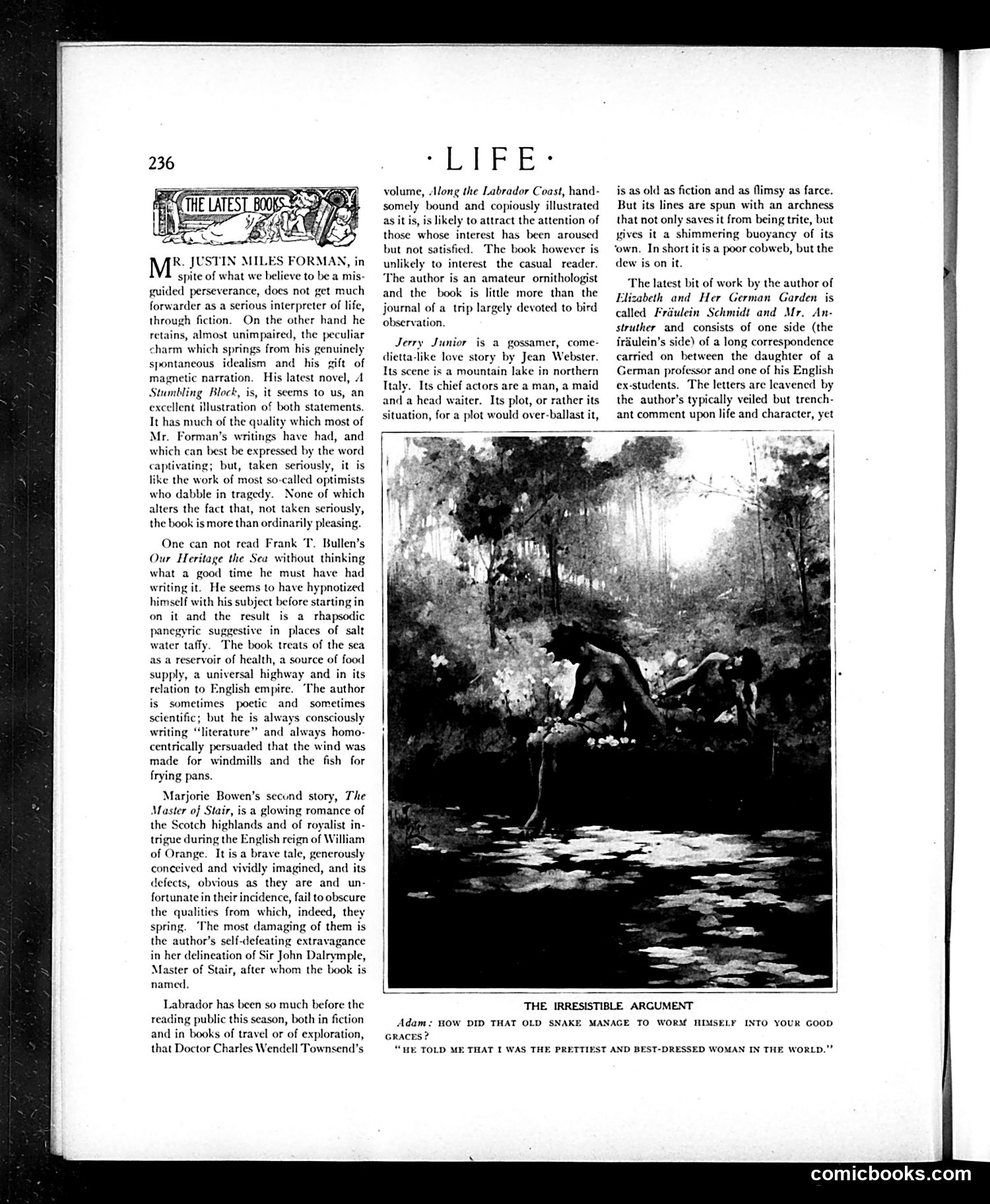
What you’re looking at
This single-panel cartoon depicts the Biblical story of Adam and Eve's temptation in the Garden of Eden. Adam questions Eve about how the serpent convinced her to eat the forbidden fruit. Eve's response—that the snake flattered her by calling her "the prettiest and best-dressed woman in the world"—satirizes women's vanity and susceptibility to compliments. The joke relies on period stereotypes about female superficiality: that women can be manipulated through appeals to appearance and fashion rather than reason. The cartoon suggests women are inherently gullible when flattered about their looks or clothing. This reflects early 20th-century attitudes about gender, presenting feminine vanity as humanity's original sin—literally the cause of mankind's fall from grace. The accompanying book reviews on the page are unrelated to this cartoon's content.
📄 Transcribed text from this page (OCR, searchable)
Machine-transcribed from the original scan — historical spelling and the odd misread are preserved.
M* JUSTIN MILES FORMAN, in spite of what we believe to be a mis- guided perseverance, docs not get much forwarder as a serious interpreter of life, through fiction. On the other hand he retains, almost unimpaired, the peculiar charm which springs from his genuinely spontaneous idealism and his gift of magnetic narration. His latest novel, A Stumbling Block, is, it seems to us, an excellent illustration of both statements. It has much of the quality which most of Mr. Forman’s writings have had, and which can best be expressed by the word captivating; but, taken seriously, it is like the work of most so-called optimists who dabble in tragedy. None of which alters the fact that, not taken seriously, the book is more than ordinarily pleasing. One can not read Frank T. Bullen’s Our Heritage the Sea without thinking what a good time he must have had writing it. He seems to have hypnotized himself with his subject before starting in on it and the result is a rthapsodic panegyric suggestive in places of salt water taffy. The book treats of the sea as a reservoir of health, a source of food supply, a universal highway and in its relation to English empire. ‘The author is sometimes poetic and sometimes scientific; but he is always consciously writing “literature” and always homo- centrically persuaded that the wind was made for windmills and the fish for frying pans. Marjorie Bowen's secund story, The Master of Stair, is a glowing romance of the Scotch highlands and of royalist in- trigue during the English reign of William of Orange. It isa brave tale, generously conceived and vividly imagined, and its defects, obvious as they are and un- fortunate in their incidence, fail to obscure the qualities from which, indeed, the spring. ‘The most damaging of them is the author’s self-defeating extravagance in her delineation of Sir John Dalrymple, Master of Stair, after whom the book named, Labrador has been so much before the reading public this season, both in fiction and in books of travel or of exploration, that Doctor Charles Wendell Townsend’s ‘LIF E* volume, Along the Labrador Coast, hand- somely bound and copiously illustrated as itis, is likely to attract the attention of those whose interest has been aroused but not satisfied. The book however is unlikely to interest the casual reader. ‘The author is an amateur ornithologist and the book is little more than the journal of a trip largely devoted to bird observation. Jerry Junior is a gossamer, come- dietta-like love story by Jean Webster. Its scene is a mountain lake in northern Ttaly. Its chief actors are a man, a maid and a head waiter. Its plot, or rather its situation, for a plot would over-ballast it, is as old as fiction and as flimsy as farce. But its lines are spun with an archness that not only saves it from being trite, but gives it a shimmering buoyancy of its ‘own. In short it is a poor cobweb, but the dew is on it. The latest bit of work by the author of Elizabeth and Her German Garden is called Fraulein Schmidt and Mr. An- struther and consists of one side (the iriulein’s side) of a long correspondence carried on between the daughter of a German professor and one of his English ex-students. The letters are leavened by the author's typically veiled but trench- ant comment upon life and character, yet THE IRRESISTIBLE ARGUMENT Adam; HOW DID THAT OLD SNAKE MANAGE TO WORM HIMSELY GRACES? INTO YOUR GooD “WE TOLD ME THAT I WAS THE PRETTIEST AND BEST-DRESSED WOMAN IN THE WORLD.” comicbooks.com