
Life, 1907-08-22 · page 17 of 24
Life — August 22, 1907 — page 17: what you’re looking at
What you’re looking at
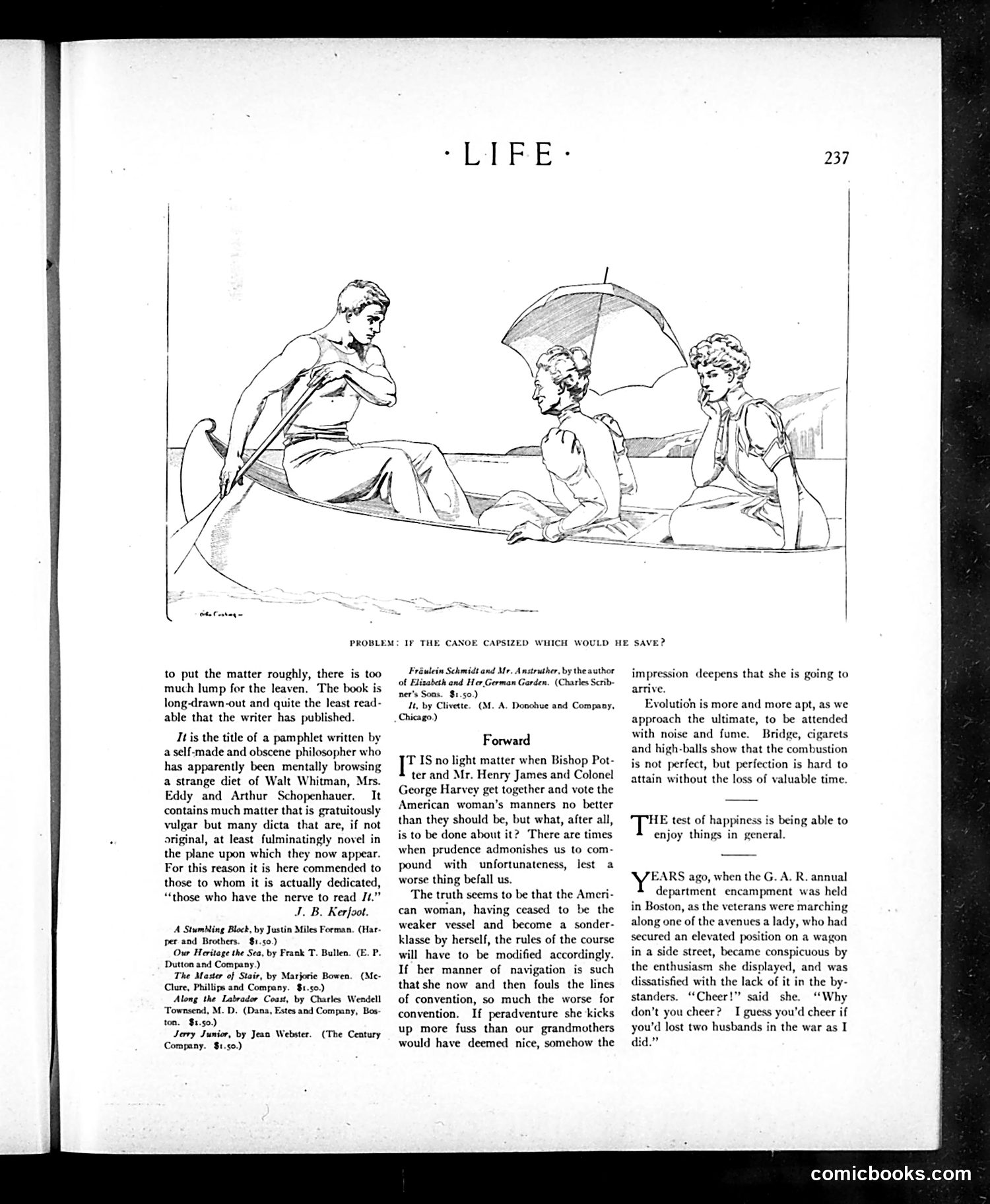
**The Cartoon:** The illustration shows a boating scene with the caption "PROBLEM: If the Canoe Capsized Which Would He Save?" A man in a canoe faces two women on a beach—one holding an umbrella. This appears to be a visual joke about male priorities and chivalry during the early 1900s, likely satirizing debates about modern women's independence and changing gender roles. **The Editorial Content:** The page includes book reviews and two opinion pieces. One discusses controversial criticism of American women's manners by prominent figures (Bishop Potter, Henry James, Colonel George Harvey), arguing that as women have gained independence and social power, old social conventions must adapt. The author suggests women's "noise and fume" during this social evolution is evidence of progress. The anecdote about the G.A.R. widow humorously illustrates women's changing social status—she demands public recognition for her wartime sacrifice, a stark contrast to traditional female passivity. **The Satire:** The page reflects early-20th-century anxieties about the "New Woman"—educated, assertive, and challenging Victorian gender norms.
📄 Transcribed text from this page (OCR, searchable)
Machine-transcribed from the original scan — historical spelling and the odd misread are preserved.
Be Chey PROBLEM to put the matter roughly, there is too much lump for the leaven. The book is long-drawn-out and quite the least read- able that the writer has published. Tt is the title of a pamphlet written by a self-made and obscene philosopher who has apparently been mentally browsing a strange diet of Walt Whitman, Mrs. Eddy and Arthur Schopenhauer. It contains much matter that is gratuitously vulgar but many dicta that are, if not original, at least fulminatingly novel in the plane upon which they now appear. For this reason it is here commended to those to whom it is actually dedicated, “those who have the nerve to read Jt.” J. B. Kerfoot. A Stumbling Block, by Justin Miles Forman. (Har- per and Brothers. $1.50.) Our Heritage the Sea, by Frank T. Bullen. (E. P. Dutton and Company.) The Master of Stair, by Marjorie Bowen Clure, Phillips and Company. $1.50.) Along the Labrador Coast, by Charles Wendell ‘Townsend, M. D. (Dana, Estes and Company, Bos- ton. $1.50.) Jerry Junior, by Jean Webster. Company. $1.50.) (Me (The Century If THE CANOE CAPSIZED WHICH WOULD HE SAVE? Fraulein Schmidt and Mr. Anstruther, by theauthor of Elizabeth and Her. German Garden. (Charles Scrib- ner’s Soas. $1.50.) It, by Clivette Chicago.) (Mf. A, Donohue and Company, Forward ." IS no light matter when Bishop Pot- ter and Mr. Henry James and Colonel George Harvey get together and vote the American woman’s manners no better than they should be, but what, after all, is to be done about it? There are times when prudence admonishes us to com- pound with unfortunateness, lest a worse thing befall us. The truth seems to be that the Ameri- can woman, having ceased to be the weaker vessel and become a sonder- klasse by herself, the rules of the course will have to be modified accordingly. If her manner of navigation is such that she now and then fouls the lines of convention, so much the worse for convention. If peradventure she kicks up more fuss than our grandmothers would have deemed nice, somehow the impression deepens that she is going to arrive. Evolution is more and more apt, as we approach the ultimate, to be attended with noise and fume. Bridge, ci and high-balls show that the combustion is not perfect, but perfection is hard to attain without the loss of valuable time. THe test of happiness is being able to enjoy things in general. EARS ago, when the G. A. R. annual department encampment was held in Boston, as the veterans were marching along one of the avenues a lady, who had secured an elevated position on a wagon in a side street, became conspicuous by the enthusiasm she displayed, and was dissatisfied with the lack of it in the by- standers. “Cheer!” said she. “Why don’t you cheer? I guess you'd cheer if you'd lost two husbands in the war as I did.” comicbooks.com