
A complete issue · 28 pages · 1907
Life — August 15, 1907
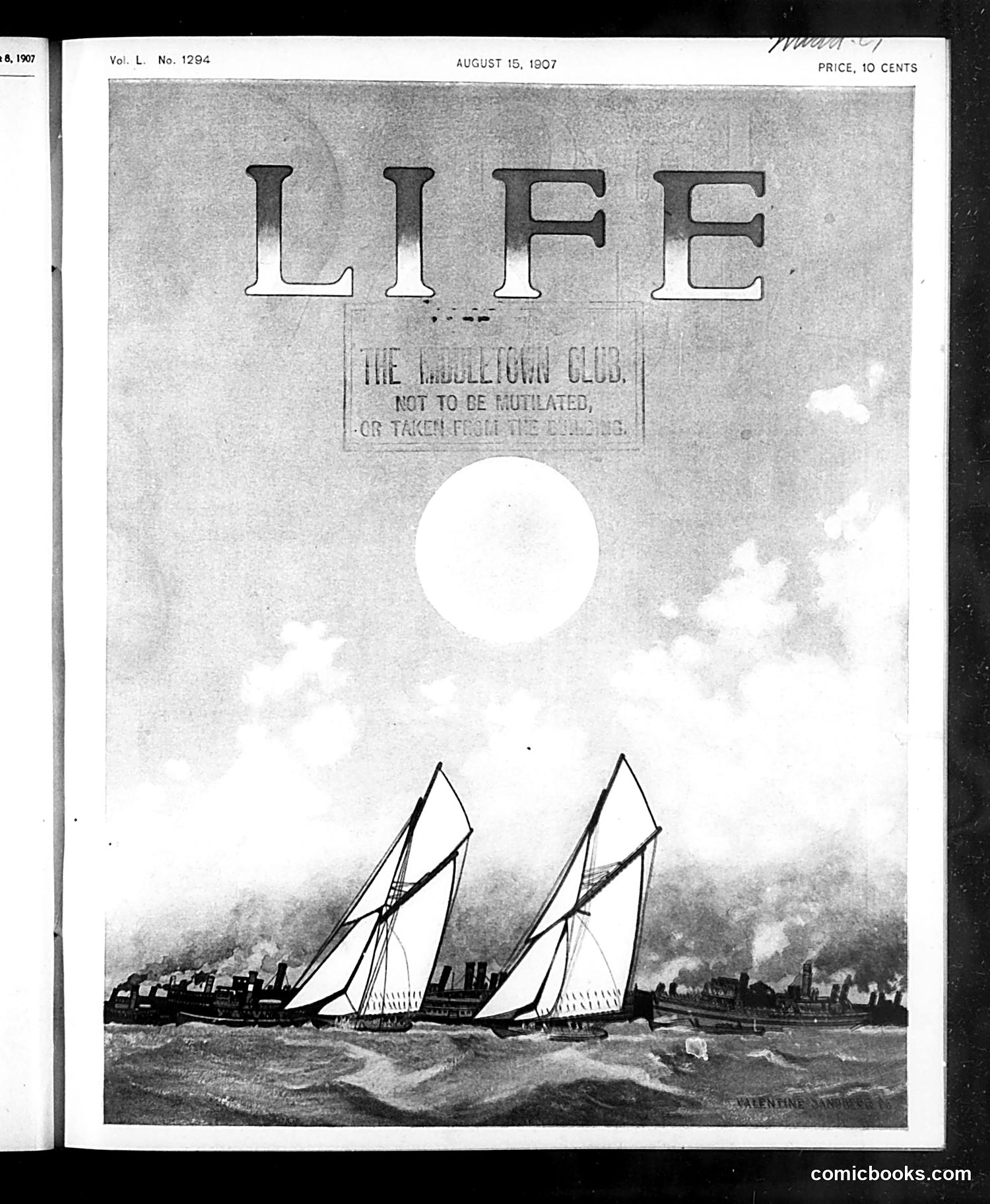
This August 15, 1907 *Life* cover depicts two racing yachts with full sails on choppy water, with an industrial cityscape smoking in the background under a bright sun. The image likely illustrates the America's Cup yacht races, a prestigious international sailing competition. The two competing vessels represent the dramatic competition between nations (probably the United States versus Britain or another challenger). The stark contrast between the elegant racing yachts in the foreground and the industrial smokestacks behind them may satirize the juxtaposition of leisurely elite sport against rapid industrial progress—suggesting wealthy Americans' pastimes coexist with the nation's manufacturing might. The stamp reading "The Lackeytown Club" appears to be a humorous publisher's mark rather than commentary on the image itself.
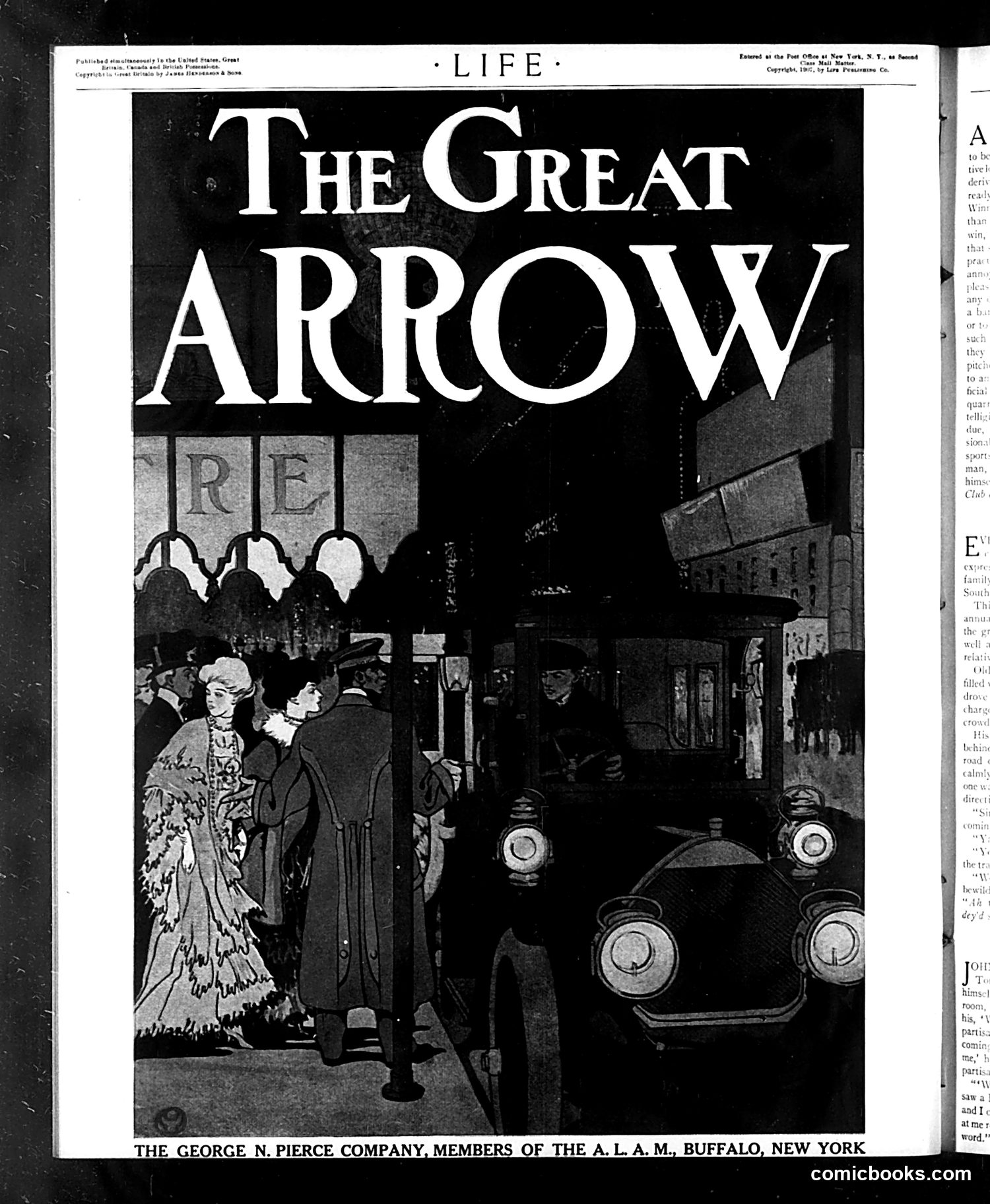
This appears to be a **film advertisement** rather than political satire. The large text "THE GREAT ARROW" dominates the page, promoting what seems to be a motion picture produced by The George N. Pierce Company (members of the A.L.A.M., an automotive manufacturers' association). The illustration depicts an elegant nighttime scene with well-dressed figures near an automobile with prominent headlights. The "RE" visible in the storefront likely references the film's title or distributor. This represents **early automotive advertising disguised as entertainment content**—a common practice in 1910s publications where car manufacturers promoted their vehicles through movie tie-ins and dramatic imagery emphasizing luxury, modernity, and aspirational lifestyle rather than practical vehicle specifications.
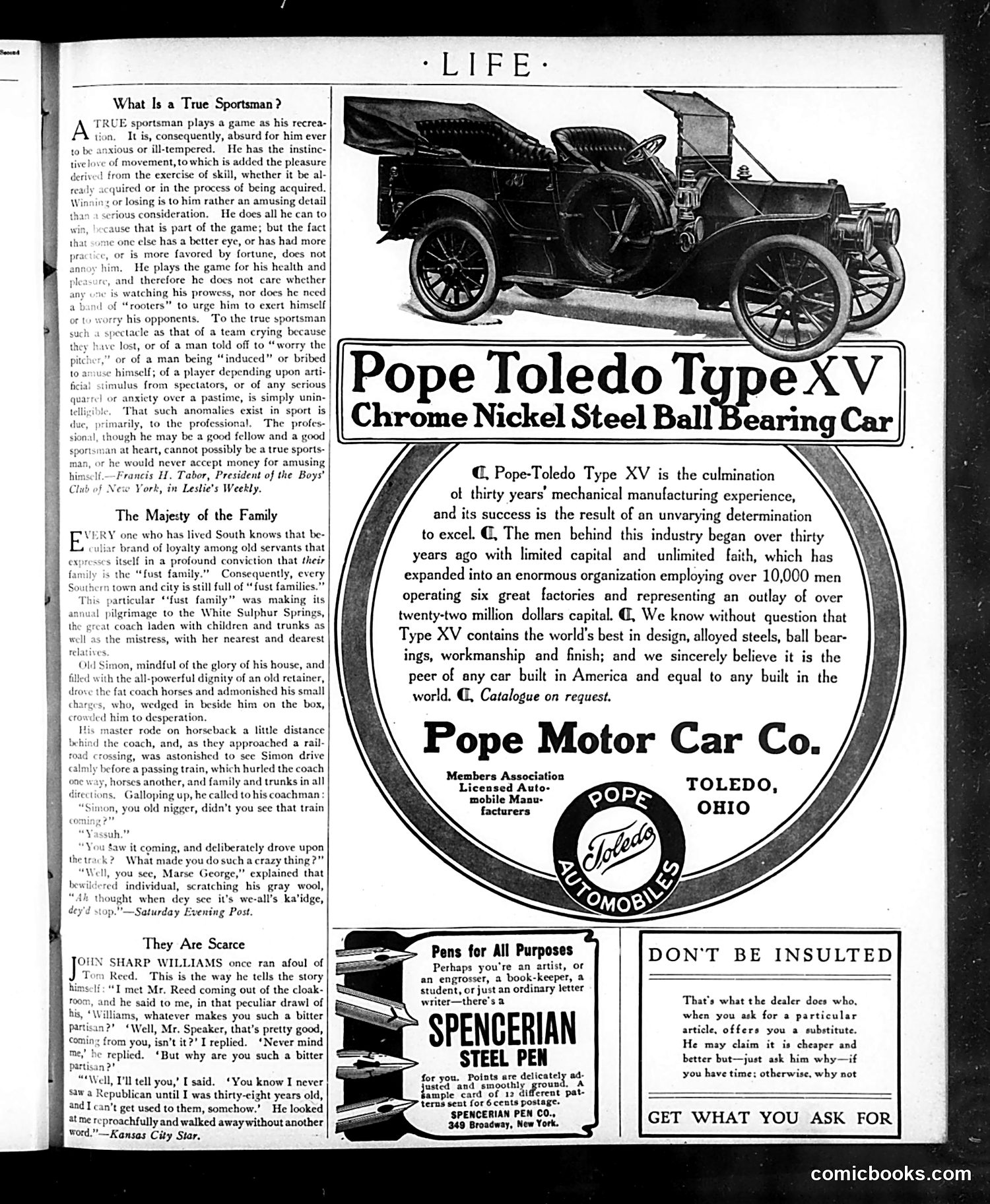
This page is primarily **advertising and editorial content** rather than political satire. The main advertisement promotes the **Pope Toledo Type XV automobile**, manufactured in Toledo, Ohio. The ad emphasizes the car's quality through claims about thirty years of manufacturing experience, advanced ball-bearing design, and American craftsmanship. The left column contains three brief **humorous anecdotes** rather than political cartoons: "What Is a True Sportsman?" discusses sporting ethics, "The Majesty of the Family" tells a story about an old retainer and a train encounter, and "They Are Scarce" recounts a dialogue about political affiliation. The smaller advertisements at bottom promote **Spencerian Steel Pens** and offer general consumer advice ("Get What You Ask For"). This appears to be a typical early 20th-century magazine page mixing light humor with product promotion.
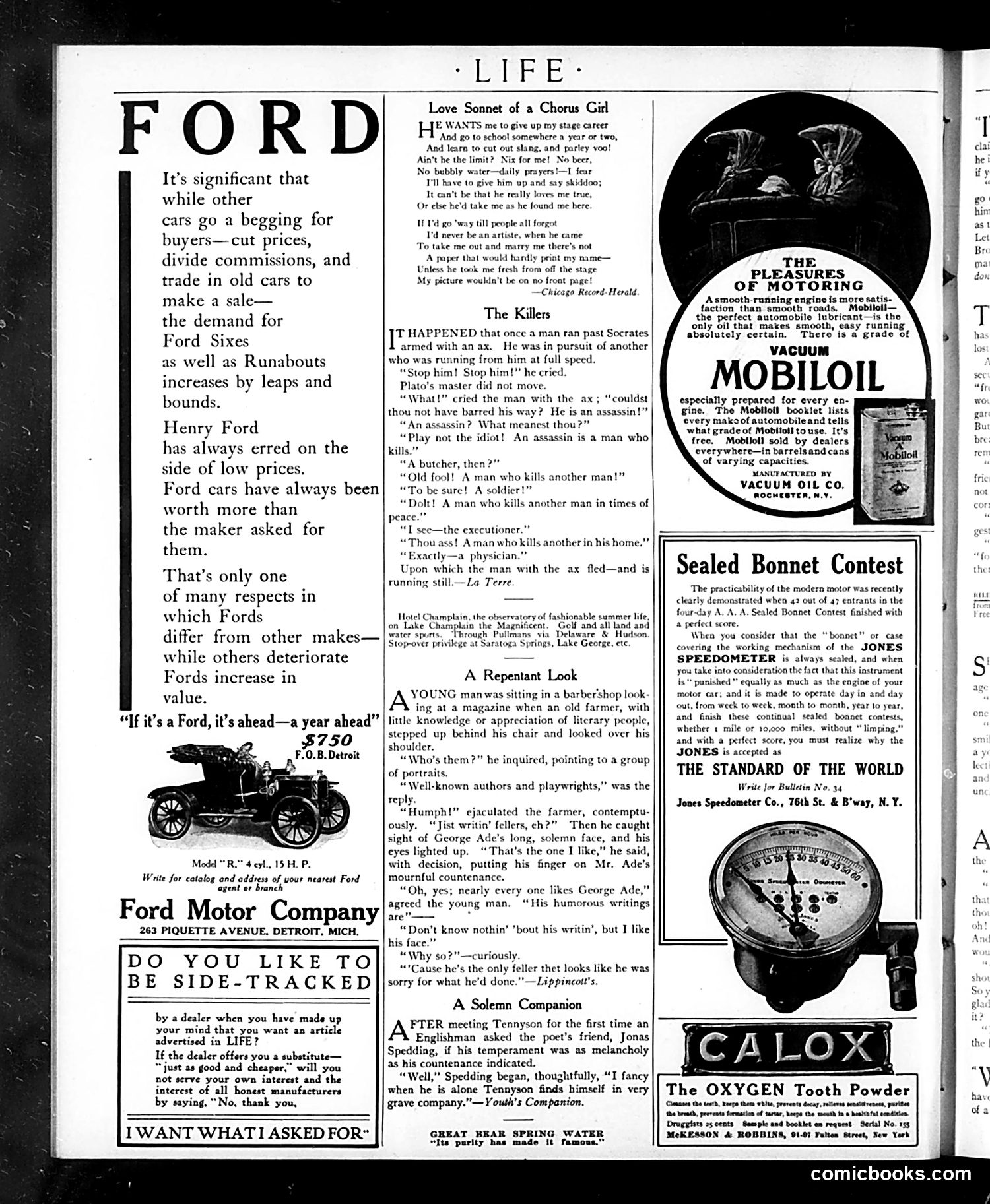
This page is primarily **advertising and literary content** rather than political satire. It features: **Main Content:** - Ford Motor Company advertisements emphasizing the Model "R"'s value and durability - Several short stories/literary pieces: "Love Sonnet of a Chorus Girl," "The Killers," "A Repentant Look," and "A Solemn Companion" - Product advertisements (Mobiloil, Calox tooth powder, etc.) **The Editorial Voice:** The Ford section includes commentary on Henry Ford's business philosophy—specifically that Ford cars maintain resale value better than competitors because Ford refuses to cut prices or trade in old vehicles. This reflects early 1900s automotive industry practices. **Satire Element:** The brief question "DO YOU LIKE TO BE SIDE-TRACKED?" criticizes dealers who substitute cheaper products when customers request advertised items—a consumer complaint about deceptive sales practices. The page reflects period concerns about honest business dealings and product value.
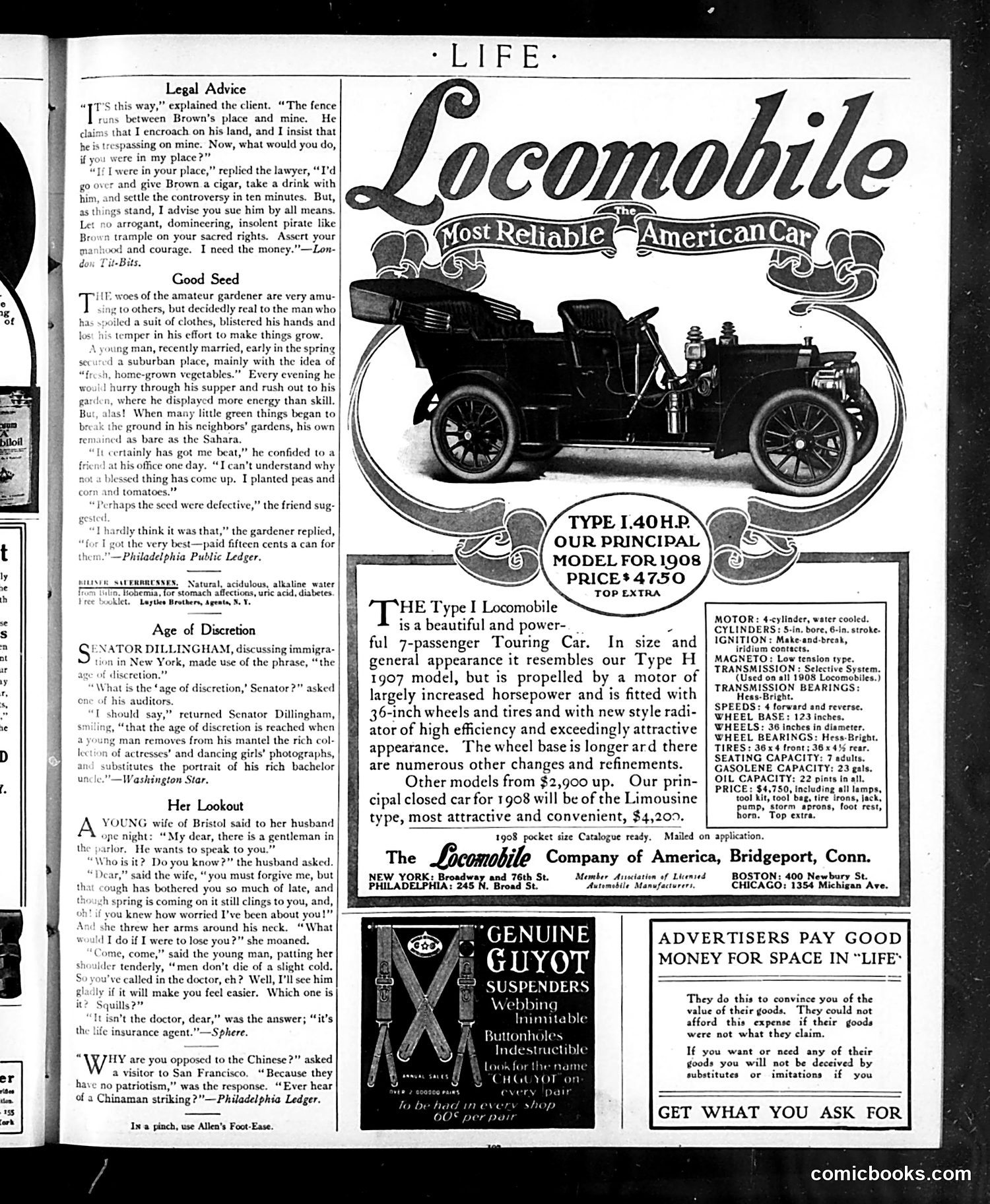
This page is primarily **advertising**, not satire. The dominant feature is a large advertisement for the Locomobile automobile, marketed as "Most Reliable American Car." The ad showcases the Type I model priced at $4,750, highlighting its 40-horsepower engine, seven-passenger capacity, and technical specifications. The left column contains four brief **humorous anecdotes** rather than political cartoons: "Legal Advice" (a property dispute joke), "Good Seed" (about an amateur gardener), "Age of Discretion" (a senator's immigration quote), and "Her Lookout" (domestic comedy). These are light social humor typical of Life magazine's satirical tradition, not commentary on current events. The page also includes smaller ads for Guyot suspenders and a notice about advertiser credibility.
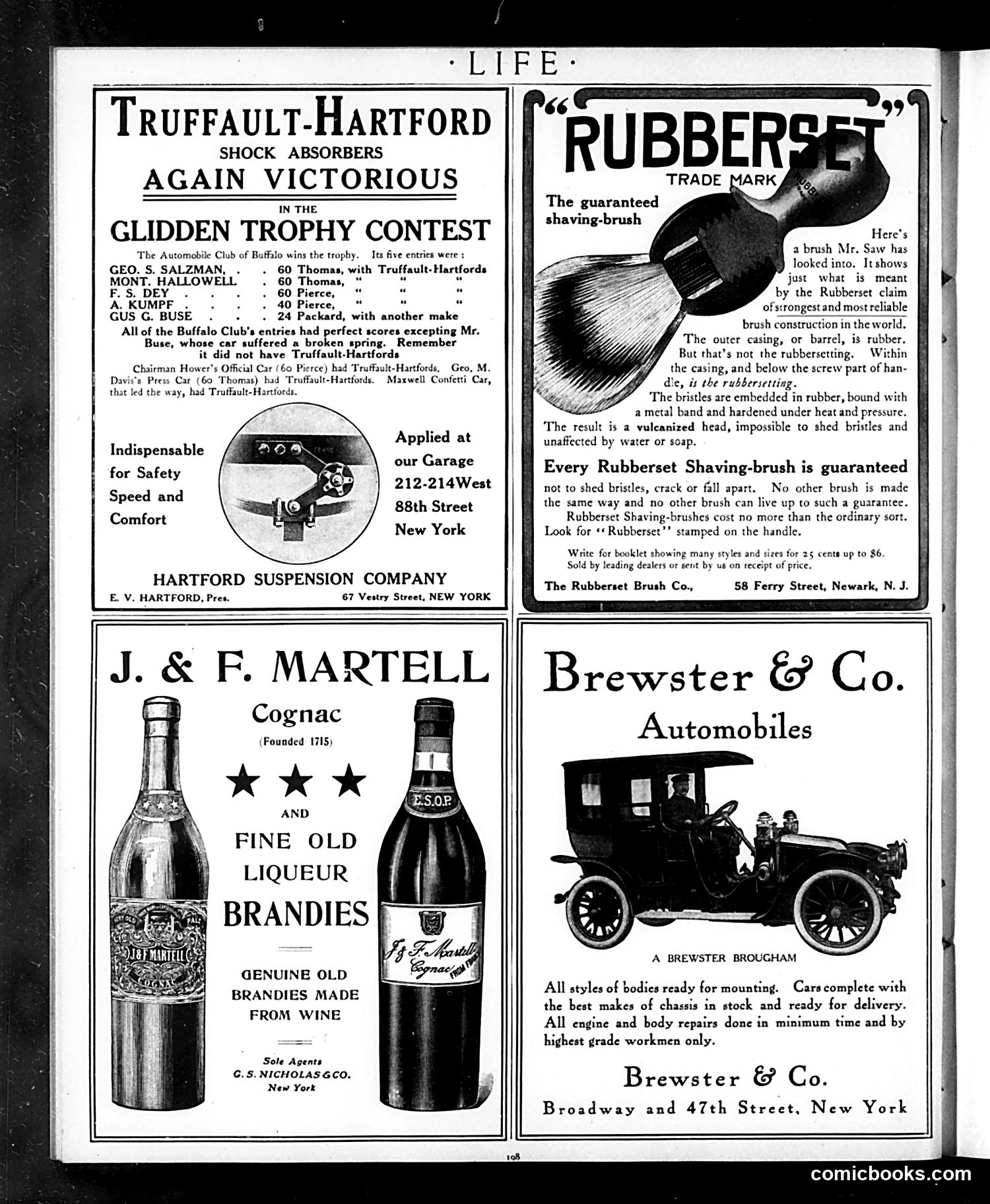
This page contains **no political cartoons or satire**—it's purely advertisements from what appears to be an early 20th-century Life magazine. The ads promote: 1. **Truffault-Hartford shock absorbers** for automobiles, referencing a "Glidden Trophy Contest" won by Buffalo's Automobile Club 2. **Rubberset shaving brushes**, emphasizing their vulcanized rubber construction and durability 3. **J. & F. Martell Cognac**, advertising brandy varieties 4. **Brewster & Co. automobiles**, showing a luxury car model The page is entirely commercial, targeting affluent readers interested in automobiles, grooming products, and luxury spirits. There is no satirical content or political commentary present.
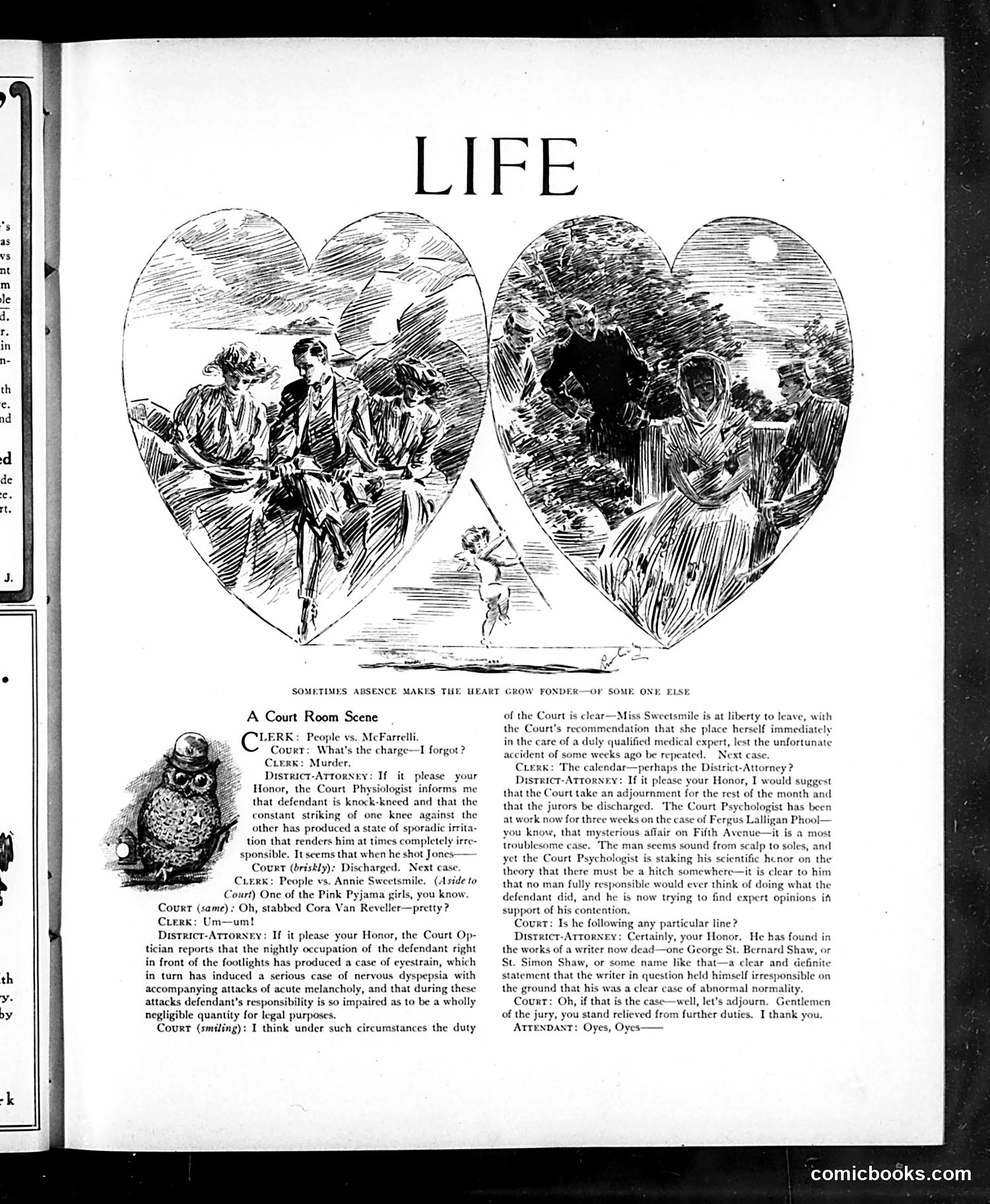
This page features a satirical illustration titled "LIFE" showing two heart-shaped vignettes. The left depicts a romantic couple in an outdoor setting; the right shows a domestic family scene. The caption reads: "SOMETIMES ABSENCE MAKES THE HEART GROW FONDER—OF SOME ONE ELSE." Below is a "Court Room Scene" dialogue satirizing legal proceedings. The exchange mocks a court case involving nervous exhaustion and physical symptoms (knee-striking, eye strain). The District Attorney argues the defendant's condition is exaggerated, while the Court Physiologist supports the plaintiff's medical claims. The satire targets both the legal system's handling of medical evidence and the emerging field of medical expertise in courtrooms—suggesting skepticism about whether such "scientific" claims were genuine or theatrical performance.
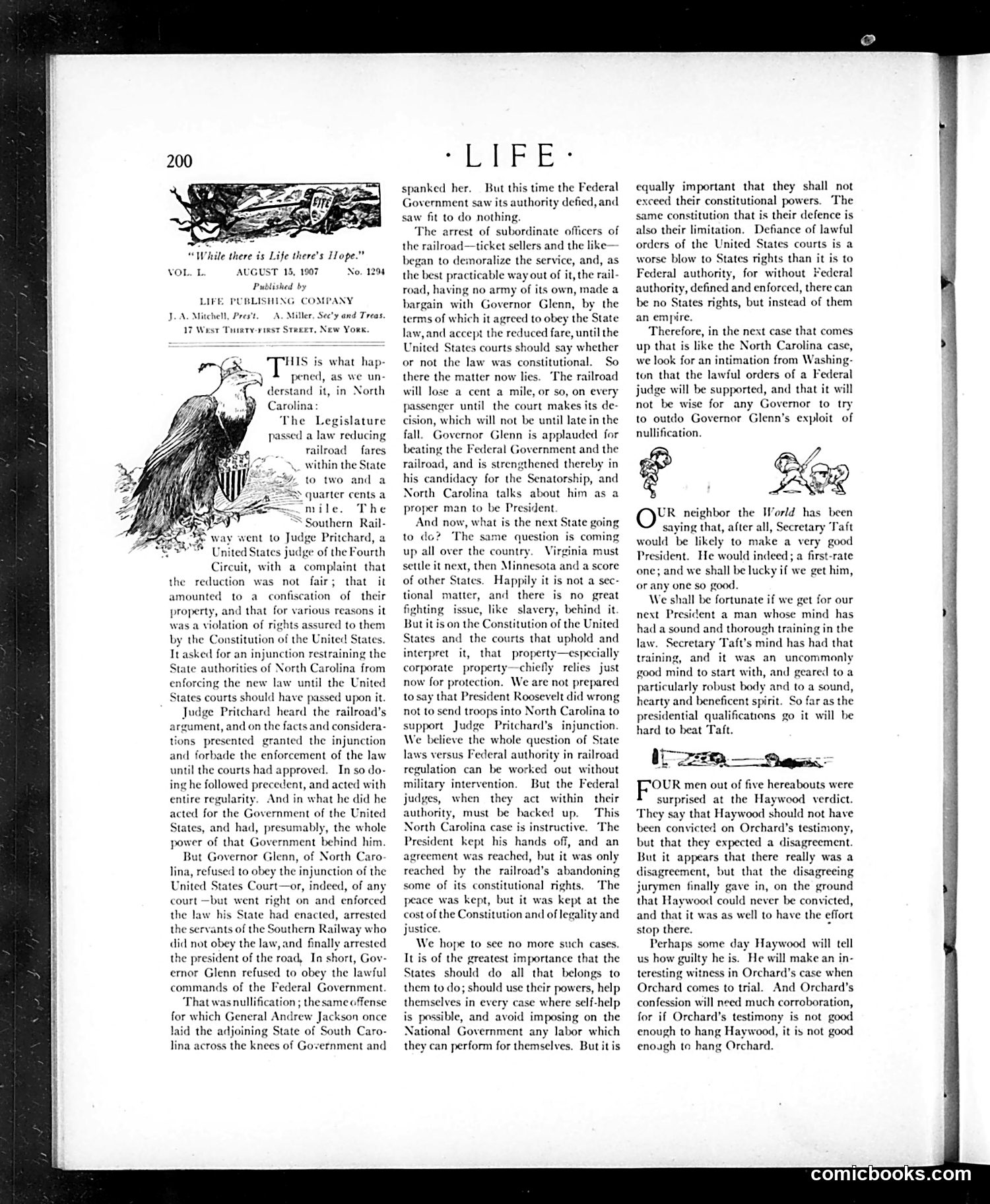
This page from *Life* magazine (August 19, 1902) discusses a legal dispute involving North Carolina's railroad regulation versus Federal Government authority. The text references Judge Pritchard's court case concerning whether a state can enforce laws that contradict Federal rulings. The illustration shows an eagle with distinctive features, likely representing American federal power or constitutional authority. The article argues that States should respect constitutional limits on their powers and not defy Federal court orders. It warns against Governor Glenn's resistance to Federal authority, drawing parallels to earlier constitutional conflicts. The piece advocates for Federal judicial supremacy while acknowledging States' legitimate powers within constitutional bounds—a core Federalism debate of the Progressive Era. The tone is cautionary toward state defiance of national authority.
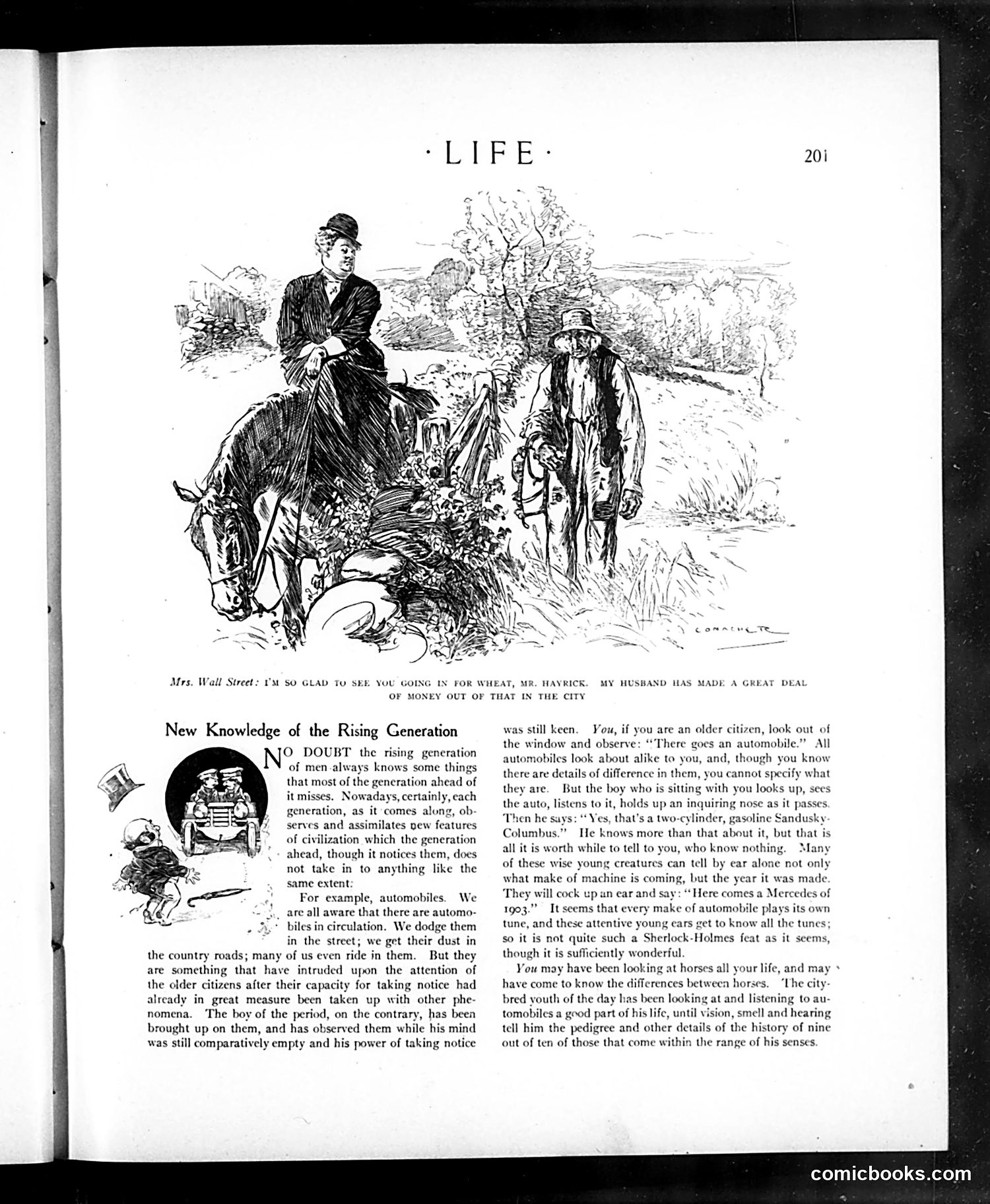
The main illustration depicts a rural scene where a woman on horseback speaks to a farmer about wheat prices and a profitable urban financial deal. The caption reads: "Mrs. Wall Street: I'm so glad to see you going in for wheat, Mr. Hayrick. My husband has made a great deal of money out of that in the city." The satire targets the disconnect between Wall Street speculators and actual farmers. The farmer's name "Hayrick" and the woman's self-identification as "Mrs. Wall Street" emphasize this divide. The joke suggests that city financiers profit from agricultural commodities while farmers themselves remain disconnected from these urban money-making schemes. The article "New Knowledge of the Rising Generation" discusses how younger people notice automobiles and other modern inventions that older generations overlook—a commentary on generational attitudes toward technological progress.
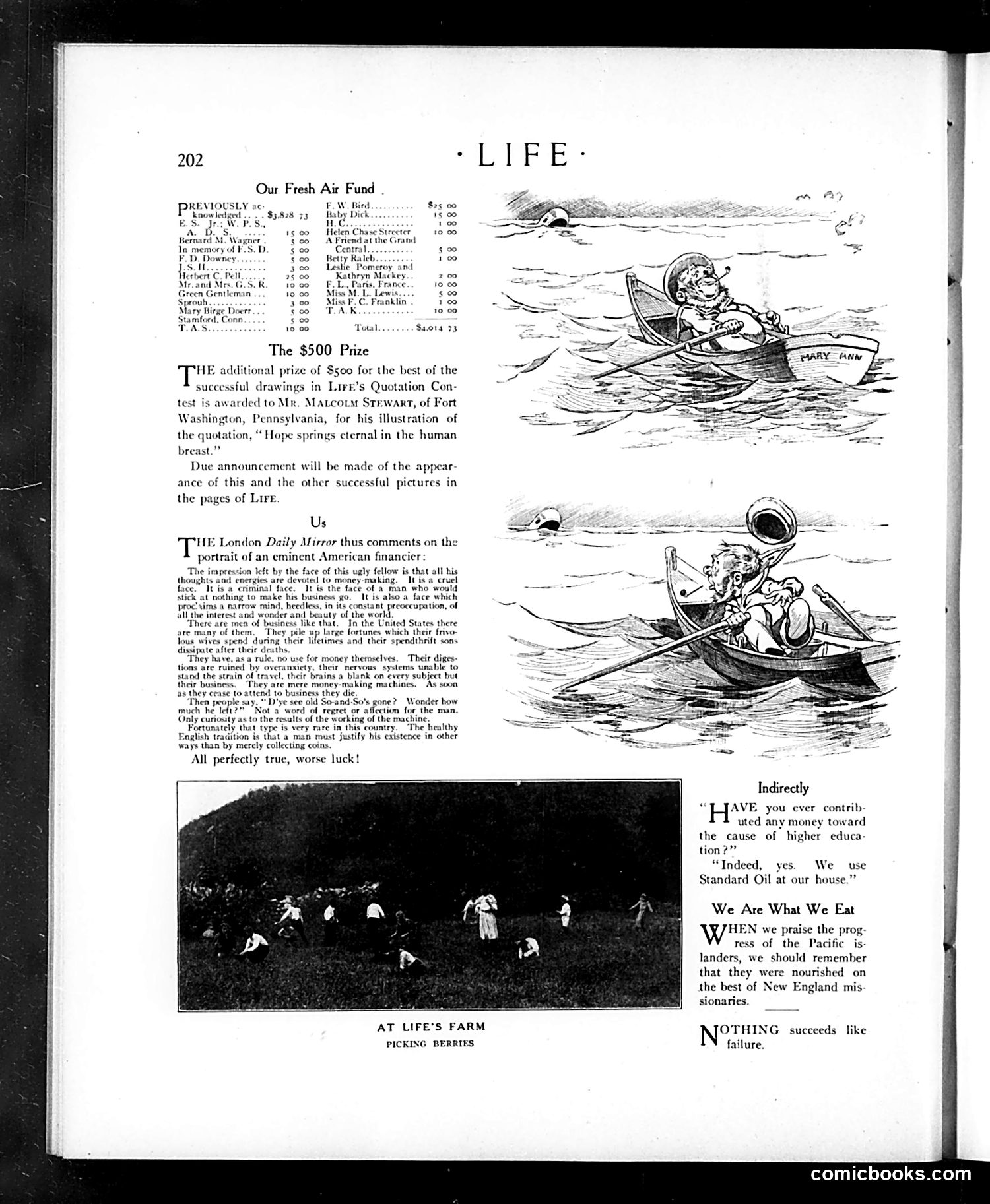
This page contains two main sections: **"Our Fresh Air Fund"** lists donors to a charitable campaign, followed by **"The $500 Prize"** announcing an award to Malcolm Stewart for an illustration of the quotation "Hope springs eternal in the human breast." **The cartoon illustrations** (right side) depict characters in boats on water, labeled "Mary Farm," appearing to satirize leisure activities or summer recreation. **"Us"** section quotes the *London Daily Mirror* critiquing American businessmen's character—suggesting they're mercenary, dishonest, and driven by profit rather than principle. The commentary contrasts this unfavorably with English business culture. The page concludes with brief quotes about education funding and an aphorism: "Nothing succeeds like failure." The satire targets American business ethics and cultural attitudes.
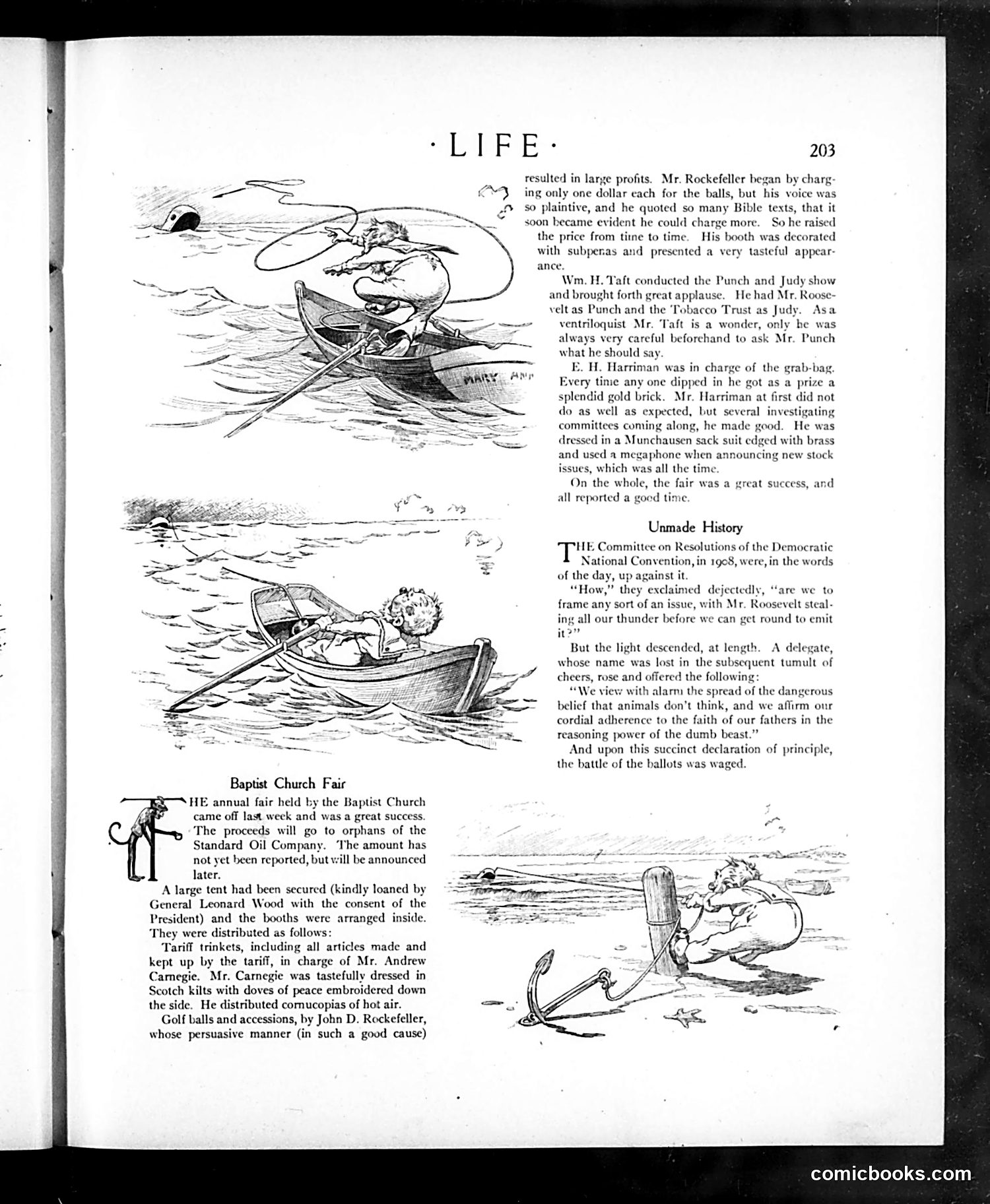
The page contains two distinct sections: **Top cartoon**: Depicts what appears to be political figures in water, likely satirizing the 1908 Democratic National Convention. The accompanying text criticizes the Committee on Resolutions for their verbose stance, quoting their objection to framing issues "with Mr. Roosevelt's stealing all our thunder before we can get around to emit it." **Lower section**: Describes the Baptist Church Fair, a charitable event benefiting orphans of the Standard Oil Company. This is satirical commentary on John D. Rockefeller's philanthropy—implying Standard Oil's business practices created orphans, making charitable donations somewhat ironic. The text mentions Rockefeller's "persuasive manner" securing donations, a sardonic reference to the monopoly's controversial reputation. Both sections critique wealthy industrialists and political hypocrisy through humor.
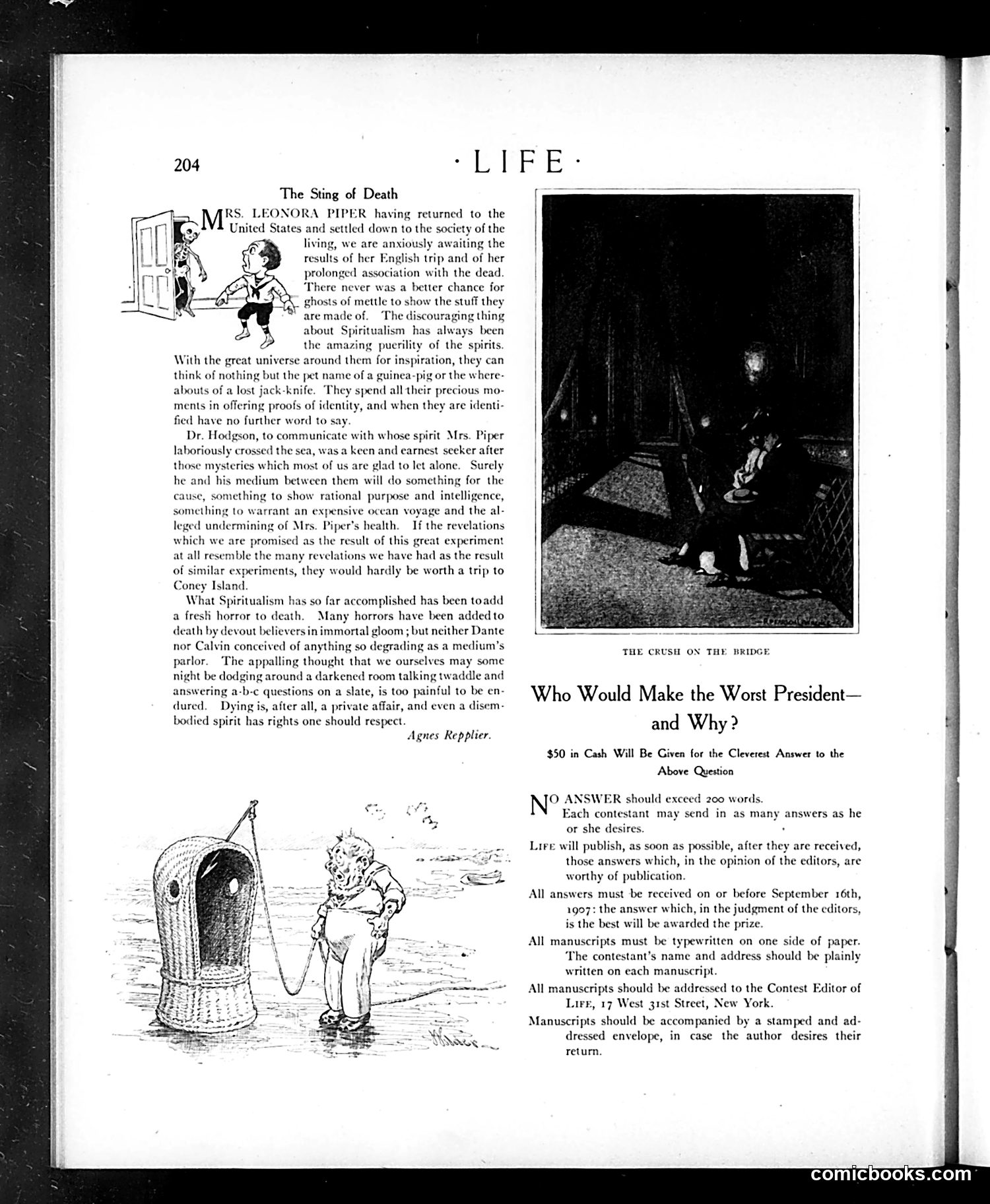
This page contains two unrelated sections. The top left features "The Sting of Death," a satirical article by Agnes Repplier criticizing spiritualism and mediums. It mocks the "puerility" of séances, where participants waste time seeking communication from deceased relatives or pets through spiritualists like "Dr. Hodgson" and "Mrs. Piper." The author suggests such activities are intellectually dishonest and degrading. The bottom right announces a contest: "Who Would Make the Worst President—and Why?" offering $50 cash for the best 200-word answer. This appears to be a humorous reader-participation feature typical of Life's satirical approach to politics, inviting readers to satirically nominate unsuitable presidential candidates. The exact historical context and intended targets remain unclear without additional dating information.
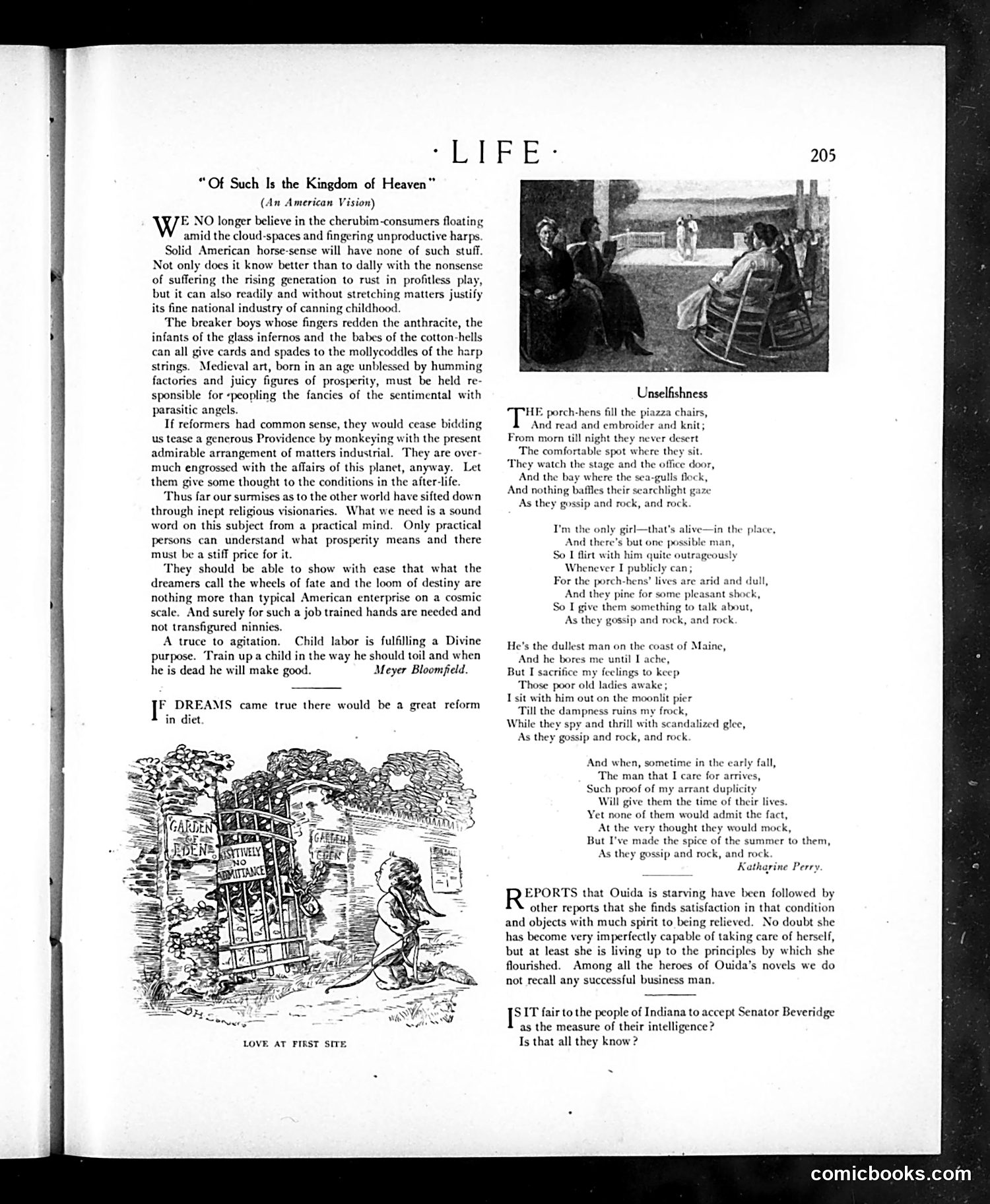
This cartoon depicts a young man approaching a garden gate labeled with various attractions: "GARDEN," "EDEN," "SUMMER," and "LOVE." The illustration satirizes romantic idealization—the notion that love strikes instantaneously upon seeing an attractive woman or idyllic setting. The surrounding text mocks sentimental romanticism and impractical idealism, arguing Americans should embrace pragmatism over sentimentality. The piece criticizes those who romanticize childhood labor and ignore industrial realities, suggesting reformers waste energy on unrealistic dreams rather than practical solutions. The cartoon's title and composition suggest satire of the phrase "love at first sight"—implying that instant attraction, like sudden conversion to idealistic causes, oversimplifies complex human and social realities that demand serious, practical consideration rather than emotional impulse.
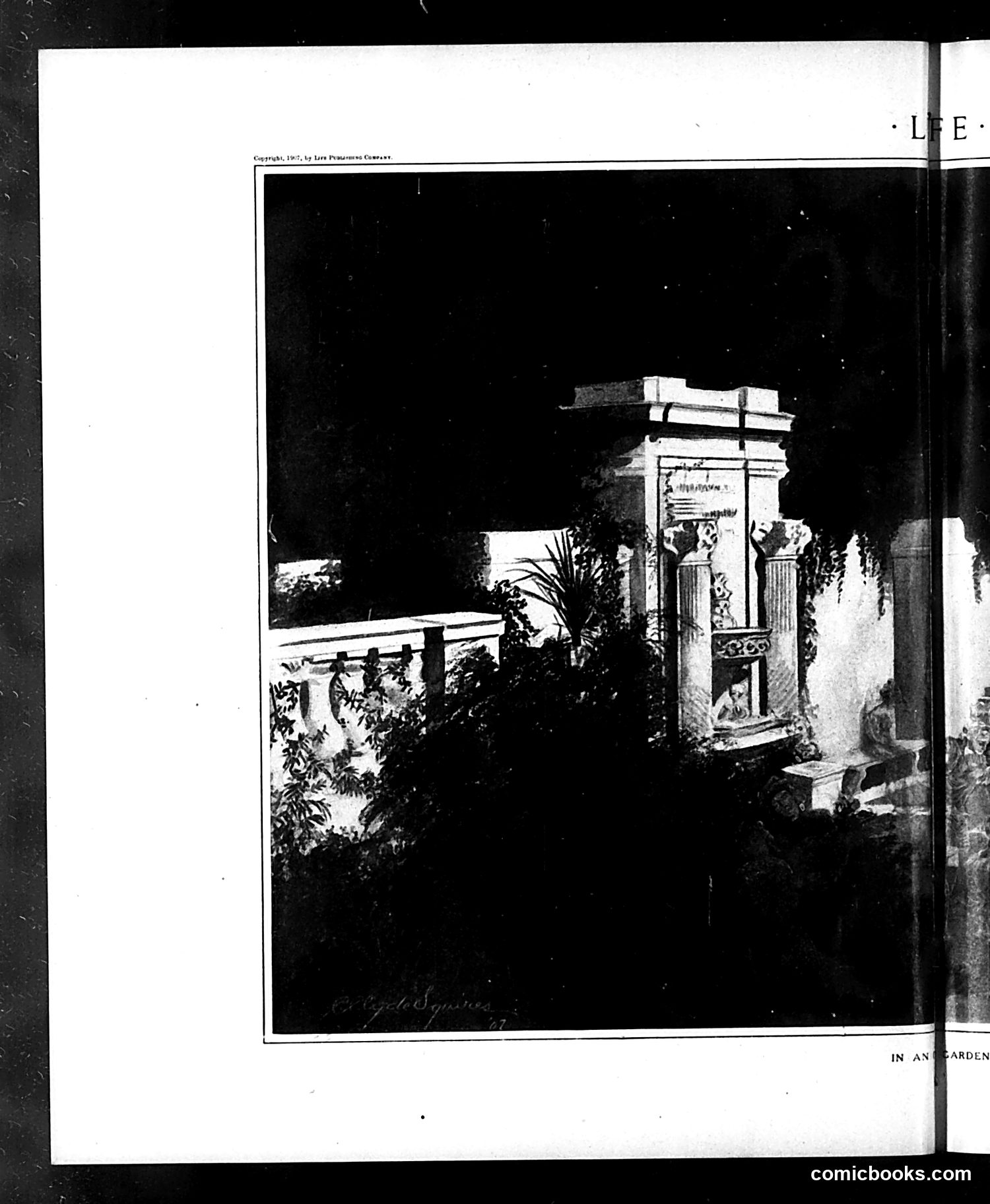
This page contains a photograph rather than a cartoon. The image shows a nighttime garden scene with classical architectural elements—a columned structure or pavilion with decorative details, surrounded by plants and foliage. The photograph appears to be artistic rather than satirical. The caption reads "IN AN GARDEN" (likely "IN A GARDEN"), suggesting this is documentation of landscape design or garden architecture rather than political commentary. Without visible caricatures, exaggerated figures, or satirical elements, this appears to be a straightforward photographic feature, possibly showcasing garden design trends or architectural styles of the era when *Life* magazine published it. The specific subject matter and historical context remain unclear from the image alone.
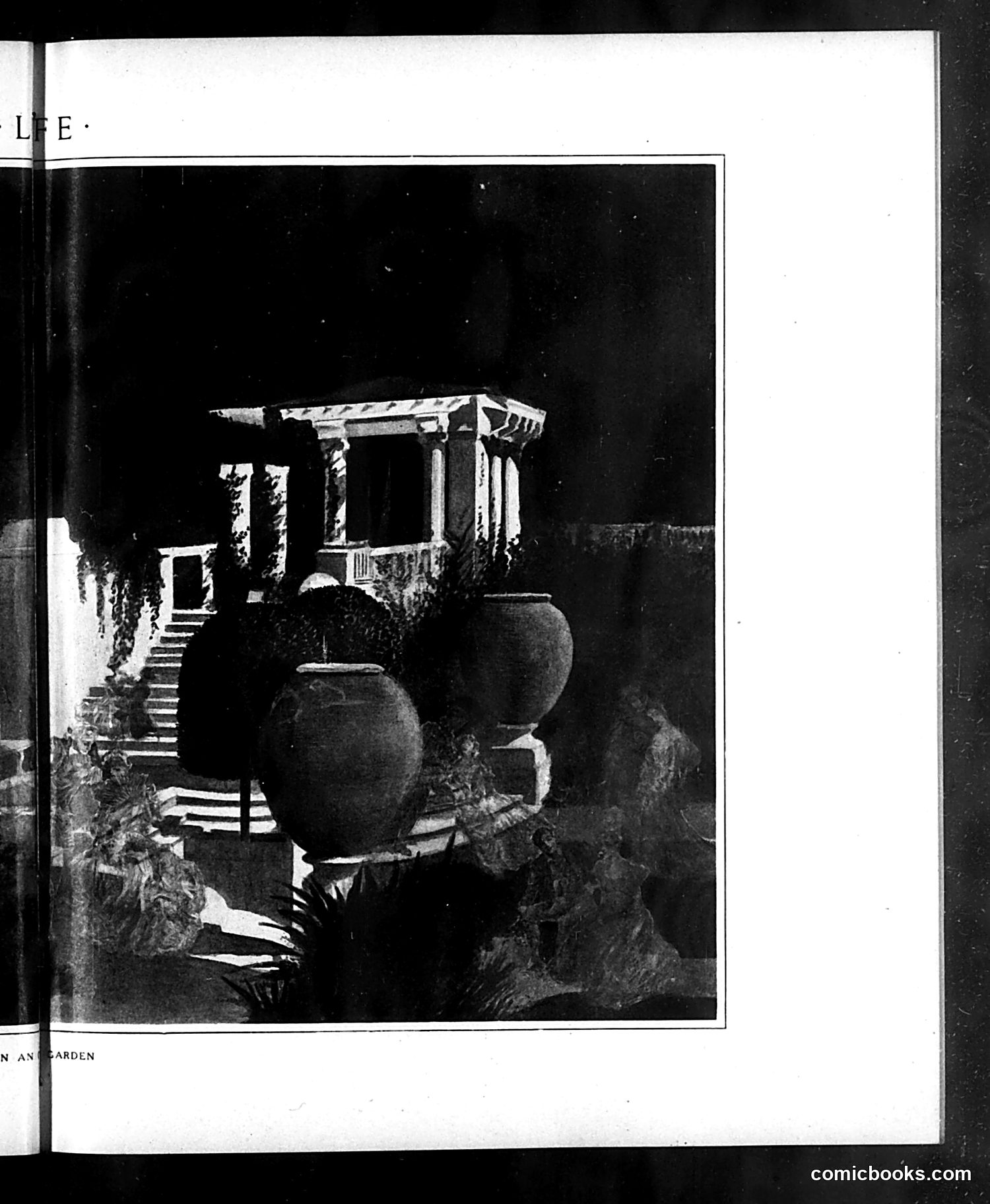
This appears to be a page from *Life* magazine featuring a black and white photograph rather than a cartoon. The image shows a classical garden structure with columns and a pergola, flanked by large decorative urns in the foreground. The setting suggests an elegant estate or formal garden. The partial text visible at bottom reads "N AN GARDEN" (likely "IN AN GARDEN" or similar), indicating this is likely an illustration accompanying an article about garden design or architecture. Without complete text or additional context, I cannot identify the specific satirical point. This may be architectural commentary, social satire about wealth and taste, or simply editorial illustration for a lifestyle feature—but the image alone doesn't provide sufficient information for definitive interpretation.
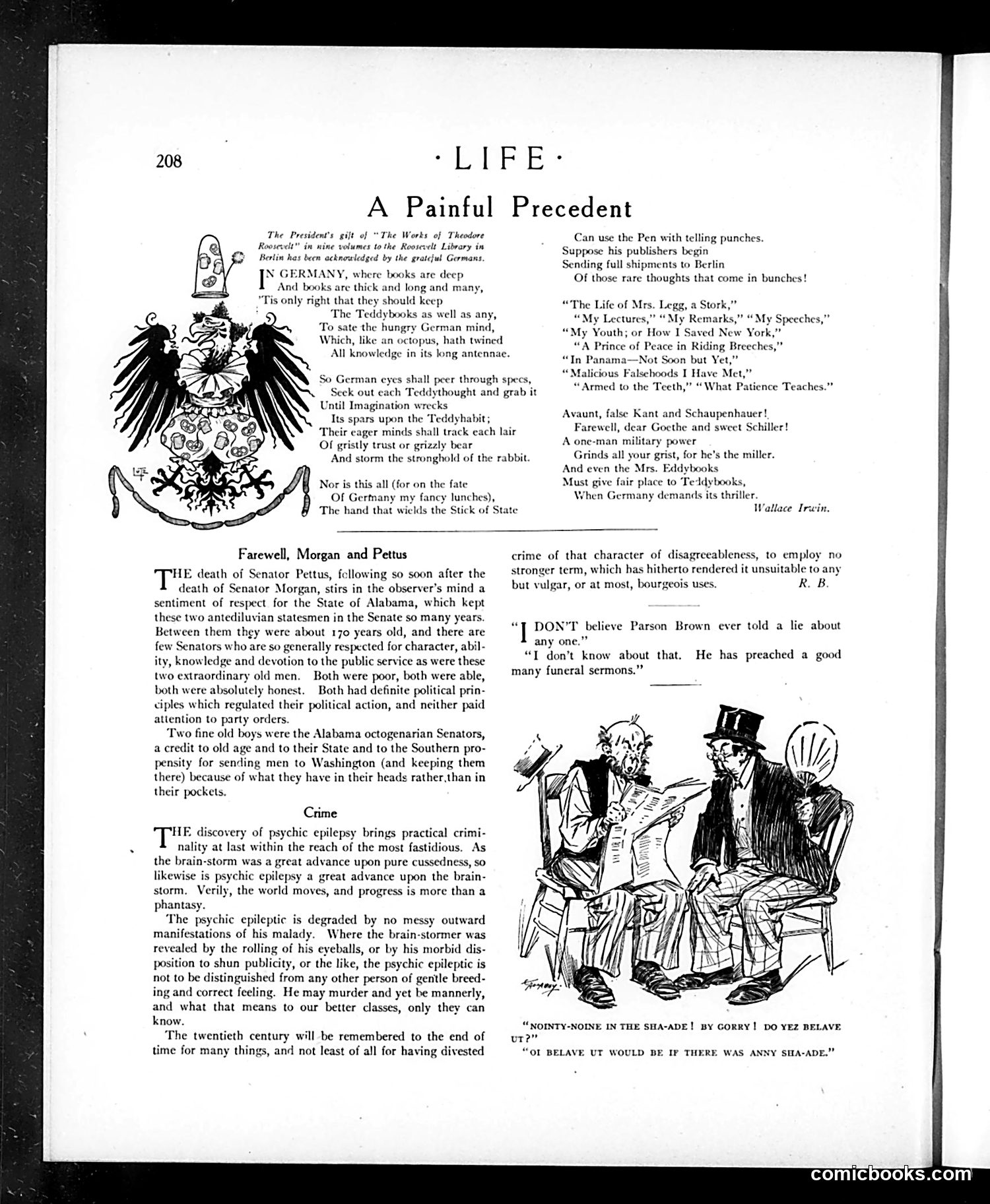
This page contains political satire on Germany and domestic American commentary (circa early 1900s based on references). **"A Painful Precedent"** mocks Germany's reception of Theodore Roosevelt's published works. The poem satirizes German intellectuals eagerly absorbing Roosevelt's writings as if they were profound philosophy, when in fact they're mostly self-promotional works about his hunting, politics, and autobiography. The humor lies in imagining German scholars treating Roosevelt's casual writings with scholarly reverence, and fears Germany might become militaristically inspired by his "one-man military power" persona. **"Farewell, Morgan and Pettus"** eulogizes two elderly Alabama senators, praising their honesty, independence, and devotion to public service despite their advanced age (170 combined years). **"Crime"** is sardonic social commentary arguing that the pseudo-scientific concept of "psychic epilepsy" allows wealthy criminals to commit terrible acts (murder) while maintaining polite social appearances—a critique of class hypocrisy where genteel breeding masks immorality. The bottom cartoon and dialogue appear to be unrelated dialect humor.
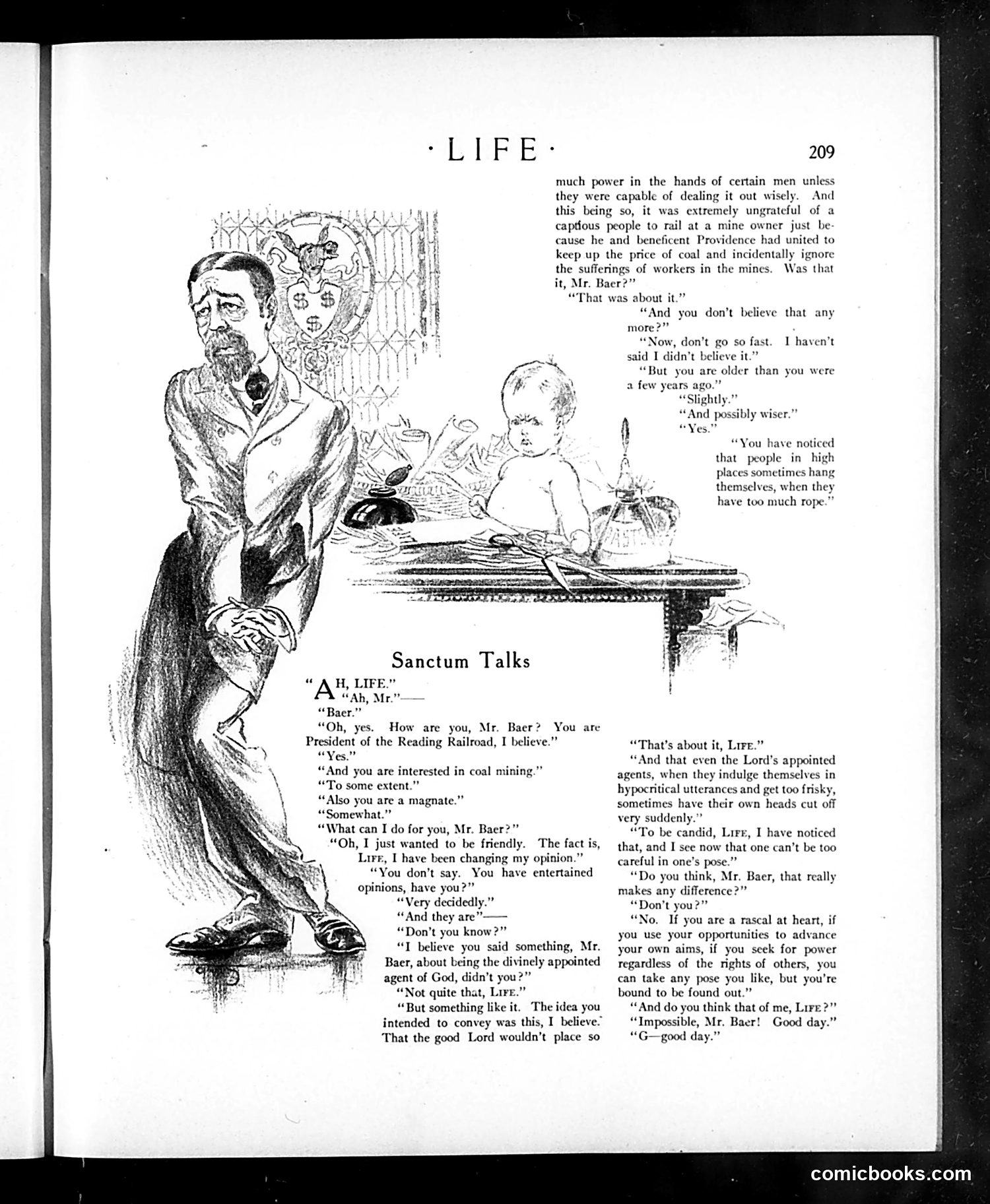
This satirical dialogue targets **George F. Baer**, president of the Reading Railroad and major coal mine operator. The cartoon mocks Baer's famous 1902 public statement during a coal miners' strike where he claimed mine owners were "divinely appointed agents of God" — positioning themselves as benevolent forces justified in keeping coal prices high regardless of worker suffering. Life's editor uses Socratic questioning to expose Baer's hypocrisy: he's supposedly changed his mind about his "divine appointment" justification, yet the conversation reveals his fundamental rascality remains unchanged. The final joke is cutting — even if Baer now privately disbelieves his own rhetoric, his corrupt nature makes the pose irrelevant. This reflects the Progressive Era's anti-monopoly sentiment and criticism of wealthy industrialists who dressed exploitation in moral language while workers endured dangerous conditions and poverty.
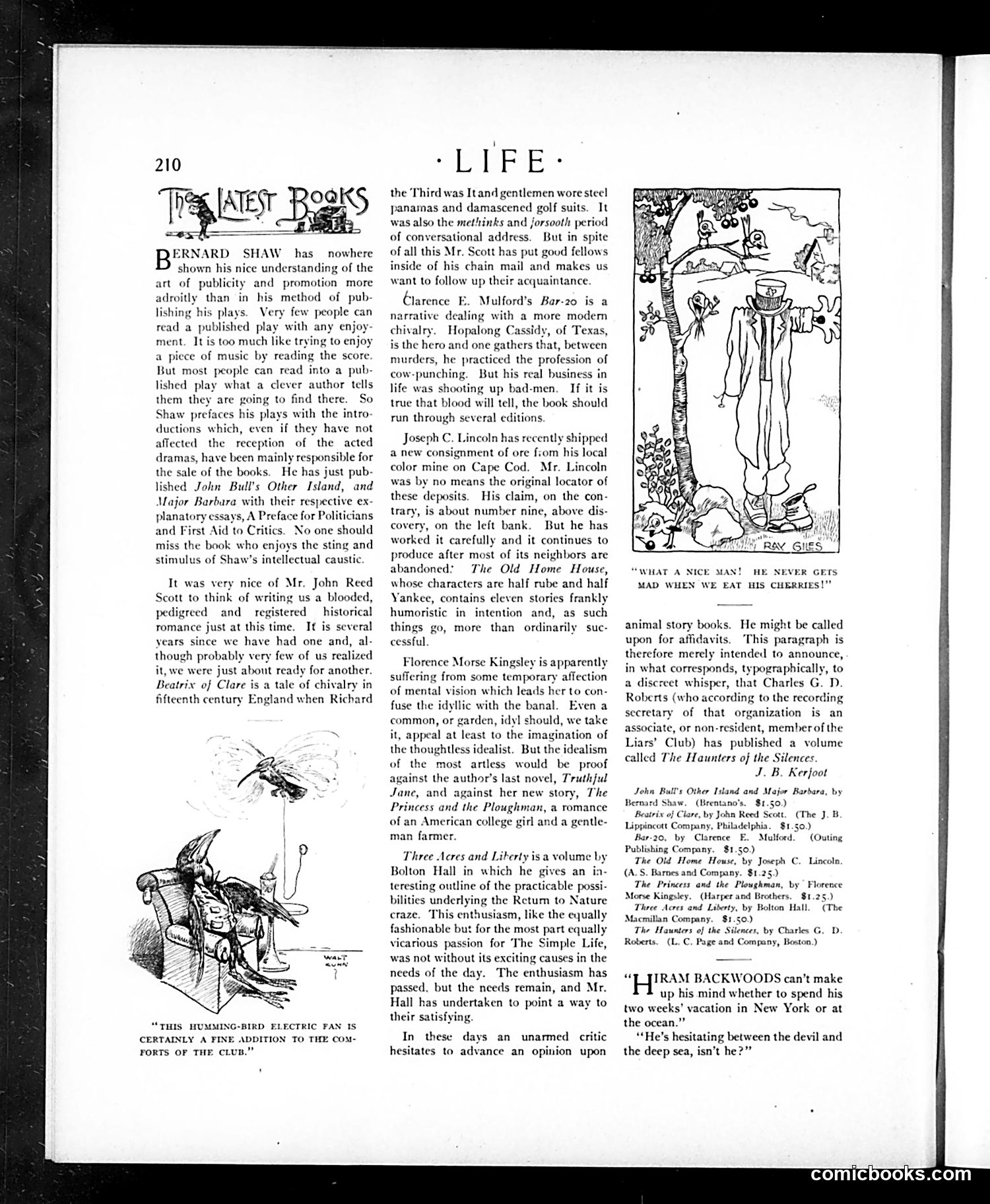
This page reviews recent books, with two cartoons illustrating club life humor. **The cartoons:** Both depict well-to-do club members. The top right shows a man in formal dress admiring a "humming-bird electric fan"—a humorous contrast between refined gentlemen and a whimsical mechanical novelty. The bottom left features the caption "This humming-bird electric fan is certainly a fine addition to the comforts of the club," with the lower cartoon showing a man noted for never getting angry "when we eat his cherries"—suggesting either a generous host or someone too timid to protest. **The satire:** The humor relies on depicting wealthy club members as simultaneously sophisticated and absurd—marveling at gadgetry or tolerating imposition without protest. This reflects early 1900s leisure-class mockery: the *Life* magazine tradition of gently ridiculing the pretensions and peculiarities of affluent society. The page is primarily a book review section, making the cartoons incidental to the magazine's main content.
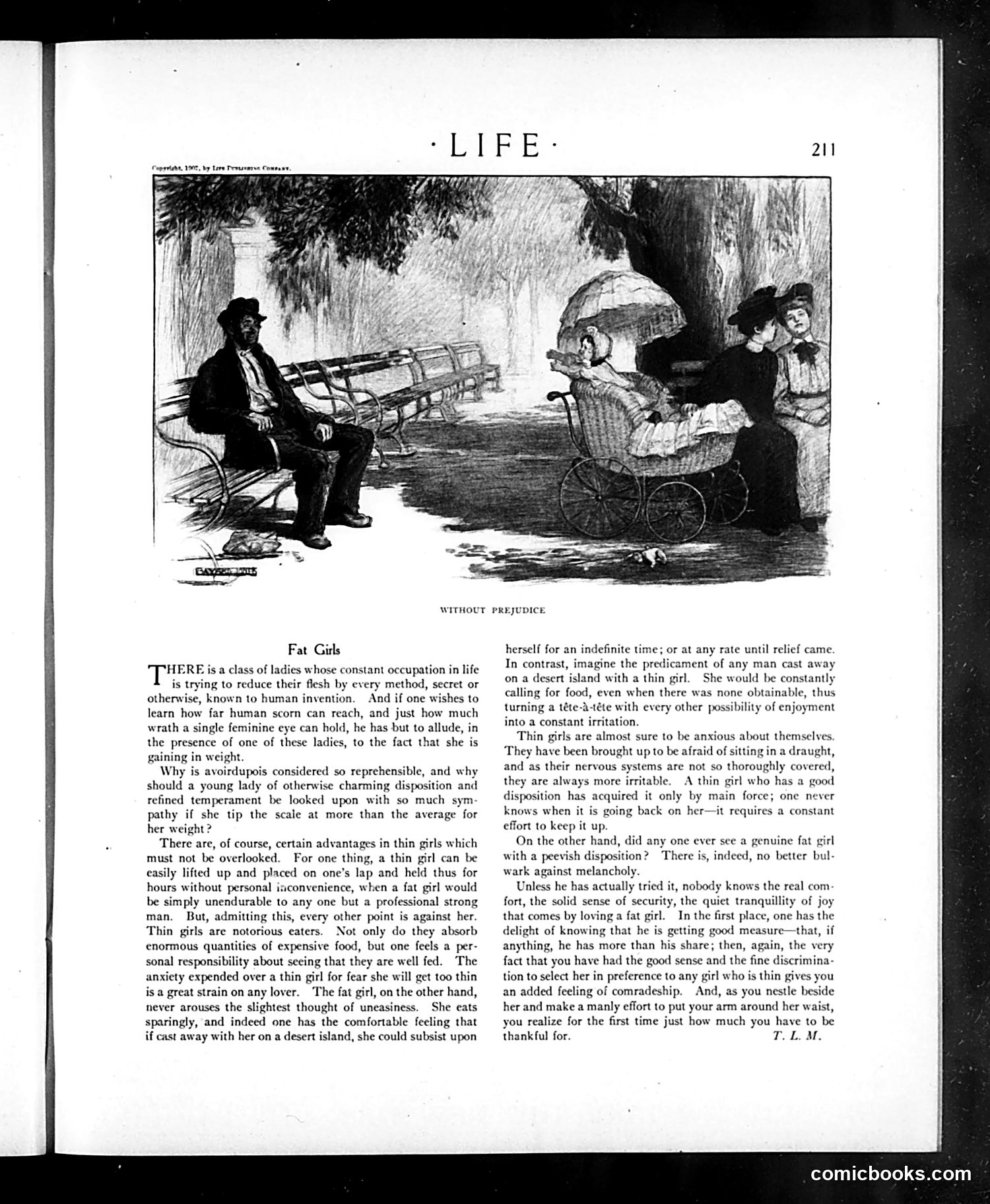
This is a satirical essay with an accompanying cartoon titled "Without Prejudice." The piece ironically defends overweight women against society's criticism of their weight. The cartoon shows a well-dressed man on a bench encountering two women with a baby carriage—presumably a "fat girl" and her companion. The essay's satire operates through exaggeration: it argues fat girls are superior romantic partners because they're content, require less anxious care than thin girls, and could literally sustain a man if stranded on a desert island. Thin girls, by contrast, are portrayed as neurotic eaters who constantly demand food and attention. The humor lies in inverting conventional 1907 beauty standards (which favored thinness) by presenting absurdist "practical" reasons to prefer heavier women. The title "Without Prejudice" signals the ironic reversal—the author claims objectivity while making deliberately ridiculous arguments about women's bodies as economic resources. This reflects early 20th-century attitudes toward female bodies and courtship, presented through exaggerated logic.
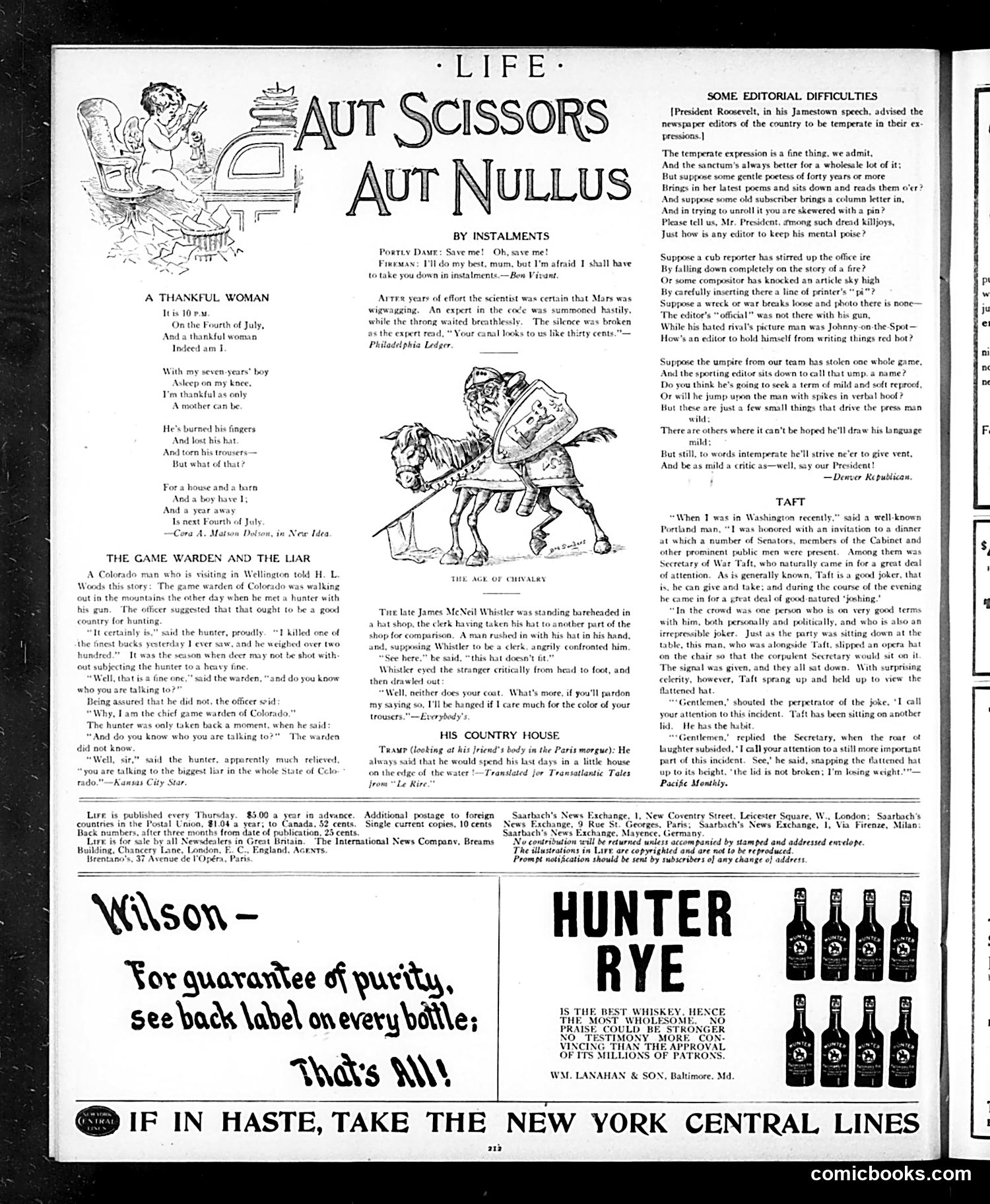
This page satirizes early-20th-century editorial challenges facing newspaper editors, likely responding to President Roosevelt's call for "temperate" journalism. The main cartoon depicts an editor wrestling with various workplace crises—a submissive female poet demanding to read her work, a compositor's printing errors ("pi"), missing photographs of major events, and a sports editor tempted to write inflammatory language about an umpire. The satire's point: Roosevelt's advice about restraint is impractical when editors face constant disruptions and frustrations. The shorter anecdotes ("The Game Warden and the Liar," "A Thankful Woman") are unrelated filler pieces. The page also includes advertisements for Wilson whiskey and Hunter Rye, typical of *Life*'s content mix.
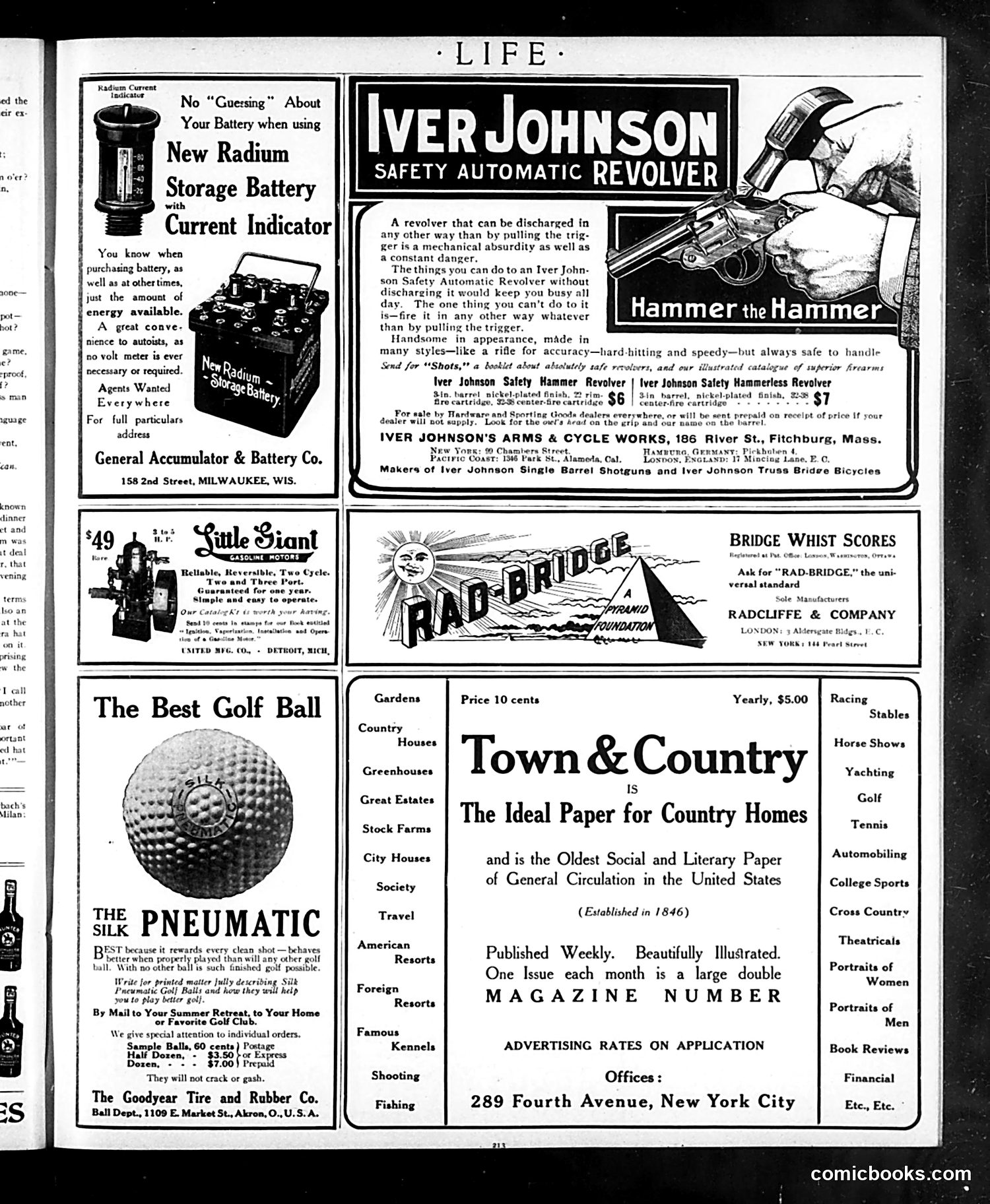
This page is **primarily advertising**, not political satire. It features product advertisements typical of the era: **Major Ads:** - **Iver Johnson Safety Automatic Revolver**: Emphasizes the gun's mechanical safety feature—it can only fire by pulling the trigger, positioning this as a major selling point for responsible owners concerned about accidental discharge. - **Radium Storage Battery**: A "New Radium" battery with current indicator for automobiles. - **Little Giant Engine**: A small motor advertised as "reliable" and reversible. - **The Pneumatic Golf Ball**: Claims superior performance over competitors. - **Town & Country Magazine**: Positioned as the ideal publication for country estates, established 1846. **Historical Context:** These ads reflect early 20th-century consumer culture—automobiles becoming commonplace, radium marketed as a desirable modern element (before radiation dangers were understood), and golf gaining popularity among wealthy Americans. **No political cartoon or satire is present** on this page. It's a straightforward advertising section from Life magazine.
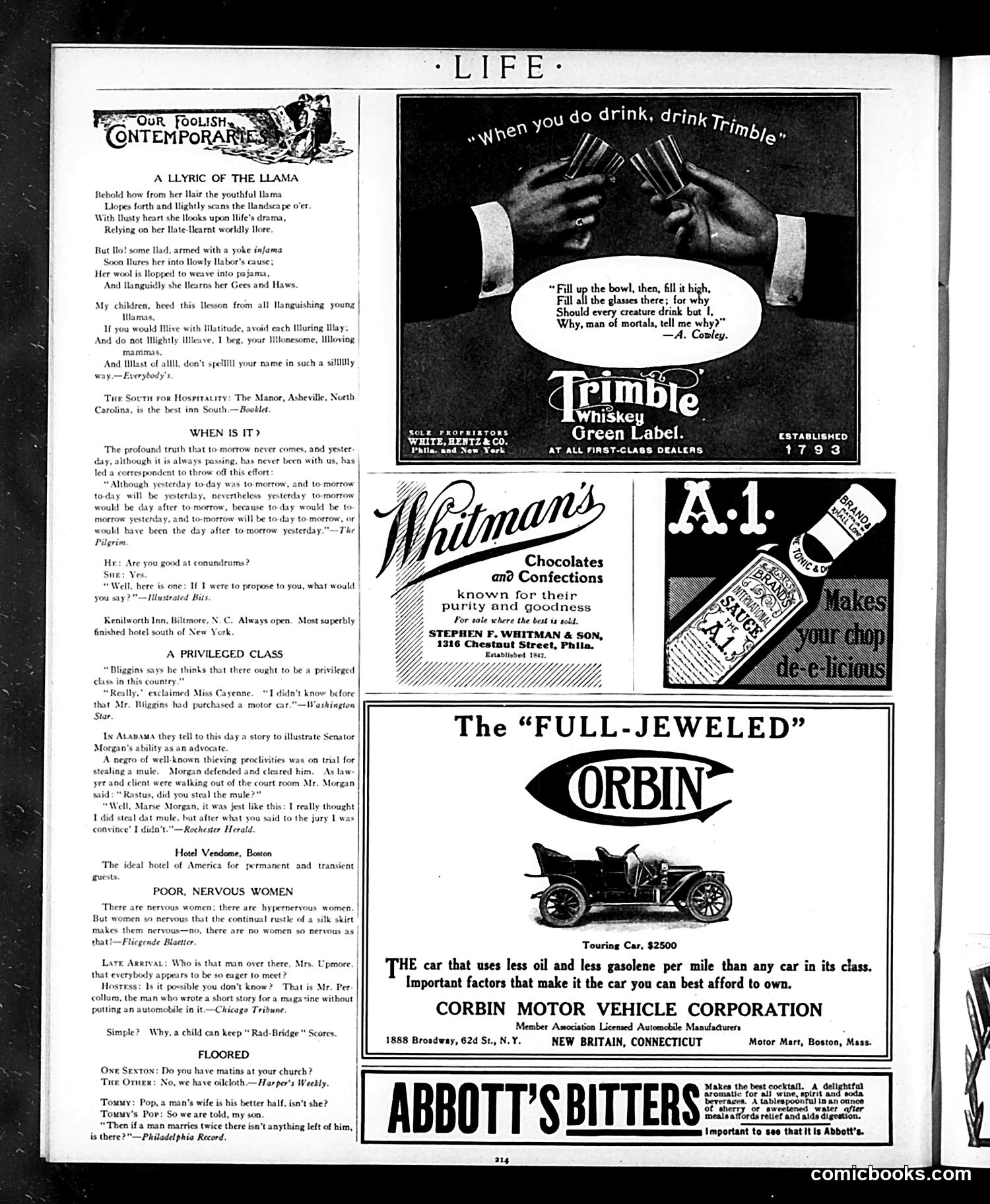
This is primarily an **advertising page** from Life magazine featuring various commercial advertisements and humorous filler content typical of early 20th-century publications. The page contains: **Advertisements:** Trimble Whiskey, Whitman's Chocolates, A.I. Sauce, Corbin automobiles, and Abbott's Bitters dominate the layout. **Satirical Content:** Small jokes and verses, including "A Lyric of the Llama" (a whimsical poem about a llama turned into pajamas), philosophical musings on time ("When Is It?"), and brief humorous exchanges (conundrums, puns). **Social Commentary:** Light satire on class ("A Privileged Class"), nervous women, and contemporary life—typical of Life's gentle humor targeting middle-class readers. The page reflects Life's dual function: a vehicle for advertising revenue while maintaining entertainment through light verse, jokes, and social observation. Nothing here constitutes serious political satire; rather, it's genteel, mainstream humor designed to appeal to contemporary audiences between advertisements.
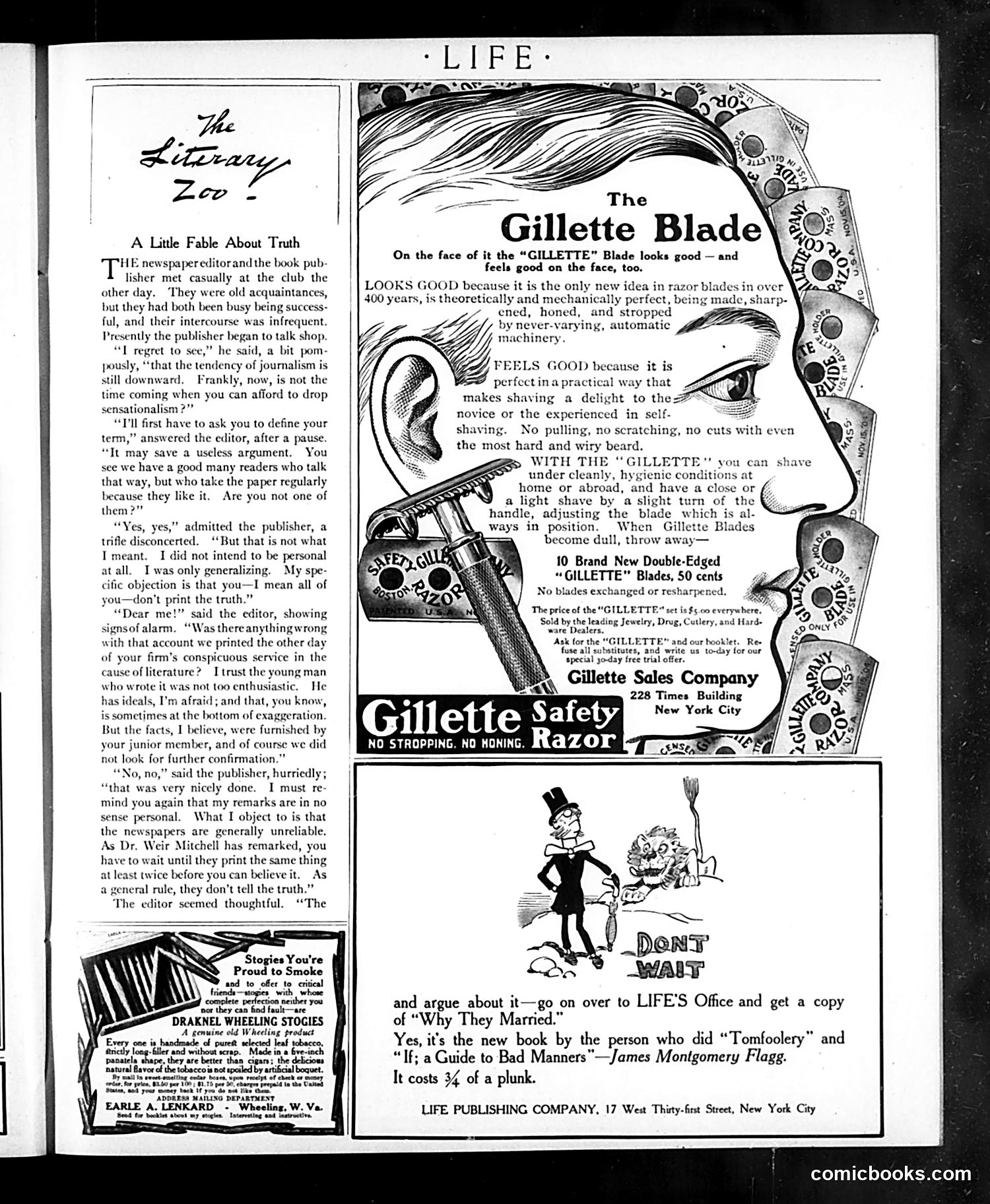
This page contains two distinct elements: **Left side ("The Literary Zoo"):** A satirical dialogue between a newspaper editor and book publisher debating journalistic truthfulness. The publisher complains newspapers are unreliable and sensationalistic. The editor's witty response—reminding the publisher that Life itself had flatteringly covered his own firm's "service to literature"—exposes the hypocrisy: publishers and readers both *demand* sensationalism while publicly condemning it. The joke targets the mutual dishonesty between press and public. **Right side:** A full-page advertisement for the Gillette Safety Razor, featuring an illustrated male face and detailed product claims about the blade's superiority. This is primarily commercial content, not satire. **Bottom:** A promotional notice for a James Montgomery Flagg book ("Why They Married"), sold by Life Publishing Company. The page demonstrates Life's dual function: satirizing cultural pretensions through humor while simultaneously accepting advertisements from major corporations.
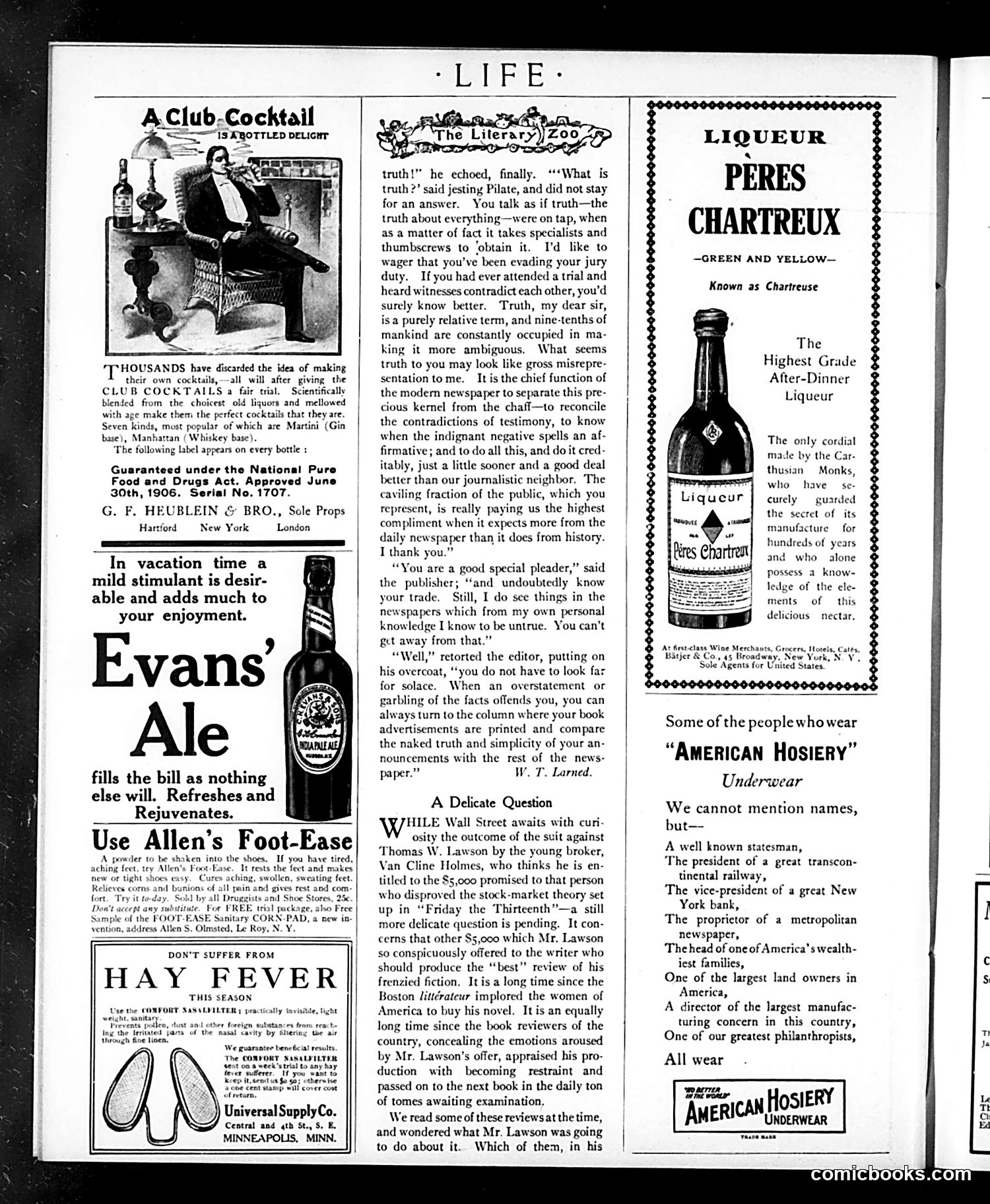
This page is primarily **advertising**, not political satire. It features product ads for alcoholic beverages (Club Cocktails, Evans' Ale), patent medicines (Allen's Foot-Ease for tired feet, a hay fever filter), and American Hosiery underwear—typical early 20th-century magazine content. The only editorial content is "A Delicate Question," a brief essay about Thomas W. Lawson, a Boston writer who offered monetary prizes ($5,000 each) for someone to disprove his stock-market theories promoted in his novel "Friday the Thirteenth" and for the best review of his work. The piece humorously questions whether anyone will claim these promised rewards, suggesting Lawson's offers may have been more promotional bluster than genuine commitment. The other editorial piece discusses newspaper editors defending their role in separating truth from contradiction in witness testimony—a commentary on journalistic integrity versus public skepticism.
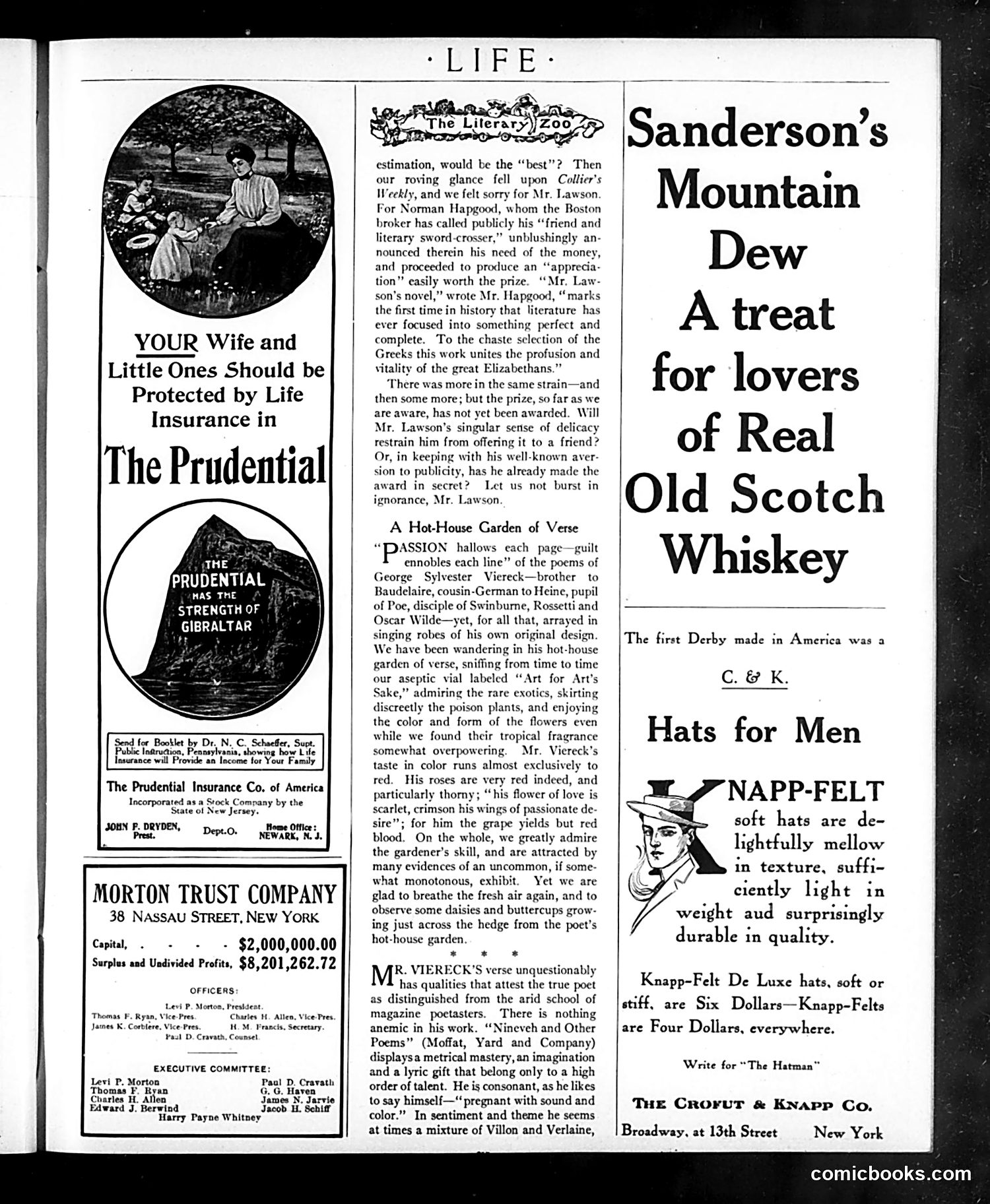
This page is primarily **advertising and literary criticism**, not political satire. The left side features **financial/insurance advertisements** for The Prudential and Morton Trust Company—standard corporate promotions with no satirical content. The center section contains a **literary review** of poet George Sylvester Viereck's work. The critic uses mock-flowery language to describe Viereck's poetry as excessively passionate and color-obsessed (obsessed with red imagery). The review is gently **satirical**—praising Viereck's technical skill while subtly mocking his overwrought romanticism as "a hot-house garden" of overwrought emotion. The critic compares him to major Romantic poets (Baudelaire, Heine, Wilde) in a tongue-in-cheek way suggesting Viereck imitates rather than originates. There's also a **jab at Thomas Lawson**, a Boston broker whose novel apparently deserves a literary prize, but whose friend Norman Hapgood suspiciously praised it in Collier's Weekly—implying the praise was bought rather than earned. The right side contains straightforward **product advertisements** for Scotch whiskey and Napp-Felt hats.
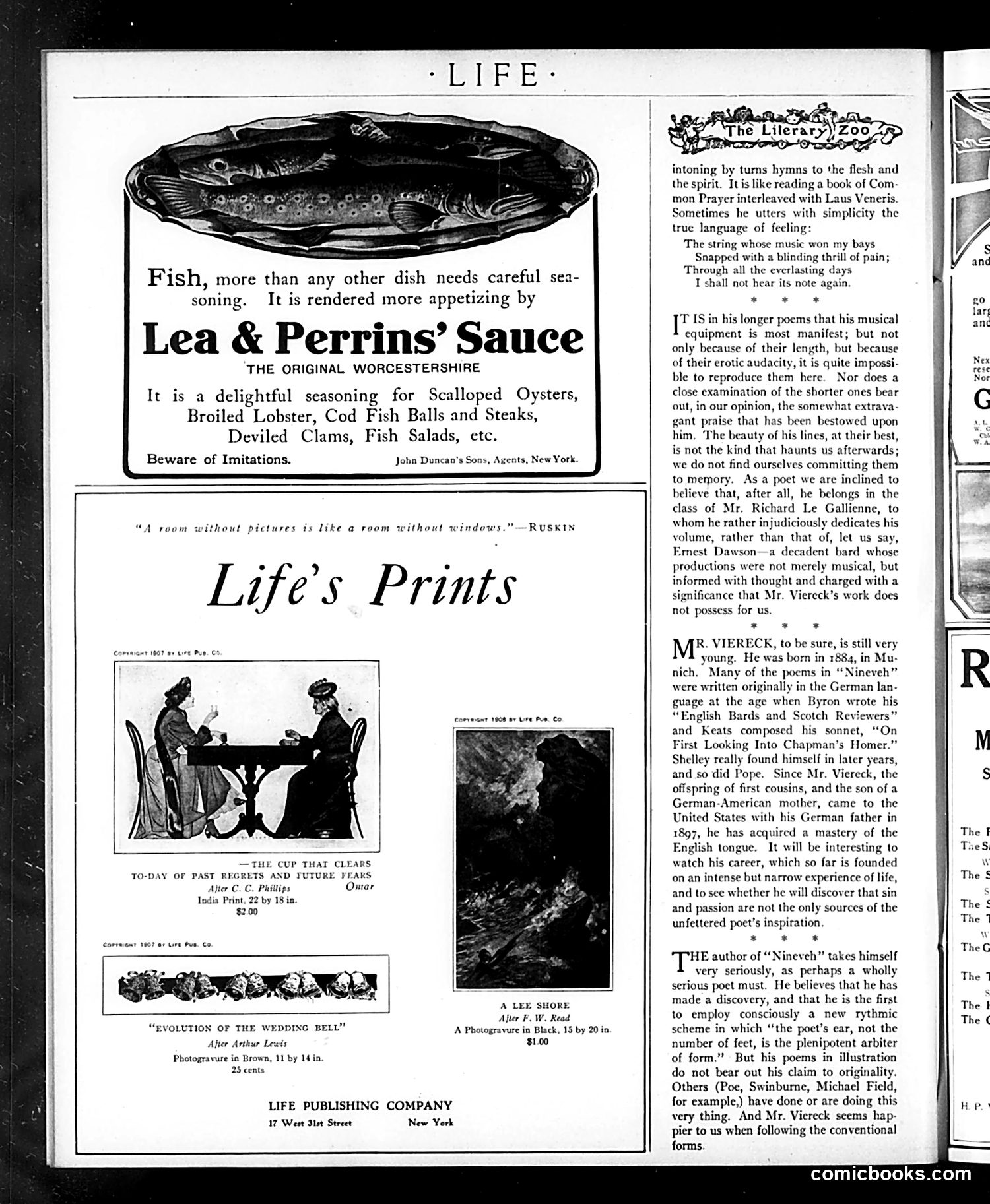
This page is primarily **advertising and literary criticism**, not political satire. The top half features a **Lea & Perrins' Sauce advertisement** with a fish illustration—a straightforward commercial promoting Worcestershire sauce as a seasoning. Below is a section titled "Life's Prints" showcasing **art reproductions for sale**: three prints by various artists, including "The Cup That Clears" and "Evolution of the Wedding Bell," priced between 25 cents and $2.00. The right column contains a **book review** of a poet named Viereck's work titled "Nineveh." The critic praises Viereck's musical sensibility but argues his poems lack the depth and originality he claims—comparing him unfavorably to established poets like Poe and Swinburne. The review notes Viereck is a young German-American poet born in Munich who immigrated to America in 1897. There is **no political cartoon or satire** on this page. It represents typical early-20th-century magazine content mixing commercial advertisements with cultural criticism.
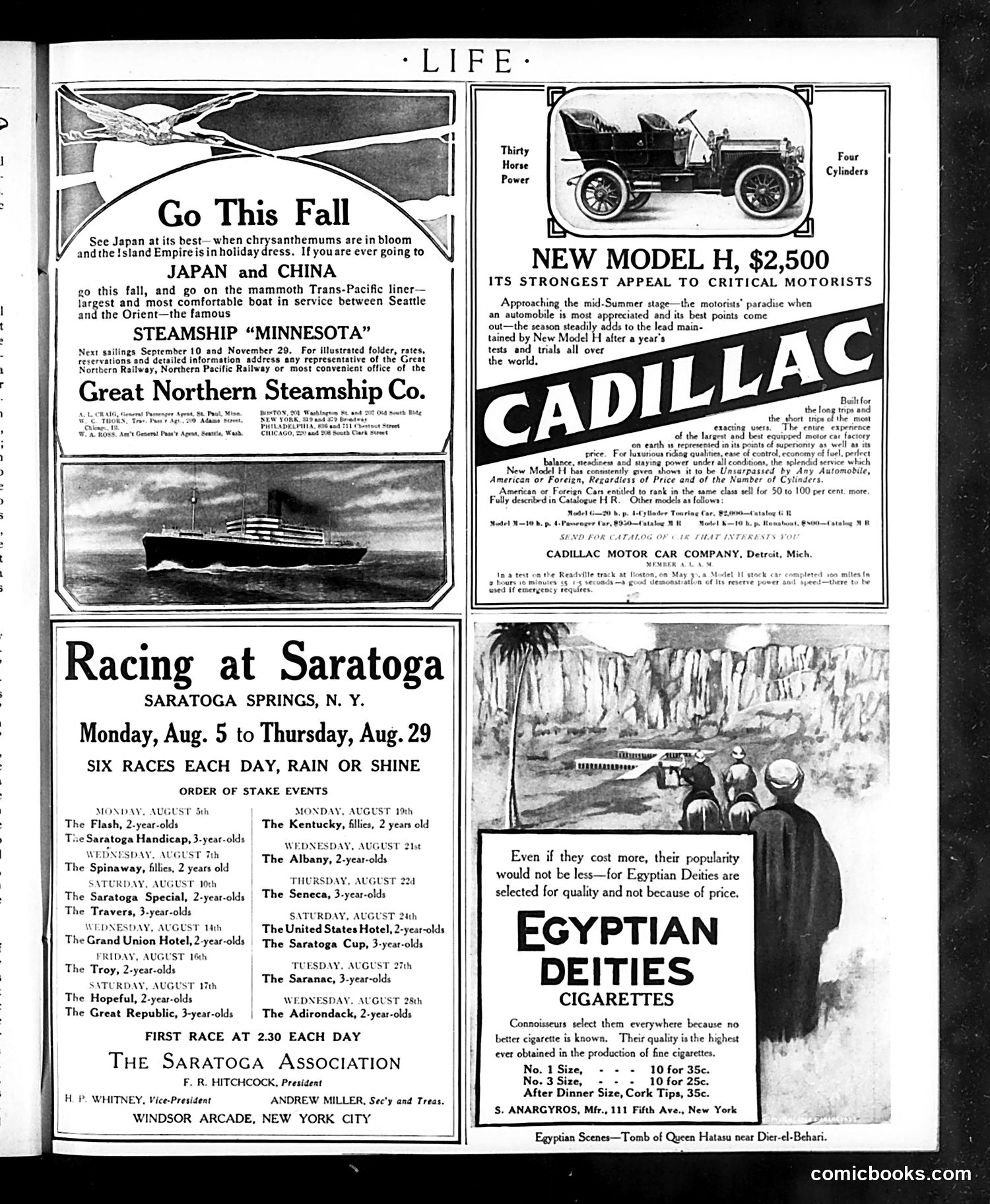
This page contains **no political cartoons or satire**—it's primarily **advertisements and travel/entertainment listings** from an early 1900s publication. The content includes: - **Travel ad**: Great Northern Steamship promoting trips to Japan and China, capitalizing on Orientalist tourism interests - **Auto advertising**: Cadillac Model H ($2,500), emphasizing engineering superiority and value against foreign competitors - **Horse racing schedule**: Saratoga Springs racing events for August - **Cigarette ad**: Egyptian Deities brand, using exotic Egyptian imagery (tomb photo) as a luxury marketing appeal The only notable contextual element is the **Egyptian Deities cigarette advertisement**, which exploits early-20th-century fascination with Egyptian culture and Egyptology—likely referencing the era's archaeological discoveries. The ad's claim that quality matters "not because of price" suggests competition in the cigarette market. No satire or political commentary is evident on this page.
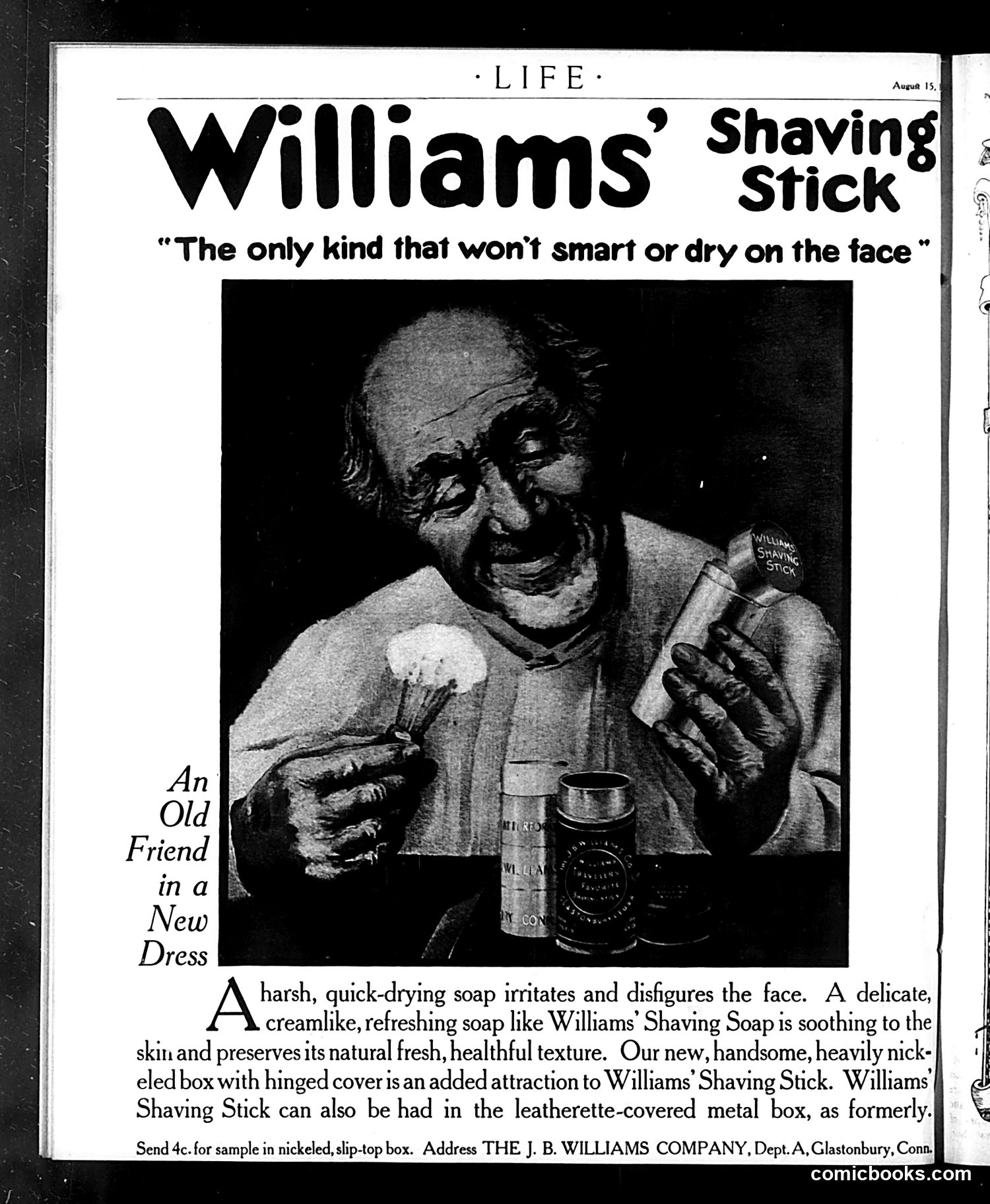
This is a **product advertisement**, not political satire. It appeared in *Life* magazine (dated August 15, though year unclear from image). The ad features an elderly man with exaggerated facial features holding Williams' Shaving Stick products. The tagline promises the soap won't "smart or dry on the face"—addressing a genuine consumer complaint about harsh soaps of the era. The "joke" or appeal is positioning Williams' as gentler than competitors' quick-drying formulas that supposedly irritated skin. The phrase "An Old Friend in a New Dress" refers to the product's redesigned packaging: a "handsome, heavily nickeled box with hinged cover" (versus the older leatherette-covered metal box). This reflects early 20th-century advertising strategy: emphasizing product improvements and appealing to comfort-conscious male consumers during an era when shaving was a significant daily ritual.