
Life, 1907-08-15 · page 9 of 28
Life — August 15, 1907 — page 9: what you’re looking at
What you’re looking at
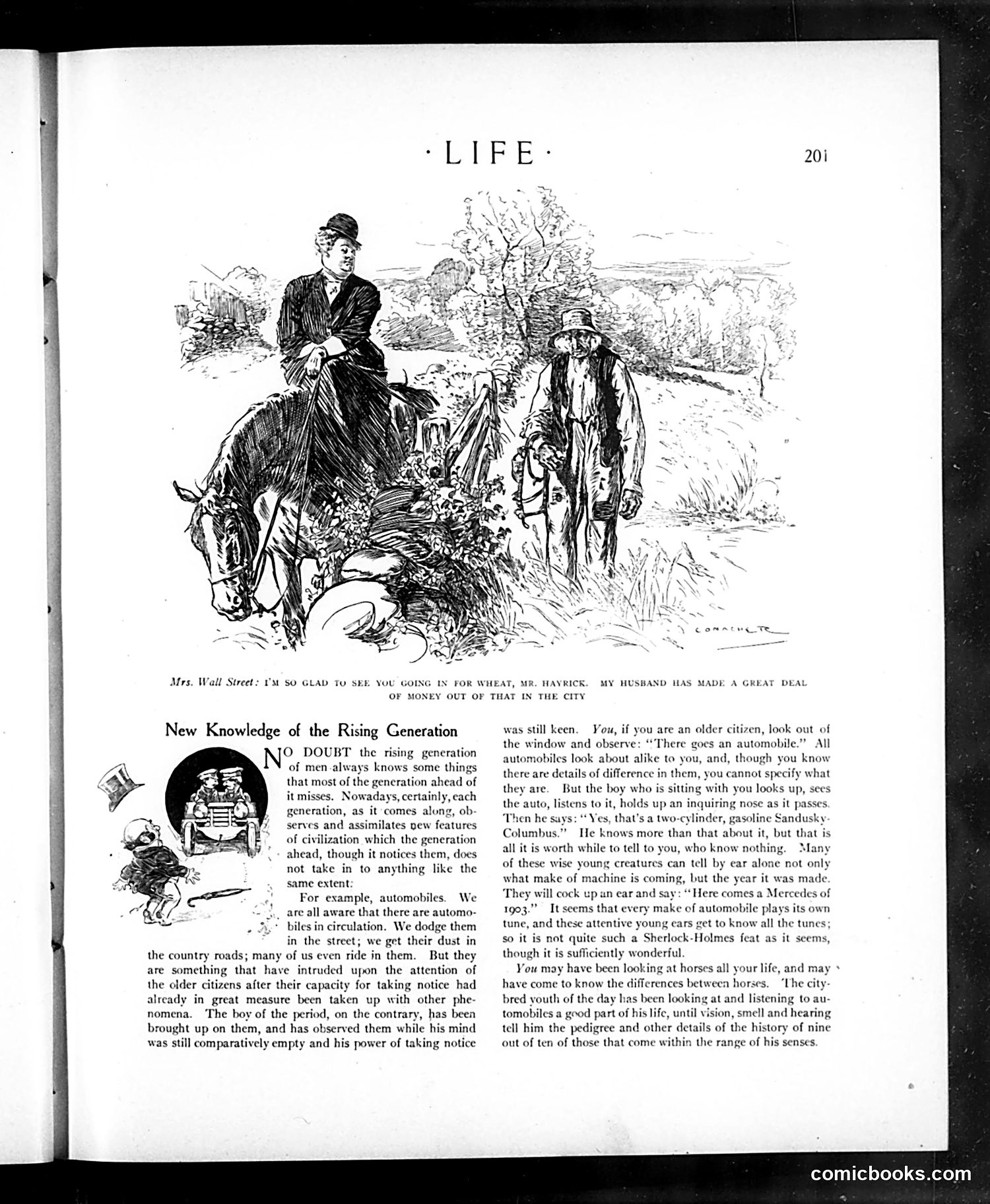
The main illustration depicts a rural scene where a woman on horseback speaks to a farmer about wheat prices and a profitable urban financial deal. The caption reads: "Mrs. Wall Street: I'm so glad to see you going in for wheat, Mr. Hayrick. My husband has made a great deal of money out of that in the city." The satire targets the disconnect between Wall Street speculators and actual farmers. The farmer's name "Hayrick" and the woman's self-identification as "Mrs. Wall Street" emphasize this divide. The joke suggests that city financiers profit from agricultural commodities while farmers themselves remain disconnected from these urban money-making schemes. The article "New Knowledge of the Rising Generation" discusses how younger people notice automobiles and other modern inventions that older generations overlook—a commentary on generational attitudes toward technological progress.
📄 Transcribed text from this page (OCR, searchable)
Machine-transcribed from the original scan — historical spelling and the odd misread are preserved.
Mrs, Wall Street: YM SO GLAD TU SEE YOU GOING IN FOR WHEAT, MR. HAYRICK. MY HUSBAND HAS MADE A GREAT DEAL OF MONEY OUT OF THAT IN THE CITY New Knowledge of the Rising Generation NO, DOUBT the ising. generation of men-always knows some things that most of the generation ahead of it misses. Nowadays, certainly, each generation, as it comes along, ob- serves and assimilates pew features of civilization which the generation ahead, though it notices them, does not take in to anything like the same extent. For example, automobiles. We are all aware that there are automo- biles in circulation. We dodge them in the street; we get their dust in the country roads; many of us even ride in them. But they are something that have intruded upon the attention of the older citizens after their capacity for taking notice had already in great measure been taken up with other phe- nomena. The boy of the period, on the contrary, has been brought up on them, and has observed them while his mind was still comparatively empty and his power of taking notice was still keen. You, if you are an older citizen, look out of the window and observe: “There goes an automobile.” All automobiles look about alike to you, and, though you know there are details of difference in them, you cannot specify what : But the boy who is sitting with you looks up, sees , holds up an inquiring nose as it passes ays: “Yes, that’s a two-cylinder, gasoline Sandusky Columbus.” He knows more than that about it, but that is all it is worth while to tell to you, who know nothing. Many of these wise young creatures can tell by ear alone not only what make of machine is coming, but the year it was made. ‘They will cock up an ear and say: “Here comes a Me 1903.” It seems that every make of automobile plays its own tune, and these attentive young ears get to know all the tunes; so it is not quite such a Sherlock-Holmes feat as it seems, though it is sufficiently wonderful You may have been looking at horses all your life, and ma have come to know the differences between horses. ‘the city bred youth of the day has been looking at and listening to au- tomobiles a good part of his life, until vision, smell and hearing tell him the pedigree and other details of the history of nine out of ten of those that come within the range of his senses les of comicbooks.com