
Life, 1907-08-15 · page 18 of 28
Life — August 15, 1907 — page 18: what you’re looking at
What you’re looking at
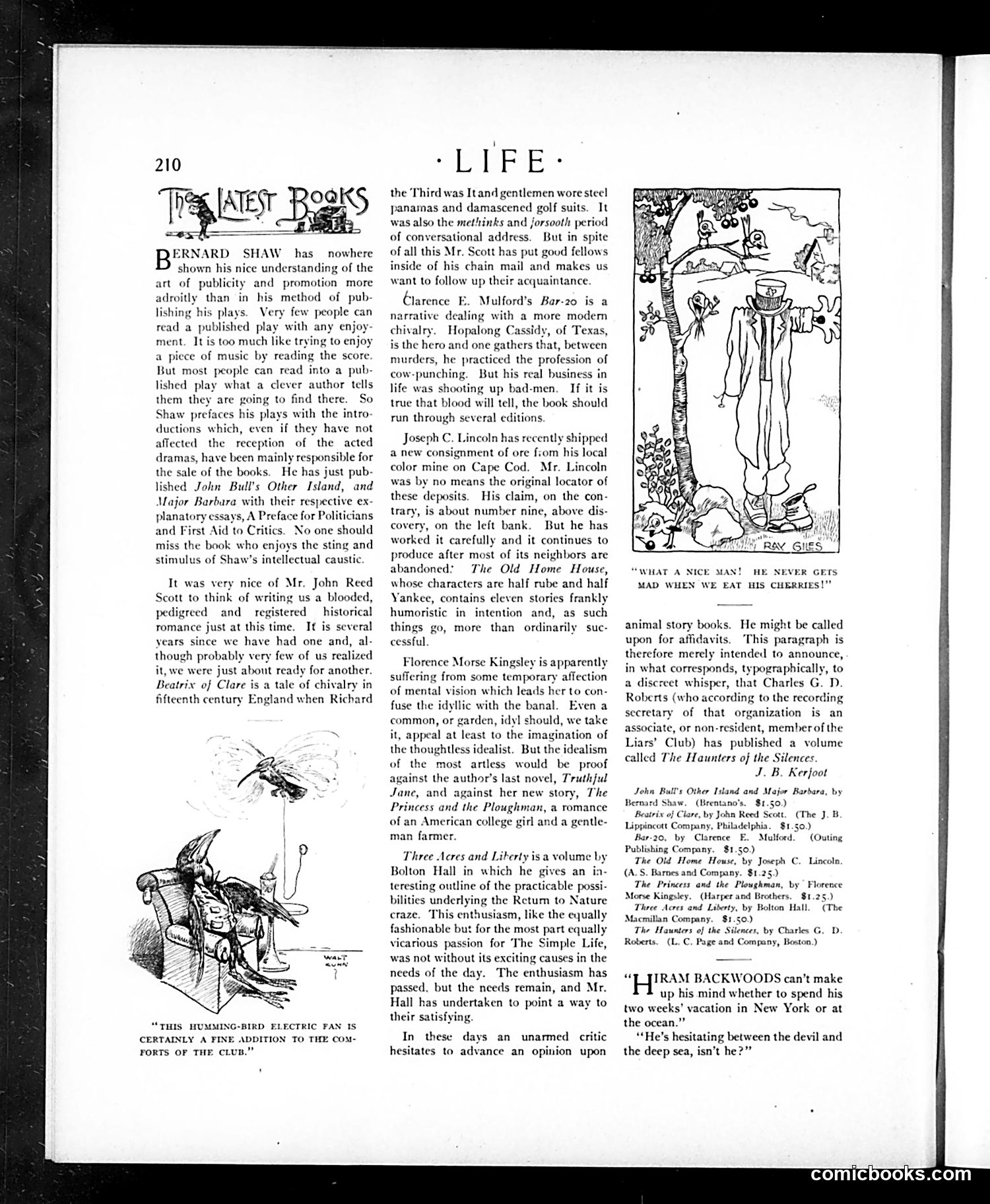
This page reviews recent books, with two cartoons illustrating club life humor. **The cartoons:** Both depict well-to-do club members. The top right shows a man in formal dress admiring a "humming-bird electric fan"—a humorous contrast between refined gentlemen and a whimsical mechanical novelty. The bottom left features the caption "This humming-bird electric fan is certainly a fine addition to the comforts of the club," with the lower cartoon showing a man noted for never getting angry "when we eat his cherries"—suggesting either a generous host or someone too timid to protest. **The satire:** The humor relies on depicting wealthy club members as simultaneously sophisticated and absurd—marveling at gadgetry or tolerating imposition without protest. This reflects early 1900s leisure-class mockery: the *Life* magazine tradition of gently ridiculing the pretensions and peculiarities of affluent society. The page is primarily a book review section, making the cartoons incidental to the magazine's main content.
📄 Transcribed text from this page (OCR, searchable)
Machine-transcribed from the original scan — historical spelling and the odd misread are preserved.
ERNARD SHAW has __ nowhere shown his nice understanding of the art of publicity and promotion more adroitly than in his method of pub- lishing his plays. Very few people can read a published play with any enjoy- ment. It is too much like trying to enjoy a piece of music by reading the score. But most people can read into a pub- lished play what a clever author tells them they are going to find there. So Shaw pr his plays with the intro ductions which, even if they have not affected the reception of the acted dramas, have been mainly responsible for the sale of the books. He has just pub- lished John Bull’s Other Island, and Major Barbara with their respective ex- ys, A Preface for Politicians and First Aid to Critics. No one should miss the book who enjoys the sting and stimulus of Shaw’s intellectual caustic. planatory e It was very nice of Mr. John Reed Scott to think of writing us a blooded, pedigreed and registered _ historical romance just at this time. If is several years since we have had one and, though probably very few of us real it, we were just about ready for another. Beatrix of Clare is a tale of chivalry in fifteenth century England when Richard “THIS HUMMING-BIRD ELECTRIC PAN IS, CERTAINLY A FINE ADDITION TO THE com- FORTS OP THE CLUB.” the Third was Itand gentlemen wore steel panamas and damascencd golf suits. It was also the methinks and jorsooth period of conversational address. But in spite of all this Mr. Scott has put goud fellows inside of his chain mail and makes us want to follow up thei acquaintance. Glarence E. Mulford’s Bar-20 is a narrative dealing with a more modem chivalry. Hopalong Cassidy, of Te is the hero and one gathers that, between murders, he practiced the profession of cow-punching. But his real business in life was shooting up bad-men, If it is true that blood will tell, the book should run through several editions Joseph C. Lincoln has recently shipped a new consignment of ore fiom his local color mine on Cape Cod. Mr. Lincoln was by no means the original locator of these deposits. His claim, on the con- trary, is about number nine, above dis- covery, on the left bank. But he has worked it carefully and it continues to produce after most of its neighbors are abandoned: The Old Home House, whose characters are half rube and half Yankee, contains eleven stories frankly humoristic in intention and, as such things go, more than ordinarily sue- cessful Florence Morse Kingsley is apparently suffering from some temporary affection of mental vision which leads her to con- fuse the idyllic with the banal. Even a common, or garden, idyl should, we take it, appeal at least to the imagination of the thoughtless idealist. But the idealism of the most artless would be proof against the author’s last novel, Truthjul Jane, and against her new story, The Princess and the Ploughman, a romance of an American college girl and a gentle- man farmer. Three Acres and Liberty isa volume by Bolton Hall in which he gives an in teresting outline of the practicable possi- bilities underlying the Retum to Nature craze. This enthusiasm, like the equally fashionable but for the most part equally vicarious passion for The Simple Life, was not without its exciting causes in the needs of the day. The enthusiasm has passed, but the needs remain, and Mr. Hall has undertaken to point a way to their satisfying. In these days an unarmed critic hesitates to advance an opinion upon “WHAT A NICE MAN! HE NEVER GETS MAD WHEN WE EAT HIS CHERRIES!"’ animal story books. He might be called upon for aifidavits. ‘This paragraph is therefore merely intended to announce, in what corresponds, typographically, to a discreet whisper, that Charles G. D. Roberts (who according to the recording sceretary of that organization is an associate, or non-resident, member of the Liars’ Club) has published a volume called The Haunters of the Silences J.B. Kerjoot John Bull's Other Island and Major Barbara, by Bernard Shaw. (Brentano's. $1.30.) Beatrix oj Clare, by John Reed Scott. (The J. B. Lippincott Company, Philadelphia. $1.50.) Bar-20, by Clarence E. Mulford. (Outing Publishing Company. $1.50.) The Old Home Heuse, by Joseph C. Lincoln. (A. S. Barnes and Company. $1.25.) The Princess and the Ploughman, by Florence Morse Kingsley. (Harper and Brothers. $1.25.) Three Acres and Liberty, by Bolton Hall. (The Macmillan Company. $1.50.) The Hawnters of the Silences, by Charles G. D. Roberts. (L, C. Page and Company, Boston.) “LJIRAM BACKWOODS can’t make up his mind whether to spend his two weeks’ vacation in New York or at the ocean.” “He's hesitating between the devil and the deep sea, isn’t he?” comicbooks.com