
Life, 1907-08-15 · page 8 of 28
Life — August 15, 1907 — page 8: what you’re looking at
What you’re looking at
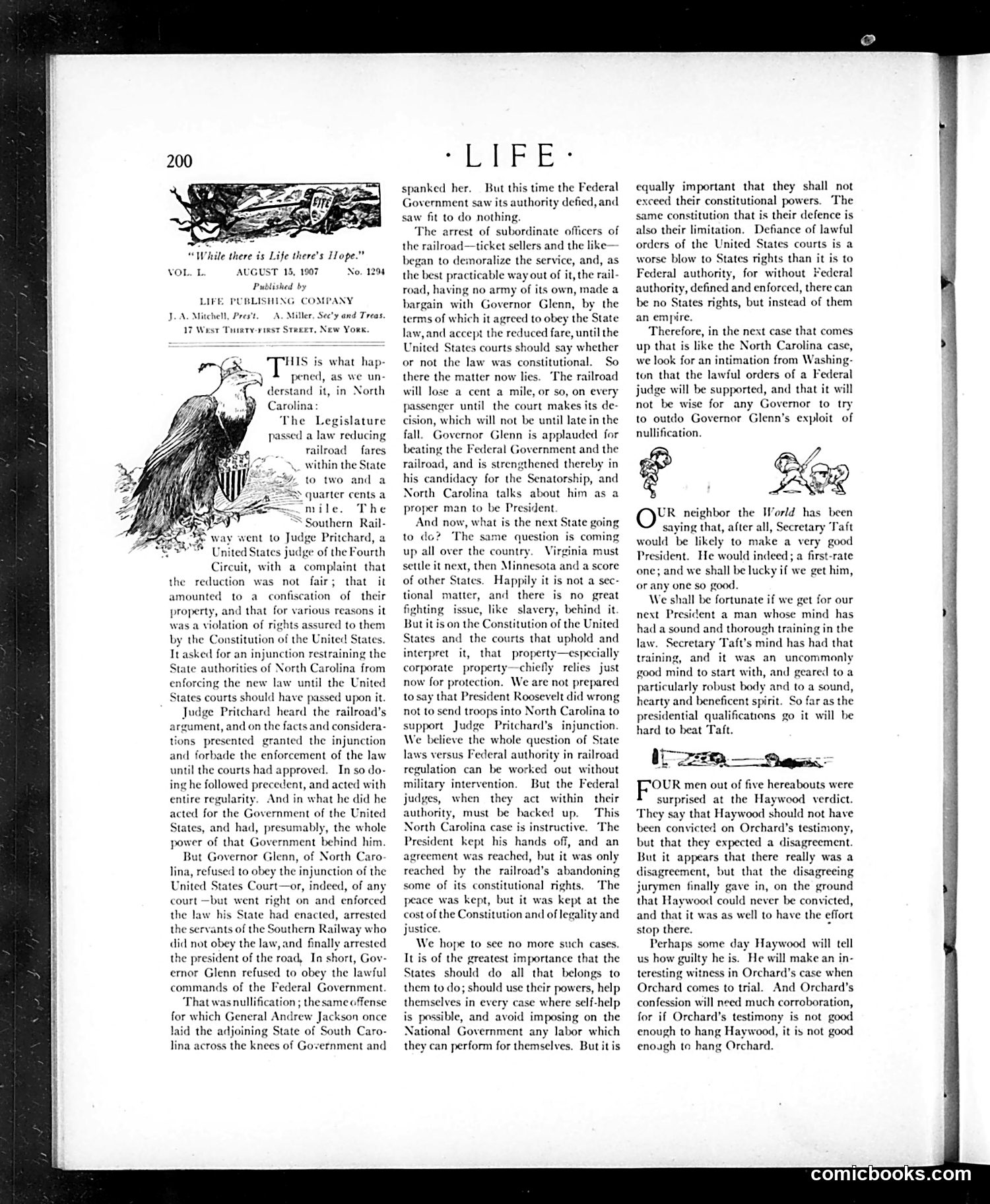
This page from *Life* magazine (August 19, 1902) discusses a legal dispute involving North Carolina's railroad regulation versus Federal Government authority. The text references Judge Pritchard's court case concerning whether a state can enforce laws that contradict Federal rulings. The illustration shows an eagle with distinctive features, likely representing American federal power or constitutional authority. The article argues that States should respect constitutional limits on their powers and not defy Federal court orders. It warns against Governor Glenn's resistance to Federal authority, drawing parallels to earlier constitutional conflicts. The piece advocates for Federal judicial supremacy while acknowledging States' legitimate powers within constitutional bounds—a core Federalism debate of the Progressive Era. The tone is cautionary toward state defiance of national authority.
📄 Transcribed text from this page (OCR, searchable)
Machine-transcribed from the original scan — historical spelling and the odd misread are preserved.
“While there is Life there's Hope.” VOL. L. AUGUST 15, 1907 No. 1294 Published by LIFE PUBLISHING COMPANY pell, Pres't 17 West Tuiery-rinsr Sreeer, New York. A. Miller, See’y and Treas. 5 TH is what hap- pened, as we un- *Y serstand it, in North Carolina: The Legislature passed a law reducing railroad fares within the State to two and a » quarter cents a mile. The ‘Southern Rail- ent to Judge Pritchard, a United States judge of the Fourth Circuit, with a complaint that the reduction was not fair; that it amounted to a confiscation of their property, and that for various reasons it was a violation of rights assured to them by the Constitution of the United States It asked for an injunction restraining the State authorities of North Carolina from enforcing the new law until the United States courts should have passed upon it. Judge Pritchard heard the railroad’s ‘gument, and on the facts and considera- tions presented granted the injunction and forbade the enforcement of the law until the courts had approved. In so do- ing he followed precedent, and acted with entire regularity, And in what he did he acted for the Government of the United States, and had, presumably, the whole power of that Government behind him. But Governor Glenn, of North Caro lina, refused to obey the injunction of the United States Court—or, indeed, of any court —but went right on and enforced the law his State had enacted, arrested the servants of the Southern Railway who did not obey the law, and finally arrested the president of the road, In short, Gov- ernor Glenn refused to obey the lawful commands of the Federal Government ‘That was nullification ; the same offense for which General Andrew Jackson on: laid the adjoining State of South Caro- lina across the knees of Government and RE But this time the Federal y defied, and spanked her. Government saw its authori saw fit to do nothing. The arrest of subordinate officers of the railroad—ticket sellers and the like began to demoralize the service, and, as the best practicable way out of it, the rail- road, having no army of its own, made a bargain with Governor Glenn, by the terms of which it agreed to obey the State law, and accept the reduced fare, until the United States courts should say whether or not the law was constitutional. So there the matter now lies. The railroad will lose a cent a mile, or so, on every passenger until the court makes its de- cision, which will not be until late in the fall. Governor Glenn is applauded for beating the Federal Government and the railroad, and is strengthened thereby in his candidacy for the Senatorship, and North Carolina talks about him as a proper man to be President And now, what is the next State going to do? The same question is coming up all over the country. Virginia must settle it next, then Minnesota and a score of other States. Happily it is not a sec- tional matter, and there is no great fighting issue, like slavery, behind it But it is on the Constitution of the United States and the courts that uphold and interpret it, that property—especially corporate property—chiefly relies just now for protection. We are not prepared to say that President Roosevelt did wrong not to send troops into North Carolina to support Judge Pritchard’s injunction, We believe the whole question of State laws versus Federal authority in railroad regulation can be worked out without military intervention. But the Federal judges, when they act within their authority, must be backed up. This North Carolina case is instructive. The President kept his hands off, and an agreement was reached, but it was only reached by the railroad’s abandoning some of its constitutional rights, The peace was kept, but it was kept at the cost of the Constitution and of legality and justice We hope to see no more such cases. It is of the greatest importance that the States should do all that belongs to hould use their powers, help themselves in every case where self-help is possible, and avoid imposing on the National Government any labor which they can perform for themselves. But it is equally important that they shall not exceed their constitutional powers. The same constitution that is their defence is also their limitation. Defiance of lawful orders of the United States courts is a worse blow to States rights than it is to Federal authority, for without Federal authority, defined and enforced, there can be no States rights, but instead of them an empire. Therefore, in the next case that comes, up that is like the North Carolina case, we look for an intimation from Washing- ton that the lawful orders of a Federal judge will be supported, and that it will not be wise for any Governor to try to outdo Governor Glenn’s exploit of nullification. Z. © G9 ov neighbor the World has been Onin that, after all, Secretary Taft would be likely to make a very good President. He would indeed ; a first-rate one; and we shall be lucky if we get him, or any one so ood. We shall be fortunate if we get for our next President a man whose mind has had a sound and thorough training in the law. Secretary Taft’s mind has had that training, and it was an uncommonly good mind to start with, and geared to a particularly robust body and to a sound, hearty and beneficent spirit. So far as the presidential qualifications go it will be hard to beat Taft. ‘OUR men out of five hereabouts were surprised at the Haywood verdict. They say that Haywood should not have been convicted on Orchard’s testimony, but that they expected a disagreement. But it appears that there really was a disagreement, but that the disagreeing jurymen finally gave in, on the ground that Haywood could never be convicted, and that it was as well to have the effort stop there. . Perhaps some day Haywood will tell us how guilty he is. He will make an in- teresting witness in Orchard’s case when Orchard comes to trial. And Orchard’s confession will need much corroboration, for if Orchard’s testimony is not good enough to hang Haywood, it is not good enough to hang Orchard. comicbooks.com