
Life, 1907-08-15 · page 26 of 28
Life — August 15, 1907 — page 26: what you’re looking at
What you’re looking at
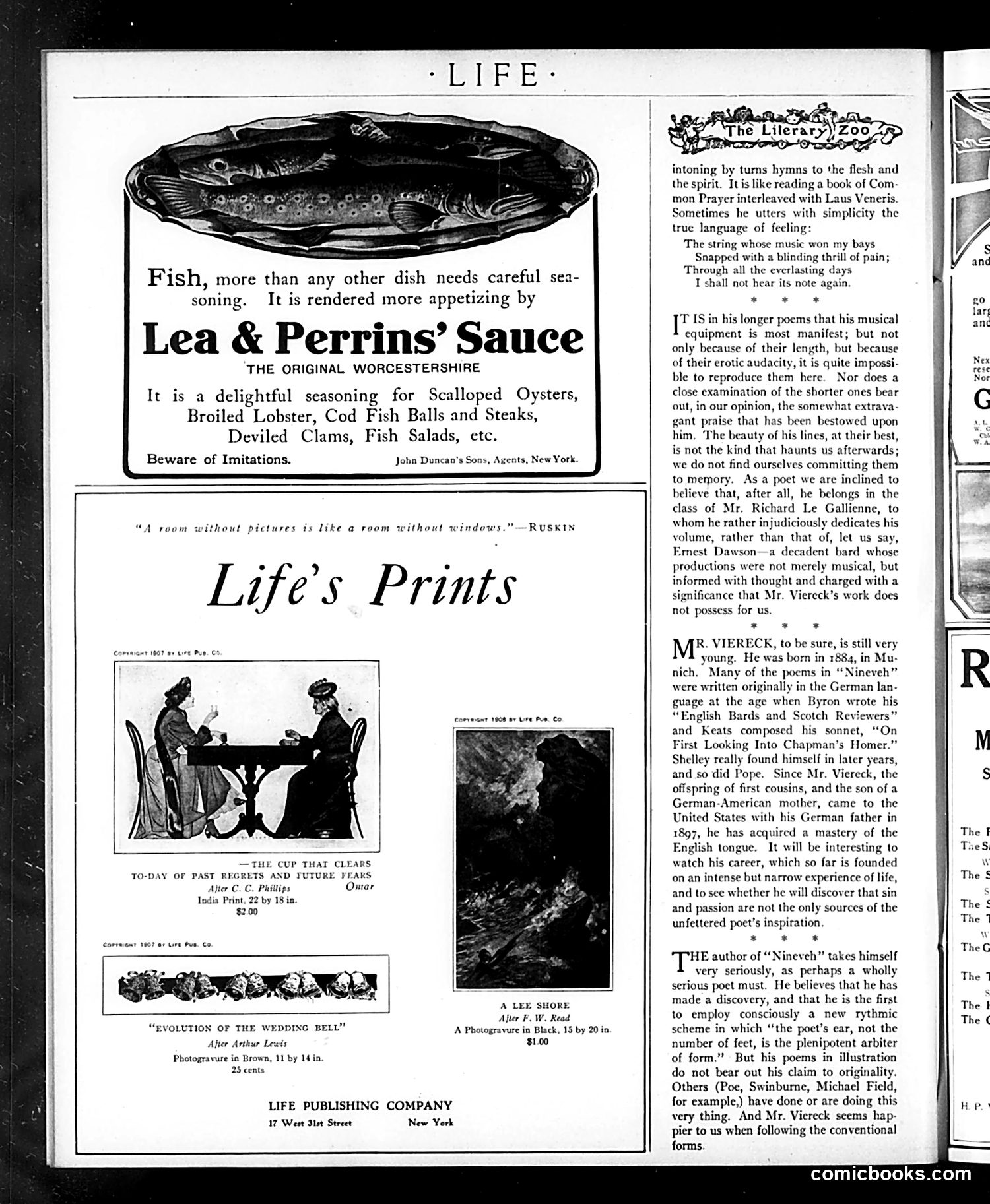
This page is primarily **advertising and literary criticism**, not political satire. The top half features a **Lea & Perrins' Sauce advertisement** with a fish illustration—a straightforward commercial promoting Worcestershire sauce as a seasoning. Below is a section titled "Life's Prints" showcasing **art reproductions for sale**: three prints by various artists, including "The Cup That Clears" and "Evolution of the Wedding Bell," priced between 25 cents and $2.00. The right column contains a **book review** of a poet named Viereck's work titled "Nineveh." The critic praises Viereck's musical sensibility but argues his poems lack the depth and originality he claims—comparing him unfavorably to established poets like Poe and Swinburne. The review notes Viereck is a young German-American poet born in Munich who immigrated to America in 1897. There is **no political cartoon or satire** on this page. It represents typical early-20th-century magazine content mixing commercial advertisements with cultural criticism.
📄 Transcribed text from this page (OCR, searchable)
Machine-transcribed from the original scan — historical spelling and the odd misread are preserved.
Fish, more than any other dish needs careful sea- soning. It is rendered more appetizing by Lea & Perrins’ Sauce THE ORIGINAL WORCESTERSHIRE It is a delightful seasoning for Scalloped Oysters, Broiled Lobster, Cod Fish Balls and Steaks, Deviled Clams, Fish Salads, etc. Beware of Imitations. John Duncan's Sons, Agents, New York. “A room without pictures is like a room without windows."—RUSKIN Life's Prints THE CUP THAT CLEARS TO-DAY OF PAST REGRETS AND FUTURE FEARS Alter C. C. Phillips Omar India Print. 22 by 18 in. 52.00 Corraent 1907 oF Lire Pee. Co. a Alter F.W. Read “EVOLUTION OF THE WEDDING BELL’ A Photogravure in Black, 15 by 20 in. After Arthur Lexis $1.00 Photogravure in Brown, 11 by 14 in. 25 cents LIFE PUBLISHING COMPANY 17 West 3st Street New York intoning by tums hymns to the flesh and the spirit. It is like reading a book of Com- mon Prayer interleaved with Laus Veneris. Sometimes he utters with simplicity the true language of feeling: The string whose music won my bays Snapped with a blinding thrill of pain; Through all the everlasting days I shall not hear its note again. * & * i IS in his longer poems that his musical equipment is most manifest; but not only because of their length, but because of their erotic audacity, it is quite impossi- ble to reproduce them here. Nor does a close examination of the shorter ones bear out, in our opinion, the somewhat extrava- gant praise that has been bestowed upon him. The beauty of his lines, at their best, is not the kind that haunts us afterwards; we do not find ourselves committing them to memory. As a poet we are inclined to believe that, after all, he belongs in the class of Mr. Richard Le Gallienne, to whom he rather injudiciously dedicates his volume, rather than that of, let us say, Emest Dawson—a decadent bard whose productions were not merely musical, but informed with thought and charged with a significance that Mr. Viereck’s work does not possess for us. * * * R. VIERECK, to be sure, is still very ‘oung. He was born in 1884, in Mu- nich. Many of the poems in “Nineveh” were written originally in the German lan- guage at the age when Byron wrote his “English Bards and Scotch Reviewers” and Keats composed his sonnet, “On First Looking Into Chapman’s Homer.” Shelley really found himself in later years, and so did Pope. Since Mr. Viereck, the offspring of first cousins, and the son of a German-American mother, came to the United States with his German father in 1897, he has acquired a mastery of the English tongue. It will be interesting to watch his career, which so far is founded on an intense but narrow experience of life, and to see whether he will discover that sin and passion are not the only sources of the unfettered poet’s inspiration. * * «* HE author of “Nineveh” takes himself very seriously, as perhaps a wholly serious poct must. He believes that he has made a discovery, and that he is the first to employ consciously a new rythmic scheme in which “the poet’s ear, not the number of fect, is the plenipotent arbiter of form.” But his poems in illustration do not bear out his claim to originality. Others (Poe, Swinburne, Michael Field, for example,) have done or are doing this very thing. And Mr. Viereck seems hap- pier to us when following the conventional forms. comicbooks.com