
A complete issue · 20 pages · 1907
Life — August 8, 1907
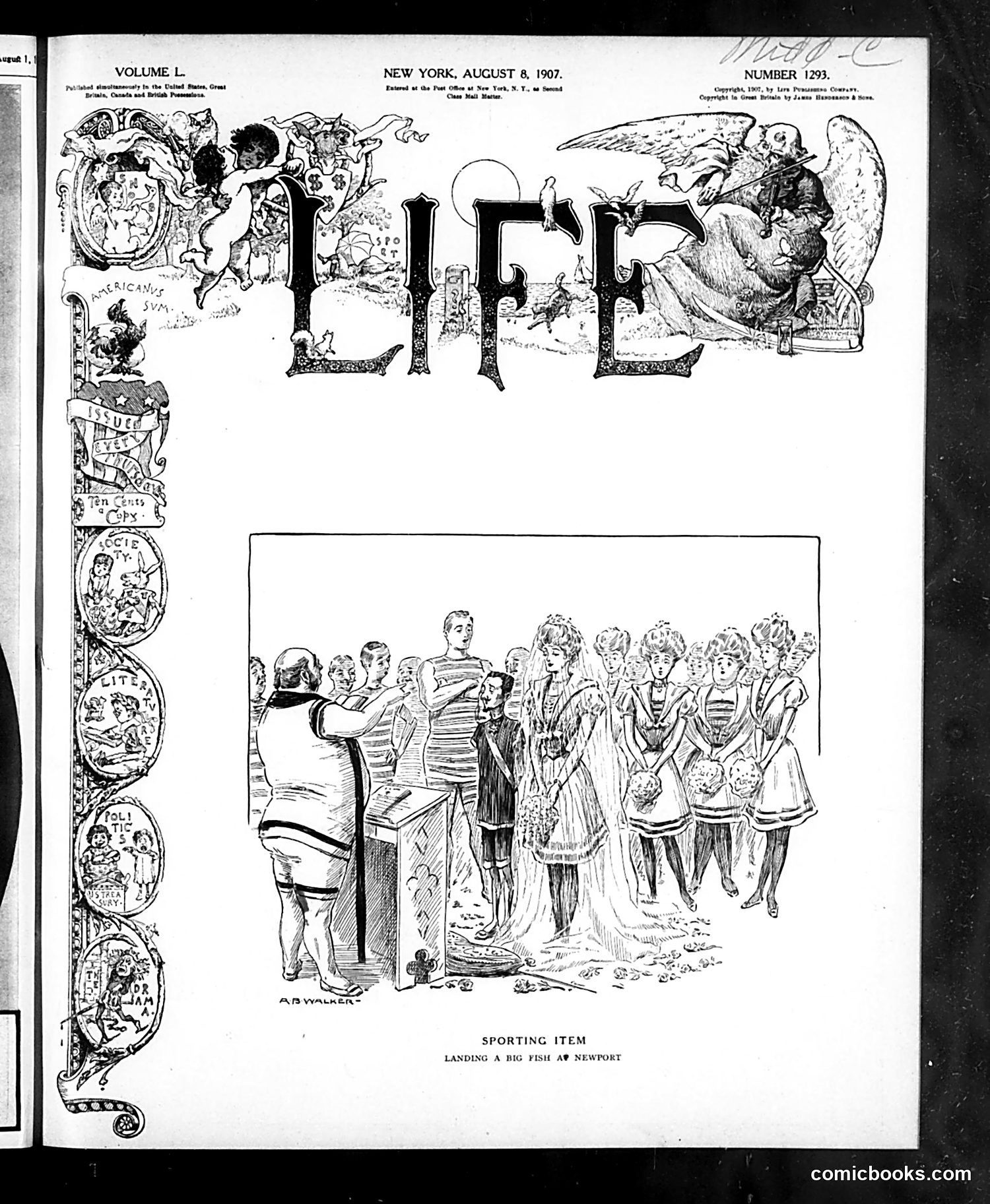
The cartoon titled "Sporting Item: Landing a Big Fish at Newport" depicts a military or naval officer using a fishing rod to "catch" a bride in wedding dress, surrounded by other women in formal attire. This is social satire about wealthy Newport, Rhode Island—the fashionable resort destination for America's elite. The joke plays on the language of sport fishing: marriage among the wealthy is presented as a competitive "sporting" pursuit, with an eligible bride as the prized "catch." The officer's determined pose and the gathered women suggest competition for advantageous marriages. This reflects early 1900s satirical commentary on high-society matrimonial customs, where strategic marriages between military/naval officers and wealthy families were common social events.
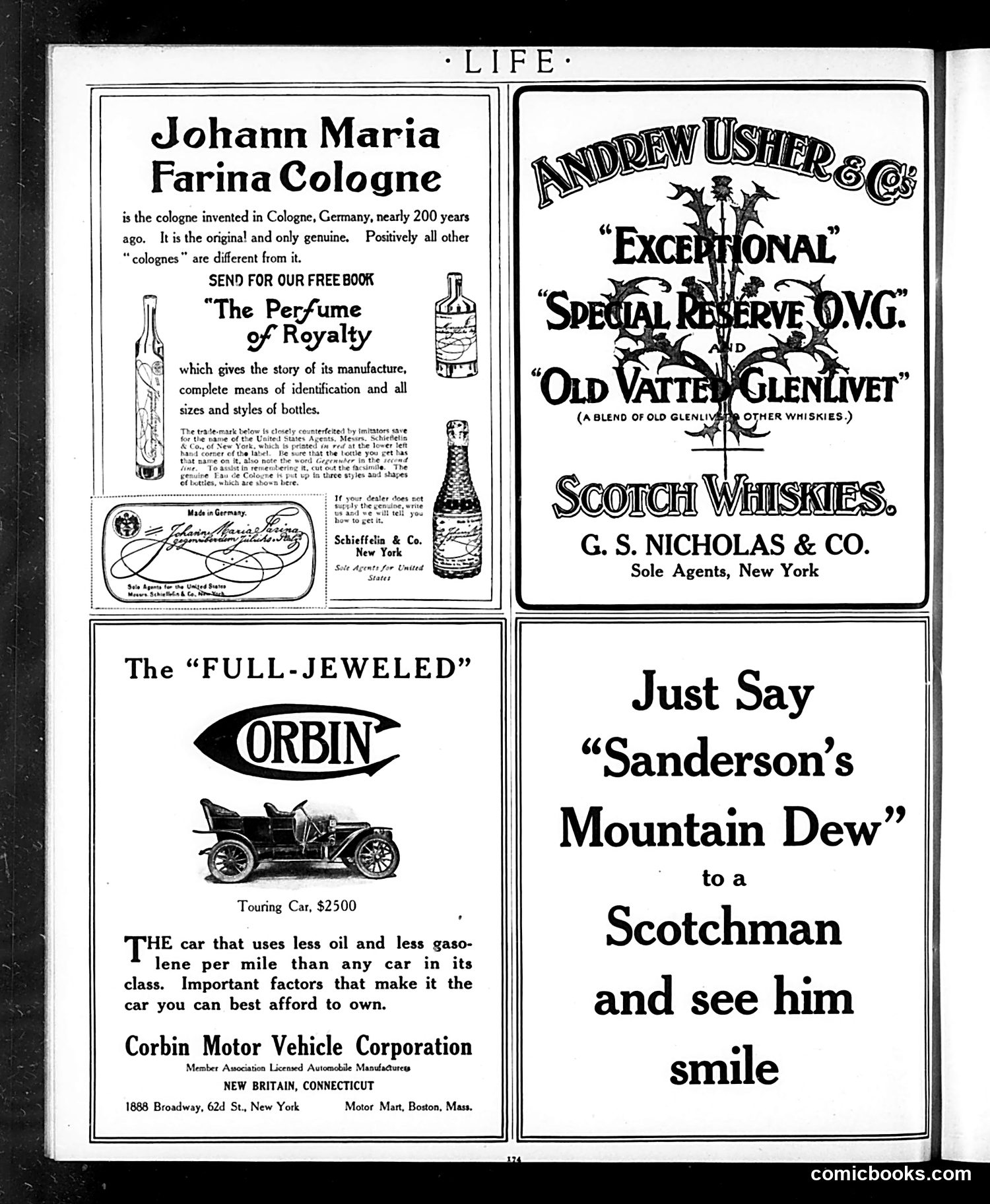
This page is **primarily advertising**, not satire or political commentary. It contains four product advertisements from what appears to be an early 20th-century issue of *Life* magazine: 1. **Johann Maria Farina Cologne** — promoting an original German cologne with a free book offer 2. **Andrew Usher & Co. Scotch Whiskies** — advertising three whisky brands 3. **Orbin automobiles** — a touring car priced at $2,500, emphasizing fuel efficiency 4. **Sanderson's Mountain Dew** — a beverage advertisement with a Scottish theme There are no political cartoons, caricatures, or satirical commentary on this page. It's a straightforward collection of luxury consumer goods marketed to affluent readers, typical of *Life*'s advertising content during this era.
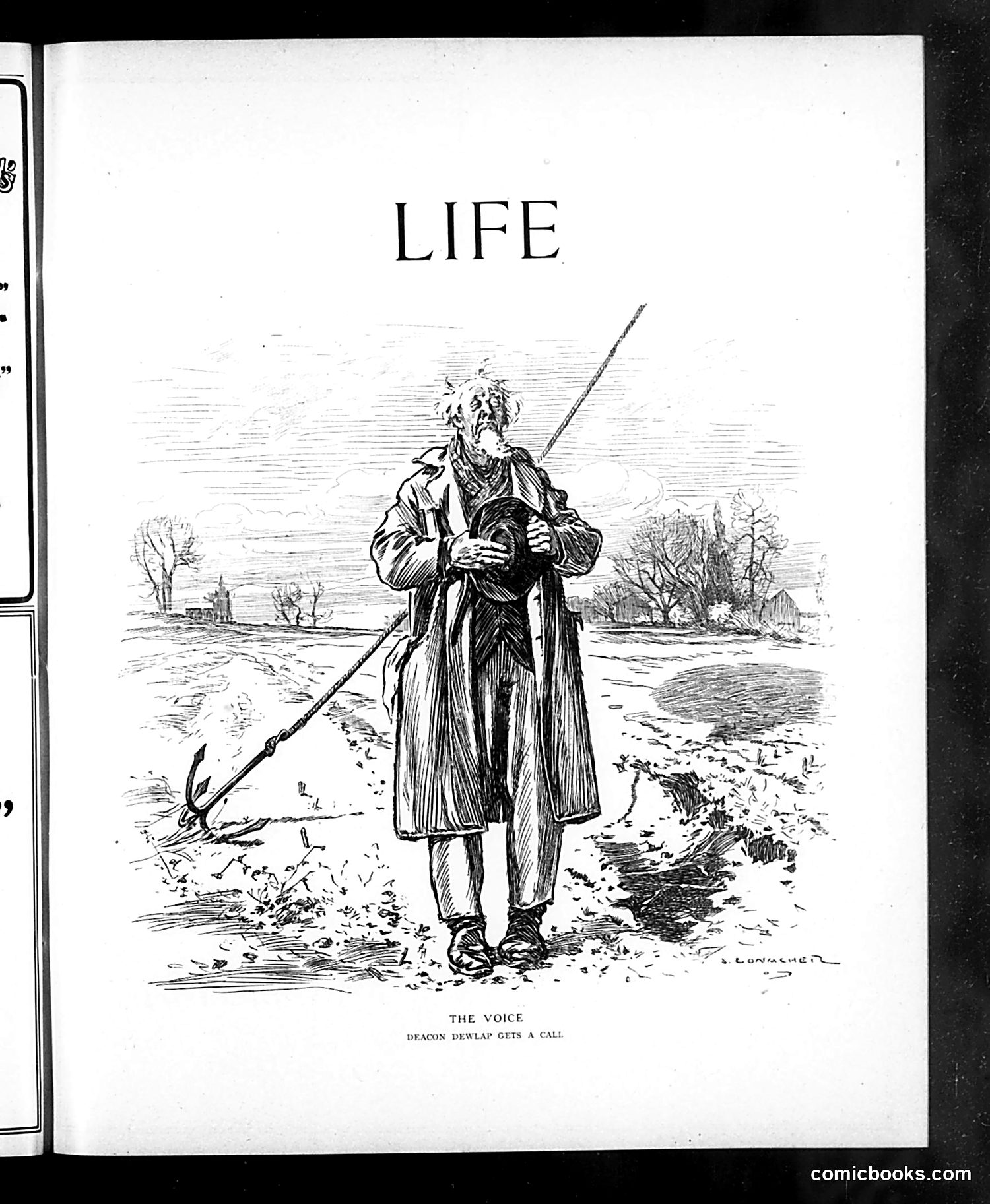
This illustration depicts "Deacon Dewlap Gets a Call"—likely a character from serialized humor in Life magazine. The engraving shows an elderly man in rural dress holding a long pole or staff, standing in a barren landscape with bare trees and water. The caption's reference to "gets a call" suggests either a religious calling (fitting for a "deacon") or a telephone call—possibly satire about new communication technology reaching rural areas. The figure's rustic appearance and weathered expression may mock rural simplicity or superstition encountering modern society. Without additional context about Deacon Dewlap's character arc in Life, the specific satirical target remains unclear, though it appears to critique rural American types common to the magazine's humor.
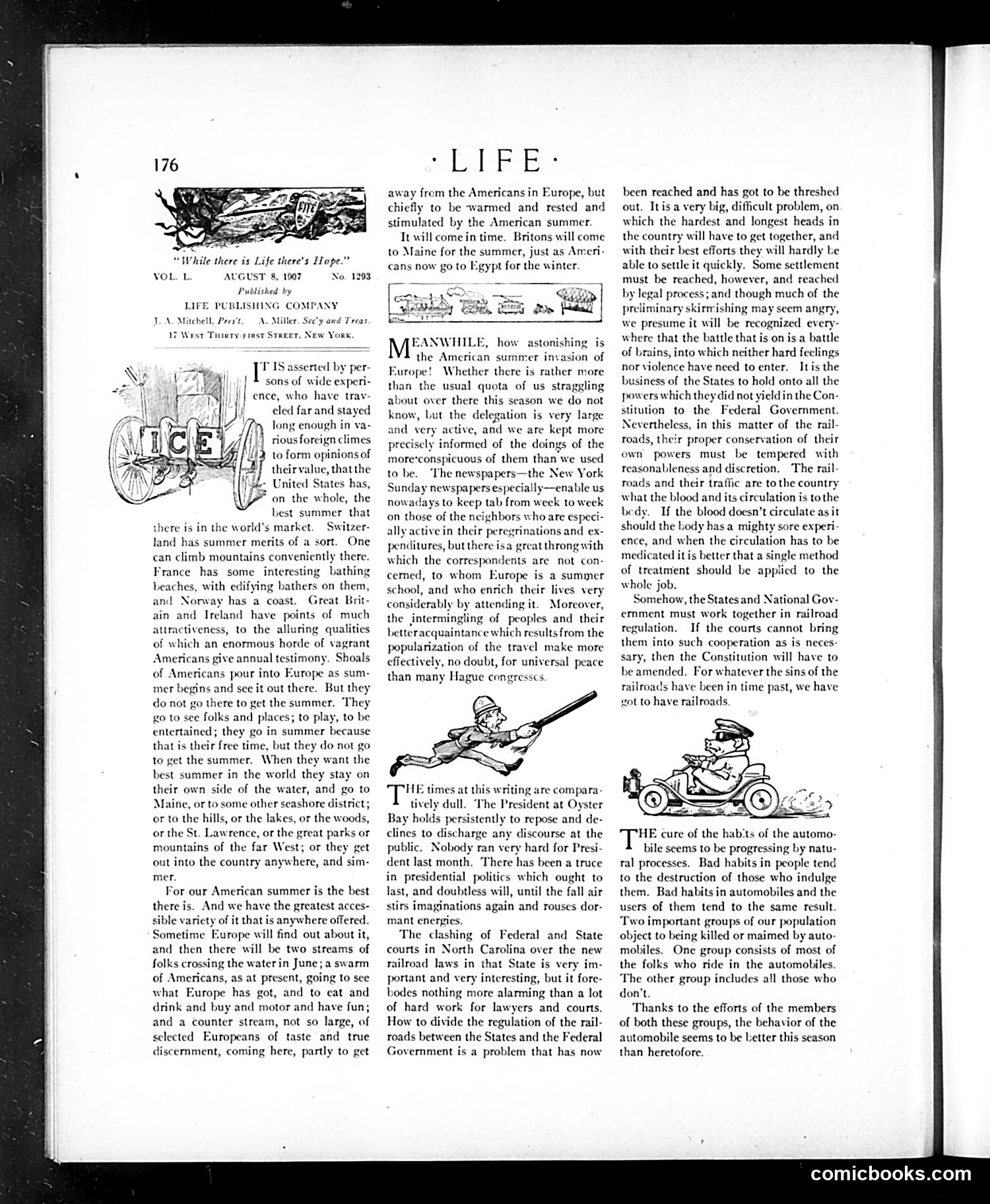
This page contains editorial commentary rather than political cartoons. The text discusses Americans vacationing in Europe during summer and criticizes railroad regulation disputes between Federal and State governments, particularly in North Carolina. Two small illustrations accompany the text: one shows a figure in a diving or flying pose (likely satirizing leisure activities), and another depicts someone in an early automobile, referencing the growing automobile industry and its safety concerns. The editorial focuses on serious issues—railroad safety, interstate commerce regulation, and automobile-related deaths—rather than humorous satire. It advocates for better coordination between state and federal authorities in regulating transportation safety, suggesting these were contentious policy debates of the era.
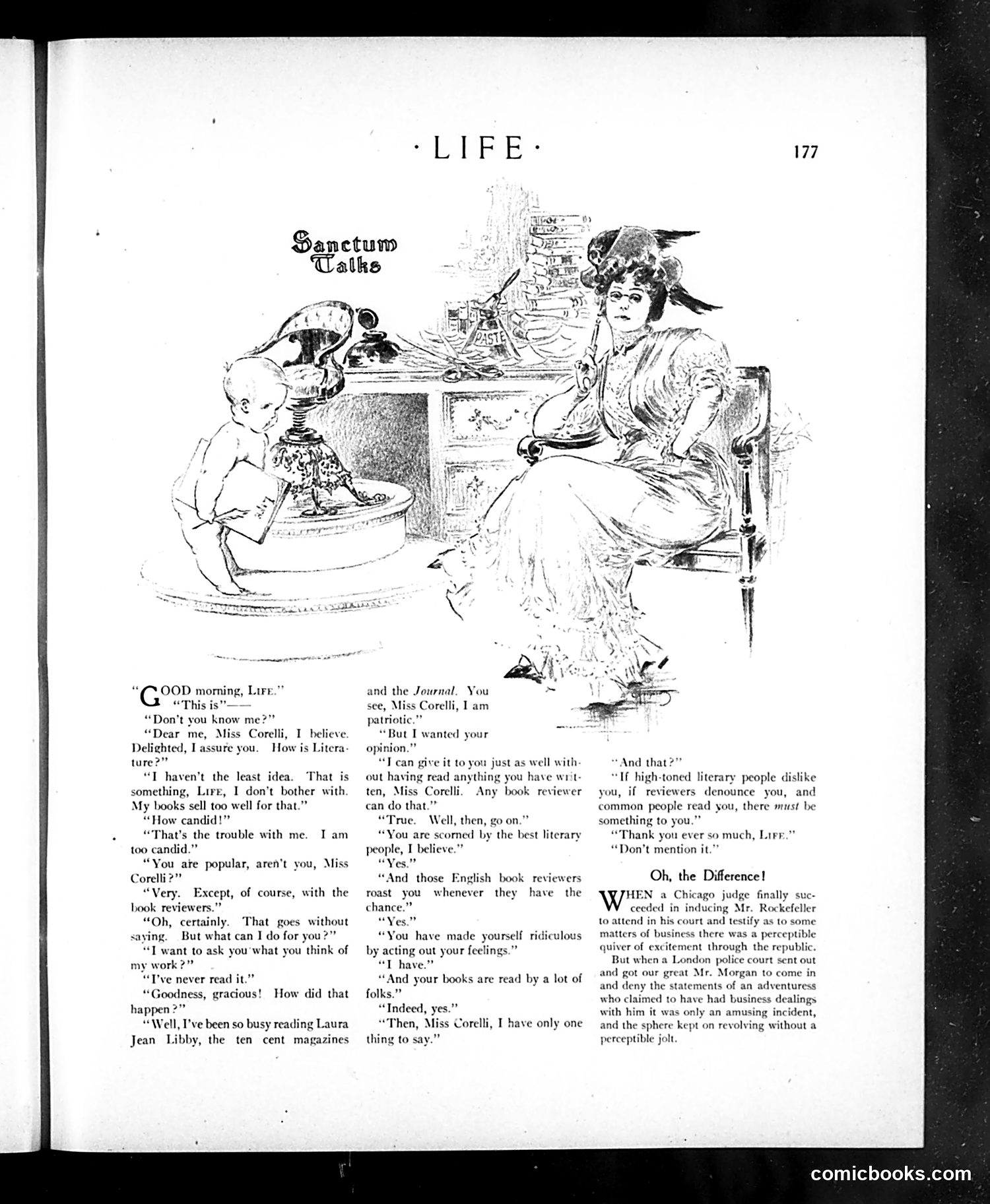
This is a satirical dialogue between "Life" (the magazine personified as a woman) and "Miss Corelli" (likely Marie Corelli, a popular British novelist of the era). The joke targets the gap between popular and critical literary taste. Miss Corelli defends her work's popularity despite dismissal by literary critics and English book reviewers. Life teases her about this contradiction—her books are widely read by "common people" yet scorned by literary establishment figures. The satire critiques both pretentious literary gatekeepers who disdain popular fiction, and authors who seek validation from both mass audiences and elite critics simultaneously. The final anecdote about a Chicago judge versus a London police court suggests American pragmatism outperforms British snobbery.
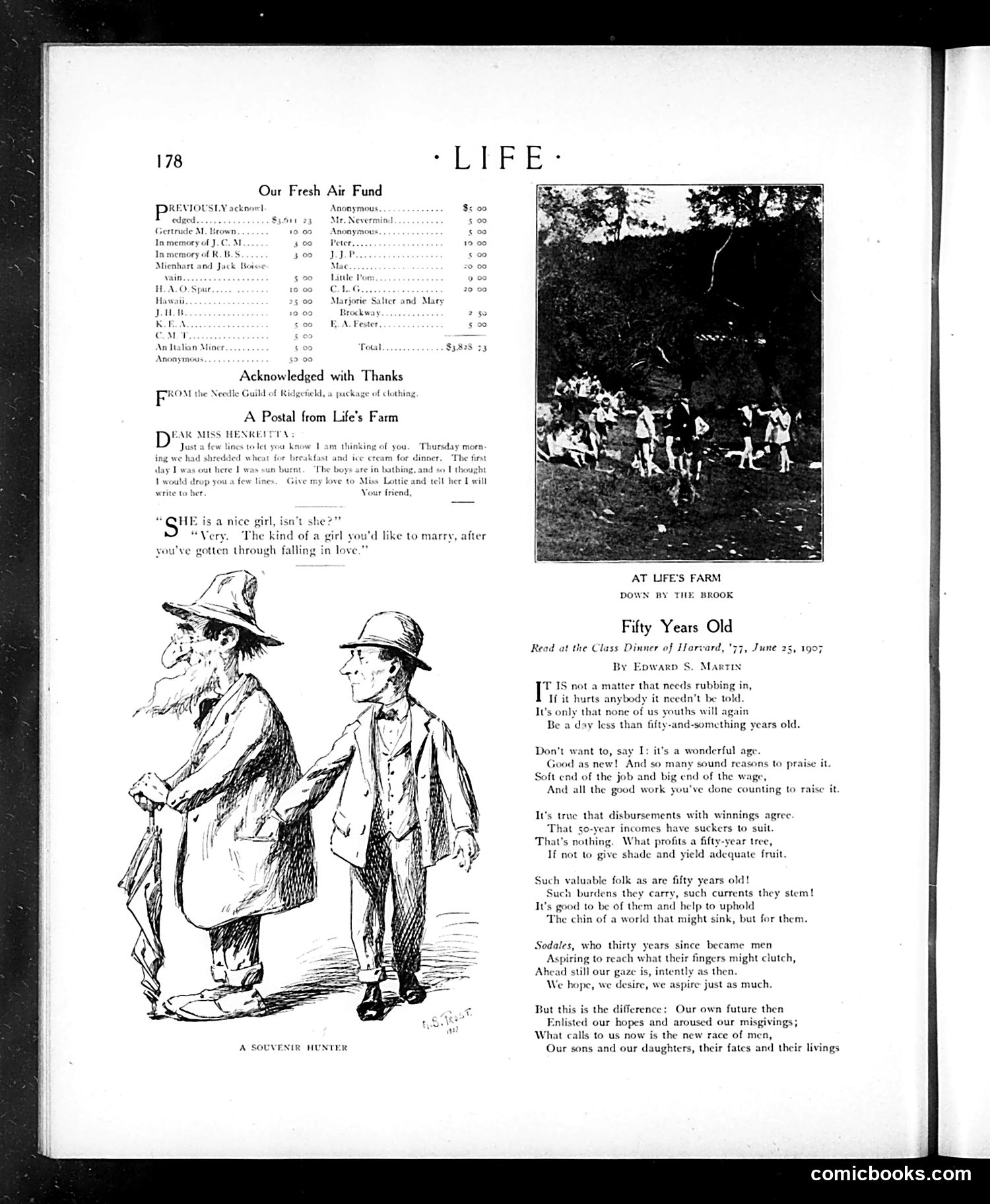
This cartoon depicts two men in conversation, with the caption "A SOUVENIR HUNTER." The figure on the left appears to be an older, somewhat disreputable character, while the figure on the right is better dressed. The dialogue reads: "SHE is a nice girl, isn't she?" / "Very. The kind of a girl you'd like to marry, after you've gotten through calling in love." The satire targets the behavior of men who collect romantic conquests as "souvenirs"—treating women as trophies rather than as people worthy of commitment. The cartoon ridicules the contradiction between casual romantic entanglement and serious matrimonial intentions, suggesting that such "hunters" view courtship as a collecting game rather than a path to genuine partnership. This reflects early 20th-century social anxieties about changing courtship practices and male behavior.
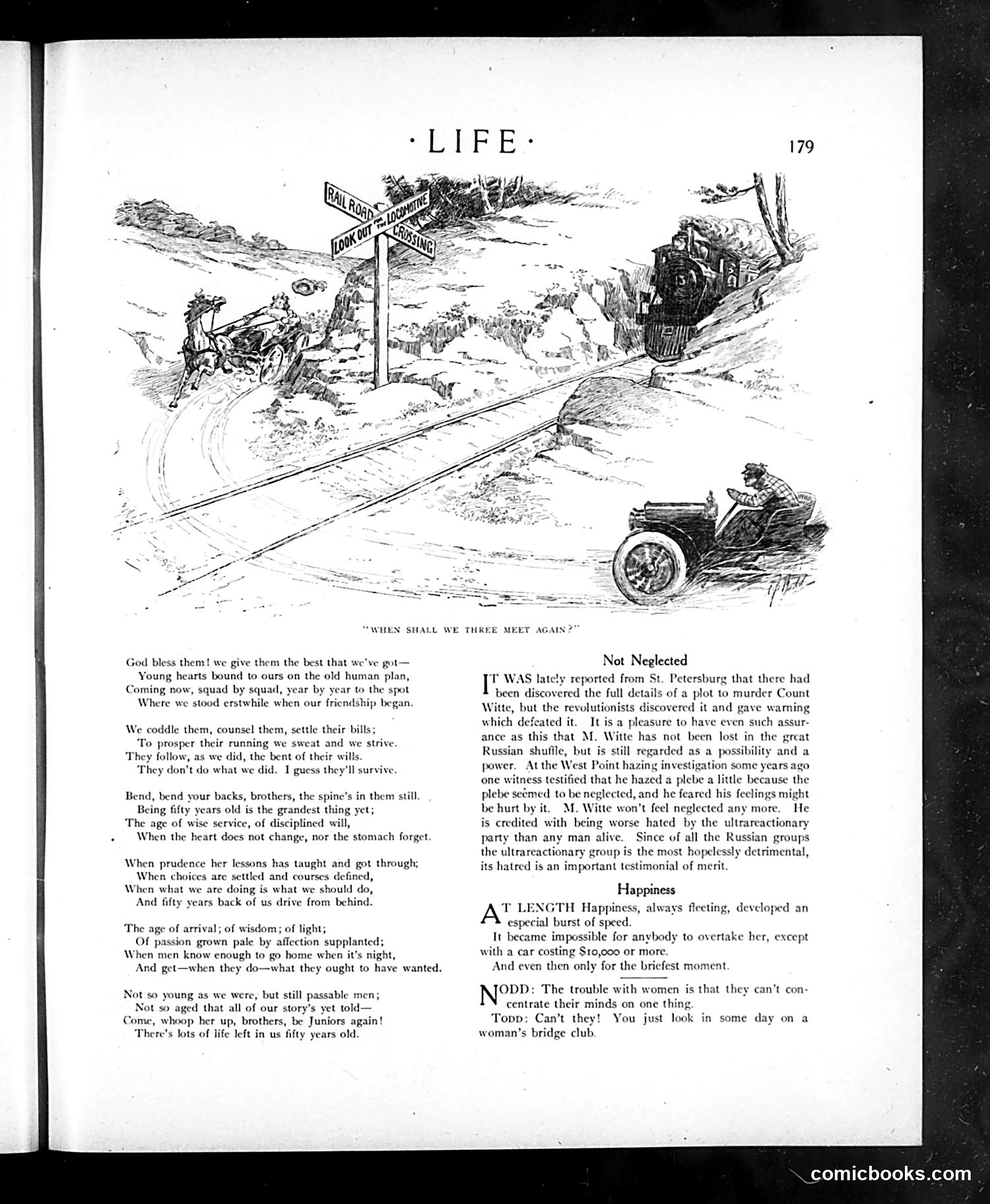
The top illustration shows a railroad crossing with a car and horse-drawn wagon meeting—captioned "When Shall We Three Meet Again?" This depicts the collision of old and new transportation methods, satirizing the coexistence of outdated horse travel with modern automobiles. The accompanying poem celebrates youth and friendship while warning against generational complacency. Below, two brief pieces mock contemporary social attitudes. "Not Neglected" references Count Witte, a Russian political figure whose reputation suffered during revolutionary upheaval. "Happiness" satirizes wealthy women's leisure pursuits, suggesting only expensive cars ($10,000+) could entertain them. The final dialogue mocks women's inability to focus, using a bridge club as the example—reflecting period sexist stereotypes about female intellect and attention spans.
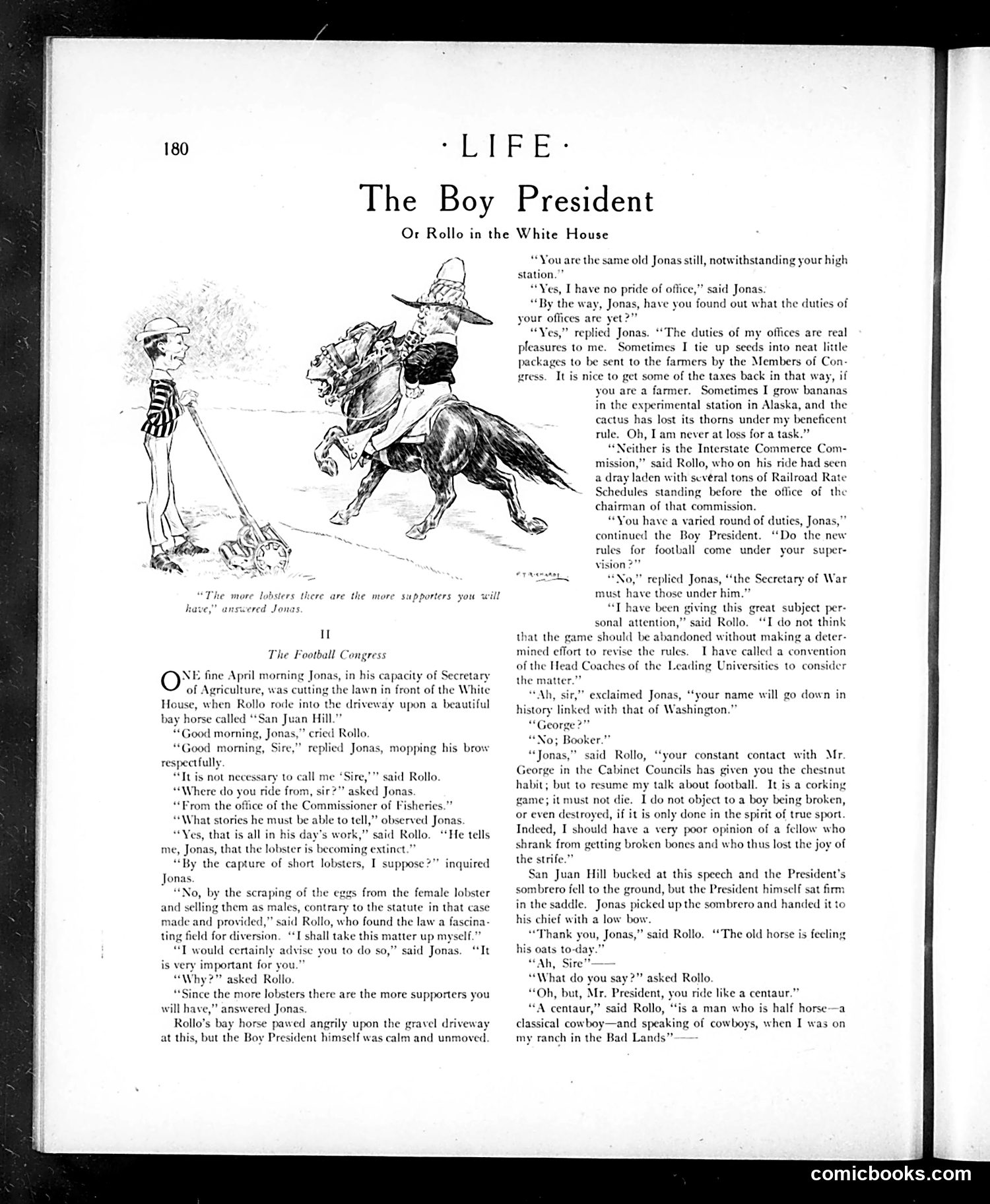
This satirical piece mocks a U.S. President (identity unclear from the image alone, though the "Boy President" title suggests someone young or inexperienced) by comparing him to "Rollo," a character from moralistic children's literature known for naive, bumbling behavior. The cartoon shows a small figure confronting a rearing horse, visually emphasizing the President's inadequacy. The text presents a dialogue where Jonas (likely a cabinet secretary) questions whether the President can handle serious duties—Interstate Commerce, football rules, cabinet matters—suggesting he's unfit for office. The satire attacks the President as childishly incompetent, more suitable for children's stories than governance. The joke relies on readers' familiarity with "Rollo" stories as emblems of juvenile foolishness.
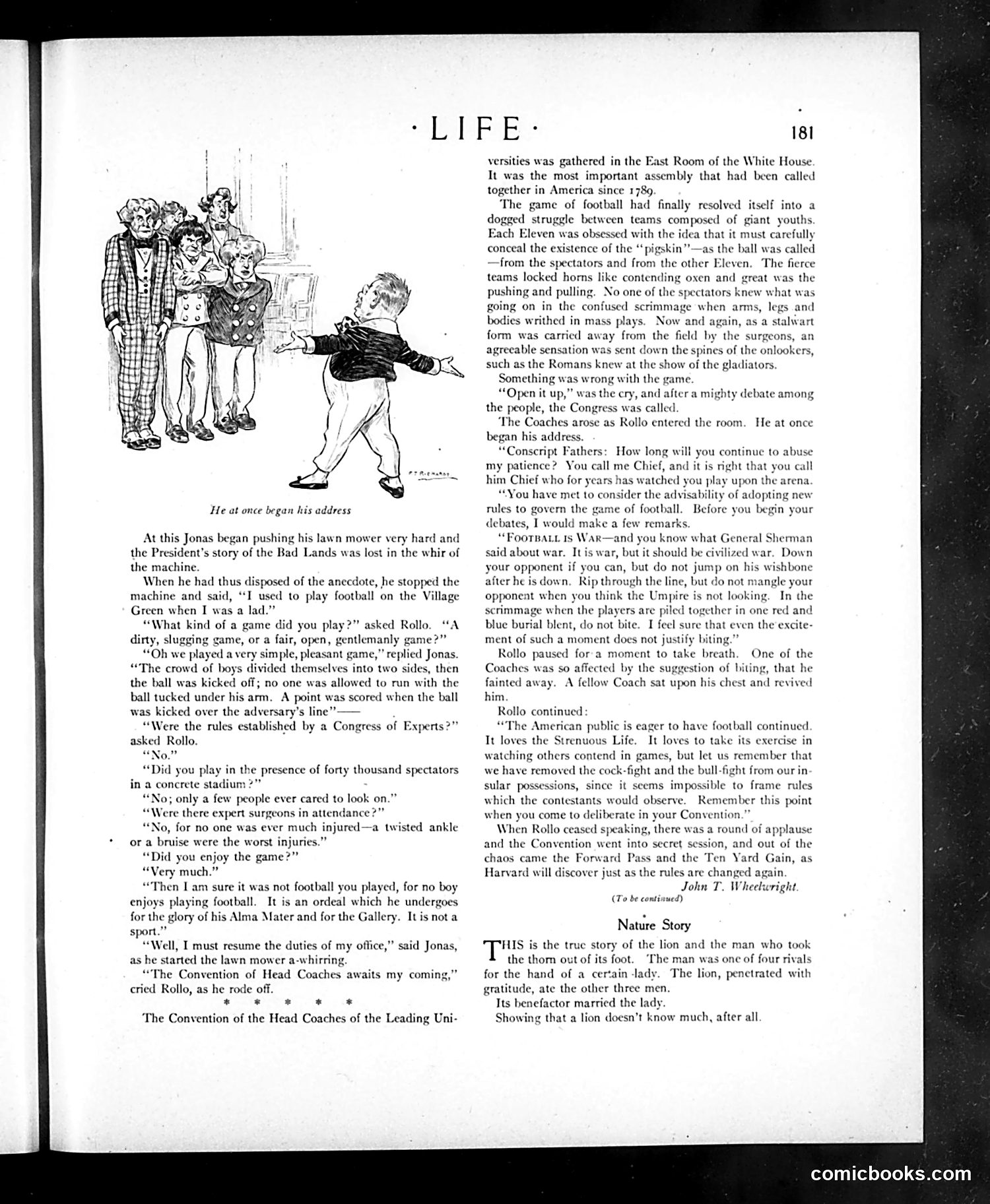
The cartoon illustrates a heated debate about American football rules, likely from the early 1900s. A figure labeled "Rollo" (appearing to be a coach or administrator) addresses what seems to be a congressional body or convention of university leaders in the White House's East Room. The satire centers on football's violence and chaos—the text mentions "twisted ankles," "bruised" players, and injuries so severe that surgeons attend games. Rollo argues for rule standardization to make football safer and more civilized, comparing it to removing cockfighting's brutality. The cartoon mocks both football's violent reputation and the absurdity of needing high-level governmental intervention to reform a sport. The joke: football enthusiasts treat the game with nearly governmental seriousness, yet it remains dangerously chaotic despite such efforts.
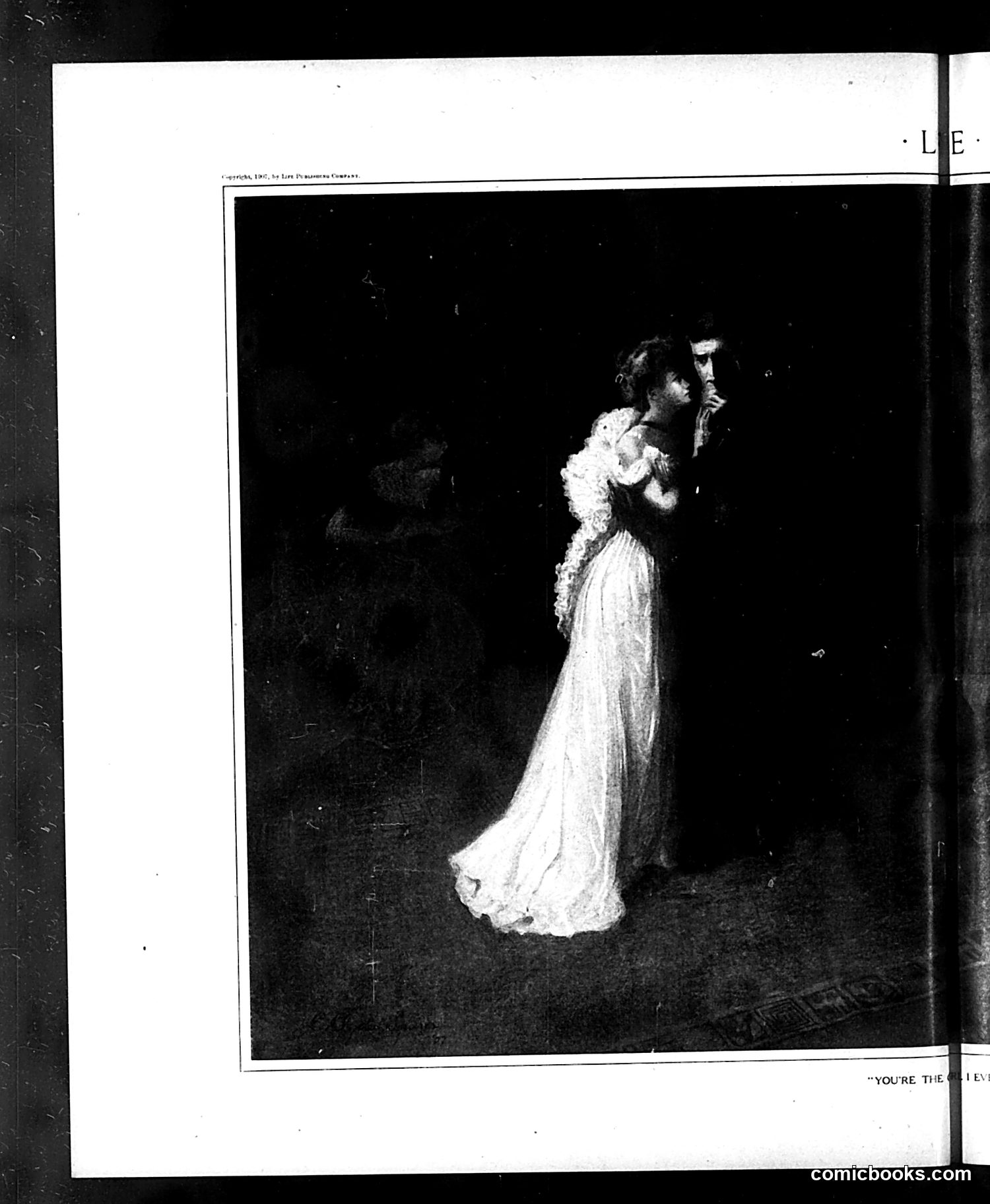
I can see this is a page from *Life* magazine with what appears to be a photograph or dark illustration in the center, framed by white borders. The partial text visible at the bottom reads "...RE THE I LEVER LOVED'" which appears to be cut off. However, the image quality is too poor and the content too obscured for me to identify specific figures, read complete captions, or determine the cartoon's subject matter with confidence. The dark central image lacks sufficient detail to discern whether it depicts a political figure, social commentary, or satirical content. To provide accurate historical analysis, I would need a clearer scan showing legible text and visible details of the illustrated or photographic content.
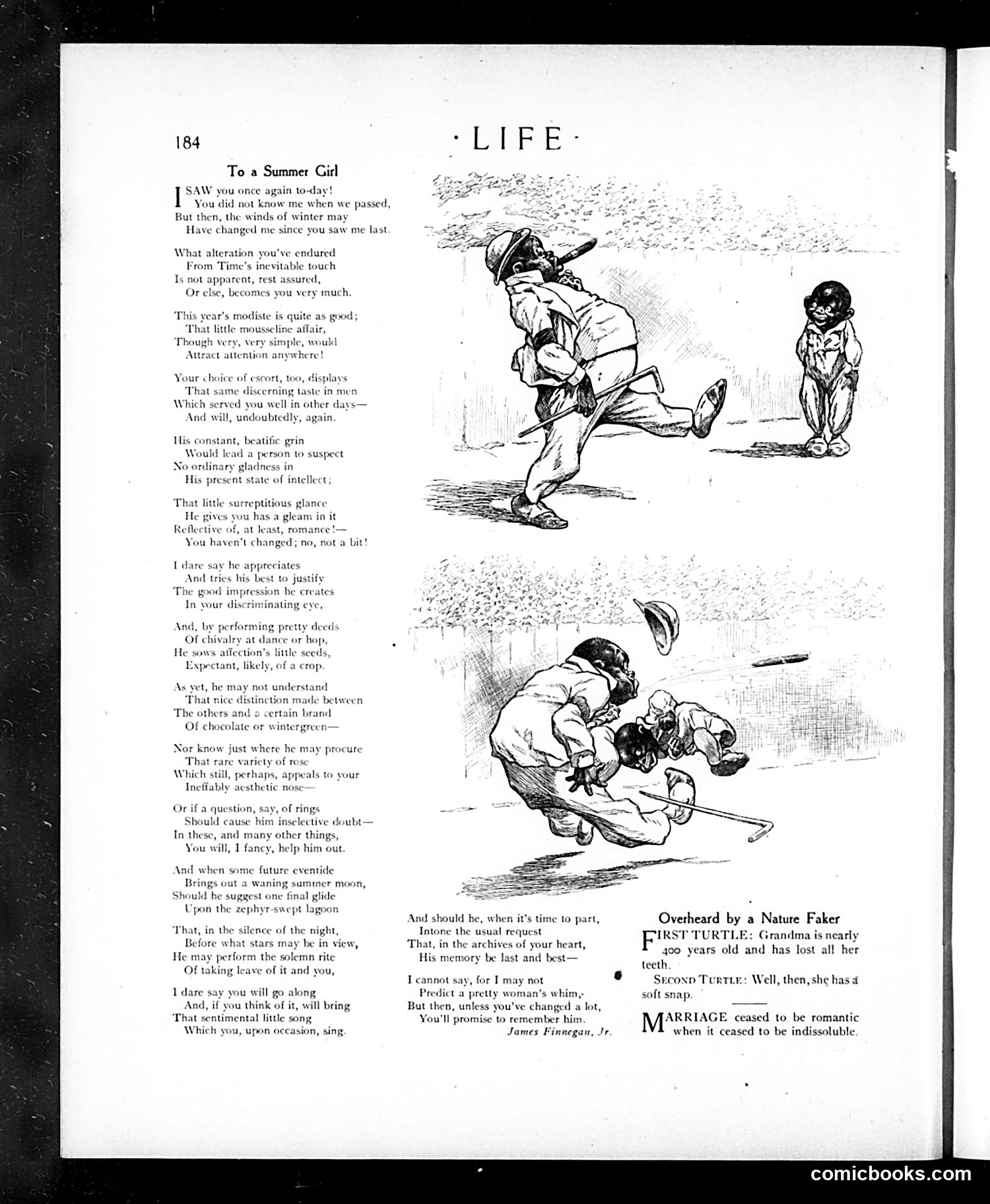
This page contains a sentimental poem addressed to a young woman the speaker encountered previously. The poem reflects on how she has changed since they last met, praising her refined taste, intellect, and romantic appeal while noting she retains an appealing "surreptitious glance." The accompanying illustrations show children playing baseball—a boy in batting stance and another scene with children on the ground, apparently during play. At bottom right is a brief humorous exchange titled "Overheard by a Nature Faker" featuring two turtles discussing an elderly grandmother turtle who has lost her teeth but possesses "a soft snap"—a pun on "snapping turtle." The overall page mixes sentimental poetry with lighthearted visual humor typical of Life magazine's satirical approach.
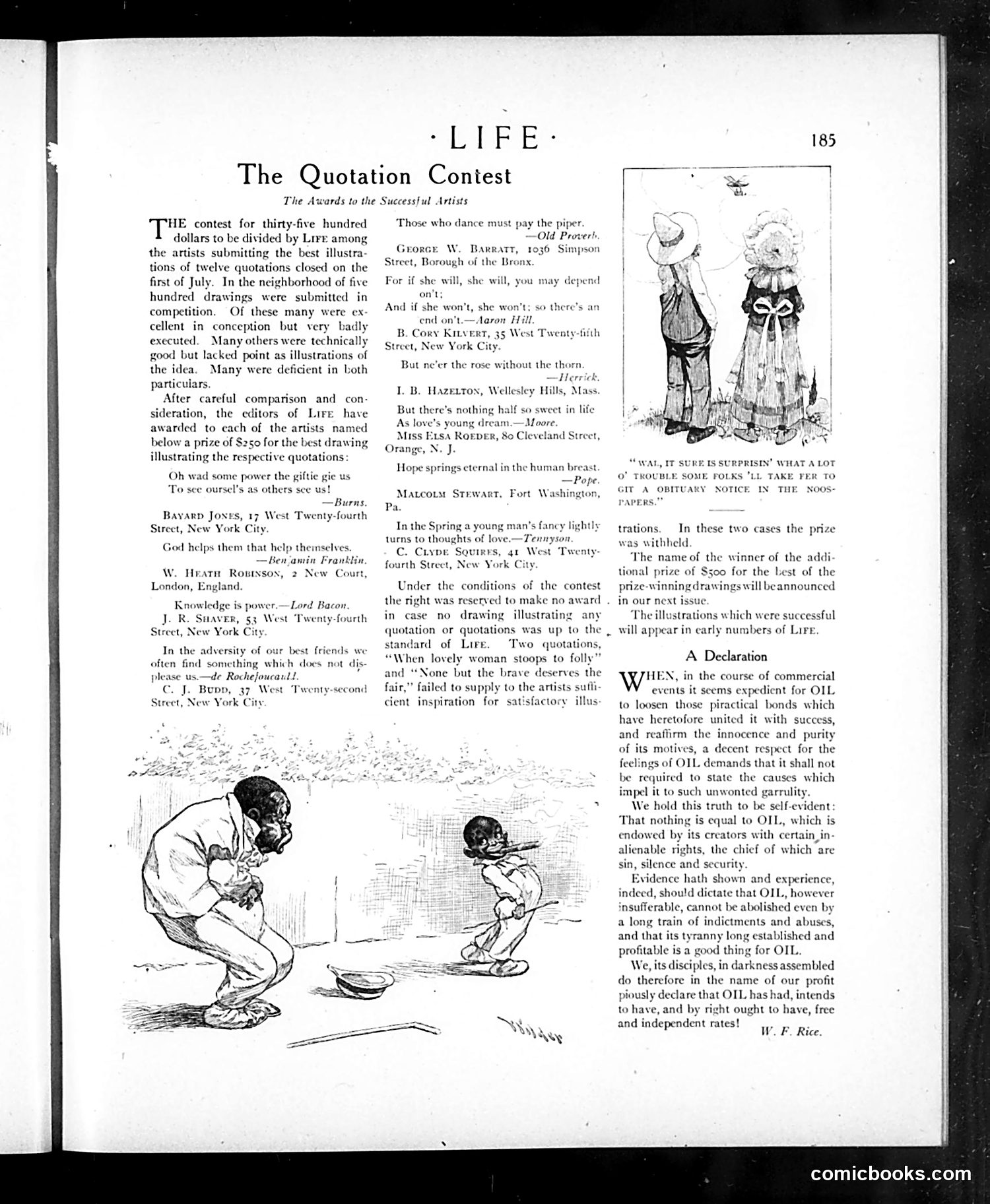
This page documents "The Quotation Contest," where Life magazine awarded prizes for illustrations of famous quotations. The winning artists are listed with their addresses and the quotes they illustrated. The two cartoon illustrations shown depict: 1. **Left image**: A figure in contorted poses, appearing to illustrate physical comedy or struggle 2. **Right image**: Two figures in Victorian dress, one appearing startled or surprised The caption quotes "Wai, it sure is surprisin'! What a lot o' trouble some folks 'll take fer to git a obituary notice in the newspapers," suggesting the cartoons humorously illustrated selected literary or proverbial quotes submitted by readers. The page also includes "A Declaration" from W.F. Rice regarding OIL's ethical standards—likely an advertisement or corporate statement, unrelated to the contest.
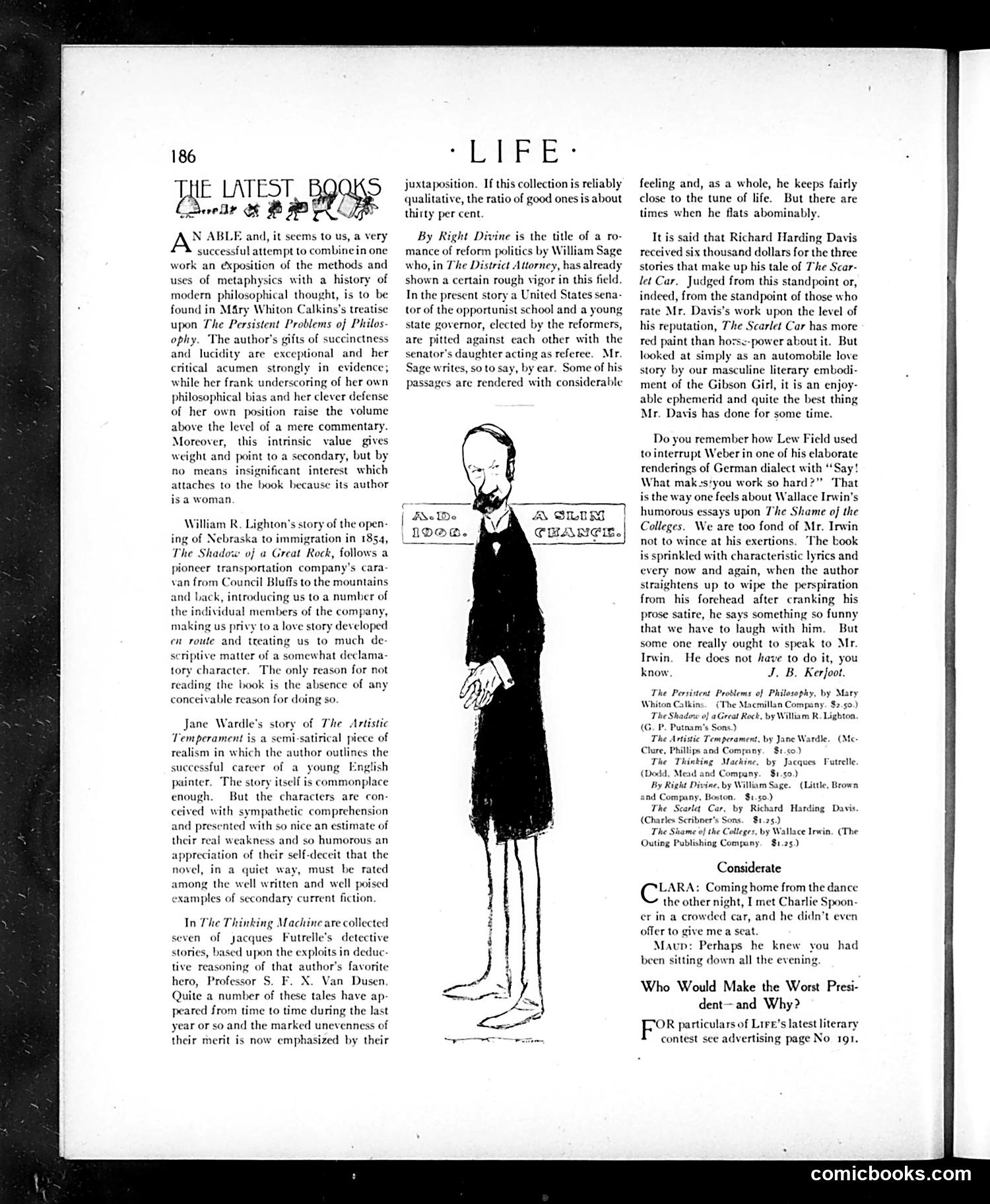
This page from Life magazine contains book reviews rather than political satire. The central illustration shows a stylized female figure in an elegant dress—likely representing "The Artistic Temperament," one of the reviewed novels by Jane Wardle about a young English painter's career. The reviews are written in Life's characteristically acerbic style, offering witty critiques of contemporary literature. Notable targets include William R. Lighton's *The Shadow of a Great Rock* (dismissed as having "no conceivable reason for doing so"), and Richard Harding Davis's *The Scarlet Car*, which the reviewer criticizes as all "red paint" rather than substance, though acknowledging it works as a "Gibson Girl" romance for masculine readers. The page demonstrates Life's role as a cultural arbiter, using humor and sharp observation to evaluate popular fiction of the era.
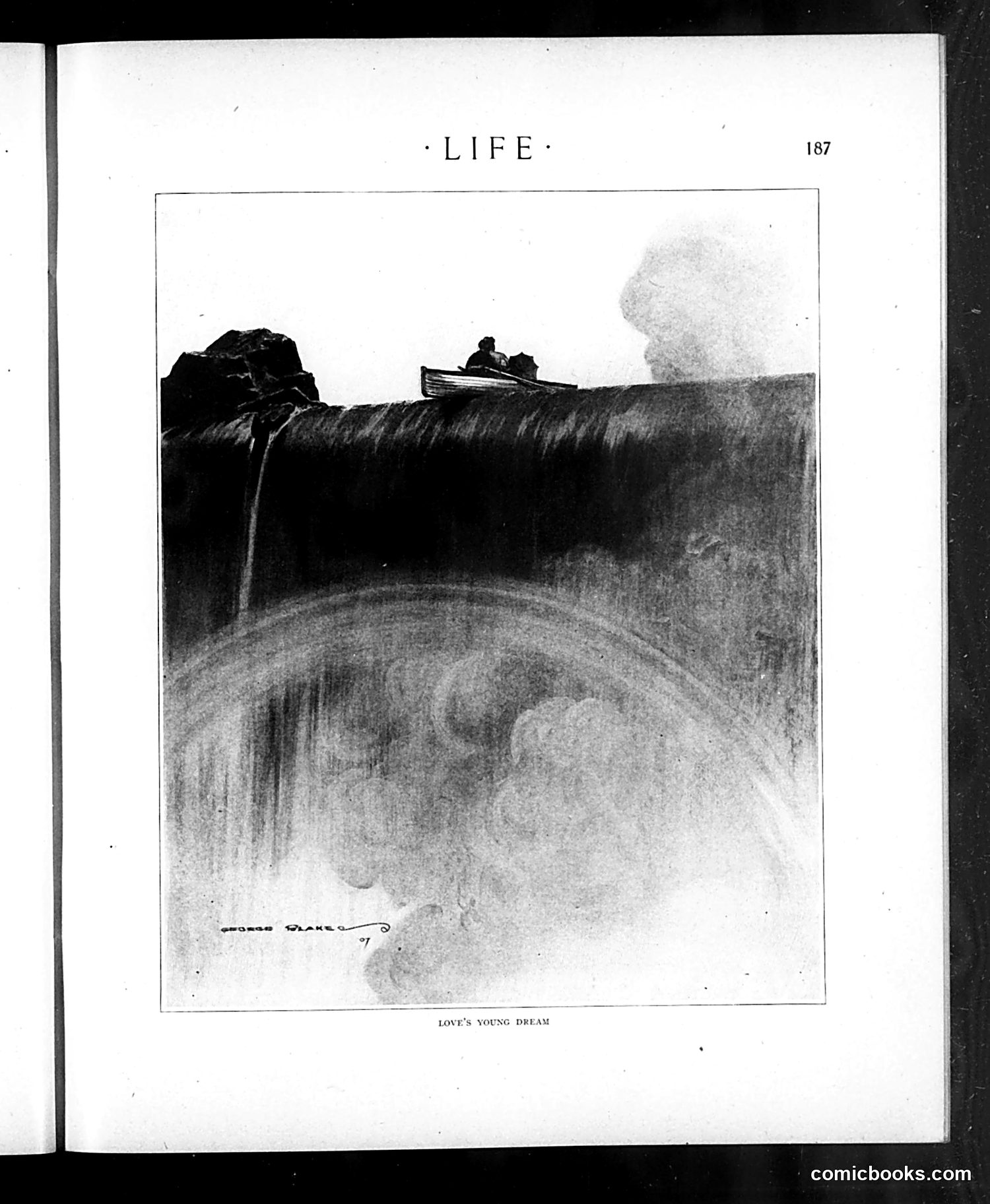
This appears to be a romantic illustration rather than political satire. The image shows a couple in a small boat on turbulent waters, with dark cliffs or rock formations looming above them and what appears to be a wave or spray in the background. The title "Love's Young Dream" suggests the artwork is commenting on romantic idealization—depicting young lovers in a picturesque, somewhat perilous natural setting. The dramatic composition, with the couple seemingly vulnerable amid powerful natural forces, may be satirizing the romantic notion that love conquers all obstacles, or ironically contrasting the idealized "dream" of romance with harsh reality. Without additional context or byline visible, the specific artist and intended satirical target remain unclear.
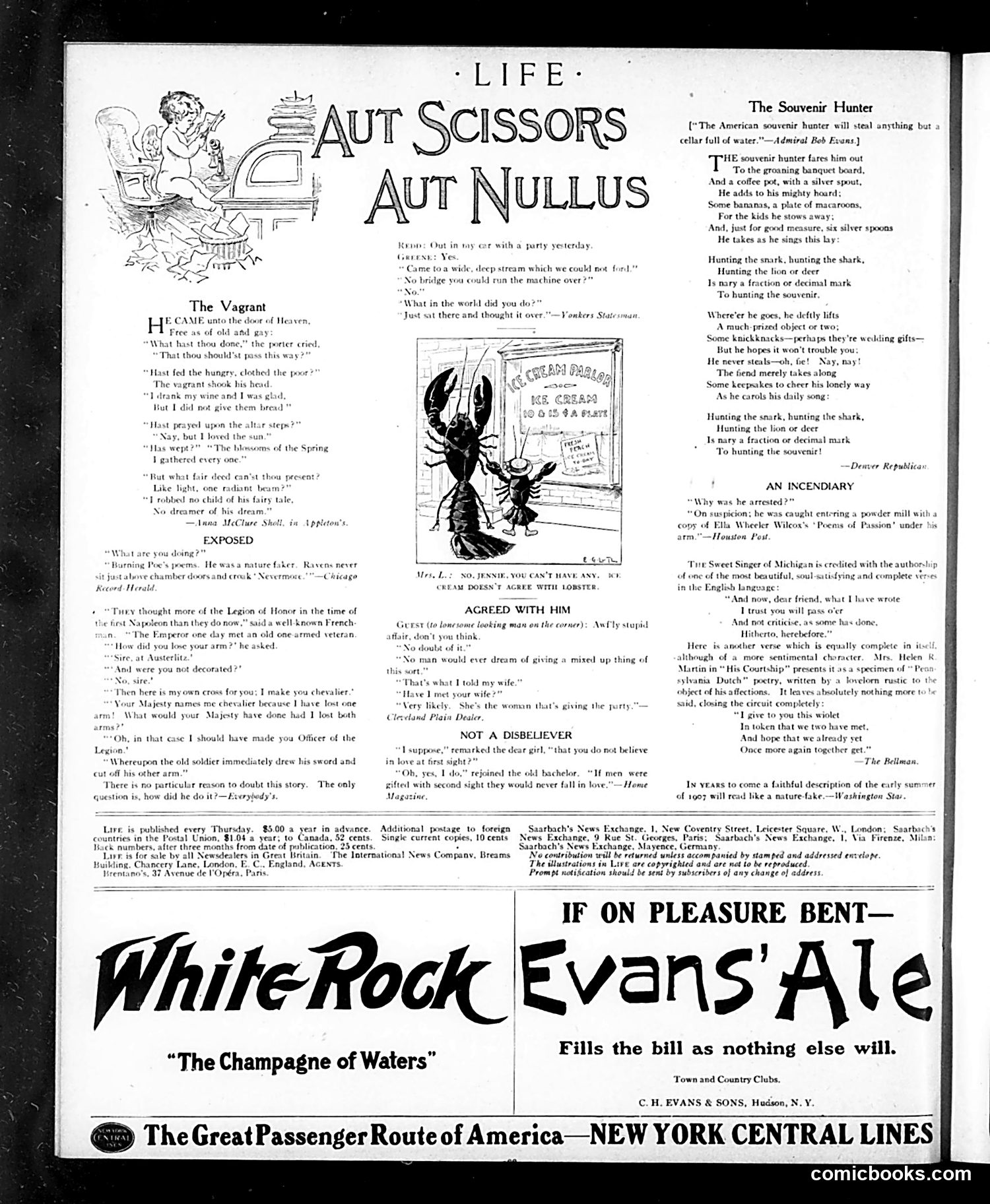
This page from *Life* satirical magazine contains several humorous pieces mocking American social types and literary pretension. **"Aut Scissors Aut Nullus"** depicts a dinner conversation where someone boasts of stealing souvenirs—coffee pots, spoons, bananas—from various venues. The satire targets the "souvenir hunter," a Gilded Age tourist type who compulsively pilfers objects as travel mementos. The accompanying verse mocks this behavior as morally equivalent to hunting dangerous game. **"The Vagrant"** uses a contrasting narrative: when asked what good he's done, a poor man admits only to stealing wine and feeling joy—yet receives forgiveness. The piece critiques society's harsher judgment of the poor versus the wealthy tourist's casual theft. Other sketches lampoon pomposity: one mocks nature-writing ("Poe's ravens never croak 'Nevermore'"), another ridicules an obviously fabricated military anecdote about self-mutilation for honor. The page reflects fin-de-siècle American anxieties about materialism, class hypocrisy, and literary affectation—typical targets for *Life's* urbane readership.
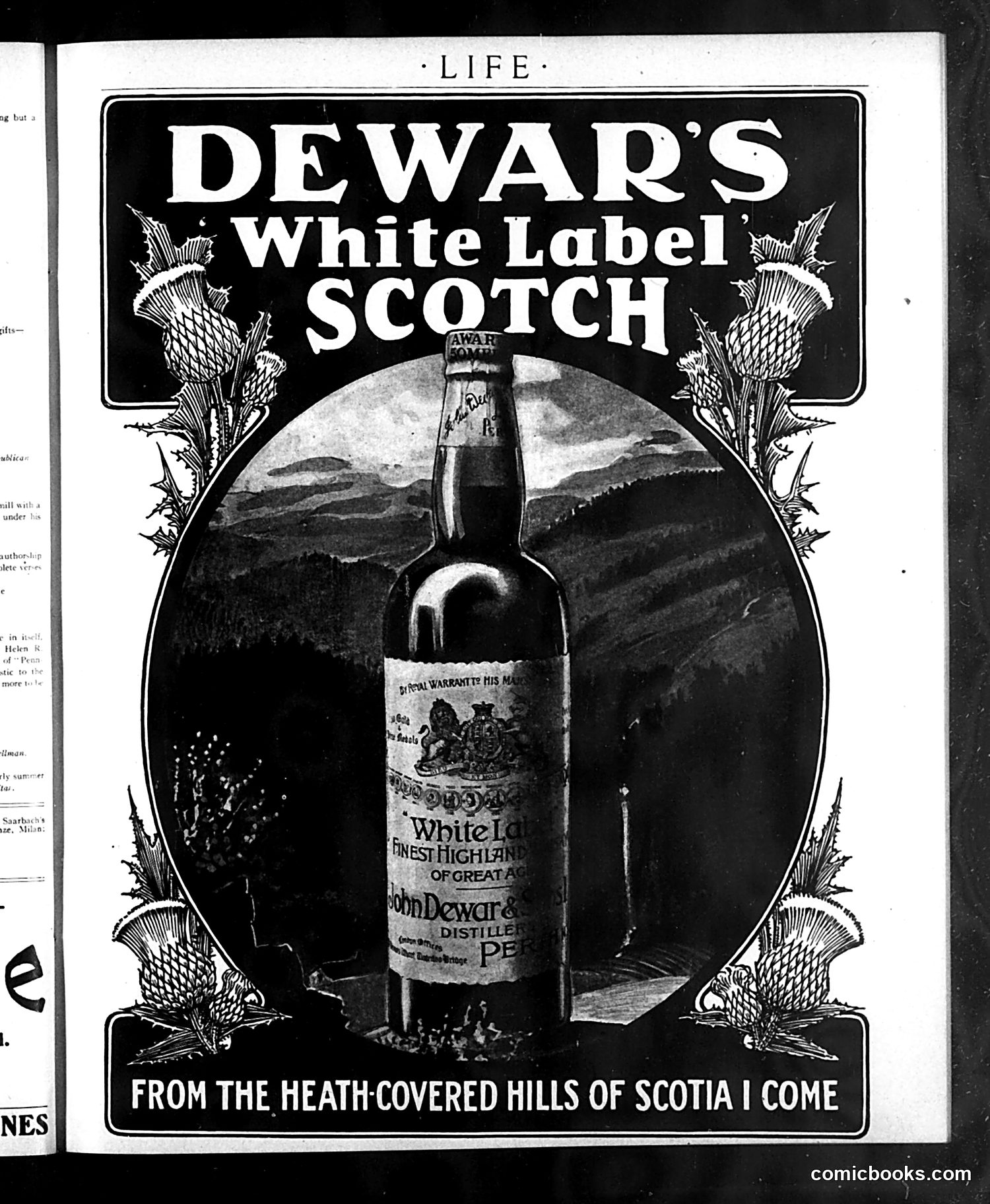
This is a **full-page advertisement**, not satire or political commentary. It promotes Dewar's White Label Scotch whisky, a Scottish product. The visual emphasizes Scottish authenticity through: - A bottle of Dewar's positioned centrally against a Highland landscape - Decorative thistles (Scotland's national symbol) in the four corners - The tagline "From the heath-covered hills of Scotia I come," invoking Scotland's geography and heritage The ad leverages nationalist imagery and romantic notions of Scotland to market the product as genuine Highland whisky. This advertising approach was common in the early 20th century, using place-of-origin appeals and cultural symbols to establish product quality and authenticity to American consumers.
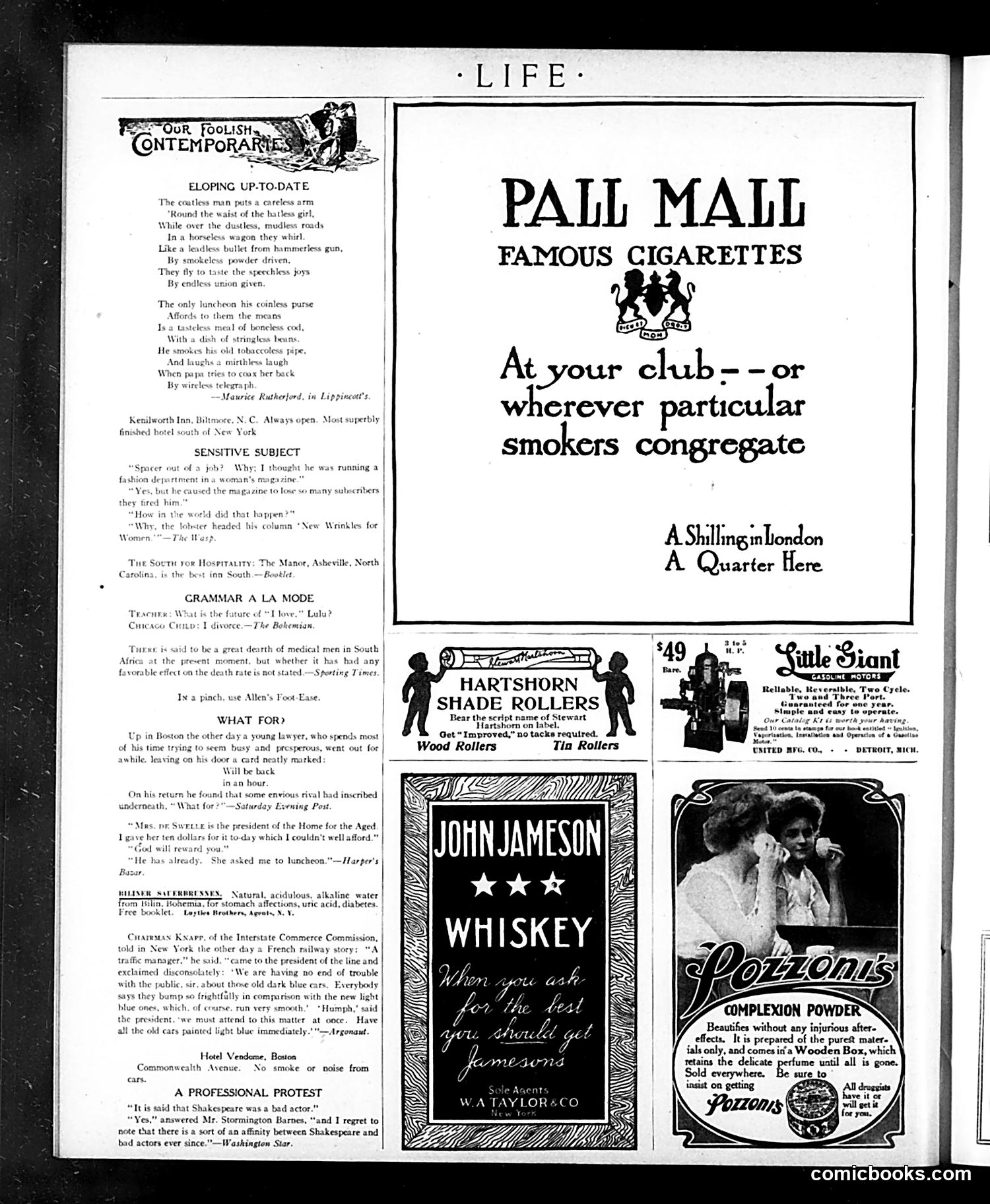
This page is primarily **advertising with brief humorous anecdotes**, not political cartoons. The "Our Foolish Contemporaries" section contains short satirical stories mocking social pretension and miscommunication: - **"Eloping Up-to-Date"**: Ridicules modern lovers who elope while distracted by technology (smokeless powder, wireless telegraph) - **"What For?"**: A lawyer's absent note is maliciously altered by a rival, creating an absurd situation - **"A Professional Protest"**: Someone objects to Shakespeare being called a bad actor, noting the irony that bad actors have always plagued Shakespearean theater The page is otherwise dominated by period advertisements for **Pall Mall cigarettes, Hartshorn shade rollers, John Jameson whiskey, Pozoni's complexion powder, and a Little Giant motor**—typical early 20th-century luxury goods marketed to middle-class readers. The humor relies on gentle mockery of contemporary life rather than political commentary. The advertising reflects the magazine's era and intended affluent, urban readership.
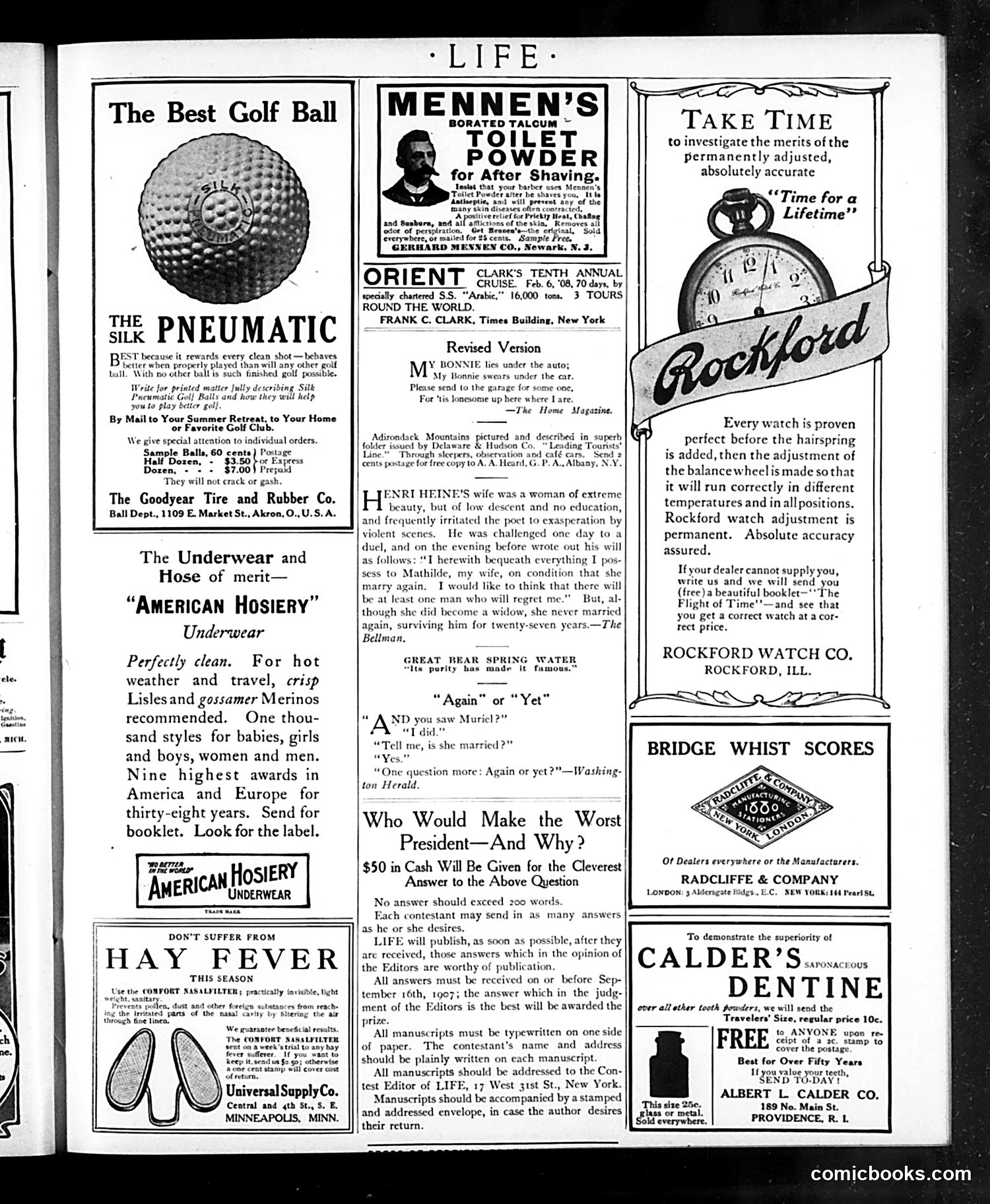
This is primarily an **advertising page** from *Life* magazine, with one notable **satirical content piece** worth explaining for modern readers: The brief poem titled "Revised Version" mocks the sentimental 19th-century song "My Bonnie Lies Over the Ocean" by replacing its romantic nostalgia with modern automobile humor. Lines like "My Bonnie lies under the auto; / My Bonnie swears under the car" joke about the newfangled danger and frustration of early motorcar ownership—vehicles that frequently broke down or caused accidents. The deliberately poor grammar ("where I are") adds comedic effect. This captures the early 1900s cultural moment when automobiles were still novelties, often unreliable and dangerous, making them targets of satire. The page also features a $50 contest asking readers "Who Would Make the Worst President—And Why?"—likely referencing contemporary political figures, though the text doesn't specify whom. The rest consists of period product advertisements (golf balls, hosiery, hay fever devices, watch brands).
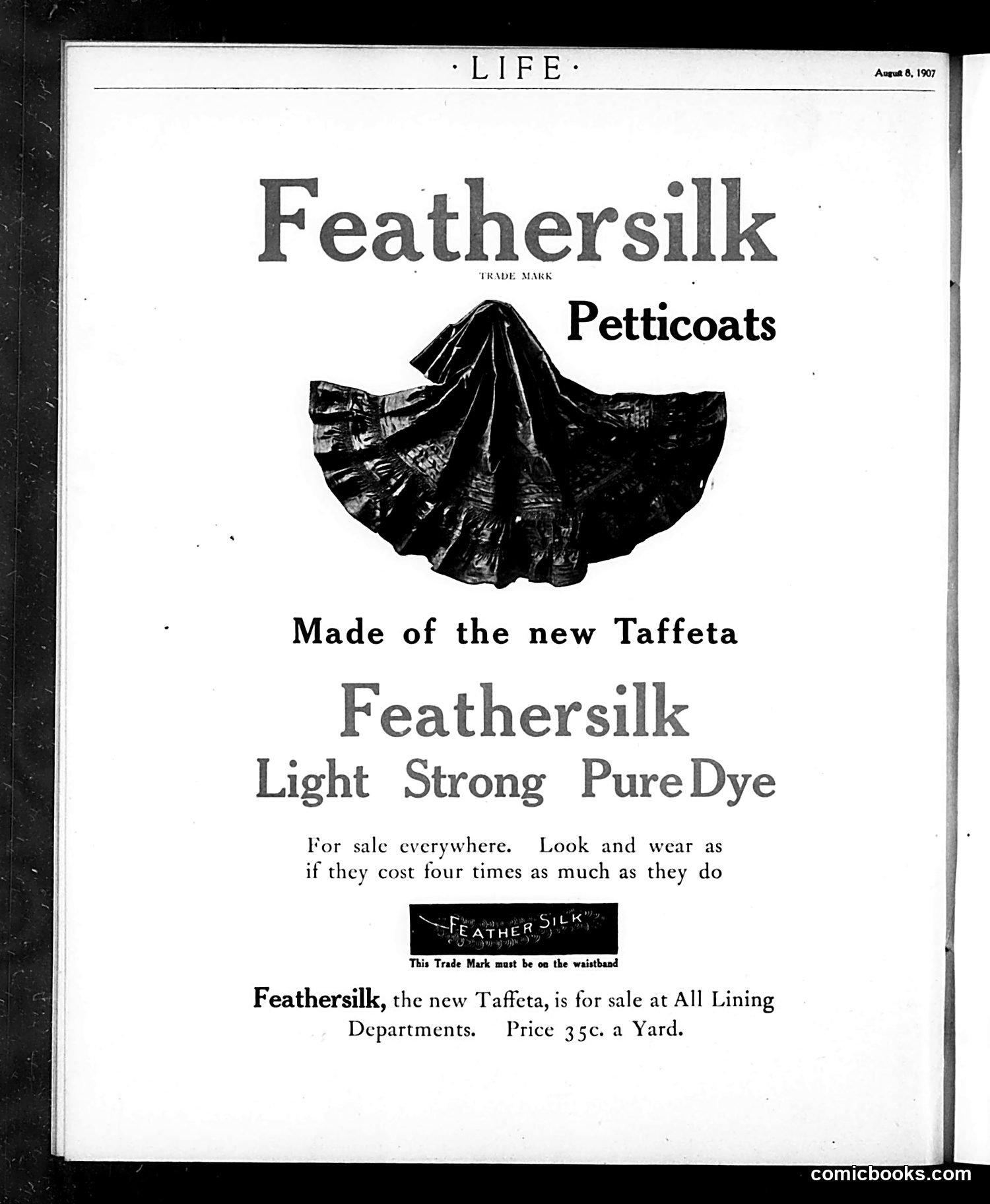
This is a straightforward advertisement, not satire or political commentary. It promotes "Feathersilk," a newly developed taffeta fabric for petticoats. The ad emphasizes the material's qualities—lightweight, strong, and colorfast ("Pure Dye")—and its affordability. The key sales pitch appears in the middle: garments made from this inexpensive fabric will "look and wear as if they cost four times as much as they do." The illustration shows a petticoat's ruffled hem. The trade mark warning indicates authenticity concerns were common enough to require prominent labeling. Priced at 35 cents per yard, it was marketed through lining departments in stores, targeting budget-conscious consumers seeking quality appearance without high cost.