
Life, 1907-08-08 · page 4 of 20
Life — August 8, 1907 — page 4: what you’re looking at
What you’re looking at
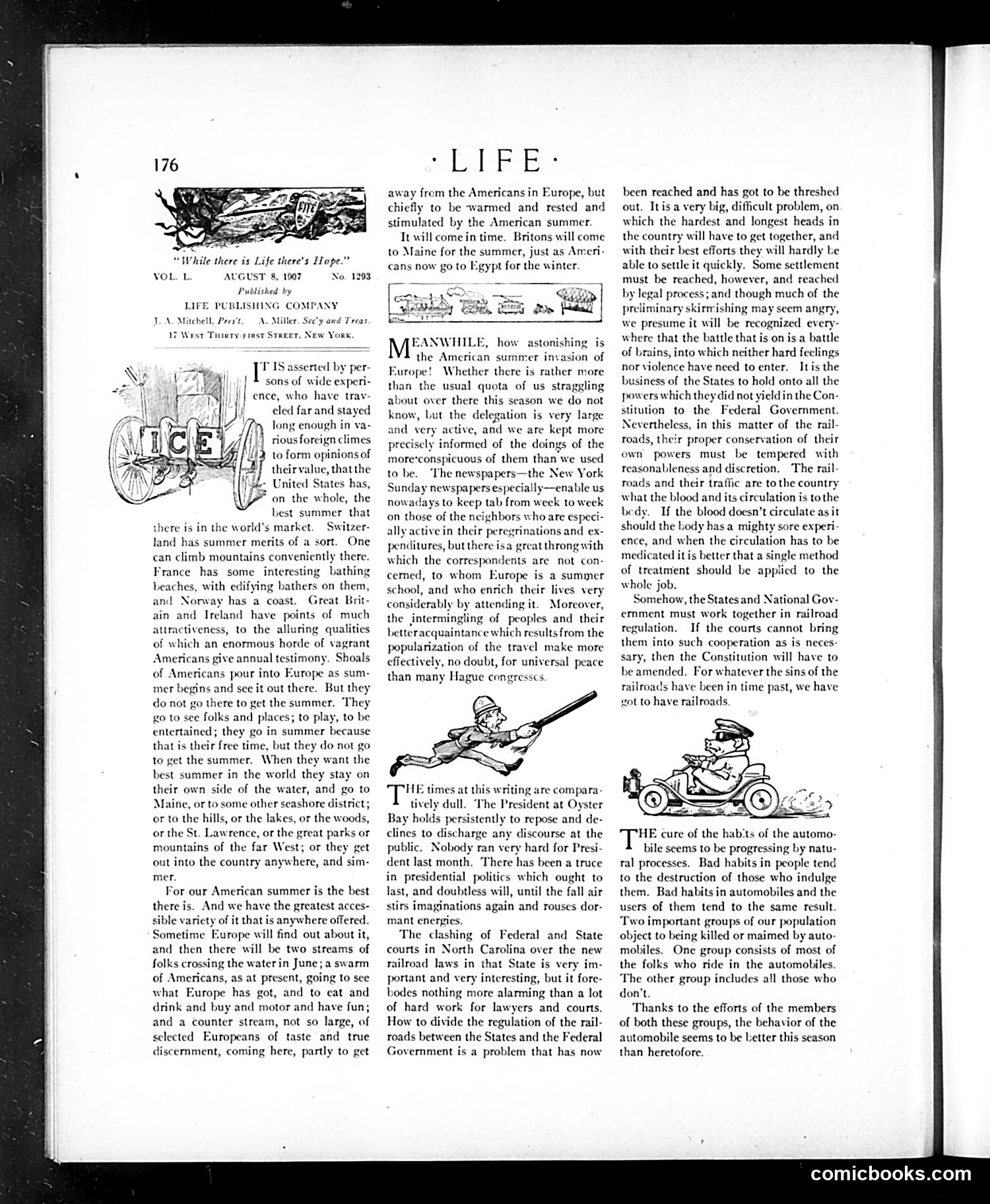
This page contains editorial commentary rather than political cartoons. The text discusses Americans vacationing in Europe during summer and criticizes railroad regulation disputes between Federal and State governments, particularly in North Carolina. Two small illustrations accompany the text: one shows a figure in a diving or flying pose (likely satirizing leisure activities), and another depicts someone in an early automobile, referencing the growing automobile industry and its safety concerns. The editorial focuses on serious issues—railroad safety, interstate commerce regulation, and automobile-related deaths—rather than humorous satire. It advocates for better coordination between state and federal authorities in regulating transportation safety, suggesting these were contentious policy debates of the era.
📄 Transcribed text from this page (OCR, searchable)
Machine-transcribed from the original scan — historical spelling and the odd misread are preserved.
“While there is Life there’s Hope.” VOL. L. AUGUST 8, 1907 No. Published by LIFE PUBLISHING COMPANY J..A. Mitchell, Pres't 17 West Trawry-riest Street, New York, 1293 A. Miller. Sec'y and Treas T IS asserted by per: sons of wide experi- i j/| ence, who have trav eled far and stayed long enough in va- rious foreign climes to form opinions of theirvalue, that the |y4, United States has, Pon the whole, the best summer that there is in the world’s market. Swit. land has summer merits of a sort. One can climb mountains conveniently there. France has some interesting bathing with edifying bathers on them, Norway has a coast. Great Brit- ain and Ireland have points of much attractiveness, to the alluring qualities of which an enormous horde of vagrant Americans give annual testimony. Shoals of Americans pour into Europe as sum- mer begins and see it out there. But they do not go there to get the summer. They go to see folks and places; to play, to be entertained; they go in summer because that is their free time, but they do not go to get the summer. When they want the best summer in the world they stay on their own side of the water, and go to Maine, or to some other seashore district; or to the hills, or the lakes, or the woods, or the $ wrence, or the great parks or mountains of the far West; or they get out into the country anywhere, and sim- mer. For our American summer is the best there is. And we have the greatest acces- sible variety of it that is anywhere offered. Sometime Europe will find out about it, and then there will be two streams of folks crossing the water in June; a swarm of Americans, as at present, going to see what Europe has got, and to eat and drink and buy and motor and have fun; and a Counter stream, not so large, of selected Europeans of taste and true discernment, coming here, partly to get SE * away from the Americans in Europe, but chiefly to be warmed and rested and stimulated by the American summer. It will come in time. Britons will come to Maine for the summer, just as Ameri- cans now go to Egypt for the winter. CRS EK seek easy Sz, ANWHILE, how astonishing is the American summer invasion of Europe! Whether there is rather more than the usual quota of us straggling about over there this season we do not know, Lut the delegation is very large and very active, and we are kept more precisely informed of the doings of the more*conspicuous of them than we used to be. ‘The newspapers—the New York Sunday newspapers especially—enable us nowadays to keep tab from week to week on those of the neighbors who are especi- ally active in their peregrinations and ex- penditures, but there isa great throng with which the correspondents are not con- cemed, to whom Europe is a summer school, and who enrich their lives very considerably by attending it. Moreover, the intermingling of peoples and their betteracquaintance which results from the popularization of the travel make more efiectively, no doubt, for universal peace than many Hague congresscs. TE times at this writing are compara: tively dull. The President at Oyster Bay holds persistently to repose and de- clines to discharge any discourse at the public. Nobody ran very hard for Presi- dent last month. There has been a truce in presidential politics which ought to last, and doubtless will, until the fall air stirs imaginations again and rouses dor- mant energies. The clashing of Federal and State courts in North Carolina over the new railroad laws in that State is very im- portant and very interesting, but it fore- bodes nothing more alarming than a lot of hard work for lawyers and courts. How to divide the regulation of the rail- roads between the States and the Federal Government is a problem that has now been reached and has got to be threshed out. Itisa very big, difficult problem, on which the hardest and longest heads in the country will have to get together, and with their best efforts they will hardly Le able to settle it quickly. Some settlement must be reached, however, and reached by legal process; and though much of the preliminary skirmishing may seem angry, we presume it will be recognized every where that the battle that is on is a battle of brains, into which neither hard feelings nor violence have need to enter. Itis the business of the States to hold onto all the powers which they did not yield in the Con stitution to the Federal Government. Nevertheless, in this matter of the rail- roads, their proper conservation of their own powers must be tempered with reasonableness and discretion. The rail roads and their trafiic are to the country what the blood and its circulation is tothe bedy. If the blood doesn’t circulate as it should the body has a mighty sore experi ence, and when the circulation has to be medicated it is better that a single method of treatment should be applied to the whole job. Somehow, the States and National Gov- ernment must work together in railroad regulation. If the courts cannot bring them into such cooperation as is neces- sary, then the Constitution will have to be amended. For whatever the sins of the railroads have been in time past, we have xot to have railroads. 'HE cure of the hab‘ts of the automo- bile seems to be progressing by natu- ral processes. Bad habits in people tend to the destruction of those who indulge them. Bad habits in automobiles and the users of them tend to the same result Two important groups of our population object to being killed or maimed by auto- mobiles. One group consists of most of the folks who ride in the automobiles. The other group includes all those who don’t. Thanks to the efforts of the members of both these groups, the behavior of the automobile seems to be better this season than heretofore. comicbooks.com