
Life, 1907-08-08 · page 14 of 20
Life — August 8, 1907 — page 14: what you’re looking at
What you’re looking at
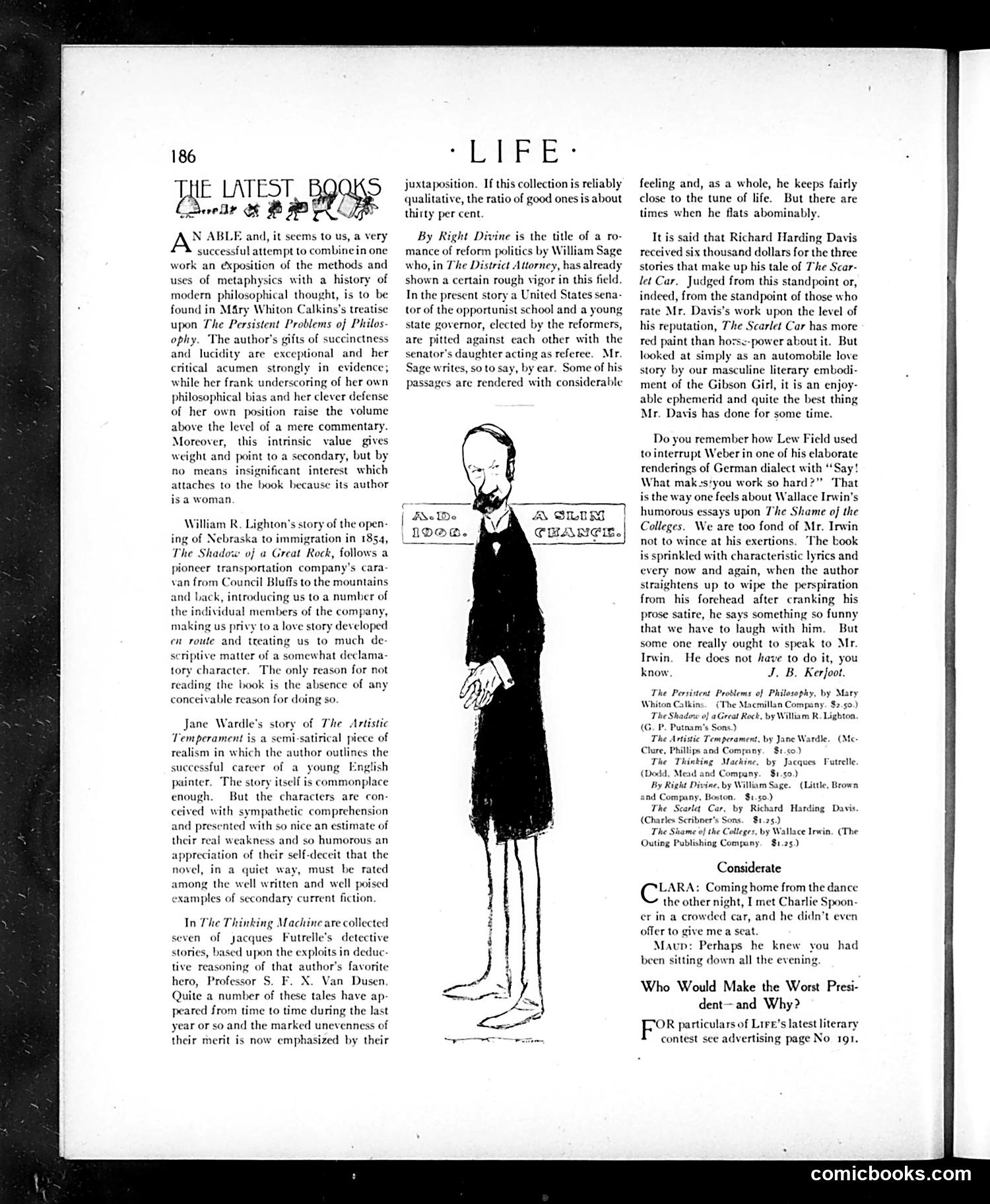
This page from Life magazine contains book reviews rather than political satire. The central illustration shows a stylized female figure in an elegant dress—likely representing "The Artistic Temperament," one of the reviewed novels by Jane Wardle about a young English painter's career. The reviews are written in Life's characteristically acerbic style, offering witty critiques of contemporary literature. Notable targets include William R. Lighton's *The Shadow of a Great Rock* (dismissed as having "no conceivable reason for doing so"), and Richard Harding Davis's *The Scarlet Car*, which the reviewer criticizes as all "red paint" rather than substance, though acknowledging it works as a "Gibson Girl" romance for masculine readers. The page demonstrates Life's role as a cultural arbiter, using humor and sharp observation to evaluate popular fiction of the era.
📄 Transcribed text from this page (OCR, searchable)
Machine-transcribed from the original scan — historical spelling and the odd misread are preserved.
186 THE LATEST. S ae BR N ABLE and, it seems to us, a very successful attempt to combine in one work an exposition of the methods and uses of metaphysics with a history of modern philosophical thought, is to be found in Mfry Whiton Calkins’s treatise upon The Persistent Problems oj Philos- ophy. The author's gifts of succinctness and lucidity are exceptional and her critical acumen strongly in evidence; while her frank underscoring of her own philosophical bias and her clever defense of her own position raise the volume above the level of a mere commentary. Moreover, this intrinsic value gives weight and point to a secondary, but by no means insignificant interest which attaches to the book because its author is a woman William R. Lighton’s story of the open- ing of Nebraska to immigration in 1854, The Shadow oj a Great Rock, follows a pioneer transportation company’s cara- van from Council Bluffs to the mountains and Lack, introducing us to a number of the individual members of the company, making us privy toa love story developed en route and treating us to much de scriptive matter of a somewhat declama- tory character. The only reason for not reading the book is the absence of any conceivable reason for doing so. Jane Wardle’s story of The Artistic Temperament is a semi-satirical piece of realism in which the author outlines the successful career of a young English painter. The story itself is commonplace enough. But the characters are con- ceived with sympathetic comprehension and presented with so nice an estimate of their real weakness and so humorous an ppreciation of their self-deceit that the novel, in a quiet way, must be rated among the well written and well poised examples of secondary current fiction. In The Thinking Machine are collected seven of jacques Futrelle’s detective stories, based upon the exploits in deduc- tive reasoning of that author's favorite hero, Professor S$. F. X. Van Dusen Quite a number of these tales have ap: peared from time to time during the last ror so and the marked unevenness of their merit is now emphasized by their - GRE juxtaposition. If this collection is reliably qualitative, the ratio of good ones is about thirty per cent. By Right Divine is the title of a ro- mance of reform politics by William Sage who, in The District Attorney, has already shown a certain rough vigor in this field. In the present story a United States sena- tor of the opportunist school and a young state governor, elected by the reformers, are pitted against each other with the senator's daughter acting as referee. Mr. Sage writes, so to say, by ear. Some of his passages are rendered with considerable a A SLING CBANCIE. feeling and, as a whole, he keeps fairly close to the tune of life. But there are times when he flats abominably. It is said that Richard Harding Davis received six thousand dollars for the three stories that make up his tale of The Scar- let Car. Judged from this standpoint or, indeed, from the standpoint of those who rate Mr. Davis's work upon the level of his reputation, The Scarlet Car has more red paint than hozse-power about it. But looked at simply as an automobile love story by our masculine literary embodi- ment of the Gibson Girl, it is an enjoy- able ephemerid and quite the best thing Mr. Davis has done for some time. Do you remember how Lew Field used to interrupt Weber in one of his elaborate renderings of German dialect with “Say What mak-s'you work so hard?” That is the way one feels about Wallace Irwin's humorous essays upon The Shame of the Colleges. We are too fond of Mr. Irwin not to wince at his exertions. ‘The book is sprinkled with characteristic lyrics and every now and again, when the author straightens up to wipe the perspiration from his forehead after cranking his prose satire, he says something so funny that we have to laugh with him. But some one really ought to speak to Mr. Irwin. He does not have to do it, you know J.B. Kerfoot. The Persistent Problems of Philosophy, by Mary Whiton Calkins. (The Macmillan Company. $2.59.) The Shadorw 0} a Great Rock, by William R. Lightoa, (G. P. Putnam's Sons.) The Artistic Temperament Clure, Phillips and Company The Thinking Machine, by Jacques (Dodd, Mead and Company. $1.50.) By Right Divine, by William Sage and Company, Boston. $1.50.) The Scar Car, by Richard Harding Davis (Charles Scribner's Sons. $1.25.) The Shame o} the Colteges, by Wallace Irwin, (The Outing Publishing Company. $1.25.) by Jane Wardle, (Me- $1.50) Futrelle. (Little, Brown Considerate (UAB Coming home from the dance the other night, I met Charlie Spoon er in a crowded car, and he didn’t even offer to give mea scat. Maun: Perhaps he knew you had been sitting down all the evening Who Would Make the Worst Presi- dent~and Why? For particulars of Lire’s latest literary contest see advertising page No 19 comicbooks.com