
A complete issue · 20 pages · 1907
Life — May 30, 1907
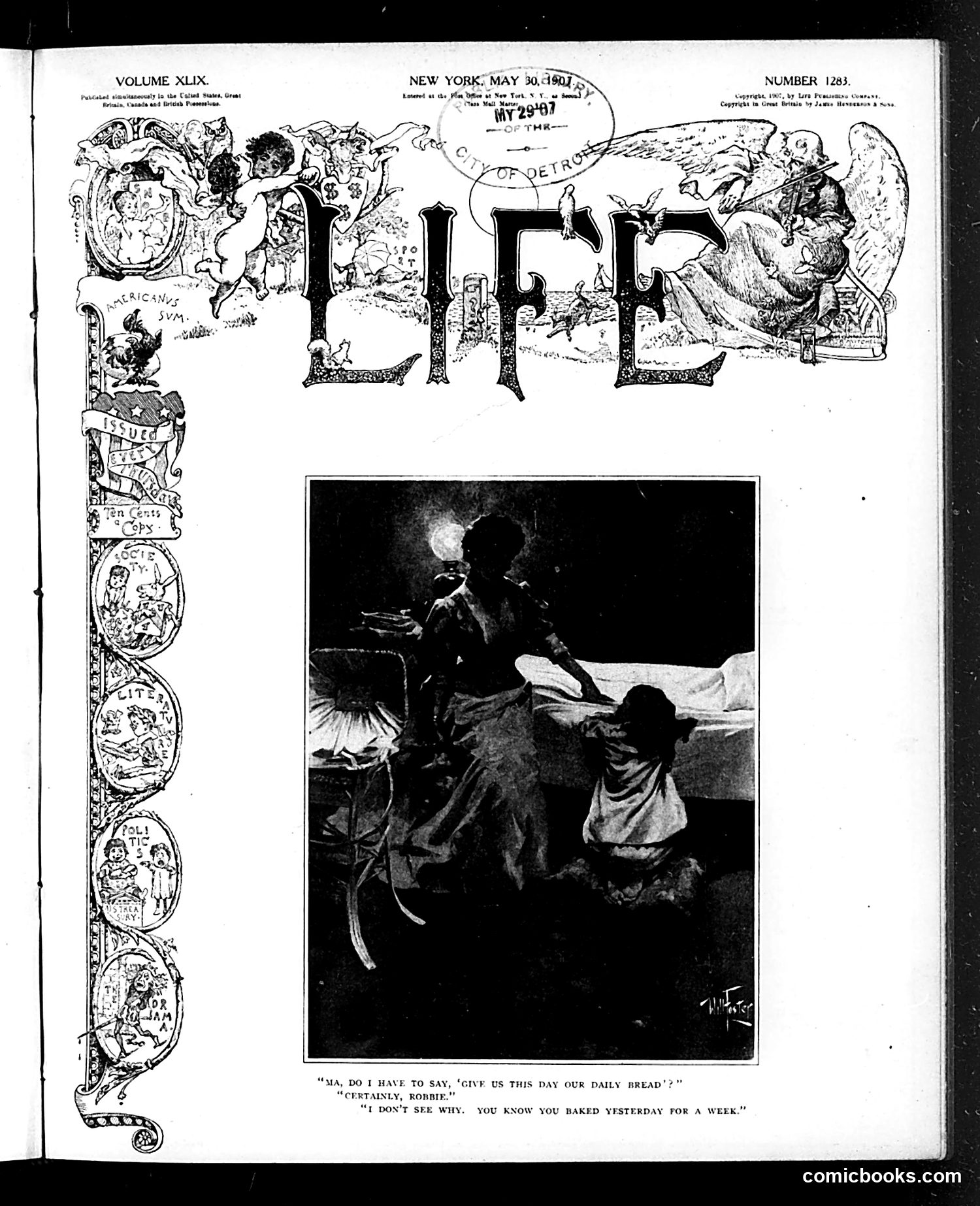
This page features a domestic scene with social commentary about bread-making and household labor. The dialogue shows a woman (likely the wife/mother) questioning a child about daily bread, with the child's response suggesting the mother hasn't baked in a week—implying she's stopped doing traditional housework. The satire appears to target changing gender roles and domestic expectations in early 20th-century America. The illustration, signed by the artist, depicts what seems to be a mother and child in an intimate moment, likely meant to humorously highlight tensions between modern women's activities and traditional domestic duties expected of wives and mothers. The elaborate decorative border on the left suggests this was a prominent feature in the magazine.
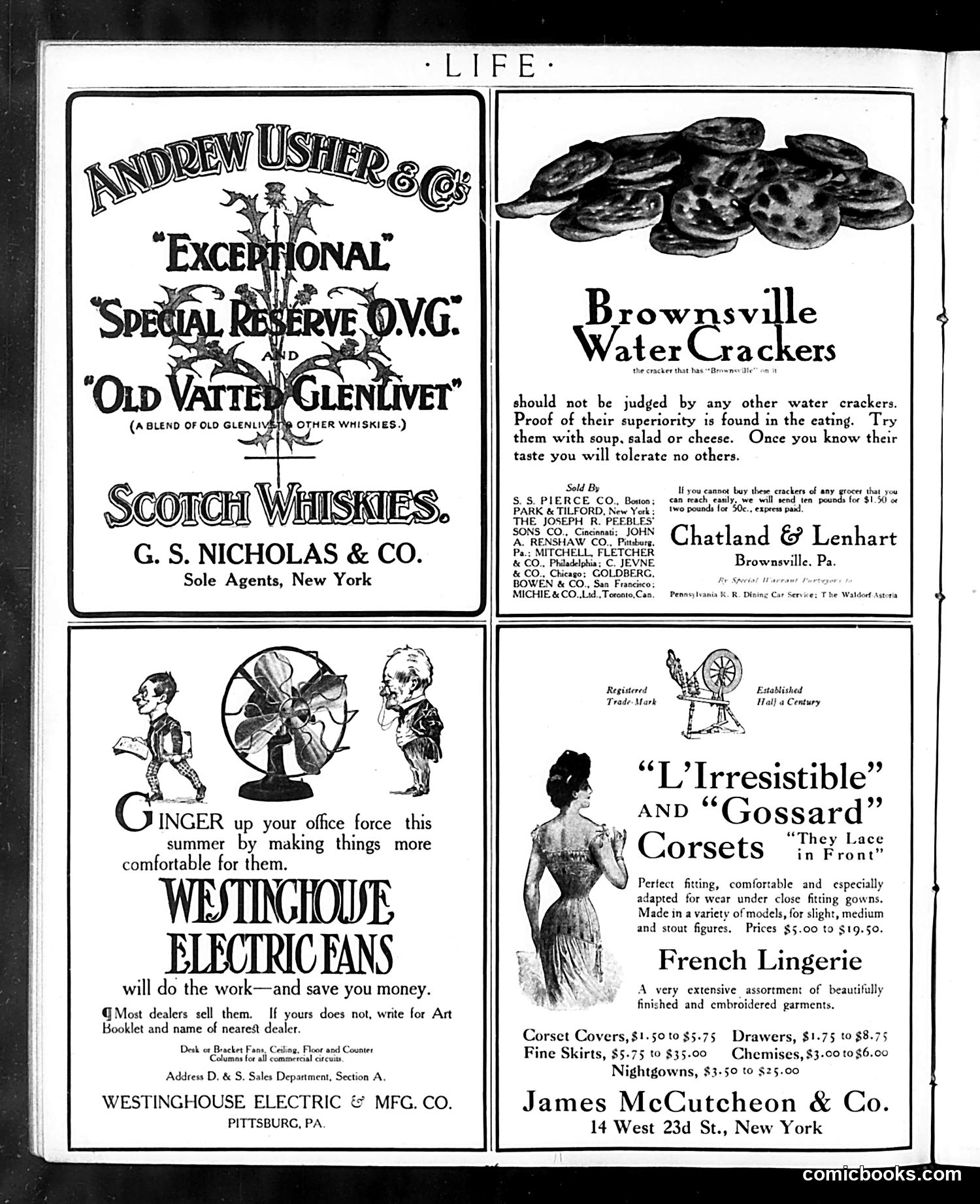
This page consists entirely of **advertisements**, not editorial content or cartoons. There is no satire or political commentary to decode. The ads include: - **Andrew Usher whisky** (Scottish, sold by G.S. Nicholas & Co., New York) - **Brownsville Water Crackers** (Pennsylvania food product) - **Westinghouse Electric Fans** (cooling appliances for office workers) - **"L'Irresistible" and "Gossard" Corsets** (women's undergarments by James McCutcheon & Co., New York) - **French Lingerie** (various intimate apparel with prices listed) The page reflects early 20th-century consumer culture, targeting both business environments (fans for offices) and personal/domestic consumption (food, clothing, whisky). The corset ads use period conventions of idealized female silhouettes to market constrictive fashion.
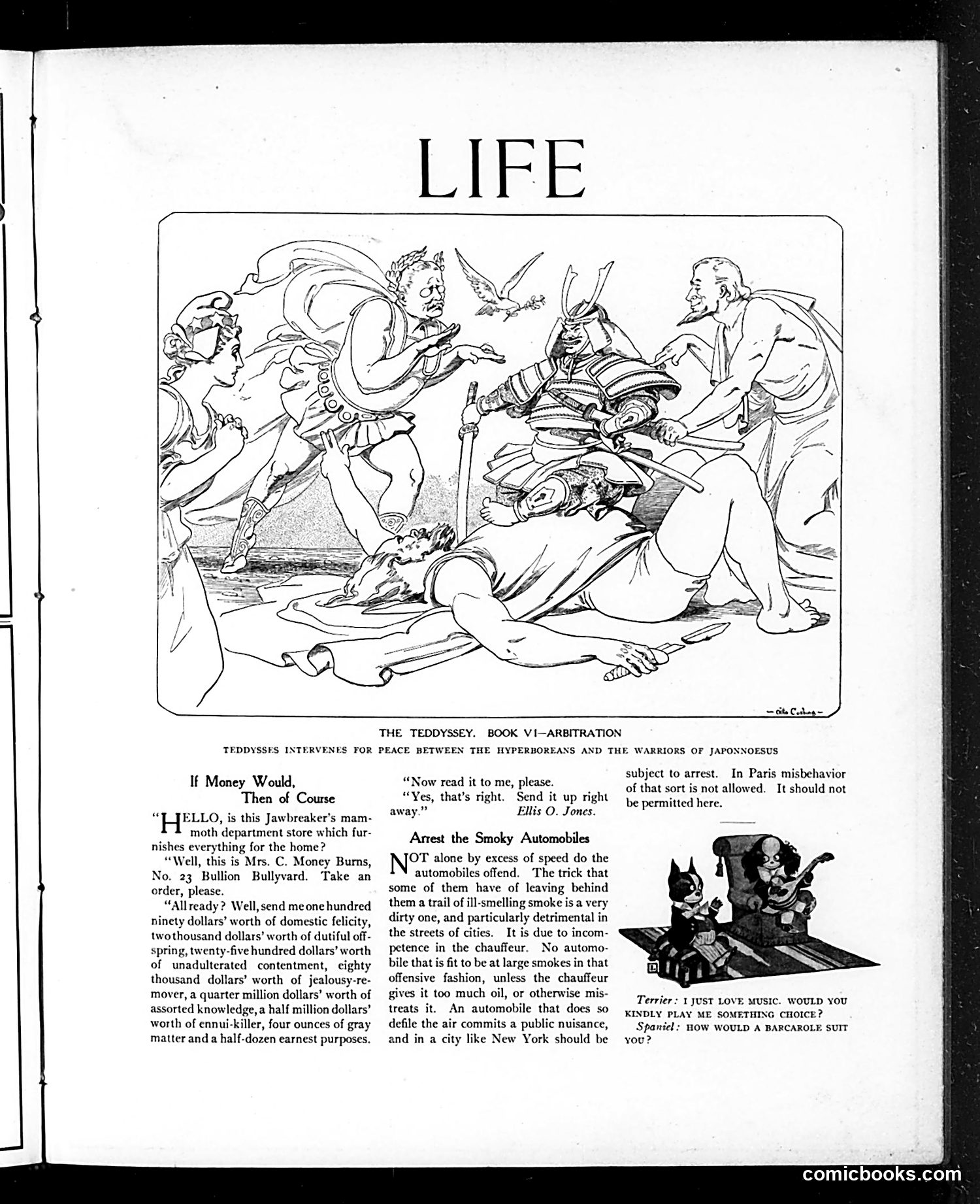
The top illustration references "The Teddyssey, Book VI—Arbitration," depicting Theodore Roosevelt mediating peace between "the Hyperboreans and the Warriors of Japanoesus"—a satirical commentary on Roosevelt's 1905 mediation of the Russo-Japanese War, which earned him a Nobel Peace Prize. Below are two brief humor pieces: "If Money Would Then of Course" jokes about a department store owner's extravagant requests, and "Arrest the Smoky Automobiles" critiques early automobiles for polluting city air with exhaust smoke—a genuine urban complaint in the early 1900s. The cartoon sidebar shows a terrier making a joke about musical preferences versus fashion choices (a "barcarole suit"). The satire targets Roosevelt's diplomatic ambitions and contemporary urban pollution concerns.
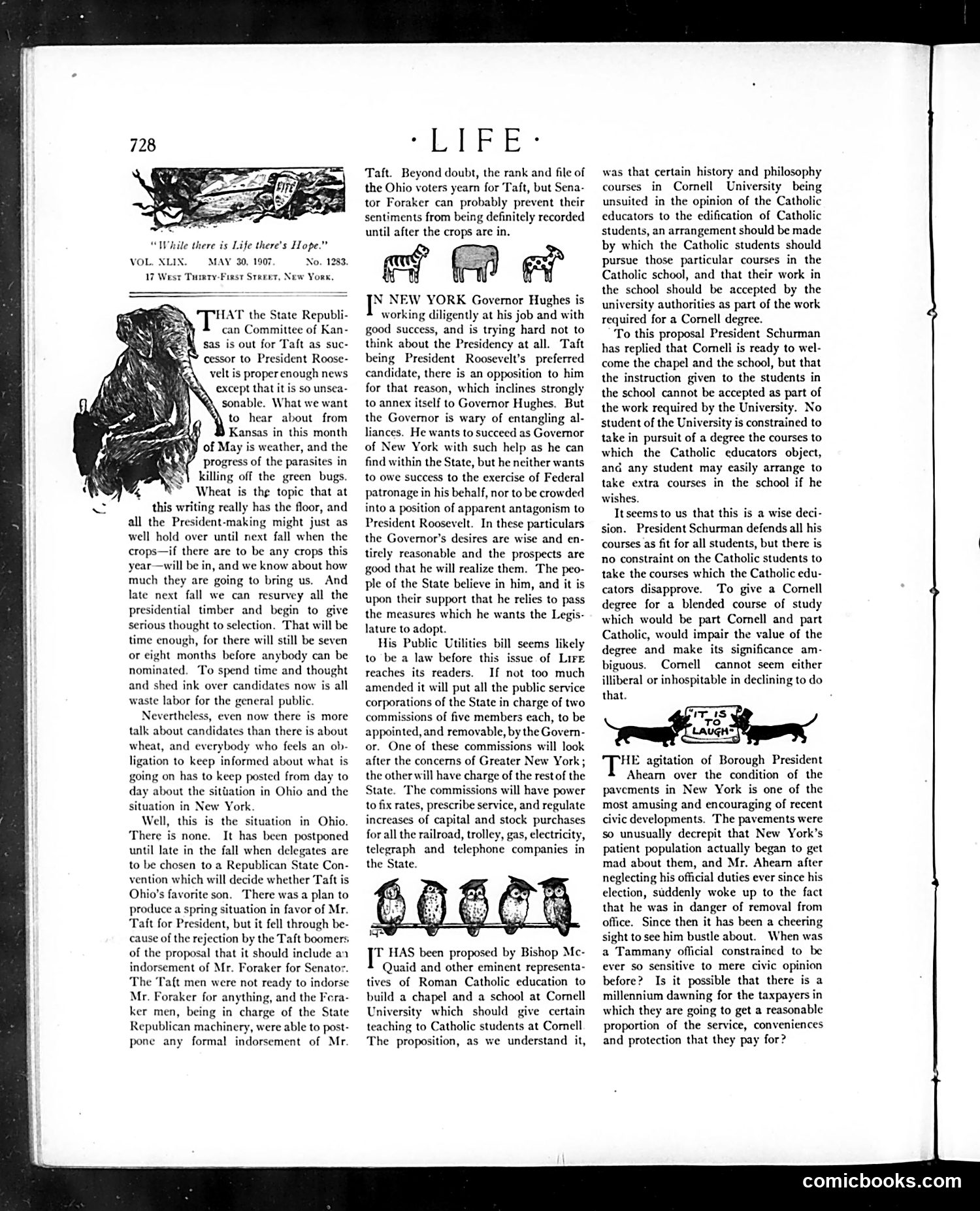
This page contains three separate political commentary pieces: 1. **The Taft succession editorial** discusses President Roosevelt's preferred successor William Howard Taft and Governor Hughes of New York. The text argues Hughes should support Taft's nomination rather than pursue the presidency himself. 2. **The Catholic education debate** addresses Bishop McQuaid's proposal to build a Catholic chapel and school at Cornell University. The editorial questions whether Cornell should accept coursework from a Catholic institution as credit toward Cornell degrees, raising concerns about institutional independence. 3. **The Borough President cartoon** (bottom) critiques Borough President Ahearn's neglect of official duties while hustling for civic improvements in New York, suggesting he's distracted from core responsibilities. The illustrations are satirical caricatures typical of Life's editorial style.
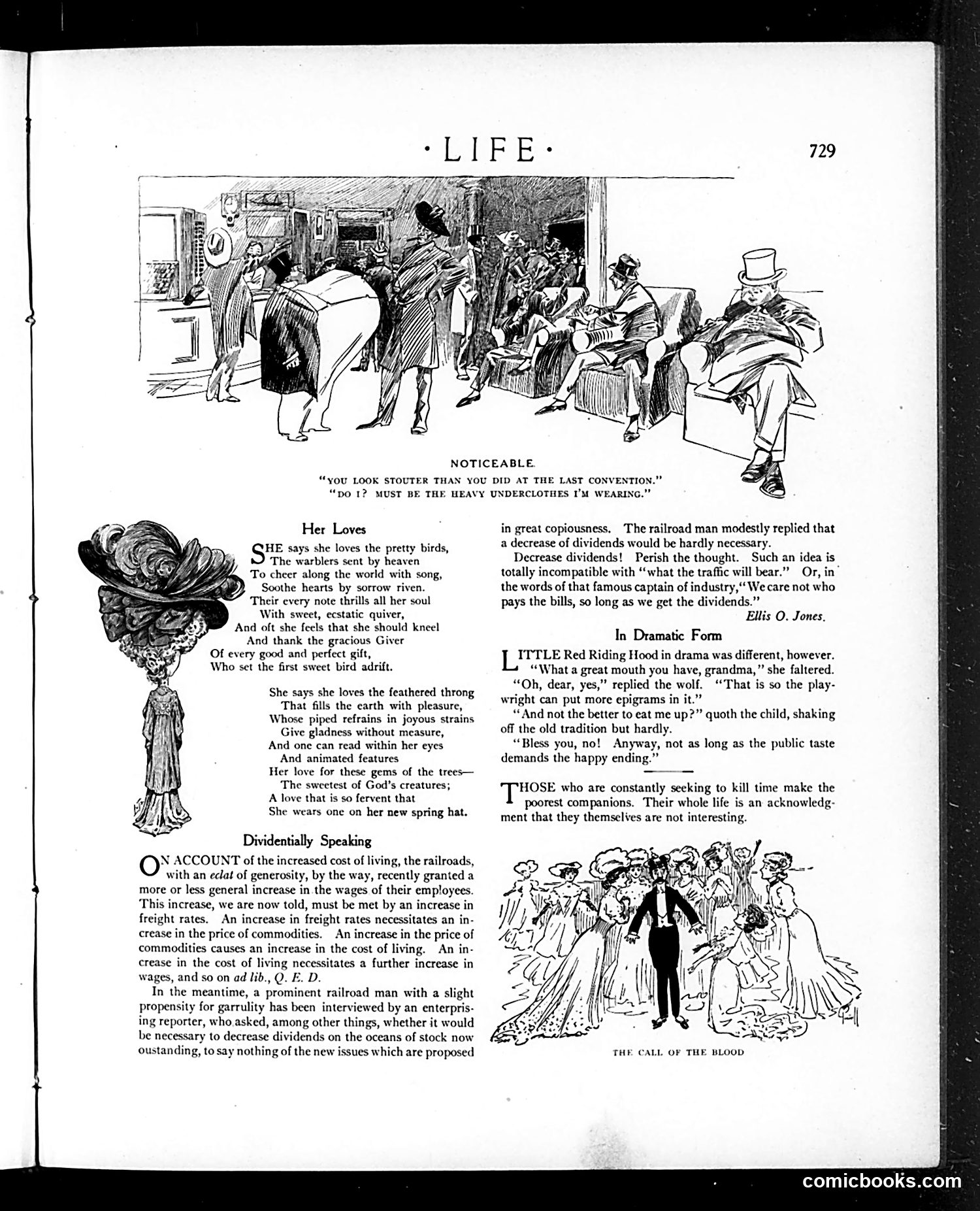
The page contains three satirical pieces about contemporary social issues: **"Noticeable"** (top cartoon): Depicts a crowded social gathering where someone comments that another person looks "stouter" and is wearing "heavy underclothes"—likely satirizing fashion trends or body-consciousness at social conventions. **"Her Loves"** (left): A sentimental poem about women's affection for birds and nature, contrasting with the satirical tone elsewhere. **"Dividentially Speaking"** (center): Mocks railroad executives' logic regarding wage increases. A railroad man argues that increased employee wages necessitate increased freight rates, which increase commodity prices, which increase living costs—creating a self-defeating economic cycle. The satire targets corporate justifications for maintaining low wages despite increased profits. **"In Dramatic Form"** (right): References Little Red Riding Hood, apparently critiquing melodramatic theatrical conventions. The overall theme appears critical of corporate economic reasoning and social pretension.
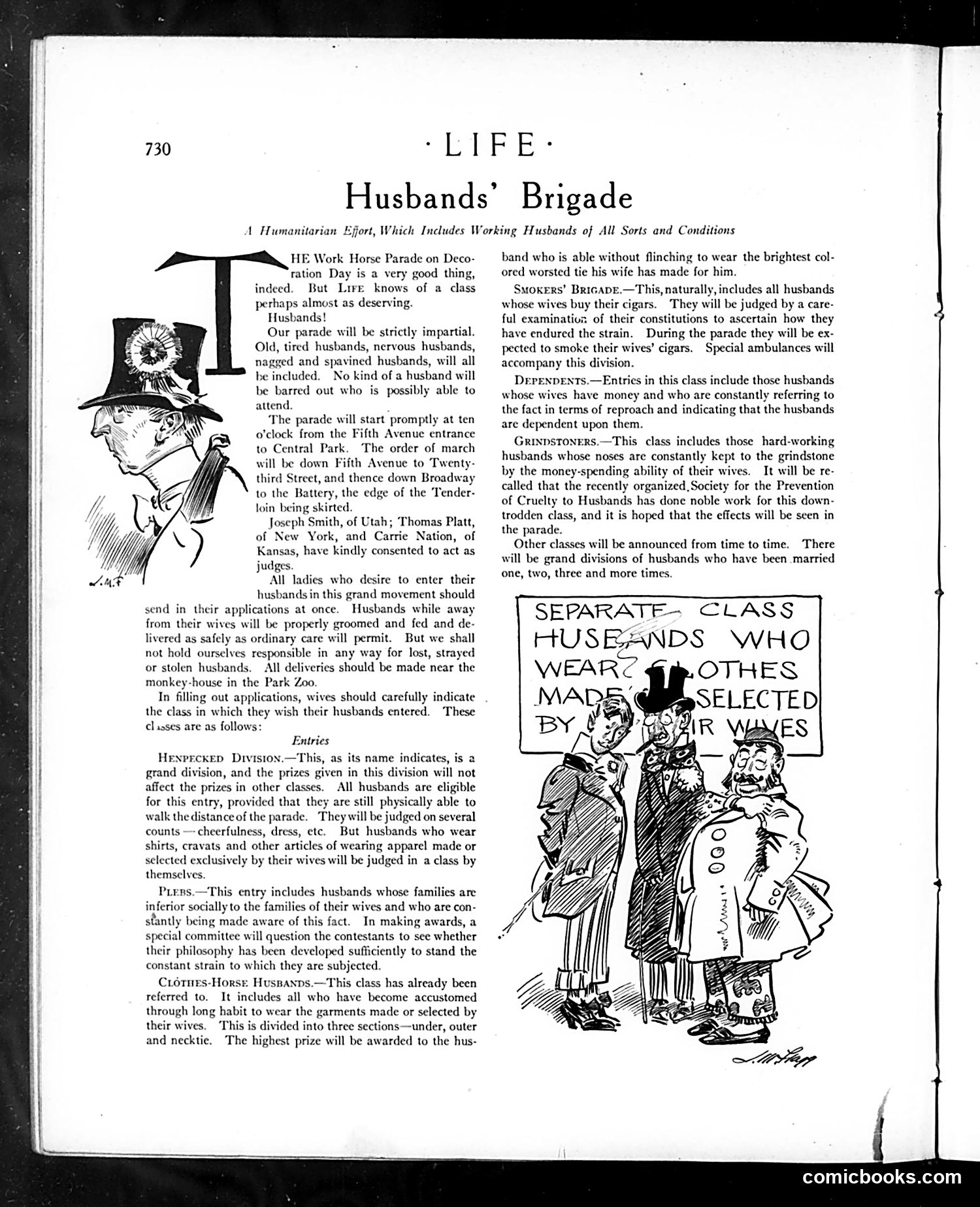
This satirical piece mocks a purported parade of husbands organized by wives. The cartoon depicts women selecting and parading their husbands like prize livestock, with classifications like "Henpecked Division," "Smokers' Brigade," "Dependents," and "Grindstones." The satire targets early-20th-century gender dynamics, specifically wives' perceived control over their husbands' appearance, habits, and social behavior. The "Clothes-Horse Husbands" category—men who wear garments selected by wives—is particularly highlighted. The joke assumes readers understand the contemporary trope of domineering wives managing "inferior" husbands socially and domestically. The cartoon exaggerates women's authority over male presentation and conduct as ridiculous, reflecting anxieties about shifting gender roles during this period.
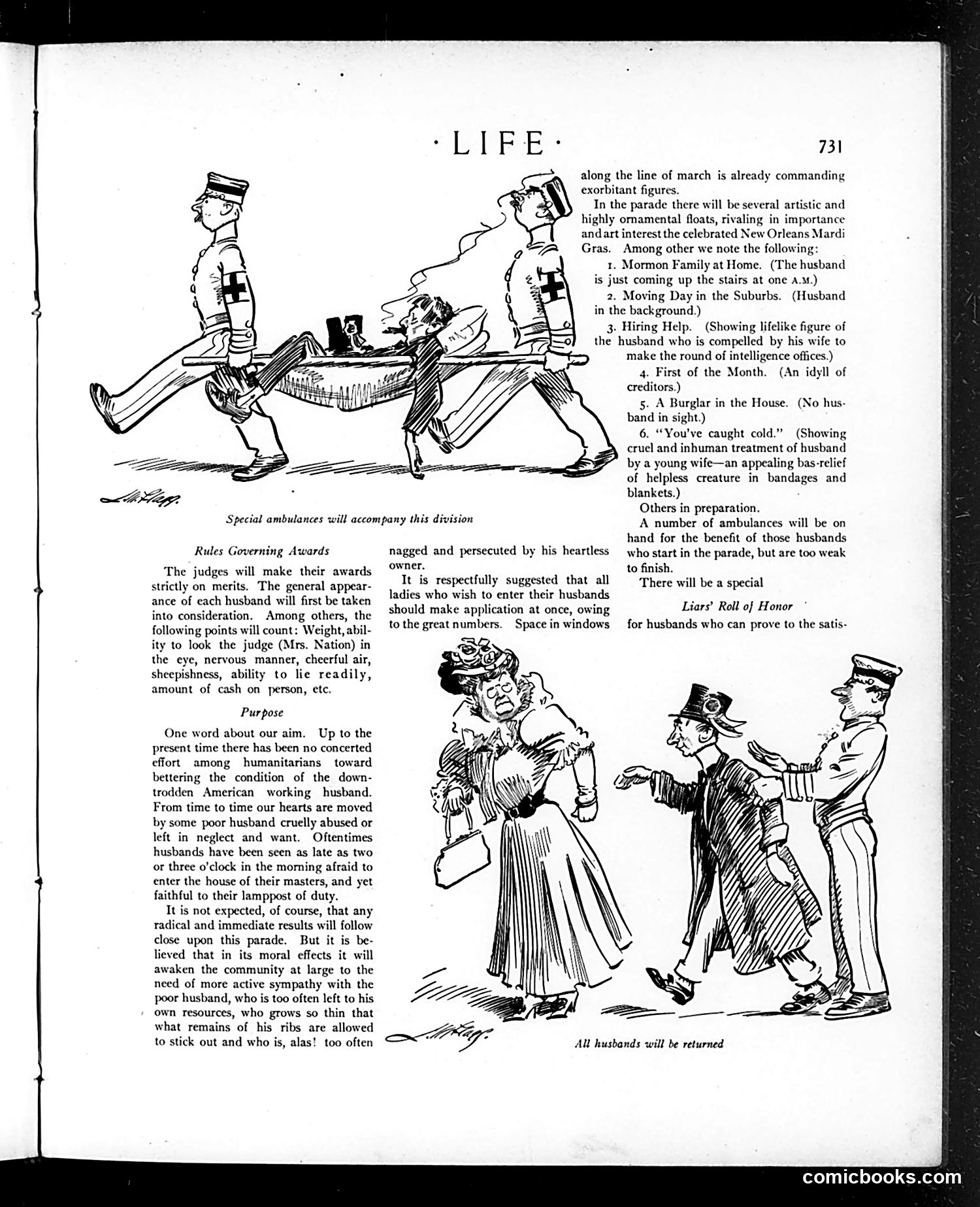
This page satirizes a proposed New Orleans Mardi Gras parade showcasing mistreated husbands. The top cartoon depicts ambulance workers carrying an injured man, captioned "Special ambulances will accompany this division." The floats listed mock domestic abuse: "Hiring Help" shows a husband forced to do intelligence work, "First of the Month" depicts creditors, and "You've caught cold" shows cruel treatment by a young wife. The lower cartoon shows officials returning husbands to their wives (captioned "All husbands will be returned"), suggesting the parade is a temporary exhibition of marital suffering. The satire targets the "downrodden American working husband" — men cruelly abused or neglected by wives. The parade mocks contemporary sympathy for mistreated workers by redirecting it toward suffering husbands, suggesting men need social support for domestic hardships.
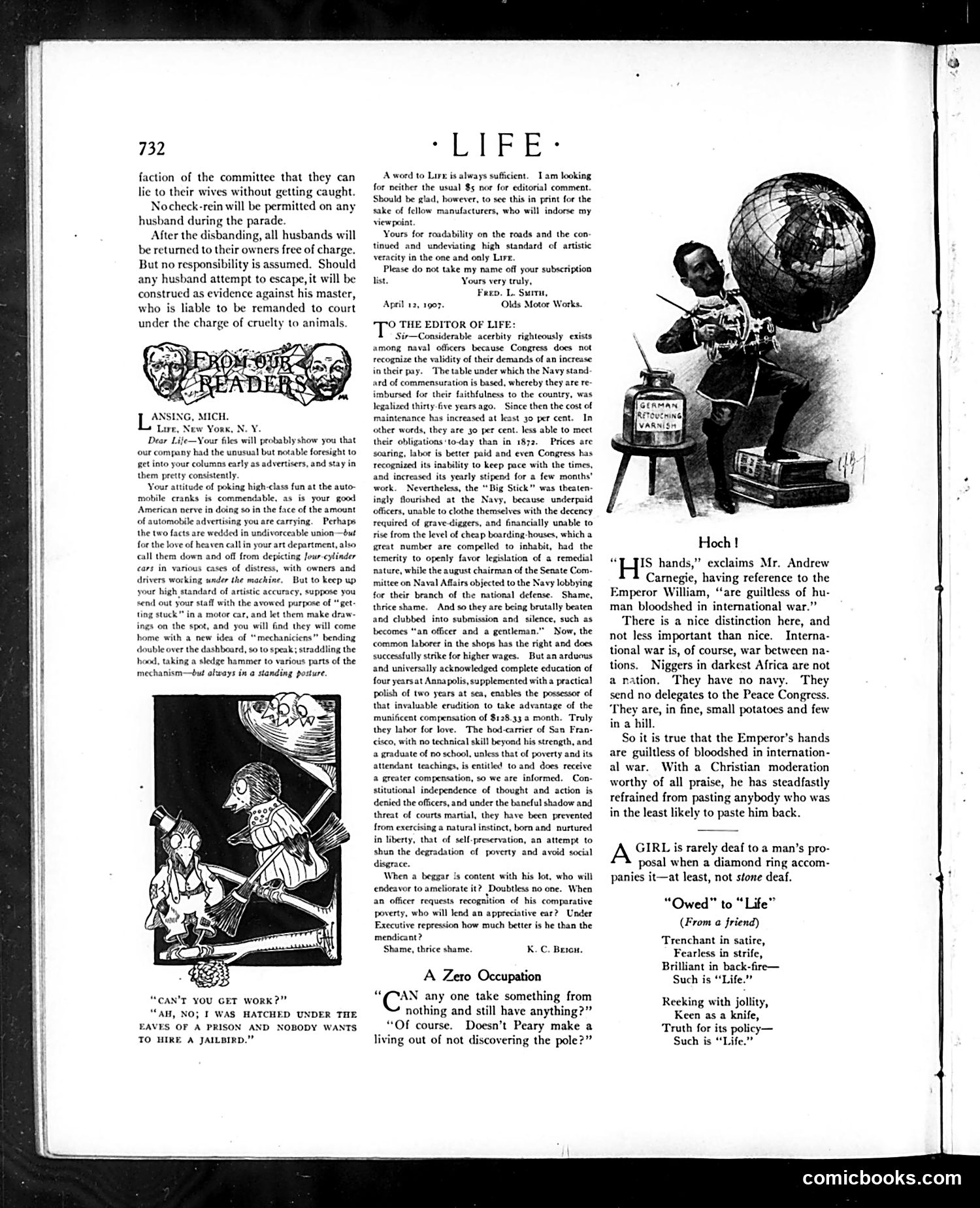
This page contains several distinct pieces. The main editorial section discusses Naval officer compensation issues—Congress's failure to adequately pay officers, forcing them into financial hardship and making them unable to maintain appropriate social standing. The author argues this penny-pinching damages the Navy's prestige and officer morale. The cartoons below satirize poverty and employment. One shows a beggar or vagrant being arrested, with dialogue about being "hatched under the eaves of a prison." Another depicts the absurdity of economic mobility—a character asks if one can make something from nothing, responding that discovery itself (like finding a pole) constitutes making a living. These pieces collectively critique economic inequality and the government's failure to properly compensate its military professionals.
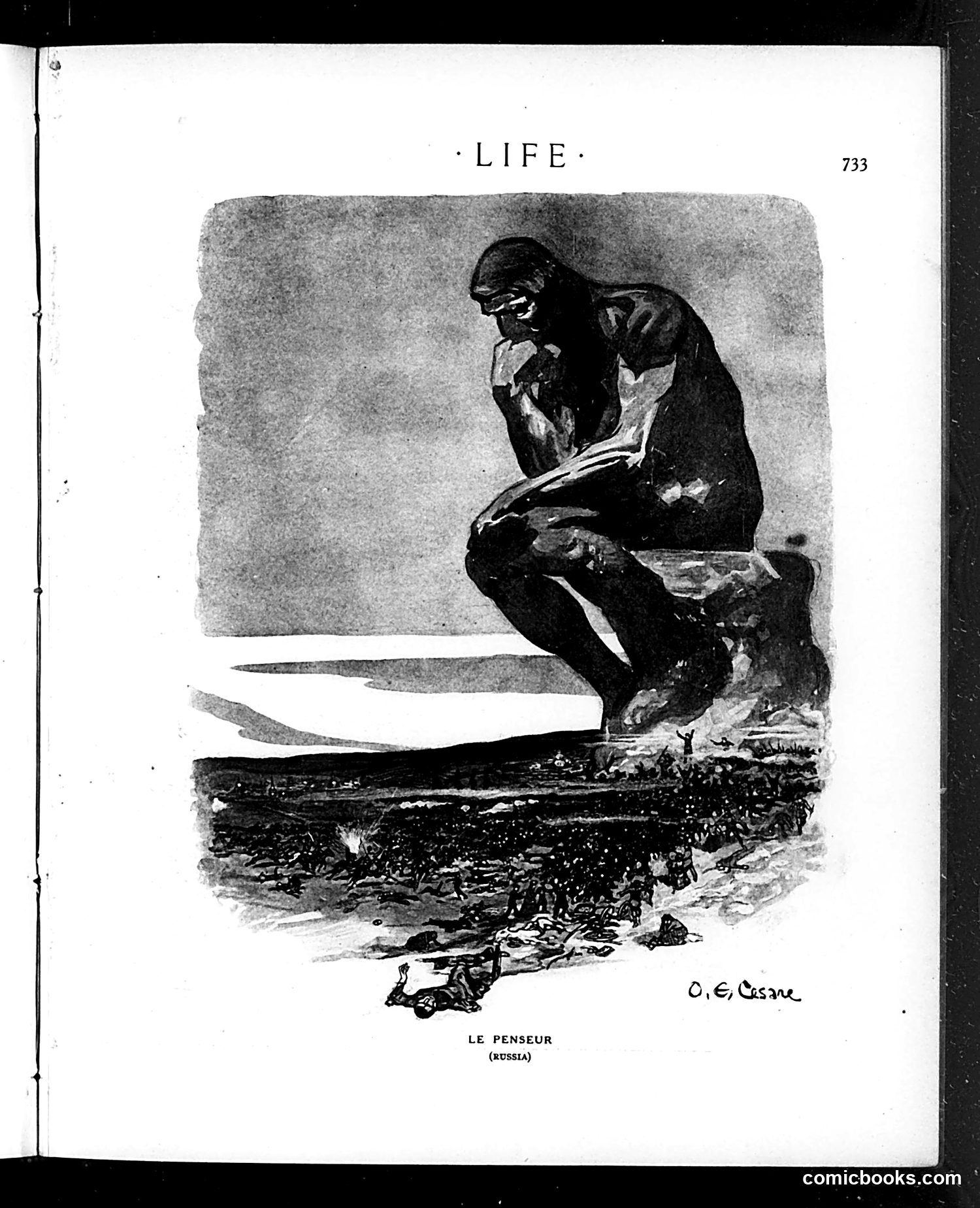
This political cartoon by O.E. Cesare depicts a figure in dark clothing seated in a contemplative pose—a clear reference to Rodin's famous sculpture "The Thinker." The caption identifies the subject as "Le Penseur (Russia)," suggesting this represents Russia or Russian leadership in a moment of deep reflection or troubled deliberation. The desolate landscape beneath—with scattered debris and barren ground—implies Russia faces significant challenges or destruction, likely referring to post-Revolutionary Russia or consequences of political upheaval. The cartoon satirizes the notion of Russian "thought" or leadership by pairing intellectual pretension with a devastated environment, suggesting that Russian contemplation is disconnected from or inadequate to address the nation's severe problems. The date and specific historical context remain unclear without additional information.
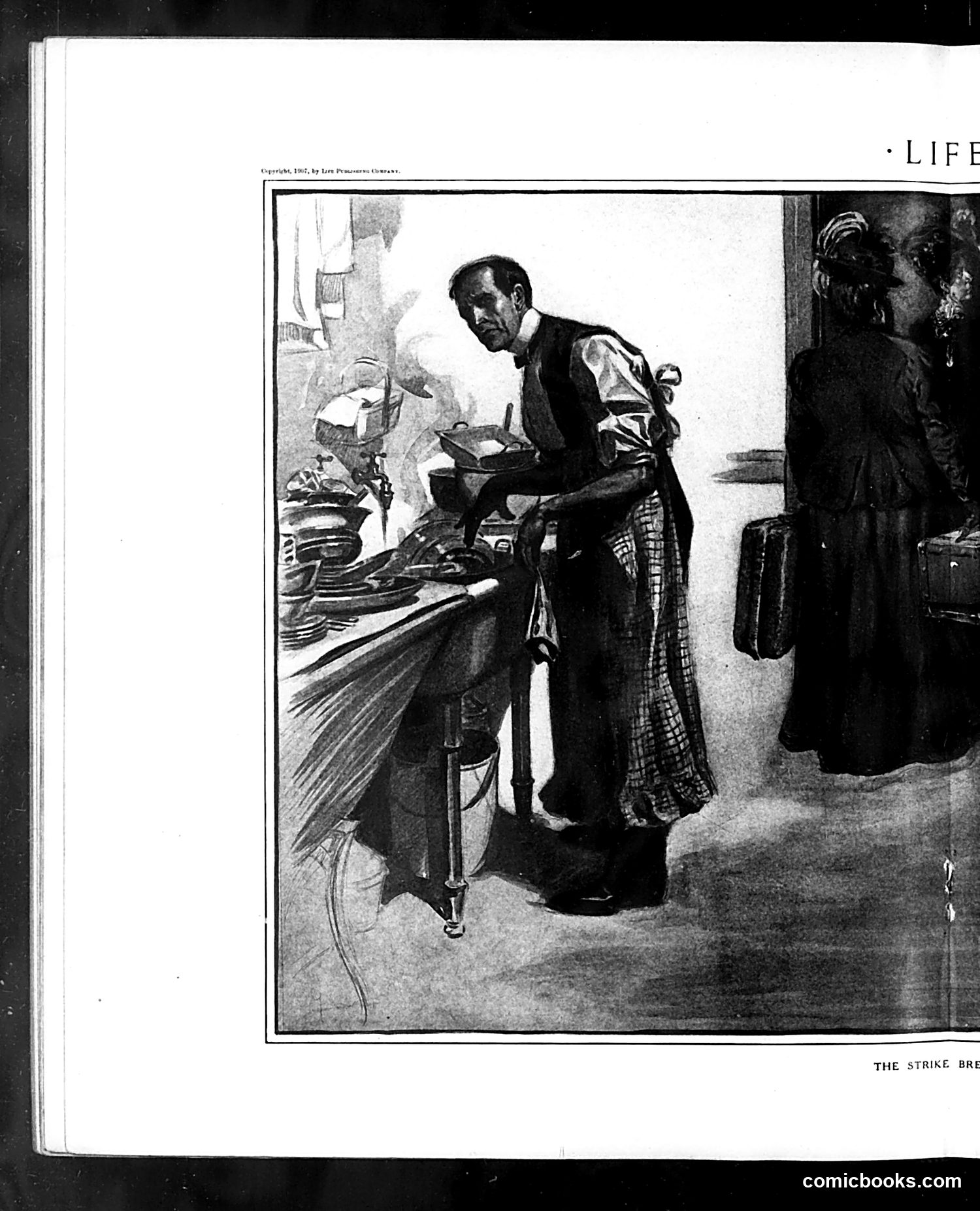
This appears to be a satirical cartoon from *Life* magazine depicting a scene titled "THE STRIKE BRE[AK]" (text cut off). The image shows a well-dressed man in formal attire at what appears to be a counter or desk, seemingly engaged in some kind of transaction or negotiation, while other figures observe in the background. The cartoon likely satirizes labor relations, specifically strike-breaking activities. The formal gentleman's composed demeanor contrasts with the surrounding tension, suggesting mockery of how strike-breakers or union-busting intermediaries conducted business. Without the complete caption or date, the specific historical strike referenced remains unclear, but the piece critiques the mechanisms used to undermine worker solidarity and collective action.
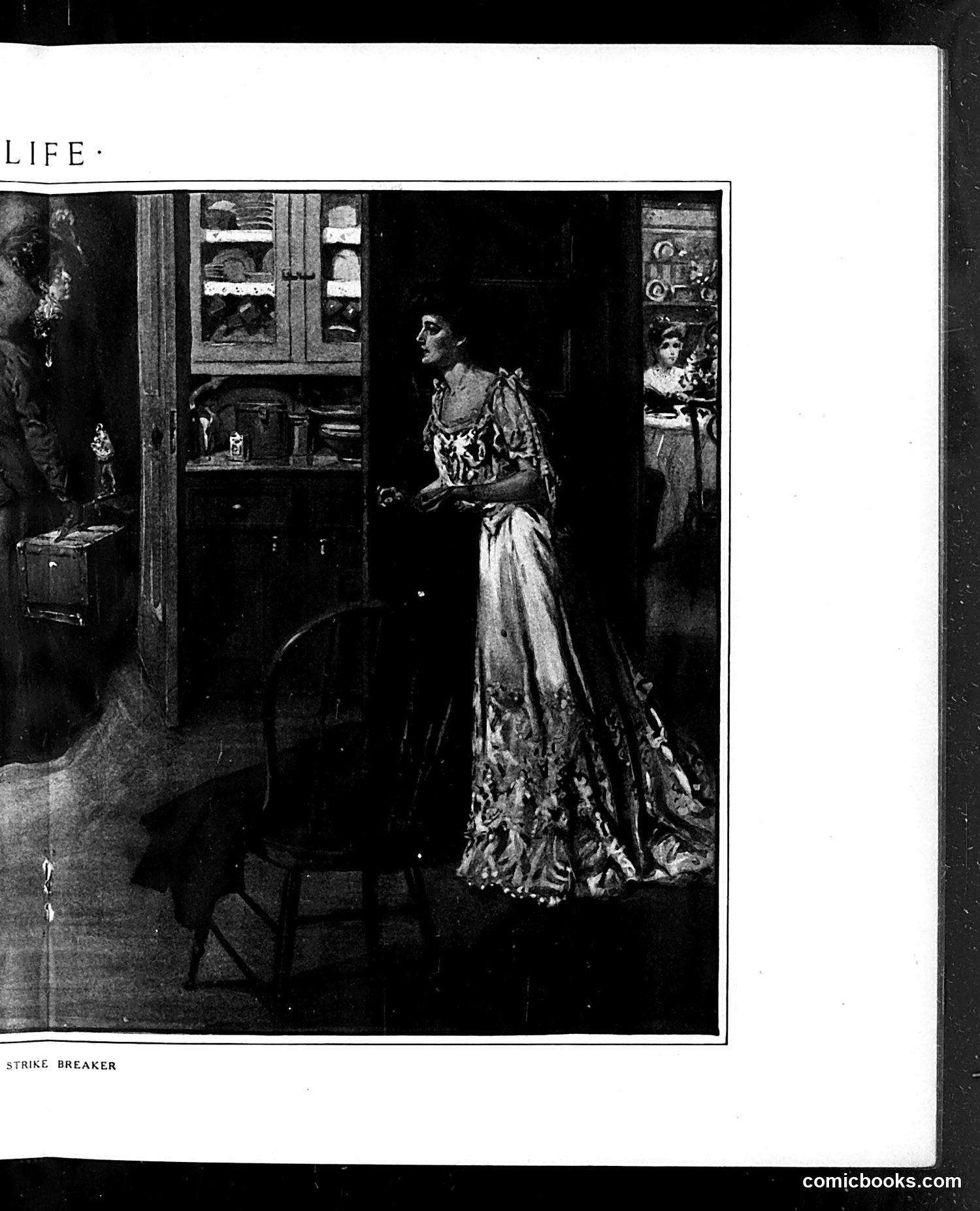
This appears to be an early 20th-century satirical illustration titled "Strike Breaker." The scene depicts an elegantly dressed woman in an ornate gown entering what looks like a shop or establishment, while several figures observe her—including what appears to be working-class men on the left side. The satire likely critiques "strike-breaking" tactics, where employers hired replacements or used other means to undermine labor strikes. The well-dressed woman may represent either a wealthy patron crossing picket lines or a deliberate commentary on class dynamics during labor disputes. The composition emphasizes the contrast between the refined visitor and the working people affected by labor actions. Without additional context, the specific strike referenced remains unclear.
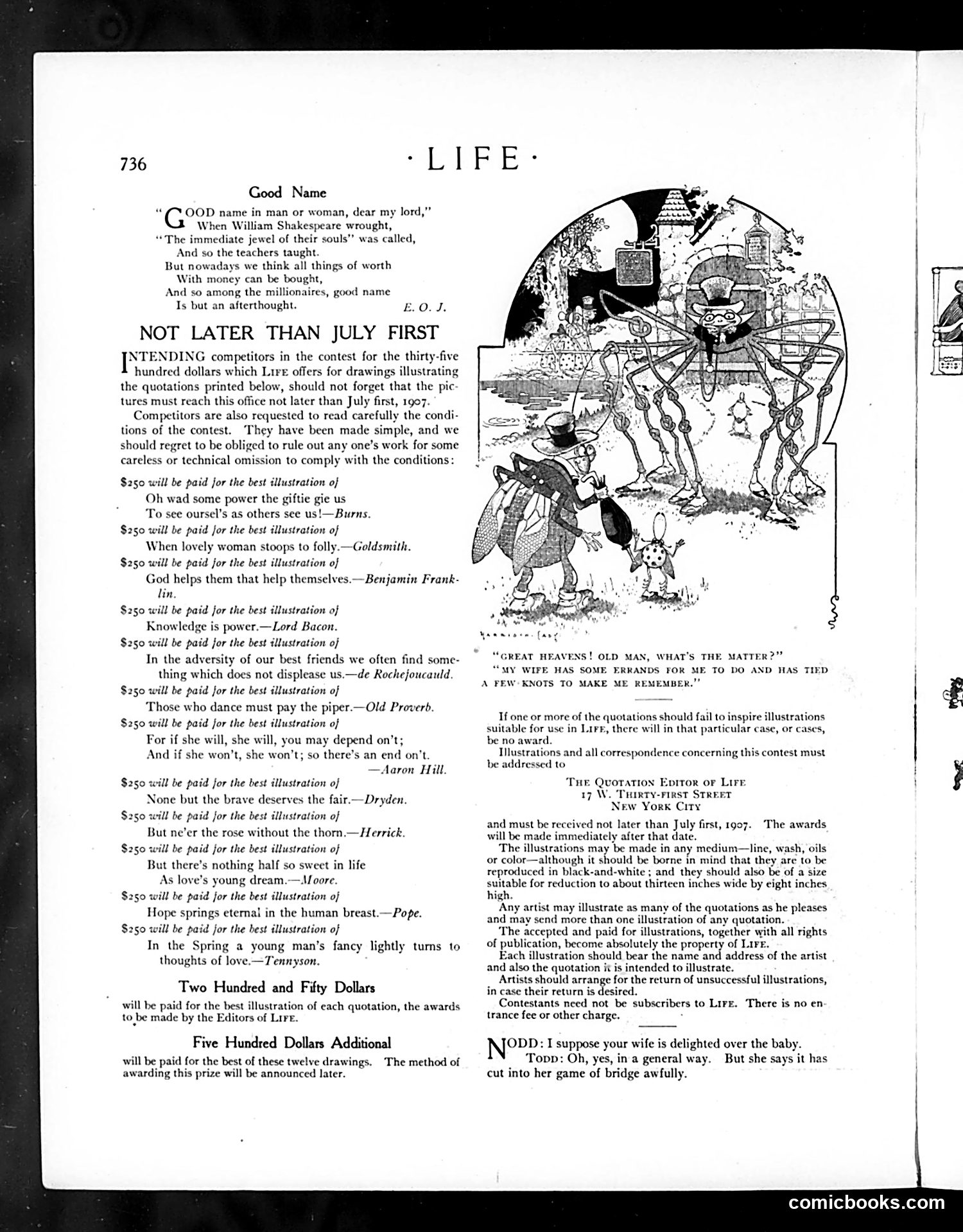
This page is primarily an **announcement for an illustration contest**, not a political cartoon. Life magazine is soliciting drawings illustrating famous quotations for publication, offering prizes totaling $250-$500 per illustration. The only actual cartoon visible is a small illustration captioned "GREAT HEAVENS! OLD MAN, WHAT'S THE MATTER?" showing what appears to be a domestic scene with figures and a large object—likely meant as an example of the type of illustration sought. At the bottom, there's a brief humorous exchange (labeled "NODD" and "TODD") about a wife's distraction with a baby interfering with her bridge game—typical light satirical humor about married life and domestic concerns common to the era. The page is essentially a call-for-submissions announcement rather than editorial satire.
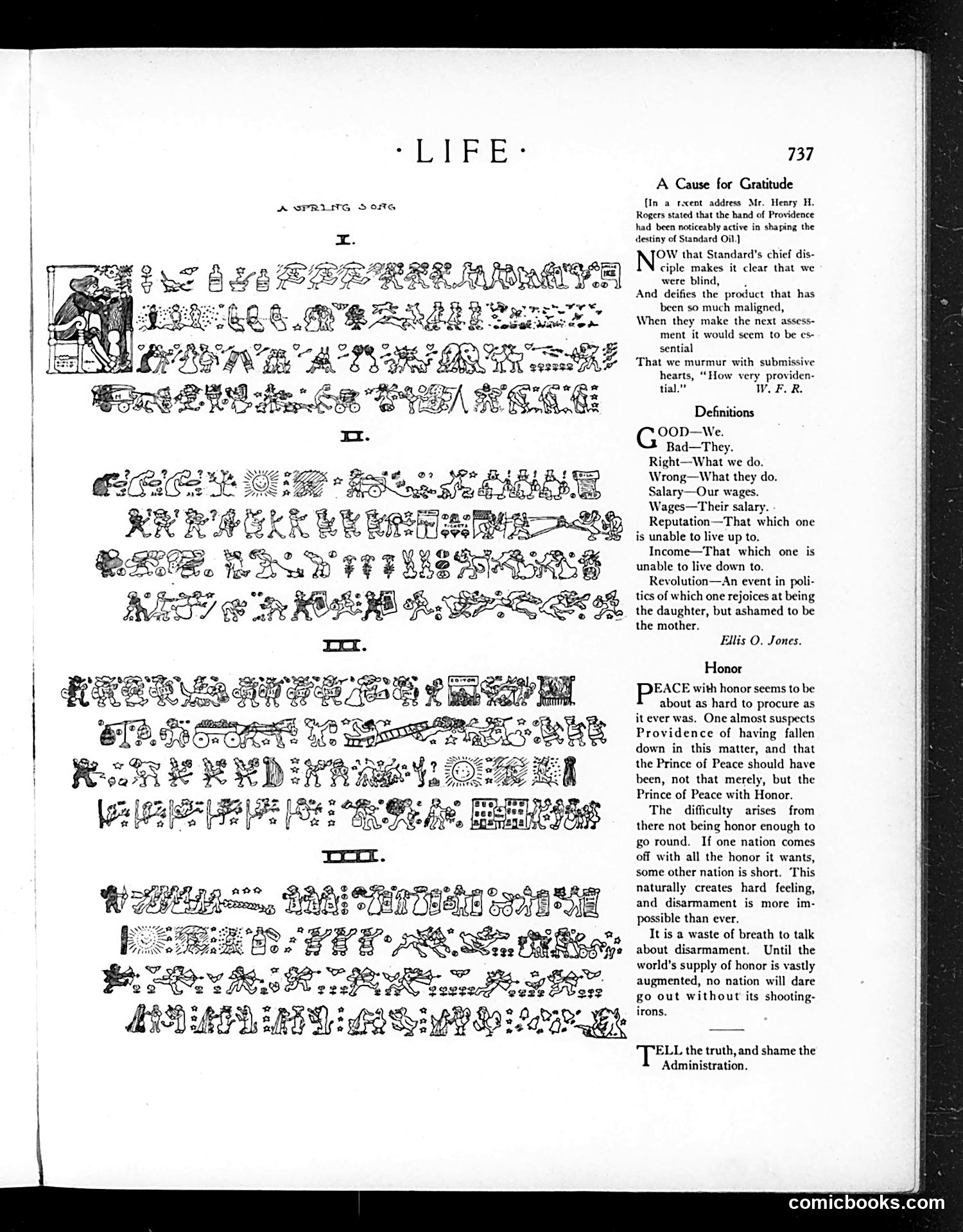
This page from *Life* magazine features four sections of symbolic/hieroglyphic-style cartoon writing (labeled I-IV) whose exact meaning is unclear from the image alone—they appear to be encoded satirical commentary using pictographic symbols rather than standard letters. The right column contains prose pieces including "A Cause for Gratitude" (crediting Henry H. Rogers' influence on Standard Oil's public perception), definitions of economic terms (Good, Bad, Wages, Reputation, Income, Revolution), and commentary on peace and honor in international relations, concluding with "TELL the truth, and shame the Administration." The hieroglyphic sections likely encoded political criticism, a common *Life* technique. Without decoding key, their specific targets remain unclear, though context suggests Standard Oil and government policy criticism.
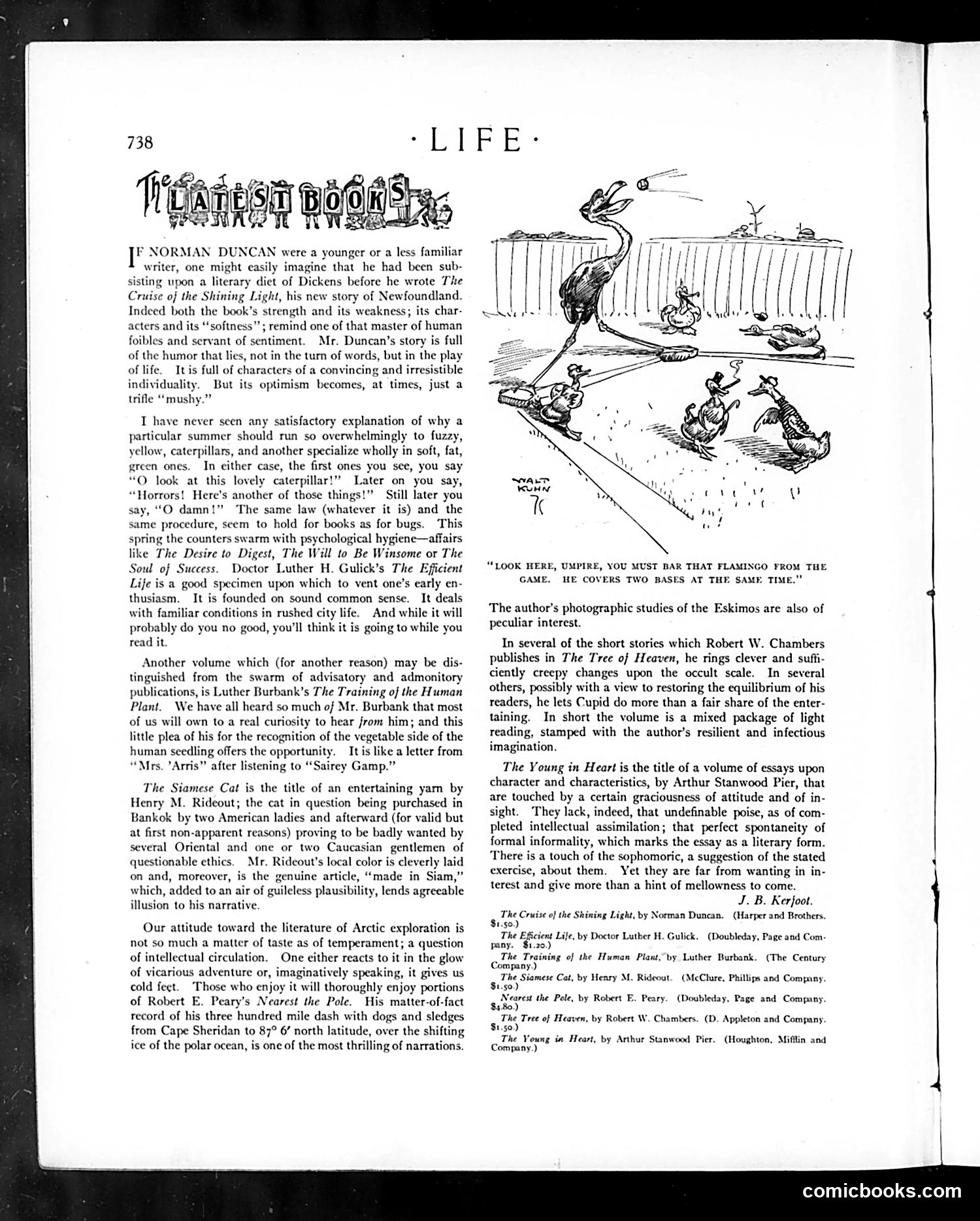
This page reviews several books, with a cartoon illustrating the review's opening metaphor. The cartoon depicts a baseball game where an umpire objects to a flamingo playing—the joke being that the bird "covers two bases at the same time" due to its long legs straddling the bases simultaneously. The cartoon humorously supports the text's discussion of Norman Duncan's novel *The Cruise of the Shining Light*. The reviewer compares reading books to observing insects: just as summer brings waves of caterpillars (first delightful, then tedious), the book market swarms with similar titles. The flamingo cartoon extends this visual analogy—suggesting certain books, like the ungainly bird, don't "fit the game" properly. The page reviews multiple contemporary books including works on psychology, Luther Burbank's horticultural philosophy, and Arctic exploration narratives, reflecting early-20th-century publishing trends toward self-help and scientific literature.
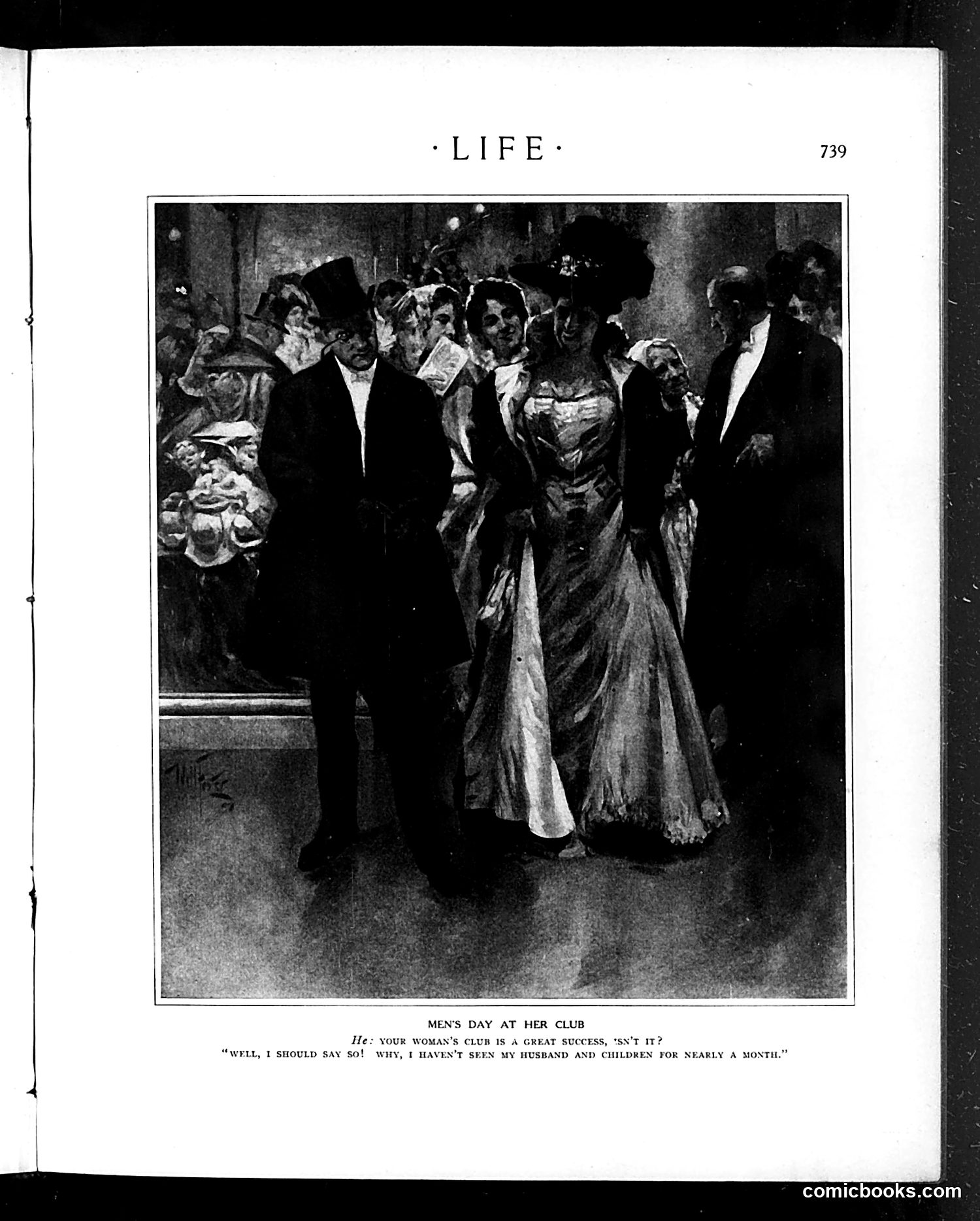
This is a satirical cartoon about women's clubs—social organizations that were becoming increasingly popular in the early 20th century. The image shows a formal gathering where well-dressed men are attending "her club," an unusual reversal of the typical gender dynamic. The humor derives from the husband's complaint: his wife's women's club is so successful that he hasn't seen her in nearly a month. The satire critiques how women's clubs, meant as spaces for female independence and social engagement, were actually keeping wives away from their domestic duties and husbands. This reflects period anxieties about women's liberation and changing gender roles—the joke suggests women's newfound social independence was problematic for family life.
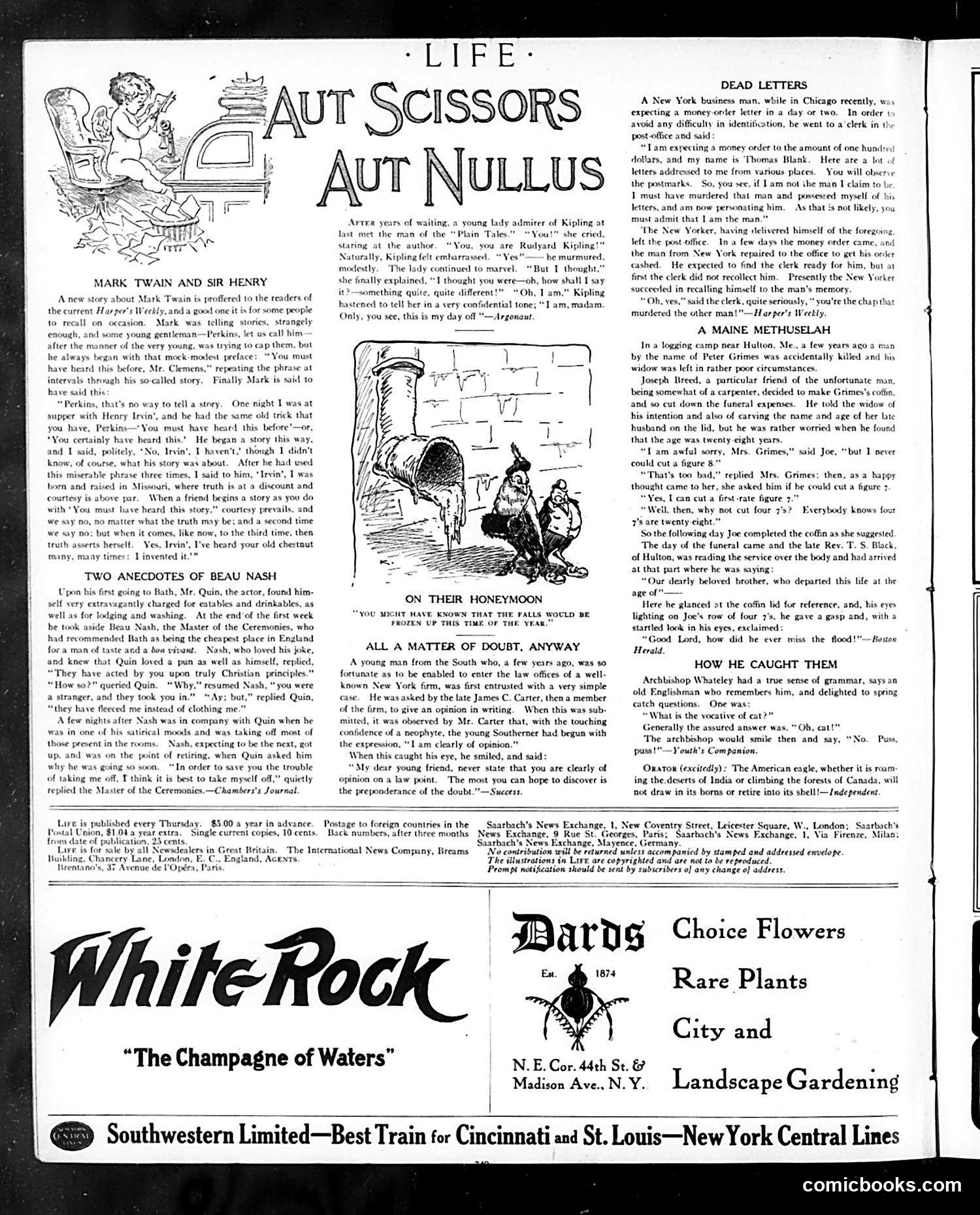
This page contains humorous anecdotes about famous figures rather than political cartoons. The main content includes: **"Mark Twain and Sir Henry"**: An anecdote where Mark Twain scolds a young man (Perkins) for prefacing stories with "You must have heard this before"—a habit even actor Henry Irving had. Twain's punchline: he invented the story himself, mocking the false modesty. **"Two Anecdotes of Beau Nash"**: Witty exchanges involving 18th-century Bath master of ceremonies Beau Nash, including a pun about being "taken in" (both cheated and welcomed as a stranger). **"Kipling" anecdote**: A lady meets Rudyard Kipling, disappointed he doesn't match her expectations. His response: "I am...quite different! Only, you see, this is my day off"—satirizing how public figures perform different personas. The **honeymoon cartoon** (bottom left) shows a couple at Niagara Falls frozen over, with the caption suggesting they should have known it freezes in winter—gentle domestic humor. These are light, witty pieces celebrating clever wordplay and absurdist humor typical of *Life* magazine's satirical style.
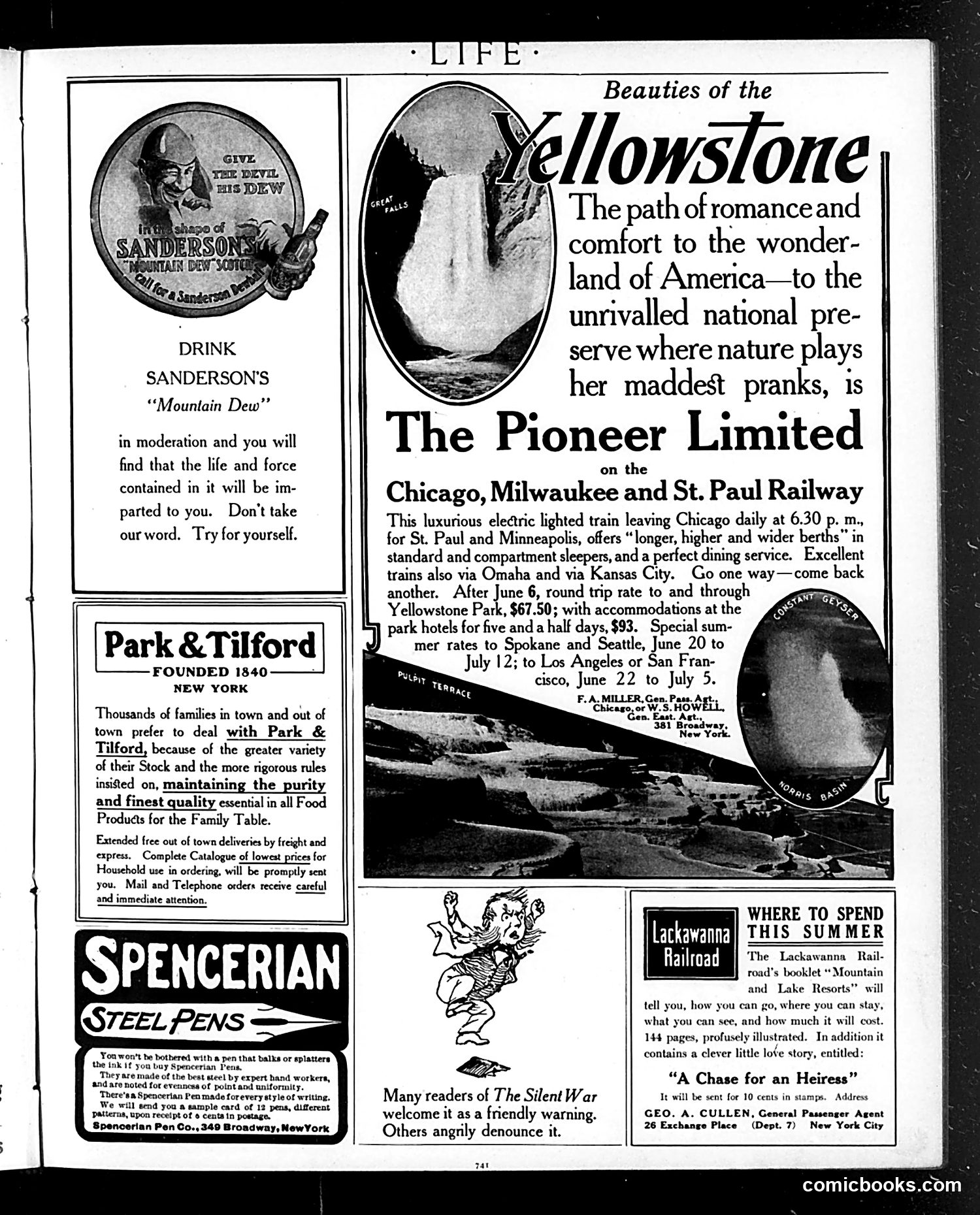
This page consists primarily of **advertisements**, not political cartoons. The content reflects early 20th-century consumer marketing: **Key Advertisements:** - **Sanderson's "Mountain Dew"**: A whiskey ad using the euphemistic "moderation" language common during the pre-Prohibition era - **Park & Tilford**: A grocery/food supplier emphasizing quality and purity standards - **Spencerian Steel Pens**: Writing instruments marketed to professionals - **Pioneer Limited train**: Tourism promotion for Yellowstone National Park travel via Chicago, Milwaukee and St. Paul Railway - **Lackawanna Railroad**: Summer vacation booklet offering a romance story ("A Chase for an Heiress") **Notable Element:** A brief text snippet mentions *The Silent War*, apparently a publication that readers either welcomed as "friendly warning" or "angrily denounce[d]"—though its specific subject remains unclear from this page. The page is essentially a commercial publication snapshot, showing period consumer goods and leisure travel marketing rather than satirical commentary.
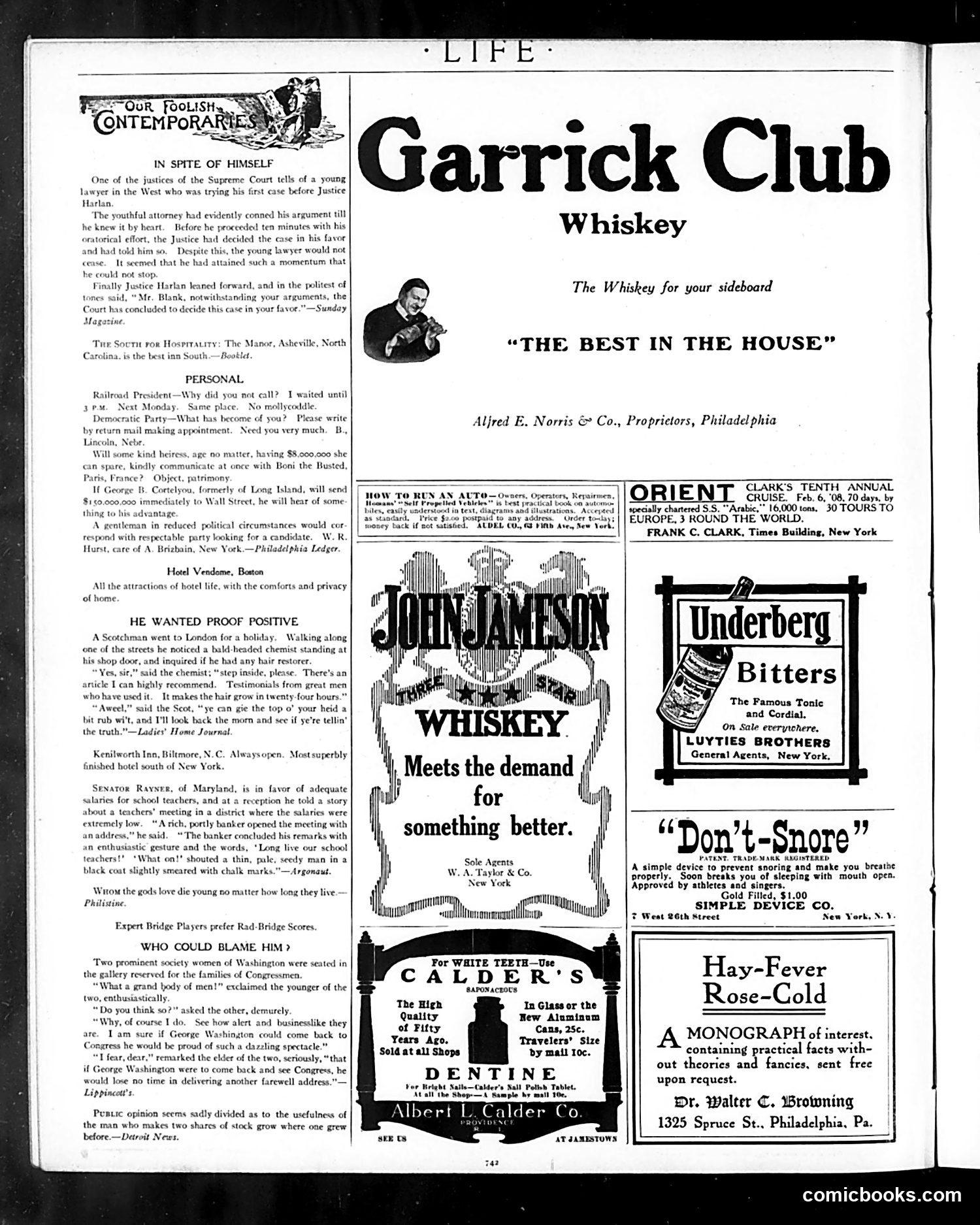
This page is primarily a collection of humorous anecdotes and advertisements, with minimal political content. The main satirical pieces are brief social jokes, not political cartoons. The most pointed commentary appears in "Who Could Blame Him?": two Washington society women admire Congress as distinguished and alert, but an older woman warns that George Washington himself would be ashamed—implying Congress represents a degradation from the founding era's ideals. Another item mocks a politician in reduced circumstances seeking a wealthy patron, satirizing transactional politics. The rest consists of personal notices and advertisements for whiskey (Garrick Club, John James), bitters, and patent medicines—typical Life magazine content from the early 20th century. There are no identifiable caricatures of specific political figures shown in the image.
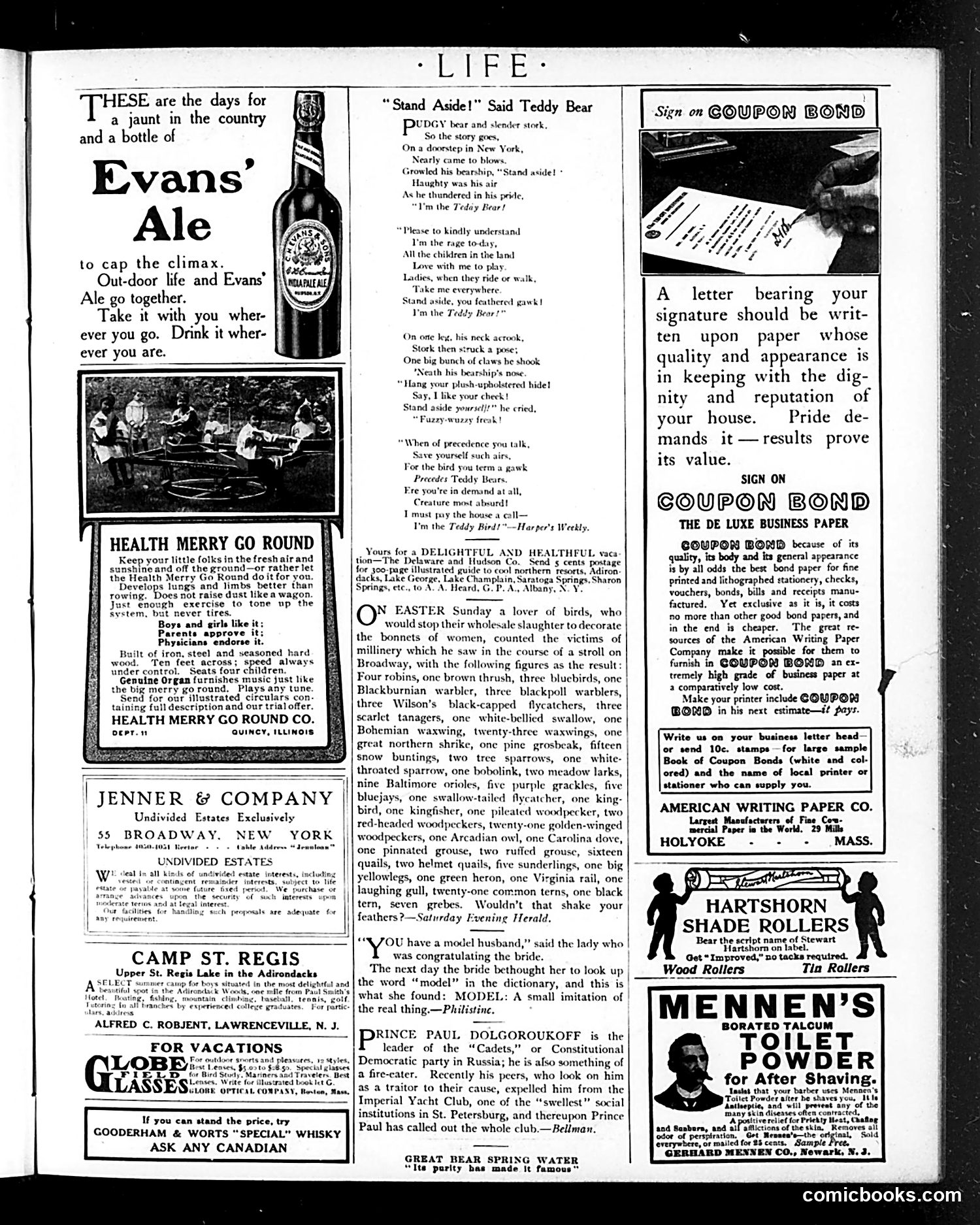
This page is primarily **advertising**, with two notable satirical pieces: ## "Stand Aside! Said Teddy Bear" (Poem) A humorous verse battle between a **Teddy Bear** and a **Stork**, competing for popularity and precedence. The Teddy Bear boasts of being "the rage today" with children and ladies, while the Stork counters that it has historical priority, calling itself "the Teddy Bird." This appears to be **topical satire** about the fad status of teddy bears (a relatively recent toy craze) versus traditional cultural symbols. The joke mocks competing trends and vanity. ## "Easter Sunday Bird Count" (Prose Piece) A naturalist documents hundreds of dead birds spotted on Broadway bonnets—robins, waxwings, woodpeckers, orioles, etc. This is **advocacy satire criticizing the fashion industry's use of bird feathers and whole birds to decorate women's hats**. By cataloging specific species in gruesome detail, the author highlights the environmental toll and animal cruelty of millinery fashion. Both pieces use humor to critique contemporary consumer culture and fashion trends.
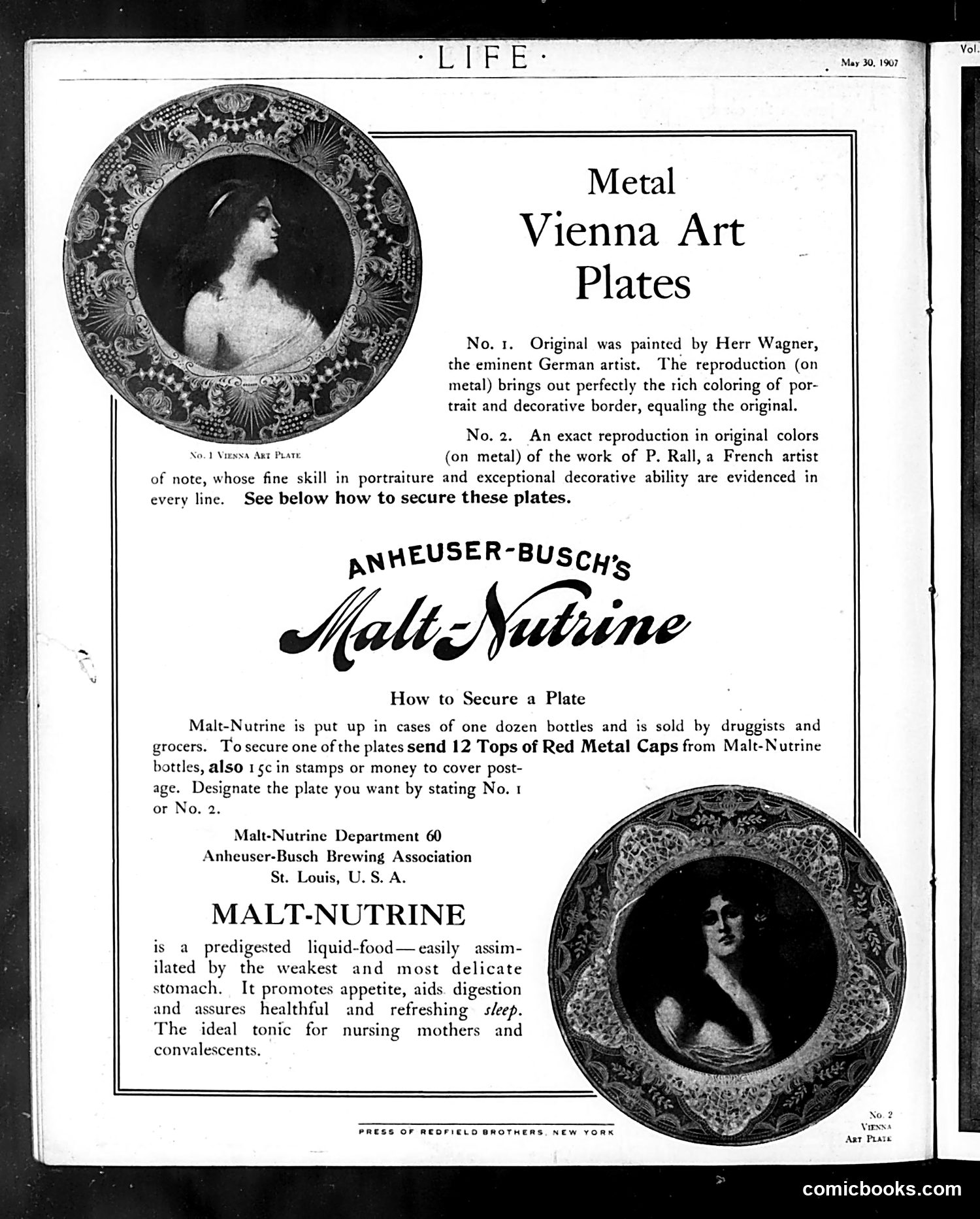
This is primarily **advertising content**, not satire or political commentary. The page features two decorative Vienna Art Plates (metal reproductions of portraits with ornate borders) and promotes Anheuser-Busch's Malt-Nutrine product. **The plates themselves** are presented as fine art—No. 1 based on work by "Herr Wagner, the eminent German artist" and No. 2 after French artist P. Rall. Both show classical portrait busts in elaborate decorative frames. **The promotion mechanism** is a common early 20th-century marketing tactic: consumers could collect 12 bottle caps from Malt-Nutrine bottles plus 15 cents postage to obtain one of these decorative plates—a form of premium incentive. **The product pitch** frames Malt-Nutrine as a digestive tonic for nursing mothers and convalescents, claiming it promotes appetite and aids digestion. This reflects contemporary patent-medicine marketing, though Anheuser-Busch's actual product was a malt extract (non-alcoholic or low-alcohol). No political or social satire is evident—it's straightforward commercial advertising.