
Life, 1907-05-30 · page 14 of 20
Life — May 30, 1907 — page 14: what you’re looking at
What you’re looking at
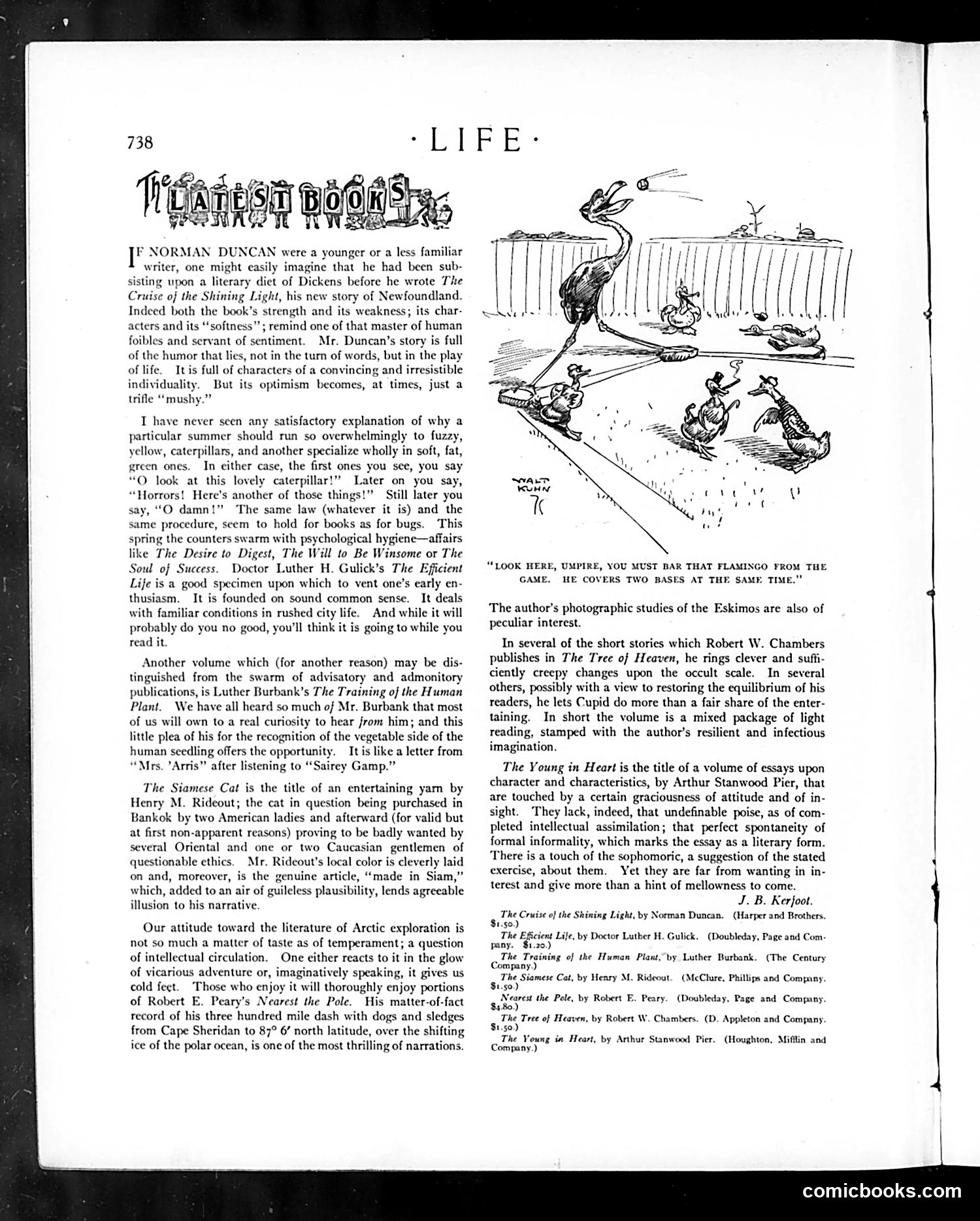
This page reviews several books, with a cartoon illustrating the review's opening metaphor. The cartoon depicts a baseball game where an umpire objects to a flamingo playing—the joke being that the bird "covers two bases at the same time" due to its long legs straddling the bases simultaneously. The cartoon humorously supports the text's discussion of Norman Duncan's novel *The Cruise of the Shining Light*. The reviewer compares reading books to observing insects: just as summer brings waves of caterpillars (first delightful, then tedious), the book market swarms with similar titles. The flamingo cartoon extends this visual analogy—suggesting certain books, like the ungainly bird, don't "fit the game" properly. The page reviews multiple contemporary books including works on psychology, Luther Burbank's horticultural philosophy, and Arctic exploration narratives, reflecting early-20th-century publishing trends toward self-help and scientific literature.
📄 Transcribed text from this page (OCR, searchable)
Machine-transcribed from the original scan — historical spelling and the odd misread are preserved.
738 Wane F NORMAN DUNCAN were a younger or a less familiar writer, one might easily imagine that he had been sub- sisting upon a literary diet of Dickens before he wrote The Cruise of the Shining Light, his new story of Newfoundland. Indeed both the book’s strength and its weakness; its char- acters and its “softness”; remind one of that master of human foibles and servant of sentiment. Mr. Duncan’s story is full of the humor that lies, not in the turn of words, but in the play of life. It is full of characters of a convincing and irresistible individuality. But its optimism becomes, at times, just a trifle “mushy.” I have never seen any satisfactory explanation of why a particular summer should run so overwhelmingly to fuzzy, yellow, caterpillars, and another specialize wholly in soft, fat, green ones. In either case, the first ones you sce, you say “© look at this lovely caterpillar!” Later on you say, “Horrors! Here’s another of those things!” Still later you say, “O damn ‘The same law (whatever it is) and the same procedure, seem to hold for books as for bugs. This spring the counters swarm with psychological hygiene—affairs like The Desire to Digest, The Will to Be Winsome or The Soul of Success. Doctor Luther H. Gulick’s The Efficient Life is a good specimen upon which to vent one’s early en- thusiasm. It is founded on sound common sense. It deals with familiar conditions in rushed city life. And while it will probably do you no good, you'll think it is going to while you read it. Another volume which (for another reason) may be dis- tinguished from the swarm of advisatory and admonitory publications, is Luther Burbank’s The Training of the Human Plant. We have all heard so much of Mr. Burbank that most of us will own to a real curiosity to hear jrom him; and this little plea of his for the recognition of the vegetable side of the human seedling offers the opportunity. It is like a letter from “Mrs. ’Arris” after listening to “Sairey Gamp.” The Siamese Cat is the title of an entertaining yam by Henry M. Rideout; the cat in question being purchased in Bankok by two American ladies and afterward (for valid but at first non-apparent reasons) proving to be badly wanted by several Oriental and one or two Caucasian gentlemen of questionable ethics. Mr. Ridcout’s local color is cleverly laid on and, moreover, is the genuine article, “made in Siam,” which, added to an air of guileless plausibility, lends agreeable illusion to his narrative Our attitude toward the literature of Arctic exploration is not so much a matter of taste as of temperament; a question of intellectual circulation. One either reacts to it in the glow of vicarious adventure or, imaginatively speaking, it gives us cold feet. Those who enjoy it will thoroughly enjoy portions of Robert E. Peary’s Nearest the Pole. His matter-of-fact record of his three hundred mile dash with dogs and sledges from Cape Sheridan to 87° 6’ north latitude, over the shifting ice of the polar ocean, is one of the most thrilling of narrations. “LOOK HERE, UMPIRE, YOU MUST BAR THAT FLAMINGO FROM THE GAME, HE COVERS TWO BASES AT THE SAME TIME.” The author’s photographic studies of the Eskimos are also of peculiar interest. In several of the short stories which Robert W. Chambers publishes in The Tree of Heaven, he rings clever and suffi- ciently creepy changes upon the occult scale. In several others, possibly with a view to restoring the equilibrium of his readers, he lets Cupid do more than a fair share of the enter- taining. In short the volume is a mixed package of light reading, stamped with the author’s resilient and infectious imagination. The Young in Heart is the title of a volume of essays upon character and characteristics, by Arthur Stanwood Pier, that are touched by a certain graciousness of attitude and of in- sight. They lack, indeed, that undefinable poise, as of com- pleted intellectual assimilation; that perfect spontaneity of formal informality, which marks the essay as a literary form. ‘There is a touch of the sophomoric, a suggestion of the stated exercise, about them. Yet they are far from wanting in in- terest and give more than a hint of mellowness to come. J.B. Kerjoot. The Cruise o} the Shining Light, by Norman Duncan. (Harper and Brothers. $1.50.) The Efficient Lije, by Doctor Luther H. Gulick. pany. $1.20.) The Training of the Human Plaxt, by Luther Burbank. Company.) The Siamese Cat, by Henry M. Rideout $1.50.) age the Pole, by Robert E. Peary. (Doubleday, Page and Company. (Doubleday, Page and Com- (The Century (McClure, Phillips and Company. ght, Tree ot Heaven, by Robert W. Chambers. (D. Appleton and Company 1.50. The Young in Heart, by Arthur Stanwood Picr. (Houghton, Mifflin and Company.) comicbooks.com