
Life, 1907-05-30 · page 16 of 20
Life — May 30, 1907 — page 16: what you’re looking at
What you’re looking at
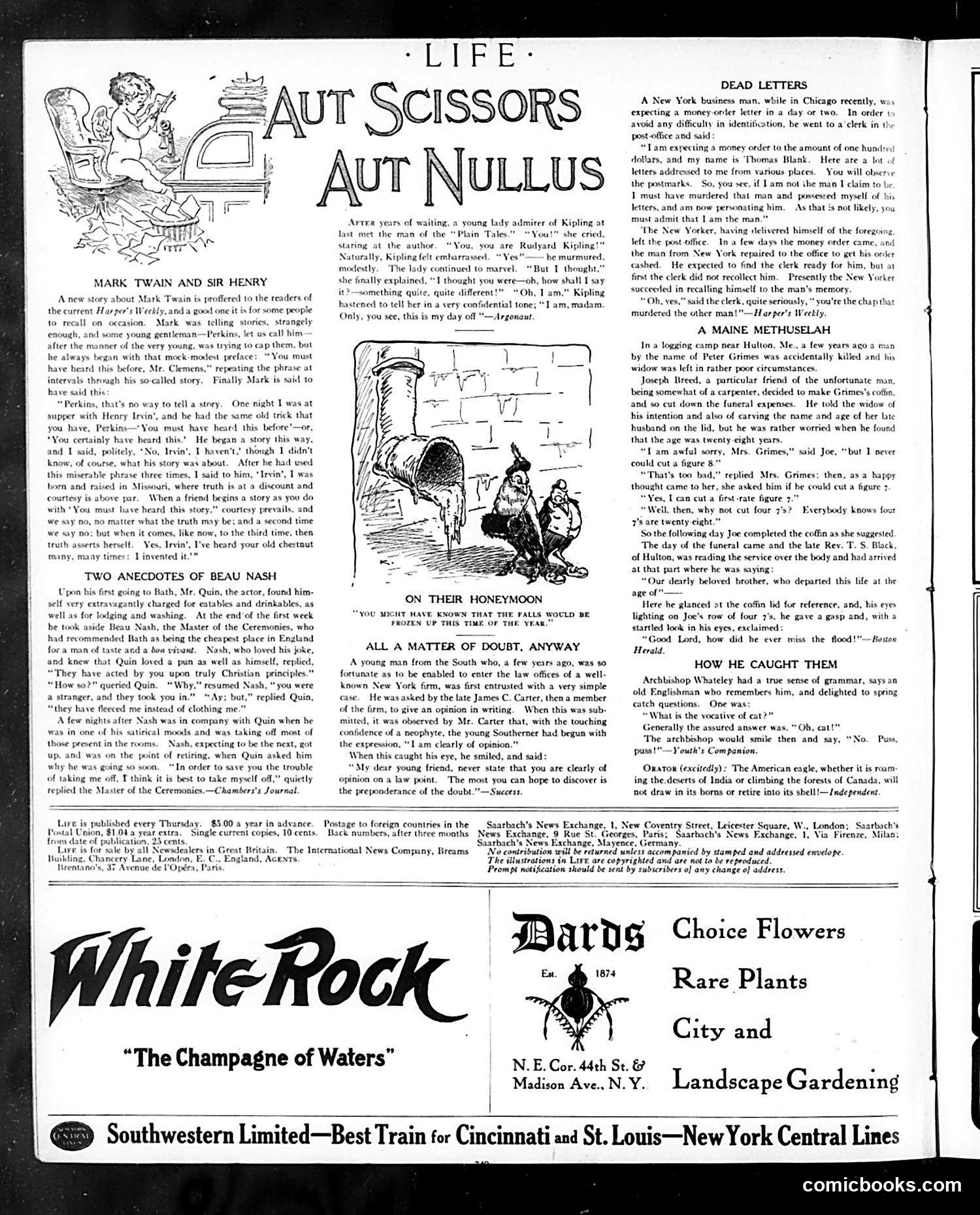
This page contains humorous anecdotes about famous figures rather than political cartoons. The main content includes: **"Mark Twain and Sir Henry"**: An anecdote where Mark Twain scolds a young man (Perkins) for prefacing stories with "You must have heard this before"—a habit even actor Henry Irving had. Twain's punchline: he invented the story himself, mocking the false modesty. **"Two Anecdotes of Beau Nash"**: Witty exchanges involving 18th-century Bath master of ceremonies Beau Nash, including a pun about being "taken in" (both cheated and welcomed as a stranger). **"Kipling" anecdote**: A lady meets Rudyard Kipling, disappointed he doesn't match her expectations. His response: "I am...quite different! Only, you see, this is my day off"—satirizing how public figures perform different personas. The **honeymoon cartoon** (bottom left) shows a couple at Niagara Falls frozen over, with the caption suggesting they should have known it freezes in winter—gentle domestic humor. These are light, witty pieces celebrating clever wordplay and absurdist humor typical of *Life* magazine's satirical style.
📄 Transcribed text from this page (OCR, searchable)
Machine-transcribed from the original scan — historical spelling and the odd misread are preserved.
Sa bil LEI UT SCISSORS - Aut NULLUS MARK TWAIN AND SIR HENRY 'y about Mark Twain is proffered to the readers ¢ the current Harper's Weekly, and a good one it is for some peop! to recall on occasion. Mark was telling stories, strangely 1 some young gentleman—Perkins, let us call him after the manner of the very young, was trying to cap them, but he always began with that mock-modest preface: “You must have heard this before, Me. Clemens,” repeating the phrase at intervals through his so-called story. Finally Mark is said to have said this Perkins, that's no way to tell.a story. One night I was at supper with Henry Irvin’, and he bad the sime old trick that you have, Perkins— You must have heard this before’—or, *You certainly have heard this." He began a story this way, 1 1 said, politely, ‘No, Irvin’, I haven't,’ though T didn't know, of course, what his story was about. After he had used this miserable phrase three times, I said to him, ‘Irvin’, T was born and raised in Missouri, where truth is at a discount and courtesy is above par. When a friend begins a story as you do with ‘You must have heard this story," courtesy prevails, and we say no, no matter what the truth may be: and a second time we say no: but when it comes, like now, to the third time, then truth asserts herself. Yes, Irvin’, I've heard your old chestaut many, many timer: I invented it." TWO ANECDOTES OF BEAU NASH Upon his first going to Bath, Mr. Quin, the actor, found him- self very extravagantly charged for eatables and drinkables, as well as for lodging and washing. At the end’of the first week he took aside Beau Nash, the Master of the Ceremonies, who had recommended Bath as being the cheapest place in England fora man of taste and a bos vitant. Nash, who loved his joke, and knew that Quin loved a pun as well as himself, replied, “They have acted by you upon truly Christian principles.” * How so?” queried Quin. “Why,” resumed Nash, “ you were a stranger, and they took you in." “Ay; but,” replied Quin, “they have feeced me instead of clothing me.” A few nights after Nash was in company with Quin when he was in one of his satirical moods and was taking off most of Nash. expecting to be the next, got up, and was on the point of retiring, when Quin asked him why he was going so soon. “In order to save you the trouble of taking me off, T think it is best to take myself off," quietly replied the Master of the Ceremonies.—Chambers's Journal. those present in t Hs. Arree years of waiting, a young lady admirer of Kipling at last met the . she cried, staring at the author. “You, you are Rudyard Kipling!” Naturally, Kipling felt embarrassed. “Yes” modestly. ‘The lady continued to marvel. “But I thought.” she finally explained, “I thought you were—oh, how shall I say it?—something quite, quite different!” “Oh, I am," Kipling ‘ened to tell her in a very confidential tone; "Iam, madam. Only, you see, this is my day off "Argonaut. of the “Plain Tales.” “You he murmured, ON THEIR HONEYMOON “YOU MICHT MAVE KNOWN THAT THE FALLS YROZEN UP THIS TIME OF THE YEAR. ALL A MATTER OF DOUBT, ANYWAY ‘A young man from the South who, a few years ago, was $0 fortunate as to be enabled to enter the law offices of a well- known New York firm, was first entrusted with a very simple case. He was asked by the late James C. Carter, then a member of the firm, to give an opinion in writing. When this was sub- mitted, it was observed by Mr. Carter that, with the touching confidence of a neophyte, the young Southerner had begun with the expression, “I am clearly of opinion.” When this caught his eye, he smiled, and said: “My dear young friend, never state that you are clearly of opinion on a law point. ‘The most you can hope to discover is the preponderance of the doubt.” —Success. DEAD LETTERS A New York business man, while in Chicago recently, wos expecting a money-onter letter in a day or two. In order | avoid any difficulty in identification, be went to a'clerk in 1 post-office and suid Tam expecting a money order to the amount of one hunvlry dolfars, and my name is ‘Thomas Blank. Here are a lot letters addressed to me from various places. You will obse the postmarks. you sec, if 1am not ihe man I claim to, I must have murdered that man and possessed myself of his letters, and am now personating him. As that !s not likely, you must admit that Iam the man.”* “The New Yorker, having delivered himself of the forego left the post-office. In a few days the money erder came, and the man from New York repaired to the office to get his order cashed. He expected to find the clerk ready for him, but at first the clerk did not recollect him. Presently the New Yorker succeeded in recalling himself to the man’s memory. “Oh, ves,” said the clerk, quite seriously, " you're the chap that murdered the other man!"—H ar per's Weekly. A MAINE METHUSELAH In a logging camp near Hultoo, Me. a few years ago a man by the name of Peter Grimes was accidentally killed and his widow was left in rather poor circumstances. Joseph Breed, a particular friend of the unfortunate man. being somewhat of a carpenter, decided to make Grimes's cofii, and so cut down the funeral expenses. He told the widow of his intention and also of carving the name and age of her late husband on the lid, but he was rather worried when he found that the age was twenty-eight years. “Lam awful sorry, Mrs. Grimes,” stid Joe, “but I never could cut a figure 8." “That's too bad,” replied Mrs. Grimes: then, as a happy thought came to her, she asked bin if he could cut a figure 7 “Yes, Lean cut a first-rate figure Weil. then, why not cut four 7's? Everybody knows four 7's are twenty-eight So the following day Joe completed the coffin as she suggested ‘The day of the funeral came and the late Rev. T. S. Black. of Hulton, was reading the service over the body and had arrived at that part where he was siying: “Our dearly beloved brother, who departed this life at the age of "— Here he glanced ot the coffin lid for reference, and, his eyes lighting 09 Joe's row of four 7's, he gave a gasp and, with a startled look in his eyes, exclaimed: “Good Lord, how did he ever miss the flood!""—Bostor Herald. HOW HE CAUGHT THEM Archbishop Whateley had a true sense of grammar, says an old Englishman who remembers him, and delighted to spring catch questions. One was “What is the vorative of cat Generally the assured answer was. “Oh, cat!" ‘The archbishop would smile then and say, “No. Puss, puss!”—Youth's Companion. Onator (excitedly): The American eagle, whether it is roar: ing the.deserts of India or climbing the forests of Canada, will ‘not draw in its horns or retire into its shell!—Independent. Live is published every Thursday. $5.00 a year in advance. jon, $1.04a year extra, Single current copies, 10 cents. of publication, 25 cents. by all Newsdealery in Great Britain. ‘The International News Company, Breams i. Chancery Lane, London, E. C., England, Acexts Postage to foreign countries in the Saarbach's News Exchange, 1, New Coventry Street, Leicester Square, W., London; Saarbach’s Back numbers, after three months News Exchange, 9 Rue St. Georges, Paris; Saarbach's News Exchange, 1, Via Firenze, Milan; Saarbach’s 3 Exchange, Mayence, Germany. No contribution will be returned unless accompanied by stamped and addressed envelope. The illustrations in Lire. are copyrighted and are not to be reproduced. Prompt notification should be sent by subscribers of any change of address While Rock “The Champagne of Waters” Darvs Ea. : 1874 N.E. Cor. 44th St. @ Madison Ave., N.Y. Choice Flowers Rare Plants City and Landscape Gardening | & Southwestern Limited—Best Train for Cin cinnati and St. Louis—New York Central Lines comicbooks.com