
Life, 1907-05-30 · page 4 of 20
Life — May 30, 1907 — page 4: what you’re looking at
What you’re looking at
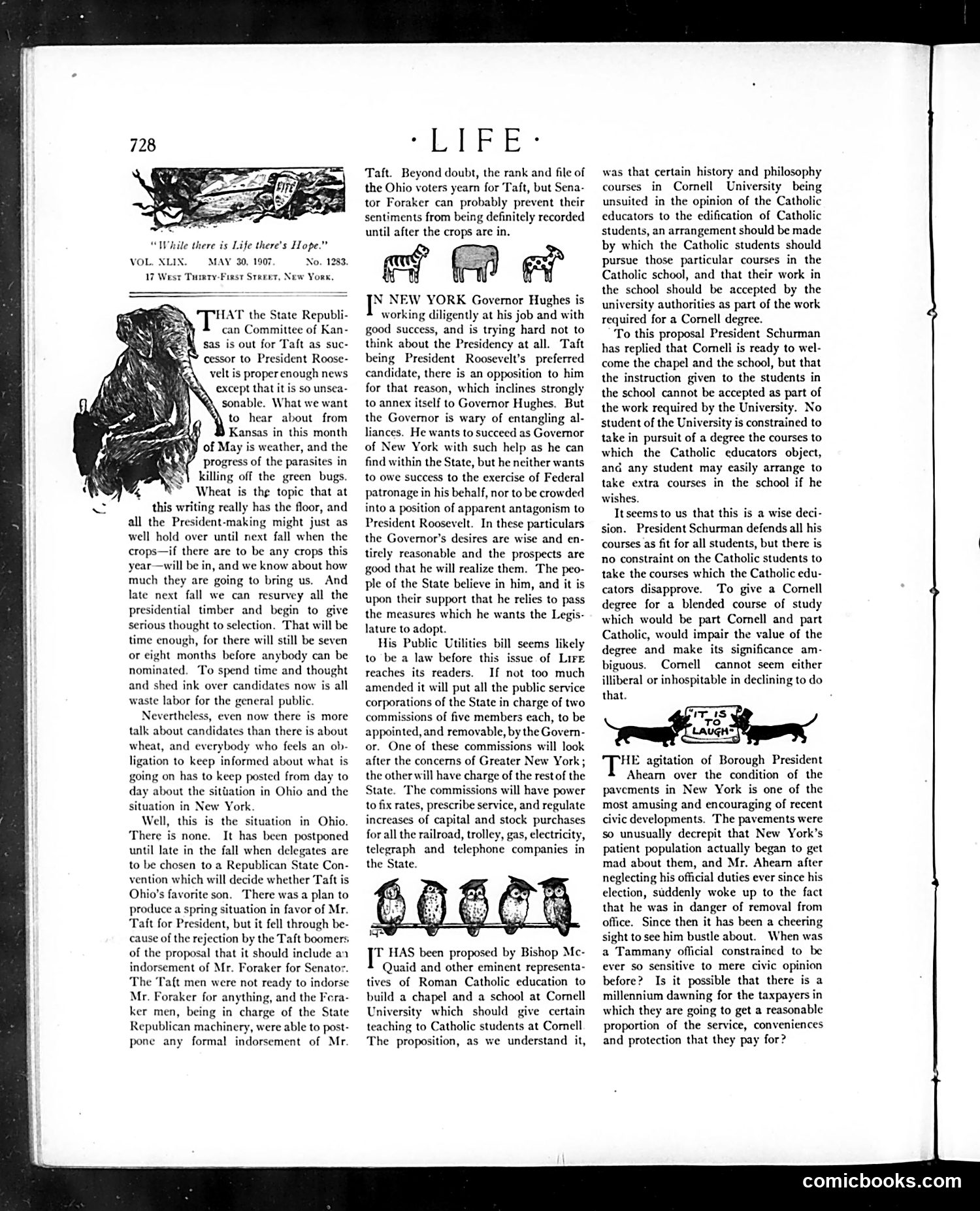
This page contains three separate political commentary pieces: 1. **The Taft succession editorial** discusses President Roosevelt's preferred successor William Howard Taft and Governor Hughes of New York. The text argues Hughes should support Taft's nomination rather than pursue the presidency himself. 2. **The Catholic education debate** addresses Bishop McQuaid's proposal to build a Catholic chapel and school at Cornell University. The editorial questions whether Cornell should accept coursework from a Catholic institution as credit toward Cornell degrees, raising concerns about institutional independence. 3. **The Borough President cartoon** (bottom) critiques Borough President Ahearn's neglect of official duties while hustling for civic improvements in New York, suggesting he's distracted from core responsibilities. The illustrations are satirical caricatures typical of Life's editorial style.
📄 Transcribed text from this page (OCR, searchable)
Machine-transcribed from the original scan — historical spelling and the odd misread are preserved.
“While there is Life there's Hope.” VOL. XLIX. — MAY 30, 1907. No. 1283. 17 West Turery-Finsr Sterer, New Yorn, pe the State Republi- can Committee of Kan- & sas is out for Taft as suc- cessor to President Roose- velt is proper enough news except that it is so unsea- sonable. What we want {to hear about from B Kansas in this month ny of May is weather, and the progress of the parasites in Ga off the green bugs. Wheat is the topic that at this writing really has the floor, and all the President-making might just as well hold over until next fall when the crops—if there are to be any crops this year—will be in, and we know about how much they are going to bring us. And late next fall we can resurvey all the presidential timber and begin to give serious thought to selection. That will be time enough, for there will still be seven or eight months before anybody can be nominated. To spend time and thought and shed ink over candidates now is all waste labor for the general public. Nevertheless, even now there is more talk about candidates than there is about wheat, and everybody who feels an ob- ligation to keep informed about what is going on has to keep posted from day to day about the situation in Ohio and the situation in New York. Well, this is the situation in Ohio. There is none. It has been postponed until late in the fall when delegates are to be chosen to a Republican State Con- vention which will decide whether Taft is Ohio's favorite son. There was a plan to produce a spring situation in favor of Mr. Taft for President, but it fell through be- cause of the rejection by the Taft boomers, of the proposal that it should include an indorsement of Mr. Foraker for Senator. The Taft men were not ready to indorse Mr. Foraker for anything, and the Fera- ker men, being in charge of the State Republican machinery, were able to post- pone any formal indorsement of Mr. EP E Taft. Beyond doubt, the rank and file of the Ohio voters yearn for Taft, but Sena- tor Foraker can probably prevent their sentiments from being definitely recorded until after the crops are in. ef A # NEW YORK Governor Hughes is working diligently at his job and with good success, and is trying hard not to think about the Presidency at all. Taft being President Roosevelt’s preferred candidate, there is an opposition to him for that reason, which inclines strongly to annex itself to Governor Hughes. But the Governor is wary of entangling al- liances. He wants to succeed as Governor of New York with such help as he can find within the State, but he neither wants to owe success to the exercise of Federal patronage in his behalf, nor to be crowded into a position of apparent antagonism to President Roosevelt. In these particulars the Governor’s desires are wise and en- tirely reasonable and the prospects are good that he will realize them. The peo- ple of the State believe in him, and it is upon their support that he relies to pass the measures which he wants the Legis- lature to adopt. His Public Utilities bill seems likely to be a law before this issue of Lire reaches its readers. If not too much amended it will put all the public service corporations of the State in charge of two commissions of five members each, to be appointed, and removable, by the Govern- or. One of these commissions will look after the concerns of Greater New York; the other will have charge of the rest of the State. The commissions will have power to fix rates, prescribe service, and regulate increases of capital and stock purchases for all the railroad, trolley, gas, electricity, telegraph and telephone companies in the State. [TAS been proposed by Bishop Mc- Quaid and other eminent representa- tives of Roman Catholic education to build a chapel and a school at Comell University which should give certain teaching to Catholic students at Comell The proposition, as we understand it, was that certain history and philosophy courses in Comell University being unsuited in the opinion of the Catholic educators to the edification of Catholic students, an arrangement should be made by which the Catholic students should pursue those particular courses in the Catholic school, and that their work in the school should be accepted by the university authorities as part of the work required for a Cornell degree. To this proposal President Schurman has replied that Comell is ready to wel- come the chapel and the school, but that the instruction given to the students in the school cannot be accepted as part of the work required by the University. No student of the University is constrained to take in pursuit of a degree the courses to which the Catholic educators object, and any student may easily arrange to take extra courses in the school if he wishes. Itseems to us that this is a wise deci- sion. President Schurman defends all his courses as fit for all students, but there is no constraint on the Catholic students to take the courses which the Catholic edu- cators disapprove. To give a Cornell degree for a blended course of study which would be part Comell and part Catholic, would impair the value of the degree and make its significance am- biguous. Comell cannot seem either illiberal or inhospitable in declining to do that. [= agitation of Borough President Aheam over the condition of the pavements in New York is one of the most amusing and encouraging of recent civic developments. The pavements were so unusually decrepit that New York’s patient population actually began to get mad about them, and Mr. Aheam after neglecting his official duties ever since his election, suddenly woke up to the fact that he was in danger of removal from office. Since then it has been a cheering sight to see him bustle about. When was a Tammany official constrained to be ever so sensitive to mere civic opinion before? Is it possible that there is a millennium dawning for the taxpayers in which they are going to get a reasonable proportion of the service, conveniences and protection that they pay for? comicbooks.com