
A complete issue · 24 pages · 1907
Life — January 31, 1907
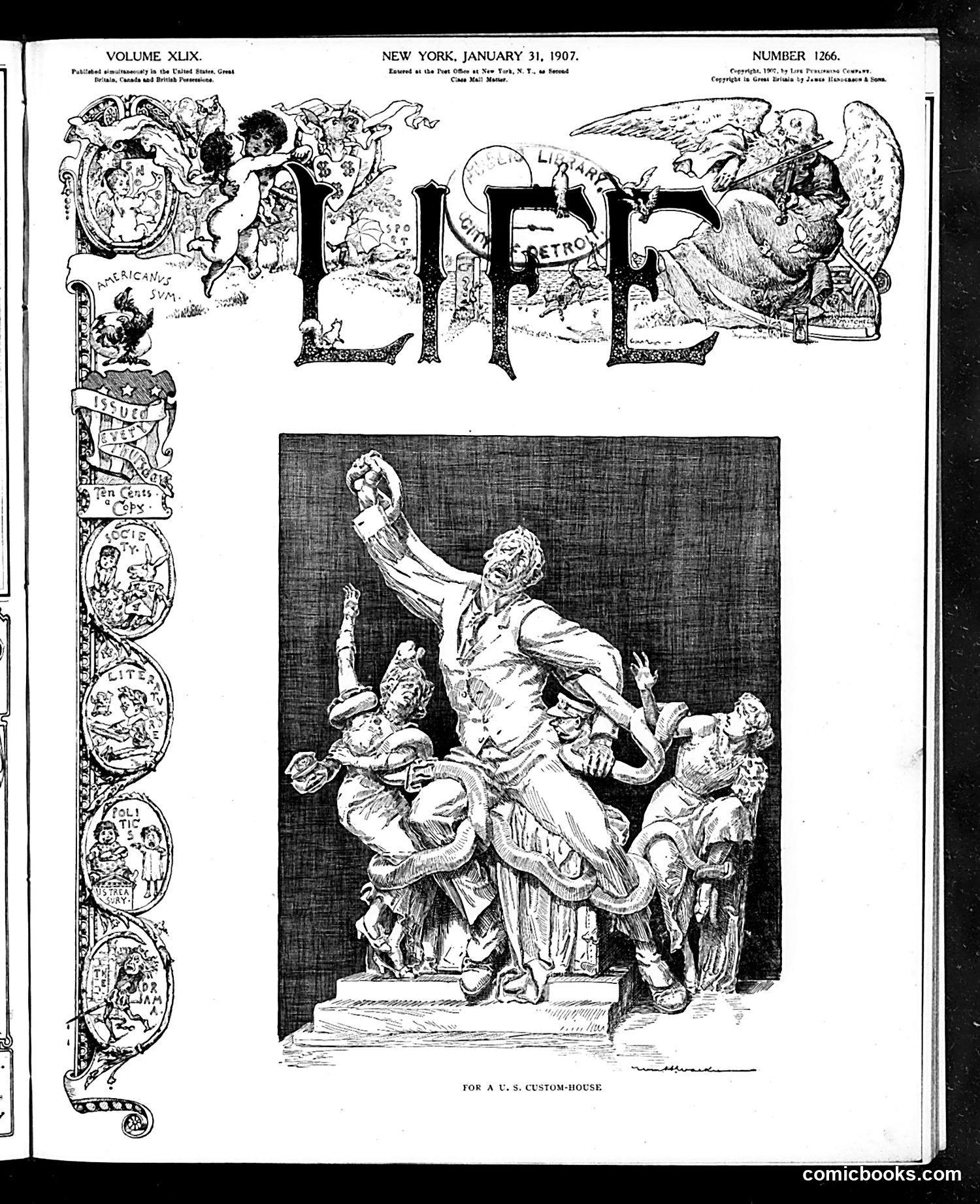
The main illustration depicts a classical female figure (likely Liberty or Justice) being lifted or carried aloft by cherubic figures, with the caption "FOR A U.S. CUSTOM-HOUSE." This appears to be political satire regarding American customs administration. The image suggests idealism or elevation of the customs service—possibly celebrating reform efforts or new leadership. The classical allegorical style was typical of early 1900s American political commentary. Without clearer historical context about specific 1907 customs-house controversies or personnel changes, the precise satirical target remains uncertain. The ornamental border featuring zodiac signs and classical motifs indicates this was a significant cover illustration for the magazine.
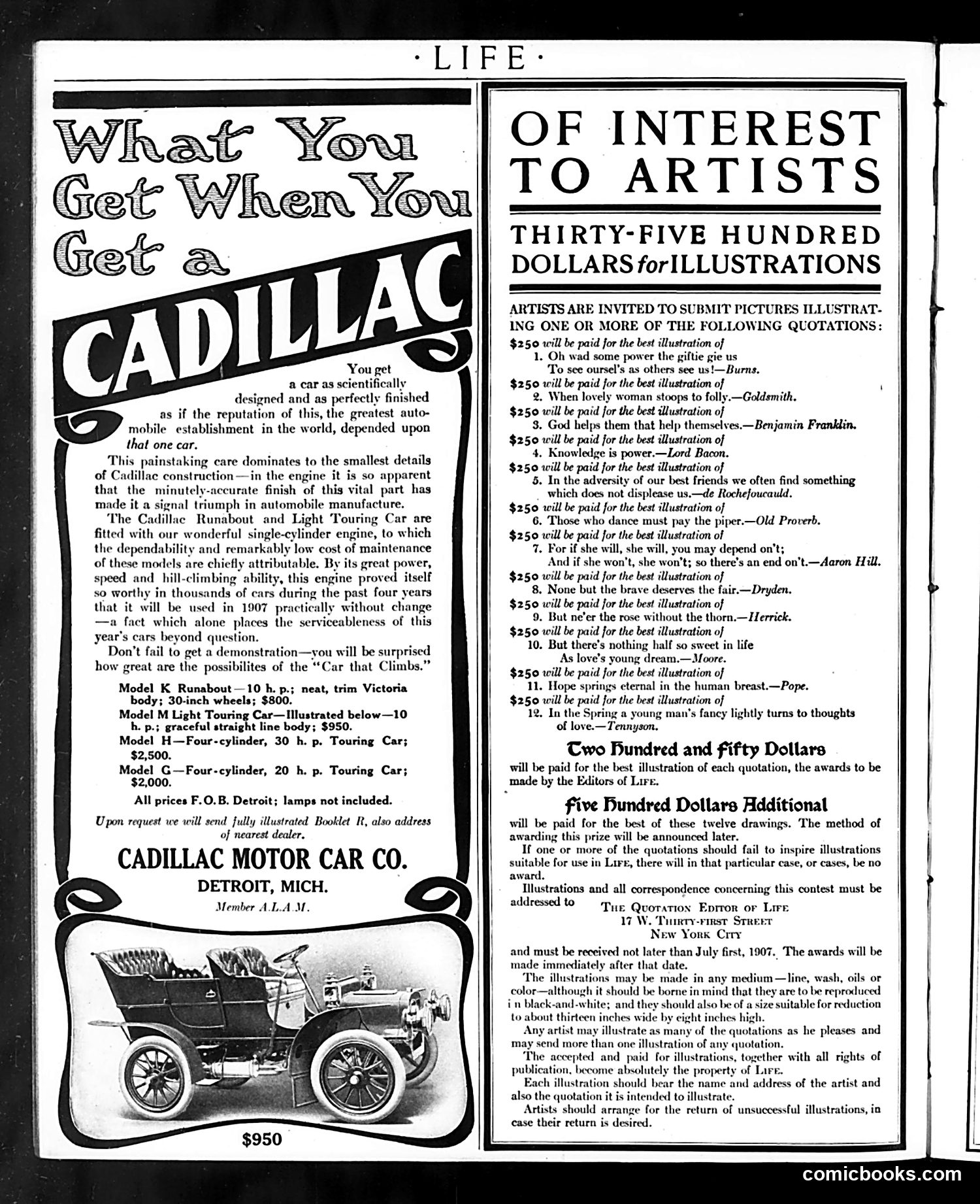
This page contains **two separate advertisements**, not political cartoons. **Left side:** A Cadillac Motor Car advertisement emphasizing engineering precision and reliability. The copy stresses that Cadillac's attention to detail in construction—particularly its single-cylinder engine—demonstrates superior manufacturing quality. The ad includes model specifications and pricing ($800-$2,500). This reflects early 1900s automotive marketing focused on technical superiority. **Right side:** A Life magazine contest soliciting artist illustrations for literary quotations, offering $250-$350 per illustration plus additional prizes ($250 total for best submission). The quotations are motivational/philosophical in nature—from figures like Burns, Goldsmith, and Franklin. This is primarily **commercial content** rather than satirical commentary. No political figures or social satire appear on this page.
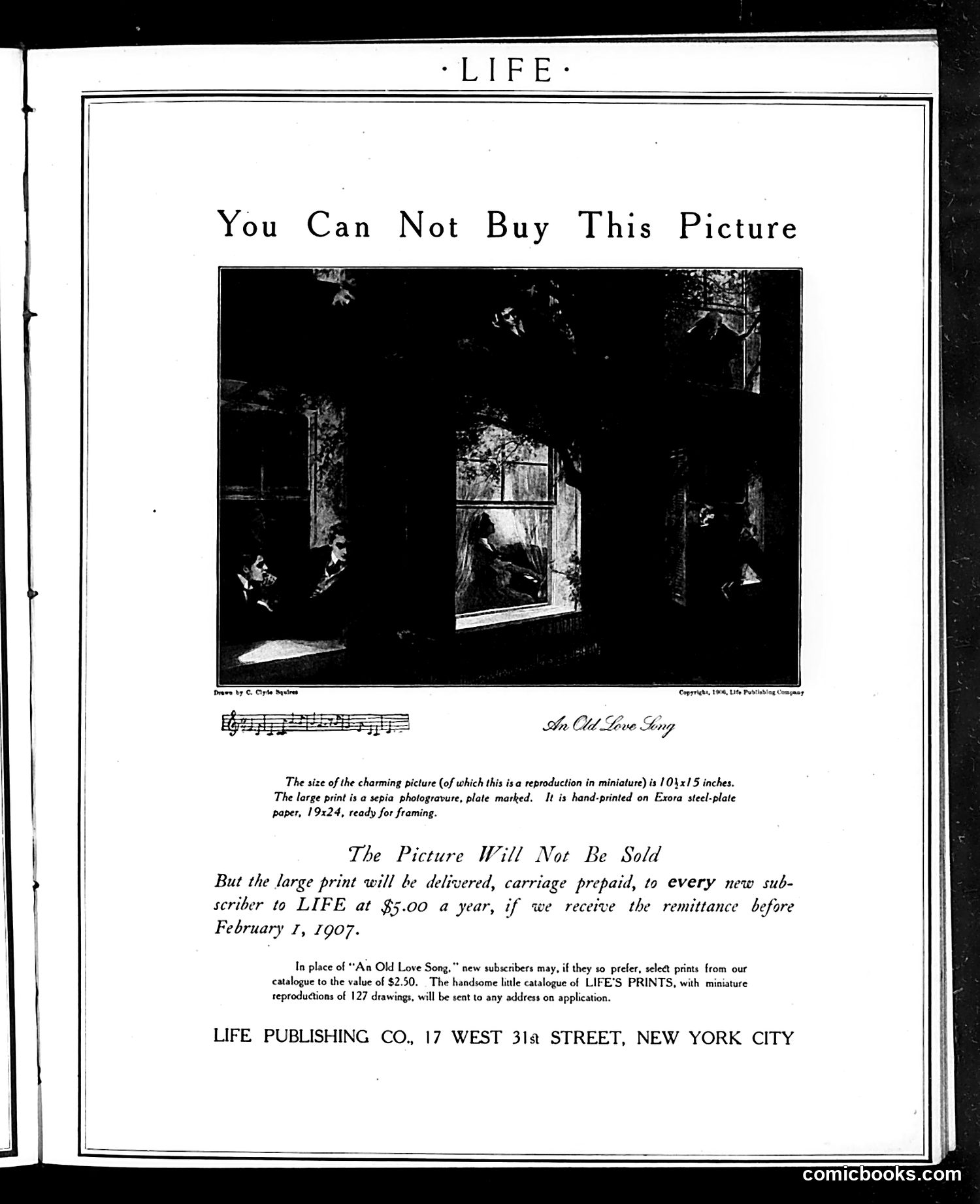
This page is primarily **advertising for Life magazine's prints**, not political satire. The headline "You Can Not Buy This Picture" is a marketing hook—the image itself (titled "An Old Love Song," credited to C. Clyde Hahn) depicts a romantic scene: silhouetted figures in an interior with a window, evoking nostalgic sentiment. The advertisement promises that while the reproduction shown cannot be purchased separately, new Life subscribers paying $5 annually before February 1, 1907, will receive a large hand-painted print (19x24 inches) delivered free. Alternatively, subscribers may select other prints valued up to $2.50 from Life's catalogue. This is essentially a **subscription incentive campaign** using an sentimental image to attract new readers to the magazine.
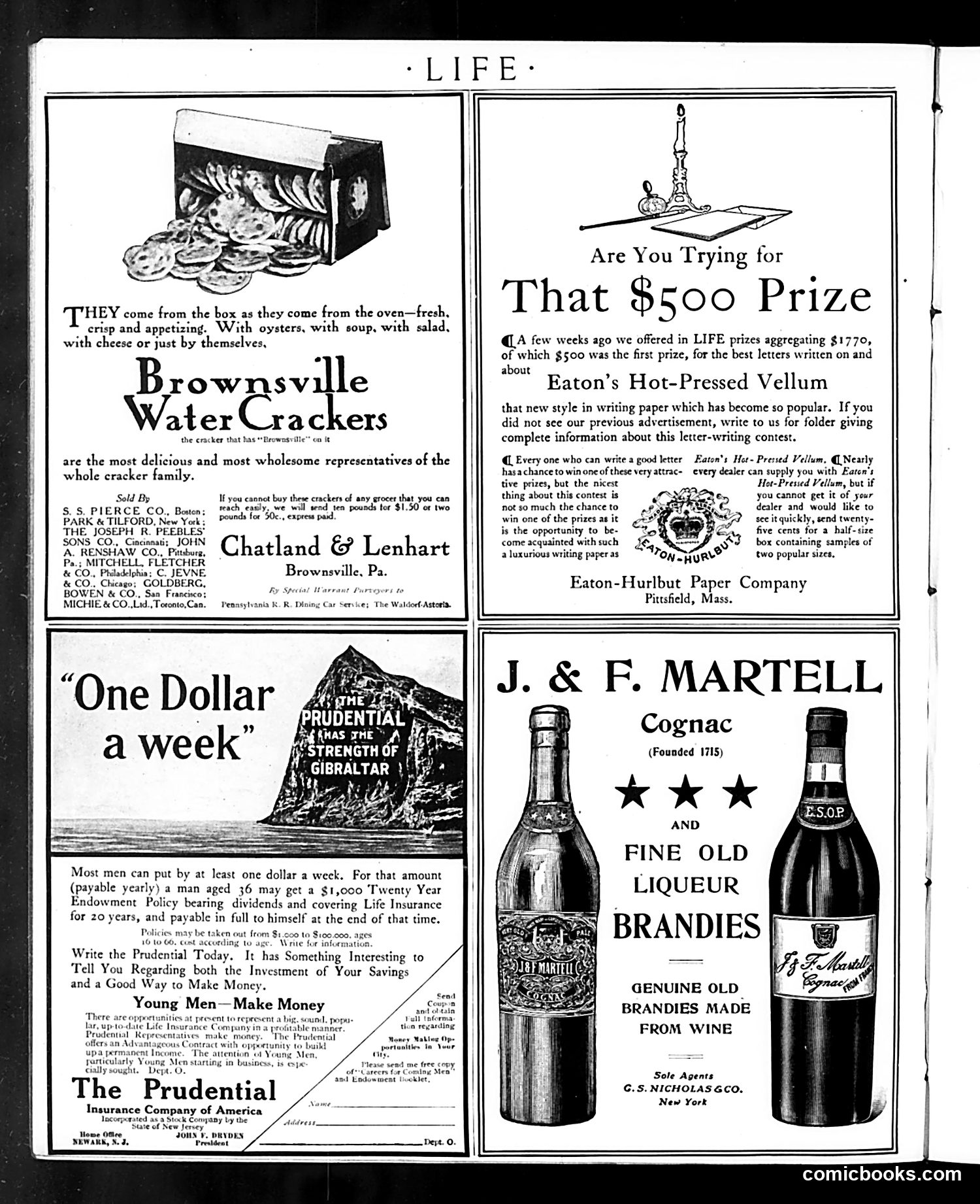
This page contains **four advertisements**, not editorial cartoons or satire. The content is commercial: 1. **Brownsville Water Crackers** — promoting a snack product from Pennsylvania 2. **Eaton's Hot-Pressed Vellum** — advertising writing paper with a contest offering $500 prize 3. **The Prudential Insurance Company** — promoting life insurance with the slogan "One Dollar a week," emphasizing affordable savings and life coverage 4. **J. & F. Martell Cognac and Fine Old Brandies** — advertising liquor products There is **no political satire or commentary** on this page. It represents typical early 20th-century Life magazine advertising, mixing consumer goods, financial services, and spirits. The Prudential ad's emphasis on affordable weekly savings reflects period concerns about financial security.
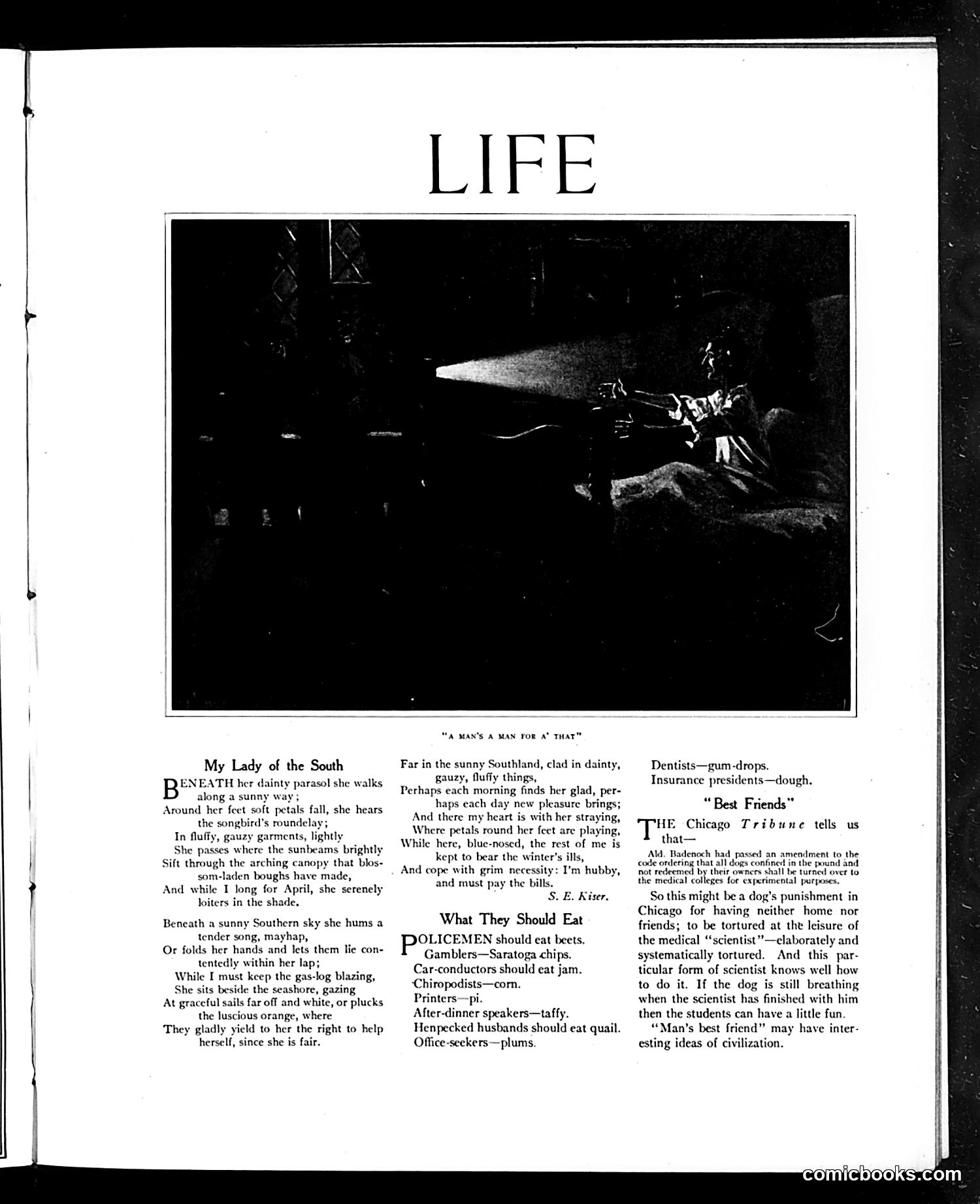
The page features a romantic poem titled "My Lady of the South" alongside a dark photographic image showing a figure illuminated by what appears to be a spotlight or beam of light in an otherwise black scene. Below the image sits a satirical section titled "What They Should Eat," listing professions paired with specific foods as jokes: - Policemen should eat beets - Gamblers should eat Saratoga chips - Chiropodists should eat corn - Printers should eat pi The accompanying text discusses a Chicago Tribune amendment regarding dog punishment, sardonically suggesting scientists could torture dogs for entertainment—social satire on vivisection practices and the casual cruelty sometimes justified in the name of science education. The juxtaposition of romantic poetry with dark imagery and cynical humor was typical of Life's approach to contemporary issues.
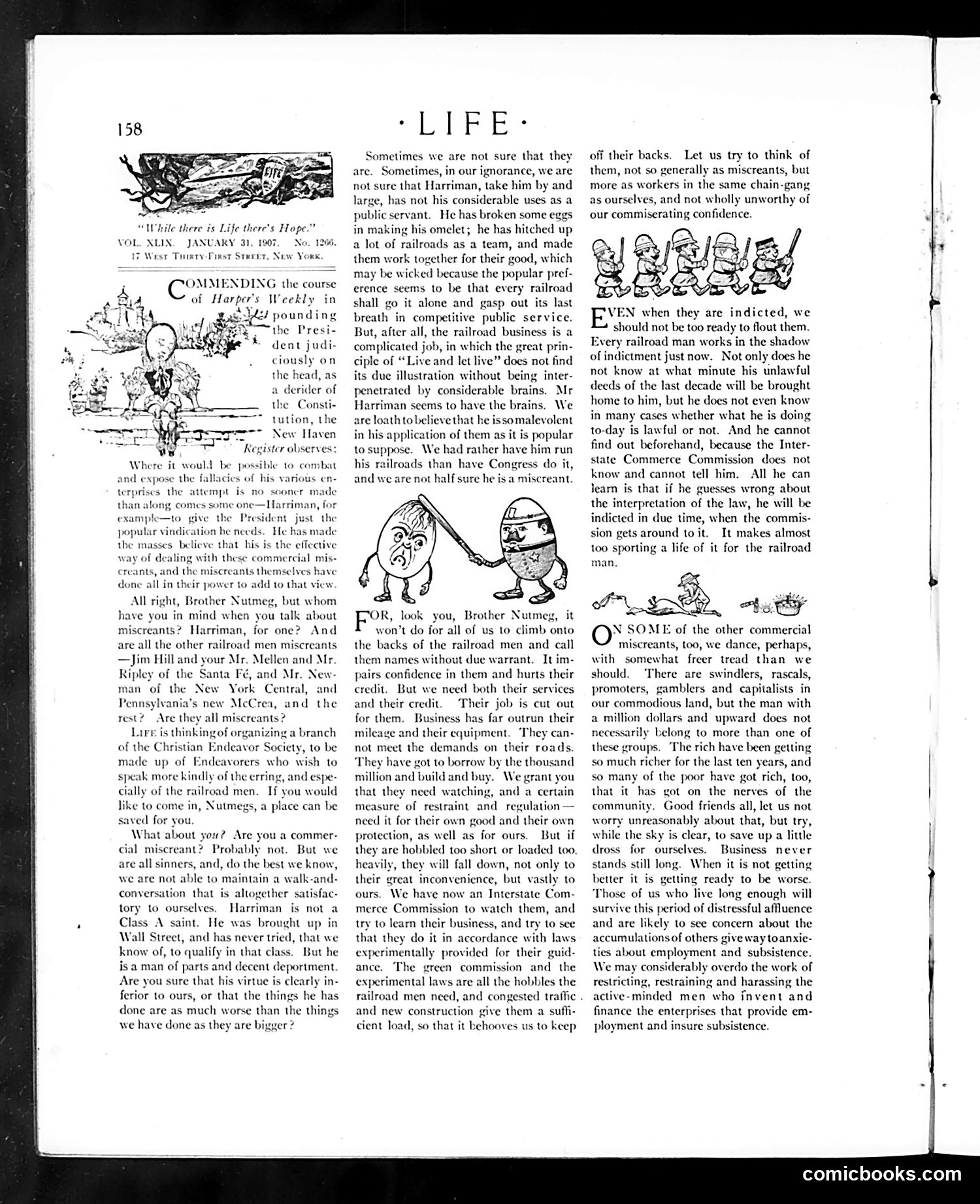
This page satirizes railroad businessmen and the Interstate Commerce Commission (ICC). The text defends railroad executives against characterization as "miscreants," arguing they operate under complicated, poorly understood regulations that make lawful compliance uncertain. The cartoon shows two rotund figures labeled "Brother Nutmeg" engaging in physical conflict, likely representing competing railroad interests or business disputes. The illustration emphasizes the absurdity of blaming railroad men when the ICC's own experimental laws create confusion about what's legally required. The broader argument: rather than condemning railroad operators, society should recognize that ambiguous regulatory frameworks—not malice—cause problems. The ICC itself needs clearer rules to prevent the very abuses it's meant to police. The satire targets regulatory overreach and vague legislation as the true culprits.
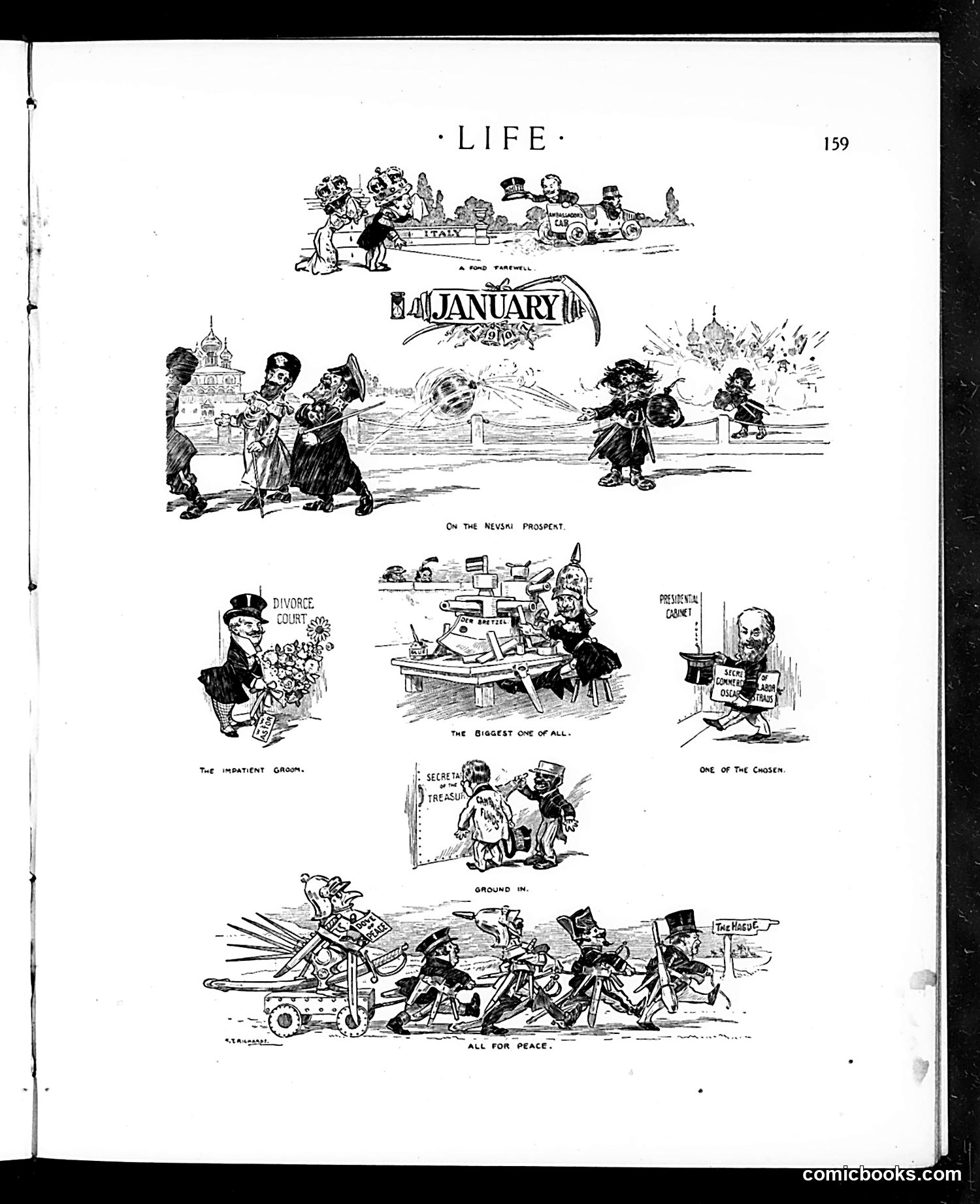
This page presents political cartoons satirizing January 1914 events. The captions reference contemporary issues: - **"A Fine Farewell"** and **"On the Neverl Prospect"** appear to mock diplomatic or political departures/expectations - **"The Impatient Groom"** (Divorce Court) satirizes marital dissolution - **"The Biggest One of All"** likely references a major political scandal or appointment - **"One of the Chosen"** (Premier Cabinet) suggests commentary on political selection - **"Ground In"** and **"All for Peace"** reference international or labor disputes The cartoons employ exaggerated caricatures typical of early 20th-century American political satire. Without clearer identification of specific figures, the exact targets remain unclear, though the overall tone suggests criticism of political instability, diplomatic failures, or cabinet machinations of the period. The artistic style is characteristic of Life's satirical approach to current events.
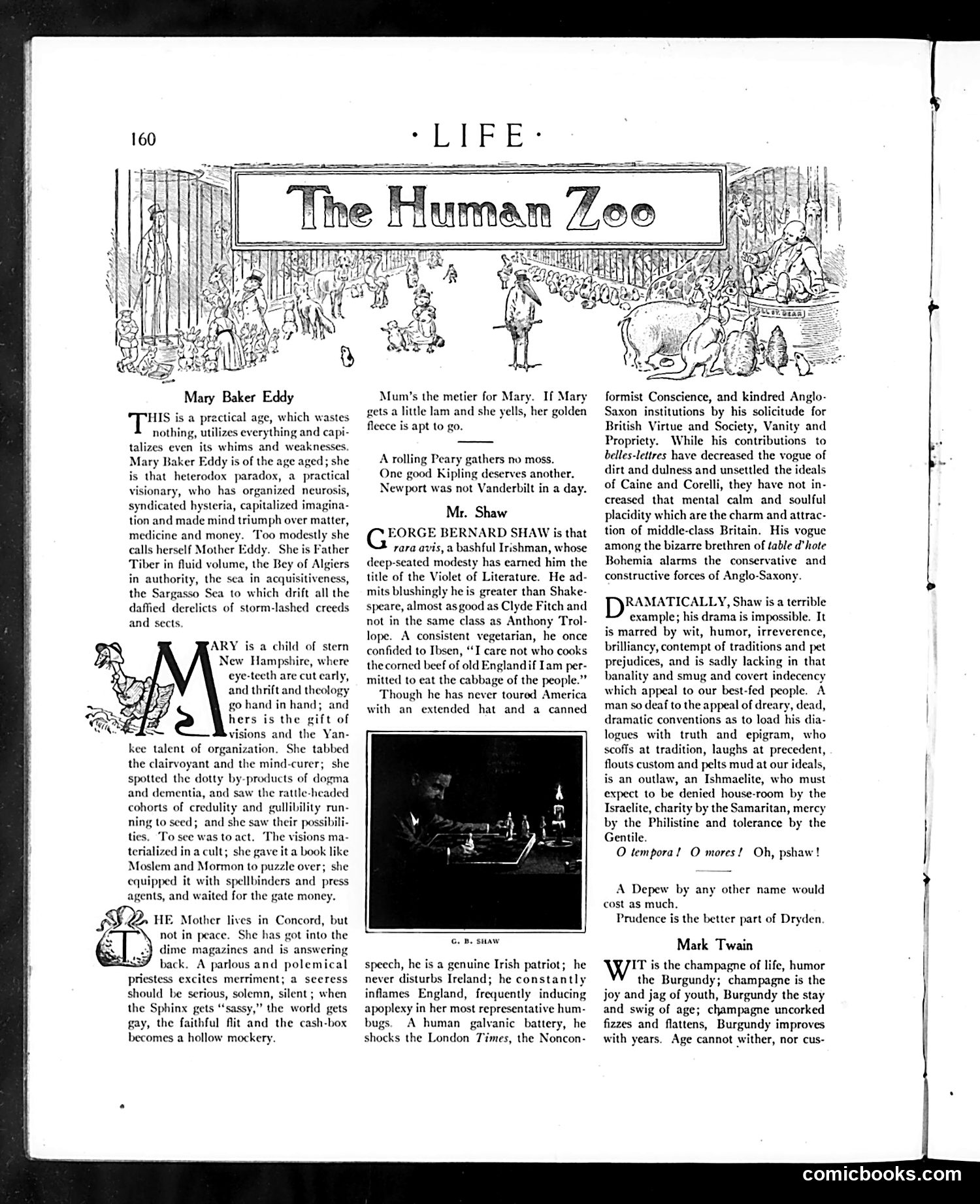
This page satirizes British society figures of the early 20th century through character sketches. "Mary Baker Eddy" mocks the Christian Science founder as a practical visionary who capitalizes on human weakness. "Mr. Shaw" refers to George Bernard Shaw, caricatured as an Irish radical and vegetarian whose dramatic works are called "impossible" and whose contrarian positions alienate British society. "Mark Twain" concludes the section, praising him as life's "champagne"—witty, humorous, and youthful in spirit. The "Human Zoo" title itself suggests these are specimens of society on display for ridicule—wealthy, famous figures reduced to their perceived character flaws and social pretensions.
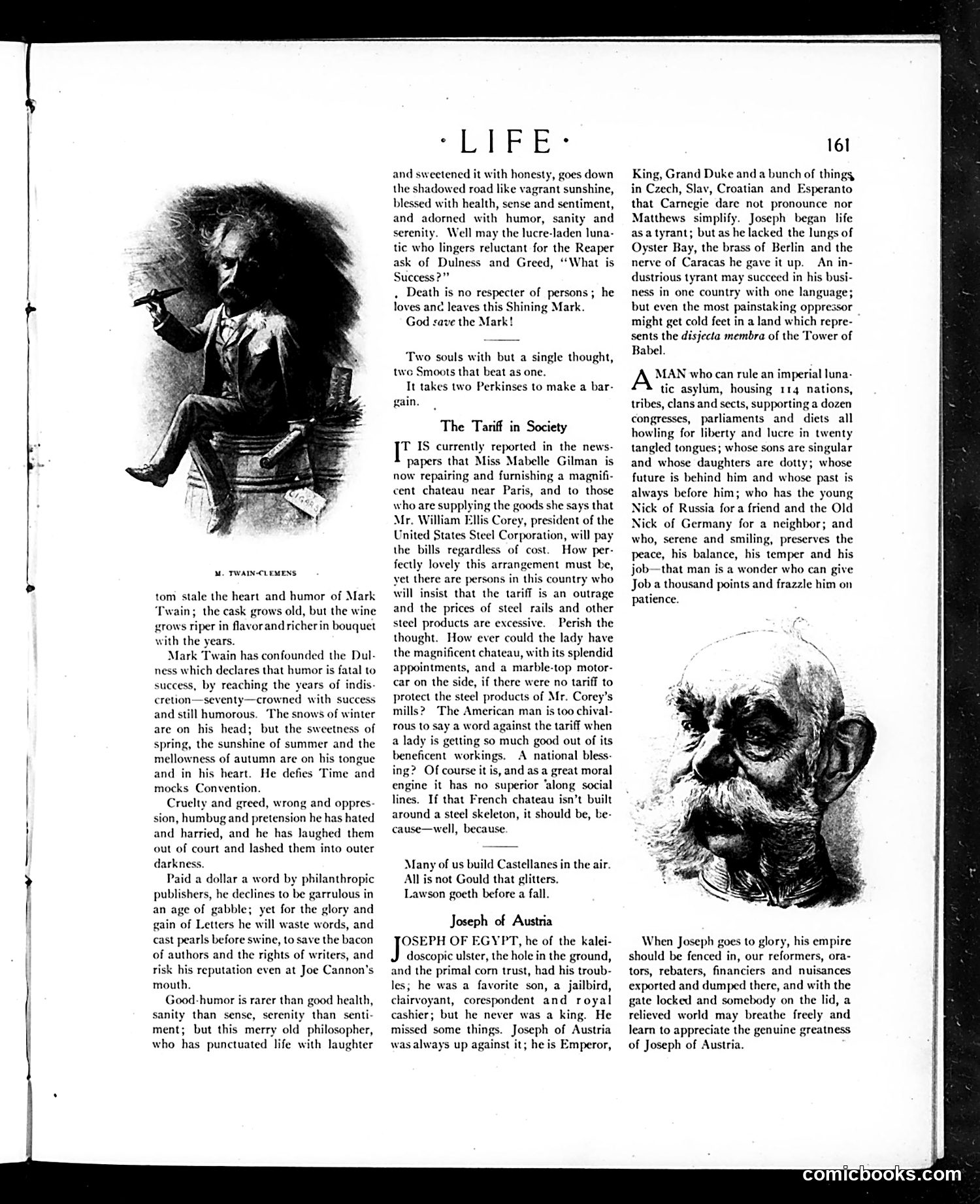
This page contains two illustrations by M. Twain-Clemens (likely a pen name) accompanying satirical commentary. The upper sketch depicts an elderly man in period dress, appearing to represent a figure of authority or privilege. The text discusses Mark Twain's use of humor to critique social hypocrisy, cruelty, and greed. A section titled "The Tariff in Society" satirizes wealthy industrialists (specifically referencing William Ellis Corey of U.S. Steel) who profit from protective tariffs while ordinary citizens bear the cost. The satire argues this represents moral corruption disguised as economic policy. A separate article on "Joseph of Austria" appears below, though its specific satirical target is unclear from this excerpt alone. The overall page exemplifies Life magazine's tradition of using wit to expose upper-class pretension and economic injustice.
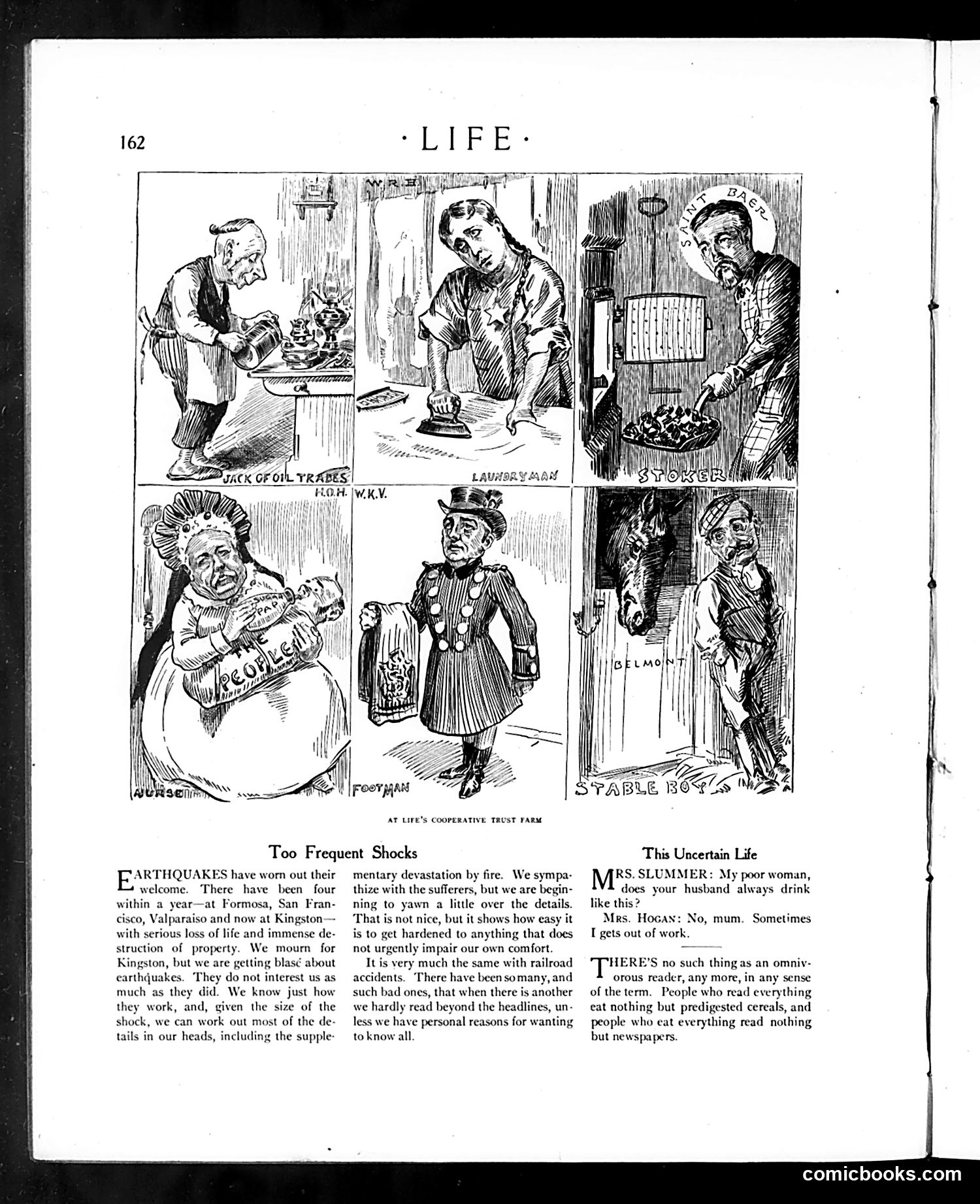
This page contains six satirical cartoon panels depicting various working-class occupations labeled as "At Life's Cooperative Trust Farm." The cartoons mock different trades: - **"Jack of All Trades"** and **"Laundry Man"** show workers in their professions - **"Nurse"** depicts healthcare work - **"Footman"** and **"Stables Boy's"** reference domestic service positions - **"Stoker"** shows industrial labor The accompanying text discusses how people have grown desensitized to repeated disasters—earthquakes in San Francisco and Kingston, railroad accidents—through media overexposure. The satire suggests that working people, hardened by constant hardship, become indifferent to tragic news. The cartoons visually reinforce this theme by depicting various laborers as worn down by their occupations.
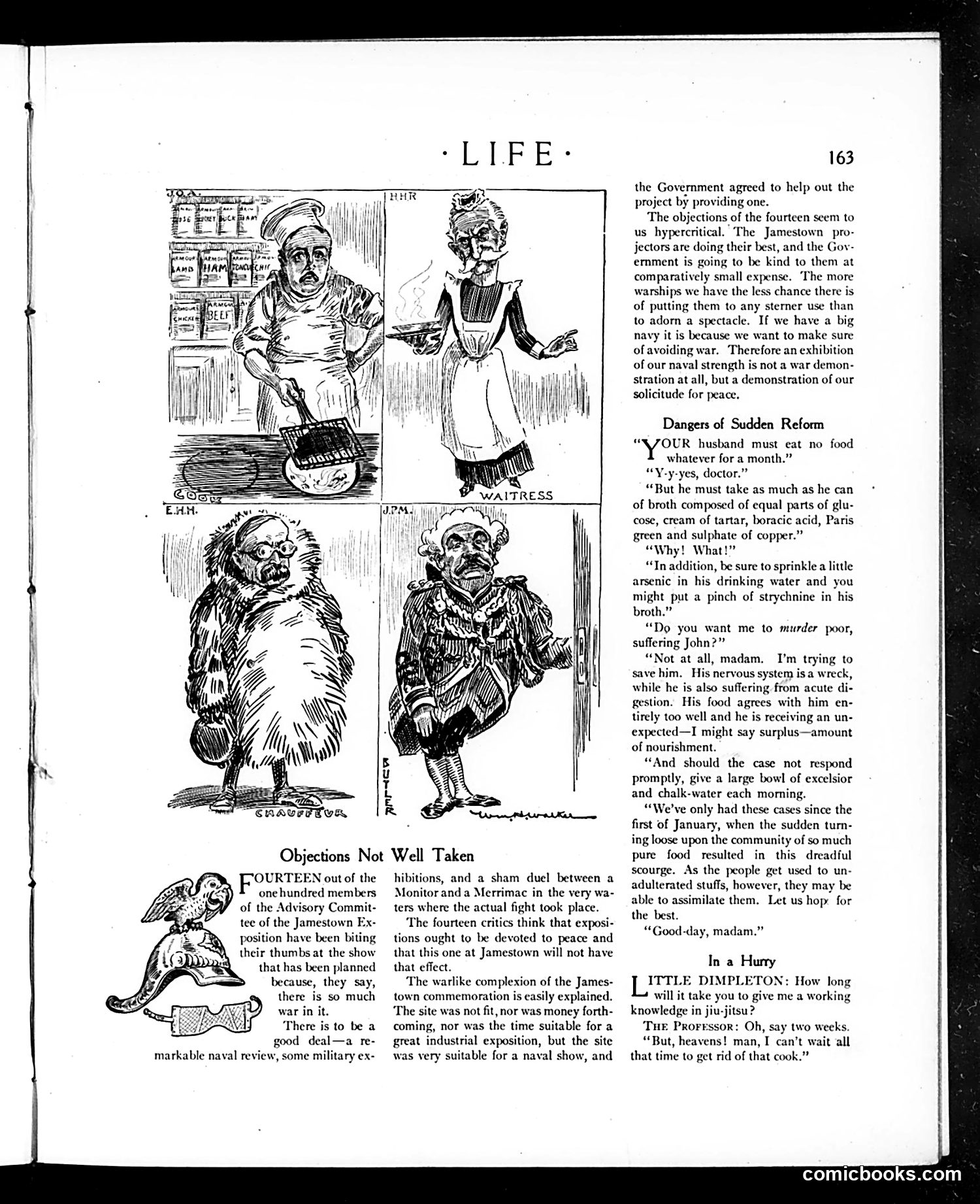
This page satirizes objections to the 1907 Jamestown Exposition (a major naval exhibition). The four caricatured figures labeled "E.H.," "Waitress," "J.P.M.," and "J.P.M." represent fourteen members of the Advisory Committee who opposed the show. Their stated concerns—that the site was unsuitable and warships were unnecessary—are mocked as hypocritical. The accompanying article argues the exposition is actually a peace demonstration, not militarism. The cartoons mock the critics as absurdly oversensitive. The section "Dangers of Sudden Reform" presents a darkly comic doctor's dialogue about radical dietary restrictions that could poison a patient—a metaphorical criticism of the objectors' extreme position on food reform, suggesting their logic is dangerously flawed.
This illustration depicts an adult male figure entering or exiting a taxi cab while a young girl stands outside watching. The image appears to be satirical commentary on urban life and social behavior, likely from the early 20th century based on the art style and vehicle design. The cartoon likely critiques either: - Taxi cab culture and its social implications - An adult's questionable interaction with a child - Contemporary concerns about urban safety or morality The girl's expression and posture suggest surprise or concern about the man's behavior. Without visible text identifying specific individuals or clearer contextual clues on this page, the exact satirical target remains unclear, though it appears to comment on social propriety or urban interactions of the era.
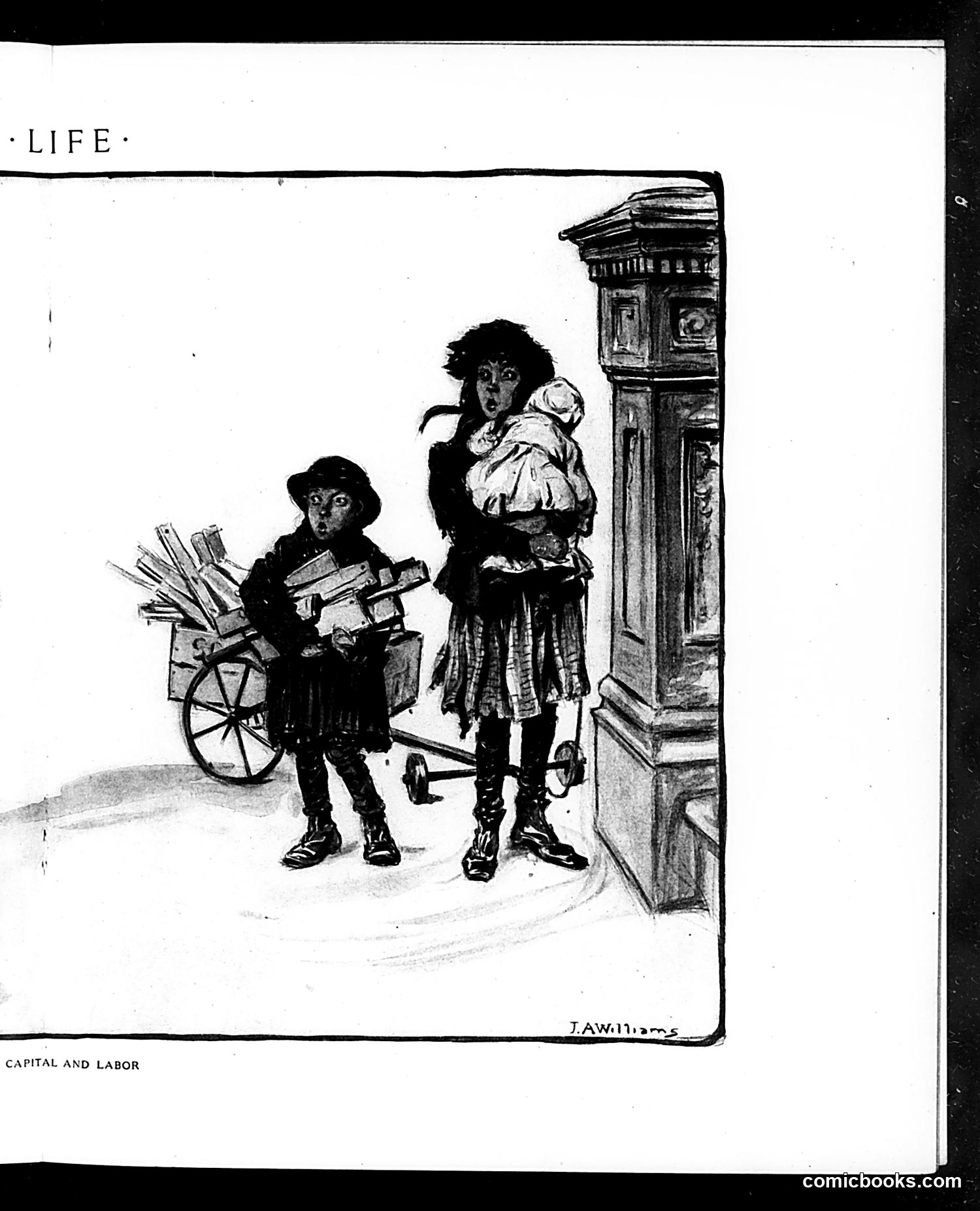
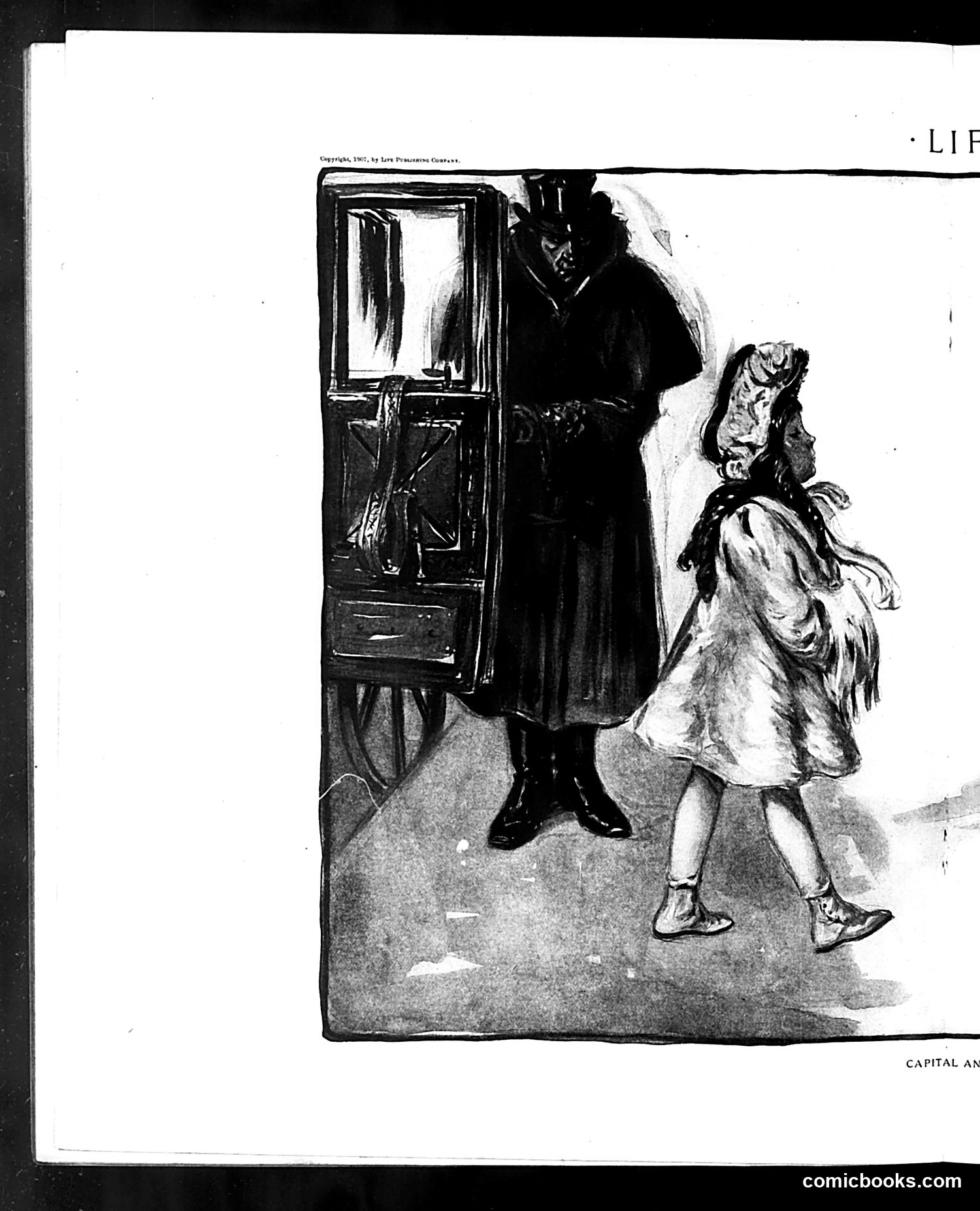
This cartoon by J.A. Williams depicts the tension between capital and labor—a central political conflict of the early 20th century. Two figures representing working-class people (identifiable by their shabby clothing and exhausted expressions) stand at a grand doorway, one carrying wood and supplies. The ornate door suggests wealth and establishment power. The title "Capital and Labor" indicates this illustrates the economic divide: laborers (the poor workers) seeking entry or assistance from those controlling capital (the wealthy represented by the imposing building). The satire critiques how working people were excluded from economic opportunity and power despite their essential contributions. This reflects Progressive Era concerns about income inequality and workers' rights.
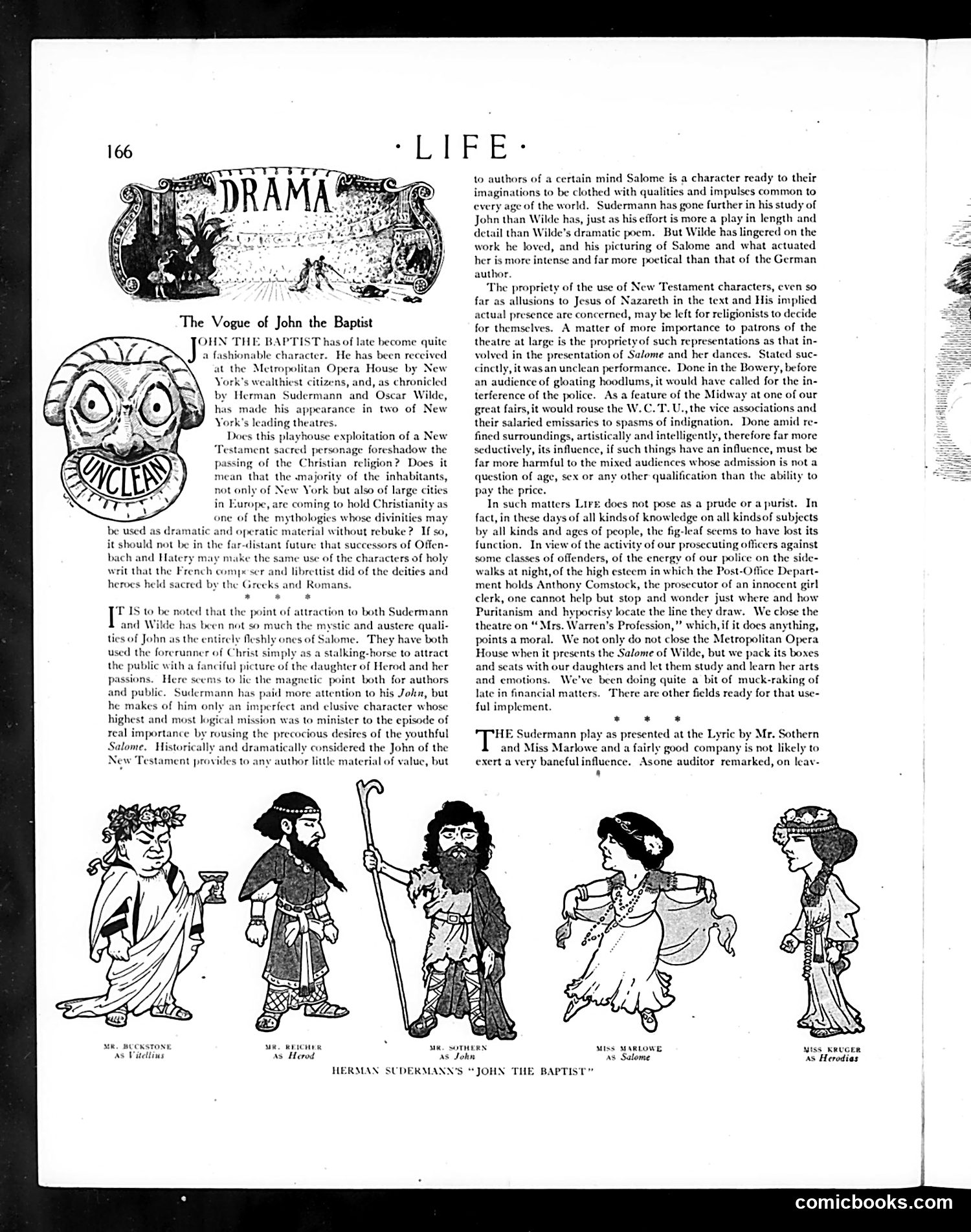
This article critiques the fashionable theatrical treatment of biblical subjects, particularly John the Baptist, by contemporary playwrights Herman Sudermann and Oscar Wilde. The text objects that these dramatists use the Baptist merely as a supporting character to showcase Salome—focusing on her sensuality rather than genuine dramatic or spiritual importance. The five caricatured figures at page bottom represent cast members from Sudermann's "John the Baptist" production, identifying actors by their roles (Mr. Beckstone as Vitellius, Mr. Reicher as Herod, Mr. Sothern as John, Miss Marlowe as Salome, Miss Kruger as Herodias). Life's satire argues that while refined audiences tolerate such "unclean performances" in elite theaters, the same content would face police interference in working-class venues—exposing class hypocrisy. The piece questions whether treating sacred Christian figures as mere dramatic material signals Christianity's declining cultural authority.
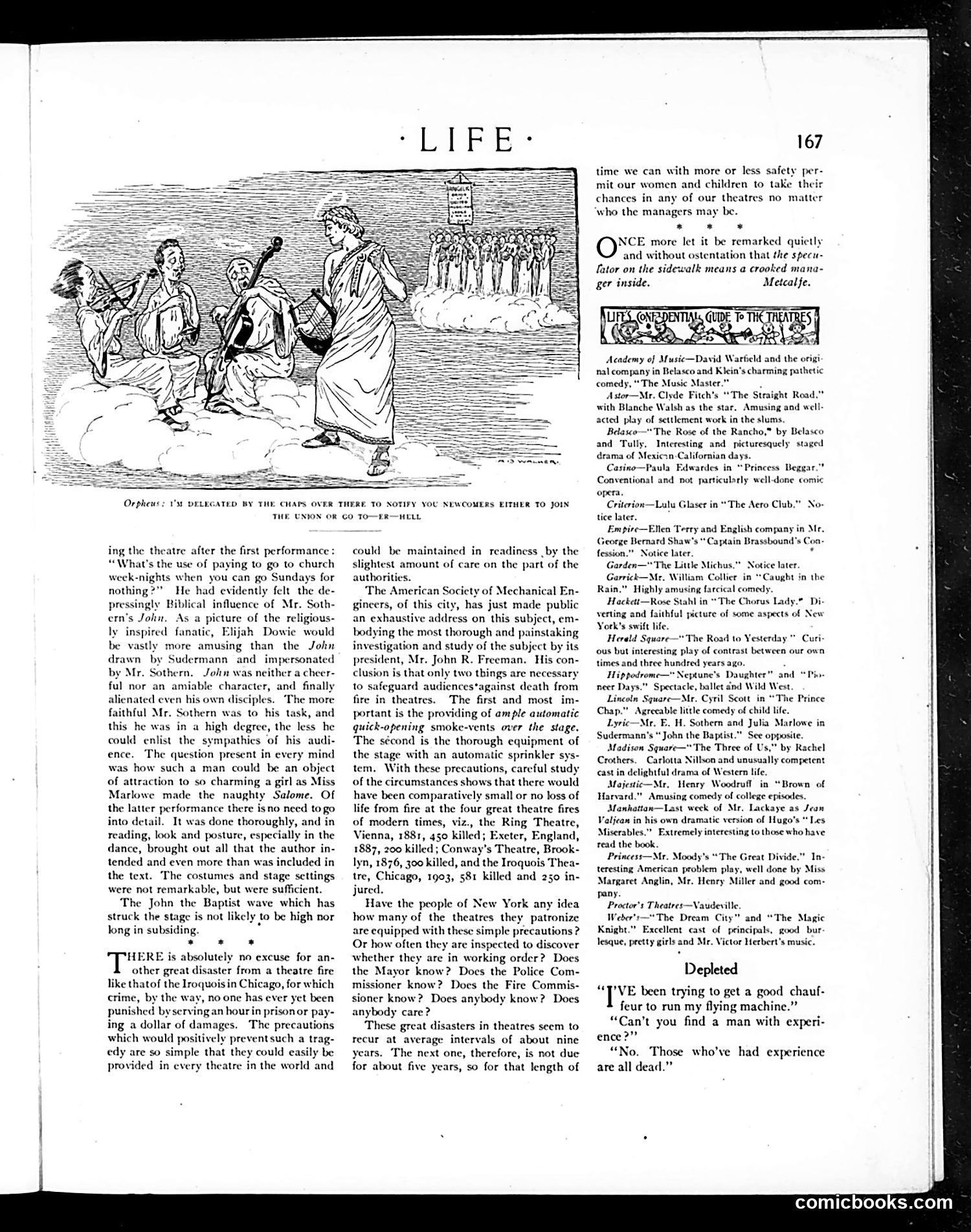
The cartoon depicts the mythological figure Orpheus addressing theatrical newcomers, instructing them to either join the union or face dire consequences ("go to—ER—HELL"). **The Satire:** This is labor-union commentary. The figure of Orpheus—traditionally associated with music and the arts—is recast as a union enforcer delivering what amounts to a coercive ultimatum. The joke targets the aggressive unionization tactics of early 1900s labor organizations in the theater industry, portraying them as intimidating and autocratic. **The Point:** Life magazine is satirizing unions' heavy-handed recruitment methods, suggesting they leave workers little choice but compliance. The mythological reference adds ironic sophistication—reducing the noble Orpheus to a modern-day enforcer underscores the gap between idealized labor advocacy and actual practices. The accompanying text discusses theater safety disasters and moral failings, suggesting Life's broader skepticism toward institutional power, whether theatrical management or labor unions.
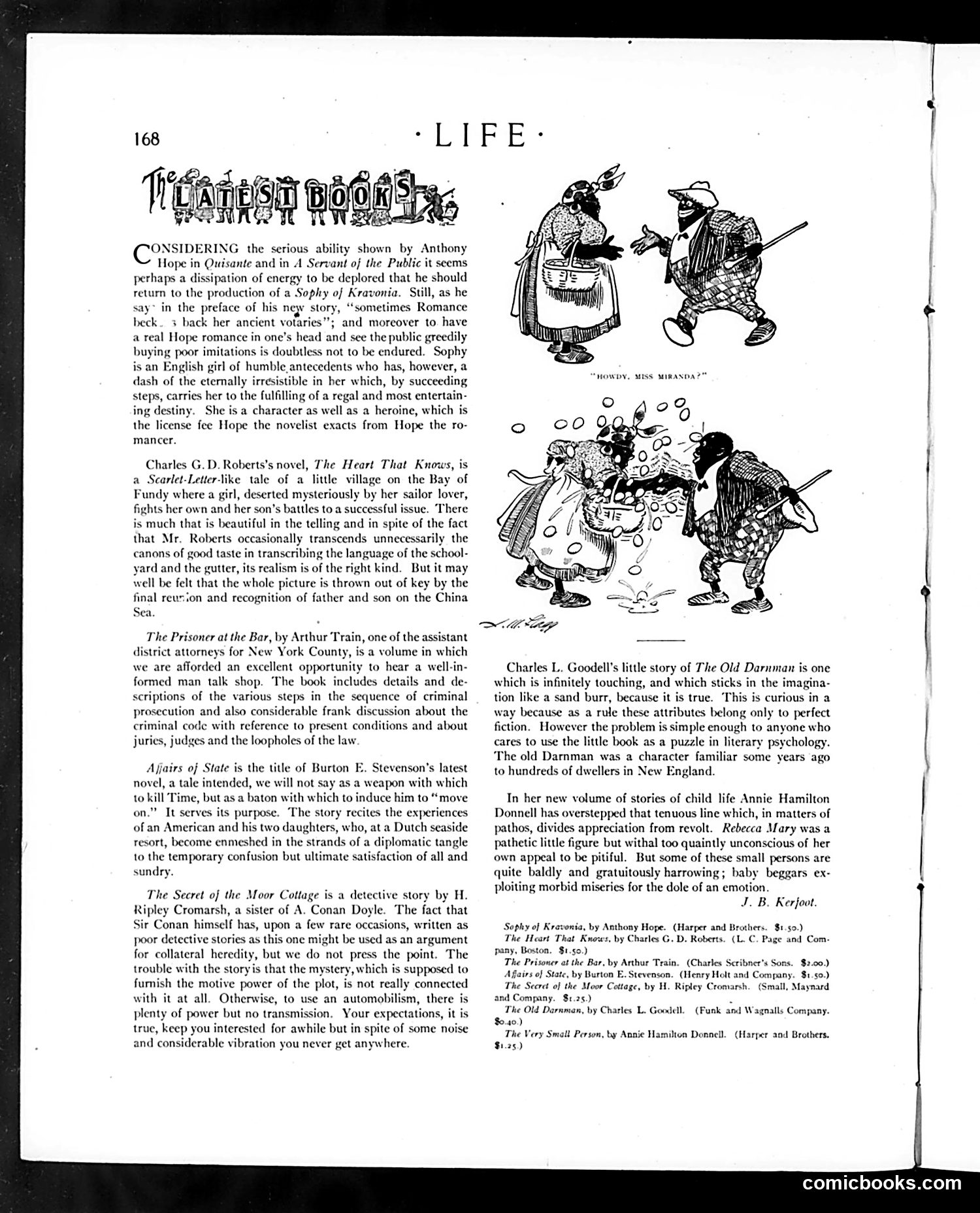
This page features literary reviews and two cartoon illustrations. The top cartoon labeled "Howdy, Miss Miranda?" depicts a man and woman in period costume engaged in conversation—likely illustrating a scene from one of the reviewed novels, possibly from Anthony Hope's romantic fiction discussed in the text. The lower cartoon shows children playing with bubbles, appearing whimsical and innocent—potentially referencing childhood themes in the reviewed books. The page reviews six novels, including works by Anthony Hope (romantic adventure fiction), Charles G.D. Roberts, and Arthur Train (a real New York prosecutor offering insider legal knowledge). The reviewer criticizes H. Ripley Cromarsh's detective story for having an unconnected plot—"plenty of power but no transmission"—a clever automotive metaphor for a story that fails to deliver despite initial promise. The reviews reflect early 1900s literary tastes favoring romance, sentiment, and realism over pure entertainment, with particular appreciation for stories grounded in authentic detail and emotional truth.
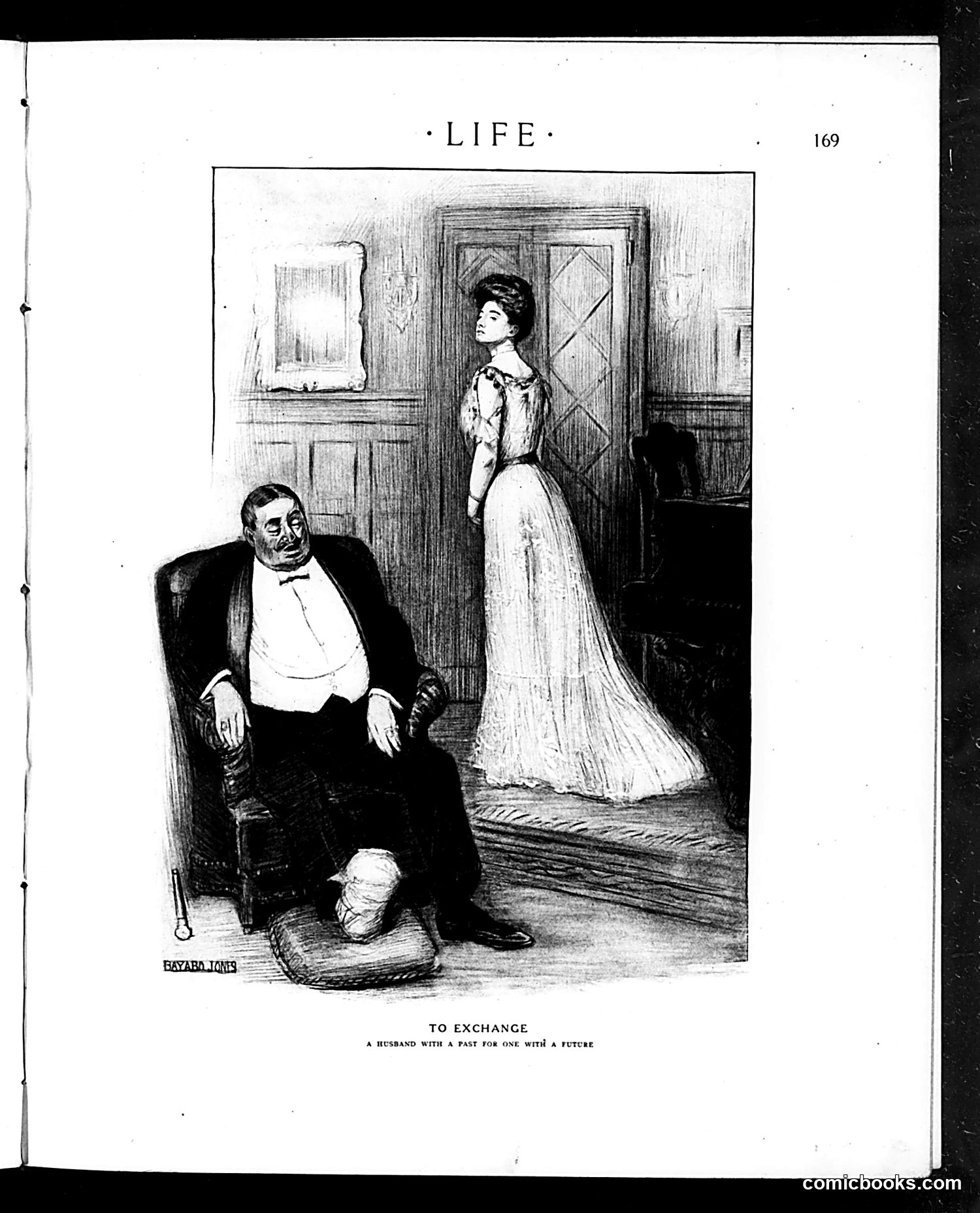
This satirical cartoon depicts a domestic scene with a pointed commentary on marriage and social ambition. A portly, well-dressed man sits dejected in a chair while a fashionable woman stands nearby, gazing upward—suggesting her thoughts elsewhere. The caption's jest—exchanging "a husband with a past for one with a future"—satirizes women's perceived mercenary approach to marriage. The cartoon implies the woman views her current husband as past his prime or usefulness and desires a more promising, upwardly-mobile replacement. This reflects early 20th-century anxieties about changing gender roles, women's agency in marriage, and concerns about materialism. The woman's elegant, trailing gown and composed posture contrast with the man's slumped resignation, emphasizing the power dynamic the cartoonist presents as absurdly reversed.
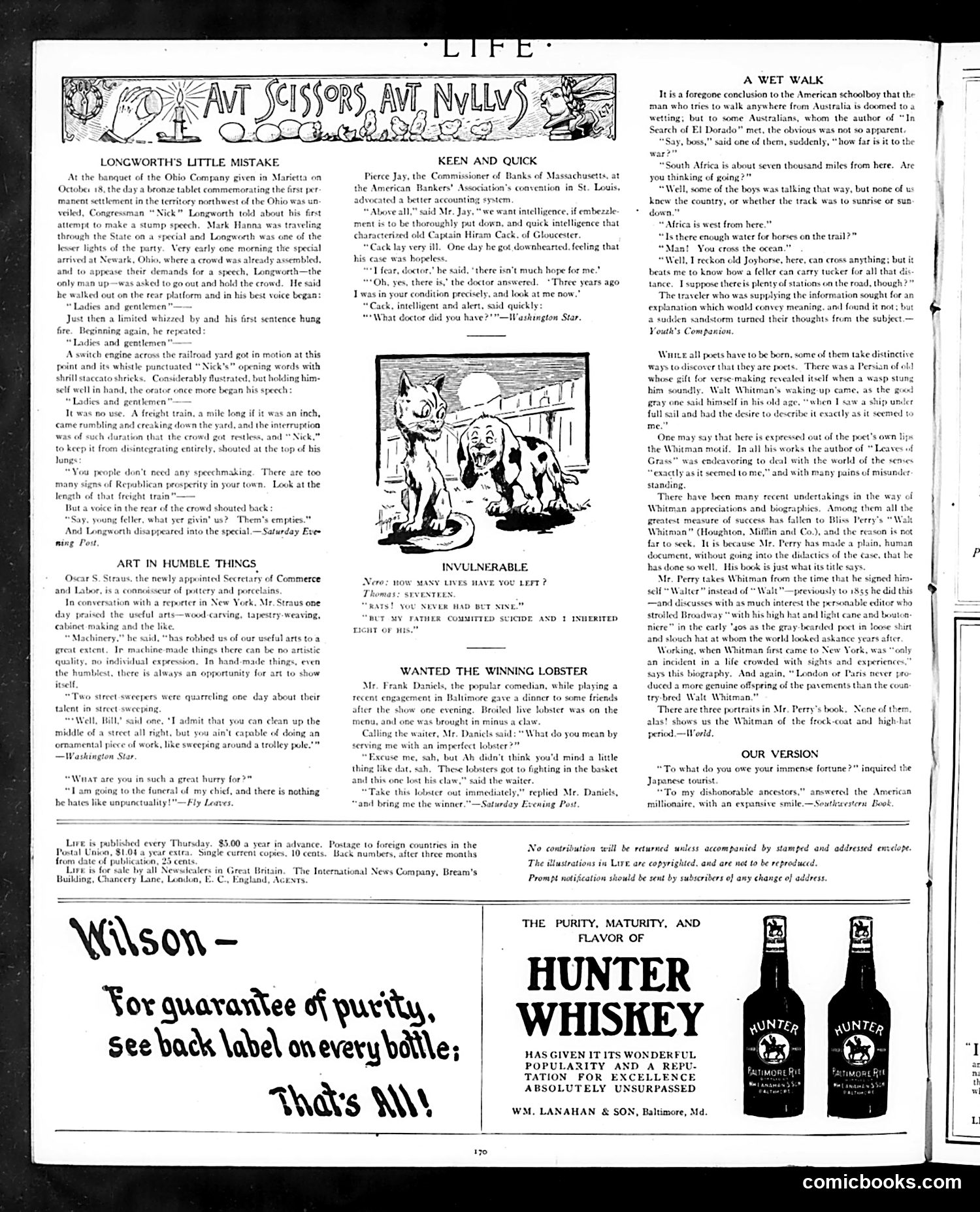
This page contains three humorous anecdotes rather than political cartoons: 1. **"Longworth's Little Mistake"**: A story mocking Nicholas Longworth (Ohio Congressman, son-in-law of Theodore Roosevelt) attempting a campaign speech in Newark, Ohio. Repeated railroad train whistles interrupt him, making his opening line—"Ladies and gentlemen"—the only words he manages before chaos drowns him out. The satire targets politicians' difficulty adapting to unexpected obstacles. 2. **"Art in Humble Things"**: Features Secretary of Commerce Oscar Straus discussing whether machine-made goods have destroyed craftsmanship, with anecdotes about street sweepers debating artistic talent. 3. **"Keen and Quick"**: A banker anecdote about diagnosing financial problems swiftly. The page includes period advertisements (Wilson whiskey, Hunter whiskey) and appears designed primarily as comedic content for educated readers familiar with current political figures.
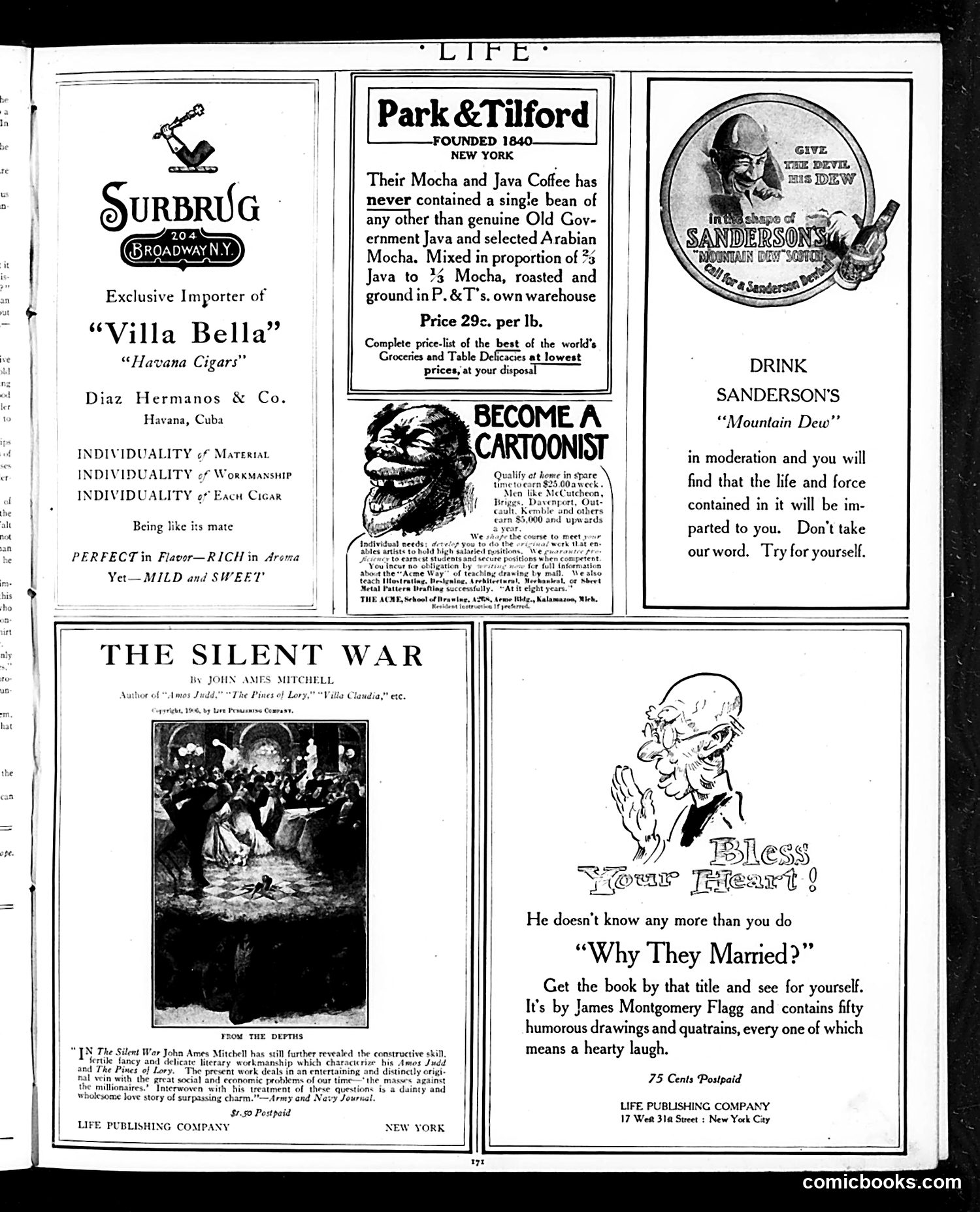
This is primarily an **advertising page** from Life magazine, circa 1906 (based on copyright notice). It contains: **Key Advertisements:** - Surbrug cigars (Havana imports) - Park & Tilford coffee - Sanderson's "Mountain Dew" (appears to be an alcoholic beverage, advertised with health claims typical of the era) - A "Become a Cartoonist" correspondence school ad - Book advertisements for "The Silent War" by John Ames Mitchell and "Why They Married?" by James Montgomery Flagg **The Cartoons:** The page features minimal editorial cartooning—mainly decorative illustrations supporting advertisements. The Sanderson's ad includes a caricatured face (possibly meant to suggest vigor/vitality from the product). The "Why They Married?" book advertisement includes a simple cartoon head. **Historical Context:** This reflects early 1900s advertising practices: health/vigor claims for alcohol, mail-order instruction, and heavy reliance on visual appeal. The page demonstrates Life's dual role as both satirical publication and advertising vehicle.
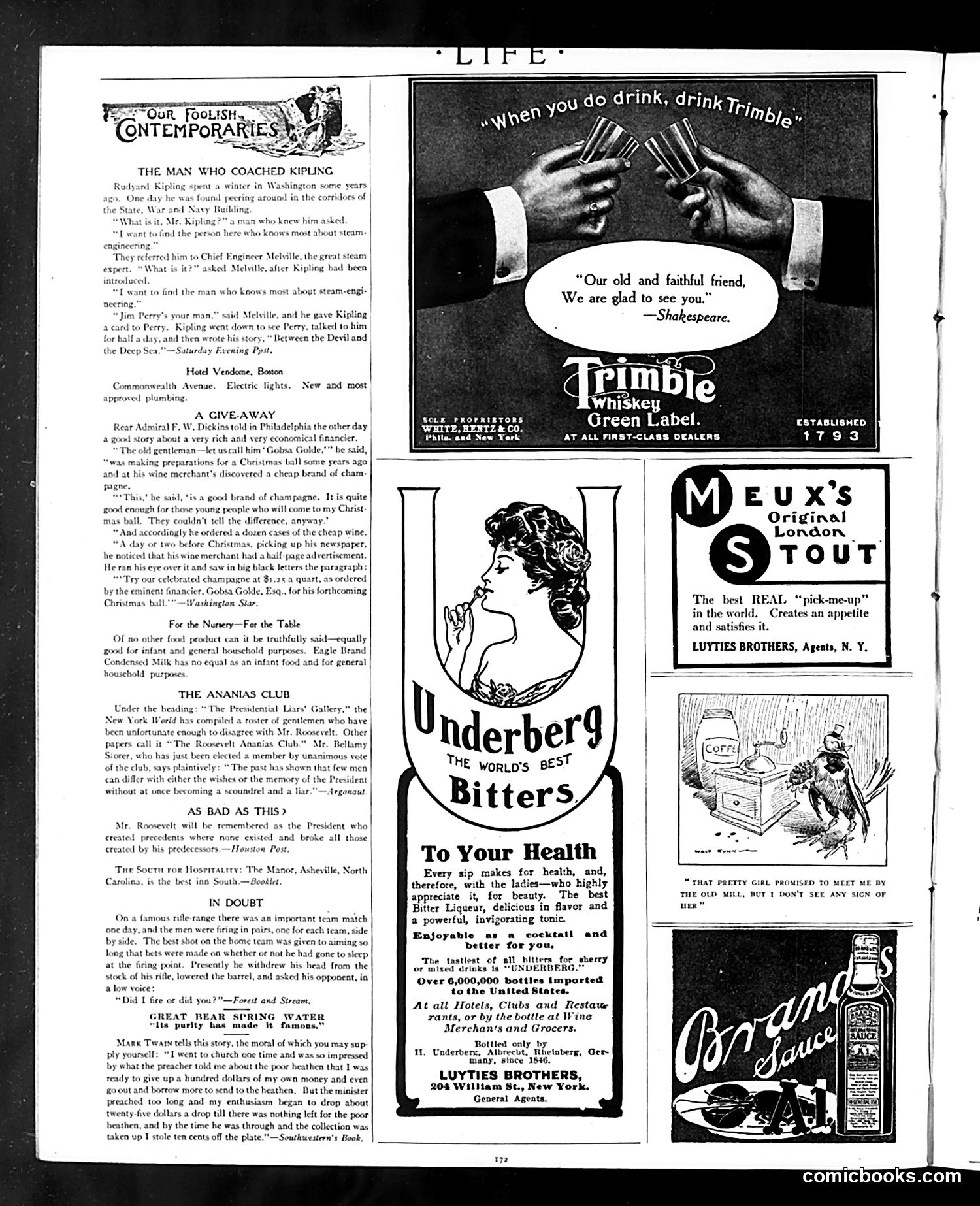
This page mixes humor columns with period advertisements. The left side contains three anecdotes: 1. **"The Man Who Coached Kipling"**: A story about author Rudyard Kipling seeking expertise on steam engineering in Washington—satirizing the notion that even famous writers need to consult specialists. 2. **"A Give-Away"**: An Admiral tells of a wealthy but stingy financier who ordered cheap champagne for a Christmas ball, then saw his own advertisement in the newspaper praising that exact champagne at $1.25/quart—mocking his false economy and exposed hypocrisy. 3. **"The Ananias Club"**: References President Theodore Roosevelt's practice of publicly attacking those who disagreed with him, labeling them liars (after Ananias from the Bible). The satire criticizes how Roosevelt created a climate where dissent equaled dishonesty. The right side features period alcohol advertisements (Trimble Whiskey, Meux's Stout, Underberg Bitters) with Shakespeare quotes and health claims—typical early 1900s marketing before such advertising regulations existed.
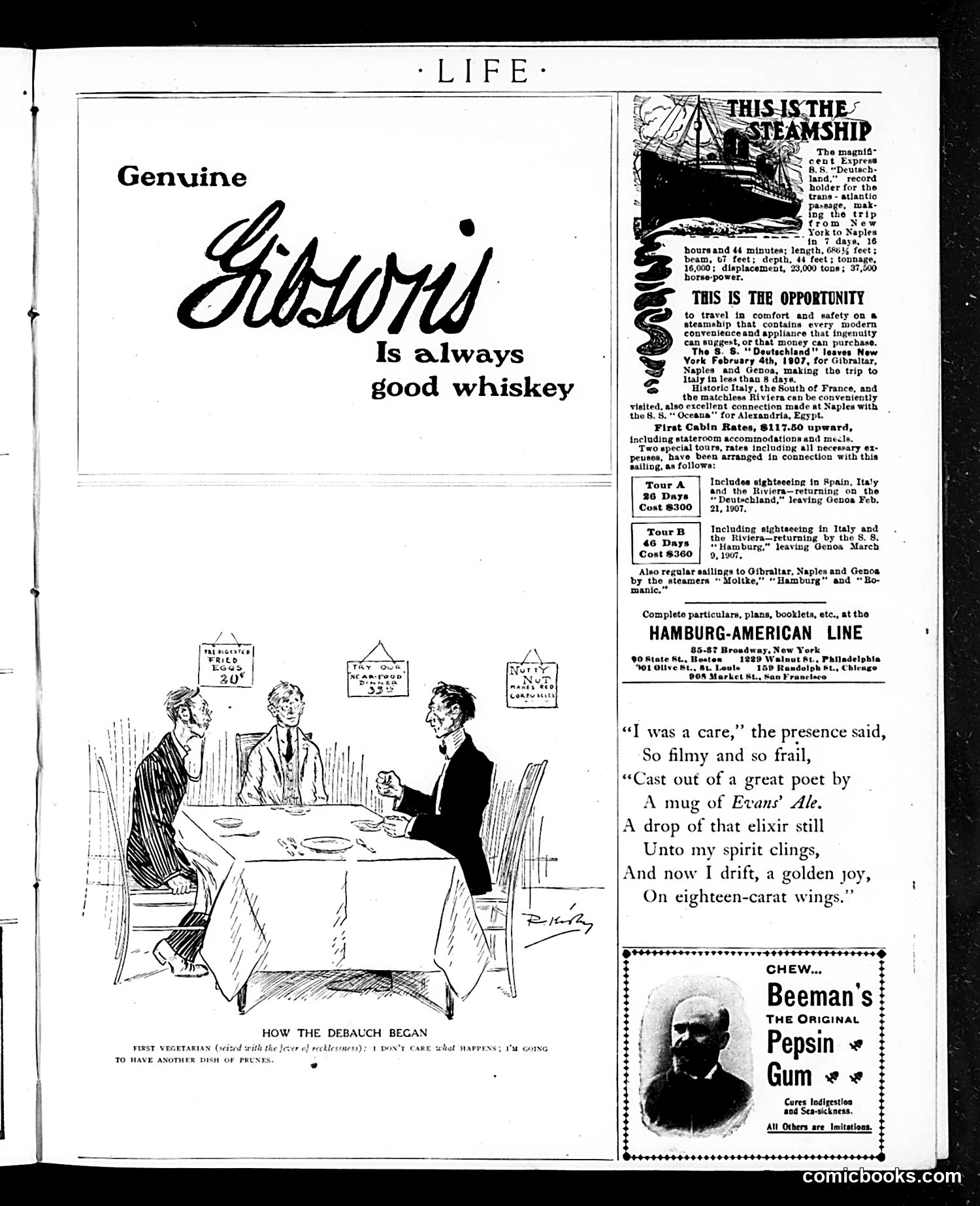
This page is primarily **advertisements** mixed with satirical content. The main cartoon, titled "How the Debauch Began," depicts three men at a dinner table. The caption explains that a strict vegetarian, recklessly abandoning his dietary principles, declares he'll order another dish of prunes—satirizing how even small moral compromises can lead to excess. The humor plays on Victorian-era anxieties about self-control and dietary virtue. The "debauch" is ironic: merely eating prunes (a modest indulgence) represents moral failure to the vegetarian, yet he's resigned to inevitable descent. The page also advertises Gerson's whiskey ("always good whiskey"), a Hamburg-American Line steamship cruise, and Beeman's Pepsin Gum. The accompanying poem about "Evans' Ale" romanticizes alcohol as spiritual transcendence—typical period advertising rhetoric. The overall effect satirizes both the era's dietary fads and how advertising exploited anxieties about indulgence and respectability.
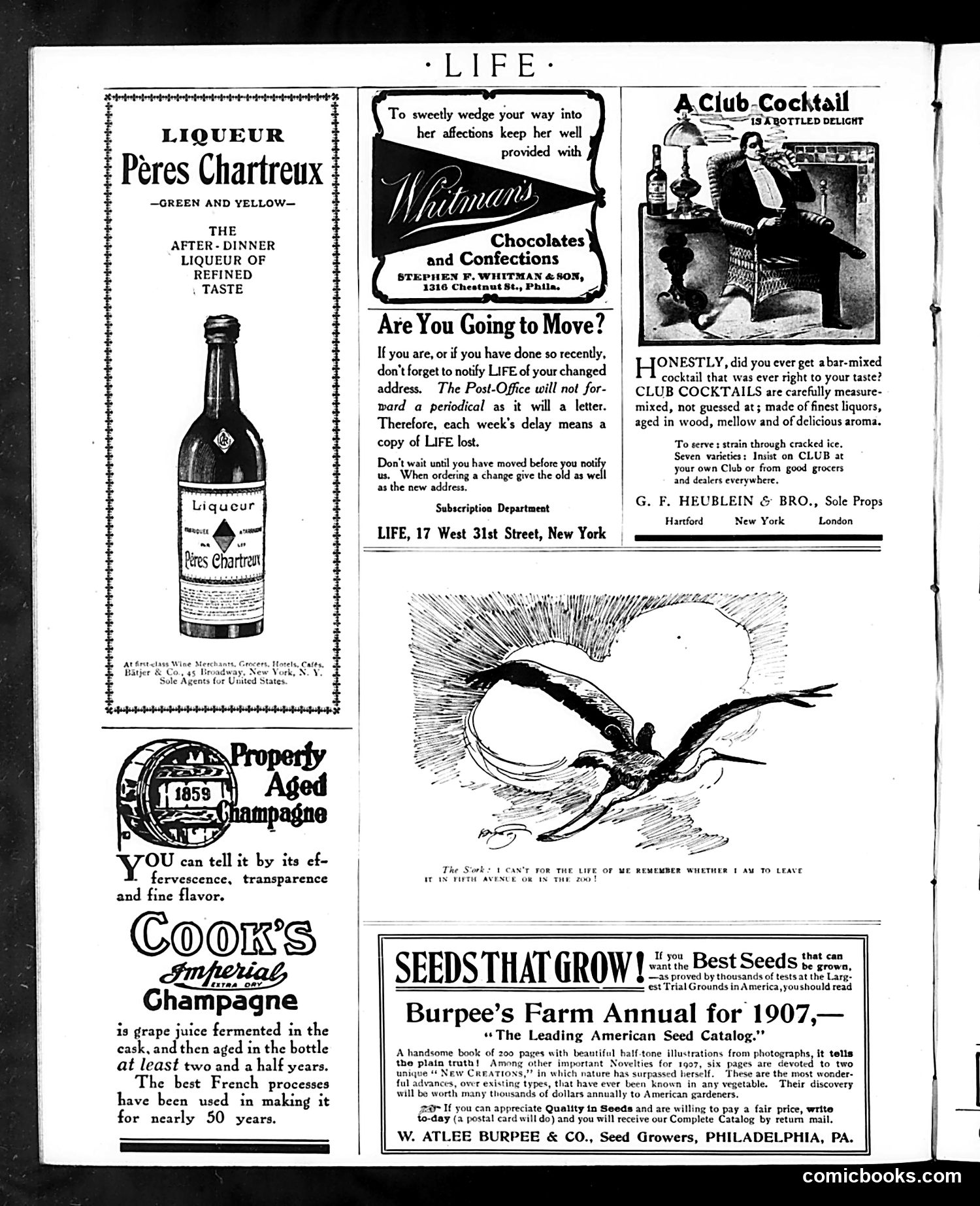
This is primarily an **advertising page** with one small cartoon. The main content comprises product advertisements for liqueurs, chocolates, champagne, cocktails, and seeds—typical of early 1900s magazines. The single cartoon depicts **a stork carrying a baby**, with the stork appearing confused about delivery instructions ("I can't for the life of me remember whether I am to leave it fifth avenue or in the zoo!"). This is a **gentle joke about urban versus rural births**—playing on the era's common "stork delivers babies" mythology while satirizing the contrast between wealthy Fifth Avenue addresses and the zoo, suggesting either absurdity or commentary on different social classes. The page otherwise shows no political content—it's a commercial product page typical of Life's mixed editorial-advertising format in the early 20th century. The humor is domestic and whimsical rather than satirical.
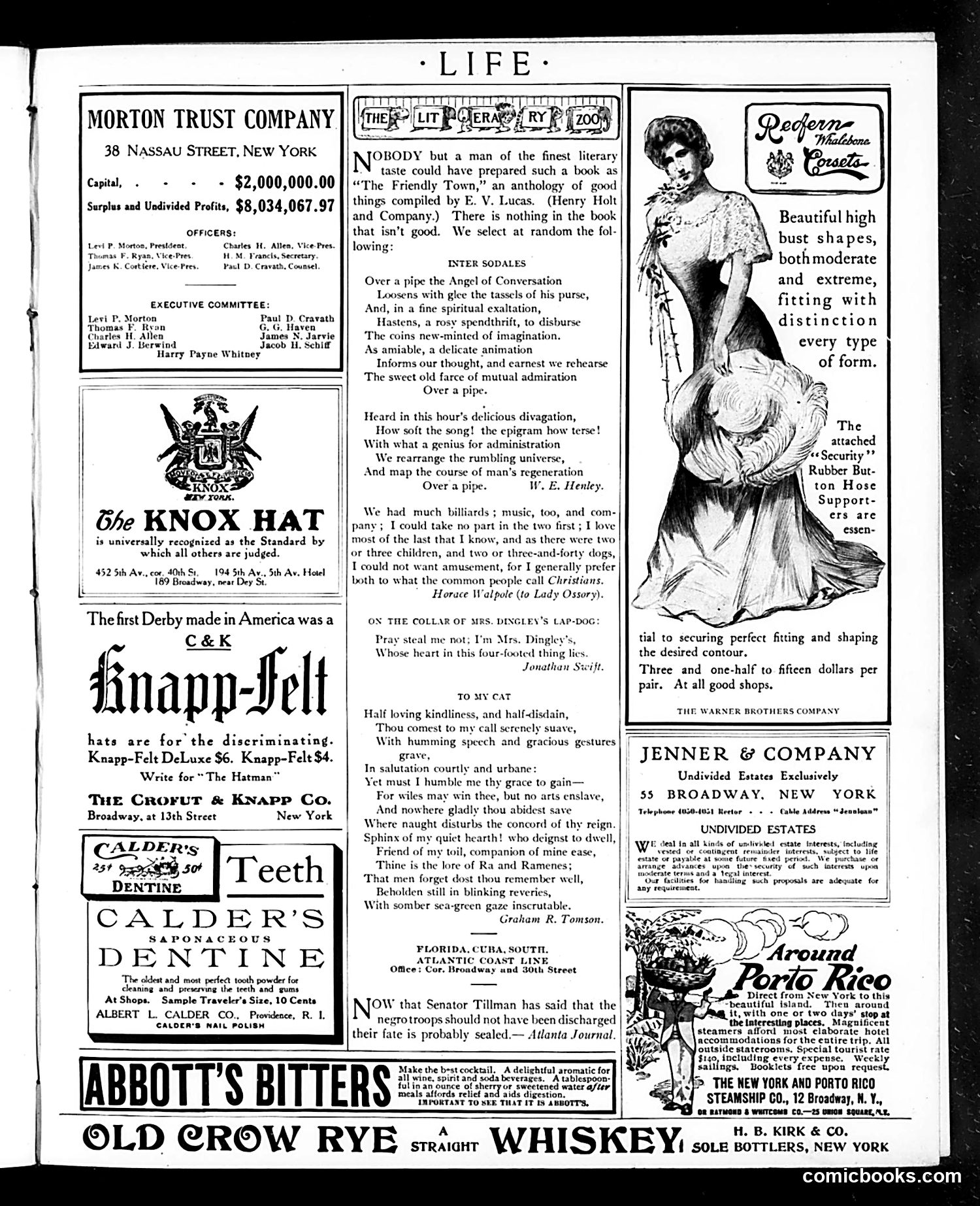
This page is primarily **advertising and literary content**, not political satire. The main featured content is "The Literary Cry" section, which showcases poetry and prose excerpts from E.V. Lucas's anthology "The Friendly Town." These include poems about friendship, cats, and pipes by authors like W.E. Henley and Graham R. Tomson—genteel, leisurely Victorian/Edwardian verse celebrating intellectual companionship and domestic life. The one political reference appears in a brief item about **Senator Tillman** (South Carolina politician known for racist views), reporting that since he stated discharged Black soldiers "should not have been discharged," their fate is "probably sealed"—suggesting his opposition would lead to their mistreatment. The rest of the page consists of advertisements for financial services (Morton Trust Company), hats (Knox Hat, Knapp-Felt), dental products (Calder's Dentine), and travel services (Florida/Cuba steamship line).
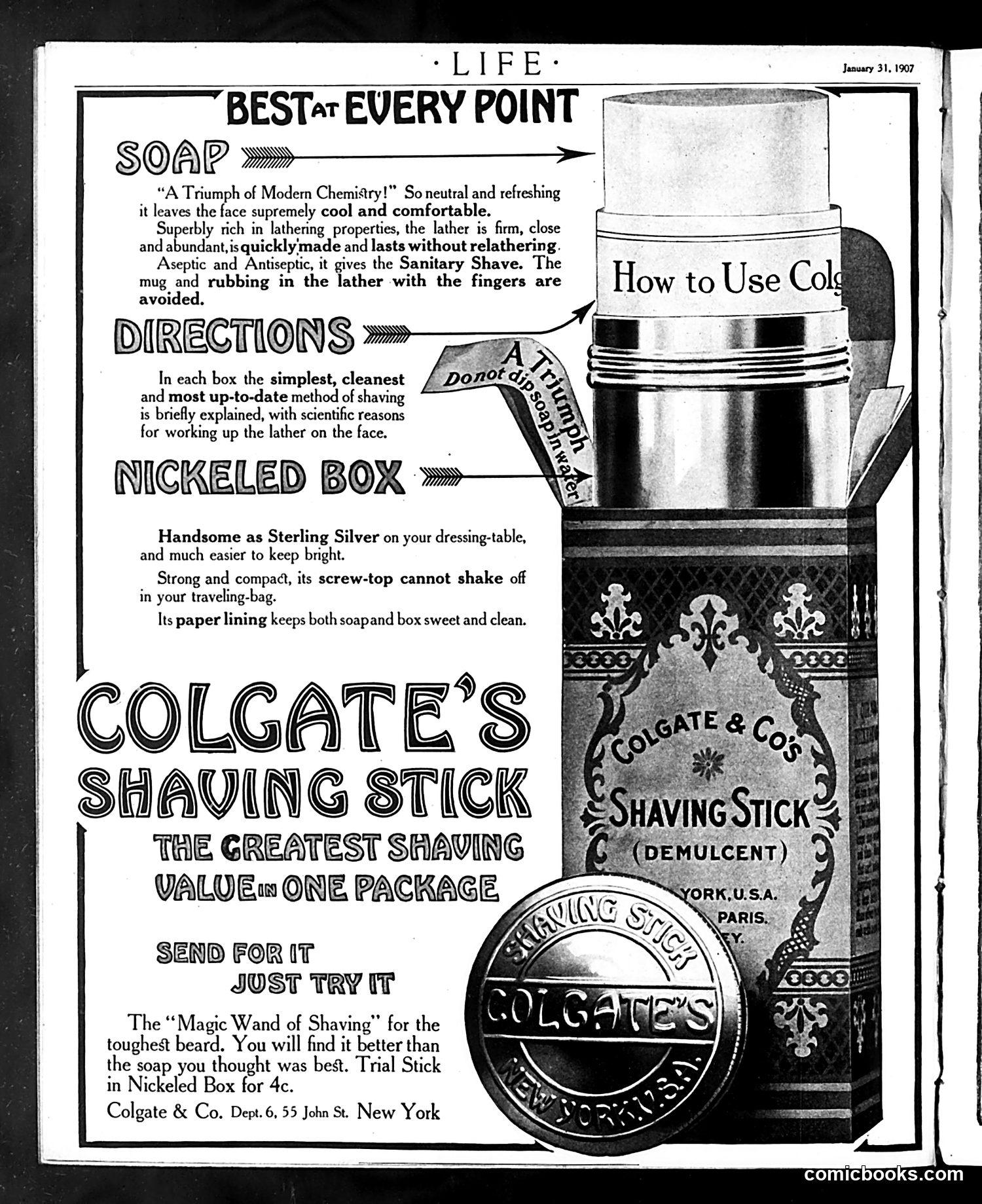
This is a **straightforward advertisement**, not satire or political commentary. It's a 1907 product promotion for Colgate's Shaving Stick in *Life* magazine. The ad emphasizes modern "chemistry" and convenience—key selling points of the era. It highlights that the product is: - **Sanitary and antiseptic** (reflecting early-1900s anxiety about germs) - **Self-contained** in a nickeled box (no messy mug required) - **Portable** for travelers - **Superior** to traditional soap for difficult beards The language ("Magic Wand," "greatest value in one package") uses hyperbolic marketing typical of the period. The accompanying product image shows an attractive cylindrical container designed to appeal to middle-class men concerned with hygiene and grooming standards. There are no caricatures or political references—this is purely commercial advertising targeting men's personal care through appeals to modernity, cleanliness, and practicality.