
Life, 1907-01-31 · page 6 of 24
Life — January 31, 1907 — page 6: what you’re looking at
What you’re looking at
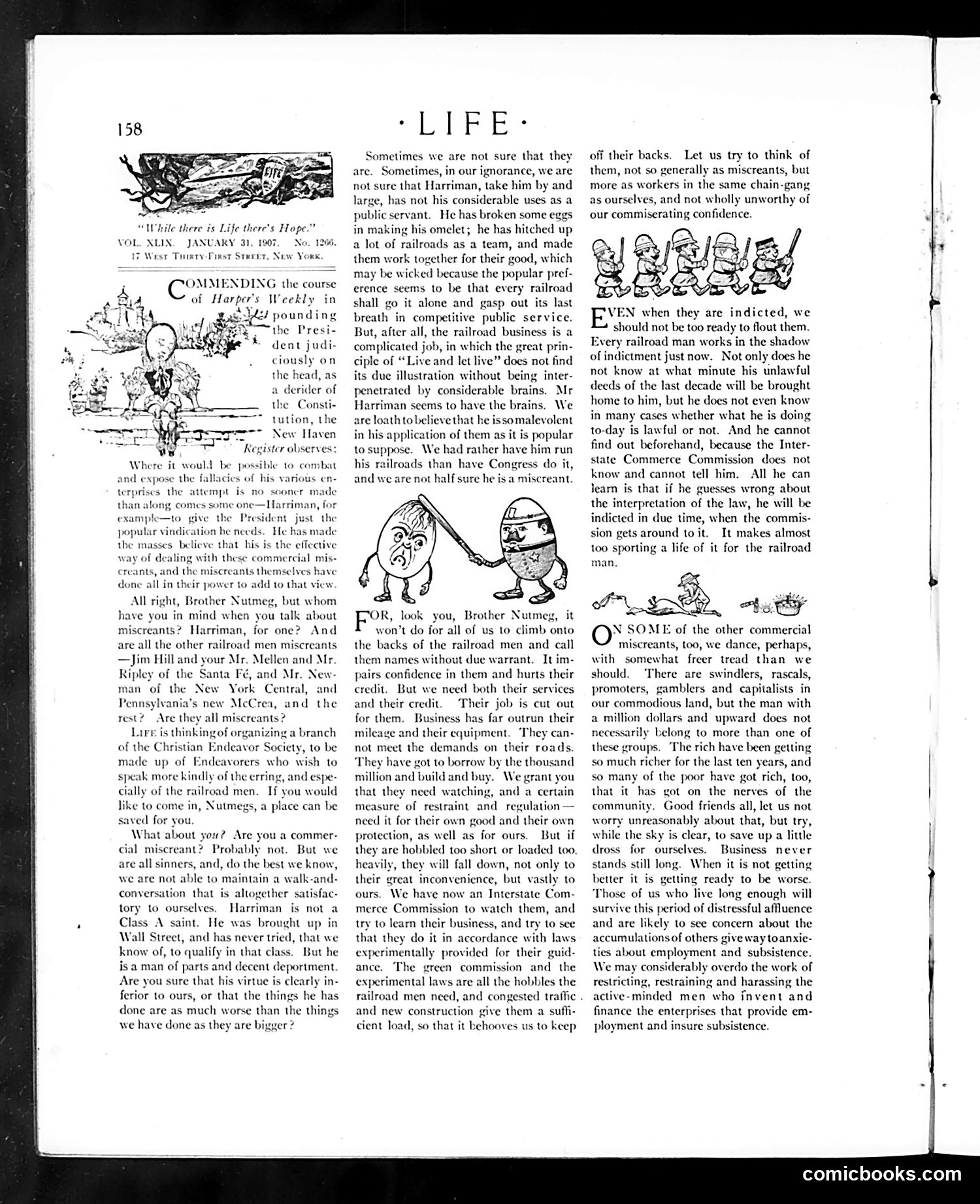
This page satirizes railroad businessmen and the Interstate Commerce Commission (ICC). The text defends railroad executives against characterization as "miscreants," arguing they operate under complicated, poorly understood regulations that make lawful compliance uncertain. The cartoon shows two rotund figures labeled "Brother Nutmeg" engaging in physical conflict, likely representing competing railroad interests or business disputes. The illustration emphasizes the absurdity of blaming railroad men when the ICC's own experimental laws create confusion about what's legally required. The broader argument: rather than condemning railroad operators, society should recognize that ambiguous regulatory frameworks—not malice—cause problems. The ICC itself needs clearer rules to prevent the very abuses it's meant to police. The satire targets regulatory overreach and vague legislation as the true culprits.
📄 Transcribed text from this page (OCR, searchable)
Machine-transcribed from the original scan — historical spelling and the odd misread are preserved.
“While there is Life there's Hope. VOL. XLIX. JANUARY 3), 1907, No. 17 West Turety- First Street, New York. j COMMENDING the course ; f Harper's Weekly in SL) pounding IG the Presi- dent judi- ciously on the head, as a derider of the Consti- tution, the ss TA7 New Haven We ol Kegister observes: eit would be possible to combat and expose the fallacies of his various en- tery than along comes some one—Harriman, for example—to give the President just the popular vindication he needs. He has made the masses believe that his is the effective wa pt is no sooner made ises the att with these commercial mis- of dealin; creants, and the miscreants themselves have done all in their power to add to that view All right, Brother Nutmeg, but whom have you in mind when you talk about miscreants? Harriman, for one? And e all the other railroad men miscreants —Jim Hill and your Mr. Mellen and Mr. Ripley of the Santa Fé, and Mr. New- man of the New York Central, and Pennsylvania's new McCrea, and the rest? Are they all miscreants? Lire is thinking of organizing a branch of the Christian Endeavor Society, to be made up of Endeavorers who wish to speak more kindly of the erring, and espe- cially of the railroad men. If you would like to come in, Nutmegs, a place can be saved for you. What about you? Are you a commer: cial miscreant? Probably not. But we are all sinners, and, do the best we know, we are not able to maintain a walk-and- conversation that is altogether satisfac- tory to ourselves. Harriman is not a Class A saint. He was brought up in Wall Street, and has never tried, that we know of, to qualify in that class. But he is a man of parts and decent deportment Are you sure that his virtue is clearly in- ferior to ours, or that the things he has done are as much worse than the things we have done as they are bigger? 2 LP Sometimes we are not sure that they are. Sometimes, in our ignorance, we are not sure that Harriman, take him by and large, has not his considerable uses as a public servant. He has broken some eg in making his omelet; he has hitched up a lot of railroads as a team, and made them work together for their good, which may be wicked because the popular pref- erence seems to be that every railroad shall go it alone and gasp out its last breath in competitive public service. But, after all, the railroad business is complicated job, in which the great prin- ciple of “Live and let live” does not find its due illustration without being inter- penetrated by considerable brains. Mr Harriman seems to have the brains. We are loath to believe that he issomalevolent in his application of them as it is popular to suppose. We had rather have him run his railroads than have Congress do it, and we are not half sure he is a miscreant. ‘OR, look you, Brother Nutmeg, it won't do for all of us to climb onto the backs of the railroad men and call them names without due warrant. It im- pairs confidence in them and hurts their credit. But we need both their services and their credit. Their job is cut out for them. Business has far outrun their mileage and their equipment. ‘They can- not meet the demands on their roads. They have got to borrow by the thousand million and build and buy. We grant you that they need watching, and a certain measure of restraint and regulation — need it for their own good and their own protection, as well as f for ours. But if they are hobbled too short or loaded too, heavily, they will fall down, not only to their great inconvenience, but vastly to ours. We have now an Interstate Com- merce Commission to watch them, and try to learn their business, and try to see that they do it in accordance with laws experimentally provided for their guid- ance. The green commission and the experimental laws are all the hobbles the railroad men need, and congested traffic and new construction give them a sufli- cient load, so that it behooves us to keep off their backs. Let us try to think of them, not so generally as miscreants, but more as workers in the same chain-gang as ourselves, and not wholly unworthy of our commiserating confidence. VEN when they are indicted, we should not be too ready to flout them. Every railroad man works in the shadow of indictment just now. Not only does he not know at what minute his unlawful deeds of the last decade will be brought home to him, but he does not even know in many cases whether what he is doing to-day is lawful or not. And he cannot find out beforehand, because the Inter- state Commerce Commission does not know and cannot tell him. All he can learn is that if he guesses wrong about the interpretation of the law, he will be indicted in due time, when the commis- sion gets around to it. It makes almost too sporting a life of it for the railroad man, POD, hy N SOME of the other commercial miscreants, too, we dance, perhaps, with somewhat freer tread than we should. here are swindlers, rascals, promoters, gamblers and capitalists in our commodious land, but the man with a million dollars and upward does not necessarily belong to more than one of these groups. The rich have been getting so much richer for the last ten years, and so many of the poor have got rich, too, that it has got on the nerves of the community. Good friends all, let us not worry unreasonably about that, but try, while the sky is clear, to save up a little dross for ourselves. Business never stands still long. When it is not getting better it is getting ready to be worse. Those of us who live long enough will survive this period of distressful afluence and are likely to see concern about the accumulations of others give way toanxie- ties about employment and subsistence. We may considerably overdo the work of restricting, restraining and harassing the tive-minded men who invent and finance the enterprises that provide em- ployment and insure subsistence. comicbooks.com