
Life, 1907-01-31 · page 9 of 24
Life — January 31, 1907 — page 9: what you’re looking at
What you’re looking at
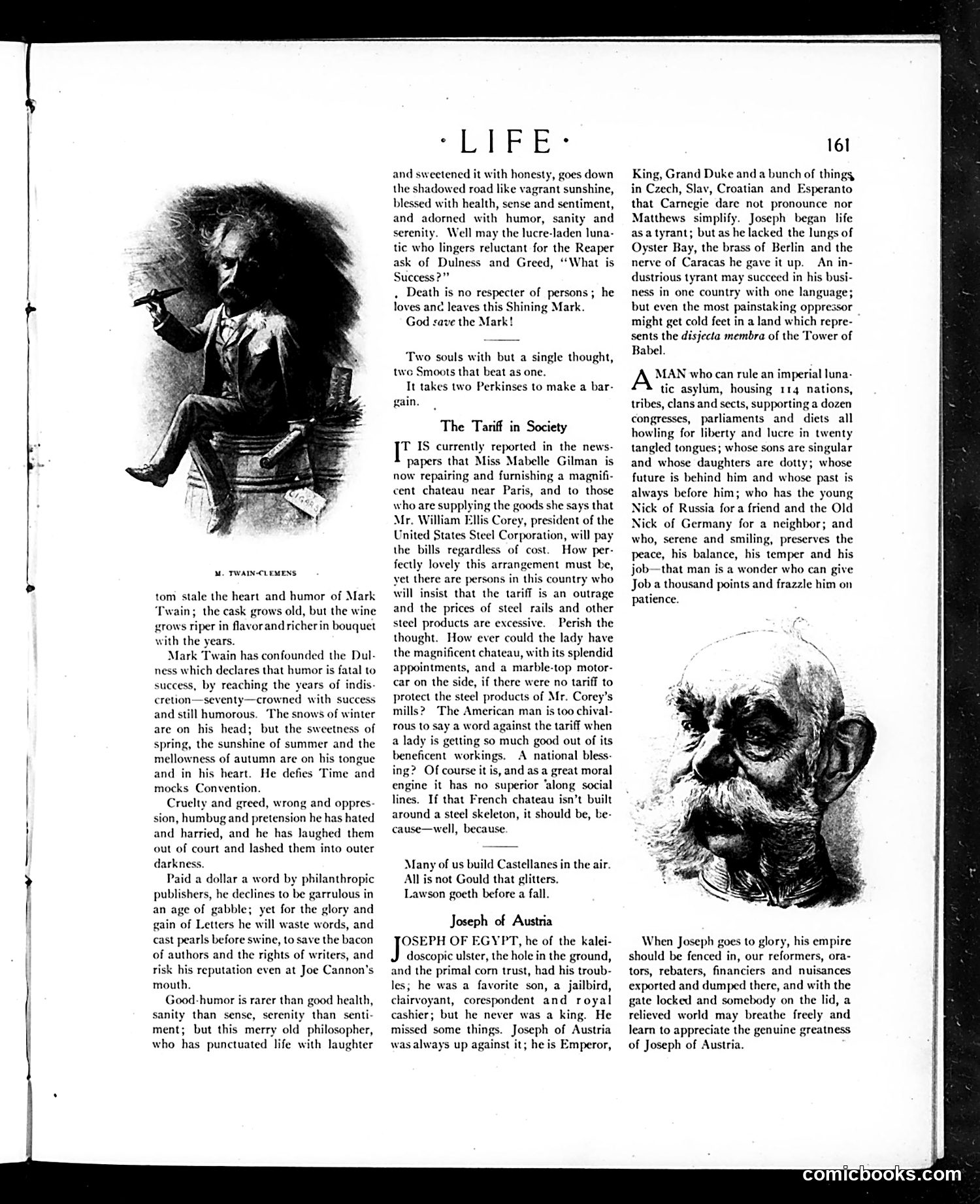
This page contains two illustrations by M. Twain-Clemens (likely a pen name) accompanying satirical commentary. The upper sketch depicts an elderly man in period dress, appearing to represent a figure of authority or privilege. The text discusses Mark Twain's use of humor to critique social hypocrisy, cruelty, and greed. A section titled "The Tariff in Society" satirizes wealthy industrialists (specifically referencing William Ellis Corey of U.S. Steel) who profit from protective tariffs while ordinary citizens bear the cost. The satire argues this represents moral corruption disguised as economic policy. A separate article on "Joseph of Austria" appears below, though its specific satirical target is unclear from this excerpt alone. The overall page exemplifies Life magazine's tradition of using wit to expose upper-class pretension and economic injustice.
📄 Transcribed text from this page (OCR, searchable)
Machine-transcribed from the original scan — historical spelling and the odd misread are preserved.
M. TWAIN-CLEMENS tom stale the heart and humor of Mark ‘Twain; the cask grows old, but the wine grows riper in flavorand richer in bouquet with the years. Mark Twain has confounded the Dul- ness which declares that humor is fatal to success, by reaching the years of indis- cretion—seventy—crowned with success and still humorous. The snows of winter are on his head; but the sweetness of spring, the sunshine of summer and the mellowness of autumn are on his tongue and in his heart. He defies Time and mocks Convention. Cruelty and greed, wrong and oppres- sion, humbug and pretension he has hated and harried, and he has laughed them out of court and lashed them into outer darkness. Paid a dollar a word by philanthropic publishers, he declines to be garrulous in an age of gabble; yet for the glory and gain of Letters he will waste words, and cast pearls before swine, to save the bacon of authors and the rights of writers, and risk his reputation even at Joe Cannon's mouth, Good-humor is rarer than good health, sanity than sense, serenity than senti- ment; but this merry old philosopher, who has punctuated life with laughter «LIFE and sweetened it with honesty, goes down the shadowed road like vagrant sunshine, blessed with health, sense and sentiment, and adorned with humor, sanity and serenity. Well may the lucre-laden luna- tic who lingers reluctant for the Reaper ask of Dulness and Greed, “What is Success?” . Death is no respecter of persons; he loves anc leaves this Shining Mark. God save the Mar Two souls with but a single thought, Smoots that beat as one. It takes two Perkinses to make a bar- gain. ry The Tariff in Society r IS currently reported in the new: papers that Miss Mabelle Gilman is now repairing and furnishing a magnifi- cent chateau near Paris, and to those who are supplying the goods she says that Mr. William Ellis Corey, president of the United States Steel Corporation, will pay the bills regardless of cost. How per- fectly lovely this arrangement must be, yet there are persons in this country who will insist that the tariff is an outrage and the prices of steel rails and other steel products are excessive. Perish the thought. How ever could the lady have the magnificent chateau, with its splendid appointments, and a marble-top motor- car on the side, if there were no tariff to protect the steel products of Mr. Corey’s mills? The American man is too chival- rous to say a word against the tariff when a lady is getting so much good out of its beneficent workings. A national bless- ing? Of course it is, and as a great moral engine it has no superior ‘along social lines. If that French chateau isn’t built around a steel skeleton, it should be, be- cause—well, because. Many of us build Castellanes in the air. All is not Gould that glitters. Lawson goeth before a fall. Joseph of Austria OSEPH OF EGYPT, he of the kalei- doscopic ulster, the hole in the ground, and the primal corn trust, had his troub- les; he was a favorite son, a jailbird, clairvoyant, corespondent and royal cashier; but he never was a king. He missed some things. Joseph of Austria was always up against it; he is Emperor, 161 King, Grand Duke anda bunch of things, in Czech, Slav, Croatian and that Carnegie dare not pronounce nor Matthews simplify. Joseph began life asatyrant; butas he lacked the lungs of Oyster Bay, the brass of Berlin and the nerve of Caracas he gave it up. An in- dustrious tyrant may succeed in his bus ness in one country with one language; but even the most painstaking oppressor might get cold feet in a land which repre- sents the disjecta membra of the Tower of Babel AYMAN who can rule an imperial luna- tic asylum, housing 114 nations, tribes, clans and sects, supporting a dozen congresses, parliaments and diets all howling for liberty and lucre in twenty tangled tongues; whose sons are singular and whose daughters are dotty; whose future is behind him and whose past is. always before him; who has the young Nick of Russia fora friend and the Old Nick of Germany for a neighbor; and who, serene and smiling, preserves the peace, his balance, his temper and his job—that man is a wonder who can give Job a thousand points and frazzle him on patience. When Joseph goes to glory, his empire should be fenced in, our reformers, ora- exported and dumped there, and with the gate locked and somebody on the lid, a relieved world may breathe freely and learn to appreciate the genuine greatness of Joseph of Austria. comicbooks.com