
Life, 1907-01-31 · page 15 of 24
Life — January 31, 1907 — page 15: what you’re looking at
What you’re looking at
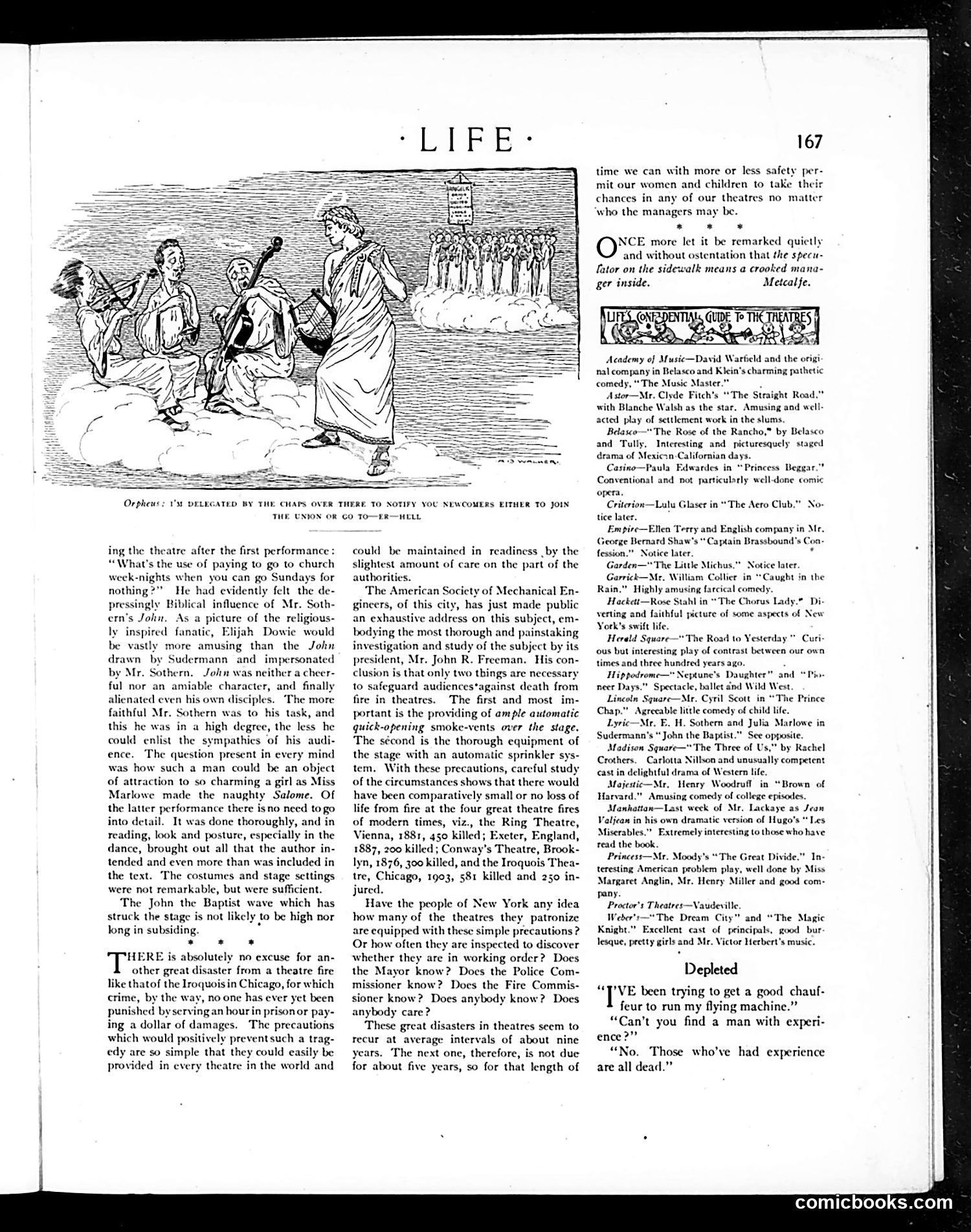
The cartoon depicts the mythological figure Orpheus addressing theatrical newcomers, instructing them to either join the union or face dire consequences ("go to—ER—HELL"). **The Satire:** This is labor-union commentary. The figure of Orpheus—traditionally associated with music and the arts—is recast as a union enforcer delivering what amounts to a coercive ultimatum. The joke targets the aggressive unionization tactics of early 1900s labor organizations in the theater industry, portraying them as intimidating and autocratic. **The Point:** Life magazine is satirizing unions' heavy-handed recruitment methods, suggesting they leave workers little choice but compliance. The mythological reference adds ironic sophistication—reducing the noble Orpheus to a modern-day enforcer underscores the gap between idealized labor advocacy and actual practices. The accompanying text discusses theater safety disasters and moral failings, suggesting Life's broader skepticism toward institutional power, whether theatrical management or labor unions.
📄 Transcribed text from this page (OCR, searchable)
Machine-transcribed from the original scan — historical spelling and the odd misread are preserved.
Orpheus: V' DELEGATED BY THE CHAPS OVER THERE TO NOTIFY YOU NEWCOMERS EITHER TO JoIN THE UNION OR GO TO—ER—HELL ing the theatre after the first performance : “What's the use of paying to go to church week-nights when you can go Sundays for nothing?” He had evidently felt the de- pressingly Biblical influence of Mr. Soth- ern’s John, As a picture of the religious- ly inspired fanatic, Elijah Dowie would be vastly more amusing than the John drawn by Sudermann and impersonated by Mr. Sothern. Jolin was neither a cheer- ful nor an amiable character, and finally alienated even his own disciples. ‘The more faithful Mr. Sothern was to his task, this he was in a high degree, the | could enlist the sympathics of his ence. The question present in every mind was how such a man could be an object of attraction to so charming a girl as Miss Marlowe made the naughty Salome. Of the latter performance there isno need to go into det It was done thoroughly, and in reading, look and posture, especially in the dance, brought out all that the author in- tended and even more than was included in the text. The costumes and stage settings were not remarkable, but were sufficient. The John the Baptist wave which has struck the stage is not likely to be high nor long in subsiding. . * 8 * HERE is absolutely no excuse for an- other great disaster from a theatre fire like thatof the Iroquois in Chicago, for which crime, by the way, no one has ever yet been punished by serving an hour in prison or pay- ing a dollar of damages. The precautions which would positively preventsuch a trag- edy are so simple that they could easily be provided in every theatre in the world and could be maintained in readiness by the slightest amount of care on the part of the authorities. ‘The American Society of Mechanical En- gincers, of this city, has just made public an exhaustive address on this subject, em- bodying the most thorough and painstaking investigation and study of the subject by its president, Mr. John R. Freeman. His con- clusion is that only two things are necessary to safeguard audiences*against death from fire in theatres. The first and most im- portant is the providing of ample automatic quick-opening smoke-vents over the stage. The sécond is the thorough equipment of the stage with an automatic sprinkler sys- tem, With these precautions, careful study of the circumstances shows that there would have been comparatively small or no loss of life from fire at the four great theatre fires of modern times, viz., the Ring Theatre, Vienna, 1881, 450 killed; Exeter, England, 1887, 200 killed ; Conway’s Theatre, Brook- lyn, 1876, 300 killed, and the Iroquois Thea- tre, Chicago, 1903, 581 killed and 250 in- jured. Have the people of New York any idea how many of the theatres they patronize are equipped with these simple precautions ? Or how often they are inspected to discover whether they are in working order? Does the Mayor know? Does the Police Com- missioner know? Does the Fire Commis- sioner know? Does anybody know? Does anybody care ? These great disasters in theatres seem to recur at average intervals of about nine years. The next one, therefore, is not due for about five years, so for that length of 167 time we can with more or less safety per- mit our women and children to take their chances in any of our theatres no matter who the managers may be. - “Ss -@ O = more let it be remarked quictly and without ostentation that the specu- fator on the sidewalk means a crooked mana- ger inside. Metcalje. Academy of Music—David Warfield and the origi nal company in Belasco and Klein's charming pathetic “The Music Master." “The Straight Road.” with Blanche Walsh as the star, Amusing and well- acted play of settlement work in the slums. Belaxco—" The Rose of the Rancho,” by Belasco and Tully, Interesting and picturesquely staged drama of Mexicvn-Californian days. Casino—Paula Edwardes in “Princess Beggar.” Conventional and not particularly well-done comic opera. Criterion—Lulu Glaser in “The Aero Club,” tice later. Empire—Ellen Terry and English company in Mr. George Bernard Shaw's “Captain Brassbound’s Coa- fession.”” Notice later ° Garden—"The Little Michus.” Notice later. Garrick—Me, William Collier in “Caught in the Rain.” Highly amusing farcical comedy. Hacketi—Rowe Stahl in “The Chorus Lady." Di verting and faithful picture of some aspects of Ne York's swift life. Herald Square—" The Road to Yesterday" Curi ous but interesting play of contrast between our own times and three hundred years ago. Hippodrome—" Neptune's Daughter” and. “Pi. neet Days.” Spectacle, ballet snd Wild West Lincoln Square—Mr. Cyril Scott_in “The Prince Chap.” Agreeable little comedy of child life. Lyric—Mr. E. H. Sothern and Julia Marlowe in Sudermann’s “John the Baptist." See opposite. Madison Square—"The Three of Us," by Rachel Crothers. Carlotta Nillson and unusually competent cast in delightful drama of Western life. Majestic—Mr, Henry Woodruff in “Brown of Harvard." Amusing comedy of college episodes. Manhattaon—Last week of Mr. Lackaye as Jean Valjean in his own dramatic version of Hugo's “Les Miserables.” Extremely interesting to those who have read the book. Princess—Mr. Moody's “The Great Divide.” In- teresting American problem play, well done by Miss Margaret Anglin, Mr. Henry Miller and good com- pany. Proctor's Theatres—Vaudeville. Weber"s—"The Dream City” and “The Magic Knight.” Excellent cast of principals, good bur- lesque, pretty girls and Mr. Victor Herbert's music. Depleted ‘T been trying to get a good chauf- feur to run my flying machine.” “Can't you find a man with experi- ence?” “No. Those who’ve had experience are all dead.” No- comicbooks.com