
Life, 1907-01-31 · page 14 of 24
Life — January 31, 1907 — page 14: what you’re looking at
What you’re looking at
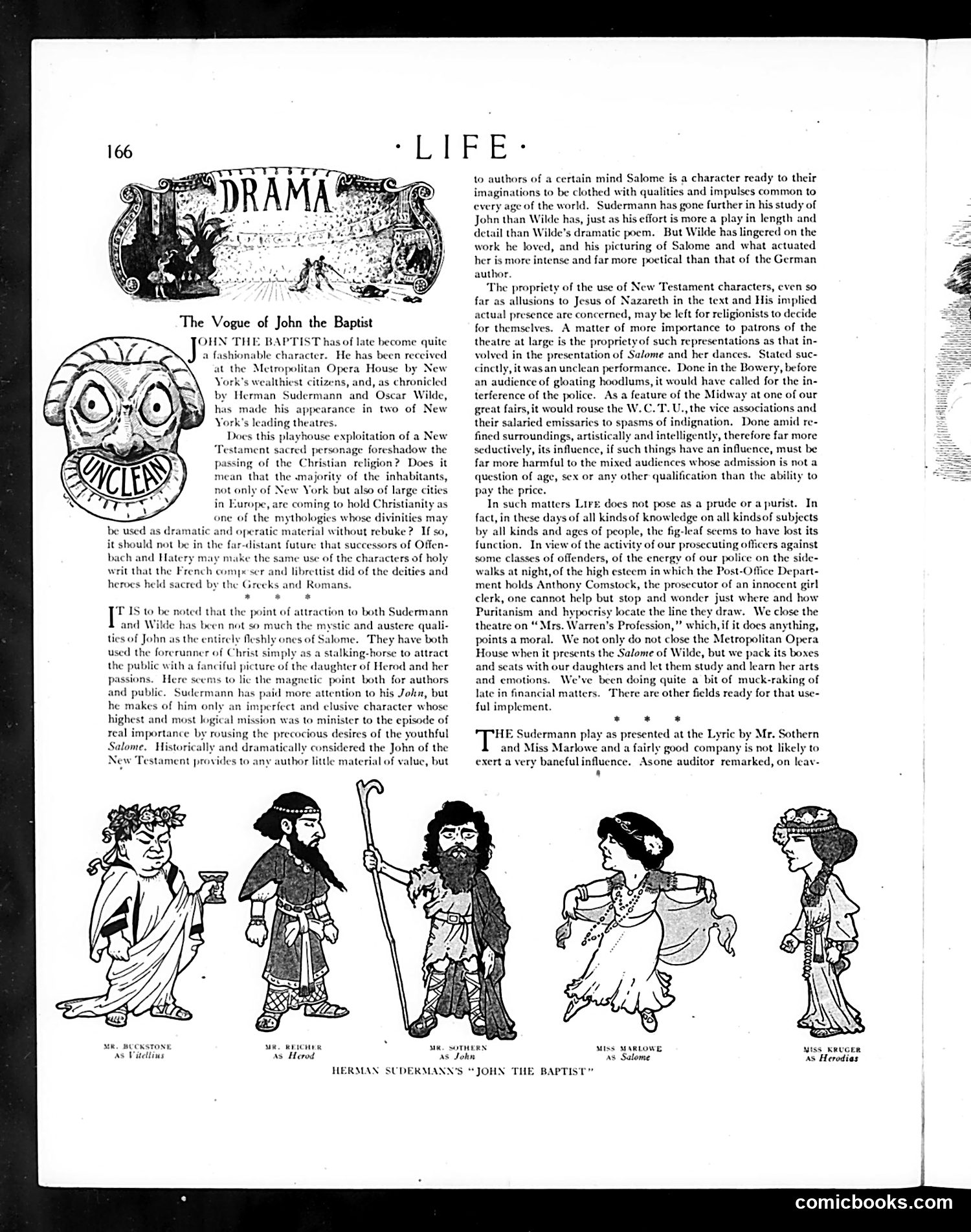
This article critiques the fashionable theatrical treatment of biblical subjects, particularly John the Baptist, by contemporary playwrights Herman Sudermann and Oscar Wilde. The text objects that these dramatists use the Baptist merely as a supporting character to showcase Salome—focusing on her sensuality rather than genuine dramatic or spiritual importance. The five caricatured figures at page bottom represent cast members from Sudermann's "John the Baptist" production, identifying actors by their roles (Mr. Beckstone as Vitellius, Mr. Reicher as Herod, Mr. Sothern as John, Miss Marlowe as Salome, Miss Kruger as Herodias). Life's satire argues that while refined audiences tolerate such "unclean performances" in elite theaters, the same content would face police interference in working-class venues—exposing class hypocrisy. The piece questions whether treating sacred Christian figures as mere dramatic material signals Christianity's declining cultural authority.
📄 Transcribed text from this page (OCR, searchable)
Machine-transcribed from the original scan — historical spelling and the odd misread are preserved.
The Vogue of John the Baptist OHN THE BAPTIST has of late become quite J a fashionable character. He has been received at the Metropolitan Opera House by York's wealthiest citizens, and, as chronicled by Herman Sudermann and Oscar Wilde, has made his appearance in two of New York's leading theatre Does this playhouse ¢ ‘Testament sacred pers ploitation of a New ge foreshadow the passing of the Christian religion? Does it mean that the majority of the inhabitants, not only of New York but also of large cities in Europe, are coming to hold Christianity as one of the mythologies whose divinities m be used as dramatic and tic material without rebuke? If so, it should not be in the far-distant future that successors of Offen- bach and Hatery may make the ne use of the characters of holy writ that the French compeser and librettist did of the deities and heroes held sacred by the Greeks and Romans. > 8 & I IS to be noted that the point ¢ and Wilde has been ne traction to both Sudermann so much the mystic and austere quali- tics of John as the entirely leshly ones of Salome. ‘They have both used the forerunner of Christ simply as a stalking-horse to attract the public with a fanciful picture of the daughter of Herod and her passions. Here seems to lic the magnetic point both for authors and public. Sudermann has paid n to his John, but he makes of him only an nd clusive character whose highest and most logical mission was to minister to the episode of real importance by rousing the precocious desires of the youthful Salome. Historically and dramatically considered the John of the New Testament provides to any author little material of value, but nperfect Mk. BECKSTONE Me. REICHER As Vitellius as Herod -LIFE- MK. SOTHERN MISS MARLOWE as John HERMAN SUDERMANN to authors of a certain mind Salome is a character ready to their imaginations to be clothed with qualities and impulses common to ery age of the world. Sudermann has gone further in his study of John than Wilde has, just as his effort is more a play in length and detail than Wilde’s dramatic poem. But Wilde has lingered on the work he loved, and his picturing of Salome and what actuated her is more intense and far more poetical than that of the German author. ‘The propriety of the use of New ‘Testament characters, far as allusions to Jesus of Nazareth in the text and His implied actual presence are concerned, may be left for religionists to decide for themselves. A matter of more importance to patrons of the theatre at large is the propriety of such representations as that in- volved in the presentation of Salome and her dances. Stated suc- cinctly, it wasan unclean performance. Done in the Bowery, before an audience of gloating hoodlums, it would have called for the in- terference of the police. As a feature of the Midway at one of our great fairs, it would rouse the W.C.T.U., the vice associations and their salaried emissarics to spasms of indignation. Done amid re- fined surroundings, artisti nd intelligently, therefore far more seductively, its influence, if such things have an influence, must be far more harmful to the mixed audiences whose admission is not a question of age, sex or any other qualification than the ability to pay the price. In such m ters Lire does not pose as a prude or a purist. In fact, in these 3 of all kinds of knowledge on all kindsof subjects by all kinds and ages of people, the fig-leaf seems to have lost its function. In view of the activity of our prosecuting officers against some classes of offenders, of the energy of our police on the side- valks at night, of the high esteem in which the Post-Office Depa ment holds Anthony Comstock, the prosecutor of an innocent girl clerk, one cannot help but stop and wonder just where and how Puritanism and hypocrisy locate the line they draw. We close the theatre on “ Mrs. Warren’s Profession,” which, if it does anything, points a moral. We not only do not close the Metropolitan Opera House when it presents the Salome of Wilde, but we pack its boxes and seats with our daughters and let them study and learn her arts and emotions. We've been doing quite a bit of muck-raking of late in financial matters. There are other fields ready for that use- ful implement. *s * 8 HE Sudermann play as presented at the Lyric by Mr. Sothern and Miss Marlowe and a fairly good company is not likely to exert a very baneful influence. Asone auditor remarked, on leav- as Salome “JOHN THE BAPTIST” comicbooks.com