
Life, 1907-01-31 · page 16 of 24
Life — January 31, 1907 — page 16: what you’re looking at
What you’re looking at
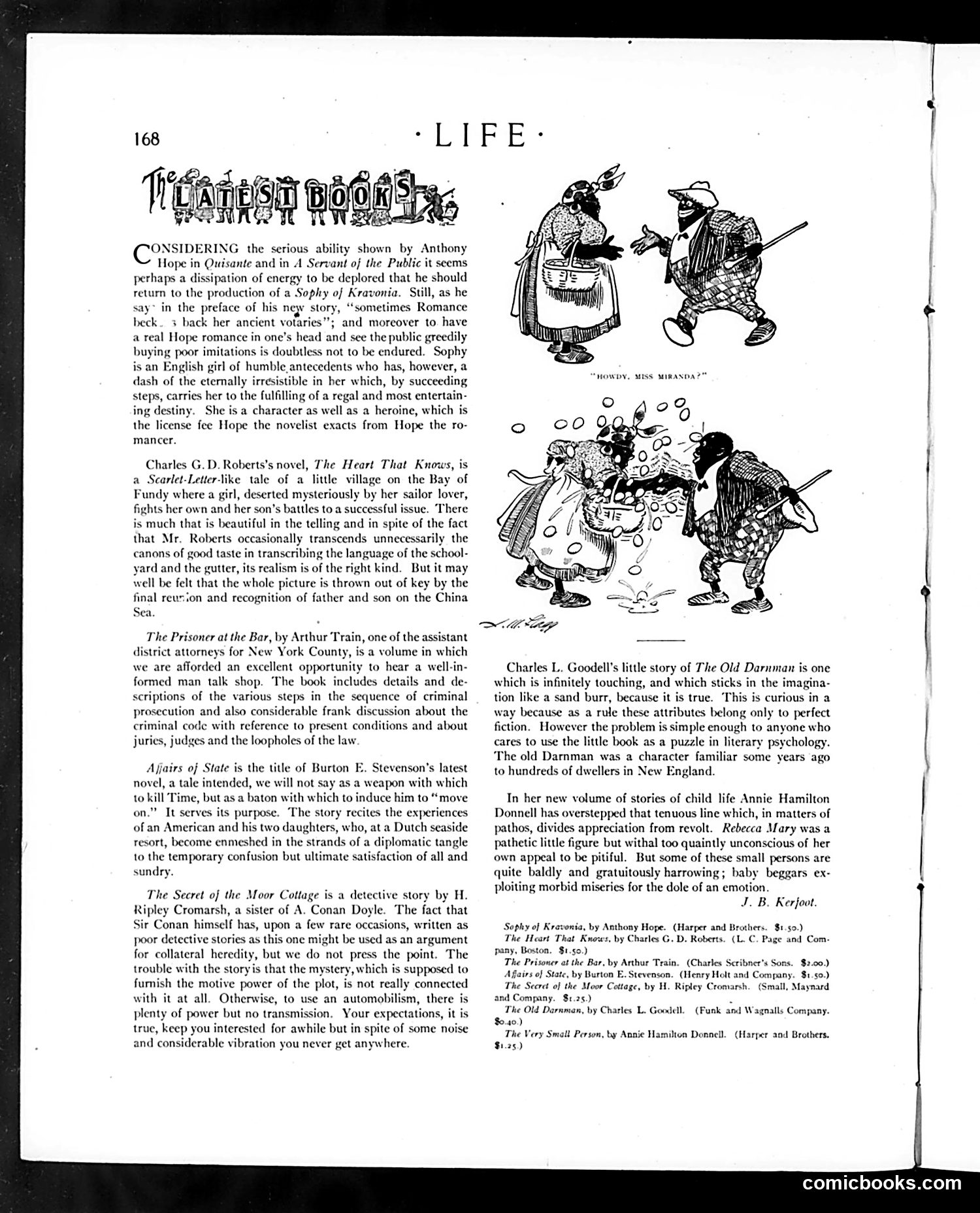
This page features literary reviews and two cartoon illustrations. The top cartoon labeled "Howdy, Miss Miranda?" depicts a man and woman in period costume engaged in conversation—likely illustrating a scene from one of the reviewed novels, possibly from Anthony Hope's romantic fiction discussed in the text. The lower cartoon shows children playing with bubbles, appearing whimsical and innocent—potentially referencing childhood themes in the reviewed books. The page reviews six novels, including works by Anthony Hope (romantic adventure fiction), Charles G.D. Roberts, and Arthur Train (a real New York prosecutor offering insider legal knowledge). The reviewer criticizes H. Ripley Cromarsh's detective story for having an unconnected plot—"plenty of power but no transmission"—a clever automotive metaphor for a story that fails to deliver despite initial promise. The reviews reflect early 1900s literary tastes favoring romance, sentiment, and realism over pure entertainment, with particular appreciation for stories grounded in authentic detail and emotional truth.
📄 Transcribed text from this page (OCR, searchable)
Machine-transcribed from the original scan — historical spelling and the odd misread are preserved.
Cc ING the serious ability shown by Anthony Hope in Quisante and in A Servant oj the Public it seems perhaps a dissipation of energy to be deplored that he should return to the production of a Sophy of Kravonia. Still, as he say’ in the preface of his new story, “sometimes Romance beck. + back her ancient votaries ”; and moreover to. have a real Hope romance in one’s head and see the public greedily buying poor imitations is doubtless not to be endured. Sophy is an English girl of humble,antecedents who has, however, a dash of the cternally irresistible in her which, by succeeding steps, carries her to the fulfilling of a regal and most entertain- ing destiny. She is a character as well as a heroine, which is the license fee Hope the novelist exacts from Hope the ro- mancer. Charles G.D. Roberts's novel, The Heart That Knows, is a Scarlet-Letter-like tale of a little village on the Bay of Fundy where a girl, deserted mysteriously by her sailor lover, fights her own and her son’s battles to a successful issue. There is much that is beautiful in the telling and in spite of the fact that Mr. Roberts occasionally transcends unnecessarily the canons of good taste in transcribing the language of the school- yard and the gutter, its rea! is of the right kind. But it may well be felt that the whole picture is thrown out of key by the final reunion and recognition of father and son on the China Sea. The Prisoner at the Bar, by Arthur Train, one of the assistant district attorneys for New York County, is a volume in which we are afforded an excellent opportunity to hear a well-in- formed man talk shop. The book includes details and de- scriptions of the various steps in the sequence of criminal prosecution and also considerable frank discussion about the criminal code with reference to present conditions and about juries, judges and the loopholes of the law. Ajjairs oj State is the title of Burton E. Stevenson’s latest novel, a tale intended, we will not say as a weapon with which to kill Time, but as a baton with which to induce him to “move on.” It serves its purpose. ‘The story recites the experienc of an American and his two daughters, who, ata Dutch seaside resort, become enmeshed in the strands of a diplomatic tangle to the temporary confusion but ultimate satisfaction of all and sundry. The Secret oj the Moor Cottage is a detective story by H. Ripley Cromarsh, a sister of A. Conan Doyle. The fact that Sir Conan himself has, upon a few rare occasions, written as poor detective stories as this one might be used as an argument for collateral heredity, but we do not press the point. The trouble with the story is that the mystery, which is supposed to furnish the motive power of the plot, is not really connected with it at all. Otherwise, to use an automobi there is plenty of power but no transmission. Your expectations, it is true, keep you interested for awhile but in spite of some noise and considerable vibration you never get anywhere. “HOWDY, MISS ARANDA?” Charles L. Goodell’s little story of The Old Darnman is one which is infinitely touching, and which sticks in the imagina- tion like a sand burr, because it is true. This is curious in a way because as a rule these attributes belong only to perfect fiction. However the problem is simple enough to anyone who cares to use the little book as a puzzle in literary psychology. ‘The old Darnman was a character familiar some to hundreds of dwellers in New England. In her new volume of stories of child life Annie Hamilton Donnell has overstepped that tenuous line which, in matters of pathos, divides appreciation from revolt. Rebecca Mary was a pathetic little figure but withal too quaintly unconscious of her own appeal to be pitiful. But some of these small persons are quite baldly and gratuitously harrowing; baby beggars ex- ploiting morbid miseries for the dole of an emotion. J.B. Kerfoot. Sophy of Kravonia, by Anthony Hope. (Harper and Brothers. $1.50.) The Heart That Knows, by Charles G. D. Roberts. (L. C. Page and Com- pany, Boston. $1.50.) The Prisoner ot the Bar. by Arthur Train. (Charles Scribner's Sons. $2.00.) Afairs of State, by Burton E. Stevenson. (Henry Holt and Company. $1.50.) The Secret of the Moor Cottage, by H. Ripley Cromarsh. (Small, Maynard and Company. $¢.25.) : The Old Dernman, by Charles L. Goodell. (Funk and Wagnalls Company. $40) The Very Smatt Person, by Annie Hamilton Donnell. (Harper and Brothers. $1.25) comicbooks.com 2.